
INTRABLOCK ROW CHAINING Sayan Malakshinov Oracle ACE Associate
INTRA-BLOCK ROW CHAINING Sayan Malakshinov Oracle ACE Associate Oracle certified performance tuning expert http: //orasql. org
The documentation states: When a table has more than 255 columns, rows that have data after the 255 th column are likely to be chained within the same block. This is called intra-block chaining. A chained row’s pieces are chained together using the rowids of the pieces. With intra-block chaining, users receive all the data in the same block. If the row fits in the block, users do not see an effect in I/O performance, because no extra I/O operation is required to retrieve the rest of the row.
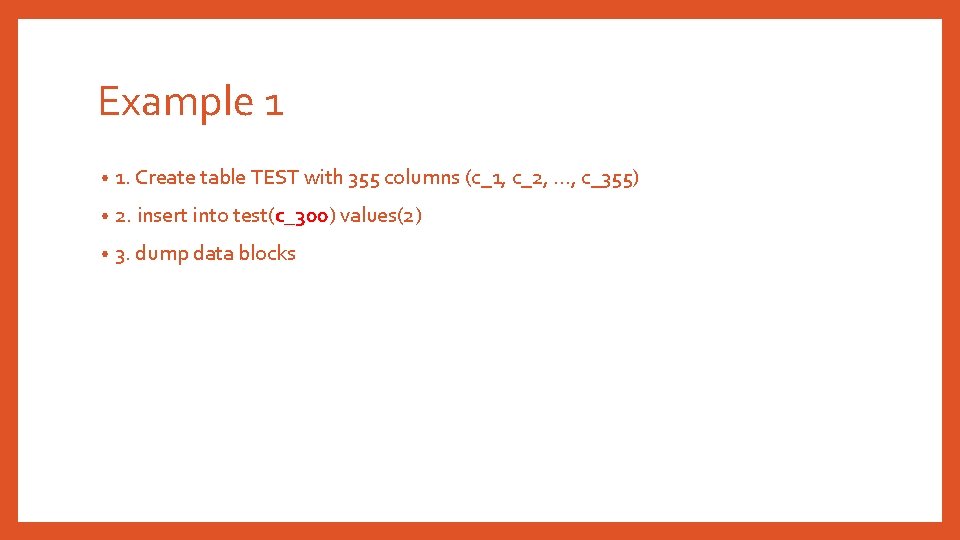
Example 1 • 1. Create table TEST with 355 columns (c_1, c_2, …, c_355) • 2. insert into test(c_300) values(2) • 3. dump data blocks

bdba: 0 x 018019 f 7 block_row_dump: tl: 260 fb: -----L-- lb: 0 x 1 cc: 255 col 0: *NULL* col 1: *NULL*. . . col 252: *NULL* col 253: *NULL* col 254: [ 2] c 1 03 tl: 54 fb: --H-F--- lb: 0 x 1 cc: 45 col 0: *NULL* col 1: *NULL*. . . col 43: *NULL* col 44: *NULL* tl – row piece length fb – flags: H - header F – first row piece L – last piece lb – “lock byte” (# of ITL entry) cc – number of columns The resulted dump file shows us: 1. Both row pieces are in the same block 0 x 018019 f 4 2. They contain only first 300 columns (trailing 55 columns are NULLs) 3. First row piece contains columns c_46 – c_300, 4. Second row piece contains columns c_1 – c_45 (they all are NULLs)
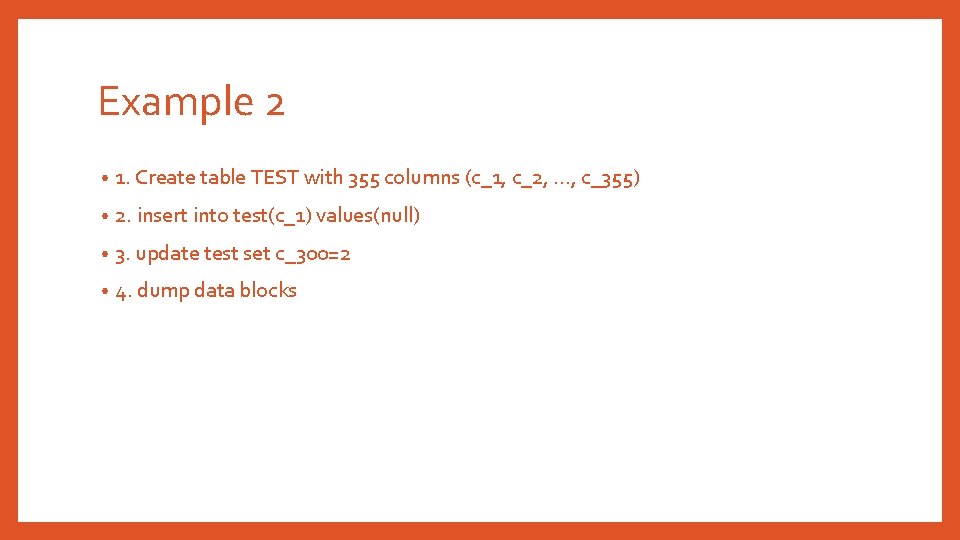
Example 2 • 1. Create table TEST with 355 columns (c_1, c_2, …, c_355) • 2. insert into test(c_1) values(null) • 3. update test set c_300=2 • 4. dump data blocks
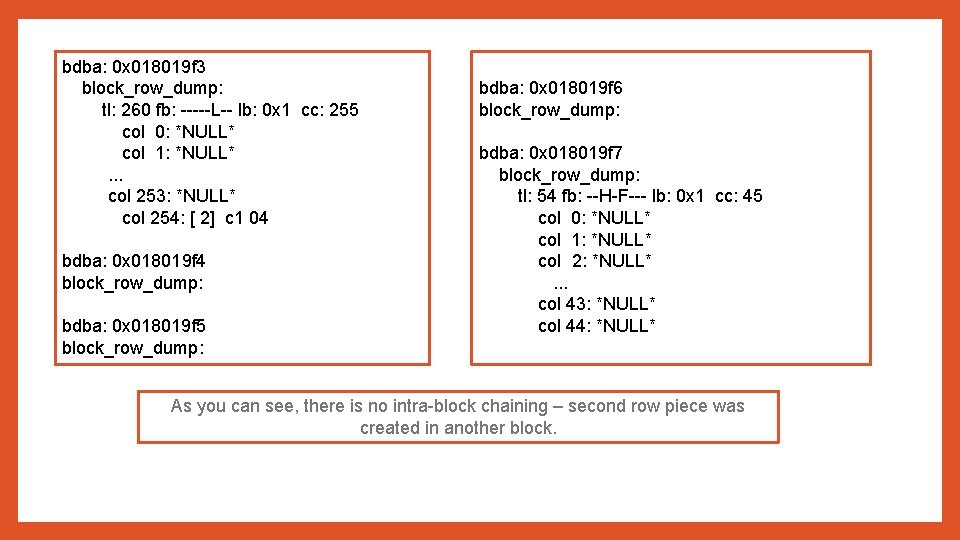
bdba: 0 x 018019 f 3 block_row_dump: tl: 260 fb: -----L-- lb: 0 x 1 cc: 255 col 0: *NULL* col 1: *NULL*. . . col 253: *NULL* col 254: [ 2] c 1 04 bdba: 0 x 018019 f 4 block_row_dump: bdba: 0 x 018019 f 5 block_row_dump: bdba: 0 x 018019 f 6 block_row_dump: bdba: 0 x 018019 f 7 block_row_dump: tl: 54 fb: --H-F--- lb: 0 x 1 cc: 45 col 0: *NULL* col 1: *NULL* col 2: *NULL*. . . col 43: *NULL* col 44: *NULL* As you can see, there is no intra-block chaining – second row piece was created in another block.
Example 3 • 1. Create table TEST with 355 columns (c_1, c_2, …, c_355) • 2. insert into test(c_1) values(1) • 3. update test set c_300=2 • 4. update test set c_301=3 • 5. update test set c_302=4 • 6. dump data blocks
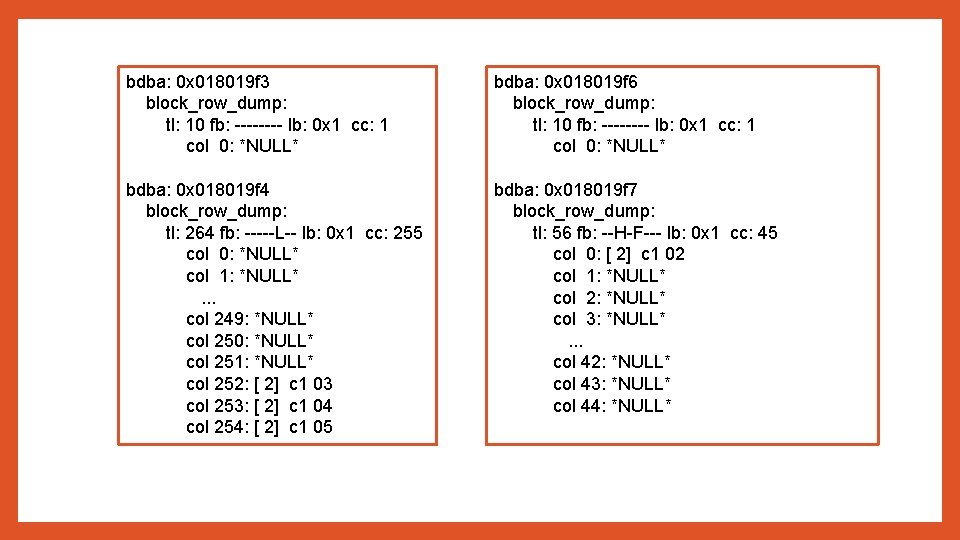
bdba: 0 x 018019 f 3 block_row_dump: tl: 10 fb: ---- lb: 0 x 1 cc: 1 col 0: *NULL* bdba: 0 x 018019 f 6 block_row_dump: tl: 10 fb: ---- lb: 0 x 1 cc: 1 col 0: *NULL* bdba: 0 x 018019 f 4 block_row_dump: tl: 264 fb: -----L-- lb: 0 x 1 cc: 255 col 0: *NULL* col 1: *NULL*. . . col 249: *NULL* col 250: *NULL* col 251: *NULL* col 252: [ 2] c 1 03 col 253: [ 2] c 1 04 col 254: [ 2] c 1 05 bdba: 0 x 018019 f 7 block_row_dump: tl: 56 fb: --H-F--- lb: 0 x 1 cc: 45 col 0: [ 2] c 1 02 col 1: *NULL* col 2: *NULL* col 3: *NULL*. . . col 42: *NULL* col 43: *NULL* col 44: *NULL*
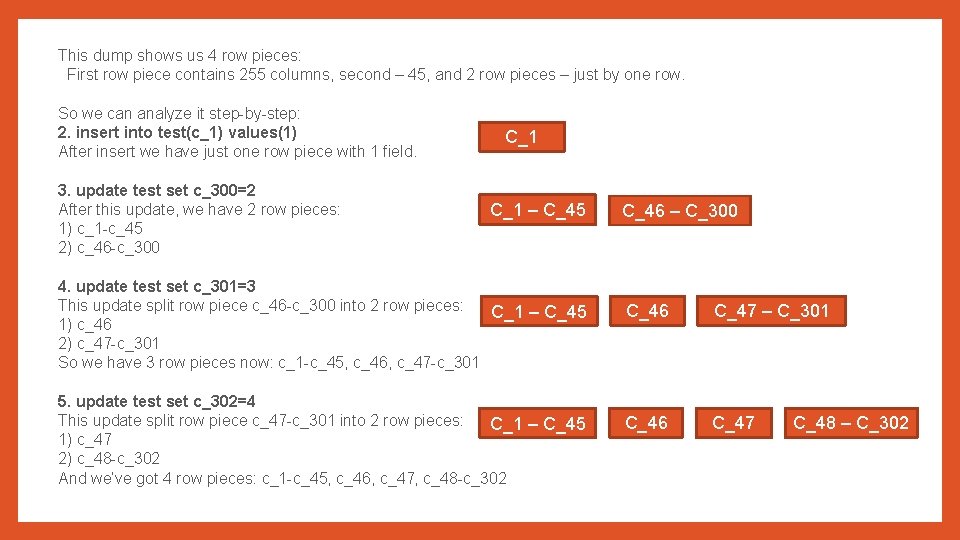
This dump shows us 4 row pieces: First row piece contains 255 columns, second – 45, and 2 row pieces – just by one row. So we can analyze it step-by-step: 2. insert into test(c_1) values(1) After insert we have just one row piece with 1 field. 3. update test set c_300=2 After this update, we have 2 row pieces: 1) c_1 -c_45 2) c_46 -c_300 C_1 – C_45 4. update test set c_301=3 This update split row piece c_46 -c_300 into 2 row pieces: C_1 – C_45 1) c_46 2) c_47 -c_301 So we have 3 row pieces now: c_1 -c_45, c_46, c_47 -c_301 5. update test set c_302=4 This update split row piece c_47 -c_301 into 2 row pieces: C_1 – C_45 1) c_47 2) c_48 -c_302 And we’ve got 4 row pieces: c_1 -c_45, c_46, c_47, c_48 -c_302 C_46 – C_300 C_46 C_47 – C_301 C_46 C_47 C_48 – C_302
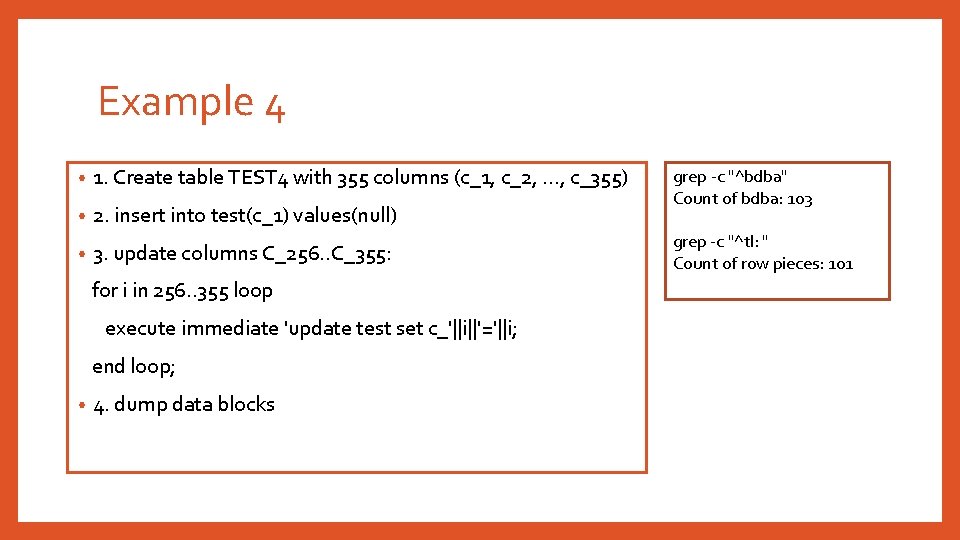
Example 4 • 1. Create table TEST 4 with 355 columns (c_1, c_2, . . . , c_355) • 2. insert into test(c_1) values(null) • 3. update columns C_256. . C_355: for i in 256. . 355 loop execute immediate 'update test set c_'||i||'='||i; end loop; • 4. dump data blocks grep -c "^bdba" Count of bdba: 103 grep -c "^tl: " Count of row pieces: 101
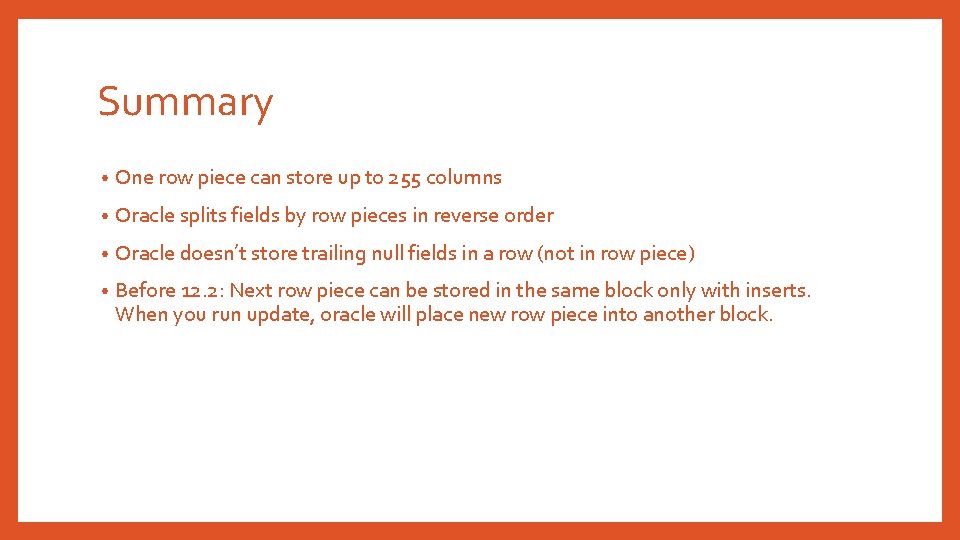
Summary • One row piece can store up to 255 columns • Oracle splits fields by row pieces in reverse order • Oracle doesn’t store trailing null fields in a row (not in row piece) • Before 12. 2: Next row piece can be stored in the same block only with inserts. When you run update, oracle will place new row piece into another block.
- Slides: 11