
Intrabeam scattering simulations in low emittance rings T
Intrabeam scattering simulations in low emittance rings T. Demma (INFN-LNF) Thanks to: F. Antoniou, A. Vivoli (CERN) M. E. Biagini, M. Boscolo (INFN-LNF) A. Chao, M. T. F. Pivi (SLAC).
Plan of Talk • Introduction • Conventional calculation of IBS • Multi-particles codes structure • Growth rates estimates and comparison with conventional theories • Bunch distribution evolution • Parallel implementation • Conclusions and outlook 2
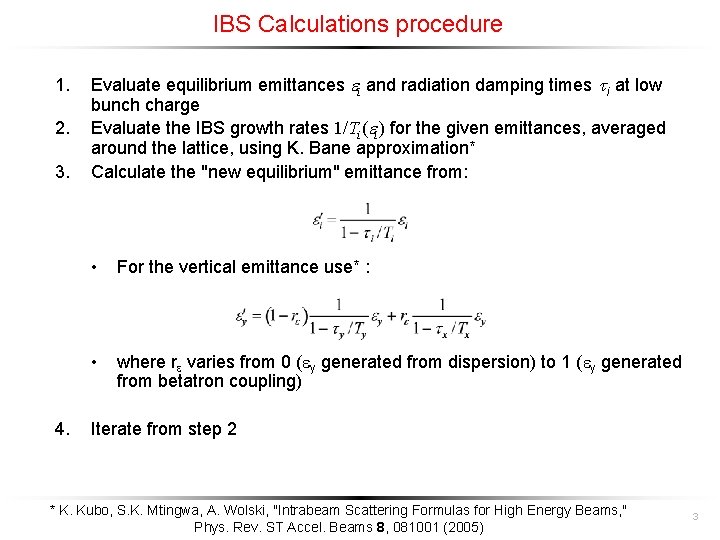
IBS Calculations procedure 1. 2. 3. 4. Evaluate equilibrium emittances ei and radiation damping times ti at low bunch charge Evaluate the IBS growth rates 1/Ti(ei) for the given emittances, averaged around the lattice, using K. Bane approximation* Calculate the "new equilibrium" emittance from: • For the vertical emittance use* : • where r varies from 0 ( y generated from dispersion) to 1 ( y generated from betatron coupling) Iterate from step 2 * K. Kubo, S. K. Mtingwa, A. Wolski, "Intrabeam Scattering Formulas for High Energy Beams, " Phys. Rev. ST Accel. Beams 8, 081001 (2005) 3
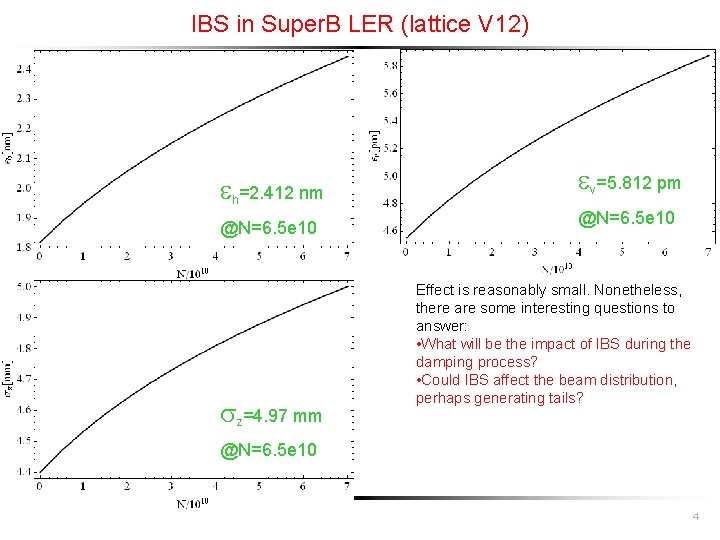
IBS in Super. B LER (lattice V 12) h=2. 412 nm @N=6. 5 e 10 z=4. 97 mm v=5. 812 pm @N=6. 5 e 10 Effect is reasonably small. Nonetheless, there are some interesting questions to answer: • What will be the impact of IBS during the damping process? • Could IBS affect the beam distribution, perhaps generating tails? @N=6. 5 e 10 4
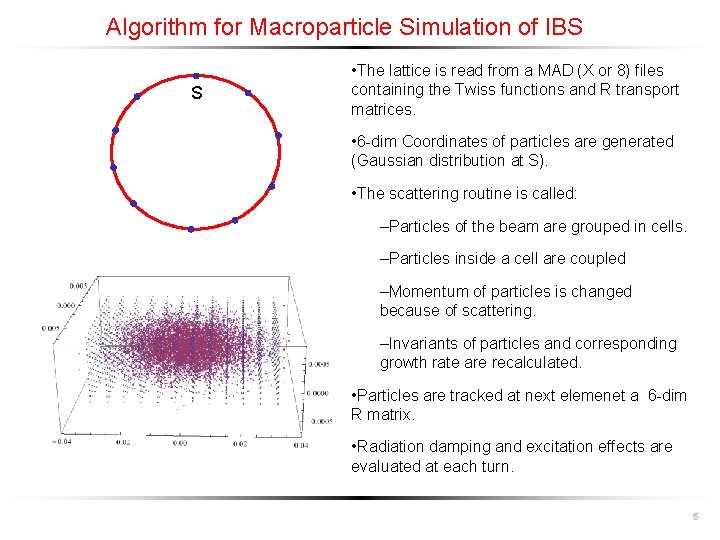
Algorithm for Macroparticle Simulation of IBS S • The lattice is read from a MAD (X or 8) files containing the Twiss functions and R transport matrices. • 6 -dim Coordinates of particles are generated (Gaussian distribution at S). • The scattering routine is called: –Particles of the beam are grouped in cells. –Particles inside a cell are coupled –Momentum of particles is changed because of scattering. –Invariants of particles and corresponding growth rate are recalculated. • Particles are tracked at next elemenet a 6 -dim R matrix. • Radiation damping and excitation effects are evaluated at each turn. 5
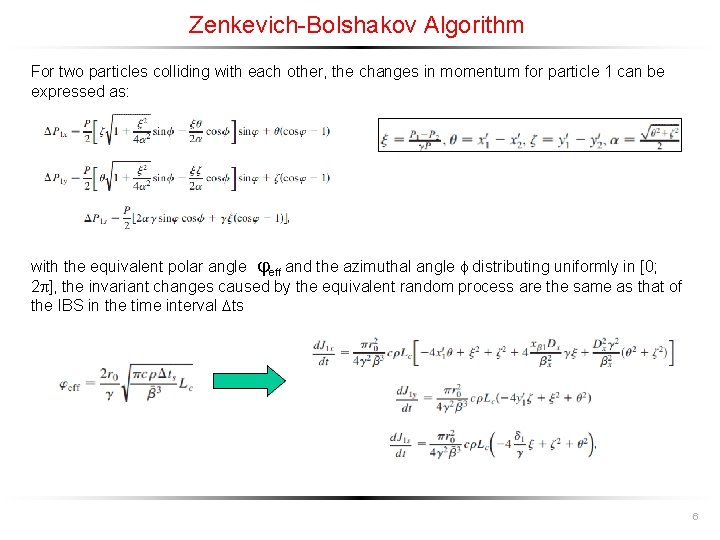
Zenkevich-Bolshakov Algorithm For two particles colliding with each other, the changes in momentum for particle 1 can be expressed as: with the equivalent polar angle eff and the azimuthal angle distributing uniformly in [0; 2 ], the invariant changes caused by the equivalent random process are the same as that of the IBS in the time interval ts 6
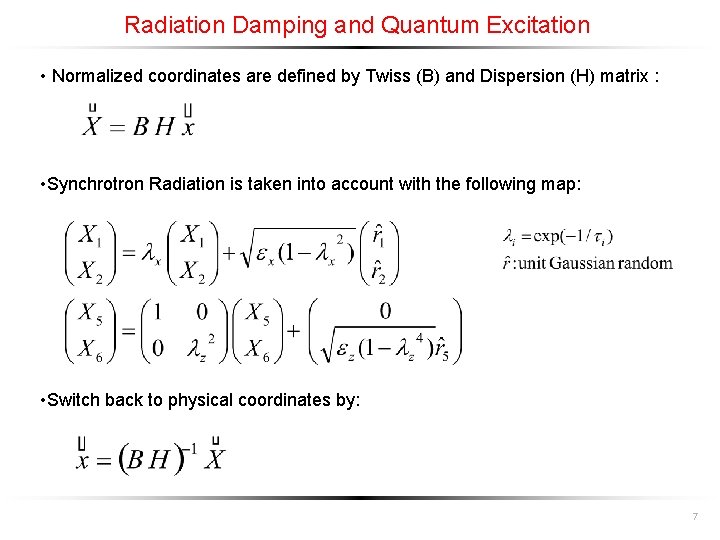
Radiation Damping and Quantum Excitation • Normalized coordinates are defined by Twiss (B) and Dispersion (H) matrix : • Synchrotron Radiation is taken into account with the following map: • Switch back to physical coordinates by: 7
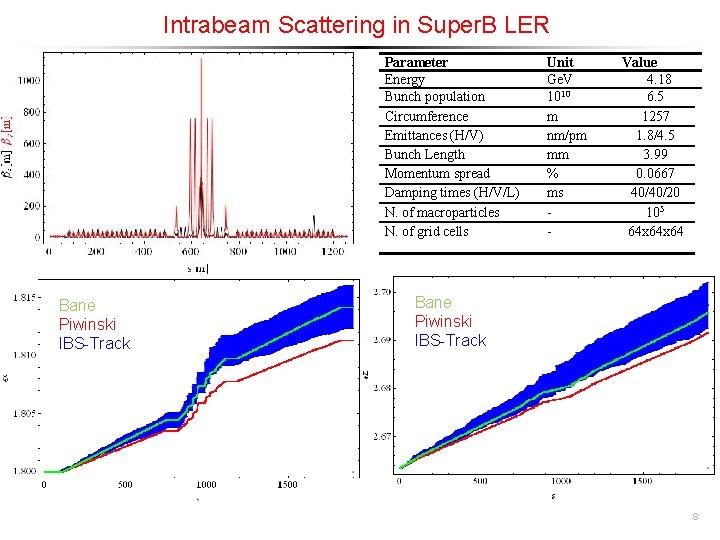
Intrabeam Scattering in Super. B LER Parameter Energy Bunch population Circumference Emittances (H/V) Bunch Length Momentum spread Damping times (H/V/L) N. of macroparticles N. of grid cells Bane Piwinski IBS-Track Unit Ge. V 1010 m nm/pm mm % ms - Value 4. 18 6. 5 1257 1. 8/4. 5 3. 99 0. 0667 40/40/20 105 64 x 64 Bane Piwinski IBS-Track 8
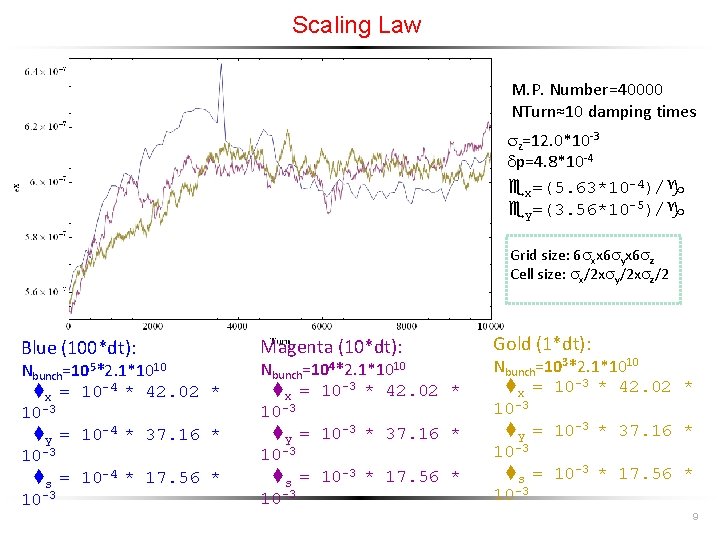
Scaling Law M. P. Number=40000 NTurn≈10 damping times z=12. 0*10 -3 dp=4. 8*10 -4 ex=(5. 63*10 -4)/g ey=(3. 56*10 -5)/g Grid size: 6 xx 6 yx 6 z Cell size: x/2 x y/2 x z/2 Blue (100*dt): Nbunch=105*2. 1*1010 tx = 10 -4 * 42. 02 * 10 -3 ty = 10 -4 * 37. 16 * 10 -3 ts = 10 -4 * 17. 56 * 10 -3 Magenta (10*dt): Nbunch=104*2. 1*1010 tx = 10 -3 * 42. 02 * 10 -3 ty = 10 -3 * 37. 16 * 10 -3 ts = 10 -3 * 17. 56 * 10 -3 Gold (1*dt): Nbunch=103*2. 1*1010 tx = 10 -3 * 42. 02 * 10 -3 ty = 10 -3 * 37. 16 * 10 -3 ts = 10 -3 * 17. 56 * 10 -3 9
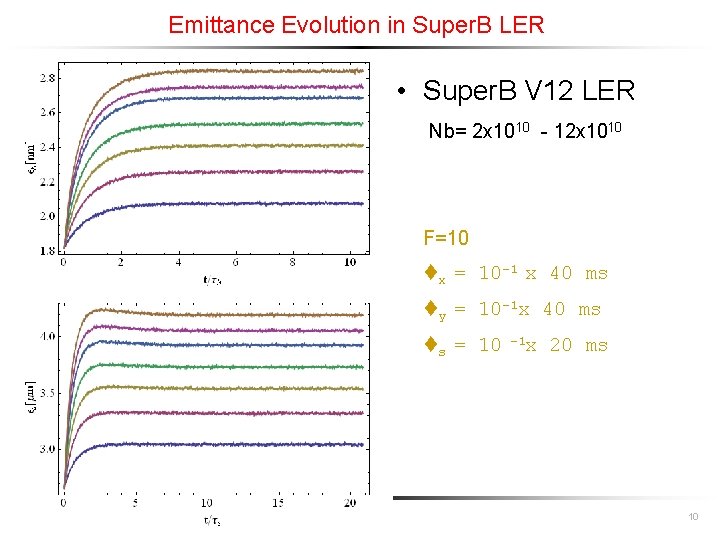
Emittance Evolution in Super. B LER • Super. B V 12 LER Nb= 2 x 10¹⁰ - 12 x 1010 F=10 tx = 10 -1 x 40 ms ty = 10 -1 x 40 ms ts = 10 -1 x 20 ms 10
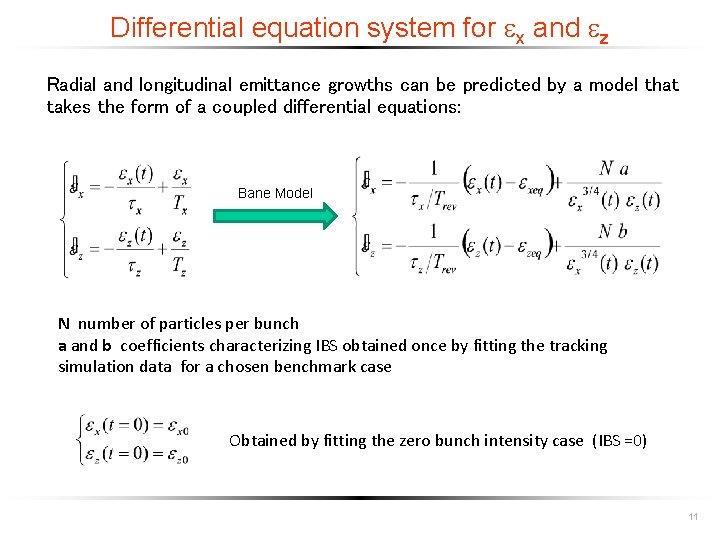
Differential equation system for x and z Radial and longitudinal emittance growths can be predicted by a model that takes the form of a coupled differential equations: Bane Model N number of particles per bunch a and b coefficients characterizing IBS obtained once by fitting the tracking simulation data for a chosen benchmark case Obtained by fitting the zero bunch intensity case (IBS =0) 11
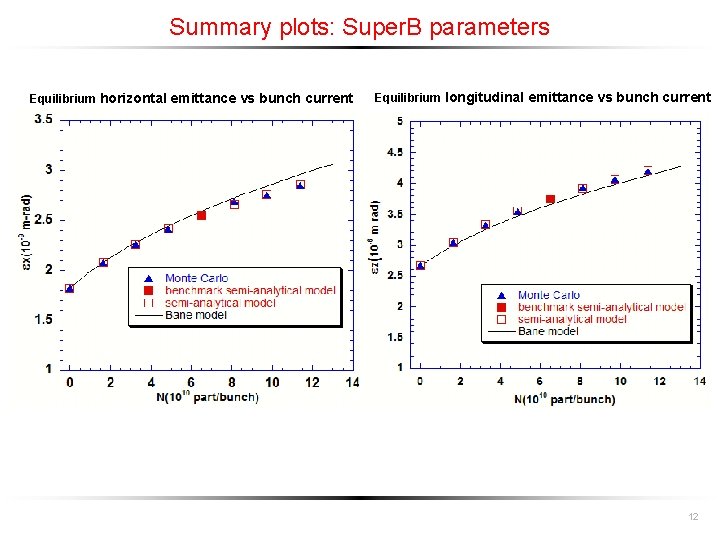
Summary plots: Super. B parameters Equilibrium horizontal emittance vs bunch current Equilibrium longitudinal emittance vs bunch current 12
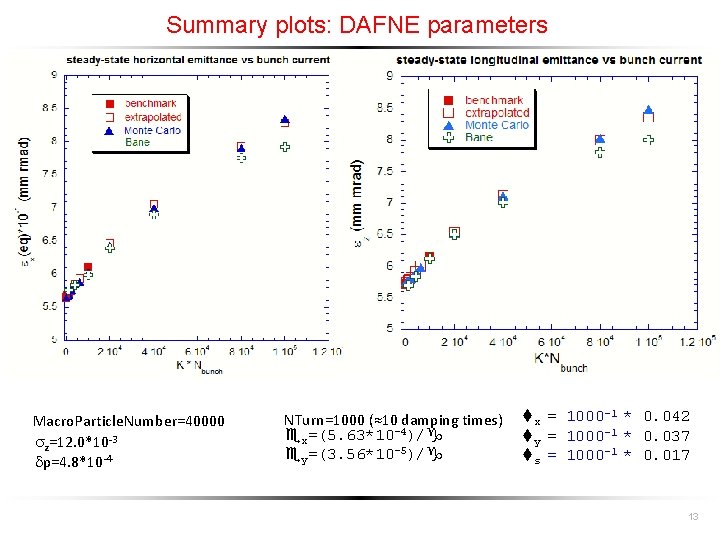
Summary plots: DAFNE parameters Macro. Particle. Number=40000 z=12. 0*10 -3 dp=4. 8*10 -4 NTurn=1000 (≈10 damping times) ex=(5. 63*10 -4)/g ey=(3. 56*10 -5)/g tx = 1000 -1 * 0. 042 ty = 1000 -1 * 0. 037 ts = 1000 -1 * 0. 017 13
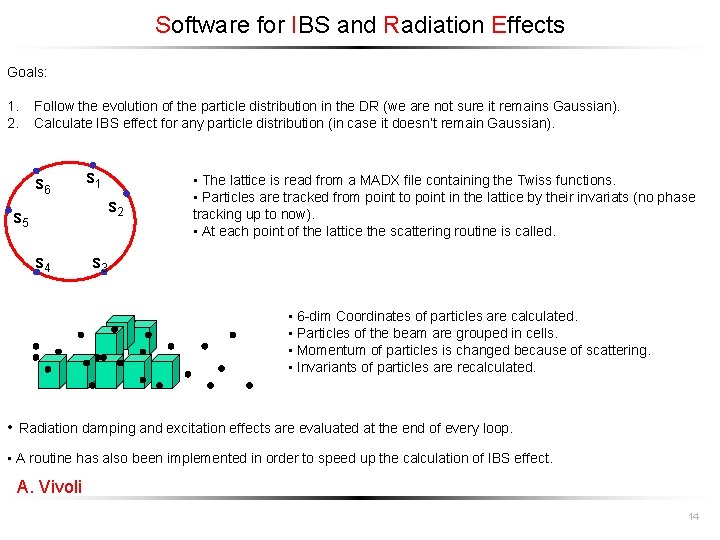
Software for IBS and Radiation Effects Goals: 1. 2. Follow the evolution of the particle distribution in the DR (we are not sure it remains Gaussian). Calculate IBS effect for any particle distribution (in case it doesn’t remain Gaussian). s 6 s 1 s 2 s 5 s 4 • The lattice is read from a MADX file containing the Twiss functions. • Particles are tracked from point to point in the lattice by their invariats (no phase tracking up to now). • At each point of the lattice the scattering routine is called. s 3 • 6 -dim Coordinates of particles are calculated. • Particles of the beam are grouped in cells. • Momentum of particles is changed because of scattering. • Invariants of particles are recalculated. • Radiation damping and excitation effects are evaluated at the end of every loop. • A routine has also been implemented in order to speed up the calculation of IBS effect. A. Vivoli 14
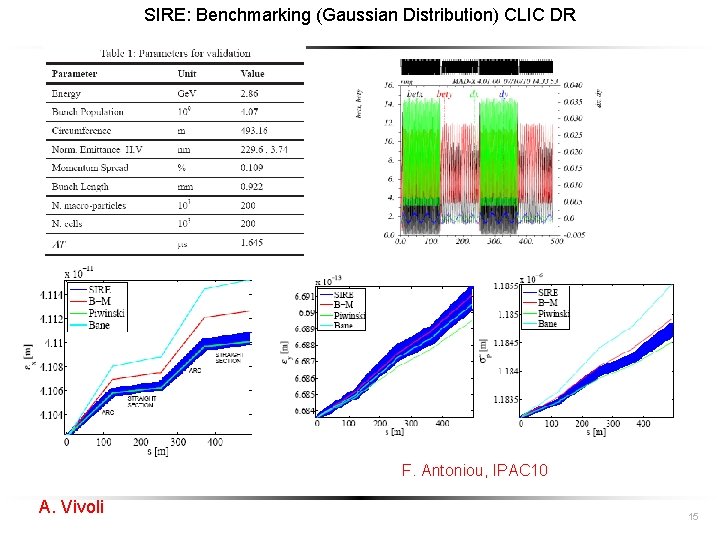
SIRE: Benchmarking (Gaussian Distribution) CLIC DR F. Antoniou, IPAC 10 A. Vivoli 15
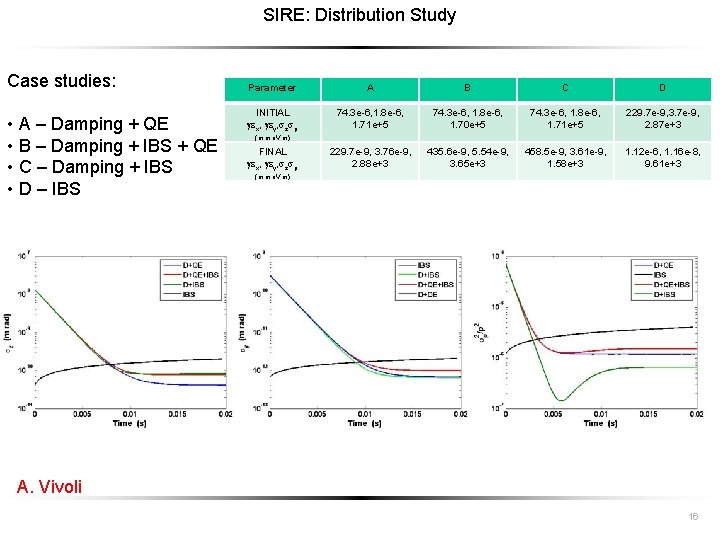
SIRE: Distribution Study Case studies: • A – Damping + QE • B – Damping + IBS + QE • C – Damping + IBS • D – IBS Parameter A B C D INITIAL g x, g y, z p 74. 3 e-6, 1. 8 e-6, 1. 71 e+5 74. 3 e-6, 1. 8 e-6, 1. 70 e+5 74. 3 e-6, 1. 8 e-6, 1. 71 e+5 229. 7 e-9, 3. 7 e-9, 2. 87 e+3 229. 7 e-9, 3. 76 e-9, 2. 88 e+3 435. 6 e-9, 5. 54 e-9, 3. 65 e+3 458. 5 e-9, 3. 61 e-9, 1. 58 e+3 1. 12 e-6, 1. 16 e-8, 9. 61 e+3 (m, m, e. V m) FINAL g x, g y, z p (m, m, e. V m) A. Vivoli 16
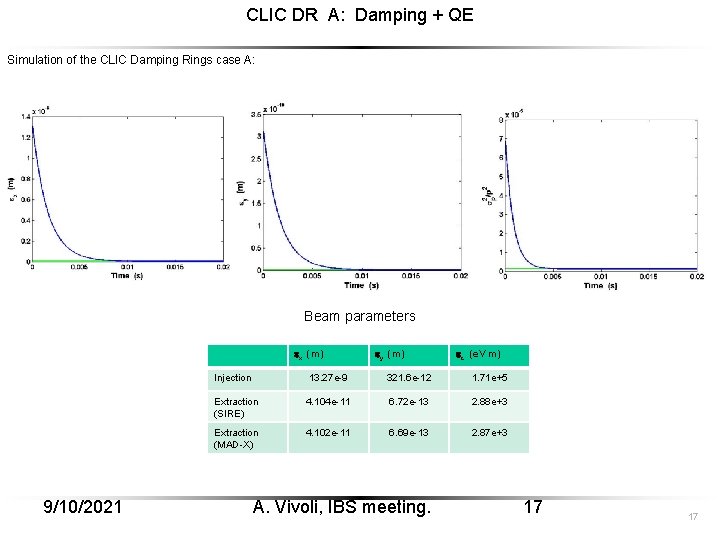
CLIC DR A: Damping + QE Simulation of the CLIC Damping Rings case A: Beam parameters ex (m) 9/10/2021 ey (m) ez (e. V m) Injection 13. 27 e-9 321. 6 e-12 1. 71 e+5 Extraction (SIRE) 4. 104 e-11 6. 72 e-13 2. 88 e+3 Extraction (MAD-X) 4. 102 e-11 6. 69 e-13 2. 87 e+3 A. Vivoli, IBS meeting. 17 17
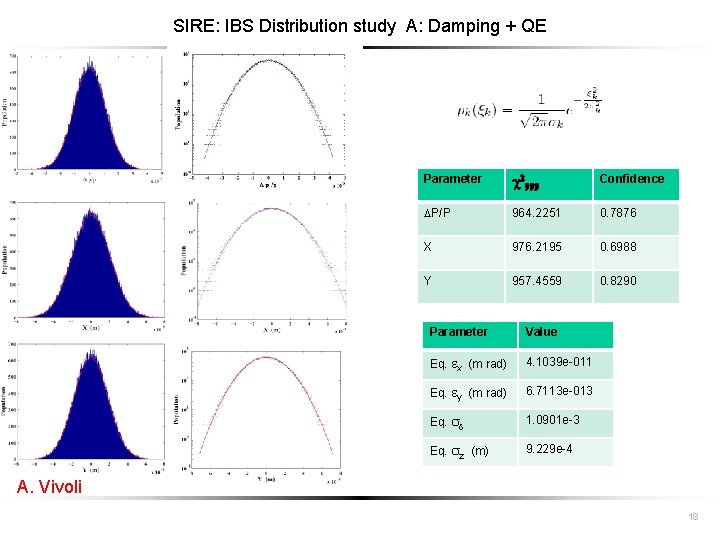
SIRE: IBS Distribution study A: Damping + QE Parameter c 2999 Confidence P/P 964. 2251 0. 7876 X 976. 2195 0. 6988 Y 957. 4559 0. 8290 Parameter Value Eq. x (m rad) 4. 1039 e-011 Eq. y (m rad) 6. 7113 e-013 Eq. d 1. 0901 e-3 Eq. z (m) 9. 229 e-4 A. Vivoli 18
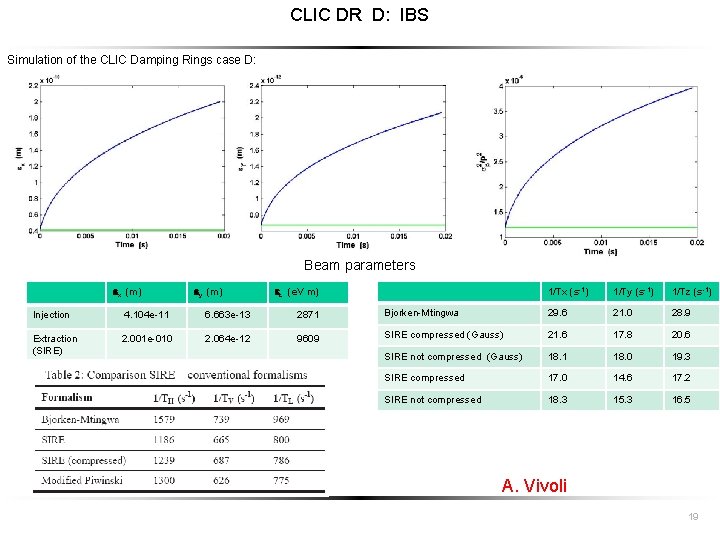
CLIC DR D: IBS Simulation of the CLIC Damping Rings case D: Beam parameters ex (m) ey (m) ez (e. V m) 1/Tx (s-1) 1/Ty (s-1) 1/Tz (s-1) Injection 4. 104 e-11 6. 663 e-13 2871 Bjorken-Mtingwa 29. 6 21. 0 28. 9 Extraction (SIRE) 2. 001 e-010 2. 064 e-12 9609 SIRE compressed (Gauss) 21. 6 17. 8 20. 6 SIRE not compressed (Gauss) 18. 1 18. 0 19. 3 SIRE compressed 17. 0 14. 6 17. 2 SIRE not compressed 18. 3 15. 3 16. 5 A. Vivoli 19
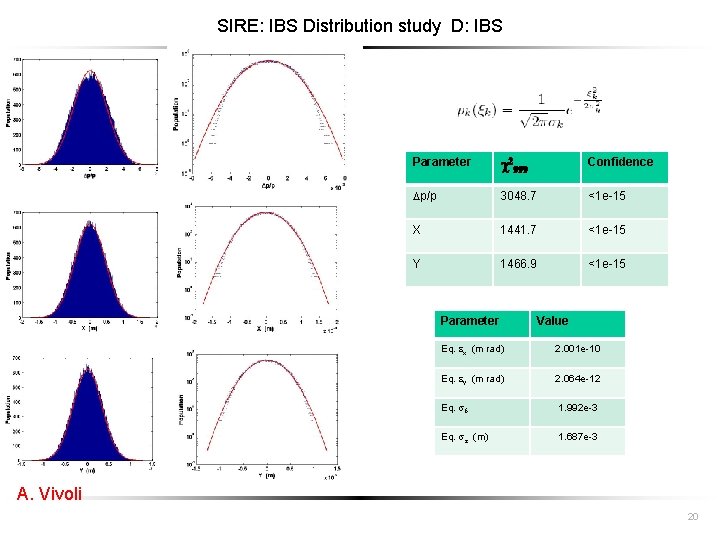
SIRE: IBS Distribution study D: IBS Parameter c 2999 Confidence p/p 3048. 7 <1 e-15 X 1441. 7 <1 e-15 Y 1466. 9 <1 e-15 Parameter Value Eq. x (m rad) 2. 001 e-10 Eq. y (m rad) 2. 064 e-12 Eq. d 1. 992 e-3 Eq. z (m) 1. 687 e-3 A. Vivoli 20
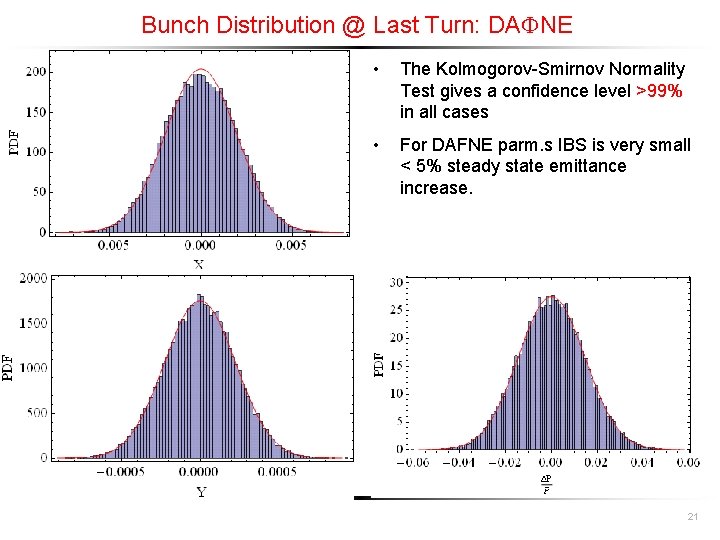
Bunch Distribution @ Last Turn: DAFNE • The Kolmogorov-Smirnov Normality Test gives a confidence level >99% in all cases • For DAFNE parm. s IBS is very small < 5% steady state emittance increase. 21
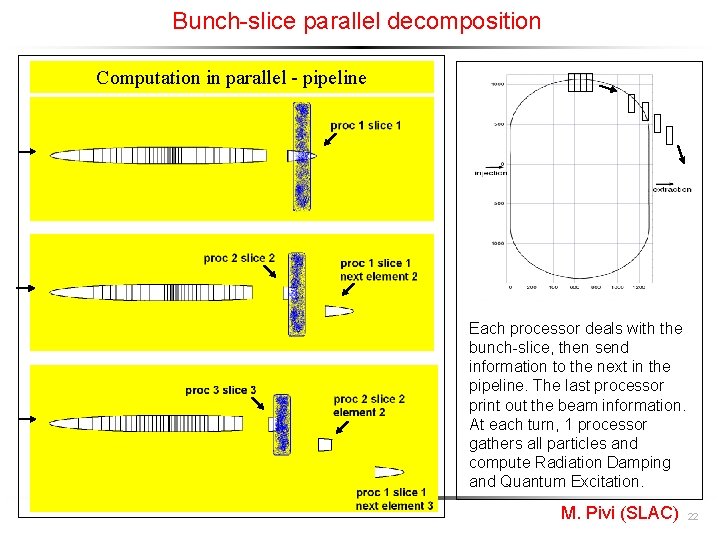
Bunch-slice parallel decomposition Computation in parallel - pipeline Each processor deals with the bunch-slice, then send information to the next in the pipeline. The last processor print out the beam information. At each turn, 1 processor gathers all particles and compute Radiation Damping and Quantum Excitation. M. Pivi (SLAC) 22
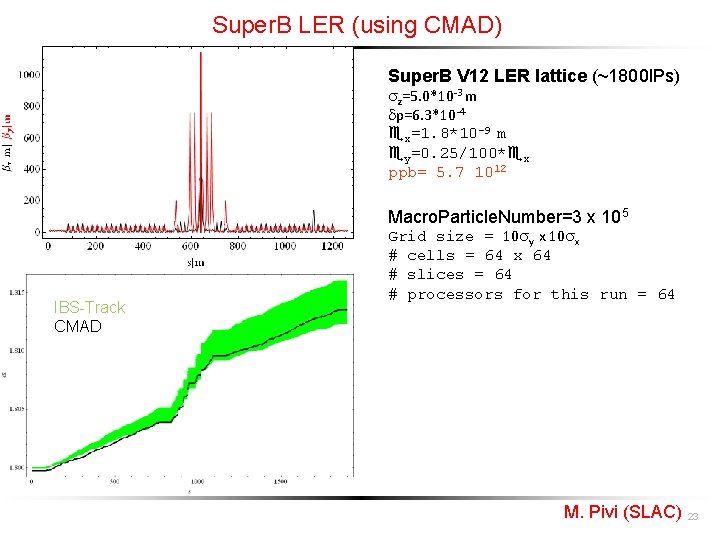
Super. B LER (using CMAD) Super. B V 12 LER lattice (~1800 IPs) z=5. 0*10 -3 m dp=6. 3*10 -4 ex=1. 8*10 -9 m ey=0. 25/100*ex ppb= 5. 7 1012 Macro. Particle. Number=3 x 10⁵ IBS-Track CMAD Grid size = 10 y x 10 x # cells = 64 x 64 # slices = 64 # processors for this run = 64 M. Pivi (SLAC) 23
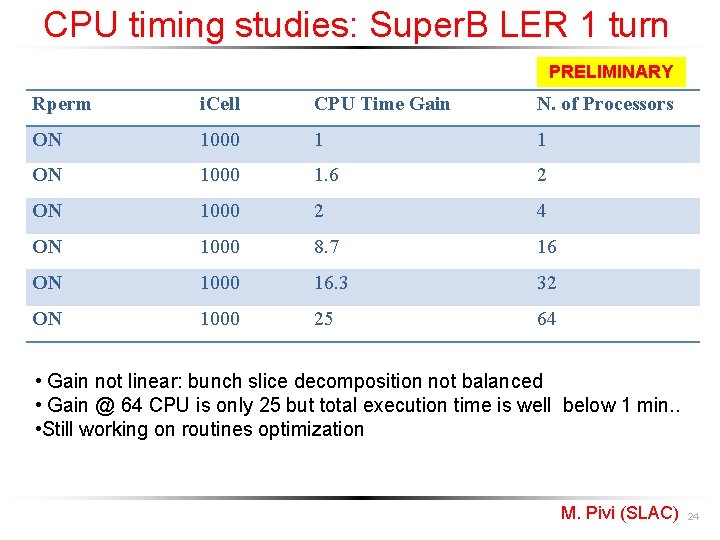
CPU timing studies: Super. B LER 1 turn PRELIMINARY Rperm i. Cell CPU Time Gain N. of Processors ON 1000 1 1 ON 1000 1. 6 2 ON 1000 2 4 ON 1000 8. 7 16 ON 1000 16. 3 32 ON 1000 25 64 • Gain not linear: bunch slice decomposition not balanced • Gain @ 64 CPU is only 25 but total execution time is well below 1 min. . • Still working on routines optimization M. Pivi (SLAC) 24
Summary • Interesting aspects of the IBS such as its impact on damping process and on generation of non Gaussian tails may be investigated with a multiparticle algorithm. • Two codes implementing the Zenkevich-Bolshakov algorithm to investigate IBS effects have been developed at LNF and at CERN: – Benchmarking with conventional IBS theories gave good results (both codes). –Evolution of the particle distribution shows deviations from Gaussian behaviour due to IBS effect (SIRE, CLIC-DR). • Parallel implementation of the algorithm is ready : –IBS routines included in CMAD (thanks to M. Pivi). • Comparison of the code results with measurements at SLS and/or Cesr-TA would provide the possibility of • Benchmarking with real data • Tuning code parameters (number of cells, number of interactions, etc. ) • Revision of theory or theory parameters (Coulomb log, approximations used, etc. ) 25
SPARES 26
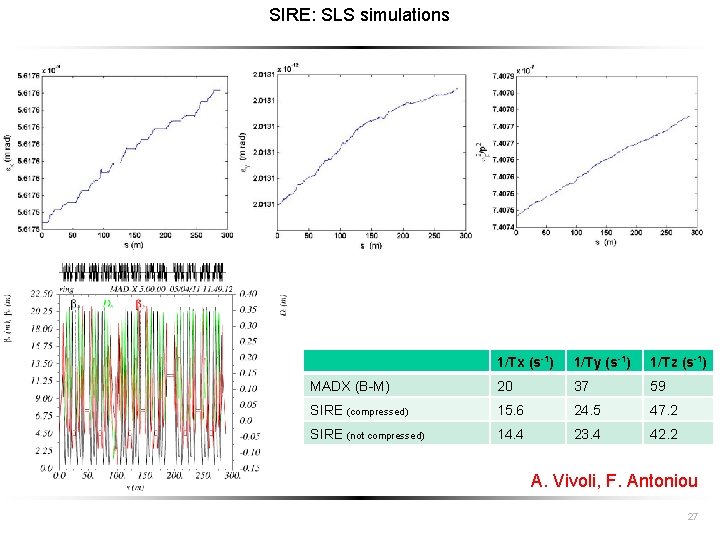
SIRE: SLS simulations 1/Tx (s-1) 1/Ty (s-1) 1/Tz (s-1) MADX (B-M) 20 37 59 SIRE (compressed) 15. 6 24. 5 47. 2 SIRE (not compressed) 14. 4 23. 4 42. 2 A. Vivoli, F. Antoniou 27
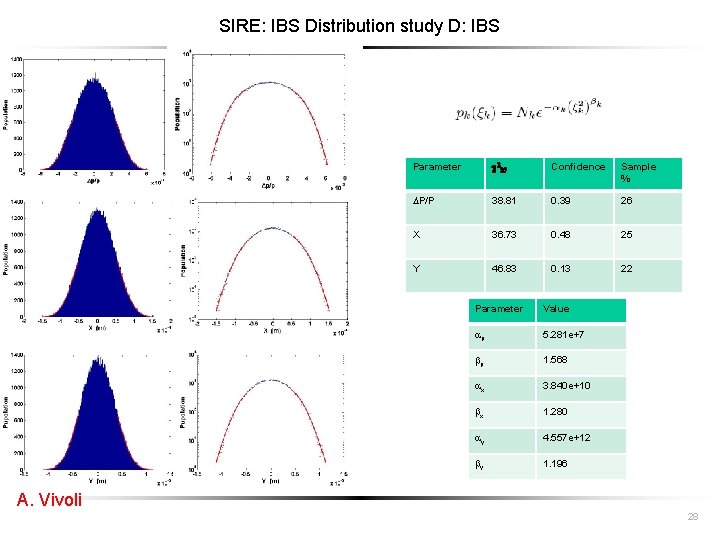
SIRE: IBS Distribution study D: IBS Parameter c 237 Confidence Sample % P/P 38. 81 0. 39 26 X 36. 73 0. 48 25 Y 46. 83 0. 13 22 Parameter Value ap 5. 281 e+7 bp 1. 568 ax 3. 840 e+10 bx 1. 280 ay 4. 557 e+12 by 1. 196 A. Vivoli 28

Bjorken-Mtingwa 29

Piwinski 30
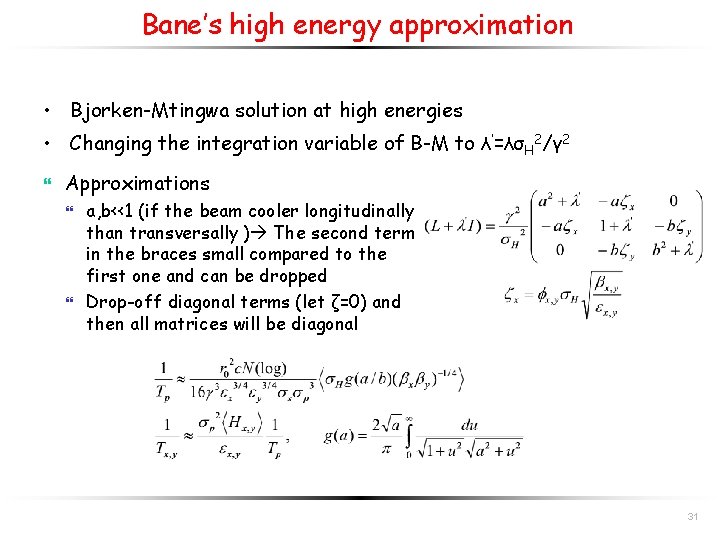
Bane’s high energy approximation • Bjorken-Mtingwa solution at high energies • Changing the integration variable of B-M to λ’=λσH 2/γ 2 Approximations a, b<<1 (if the beam cooler longitudinally than transversally ) The second term in the braces small compared to the first one and can be dropped Drop-off diagonal terms (let ζ=0) and then all matrices will be diagonal 31
- Slides: 31