
Into the Wild by Jon Krakauer Chapter 6
Into the Wild by Jon Krakauer Chapter 6: Anza-Borrego Project and Presentation by: Student A Student B Student C Student D
Re-telling of Chapter 6… Krakauer receives a letter from Ron Franz inquiring about Mc. Candless. In the letter, Franz says he met Mc. Candless in May 1992, they travelled together, and Franz wants to know more about the details of his death (48). Mc. Candless left an impression on many during his journeys, but “nobody, however, was more affected by his or her brief contact than [was] Ronald Franz” (48). Franz was 80 when he and Alex met.

Ronald A. Franz—Who is he? ü Devout Christian ü Army man ü On NYE 1957, his wife and only child were hit and killed by a drunk driver ü Due to loss, Franz “hit the whiskey hard” ü After 6 months, Franz stopped drinking cold turkey, but “never really got over the loss” (50) ü Took to adopting— 14 Okinawan boys/girls ü Meeting Alex “rekindled his paternal instincts” (50)
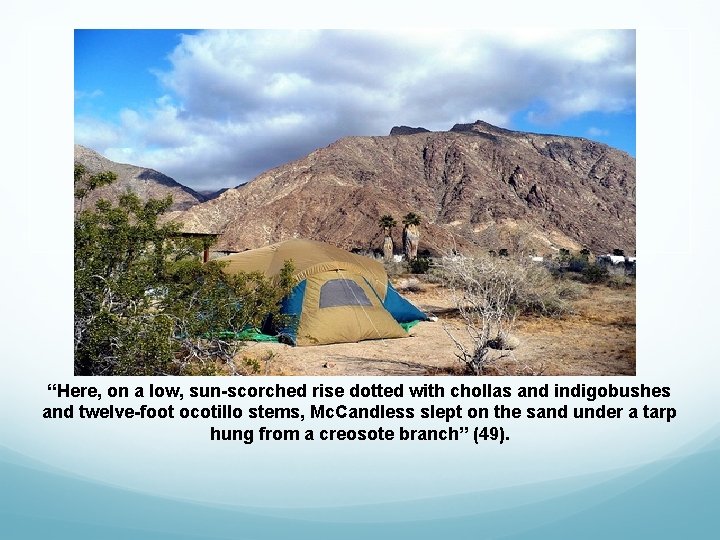
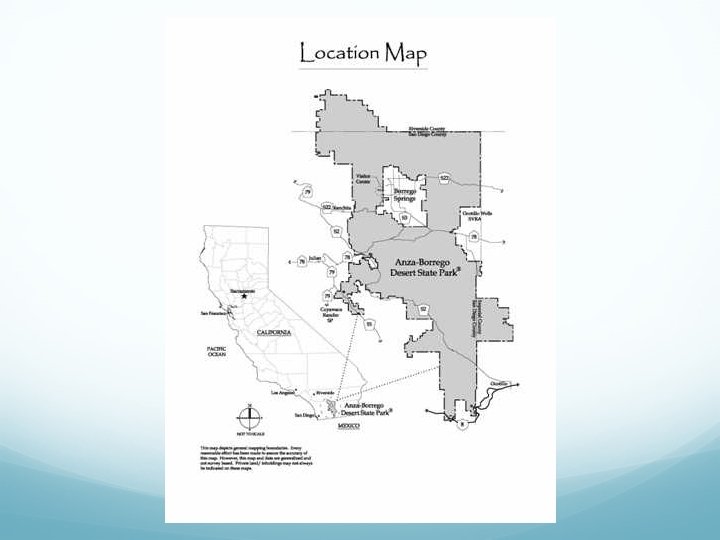
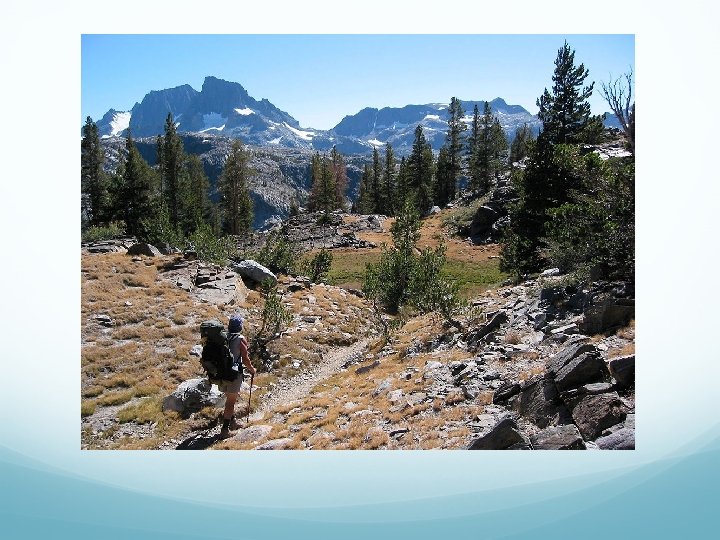
“Here, on a low, sun-scorched rise dotted with chollas and indigobushes and twelve-foot ocotillo stems, Mc. Candless slept on the sand under a tarp hung from a creosote branch” (49).
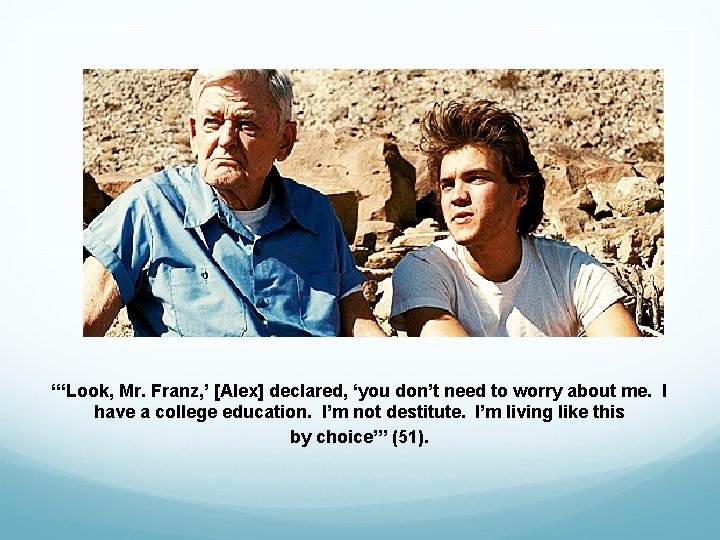
“‘Look, Mr. Franz, ’ [Alex] declared, ‘you don’t need to worry about me. I have a college education. I’m not destitute. I’m living like this by choice’” (51).
Details of their relationship… Alex confided in Franz that he was planning an “ultimate adventure” in Alaska (51). Franz taught Alex the art of leatherworking—henceforth, THE BELT was created (51) Alex lectured Franz about Franz repeatedly remarks “the shortcomings of his sedentary existence” (51). about how smart Alex was Alex goes on angry rants about “his parents or politicians or the endemic idiocy of mainstream American life” (52). Franz listens patiently to Alex’s rants and suggestions, and he enjoys taking care of Alex
Franz drives Alex to San Diego Postcard—Alex is “riding the rails, ” thrown in jail, released and travels to Coachella, CA Franz picks Alex up and, together, they travel to Grand Junction, Colorado On this trip, Franz asks Alex “if [Franz] can adopt him” because he has no family left. Alex replies, “We’ll talk about it when I get back from Alaska, Ron” (55). NOTABLE QUOTE—page 55 Franz finds himself “deeply and unexpectedly hurt” by Alex’s sudden departure (56) NOTABLE QUOTE in letter—Pages 57 to 58

…and, incredibly…
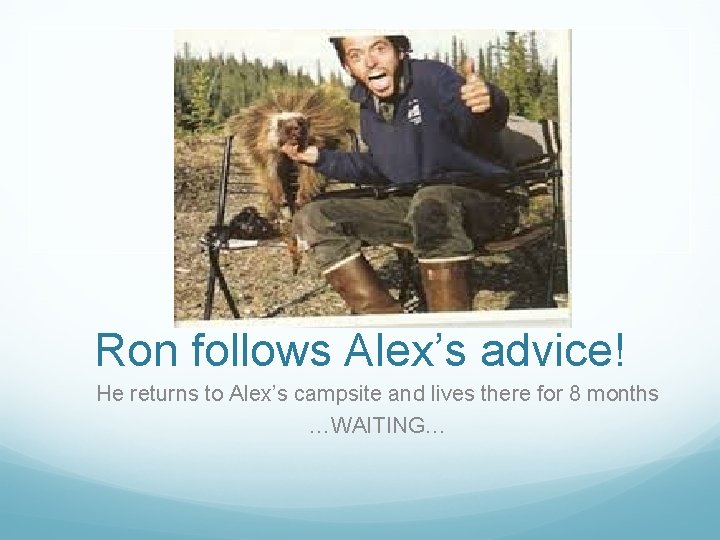
Ron follows Alex’s advice! He returns to Alex’s campsite and lives there for 8 months …WAITING…
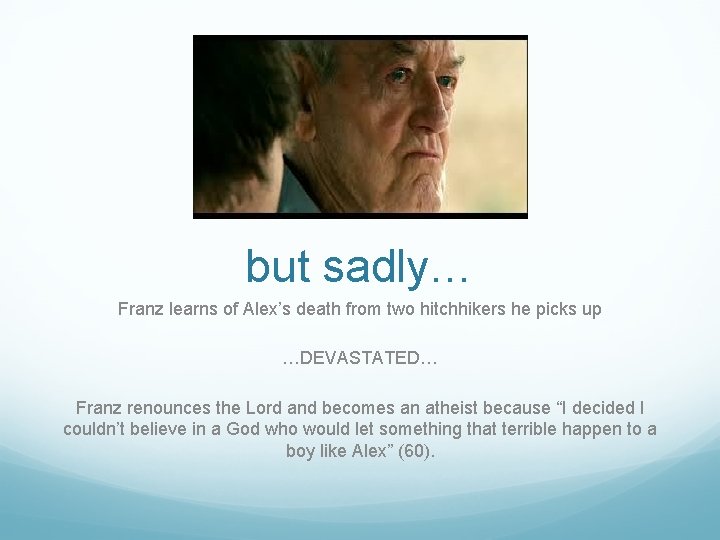
but sadly… Franz learns of Alex’s death from two hitchhikers he picks up …DEVASTATED… Franz renounces the Lord and becomes an atheist because “I decided I couldn’t believe in a God who would let something that terrible happen to a boy like Alex” (60).
“After I dropped off the hitchhikers, I…drove back to the store and bought a bottle of whiskey. And then I went out into the desert and drank it. I wasn’t used to drinking, so it made me sick. Hoped it’d kill me, but it didn’t. Just made me real, real sick” (60).
Author’s Purpose… Why did Krakauer include this chapter? To show the powerful effect Mc. Candless had on those around him Jan and Bob, Tracy, etc. Alex=lifestyle change, drinking, loss of faith for Franz To show that others WERE and ARE affected by Mc. Candless’s death Prompts the questions: Were Chris Mc. Candless’s actions selfish? Did Mc. Candless owe his family anything? Did he owe Ronald Franz anything? What responsibilities must we assume in relationships?
Thematic Connections… “the grip wilderness has on the American imagination…” The wilderness, the openrange, the endless possibilities—this was the appeal to Alex and, eventually, Alex came to inspire Franz to see a world of endless possibility also. Although, unfortunately, both stories experience sad endings—Alex dies and Franz is broken-hearted and disillusioned.
Thematic Connections… “the allure highrisk activities hold for young men of a certain mind…” Alex wanted adventure and he pursues this singlemindedly. Interestingly, his idealism and enthusiasm encourages an older man (Franz) to take on the lifestyle of a younger, freespirited man. Franz even lives at the same campsite Alex was at— however, is he trying to emulate Alex or is he simply waiting for Alex to return?
Thematic Connections… “the complicated, highly-charged bond between fathers and sons…” Franz desperately wants a father-son relationship with Alex, yet Alex does NOT want this—parallels Walt Mc. Candless’s strained relationship with Chris before Chris left In both relationships, Alex/Chris shows his moral compass Franz—”you wrong if you think joy emanates…from human relationships” (57) Walt—not accepting gifts to “buy my respect” (21) AND…more to come with Walt and Chris
Hero or Hubris? Alex/Chris MADE AN IMPACT Alex/Chris did not compromise his beliefs to make others happy Alex’s influence changes Franz’s lifestyle Alex caused Franz happiness, but also pain, suffering and hurt Alex was reckless in his relationship with Franz, causing Franz to lose his faith in religion Alex did not learn from Franz; rather, he instructed Franz and then left him
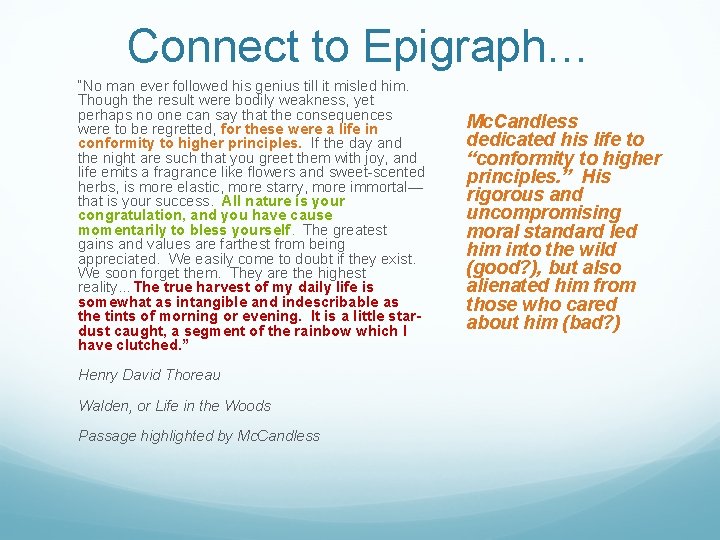
Connect to Epigraph… “No man ever followed his genius till it misled him. Though the result were bodily weakness, yet perhaps no one can say that the consequences were to be regretted, for these were a life in conformity to higher principles. If the day and the night are such that you greet them with joy, and life emits a fragrance like flowers and sweet-scented herbs, is more elastic, more starry, more immortal— that is your success. All nature is your congratulation, and you have cause momentarily to bless yourself. The greatest gains and values are farthest from being appreciated. We easily come to doubt if they exist. We soon forget them. They are the highest reality…The true harvest of my daily life is somewhat as intangible and indescribable as the tints of morning or evening. It is a little stardust caught, a segment of the rainbow which I have clutched. ” Henry David Thoreau Walden, or Life in the Woods Passage highlighted by Mc. Candless dedicated his life to “conformity to higher principles. ” His rigorous and uncompromising moral standard led him into the wild (good? ), but also alienated him from those who cared about him (bad? )
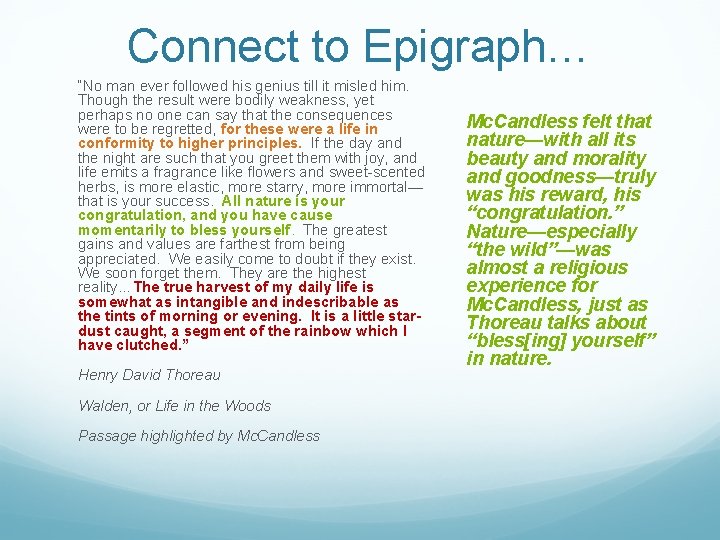
Connect to Epigraph… “No man ever followed his genius till it misled him. Though the result were bodily weakness, yet perhaps no one can say that the consequences were to be regretted, for these were a life in conformity to higher principles. If the day and the night are such that you greet them with joy, and life emits a fragrance like flowers and sweet-scented herbs, is more elastic, more starry, more immortal— that is your success. All nature is your congratulation, and you have cause momentarily to bless yourself. The greatest gains and values are farthest from being appreciated. We easily come to doubt if they exist. We soon forget them. They are the highest reality…The true harvest of my daily life is somewhat as intangible and indescribable as the tints of morning or evening. It is a little stardust caught, a segment of the rainbow which I have clutched. ” Henry David Thoreau Walden, or Life in the Woods Passage highlighted by Mc. Candless felt that nature—with all its beauty and morality and goodness—truly was his reward, his “congratulation. ” Nature—especially “the wild”—was almost a religious experience for Mc. Candless, just as Thoreau talks about “bless[ing] yourself” in nature.
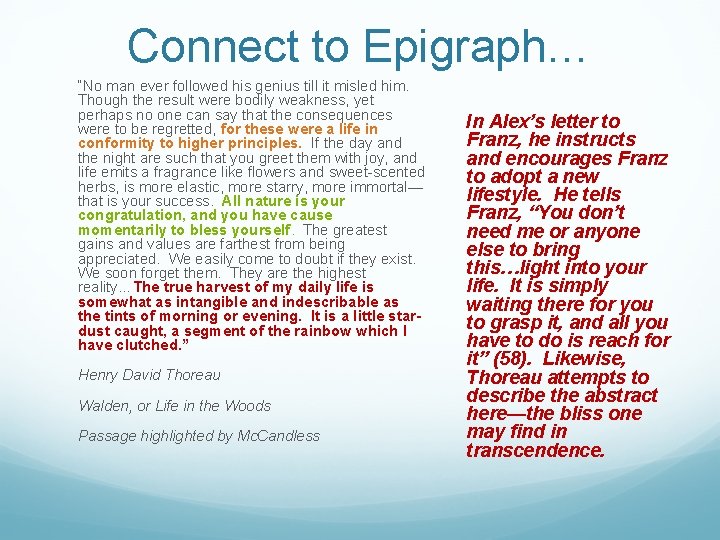
Connect to Epigraph… “No man ever followed his genius till it misled him. Though the result were bodily weakness, yet perhaps no one can say that the consequences were to be regretted, for these were a life in conformity to higher principles. If the day and the night are such that you greet them with joy, and life emits a fragrance like flowers and sweet-scented herbs, is more elastic, more starry, more immortal— that is your success. All nature is your congratulation, and you have cause momentarily to bless yourself. The greatest gains and values are farthest from being appreciated. We easily come to doubt if they exist. We soon forget them. They are the highest reality…The true harvest of my daily life is somewhat as intangible and indescribable as the tints of morning or evening. It is a little stardust caught, a segment of the rainbow which I have clutched. ” Henry David Thoreau Walden, or Life in the Woods Passage highlighted by Mc. Candless In Alex’s letter to Franz, he instructs and encourages Franz to adopt a new lifestyle. He tells Franz, “You don’t need me or anyone else to bring this…light into your life. It is simply waiting there for you to grasp it, and all you have to do is reach for it” (58). Likewise, Thoreau attempts to describe the abstract here—the bliss one may find in transcendence.
Works Cited "Anza-Borrego Desert State Park. " California Department of Parks and Recreation. State of California, 2013. Web. 29 Jan. 2014. <http: //www. parks. ca. gov/>. "Camping at Anza-Borrego. " Greene Adventures. Wordpress, 2011. Web. 29 Jan. 2014. <http: //www. greeneadventures. com/>. "Destinations: Hiking At Anza Borrego Desert State Park, CA. " frogcitycheese, 2014. Web. 29 Jan. 2014. <http: //www. frogcitycheese. com/>. Krakauer, Jon. Into the Wild. New York: Anchor Books, 2007. Print. "Last Words of Christopher Mc. Candless. " Zimbio. Livingly Media, Inc. , 2014. Web. 29 Jan. 2014. <http: //www. zimbio. com>. "Mc. Candless and Franz (film photo). " Filmtrivia. tumblr, 7 Jan. 2012. Web. 29 Jan. 2014. <http: //filmtrivia. tumblr. com>. "Real Ronald Franz. " Youtube. Google Images, 4 June 2009. Web. 29 Jan. 2014. <http: //www. google. com/>. "Tearful Ronald Franz (film). " FSM Board: Movie Characters You Fear You'll Become. Film Score Monthly, 2014. Web. 29 Jan. 2014. <http: //filmscoremontly. com>.
- Slides: 22