
Intimacy and Sexuality through the Aging Process ACKNOWLEDGEMENT
- Slides: 44
Intimacy and Sexuality through the Aging Process
ACKNOWLEDGEMENT These slides were designed by Fran Floersheimer, LBSW, GA, CART as part of her role in the HRSA sponsored Houston Geriatric Education Center. Please credit her if utilizing these slides and recognize the Health Resource Service Administration for their support of our geriatric education program.
Funded By This project is funded by a grant from the Health Resources and Services Administration (HRSA) of the Department of Health and Human Services. The grant was initially funded in 2007 with renewed funding for five years beginning in 2010. The grant ended in June, 2015 (Grant #UB 4 HP 19058). 3
Learning Objectives • Begin an informative dialogue by: – Exploring our attitudes about sexuality and intimacy among older adults – Discussing challenging situations that can occur and identify helpful resources and strategies – Exploring current attitudes and practices in care facilities that impact residents’ expressions of intimacy – Understanding changes associated with dementia that impact intimacy and sexual behavior
Why is this important? • 4 million baby boomers will turn 65 each year for the next 18 years • 10, 000+ per day • Sexuality is a core human dimension • Intimacy is an enduring human need • Sexual rights don’t expire with age • Sexual rights do not expire with disease or disability
Intimacy vs. Sexuality • Exists, but expressed differently across relationships • Five components of intimacy (Moss & Schwebel, 1993): – Commitment (connection) – Mutuality (interdependence, reciprocity) – Emotional intimacy (caring, positive regard, compassion) – Cognitive intimacy ( shared values, goals) – Physical intimacy (sexual & non-sexual)
The Importance of Facing Life Together • Family Functioning • Marital satisfaction • The support of family and those involved with caregiving, and coping ability appear to affect the adjustment process for the spousal caregivers, and ultimately their satisfaction with life regarding issues of intimacy and sexuality through the aging process.
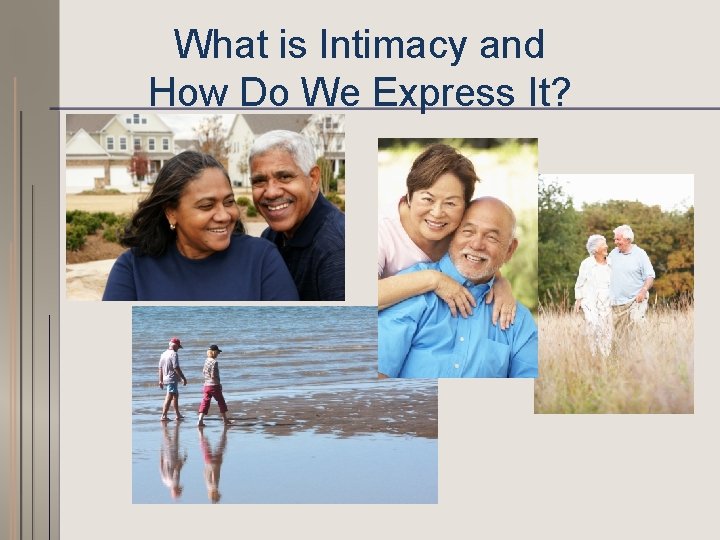
What is Intimacy and How Do We Express It?
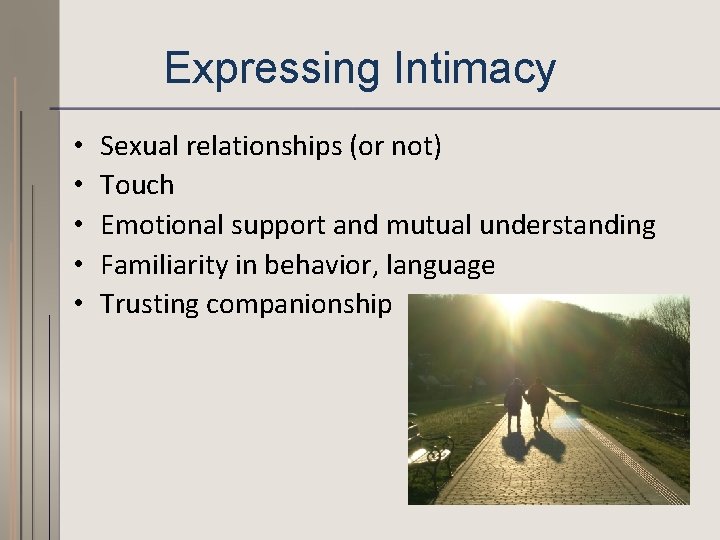
Expressing Intimacy • • • Sexual relationships (or not) Touch Emotional support and mutual understanding Familiarity in behavior, language Trusting companionship
Advantages of Aging • • • May feel wiser or more experienced More self-confidence Greater self-awareness Fewer distractions Less idealistic
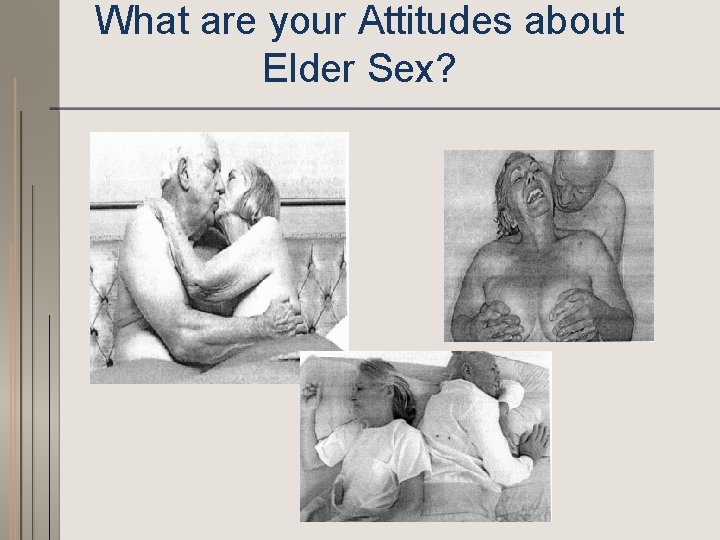
What are your Attitudes about Elder Sex?
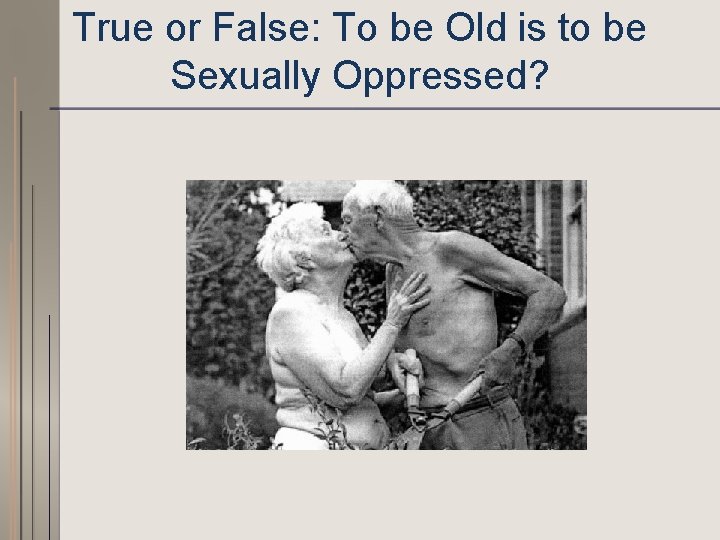
True or False: To be Old is to be Sexually Oppressed?
Changes in Circumstances Equal Changes in Intimacy Change in ability to care for self (ADLs) Dependence of one spouse on the other Change in social interactions Cognitive, behavioral and emotional changes • Physical changes • Medication interference • Caregivers role changes, no longer equal partnership • •
Intimacy Changes (cont’d) • Increased (hypersexuality) or decreased libido • Confusion about what to do or say • Lack of initiation or follow-through • Challenges recognizing the right time and place to express affection • Hygiene/Self-care issues
Dementia Causes Many Changes • • • Loss of social skills Loss of inhibitions Lack of judgment Decreased ability to care for self Lack of understanding of consequences of one’s behavior Increased confusion and distrust Inability to communicate needs or wants Inappropriate behaviors, i. e. flirting, touching, public undressing or masturbation, etc. Not recognizing familiar people Role confusion
These Changes Cause Risks If Not Addressed • • • Communication and Misunderstanding Diminished self-esteem Unnecessarily lowered expectations Avoidance of intimacy Medication non-compliance
Sex? Don’t Take it Personally It is extremely important to realize that loss of sexual manners occurs as a result of disease, at times, and not because someone has suddenly lost regard for his/her partner.
Sex? Don’t Take it Personally (Cont’d) • Every 67 seconds someone in the U. S. develops Alzheimer’s Disease • By 2050, the number of people world wide who live with dementia is expected to more than triple (115 million) • Care for these populations changes the relationship with their loved ones. • Care for these populations changes the rules of intimacy for couples.
Sex? Don’t Take it Personally (Cont’d) • Sexual intimacy is a basic human need often overlooked in the provision of quality care; For example, persons with Alzheimer’s disease and their partners. However, the interpersonal and sexual consequences of this disease, changes customary notions and expressions of tenderness.
Sex? Don’t take it Personally(Cont’d) • Just because the person’s sexual expression changes, does not mean they do not require intimacy. This population still needs affection in a non-intercourse format, such as: • Touching • Holding • Hugging • Kissing
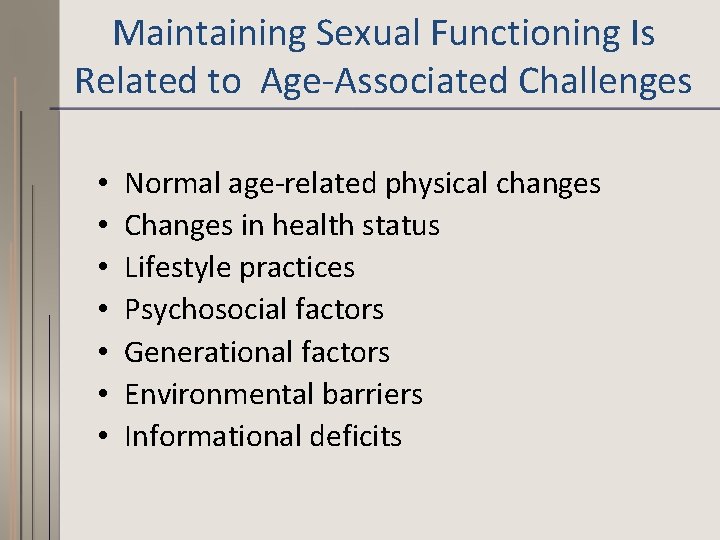
Maintaining Sexual Functioning Is Related to Age-Associated Challenges • • Normal age-related physical changes Changes in health status Lifestyle practices Psychosocial factors Generational factors Environmental barriers Informational deficits
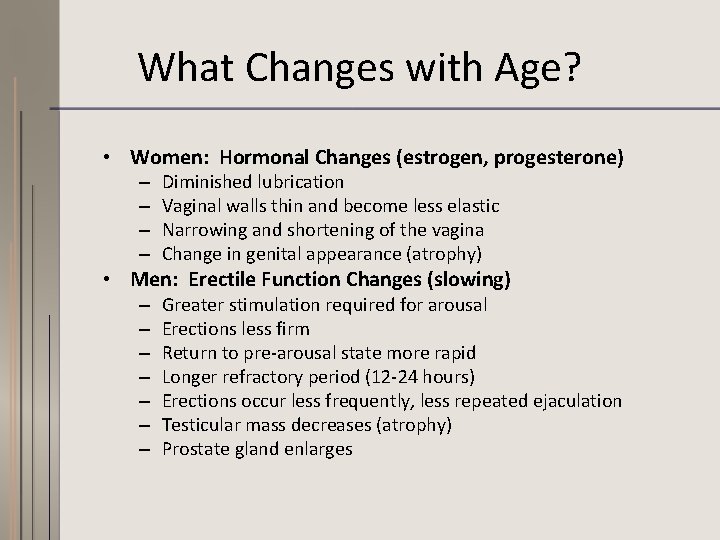
What Changes with Age? • Women: Hormonal Changes (estrogen, progesterone) – – Diminished lubrication Vaginal walls thin and become less elastic Narrowing and shortening of the vagina Change in genital appearance (atrophy) • Men: Erectile Function Changes (slowing) – – – – Greater stimulation required for arousal Erections less firm Return to pre-arousal state more rapid Longer refractory period (12 -24 hours) Erections occur less frequently, less repeated ejaculation Testicular mass decreases (atrophy) Prostate gland enlarges
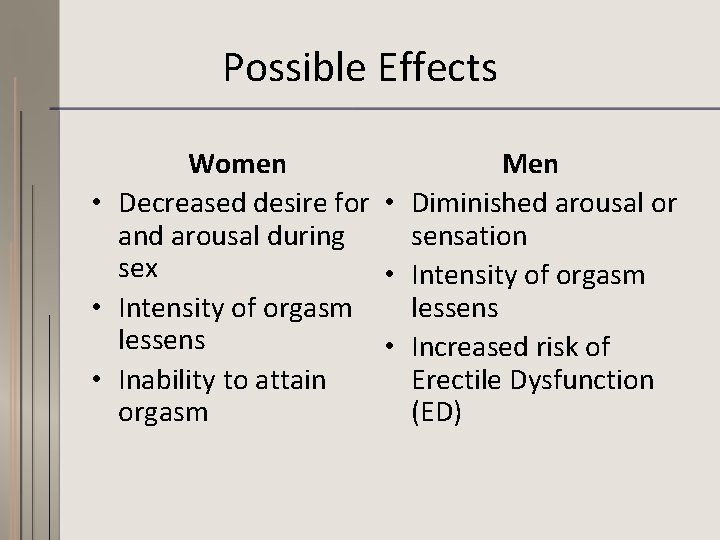
Possible Effects Women Men • Decreased desire for • Diminished arousal or and arousal during sensation sex • Intensity of orgasm lessens • Increased risk of Erectile Dysfunction • Inability to attain (ED) orgasm
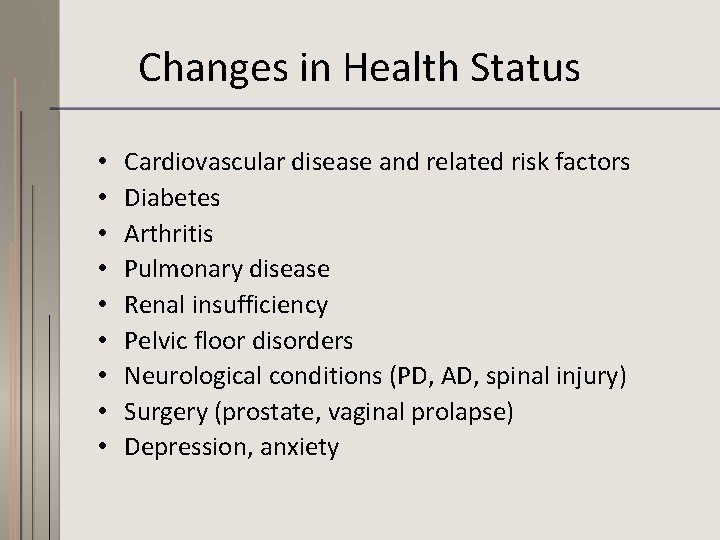
Changes in Health Status • • • Cardiovascular disease and related risk factors Diabetes Arthritis Pulmonary disease Renal insufficiency Pelvic floor disorders Neurological conditions (PD, AD, spinal injury) Surgery (prostate, vaginal prolapse) Depression, anxiety
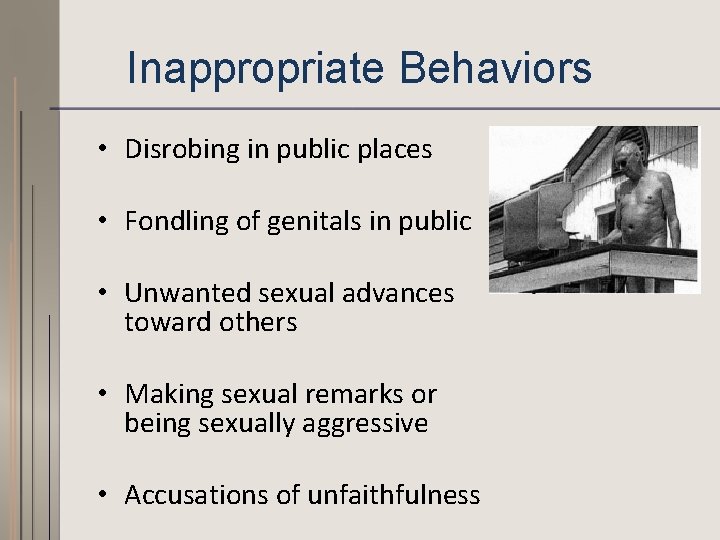
Inappropriate Behaviors • Disrobing in public places • Fondling of genitals in public • Unwanted sexual advances toward others • Making sexual remarks or being sexually aggressive • Accusations of unfaithfulness
Dealing with Difficult Feelings • • • Marital dissatisfaction Frustration Anger, resentment Guilt Loss, grief Embarrassment Loneliness Positive feelings Attitudes of adult children toward sexual expression
The Importance of Communication
What can the Caregiver do? • Choose your battles-can you tolerate certain behaviors as they are? • Inform the bystander or acquaintance about your loved one’s dementia. • Remain calm and keep your sense of humor. Go with the flow. • Gently distract or remove from the situation without causing a scene. If there is resistance, try a persuasive line such as, “let’s go change your clothes/shower so you can look good for that nice, young lady. ” • Do NOT reprimand or belittle! The behavior is NOT purposeful and the person likely does not know better.
What can the Caregiver Do? (cont) • Reconcile morals and cultural norms with personal values • Deal with guilt • Reach out to family members • Fulfill your needs-companionship, emotional, intimacy, and spirituality
Interesting Facts about Sexuality Among Older Adults • The majority of older adults are engaged in spousal or other intimate relationships and regard sexuality as an important part of life. • The spread of STDs (sexually transmitted diseases) has become a major public health concern in the aging community.
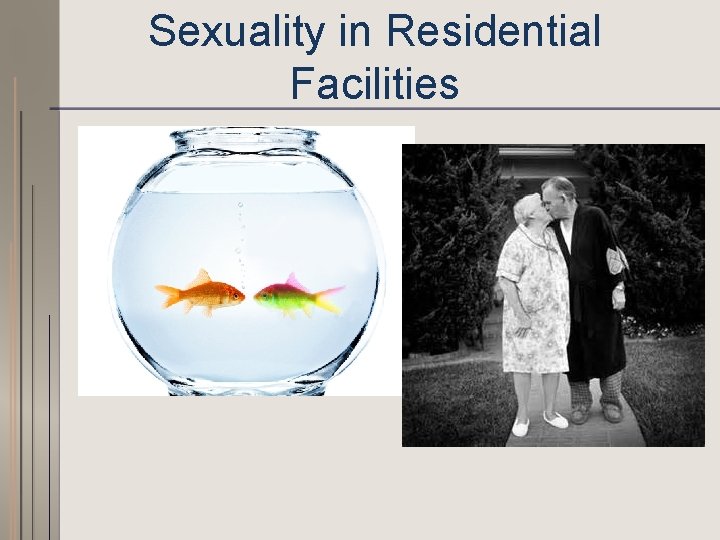
Sexuality in Residential Facilities
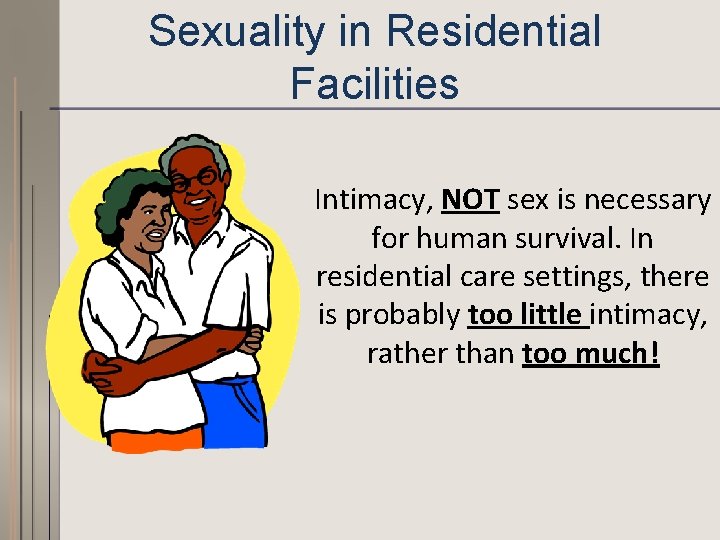
Sexuality in Residential Facilities Intimacy, NOT sex is necessary for human survival. In residential care settings, there is probably too little intimacy, rather than too much!
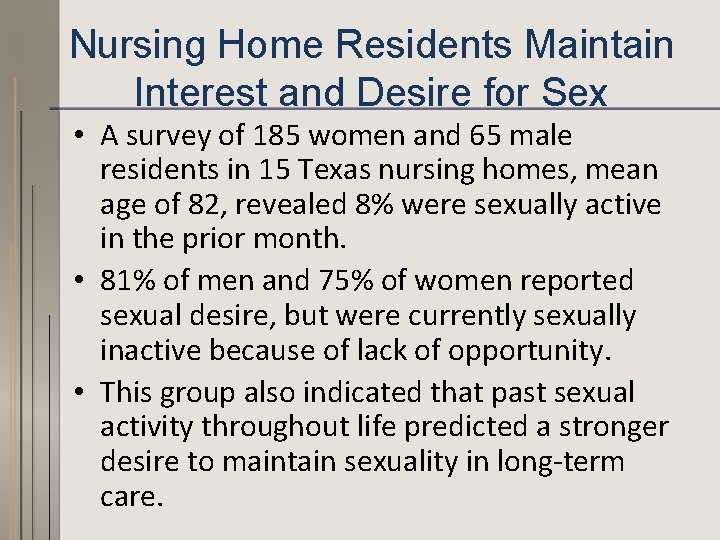
Nursing Home Residents Maintain Interest and Desire for Sex • A survey of 185 women and 65 male residents in 15 Texas nursing homes, mean age of 82, revealed 8% were sexually active in the prior month. • 81% of men and 75% of women reported sexual desire, but were currently sexually inactive because of lack of opportunity. • This group also indicated that past sexual activity throughout life predicted a stronger desire to maintain sexuality in long-term care.
“…Sexual behavior in nursing homes differs in significant ways from such behaviors at home: It no longer is a private matter, but in one way or another, has an impact on staff, other residents and the families of residents…” -Nancy Mace and Peter Rabins The 36 Hour Day
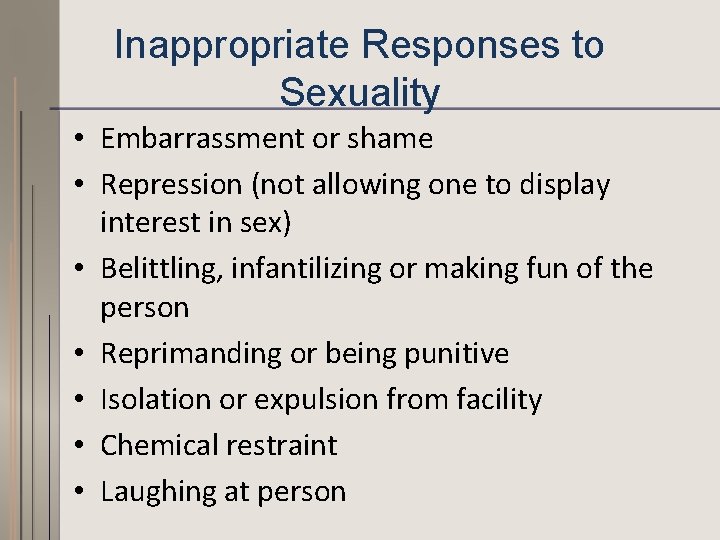
Inappropriate Responses to Sexuality • Embarrassment or shame • Repression (not allowing one to display interest in sex) • Belittling, infantilizing or making fun of the person • Reprimanding or being punitive • Isolation or expulsion from facility • Chemical restraint • Laughing at person
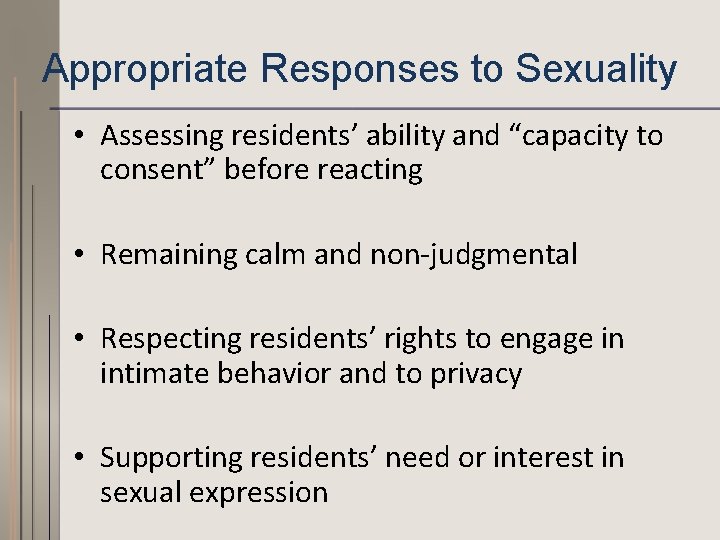
Appropriate Responses to Sexuality • Assessing residents’ ability and “capacity to consent” before reacting • Remaining calm and non-judgmental • Respecting residents’ rights to engage in intimate behavior and to privacy • Supporting residents’ need or interest in sexual expression
Assessing Capacity • Is the person aware of the relationship? • Is the person able to avoid exploitation? • Is the person aware of the potential risks?
Considerations for Staff/Caregiver • Resident rights and safety • Family preferences • Embarrassment or confusion • Personal values/beliefs • Rules and regulations
Things to Remember • Every facility needs to have a formal institutional policy on resident rights to sexual expression-consult DADS (Department of Aging and Disability Services), if not already in place. • All staff should know the history of past behavior and social relationships. • Always try to preserve and respect remaining capabilities. • People with dementia continue to need loving, safe relationship, caring touch and expressions of intimacy.
Some Solutions • Honoring Couplehood: Conjugal visits/private rooms • “Do Not Disturb” signage • Flexible visitation and facility schedules • Tolerance for same sex couples **These solutions are useful provided they abide by facility regulations
Advantages of Aging • • • May feel wiser or more experienced More self-confidence Greater self-awareness Fewer distractions Less idealistic
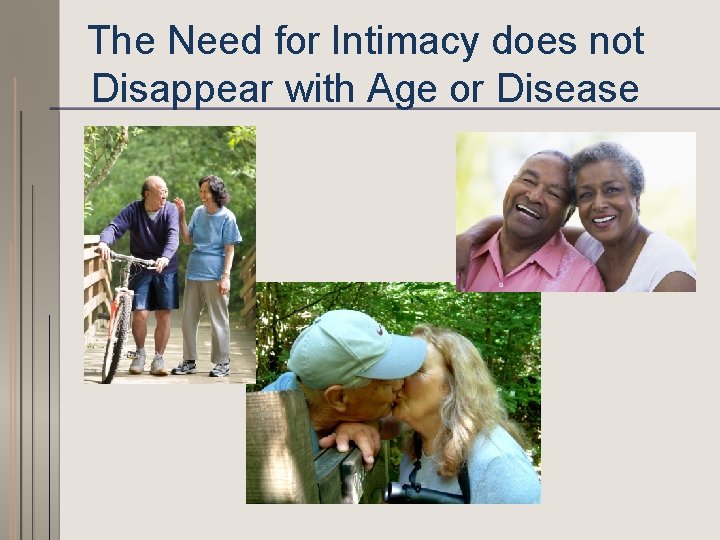
The Need for Intimacy does not Disappear with Age or Disease
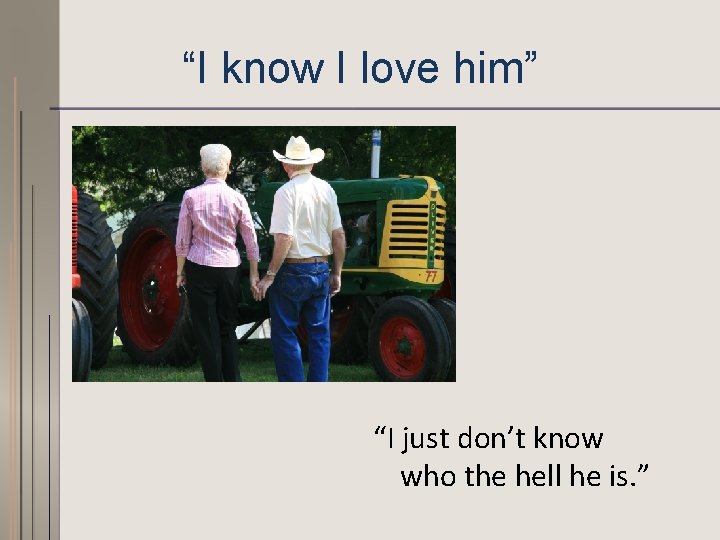
“I know I love him” “I just don’t know who the hell he is. ”
References • Alzheimer’s Association • Ramzi R Hajjar, Hosam K Kamel, Sex and the nursing home, Clinics in Geriatric Medicine, Volume 19, Issue 3, August 2003, Pages 575586, ISSN 0749 -0690 • Nancy Mace and Peter Rabins, The 36 Hour Day • Moss, B. F. & Schwebel, A. I. (1993). Defining Intimacy in Romantic Relationships. UFamily Relations. U, 42, 31 -37.