
Intestinal Worms Dr Manahil Ghandour Introduction Intestinal worms




- Slides: 62
Intestinal Worms Dr. Manahil Ghandour
Introduction Intestinal worms infestation occur mainly in warm – overcrowded tropical regions. . Due to : - lack of clean water. - Inadequate sanitation In spite of this, cold areas are not free. * Infection ; (accepted as a natural phenomena in some areas).
• They can cause considerable morbidity particularly when the host is already weakened by malnutrition and concurrent disease“. * Morbidity depends on Intensity…
Types of Intestinal Worms Three types ; - 1 - Nematodes ( Round worms). 2 - Cestodes ( Flat worms ). 3 - Trematodes ( Flukes ).
1 - Nematodes (Round Worm)
Nematodes * It is round worm. * unsegmented. * has a mouth, esophagus and anus. * It has separate sex. * reproduction by : ( ova parous or larvi parous.
Nematode * the main member of this group is : - Ascaris –lumbricoides. - E. vermicularis. - Ankylostoma. - Trichuris Trichura. etc…. .
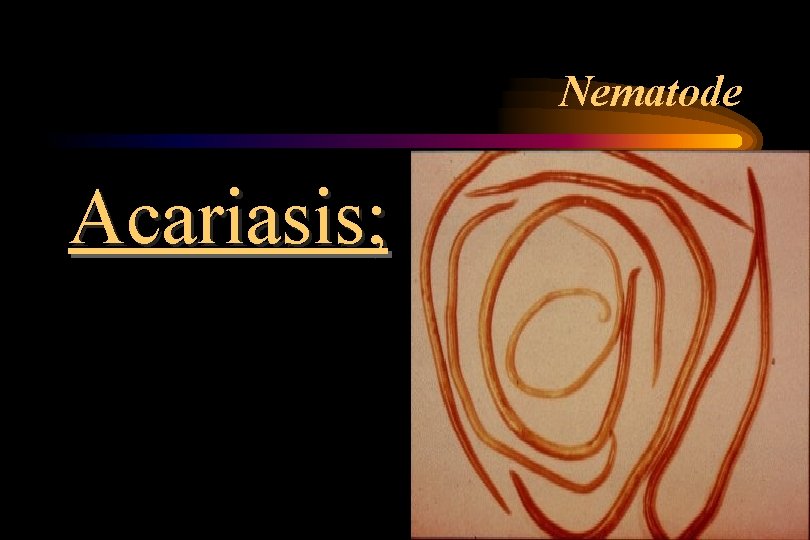
Nematode Acariasis;
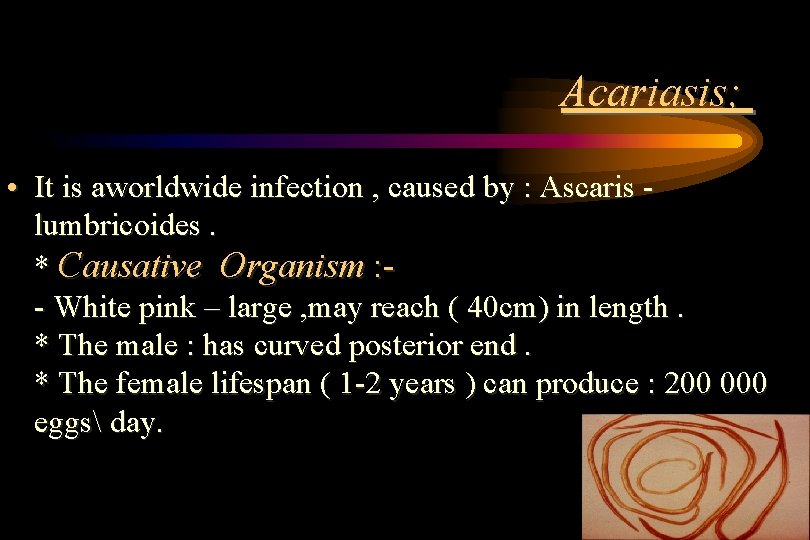
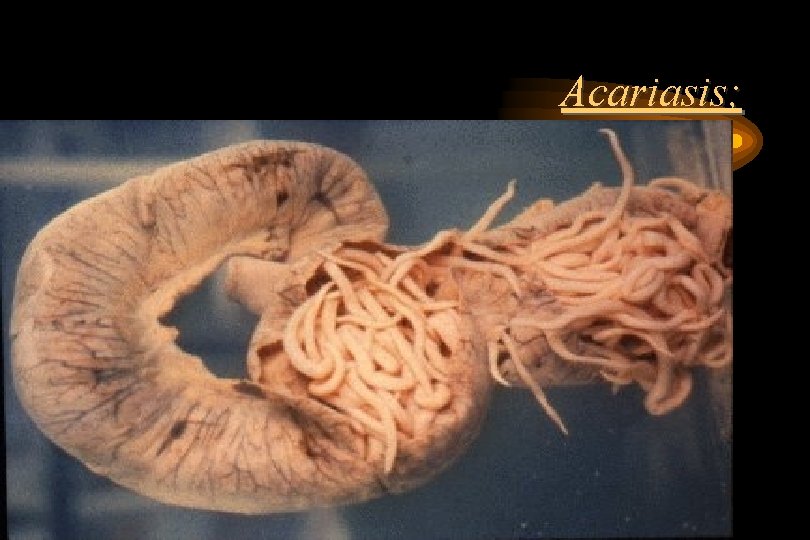
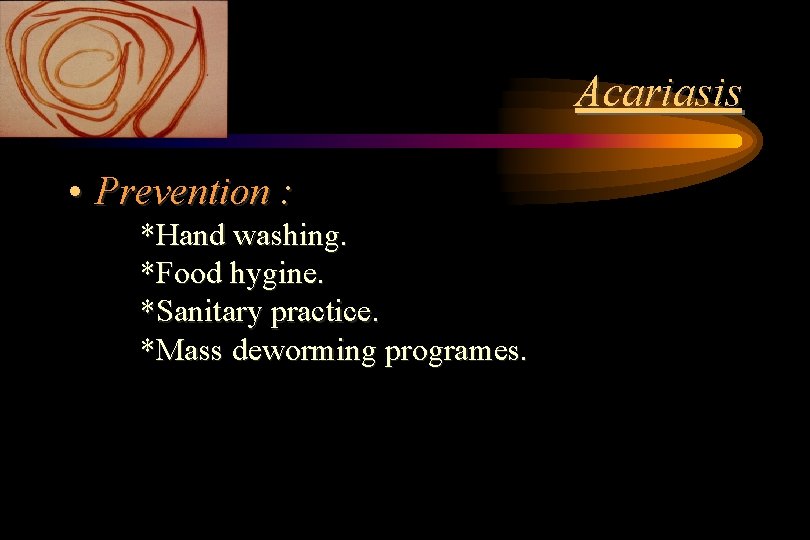
Acariasis; • It is aworldwide infection , caused by : Ascaris lumbricoides. * Causative Organism : - White pink – large , may reach ( 40 cm) in length. * The male : has curved posterior end. * The female lifespan ( 1 -2 years ) can produce : 200 000 eggs day.
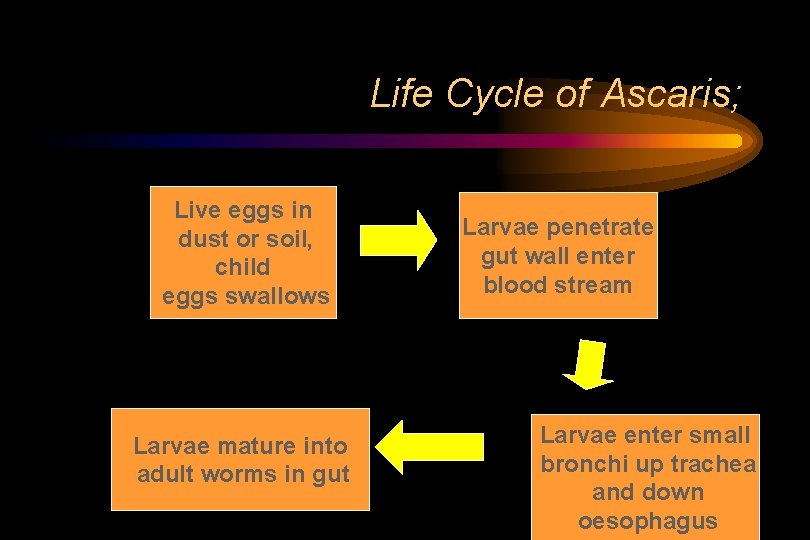
Life Cycle of Ascaris; Live eggs in dust or soil, child eggs swallows Larvae mature into adult worms in gut Larvae penetrate gut wall enter blood stream Larvae enter small bronchi up trachea and down oesophagus
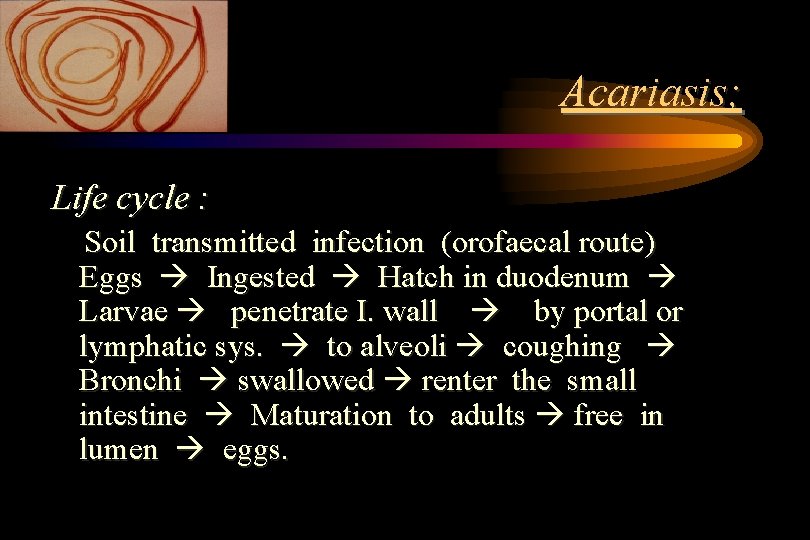
Acariasis; Life cycle : Soil transmitted infection (orofaecal route) Eggs Ingested Hatch in duodenum Larvae penetrate I. wall by portal or lymphatic sys. to alveoli coughing Bronchi swallowed renter the small intestine Maturation to adults free in lumen eggs.
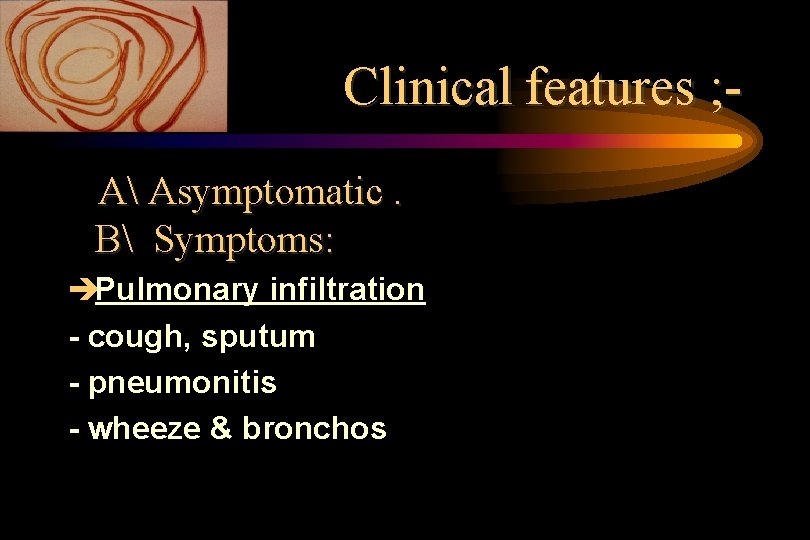
Clinical features ; A Asymptomatic. B Symptoms: èPulmonary infiltration - cough, sputum - pneumonitis - wheeze & bronchos
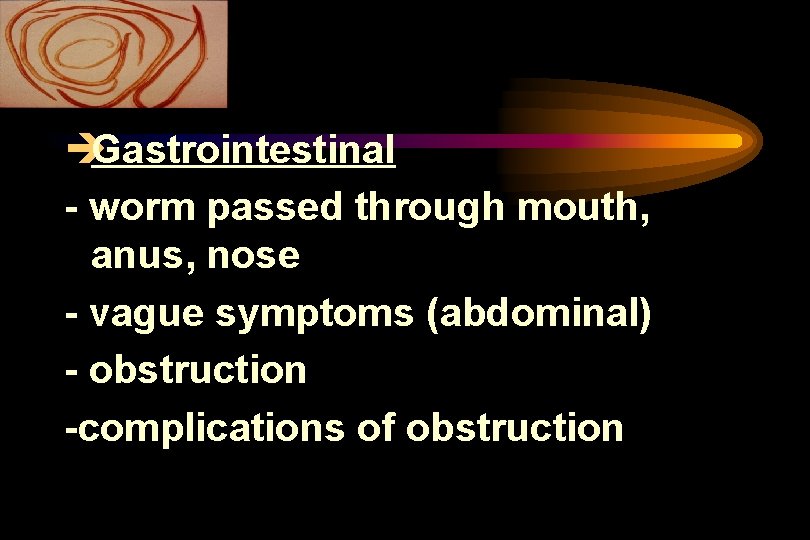
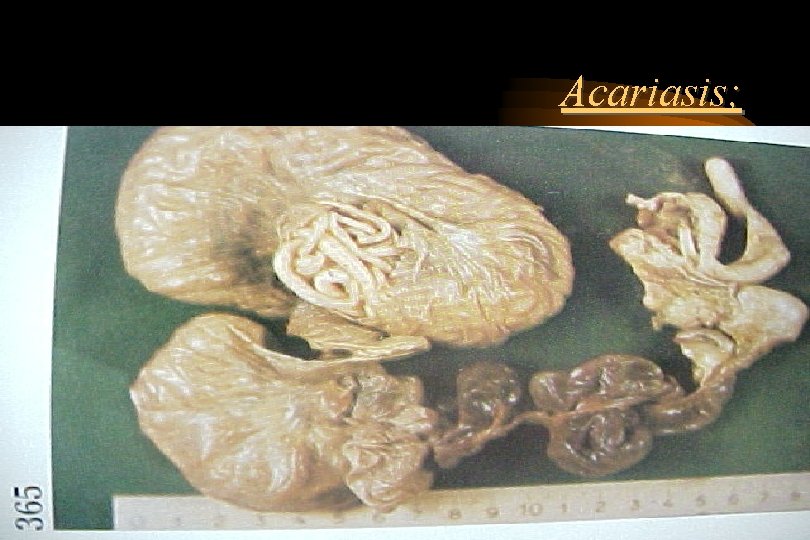
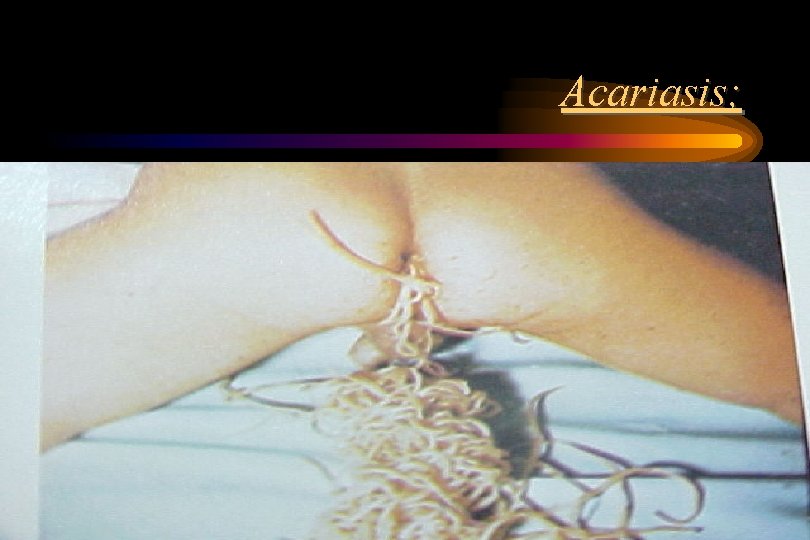
èGastrointestinal - worm passed through mouth, anus, nose - vague symptoms (abdominal) - obstruction -complications of obstruction
Acariasis;
Acariasis;
Acariasis;
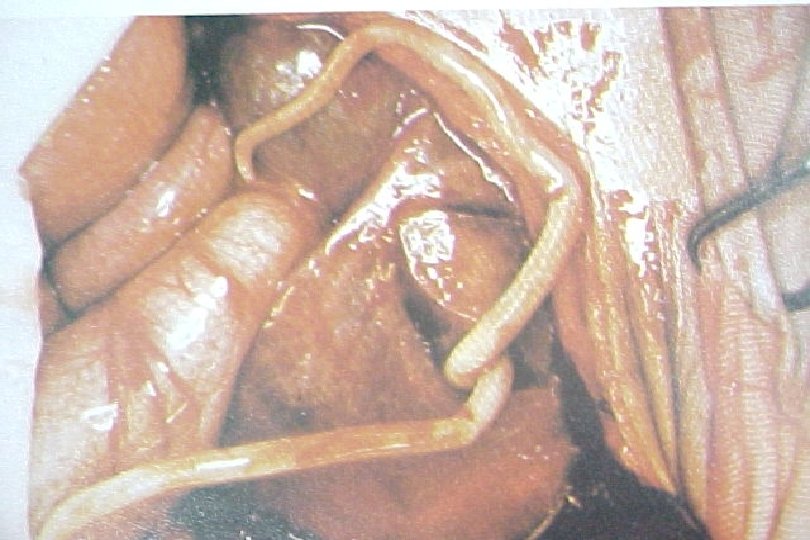
Acariasis - Biliary tract cholicystitis. - rarer manifestations. - Liver infection - appendix acute appendicitis - Pancreas pancreatitis. -liver parenchyma granulomatous reaction, secondary infection and abscess formation.
Diagnosis; : History of passage of worms. 1 -Stool microscopic ex. eggs. -2 - Eosinophilia , high serum Ig. E -
Acariasis; May need : 1 -straight x - abd. 2 -US ; biliary tract. 3 -Barium meal. 4 -I. v cholangiography
Acariasis; • *Treatment : - Mebendazole ( 100 mg / Bd / 3 days ). - Albendazole (400 mg / Single dose) *Piperazine syrup ( 75 mg /kg -before dinner )…. 4 g. Is max. . -S/E. *Corticosteroids --- larval pneumonitis. -
Acariasis • Prevention : *Hand washing. *Food hygine. *Sanitary practice. *Mass deworming programes.
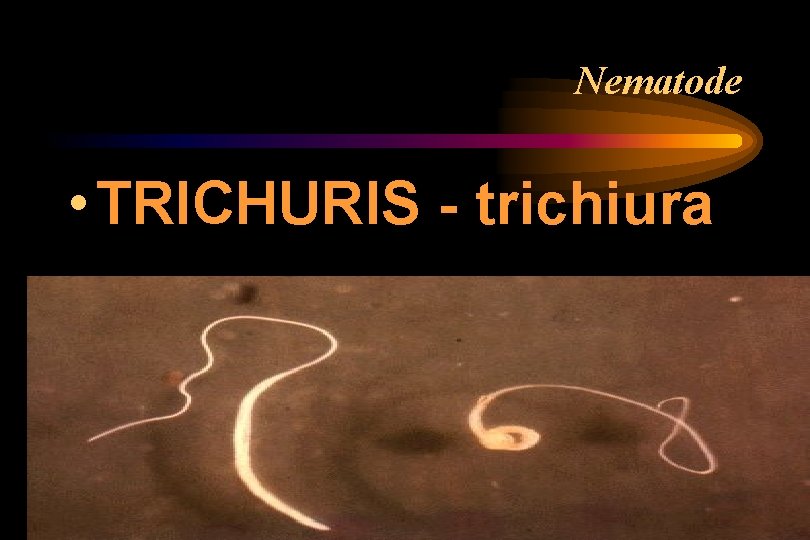
Nematode • TRICHURIS - trichiura
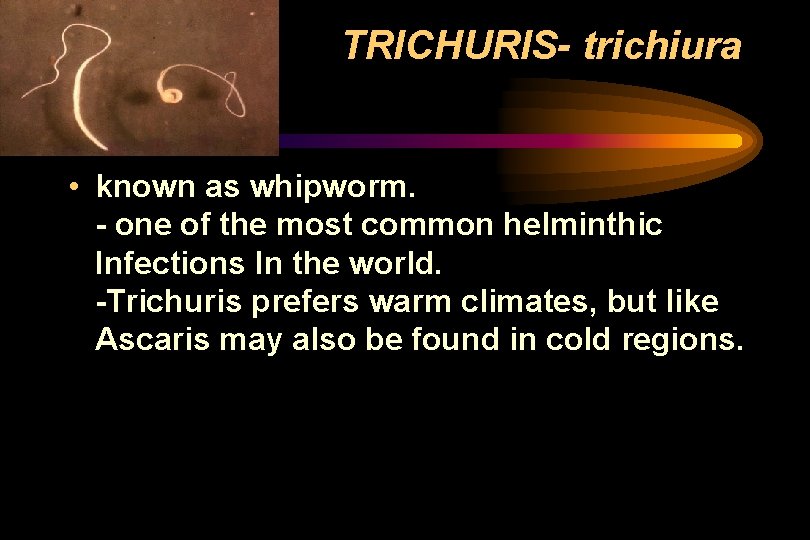
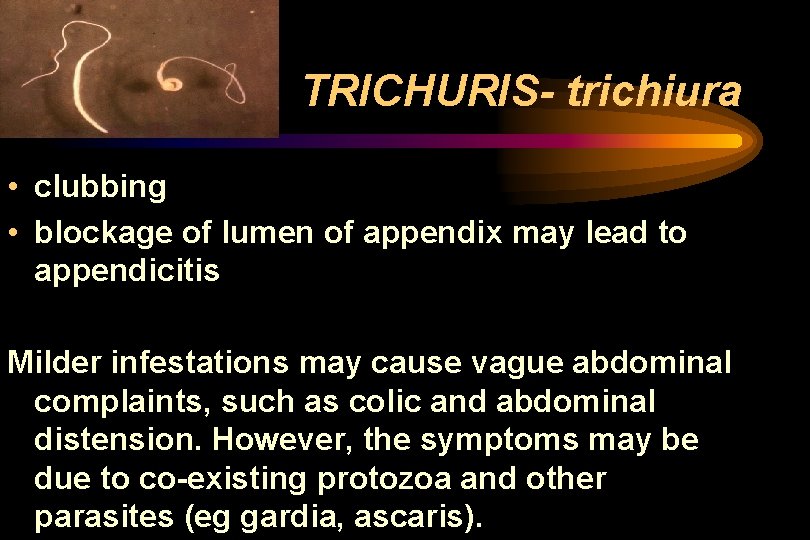
TRICHURIS- trichiura • known as whipworm. - one of the most common helminthic Infections In the world. -Trichuris prefers warm climates, but like Ascaris may also be found in cold regions.
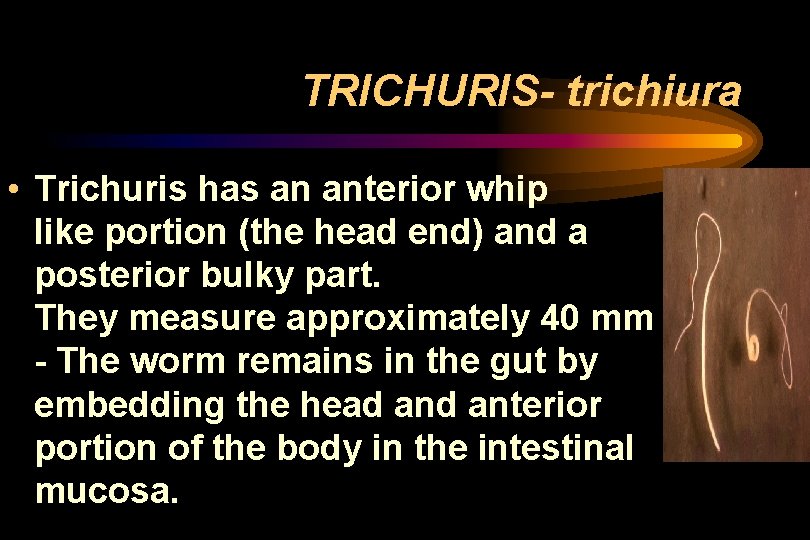
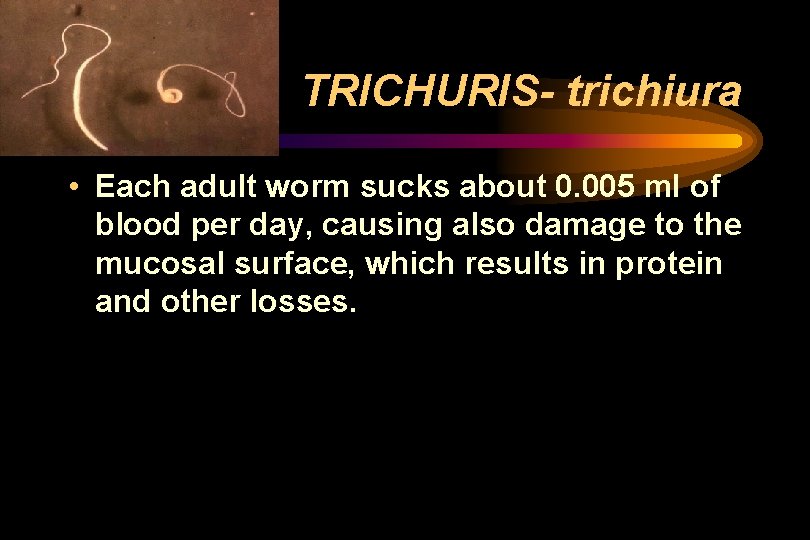
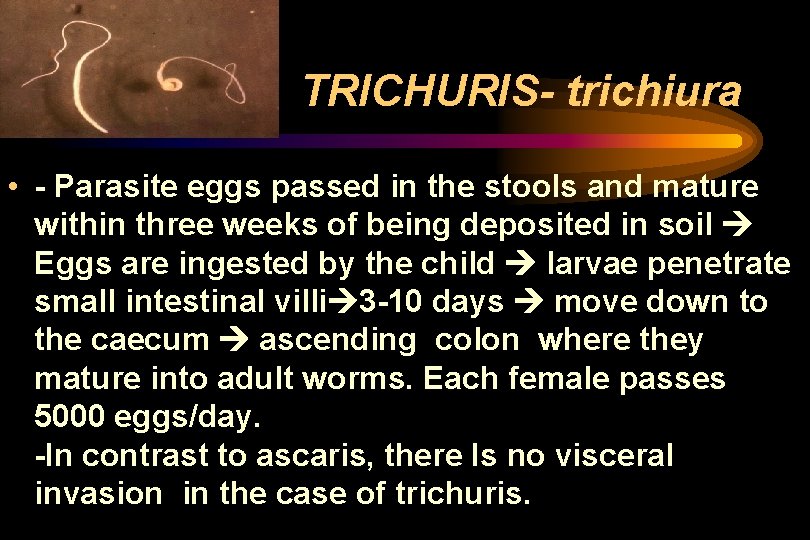
TRICHURIS- trichiura • Trichuris has an anterior whip like portion (the head end) and a posterior bulky part. They measure approximately 40 mm - The worm remains in the gut by embedding the head anterior portion of the body in the intestinal mucosa. -
TRICHURIS- trichiura • Each adult worm sucks about 0. 005 m. I of blood per day, causing also damage to the mucosal surface, which results in protein and other losses.
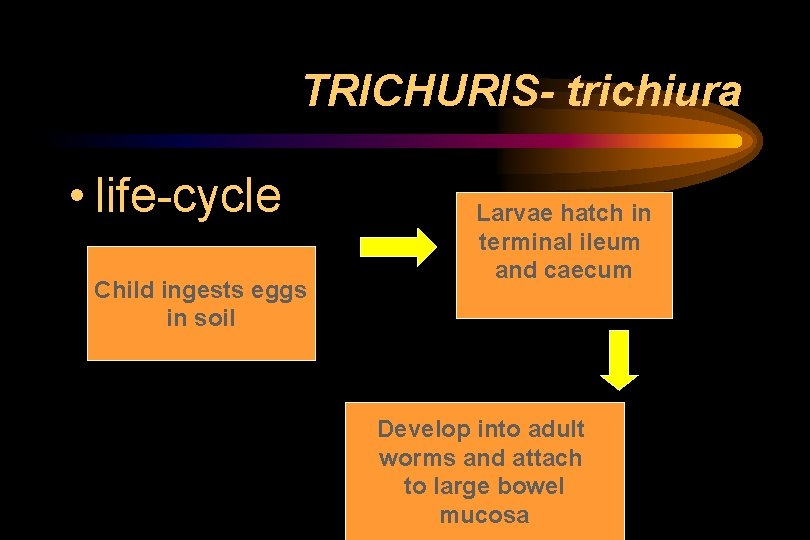
TRICHURIS- trichiura • life-cycle Child ingests eggs in soil Larvae hatch in terminal ileum and caecum Develop into adult worms and attach to large bowel mucosa
TRICHURIS- trichiura • - Parasite eggs passed in the stools and mature within three weeks of being deposited in soil Eggs are ingested by the child larvae penetrate small intestinal villi 3 -10 days move down to the caecum ascending colon where they mature into adult worms. Each female passes 5000 eggs/day. -In contrast to ascaris, there Is no visceral invasion in the case of trichuris.
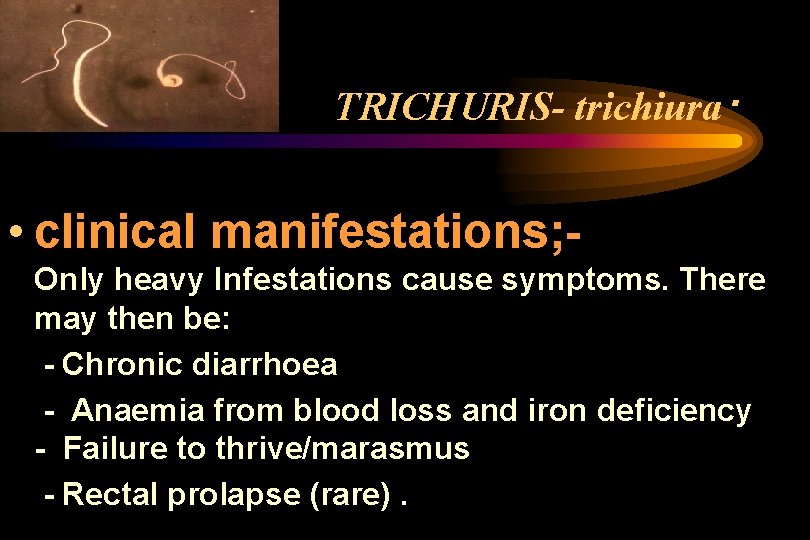
. TRICHURIS- trichiura • clinical manifestations; Only heavy Infestations cause symptoms. There may then be: - Chronic diarrhoea - Anaemia from blood loss and iron deficiency - Failure to thrive/marasmus - Rectal prolapse (rare).
TRICHURIS- trichiura • clubbing • blockage of lumen of appendix may lead to appendicitis Milder infestations may cause vague abdominal complaints, such as colic and abdominal distension. However, the symptoms may be due to co-existing protozoa and other parasites (eg gardia, ascaris).
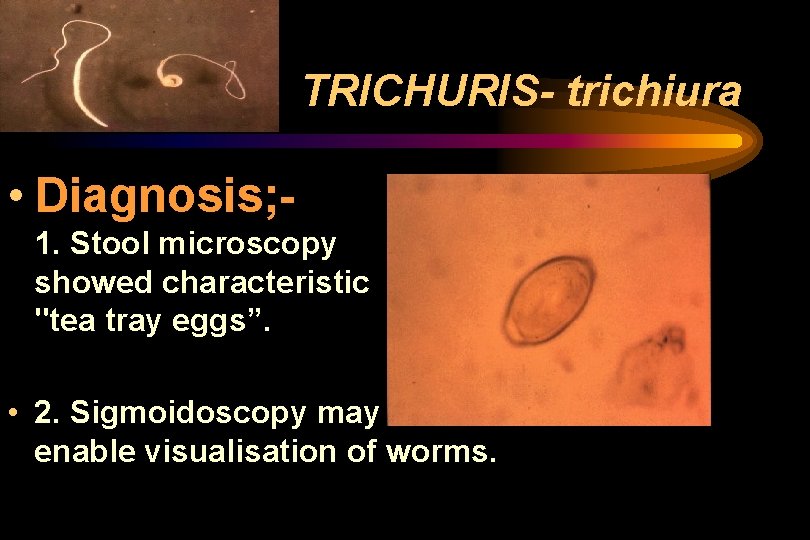
TRICHURIS- trichiura • Diagnosis; 1. Stool microscopy showed characteristic "tea tray eggs”. • 2. Sigmoidoscopy may enable visualisation of worms.
TRICHURIS- trichiura • *Treatment : Mebendazole - cure rate of 70% - 90% - reduces egg output by 90 - 99% OR • Albendazole • Treat the iron deficiency anaemia. -
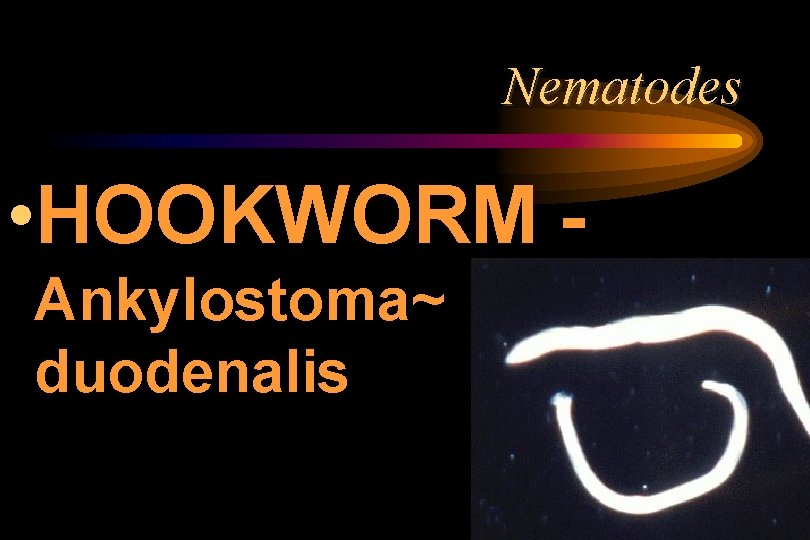
Nematodes • HOOKWORM Ankylostoma~ duodenalis
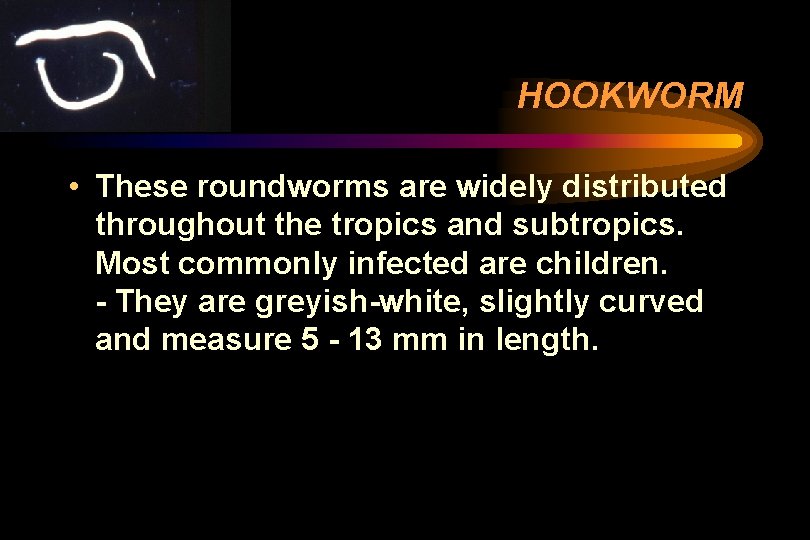
HOOKWORM • These roundworms are widely distributed throughout the tropics and subtropics. Most commonly infected are children. - They are greyish-white, slightly curved and measure 5 - 13 mm in length.
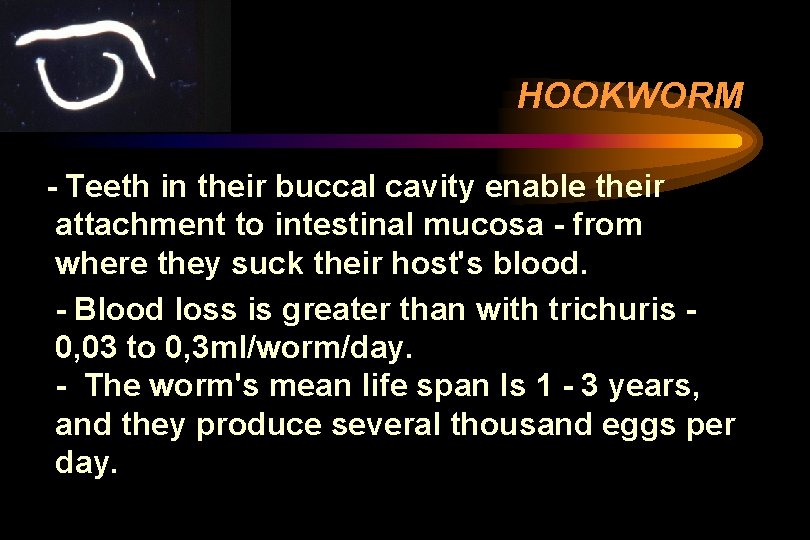
HOOKWORM - Teeth in their buccal cavity enable their attachment to intestinal mucosa - from where they suck their host's blood. - Blood loss is greater than with trichuris 0, 03 to 0, 3 ml/worm/day. - The worm's mean life span Is 1 - 3 years, and they produce several thousand eggs per day.
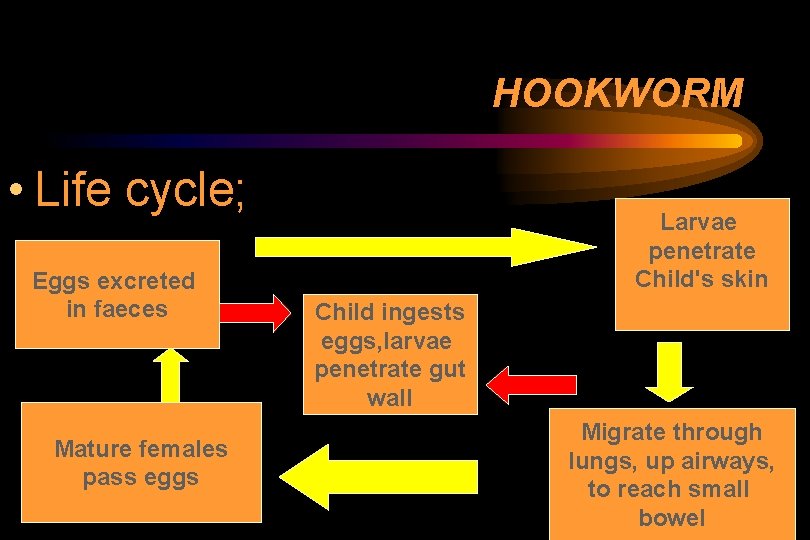
HOOKWORM • Life cycle; Eggs excreted in faeces Mature females pass eggs Larvae penetrate Child's skin Child ingests eggs, larvae penetrate gut wall Migrate through lungs, up airways, to reach small bowel
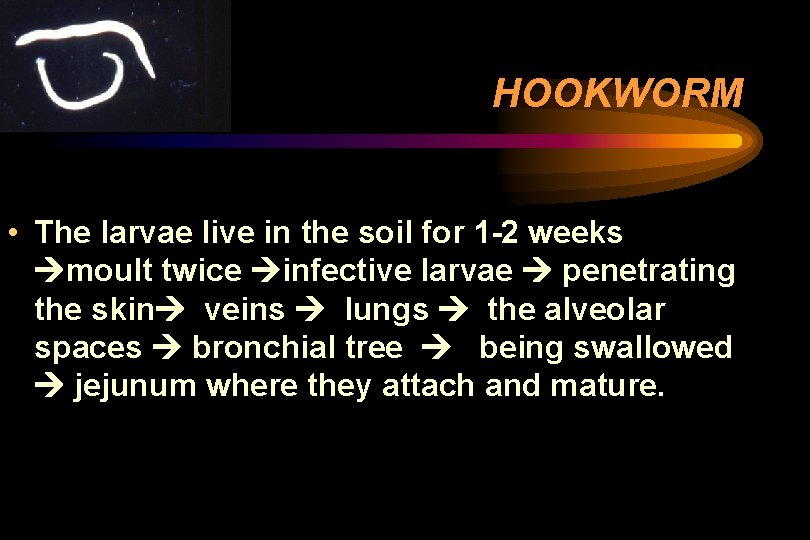
HOOKWORM • The larvae live in the soil for 1 -2 weeks moult twice infective larvae penetrating the skin veins lungs the alveolar spaces bronchial tree being swallowed jejunum where they attach and mature.
HOOKWORM • The child may thus become Infected via 3 mechanisms: I) Larvae penetrating the intact skin 2) Drinking contaminated water 3) Pica - transferring eggs to the mouth via dust and dirt.
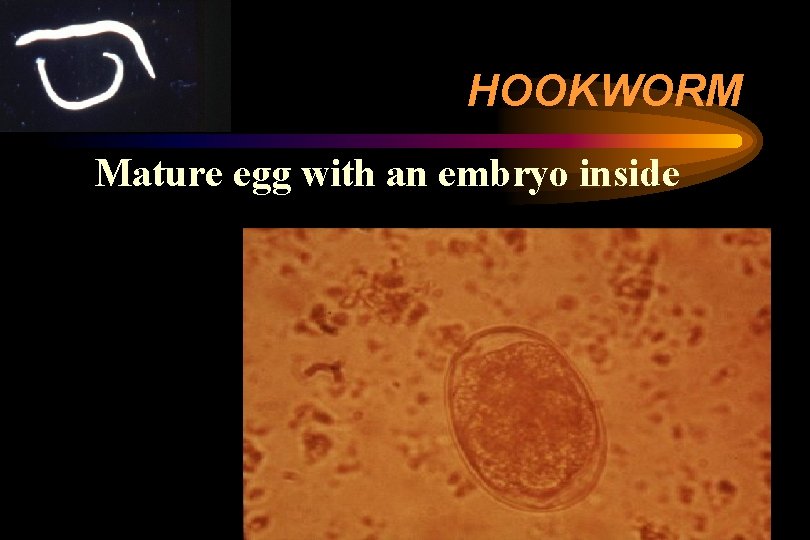
HOOKWORM Mature egg with an embryo inside
HOOKWORM • clinical manifestations; -majority are asymptomatic. - Invasion of the skin may be associated with an irritating dermatitis 'ground itch'. • lung migration; - bronchospasm - pneumonitis • Small intestine ; - epigastric pain and tenderness. - anaemia, hunger and pica.
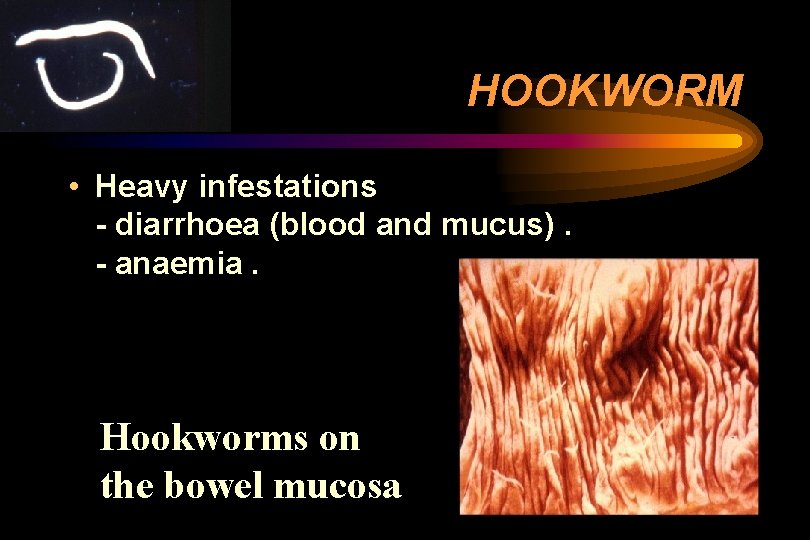
HOOKWORM • Heavy infestations - diarrhoea (blood and mucus). - anaemia. Hookworms on the bowel mucosa
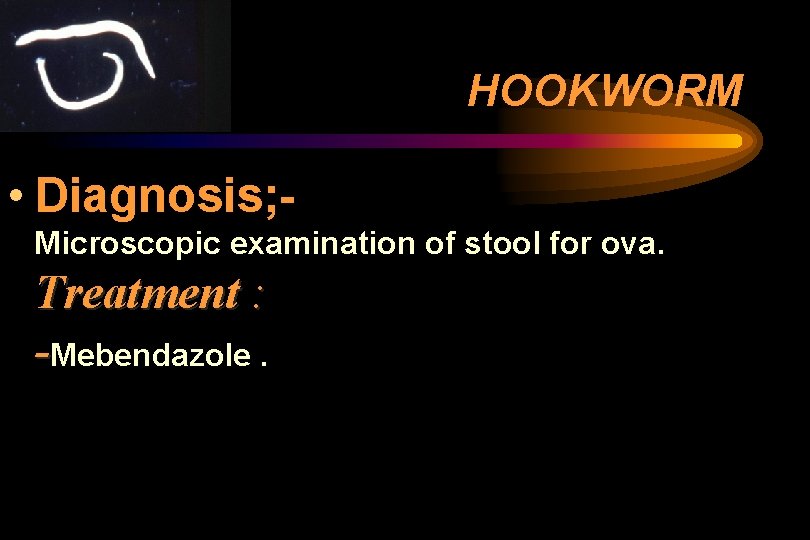
HOOKWORM • Diagnosis; Microscopic examination of stool for ova. Treatment : -Mebendazole.
Enterobius vermicularls.
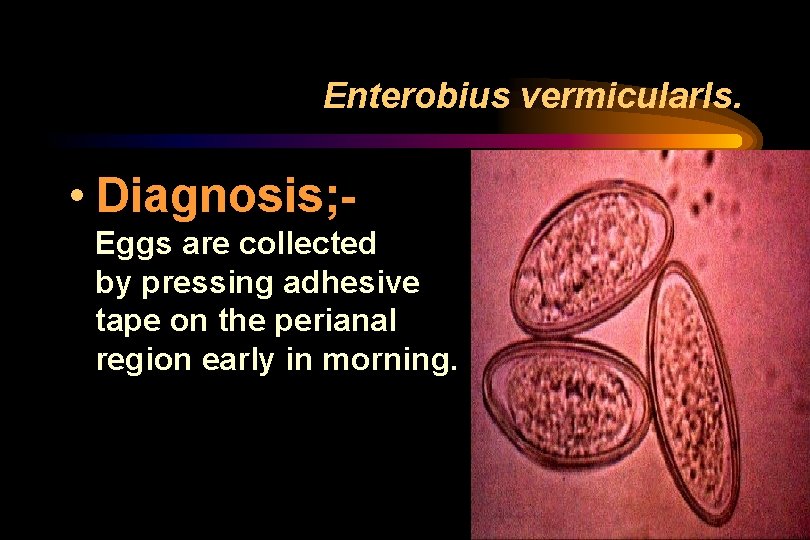
Enterobius vermicularls. - They are small white worms about 1 cm in length. - The eggs are characteristic, because after a 6 hour maturation period, a single coiled larvae can be seen within each ovum. -They may remain viable for 20 days
Enterobius vermicularls. Refers to as the 'pinworm' and calls Strongyloides stercozalis the 'threadworm'). - Enterobius occurs world-wide and Infects individuals of all ages and socio- economic levels, but it is especially common In children. - The infection is essentially harmless and problem are more social than medical.
Enterobius vermicularls. • Life cycle; The child ingests embryonated eggs found in fingernails, clothing, bedding or house-dust hatch in stomach larvae migrate to caecal region ( mature into adult ). . The adult females migrate by night to perianal region, to deposit masses of eggs Perianal itching from the eggs Induces scratching eggs are transmitted to the mouth on the finger.
Enterobius vermicularls. • clinical manifestations; 1. Nocturnal anal pruritis. • 2. Sleeplessness, because of the irritation. • 3. Vulvovaginitis, and even urethritis. • 4. Abdominal pain or appendicitis ( rare).
Enterobius vermicularls. • Diagnosis; Eggs are collected by pressing adhesive tape on the perianal region early in morning.
Enterobius vermicularls. • Treatment : -Mebendazole or abendazole. -Regular bathing and changing of underclothes. -Keeping fingernails short. -Treat the whole family.
Strongyloides
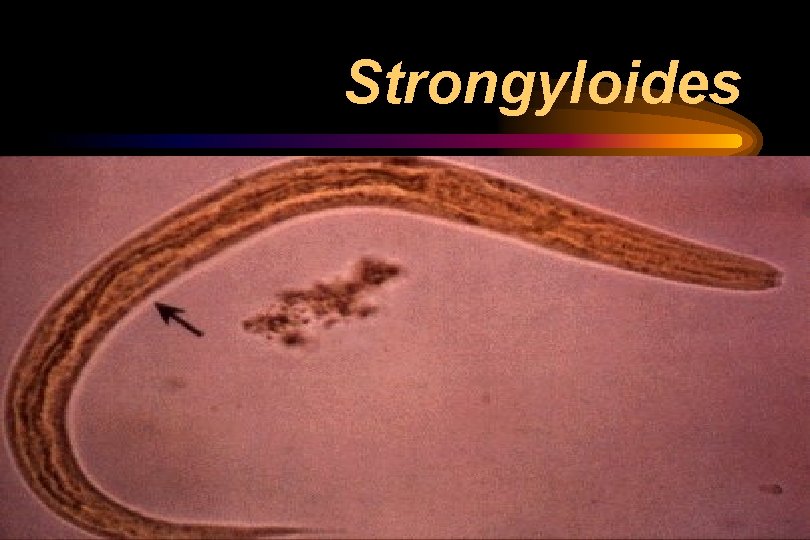
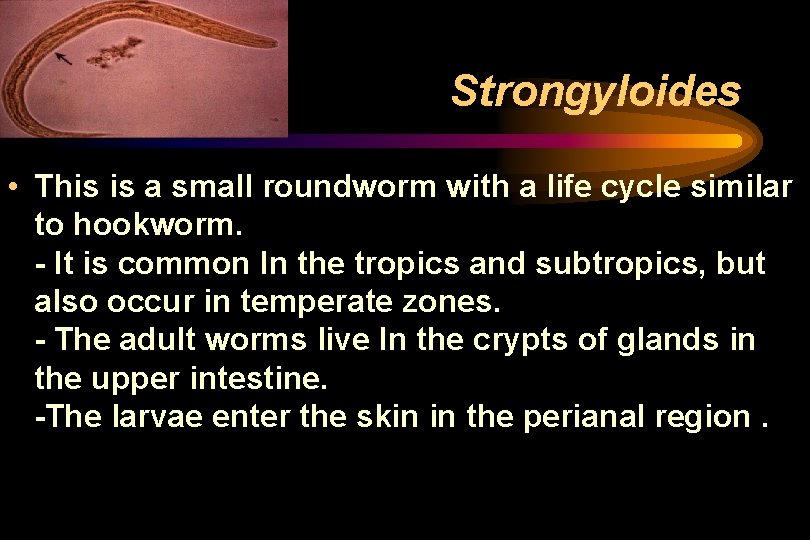
Strongyloides • This is a small roundworm with a life cycle similar to hookworm. - It is common In the tropics and subtropics, but also occur in temperate zones. - The adult worms live In the crypts of glands in the upper intestine. -The larvae enter the skin in the perianal region.
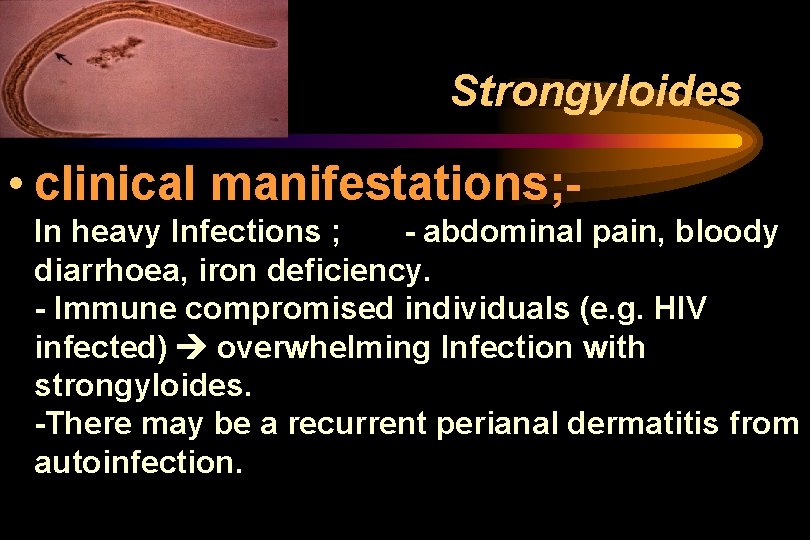
Strongyloides • clinical manifestations; In heavy Infections ; - abdominal pain, bloody diarrhoea, iron deficiency. - Immune compromised individuals (e. g. HIV infected) overwhelming Infection with strongyloides. -There may be a recurrent perianal dermatitis from autoinfection.
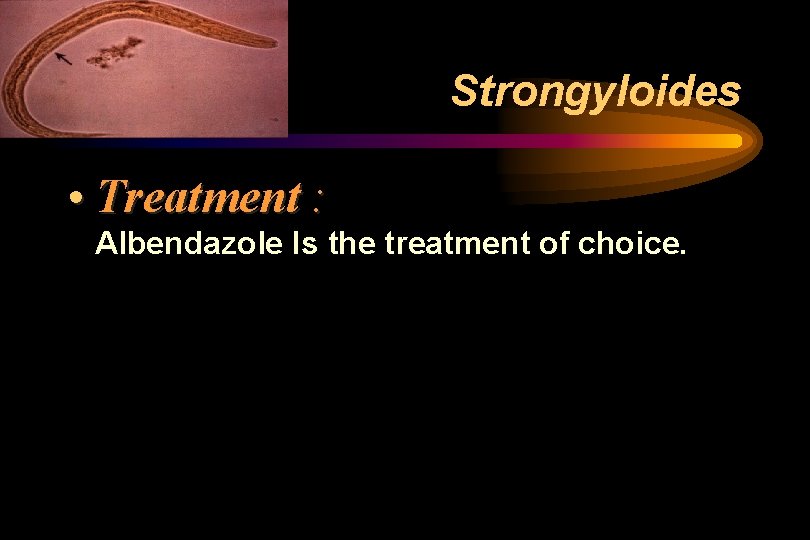
Strongyloides • Treatment : Albendazole Is the treatment of choice.
Toxocara canis;
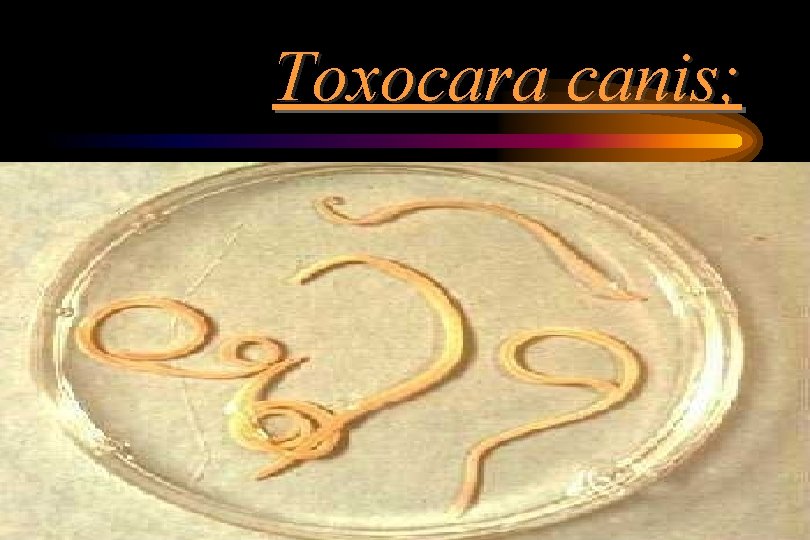
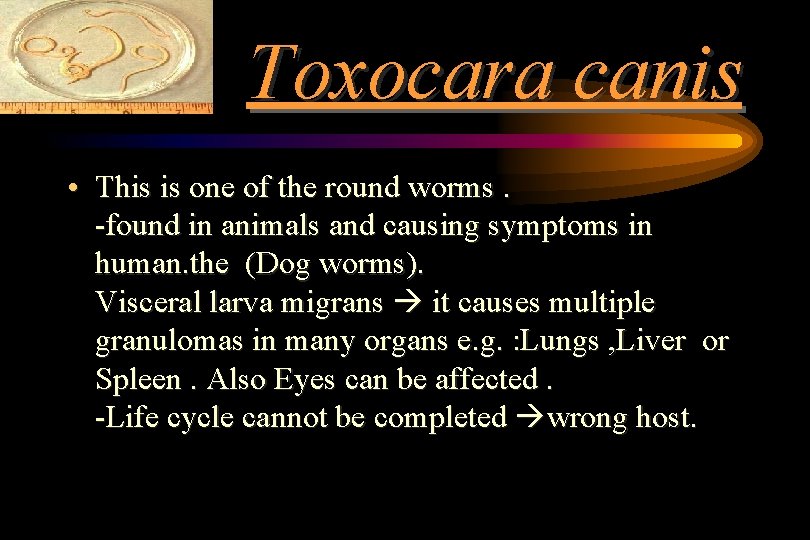
Toxocara canis • This is one of the round worms. -found in animals and causing symptoms in human. the (Dog worms). Visceral larva migrans it causes multiple granulomas in many organs e. g. : Lungs , Liver or Spleen. Also Eyes can be affected. -Life cycle cannot be completed wrong host.
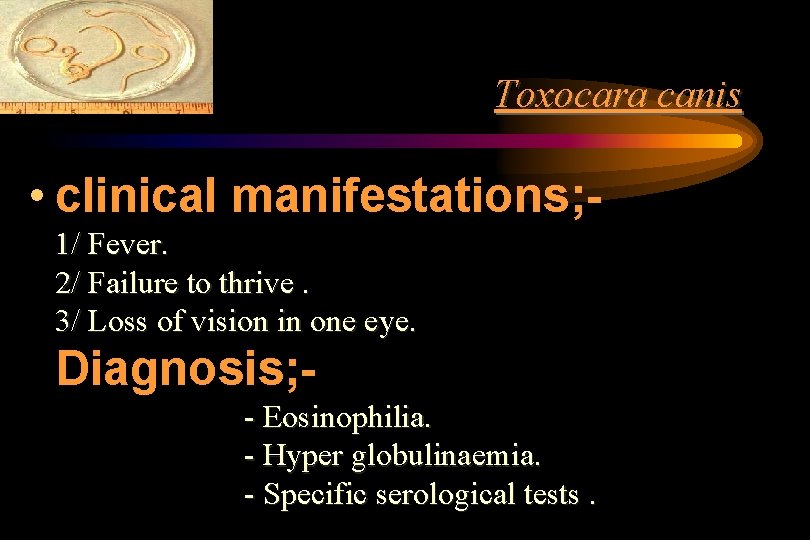
Toxocara canis • clinical manifestations; 1/ Fever. 2/ Failure to thrive. 3/ Loss of vision in one eye. Diagnosis; - Eosinophilia. - Hyper globulinaemia. - Specific serological tests.
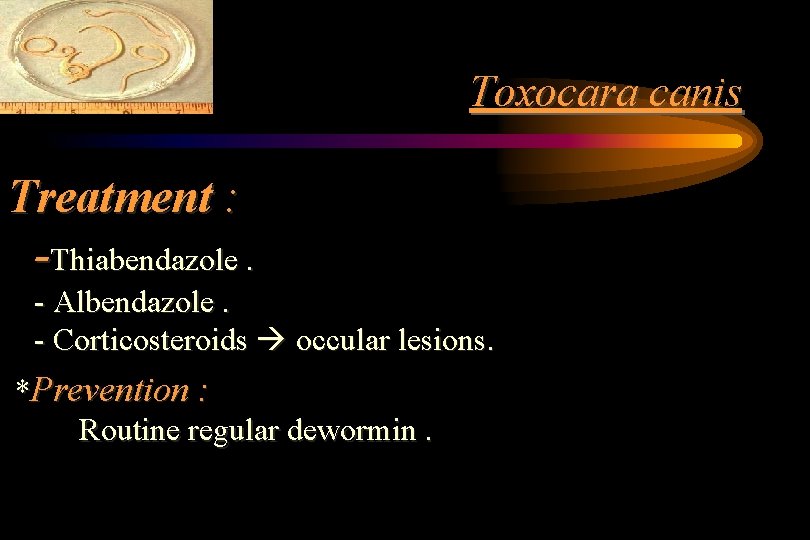
Toxocara canis Treatment : -Thiabendazole. - Albendazole. - Corticosteroids occular lesions. *Prevention : Routine regular dewormin.
• Tapeworms
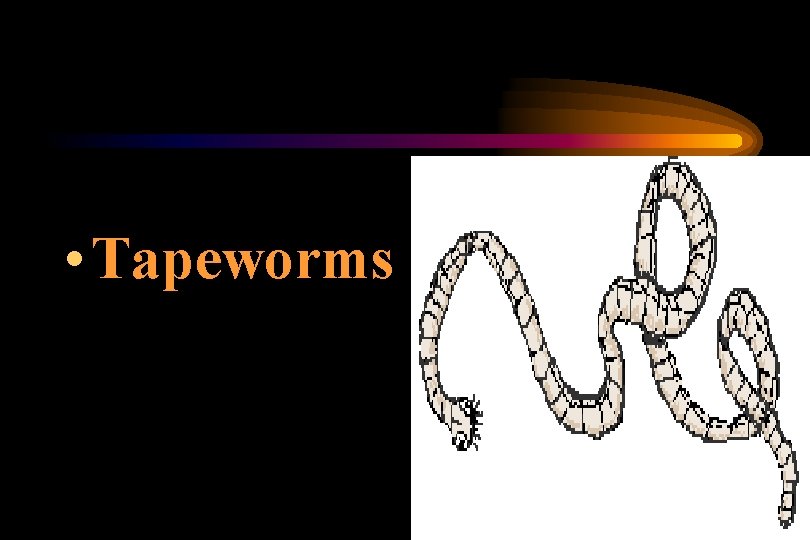
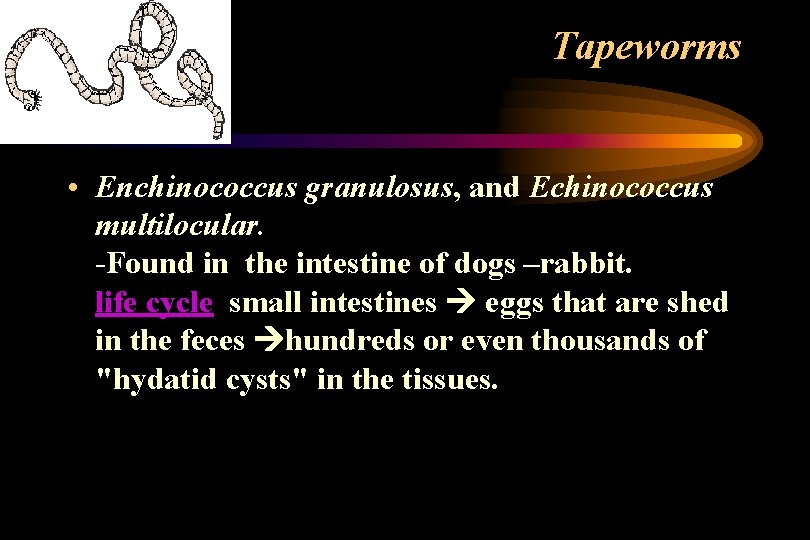
Tapeworms • Enchinococcus granulosus, and Echinococcus multilocular. -Found in the intestine of dogs –rabbit. life cycle small intestines eggs that are shed in the feces hundreds or even thousands of "hydatid cysts" in the tissues.
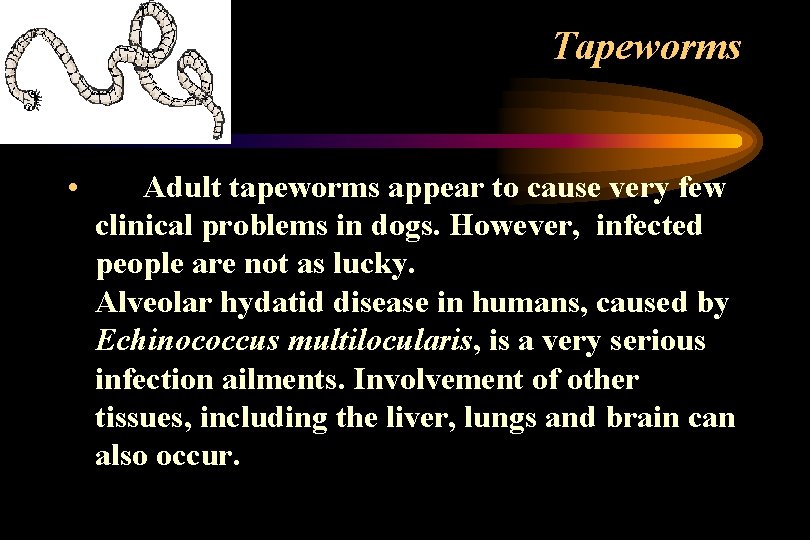
Tapeworms • Adult tapeworms appear to cause very few clinical problems in dogs. However, infected people are not as lucky. Alveolar hydatid disease in humans, caused by Echinococcus multilocularis, is a very serious infection ailments. Involvement of other tissues, including the liver, lungs and brain can also occur.
Thanks