
Intestinal Helminths DR MONA BADR CLASSIFICATION OF PARASITES

Intestinal Helminths DR MONA BADR
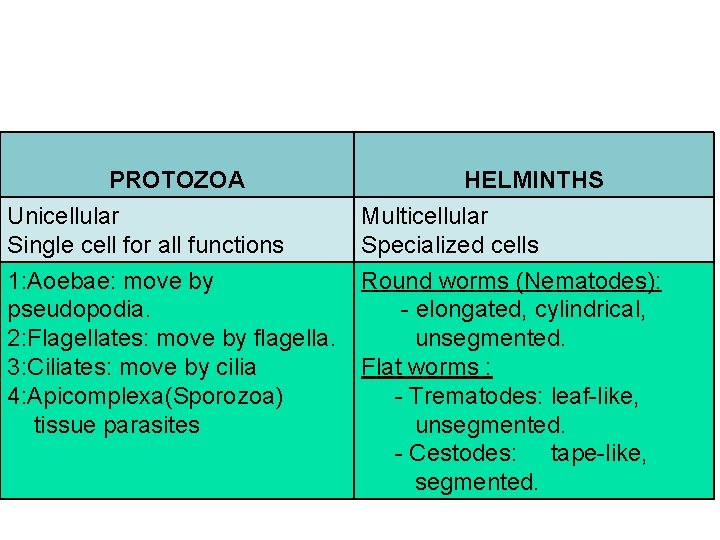
CLASSIFICATION OF PARASITES PROTOZOA Unicellular Single cell for all functions 1: Aoebae: move by pseudopodia. 2: Flagellates: move by flagella. 3: Ciliates: move by cilia 4: Apicomplexa(Sporozoa) tissue parasites HELMINTHS Multicellular Specialized cells Round worms (Nematodes): - elongated, cylindrical, unsegmented. Flat worms : - Trematodes: leaf-like, unsegmented. - Cestodes: tape-like, segmented.

Nematodes : General features 1. 2. 3. Elongated worm, cylindrical, unsegmented and tapering at both ends. Variable in size, measure <1 cm to about 100 cm. Sex separate and male is smaller than female
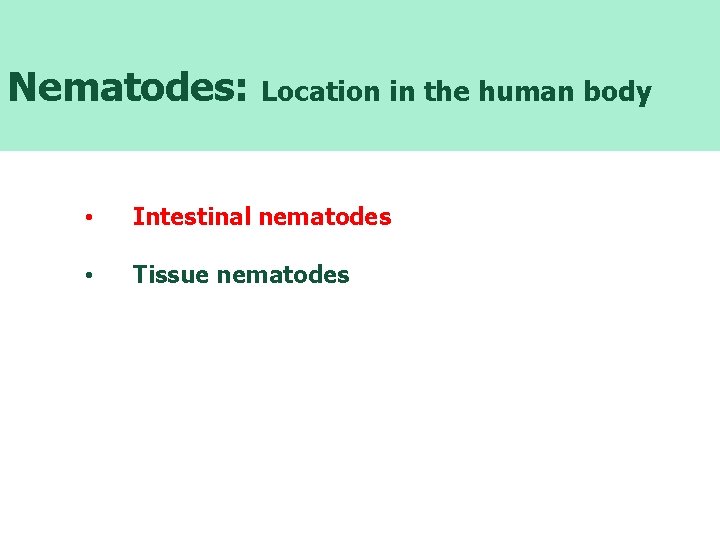
Nematodes: Location in the human body • Intestinal nematodes • Tissue nematodes
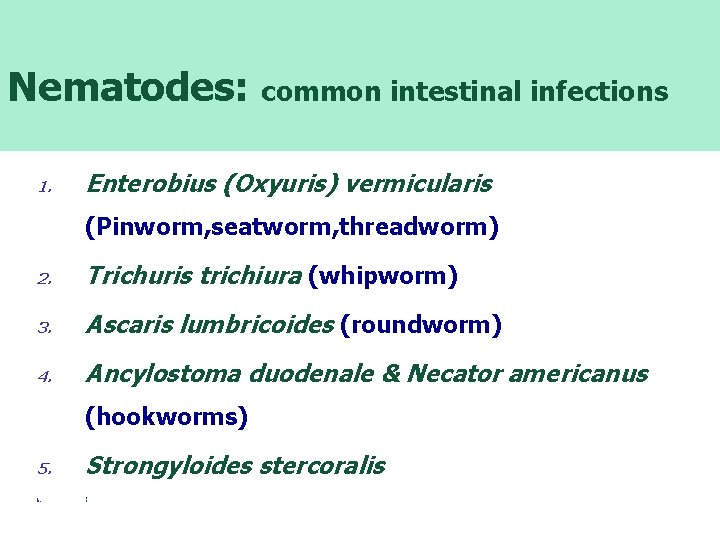
Nematodes: common intestinal infections Common intestinal nematode infections: 1. Enterobius (Oxyuris) vermicularis (Pinworm, seatworm, threadworm) 2. Trichuris trichiura (whipworm) 3. Ascaris lumbricoides (roundworm) 4. Ancylostoma duodenale & Necator americanus (hookworms) 5. Strongyloides stercoralis 6. :

1 -Enterobius vermicularis (THREAD WORM) (Common names : Pin worm, seat worm, ) n n n Found all over the world but more common in temperate regions. Children are more often evolved than adults , it tends to occur in groups living together such as families , army camps or nursery. Adult worms are mainly located in lumen of cecum and the female migrate to rectum to deposits her eggs on perianal skin. Direct human to human infection occurs mainly by swallowing the eggs. In addition , autoinfection occurs by contamination of the fingers. It can be seen by naked eye as white thread ± 1 cm. n Male is smaller than female ± 0. 5 cm, with coiled end.

Enterobius vermicularis
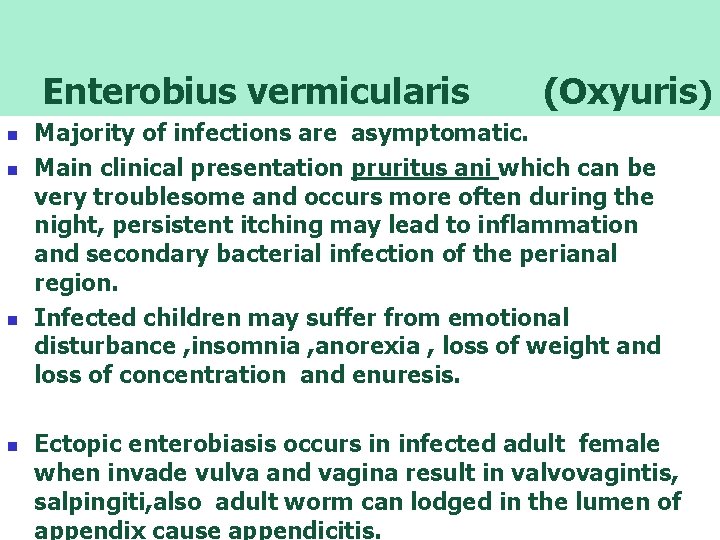
Enterobius Pathology vermicularis (Oxyuris) Majority of infections are asymptomatic. n Main clinical presentation pruritus ani which can be very troublesome and occurs more often during the night, persistent itching may lead to inflammation and secondary bacterial infection of the perianal region. n Infected children may suffer from emotional disturbance , insomnia , anorexia , loss of weight and loss of concentration and enuresis. n Ectopic enterobiasis occurs in infected adult female when invade vulva and vagina result in valvovagintis, salpingiti, also adult worm can lodged in the lumen of appendix cause appendicitis. n
Enterobius vermicularis (Oxyuris) DIAGNOSIS : Unlike other intestinal Nematodes, the eggs are not usually found in faeces. The best method is to look for them around the anus by taking an anal swab or by using CELLULOSE ADHESIVE TAPE, the examination should be done before defecation or bathing. Treatment Albandazole , Mebendazole for whole family

Enterobius vermicularis (Oxyuris)

Ascaris lumbricoides (roundworm)

Ascaris lumbricoides (roundworm) The commonest human helminthes infection all over the world. The large round worm which is normally located in the small intestine. n Found in jejunum and upper part of ileum. n Female ± 20 cm longer than male ± 10 cm n Feed on semi digested food.

Ascaris lumbricoides (roundworm) LIFE CYCLE
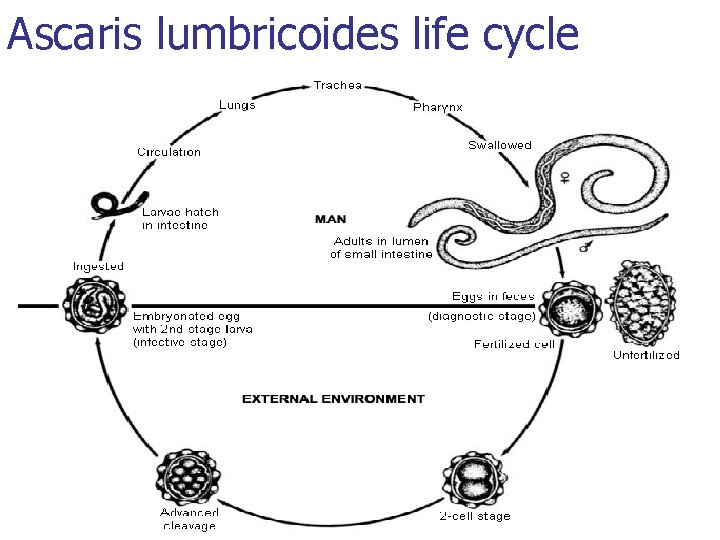
Ascaris lumbricoides life cycle

Ascaris eggs Ascaris larva emerging from egg Ascaris egg (embryonated
Ascaris lumbricoides (roundworm) Pathology: 1 -Adult worm: n Light infection : asymptomatic. Heavy infection : intestinal obstruction Migrating adult : to bile duct -jaundice n 2 -Larvae: Loeffler`s syndrome Pneumonitis and bronchospasm, cough with bloody sputum Eosinophilia, urticaria

Ascaris lumbricoides (roundworm) Loeffler`s syndrome: Larvae in lung pnumonia, cough , bloody sputum
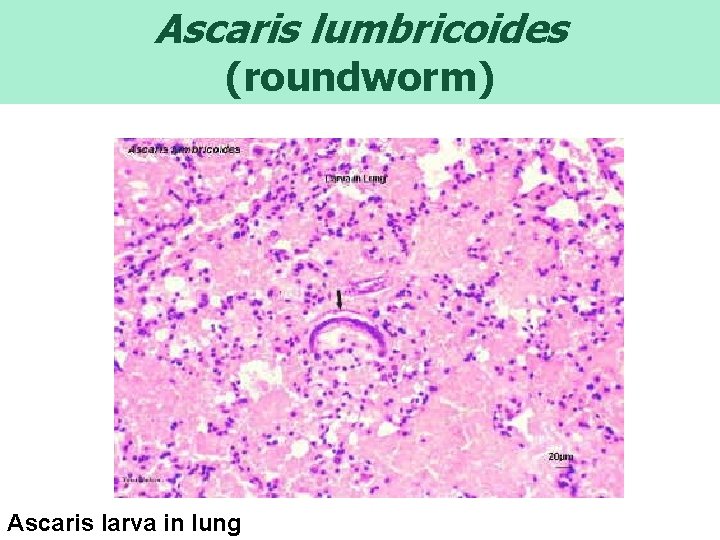
Ascaris lumbricoides (roundworm) Ascaris larva in lung

Ascaris lumbricoides (roundworm) Diagnosis: -eggs in stool. -larvae in sputum. -adult may pass with stool. Treatment: Albendazole , Mebendazole
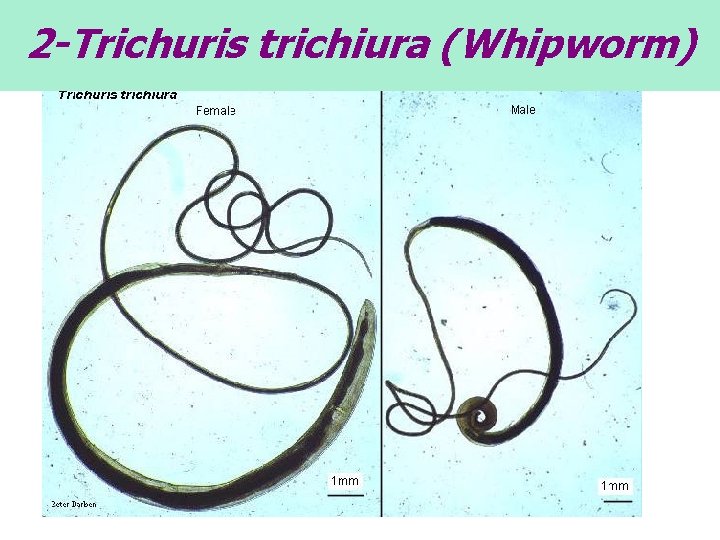
2 -Trichuris trichiura (Whipworm)


Trichuris trichiura
Trichuris trichiura (whipworm) World wide , common in poor sanitation. n It coexists with Ascaris because of similar requirement( the eggs to be ebryonated egg infective stage it needs to be 3 weeks in the soil). n Adult live in large intestine especially caecum and appendix –in heavy infection the whole length of large intestine affected. n Male and female worm have narrow anterior portion penetrate the intestinal mucosa
Trichuris trichiura (Whipworm) Pathology n n - light infection : asymptomatic heavy infection : abdominal pain , bloody diarrhea. Rectal prolapsed in children is a common complication.
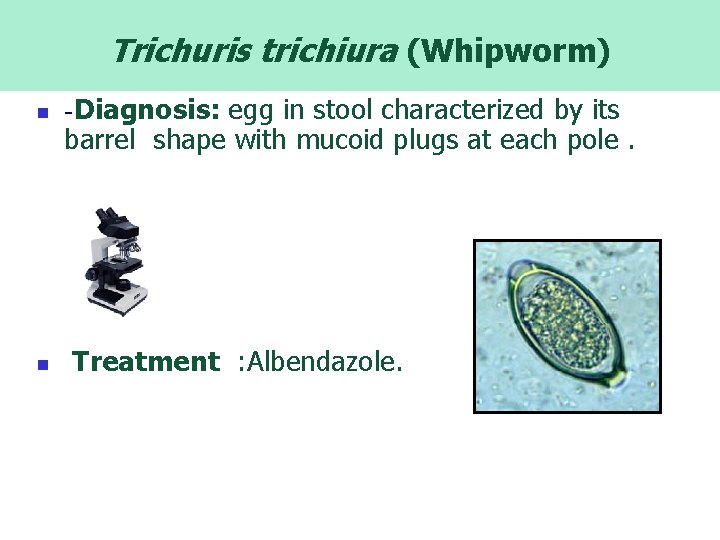
Trichuris trichiura (Whipworm) n n -Diagnosis: egg in stool characterized by its barrel shape with mucoid plugs at each pole. Treatment : Albendazole.
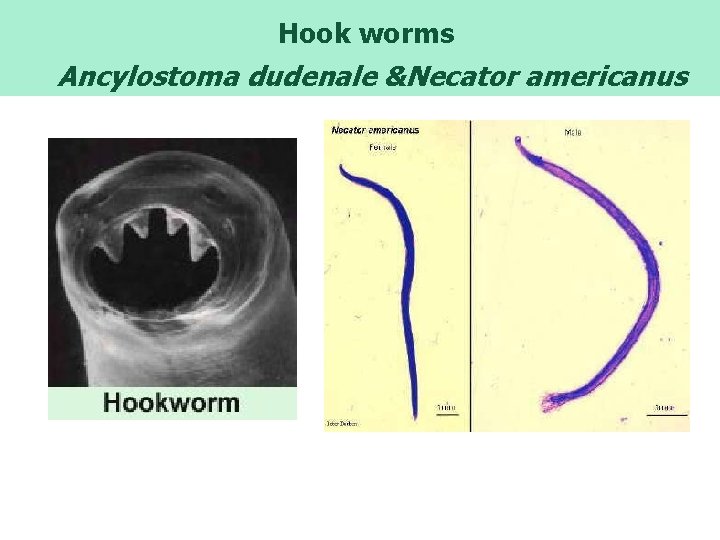
Hook worms Ancylostoma dudenale &Necator americanus

Hook worms Buccal cavity attached to intestinal mucosa

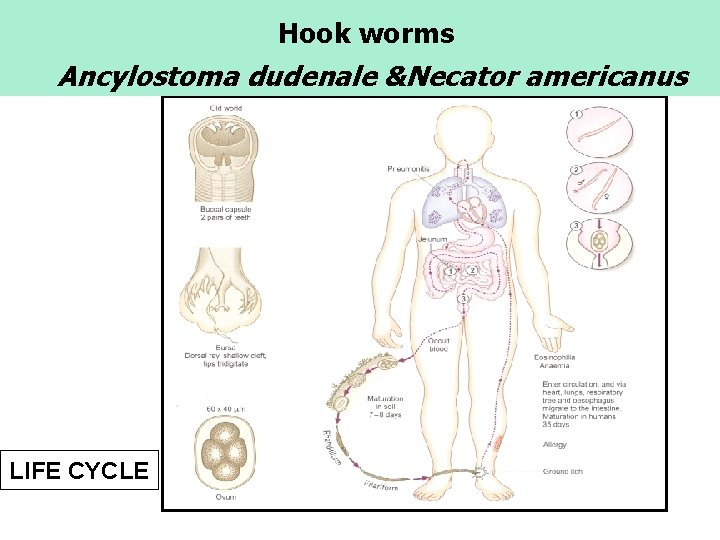
Hook worms Ancylostoma dudenale &Necator americanus LIFE CYCLE

Life cycle of HOOK WORM (Ancylostoma Duodenale & Nector Americanus) n Infective stage is FILARIFORM LARVA penetrate the skin cause itching and dermatitis then larva go to the circulation ( lungs causes slight pneumonitis and bronchitis ) larva then swallowed and go to small intestine , they attach to the mucous membrane where they mature into adult and the female starts laying eggs to be passed in stool( not infective). n The eggs need to be in soil for about one week to become FILARIFORM LARVA INFECTIVE STAGE.
Hook worms Ancylostoma dudenale &Necator americanus n n n A common cause of anemia in endemic areas. Found in small intestine mainly jejunum. Its buccal capsule (mouth) lined with hard hooks, triangular cutting plates and anticoagulant glands.
Hook worms Pathology& clinical picture: - larvae: §At the site of entry of larvae intense itching(ground itch) and dermatitis. §Migration phase: cough with bloody sputum pneumonitis and bronchitis but less sever than Ascaris , eosinophilia urticaria. - Adult worm: § § low worm burden (INFECTION): no symptoms. Moderate to heavy burden: • Epigastric pain, vomiting , hemorrhagic enteritis. • Protein loss: hypo-proteinaemia edema. • Anemia: due to withdrawal of blood by parasites and hemorrhage from punctured sites lead to sever anemia = microcytic hypo chromic anemia .
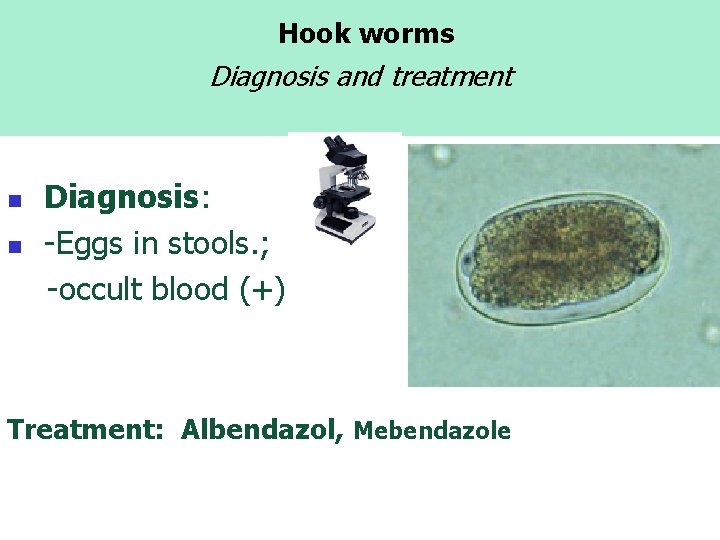
Hook worms Diagnosis and treatment Diagnosis: n -Eggs in stools. ; -occult blood (+) n Treatment: Albendazol, Mebendazole
Strongyloides stercoralis Widely distributed in tropical area at Asia, Africa & South America. n fatal dissemination in immunocompromised host. n It is smallest pathogenic nematodes ± 2. 5 mm. n adult live in mucous membrane of duodenum jejunum rarely mucous membrane of bronchus. n n AUTOINFECTION IS VERY IMPORTANT CRITERIA.
Strongyloides stercoralis life cycle n n The parasite shows 3 different modes of development: 1 -Direct development: The rhabiditiform larva pass from stool and become directly a Filariform larva if the environment of the soil is good. 2 -Indirect development : in external environment Rh. larva becomes free living adults, produce eggs, rhabiditiform larva and Filariform larva(Infective stage). 3 -AUTOINFECTION: n n Internal : when the rhabiditiform larva become a filariform larva in the intestine and penetrate the intestine External : fecal contamination of skin –Rh larva > filariform penetrates the skin
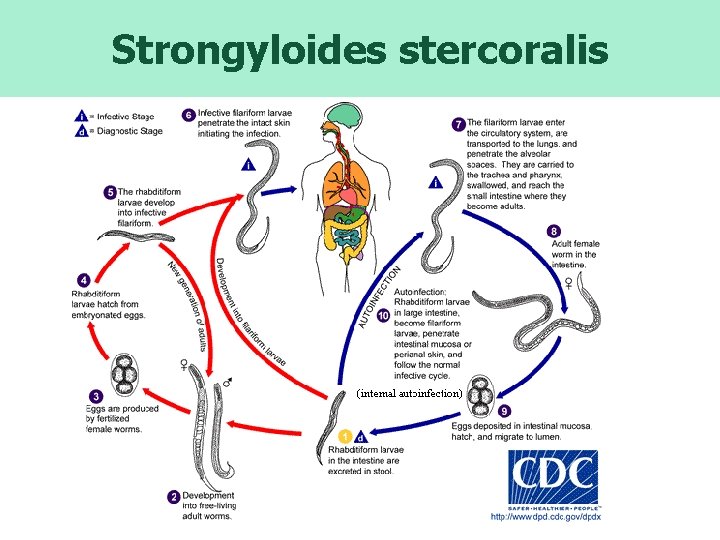
Strongyloides stercoralis LIFE CYCLE

Strongyloides stercoralis: Pathology and clinical picture: Cuteneous little reaction on penetration. sever dermatitis at perianal region in case of external autoinfection. n Migration : pneumonitis during larval migration. . n Intestinal: inflammation of upper intestinal mucosa, diarrhea, upper abdominal pain in the epigastria colicky in nature. n Disseminated strongyloidiasis : in patient with immunodeficiency , uncontrolled diarrhea – granulomatus changes –necrosis--perforation--peritonitis --death. n
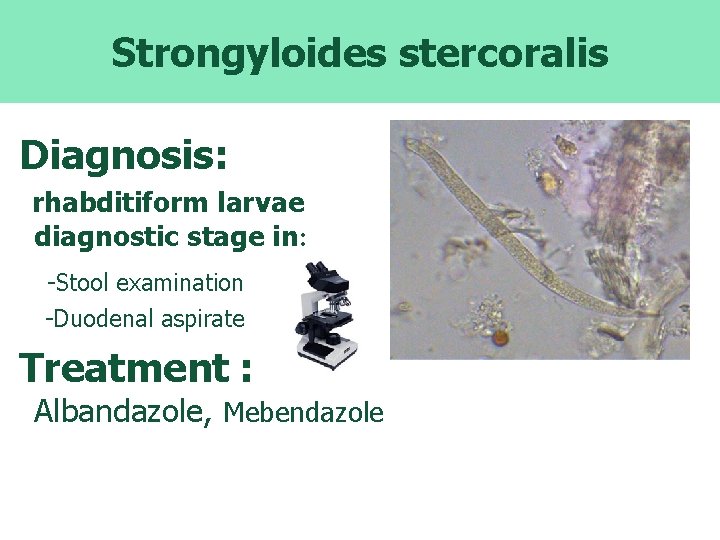
Strongyloides stercoralis Diagnosis: rhabditiform larvae diagnostic stage in: -Stool examination -Duodenal aspirate Treatment : Albandazole, Mebendazole
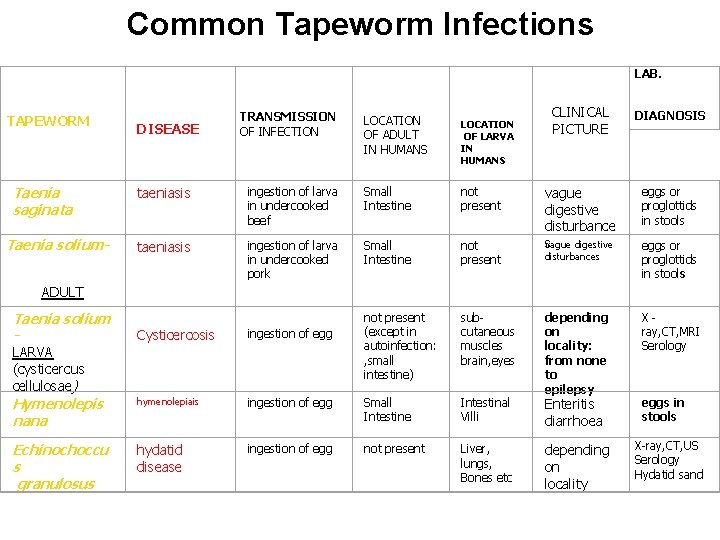
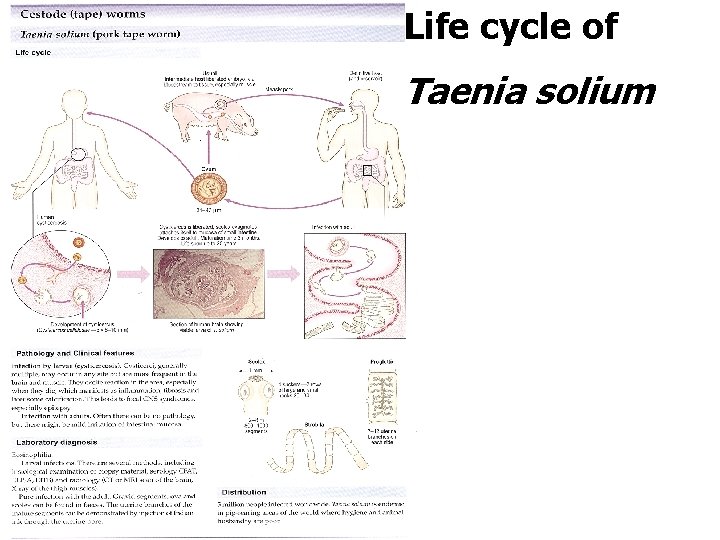
Common Tapeworm Infections LAB. TAPEWORM Taenia saginata Taenia solium- DISEASE TRANSMISSION OF INFECTION LOCATION OF ADULT IN HUMANS LOCATION OF LARVA IN HUMANS taeniasis ingestion of larva in undercooked beef Small Intestine not present taeniasis ingestion of larva in undercooked pork Small Intestine not present Cysticercosis not present (except in autoinfection: , small intestine) subcutaneous muscles brain, eyes CLINICAL PICTURE DIAGNOSIS vague digestive disturbance vague digestive s eggs or proglottids in stools depending on locality: from none to epilepsy X ray, CT, MRI Serology depending on locality X-ray, CT, US Serology Hydatid sand disturbances eggs or proglottids in stools ADULT Taenia solium LARVA (cysticercus cellulosae) ingestion of egg Hymenolepis nana hymenolepiais ingestion of egg Small Intestine Intestinal Villi Echinochoccu s granulosus hydatid disease ingestion of egg not present Liver, lungs, Bones etc Enteritis diarrhoea eggs in stools
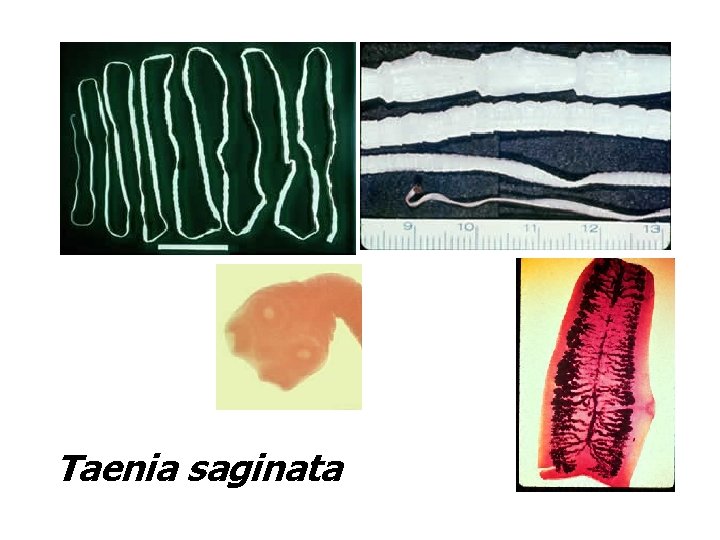
Taenia saginata
Life cycle of Taenia saginata
Taenia saginata life cycle
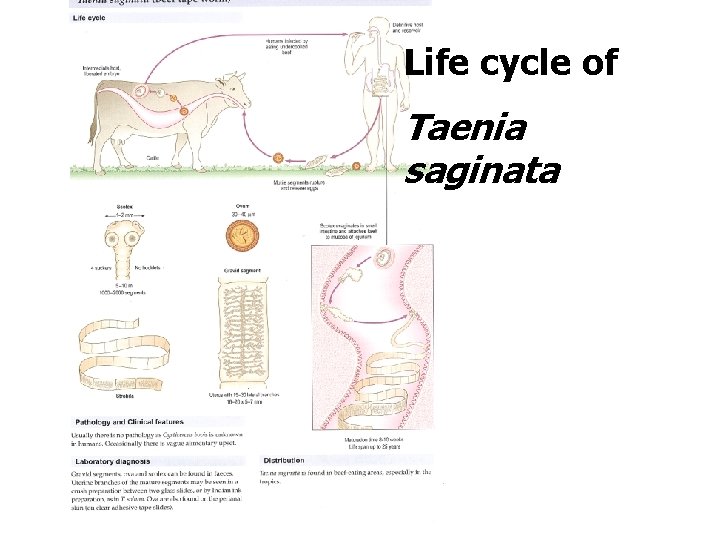
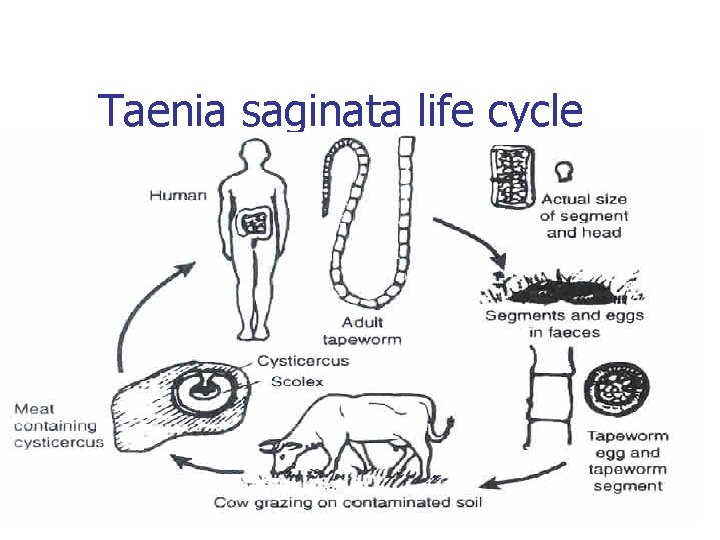
Taenia saginata n n Is an obligatory parasite of man , the adult worm live in the SMALL INTESTINE. CATTLE become infected by ingesting grass contaminated with eggs or gravid segments which passed from human faeces. In the cattle the onchosphere hatches out go to circulation and transformed to cysticercus stage in the muscle known as CYSTICERCUS BOVIS. Man become infected by eating undercooked or improperly cooked beef , the adult worm lives in small intestine of man passing eggs and gravid proglottids to the environment. The majority of cases are Asymptomatic , some patients have vague intestinal discomfort , vomiting and diarrhoea.
Life cycle of Taenia solium
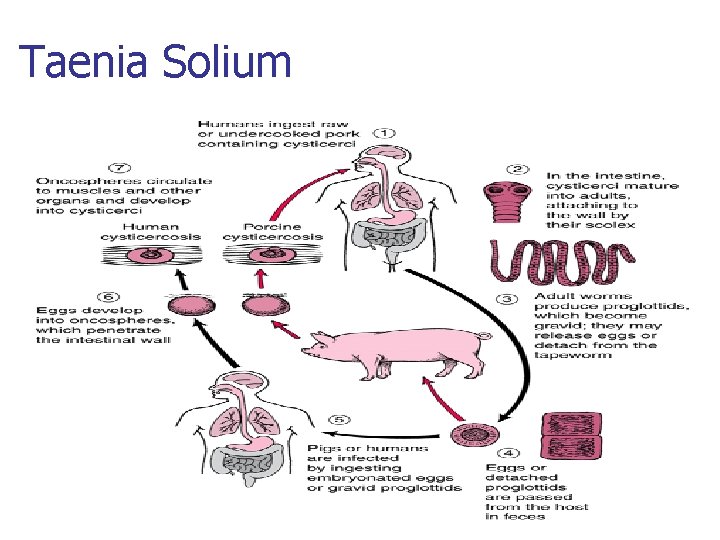
Taenia Solium
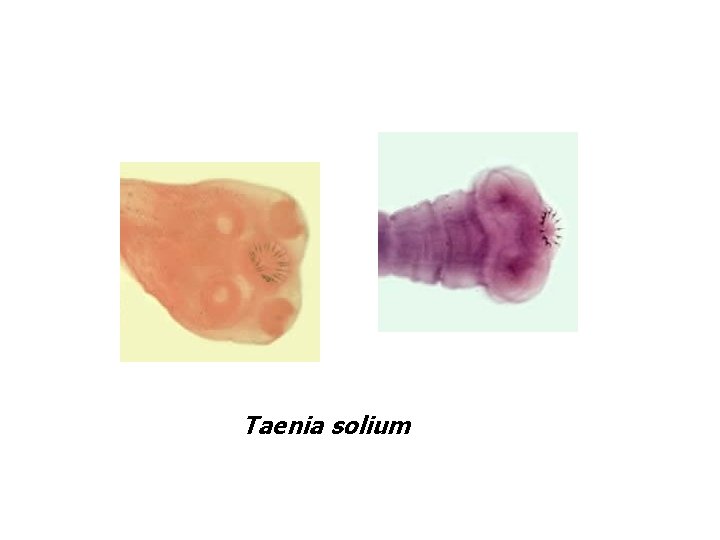
Taenia solium
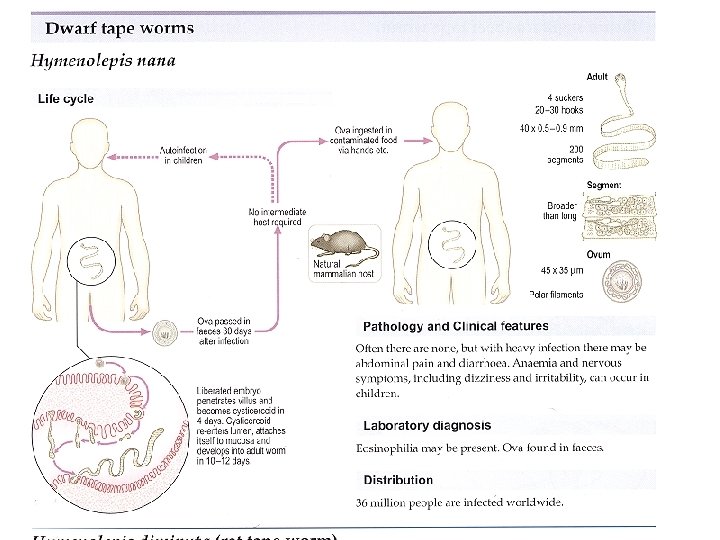

Hymenolepis nana
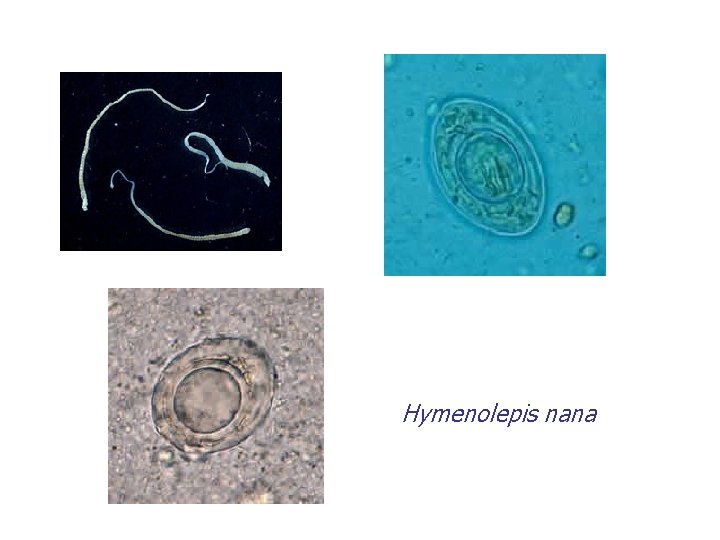
Hymenolepis nana
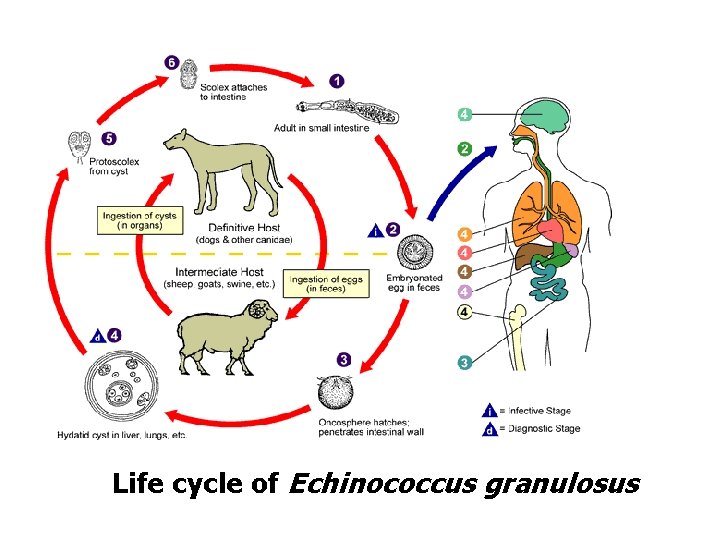
Life cycle of Echinococcus granulosus
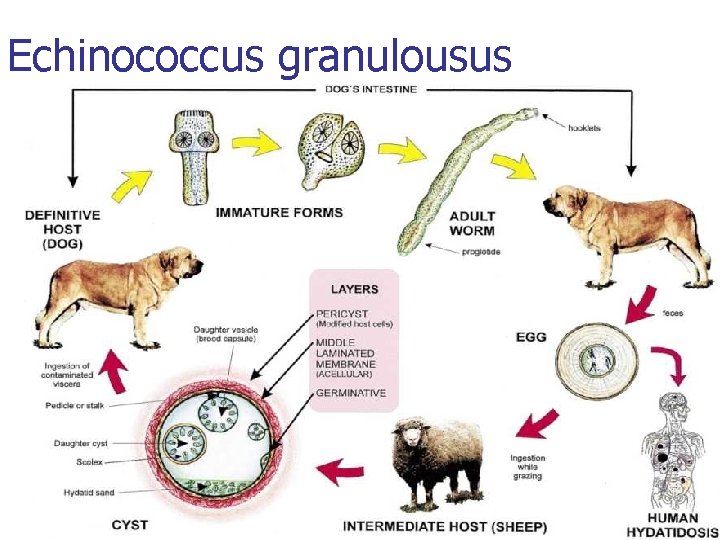
Echinococcus granulousus
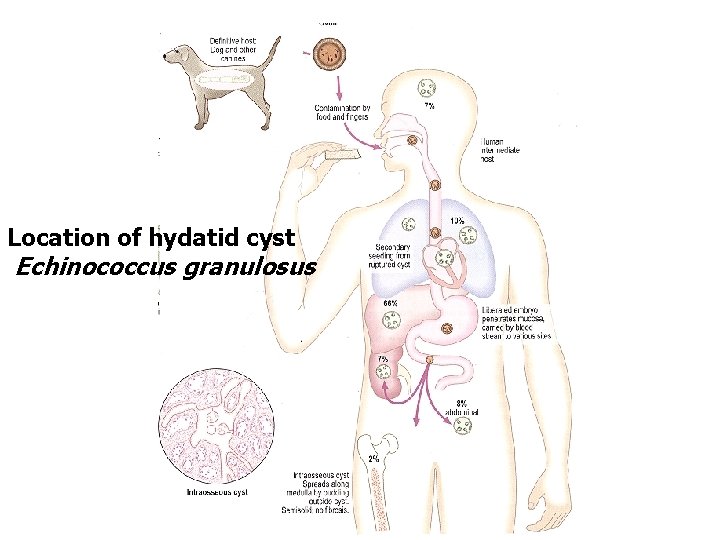
Location of hydatid cyst Echinococcus granulosus
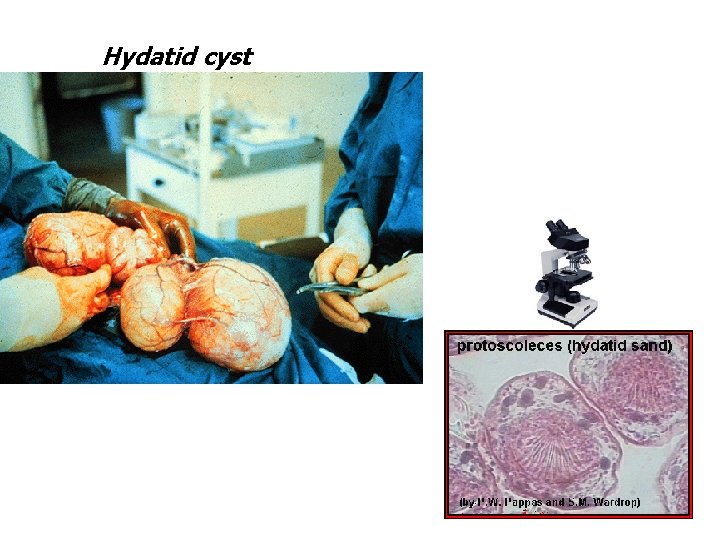
Hydatid cyst
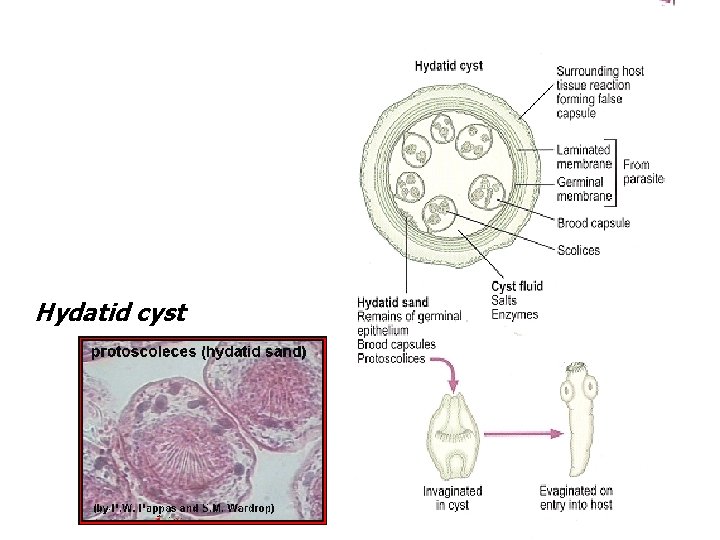
Hydatid cyst
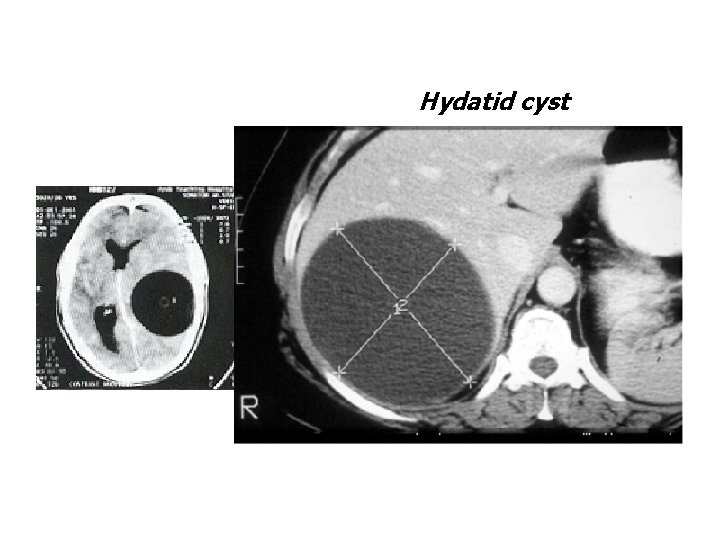
Hydatid cyst
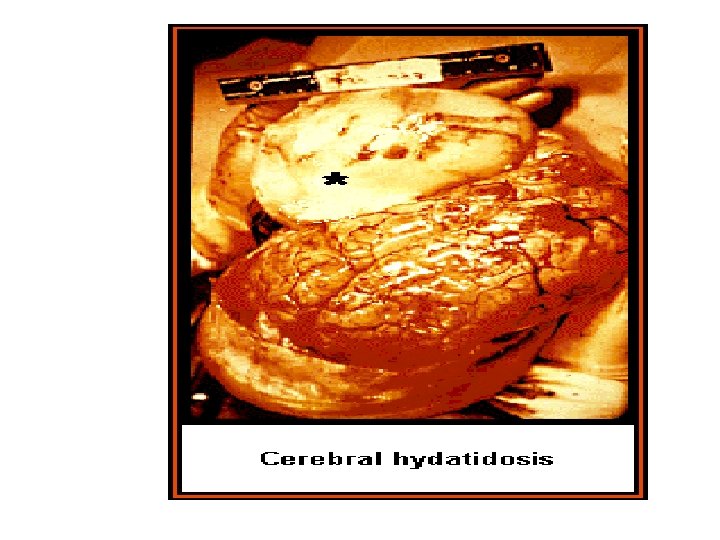
Diagnosis of Hydatid cyst n n n Imaging : computed tomography (CT), magnetic resonance imaging (MRI) revealed a cystic swelling with smooth outline. Microscopy: hyadtid sand Serologic tests; to detect specific antibodies
Treatment of Tapeworms n n Intestinal stages: Praziquantel Tissue stages ( Hydatid , cysticersosis): n Depends on clinical condition : Surgical and/or Albendazole
- Slides: 59