
Interviews Steinar Kvale Svend Brinkmann Inter Views Learning
Interviews Steinar Kvale, Svend Brinkmann, Inter. Views: Learning the Craft of Qualitative Research Interviewing.
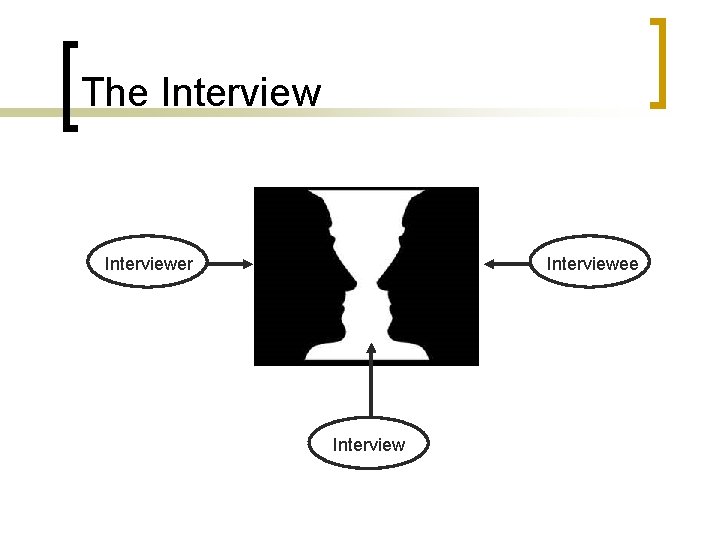
The Interviewer Interviewee Interview
Interviews n Unstructured n Semi-structured
Interviews n Unstructured Interviews ¡ ¡ Researcher has a small set of selfprompts to help investigate the research question, but questions are not fixed. One question can lead to a number of followup questions depending on the response. They tend to be more like conversations than interviews. Useful when exploring a new area.
Interviews n Structured Interviews ¡ ¡ The questions are fixed and predetermined as is the sequence of questions. No new questions can be added during interview, and questions are given to interviewee (generally several days) before the interview begins. A lot of senior managers prefer time to prepare their answers.
Interviews n Semi-Structured Interviews ¡ ¡ Some interview questions are fully decided, whereas others might not be fixed. The researcher has leeway in asking follow-up questions. This is the ideal compromise, it gives a structure to the interview, but also gives flexibility.
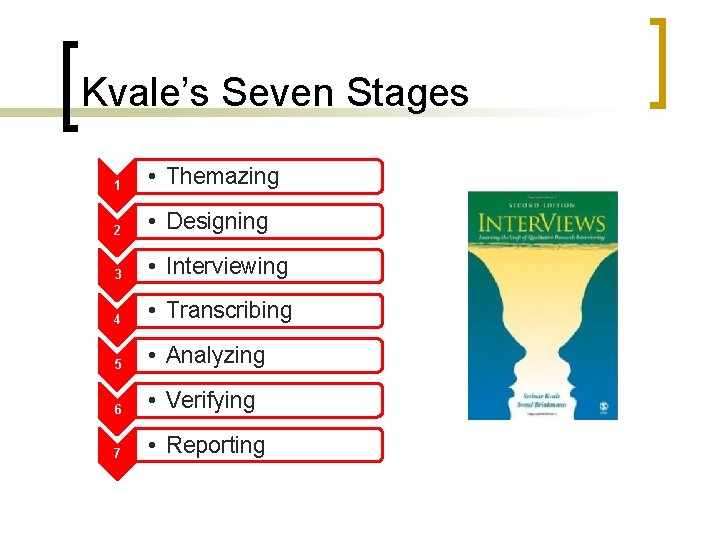
Kvale’s Seven Stages 1 • Themazing 2 • Designing 3 • Interviewing 4 • Transcribing 5 • Analyzing 6 • Verifying 7 • Reporting
Kvale’s Seven Stages 1. Themazing ¡ What is theme of the interview?
Kvale’s Seven Stages 1. Themazing ¡ What is theme of the interview? ¡ It’s your Research Question
Kvale’s Seven Stages 2. Designing ¡ How will the intended knowledge be obtained?
Kvale’s Seven Stages 2. Designing ¡ How will the intended knowledge be obtained? ¡ Design your Interview Questions
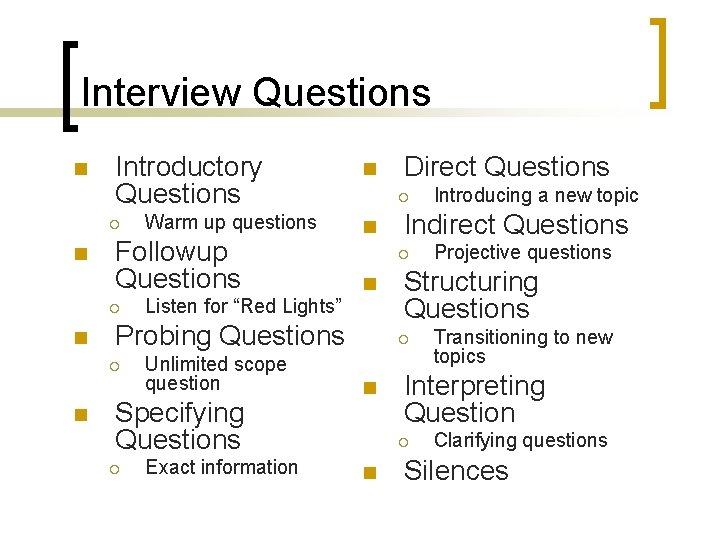
Interview Questions n Introductory Questions ¡ n Followup Questions ¡ n Listen for “Red Lights” Unlimited scope question Specifying Questions ¡ Exact information Direct Questions ¡ n n Transitioning to new topics Interpreting Question ¡ n Projective questions Structuring Questions ¡ n Introducing a new topic Indirect Questions ¡ Probing Questions ¡ n Warm up questions n Clarifying questions Silences
Kvale’s Seven Stages 3. Interviewing ¡ Conduct the interviews carefully
Interviews n n n Establish a rapport Treat interviewees with respect Think about your appearance Think about body language Maintain firm eye contact Don’t Invade their space
Interviews n How are you going to record? ¡ ¡ ¡ n Tape recorder Pen and paper – must be verbatim Video recorder But whichever you use, you must do a verbatim recording of the interview, both questions and answers.
Kvale’s Seven Stages 4. Transcribing ¡ Converting interview into written text
Kvale’s Seven Stages 4. Transcribing ¡ Converting interview into written text ¡ Must include everything said. Can be in appendix of thesis or on a CD.
Kvale’s Seven Stages 5. Analyzing ¡ Based on the appropriate type of investigation
Simple Analysis
Analysing Text n n Faced with the lack of organisation of data and the sheer amount of rambling can be somewhat overwhelming With the best will in the world about trying to avoid bias, when there is multiple interpretations of data, selecting the one that best matches your research question becomes very tempting.
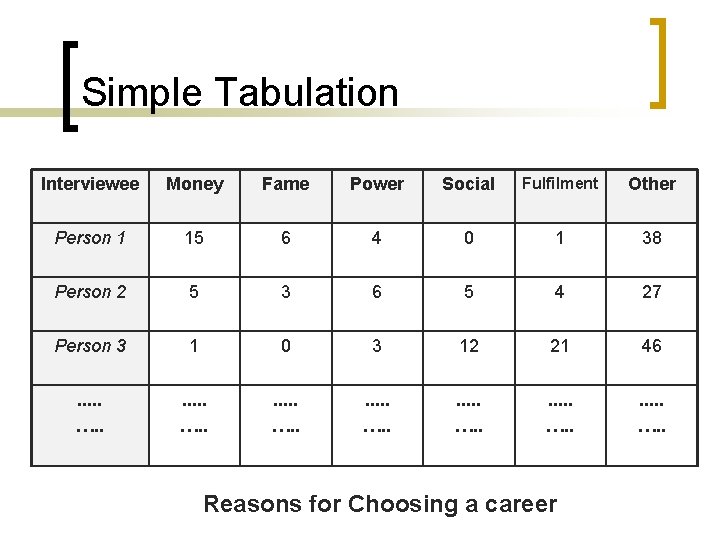
Simple Tabulation Interviewee Money Fame Power Social Fulfilment Other Person 1 15 6 4 0 1 38 Person 2 5 3 6 5 4 27 Person 3 1 0 3 12 21 46 . . …. . …. . Reasons for Choosing a career
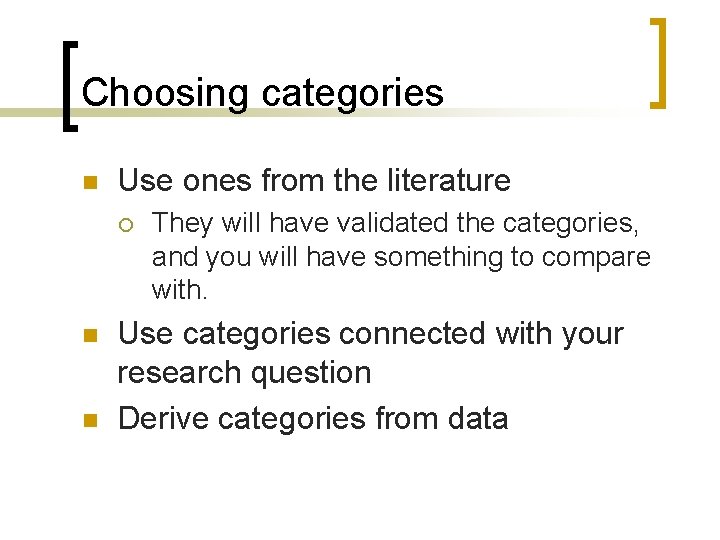
Choosing categories n Use ones from the literature ¡ n n They will have validated the categories, and you will have something to compare with. Use categories connected with your research question Derive categories from data
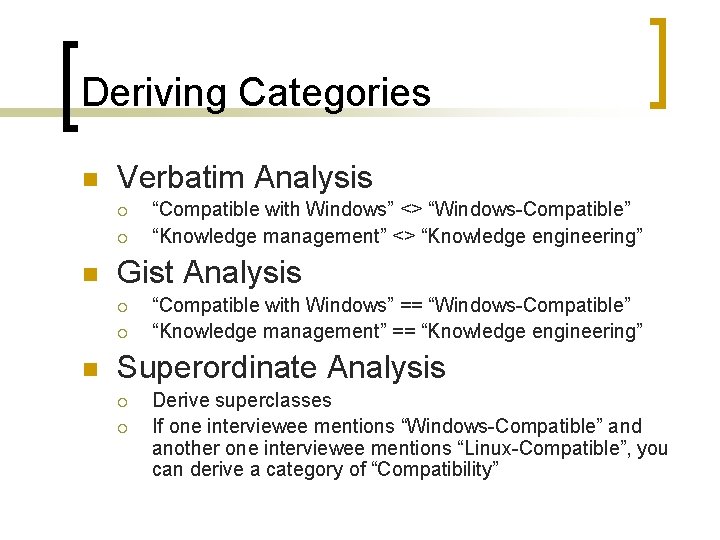
Deriving Categories n Verbatim Analysis ¡ ¡ n Gist Analysis ¡ ¡ n “Compatible with Windows” <> “Windows-Compatible” “Knowledge management” <> “Knowledge engineering” “Compatible with Windows” == “Windows-Compatible” “Knowledge management” == “Knowledge engineering” Superordinate Analysis ¡ ¡ Derive superclasses If one interviewee mentions “Windows-Compatible” and another one interviewee mentions “Linux-Compatible”, you can derive a category of “Compatibility”
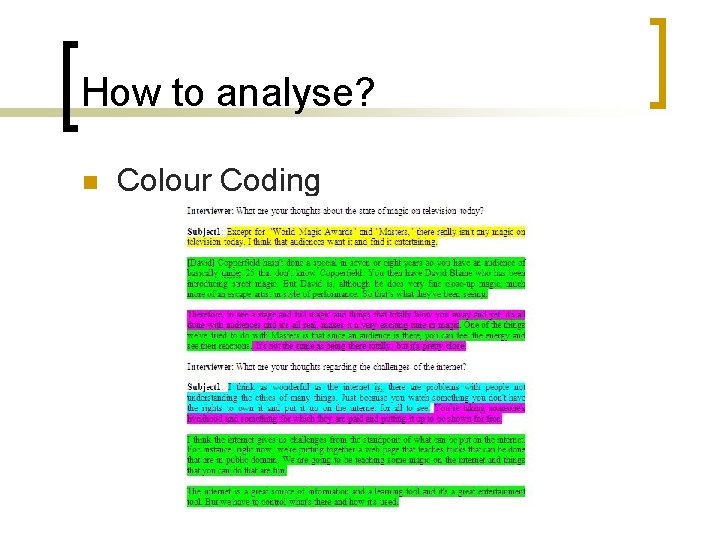
How to analyse? n Colour Coding
Advanced Analysis
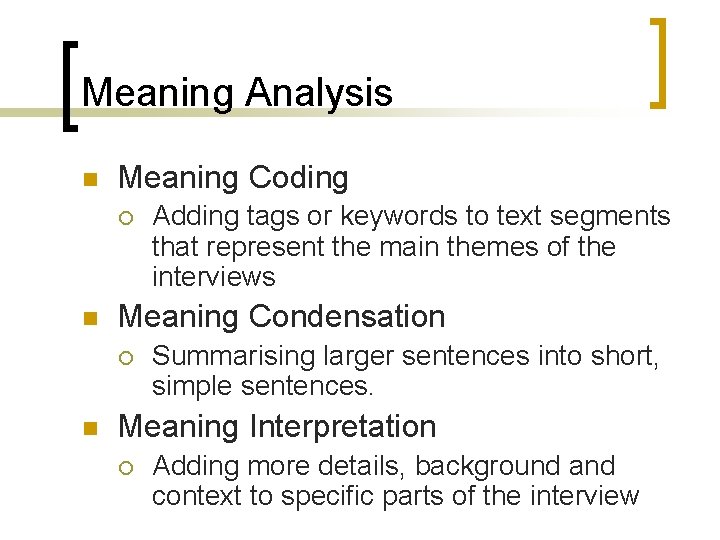
Meaning Analysis n Meaning Coding ¡ n Meaning Condensation ¡ n Adding tags or keywords to text segments that represent the main themes of the interviews Summarising larger sentences into short, simple sentences. Meaning Interpretation ¡ Adding more details, background and context to specific parts of the interview
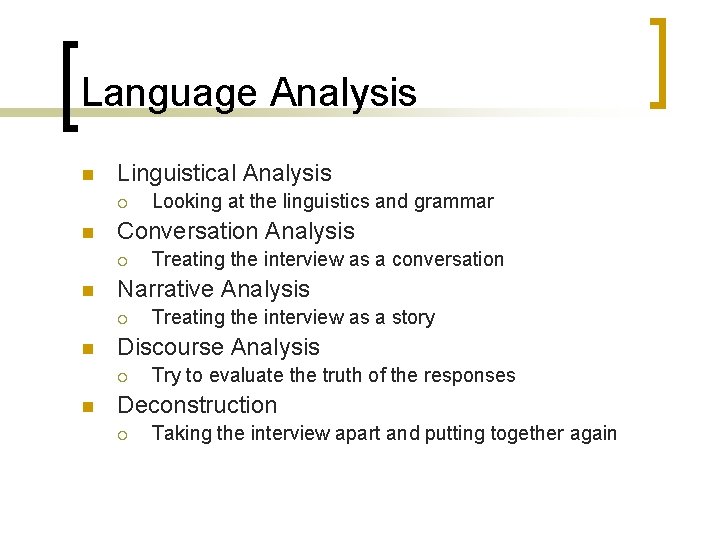
Language Analysis n Linguistical Analysis ¡ n Conversation Analysis ¡ n Treating the interview as a story Discourse Analysis ¡ n Treating the interview as a conversation Narrative Analysis ¡ n Looking at the linguistics and grammar Try to evaluate the truth of the responses Deconstruction ¡ Taking the interview apart and putting together again
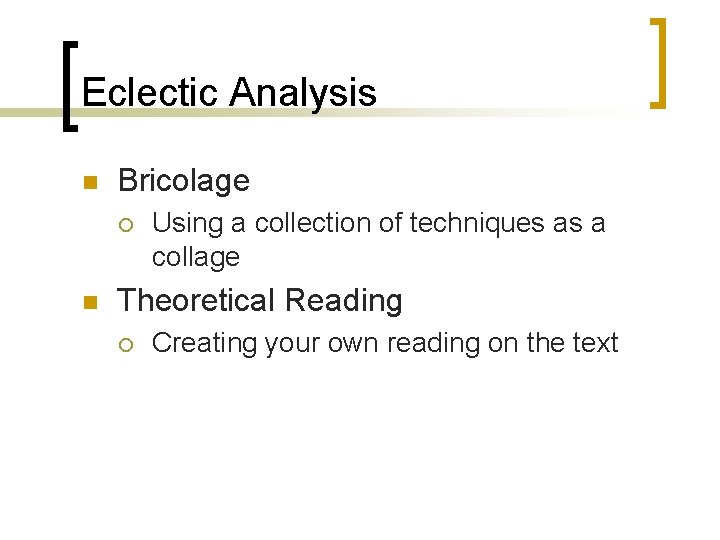
Eclectic Analysis n Bricolage ¡ n Using a collection of techniques as a collage Theoretical Reading ¡ Creating your own reading on the text
Kvale’s Seven Stages 6. Verifying ¡ Checking that validity, reliability, and generalizibility of the findings
Kvale’s Seven Stages n Validity ¡ n Reliability ¡ n Can you check the truth of the statements? e. g. number of employees in organisation, number of customers Are there any internal contradictions? Did you include the same question twice expressed in different ways to check the truthfulness of the responses? Generalizibility ¡ How do the answers agree with broader research and other interview answers?
Kvale’s Seven Stages 7. Reporting ¡ Communicate findings in a scientific and ethical manner.
Kvale’s Seven Stages 7. Reporting ¡ Communicate findings in a scientific and ethical manner. ¡ In the dissertation document
Interviews FAQ
What books should I read about interviews? n n n Anything and everything by Steinar Kvale “Interpreting Qualitative Data” by David Silverman “Research Design” by John Creswell
How do I think of questions for the interview? n There really should be two sources ¡ ¡ All questions need to come from the research question of the experiment If you find literature with a sufficiently similar research topic, you can use or adapt those questions
How many people should I interview? n 12 n ± 10 people is a good rule-of thumb
Are there situations where I shouldn’t use interviews? n Yes, loads of situations, e. g. electoral voting behaviour, or capturing a person’s attitudes and interactions with their environments.
When should I do the interviews? n Typically there are two times to do interviews; ¡ ¡ As part of the requirements gathering process As part of the evaluation process
Are there software packages that can help me ? ? n Loads ¡ ¡ ¡ n ATLAS. ti n. VIVO Max. QDA NUD*IST Hyper. RESEARCH But, do not underestimate the power of Excel, it’s a brilliant tool when used well
Further Tips n n n n Decide on an order of questions that easily flows one to the next Try to use language that is easy to understand relevant to the interviewee Avoid Leading questions Try to stop the interviewee using qualifiers Add a few control questions into the interview for validation Avoid smalltalk during the interview LISTEN, LISTEN
- Slides: 40