
INTERVIEWS LOUIS COHEN LAWRENCE MANION AND KEITH MORRISON

- Slides: 43
INTERVIEWS © LOUIS COHEN, LAWRENCE MANION AND KEITH MORRISON © 2018 Louis Cohen, Lawrence Manion and Keith Morrison; individual chapters, the contributors
STRUCTURE OF THE CHAPTER • • • Conceptions of the interview Purposes of the interview Types of interview Planning interview-based research procedures Group interviewing Interviewing children Interviewing minority and marginalized people Focus groups Non-directive, focused, problem-centred and in-depth interviews Telephone interviewing Online interviewing Ethical issues in interviewing © 2018 Louis Cohen, Lawrence Manion and Keith Morrison; individual chapters, the contributors
CONCEPTIONS OF THE INTERVIEW For information transfer A biased transaction An encounter like any other aspect of everyday life © 2018 Louis Cohen, Lawrence Manion and Keith Morrison; individual chapters, the contributors
PURPOSES OF THE INTERVIEW • To evaluate or assess a person in some respect • To select or promote an employee • To effect therapeutic change, e. g. the psychiatric interview • To test or develop hypotheses • To gather data • To sample respondents’ opinions, as in doorstep interviews © 2018 Louis Cohen, Lawrence Manion and Keith Morrison; individual chapters, the contributors
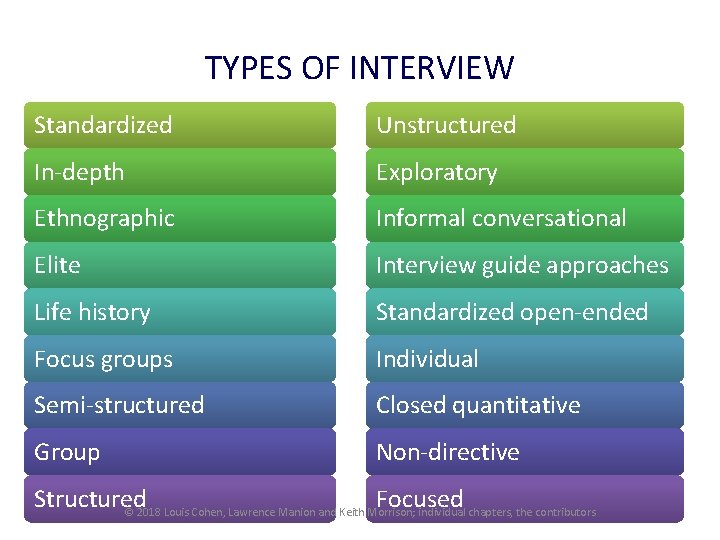
TYPES OF INTERVIEW Standardized Unstructured In-depth Exploratory Ethnographic Informal conversational Elite Interview guide approaches Life history Standardized open-ended Focus groups Individual Semi-structured Closed quantitative Group Non-directive Structured Focused © 2018 Louis Cohen, Lawrence Manion and Keith Morrison; individual chapters, the contributors
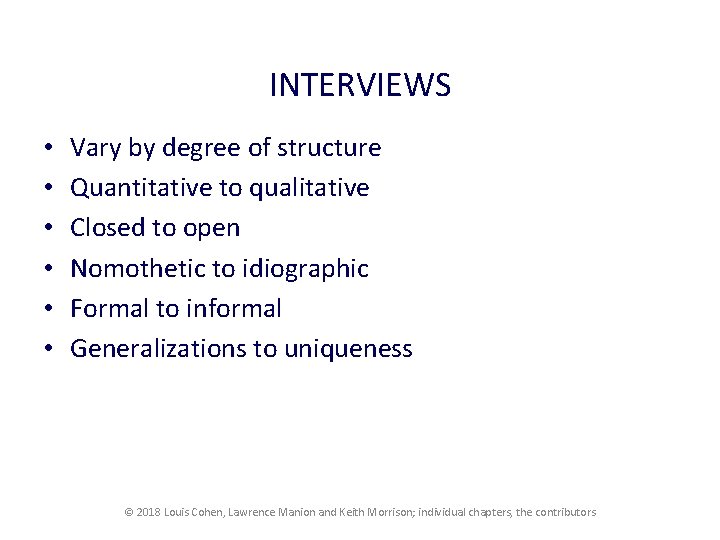
INTERVIEWS • • • Vary by degree of structure Quantitative to qualitative Closed to open Nomothetic to idiographic Formal to informal Generalizations to uniqueness © 2018 Louis Cohen, Lawrence Manion and Keith Morrison; individual chapters, the contributors
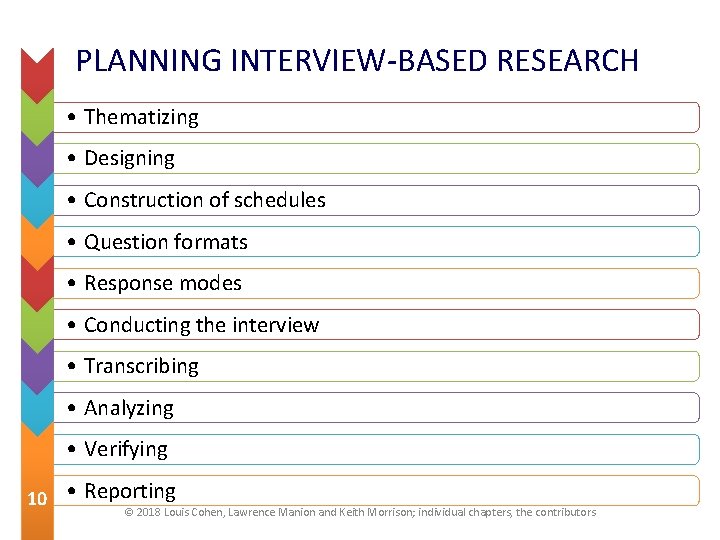
PLANNING INTERVIEW-BASED RESEARCH • Thematizing 1 2 3 4 5 • Designing • Construction of schedules • Question formats • Response modes • Conducting the interview • Transcribing 6 • Analyzing 8 7 9 • Verifying 10 • Reporting © 2018 Louis Cohen, Lawrence Manion and Keith Morrison; individual chapters, the contributors
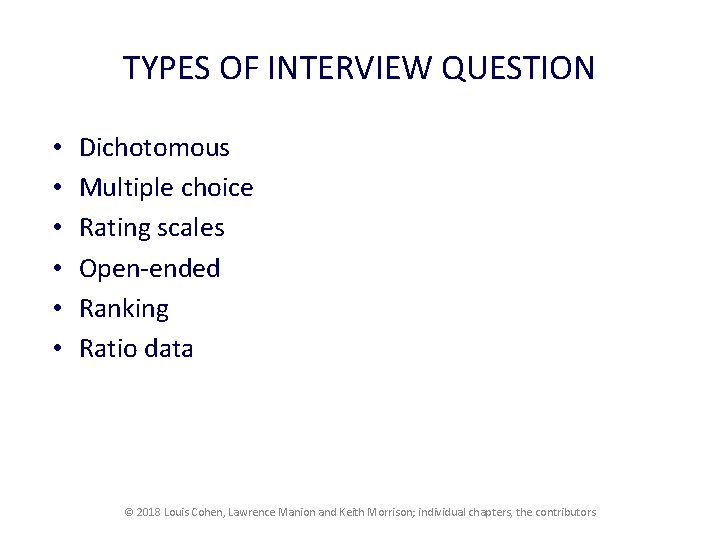
TYPES OF INTERVIEW QUESTION • • • Dichotomous Multiple choice Rating scales Open-ended Ranking Ratio data © 2018 Louis Cohen, Lawrence Manion and Keith Morrison; individual chapters, the contributors
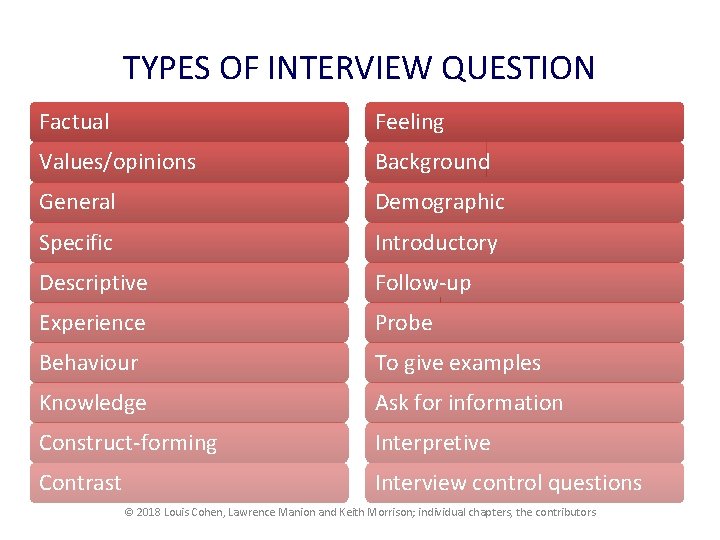
TYPES OF INTERVIEW QUESTION Factual Feeling Values/opinions Background General Demographic Specific Introductory Descriptive Follow-up Experience Probe Behaviour To give examples Knowledge Ask for information Construct-forming Interpretive Contrast Interview control questions © 2018 Louis Cohen, Lawrence Manion and Keith Morrison; individual chapters, the contributors
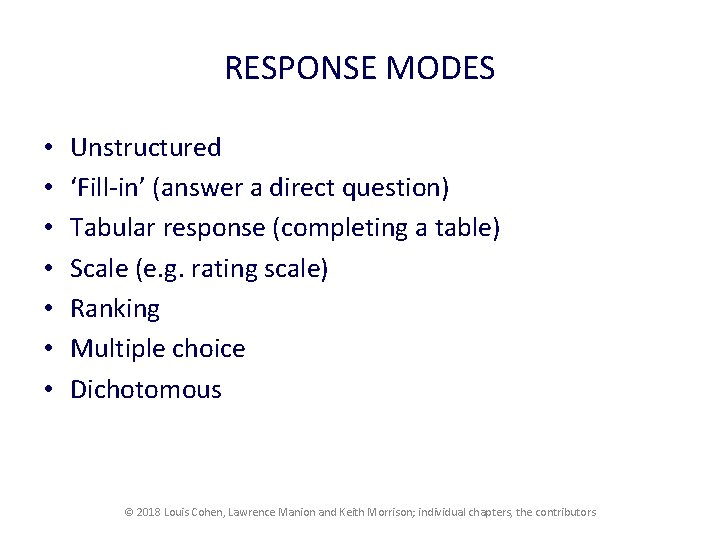
RESPONSE MODES • • Unstructured ‘Fill-in’ (answer a direct question) Tabular response (completing a table) Scale (e. g. rating scale) Ranking Multiple choice Dichotomous © 2018 Louis Cohen, Lawrence Manion and Keith Morrison; individual chapters, the contributors
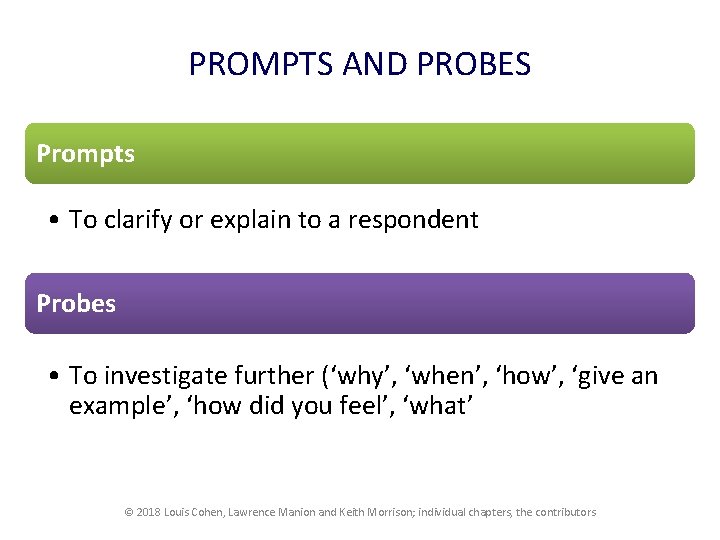
PROMPTS AND PROBES Prompts • To clarify or explain to a respondent Probes • To investigate further (‘why’, ‘when’, ‘how’, ‘give an example’, ‘how did you feel’, ‘what’ © 2018 Louis Cohen, Lawrence Manion and Keith Morrison; individual chapters, the contributors
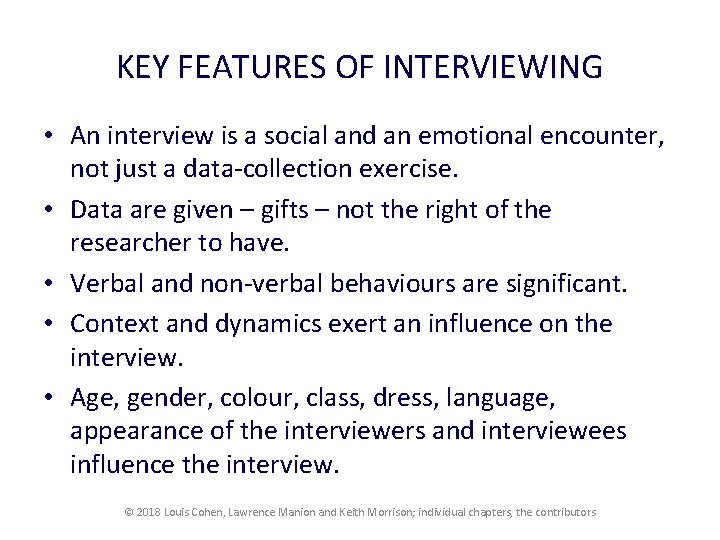
KEY FEATURES OF INTERVIEWING • An interview is a social and an emotional encounter, not just a data-collection exercise. • Data are given – gifts – not the right of the researcher to have. • Verbal and non-verbal behaviours are significant. • Context and dynamics exert an influence on the interview. • Age, gender, colour, class, dress, language, appearance of the interviewers and interviewees influence the interview. © 2018 Louis Cohen, Lawrence Manion and Keith Morrison; individual chapters, the contributors
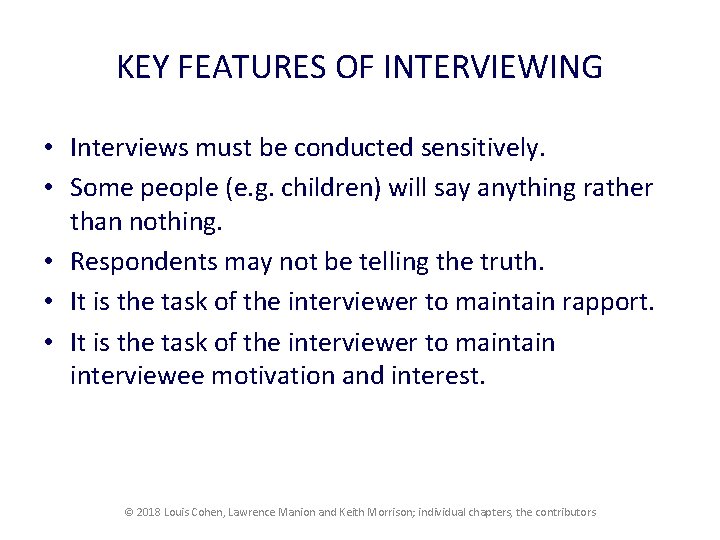
KEY FEATURES OF INTERVIEWING • Interviews must be conducted sensitively. • Some people (e. g. children) will say anything rather than nothing. • Respondents may not be telling the truth. • It is the task of the interviewer to maintain rapport. • It is the task of the interviewer to maintain interviewee motivation and interest. © 2018 Louis Cohen, Lawrence Manion and Keith Morrison; individual chapters, the contributors
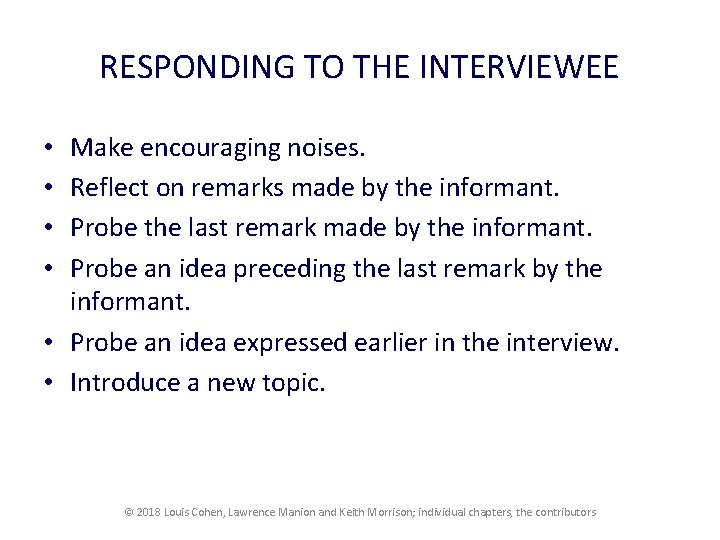
RESPONDING TO THE INTERVIEWEE Make encouraging noises. Reflect on remarks made by the informant. Probe the last remark made by the informant. Probe an idea preceding the last remark by the informant. • Probe an idea expressed earlier in the interview. • Introduce a new topic. • • © 2018 Louis Cohen, Lawrence Manion and Keith Morrison; individual chapters, the contributors
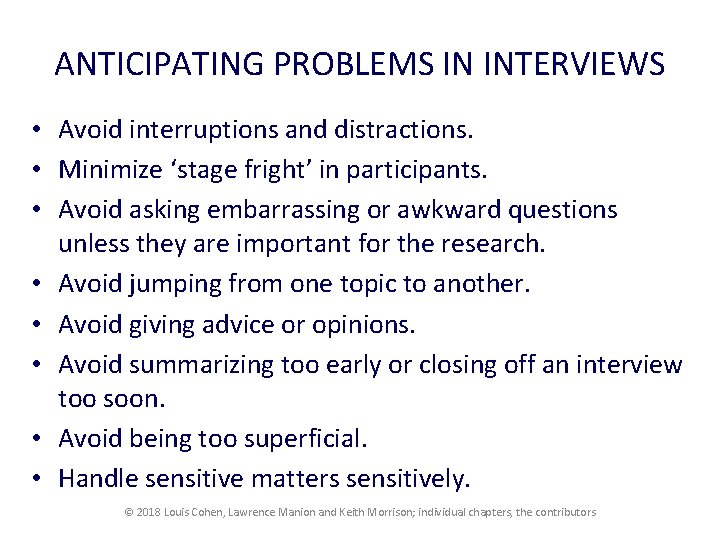
ANTICIPATING PROBLEMS IN INTERVIEWS • Avoid interruptions and distractions. • Minimize ‘stage fright’ in participants. • Avoid asking embarrassing or awkward questions unless they are important for the research. • Avoid jumping from one topic to another. • Avoid giving advice or opinions. • Avoid summarizing too early or closing off an interview too soon. • Avoid being too superficial. • Handle sensitive matters sensitively. © 2018 Louis Cohen, Lawrence Manion and Keith Morrison; individual chapters, the contributors
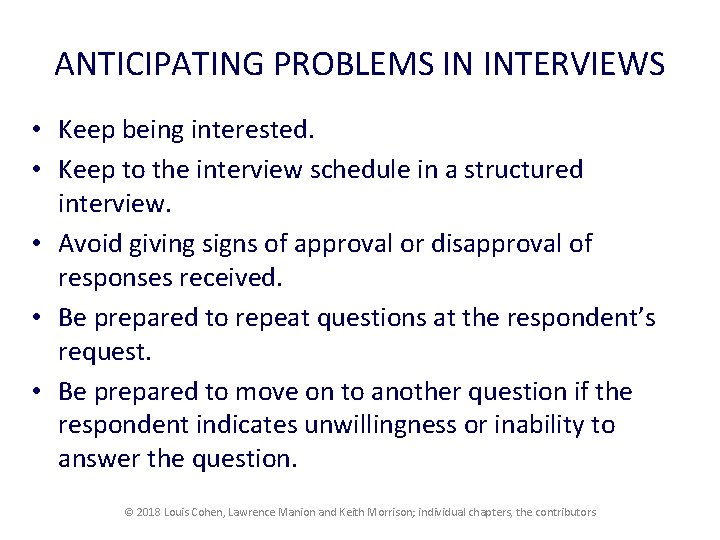
ANTICIPATING PROBLEMS IN INTERVIEWS • Keep being interested. • Keep to the interview schedule in a structured interview. • Avoid giving signs of approval or disapproval of responses received. • Be prepared to repeat questions at the respondent’s request. • Be prepared to move on to another question if the respondent indicates unwillingness or inability to answer the question. © 2018 Louis Cohen, Lawrence Manion and Keith Morrison; individual chapters, the contributors
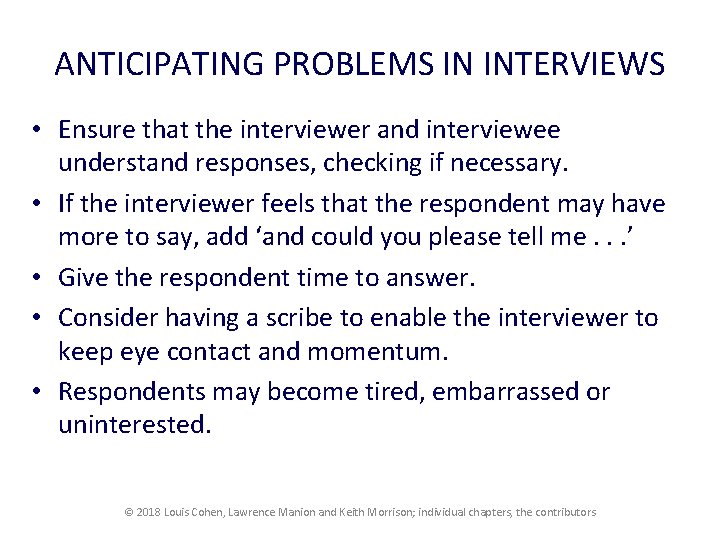
ANTICIPATING PROBLEMS IN INTERVIEWS • Ensure that the interviewer and interviewee understand responses, checking if necessary. • If the interviewer feels that the respondent may have more to say, add ‘and could you please tell me. . . ’ • Give the respondent time to answer. • Consider having a scribe to enable the interviewer to keep eye contact and momentum. • Respondents may become tired, embarrassed or uninterested. © 2018 Louis Cohen, Lawrence Manion and Keith Morrison; individual chapters, the contributors
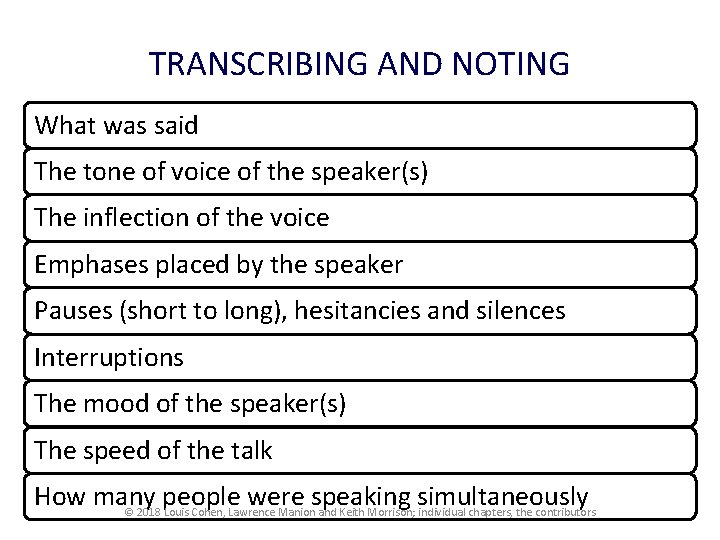
TRANSCRIBING AND NOTING What was said The tone of voice of the speaker(s) The inflection of the voice Emphases placed by the speaker Pauses (short to long), hesitancies and silences Interruptions The mood of the speaker(s) The speed of the talk How many people were speaking simultaneously © 2018 Louis Cohen, Lawrence Manion and Keith Morrison; individual chapters, the contributors
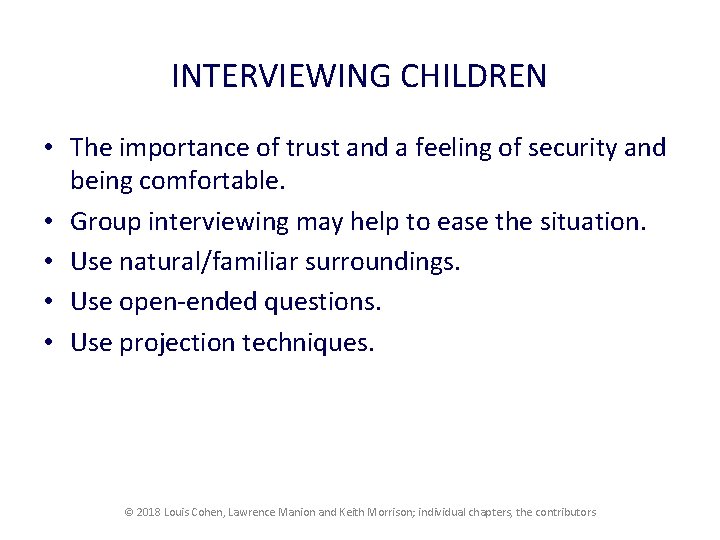
INTERVIEWING CHILDREN • The importance of trust and a feeling of security and being comfortable. • Group interviewing may help to ease the situation. • Use natural/familiar surroundings. • Use open-ended questions. • Use projection techniques. © 2018 Louis Cohen, Lawrence Manion and Keith Morrison; individual chapters, the contributors
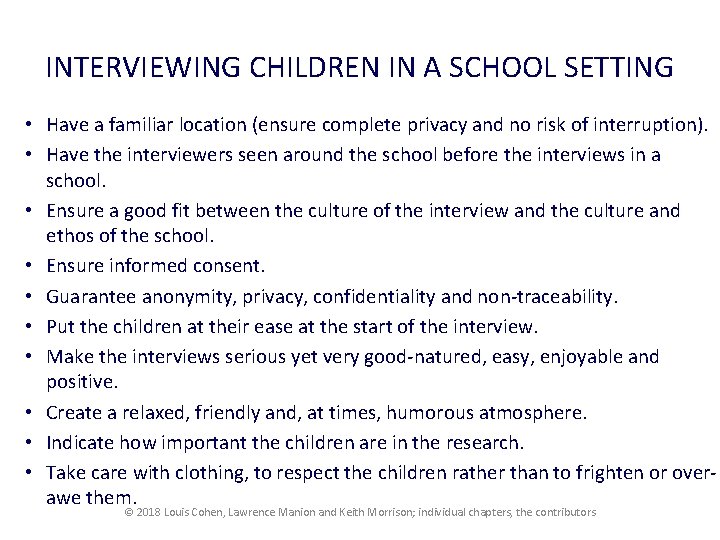
INTERVIEWING CHILDREN IN A SCHOOL SETTING • Have a familiar location (ensure complete privacy and no risk of interruption). • Have the interviewers seen around the school before the interviews in a school. • Ensure a good fit between the culture of the interview and the culture and ethos of the school. • Ensure informed consent. • Guarantee anonymity, privacy, confidentiality and non-traceability. • Put the children at their ease at the start of the interview. • Make the interviews serious yet very good-natured, easy, enjoyable and positive. • Create a relaxed, friendly and, at times, humorous atmosphere. • Indicate how important the children are in the research. • Take care with clothing, to respect the children rather than to frighten or overawe them. © 2018 Louis Cohen, Lawrence Manion and Keith Morrison; individual chapters, the contributors
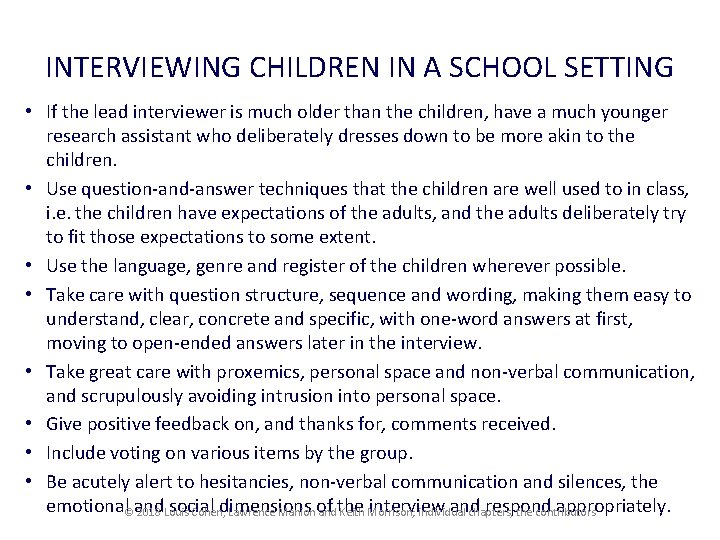
INTERVIEWING CHILDREN IN A SCHOOL SETTING • If the lead interviewer is much older than the children, have a much younger research assistant who deliberately dresses down to be more akin to the children. • Use question-and-answer techniques that the children are well used to in class, i. e. the children have expectations of the adults, and the adults deliberately try to fit those expectations to some extent. • Use the language, genre and register of the children wherever possible. • Take care with question structure, sequence and wording, making them easy to understand, clear, concrete and specific, with one-word answers at first, moving to open-ended answers later in the interview. • Take great care with proxemics, personal space and non-verbal communication, and scrupulously avoiding intrusion into personal space. • Give positive feedback on, and thanks for, comments received. • Include voting on various items by the group. • Be acutely alert to hesitancies, non-verbal communication and silences, the emotional and social dimensions of the interview and respond appropriately. © 2018 Louis Cohen, Lawrence Manion and Keith Morrison; individual chapters, the contributors
DIFFICULTIES IN INTERVIEWING CHILDREN Easily distracted. Researcher is seen as an authority figure. Children are not always clear in their responses. Limited attention span. Children may say what they think the researcher wants to hear rather than what they really think/feel. • Interview seen as a test. • Children may be unwilling to contradict an adult or assert themselves. • Children may be inarticulate, hesitant and nervous. • • • © 2018 Louis Cohen, Lawrence Manion and Keith Morrison; individual chapters, the contributors
DIFFICULTIES IN INTERVIEWING CHILDREN • Keeping the children’s teacher away from the children. • How to respond to the child who says something then immediately wishes she hadn’t said it. • Eliciting genuine responses. • Getting beyond the institutional, headteacher’s or ‘expected’ response. • Avoiding receiving a socially desirable response. • Ensuring that the child is giving a true opinion. • Keeping children to the point. © 2018 Louis Cohen, Lawrence Manion and Keith Morrison; individual chapters, the contributors
DIFFICULTIES IN INTERVIEWING CHILDREN • Avoid children being too extreme or destructive of each other’s views. • Appropriate language level. • Children may take a question too literally. • Enable the children to see a situation through other people’s eyes. • Avoid the interview being boring. • Children may not remember/recall information. • Children may be too focused on a particular situation. • Children may say ‘yes’ to anything. © 2018 Louis Cohen, Lawrence Manion and Keith Morrison; individual chapters, the contributors
DIFFICULTIES IN INTERVIEWING CHILDREN • Children may say anything in order to please. • Children may say that they ‘don’t know’ when they actually do know. • Children may say anything rather than feel they do not have ‘the answer’. • Some children may dominate the conversation. • Children may feel very exposed in front of their peers. • Children may feel uncomfortable or threatened. • Children may tell lies. © 2018 Louis Cohen, Lawrence Manion and Keith Morrison; individual chapters, the contributors
INTERVIEWING MINORITY AND MARGINALIZED PEOPLE • • • Use informal, open-ended interviews. Follow the train of thought and response of the respondent. Use age-appropriate and context-appropriate language. Use qualitative and in-depth interviewing. Give participants a ‘voice’. Be non-judgemental. Enable the participant to feel safe, secure and supported. Be aware of asymmetries of power. Use non-language-based techniques. Secure informed consent (e. g. from responsible adults). © 2018 Louis Cohen, Lawrence Manion and Keith Morrison; individual chapters, the contributors
FOCUS GROUPS • Focus groups are contrived settings, bringing together a specifically chosen sector of the population, previously unknown to each other, to discuss a particular given theme or topic. • The interaction with the group leads to data and outcomes. • They are unnatural settings focused on a particular issue. © 2018 Louis Cohen, Lawrence Manion and Keith Morrison; individual chapters, the contributors
FOCUS GROUPS ARE USEFUL FOR. . . • Orientation to a particular field of focus. • Developing themes, topics and schedules for subsequent research. • Generating hypotheses. • Generating and evaluating data from sub-groups of a population. • Gathering qualitative data. • Generating data quickly and cheaply. • Gathering data on attitudes, values and opinions. © 2018 Louis Cohen, Lawrence Manion and Keith Morrison; individual chapters, the contributors
FOCUS GROUPS ARE USEFUL FOR. . . • Empowering participants to speak out. • Encouraging groups, rather than individuals, to voice opinions. • Encouraging non-literate participants. • Providing greater coverage of issues than would be possible in a survey. • Gathering feedback from previous studies. © 2018 Louis Cohen, Lawrence Manion and Keith Morrison; individual chapters, the contributors
RUNNING A FOCUS GROUP Decide the number of focus groups for a single topic. Decide the size of the group. How to allow for people not ‘turning up’ on the day. Sampling. Ensuring that participants have something to say and feel comfortable enough to say it. • Keeping the meeting open-ended but to the point. • • • © 2018 Louis Cohen, Lawrence Manion and Keith Morrison; individual chapters, the contributors
NON-DIRECTIVE INTERVIEWS • The respondent is responsible for initiating and directing the course of the encounter. • Useful for probing deeper attitudes and perceptions of the person being interviewed. • Reduces interviewer bias. • Can lead to changes in the respondent’s behaviour. © 2018 Louis Cohen, Lawrence Manion and Keith Morrison; individual chapters, the contributors
THE FOCUSED INTERVIEW • The persons interviewed are known to have been involved in a particular situation. • Content analysis of prior data sets the agenda for the interview. • The investigator constructs the interview guide. • The actual interview is focused on the subjective experiences of the people who have been exposed to the situation. • Responses enable the researcher to test the validity of hypotheses, and to ascertain unanticipated responses to the situation. © 2018 Louis Cohen, Lawrence Manion and Keith Morrison; individual chapters, the contributors
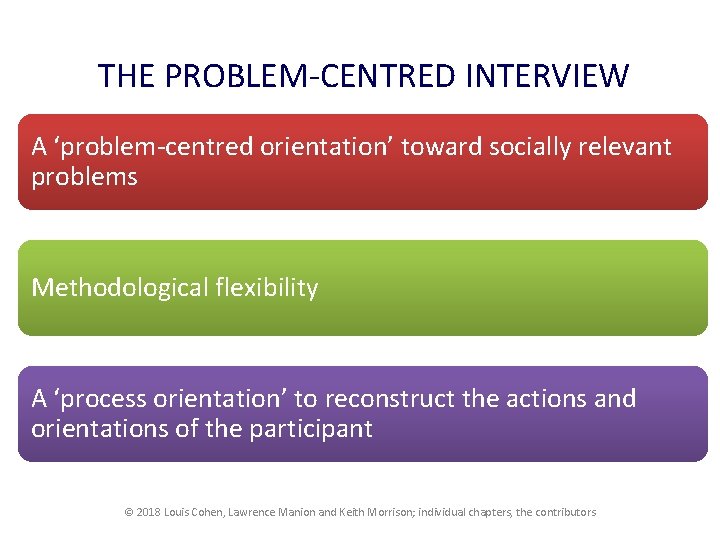
THE PROBLEM-CENTRED INTERVIEW A ‘problem-centred orientation’ toward socially relevant problems Methodological flexibility A ‘process orientation’ to reconstruct the actions and orientations of the participant © 2018 Louis Cohen, Lawrence Manion and Keith Morrison; individual chapters, the contributors
TELEPHONE INTERVIEWING Cheaper and quicker than face-to-face interviewing. Enables researchers to reach a widely dispersed population. Travel costs are omitted. Useful for brief surveys. Protects the anonymity of respondents. Can gather rapid responses to a structured questionnaire. Monitoring and quality control are undertaken more easily since interviews are undertaken and administered centrally. • Interviewer effects are reduced. • Greater interviewer control of the interview. • • © 2018 Louis Cohen, Lawrence Manion and Keith Morrison; individual chapters, the contributors
TELEPHONE INTERVIEWING • Greater uniformity in the conduct of the interview and the standardization of questions. • Results tend to be quantitative. • Quicker to administer than face-to-face interviews. • Call-back costs are slight. • People can be reached at times more convenient to them than if a visit were to be made. • Safer to undertake than visiting dangerous places. • Can collect sensitive data. • Does not rely on the literacy of the respondent. • May put pressure on the respondent to respond. © 2018 Louis Cohen, Lawrence Manion and Keith Morrison; individual chapters, the contributors • Response rate is higher than, e. g. questionnaires.
TELEPHONE INTERVIEWING • Will the people have the information that you require? Who will you need to speak to on the telephone? • There is a need to pilot the interview schedule and to prepare and train the telephonists. • Keep to the same, simple response categories for several questions. • Keep personal details until the end of the interview. • Keep to no more than, at the most, 35 questions, and to no more than, at the most, 15 minutes. © 2018 Louis Cohen, Lawrence Manion and Keith Morrison; individual chapters, the contributors
TELEPHONE INTERVIEWING • Be clear with the respondents at the start of the interview that they have the time to answer and that they are suitable respondents. • Ask to speak to the most suitable person. • Keep the terminology simple and to the point. • Keep the response categories very simple and use them consistently. • Rather than asking direct personal questions, ask about groups (e. g. which age group do they fall into (and give the age groups) or income brackets (and give them)). © 2018 Louis Cohen, Lawrence Manion and Keith Morrison; individual chapters, the contributors
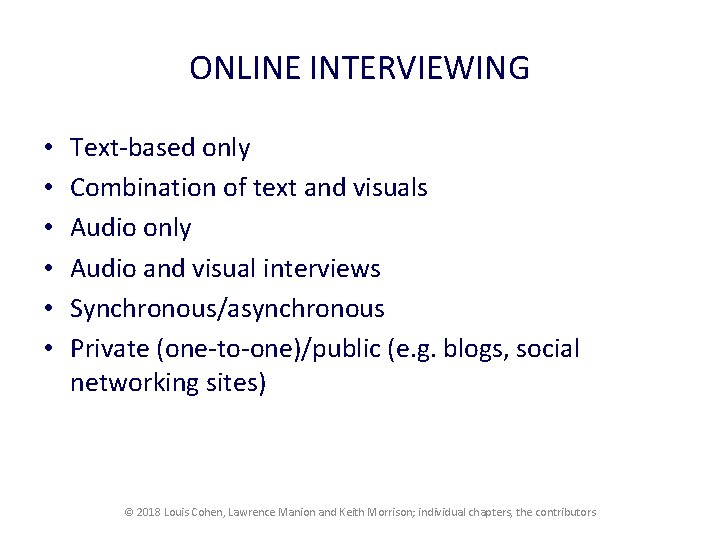
ONLINE INTERVIEWING • • • Text-based only Combination of text and visuals Audio only Audio and visual interviews Synchronous/asynchronous Private (one-to-one)/public (e. g. blogs, social networking sites) © 2018 Louis Cohen, Lawrence Manion and Keith Morrison; individual chapters, the contributors
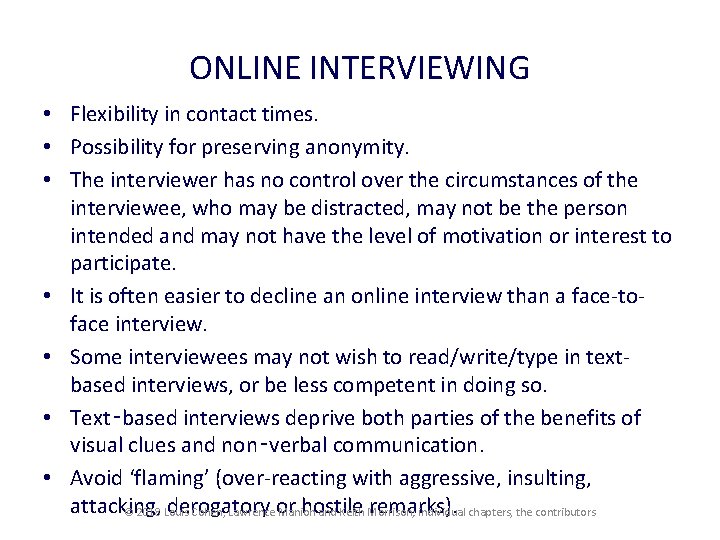
ONLINE INTERVIEWING • Flexibility in contact times. • Possibility for preserving anonymity. • The interviewer has no control over the circumstances of the interviewee, who may be distracted, may not be the person intended and may not have the level of motivation or interest to participate. • It is often easier to decline an online interview than a face-toface interview. • Some interviewees may not wish to read/write/type in textbased interviews, or be less competent in doing so. • Text‑based interviews deprive both parties of the benefits of visual clues and non‑verbal communication. • Avoid ‘flaming’ (over-reacting with aggressive, insulting, attacking, derogatory or hostile remarks). © 2018 Louis Cohen, Lawrence Manion and Keith Morrison; individual chapters, the contributors
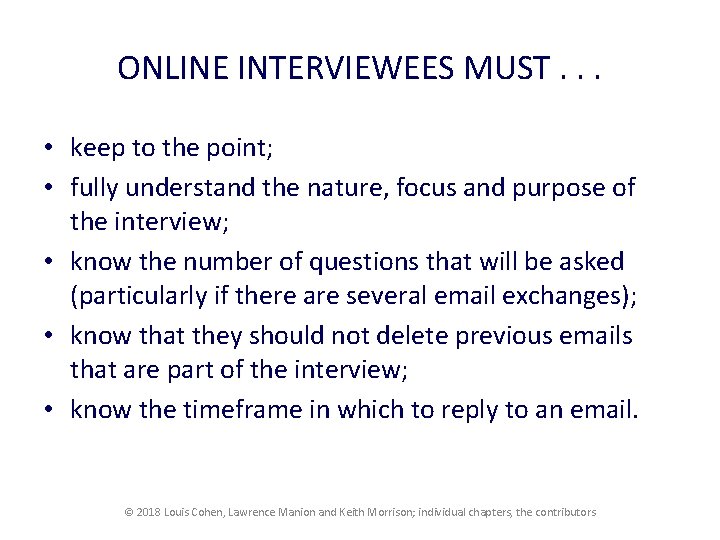
ONLINE INTERVIEWEES MUST. . . • keep to the point; • fully understand the nature, focus and purpose of the interview; • know the number of questions that will be asked (particularly if there are several email exchanges); • know that they should not delete previous emails that are part of the interview; • know the timeframe in which to reply to an email. © 2018 Louis Cohen, Lawrence Manion and Keith Morrison; individual chapters, the contributors
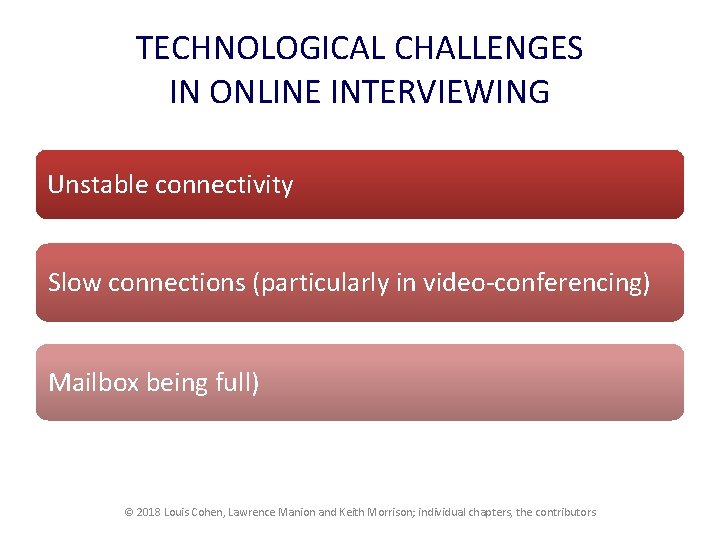
TECHNOLOGICAL CHALLENGES IN ONLINE INTERVIEWING Unstable connectivity Slow connections (particularly in video-conferencing) Mailbox being full) © 2018 Louis Cohen, Lawrence Manion and Keith Morrison; individual chapters, the contributors
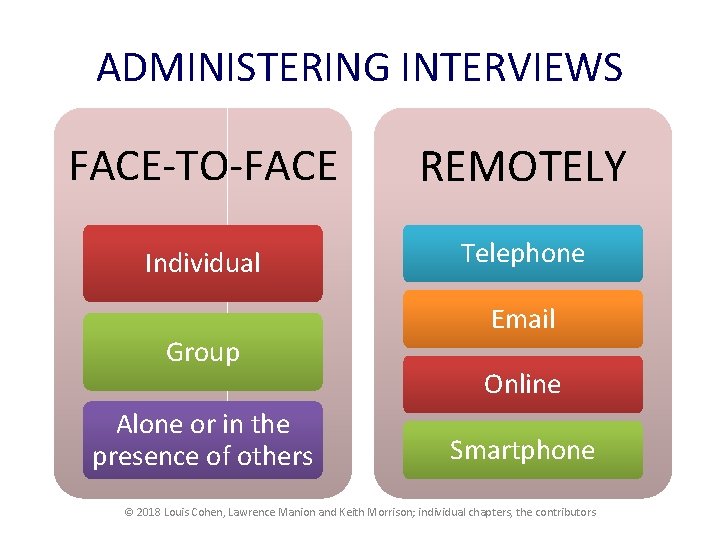
ADMINISTERING INTERVIEWS FACE-TO-FACE REMOTELY Individual Telephone Group Alone or in the presence of others Email Online Smartphone © 2018 Louis Cohen, Lawrence Manion and Keith Morrison; individual chapters, the contributors
ETHICAL ISSUES IN INTERVIEWING • Informed consent • Confidentiality, anonymity, non-identifiability and non-traceability • Consequences of the interviews • Benefits from the interview (and for whom) • Prevention of harm • Access to data • Respondent validation • Respectful conduct of the interview © 2018 Louis Cohen, Lawrence Manion and Keith Morrison; individual chapters, the contributors