
INTERVIEWS AND QUESTIONNAIRES Week 8 Research Methodology NJ
- Slides: 28
INTERVIEWS AND QUESTIONNAIRES Week 8 Research Methodology NJ Kang
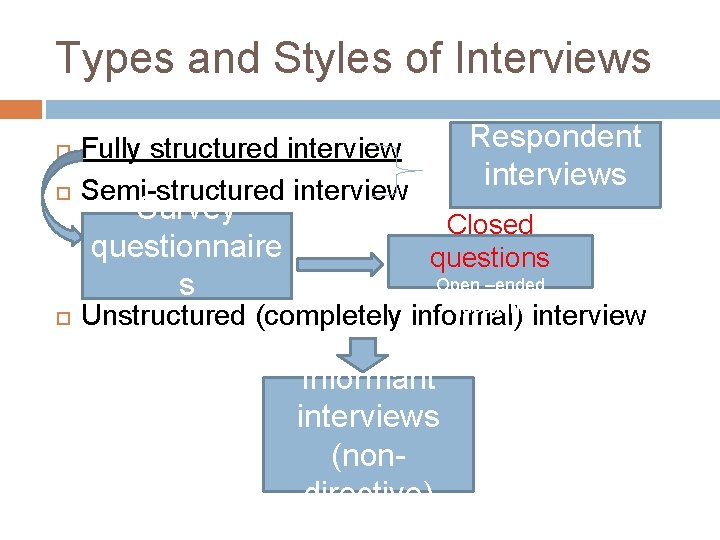
Types and Styles of Interviews Respondent interviews Fully structured interview Semi-structured interview Survey questionnaire s Closed questions Open –ended questions Unstructured (completely informal) interview Informant interviews (nondirective)
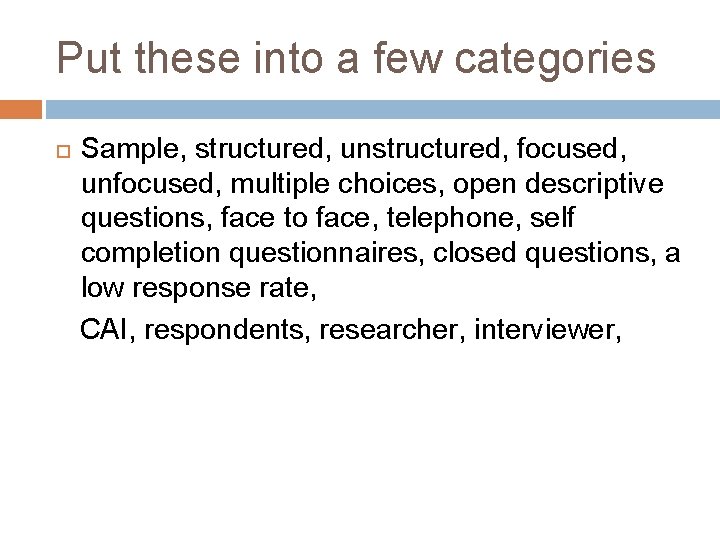
Put these into a few categories Sample, structured, unstructured, focused, unfocused, multiple choices, open descriptive questions, face to face, telephone, self completion questionnaires, closed questions, a low response rate, CAI, respondents, researcher, interviewer,
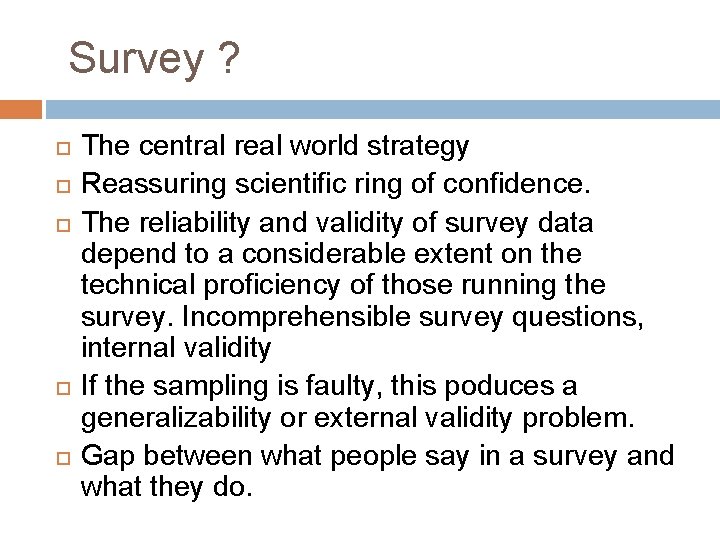
Survey ? The central real world strategy Reassuring scientific ring of confidence. The reliability and validity of survey data depend to a considerable extent on the technical proficiency of those running the survey. Incomprehensible survey questions, internal validity If the sampling is faulty, this poduces a generalizability or external validity problem. Gap between what people say in a survey and what they do.
Types of surveys CAI CASIC Internet Paper
Self-completed Questionnaires Begin with warm up questions Divide the questions into sub topics From the general to specific. From the less personal to personal. Ends with wrap up questions Close with Appreciation (see figure 9. 1)
10. 6 checklist Keep the language simple. Keep questions short Avoid double-barreled questions Avoid leading questions Avoid questions in the negative Ask questions only where respondents are likely to have to knowledge needed to answer Remove ambiguity Avoid a prestige bias.
Designing self-completed questionnaires 1. Specific questions are better than general ones What types of task affected your students’ participation? Which task types affect your students’ participation the most? (show list) 2. Closed questions are usually preferable to open questions
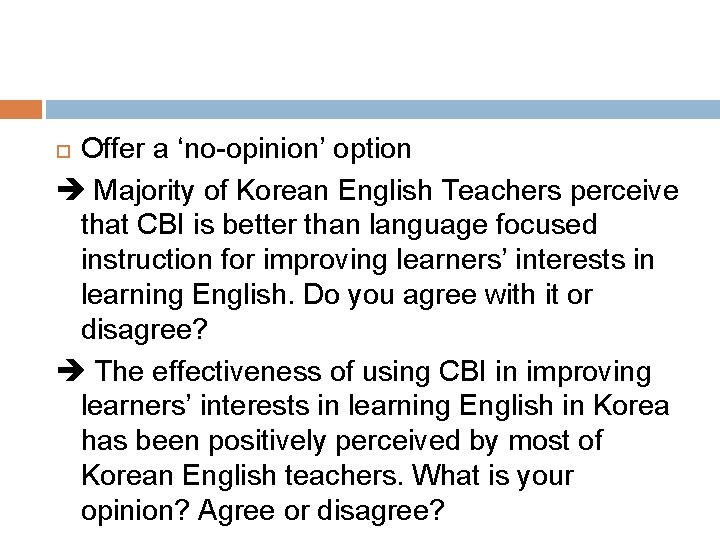
Offer a ‘no-opinion’ option Majority of Korean English Teachers perceive that CBI is better than language focused instruction for improving learners’ interests in learning English. Do you agree with it or disagree? The effectiveness of using CBI in improving learners’ interests in learning English in Korea has been positively perceived by most of Korean English teachers. What is your opinion? Agree or disagree?
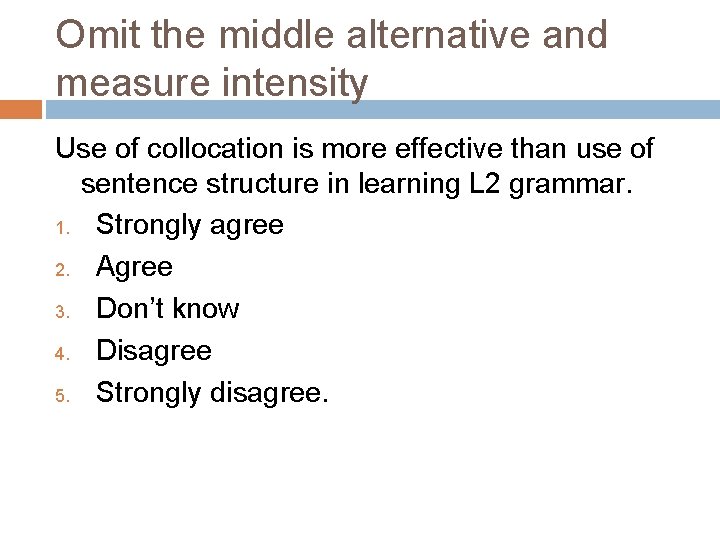
Omit the middle alternative and measure intensity Use of collocation is more effective than use of sentence structure in learning L 2 grammar. 1. Strongly agree 2. Agree 3. Don’t know 4. Disagree 5. Strongly disagree.
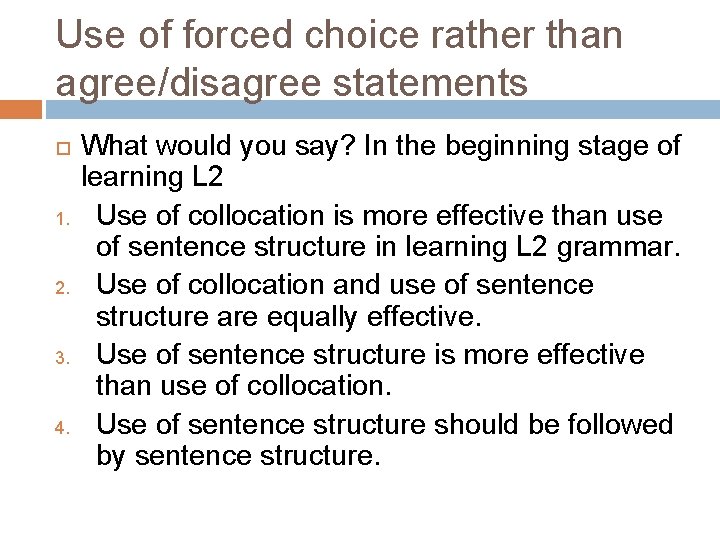
Use of forced choice rather than agree/disagree statements 1. 2. 3. 4. What would you say? In the beginning stage of learning L 2 Use of collocation is more effective than use of sentence structure in learning L 2 grammar. Use of collocation and use of sentence structure are equally effective. Use of sentence structure is more effective than use of collocation. Use of sentence structure should be followed by sentence structure.
Question order General questions should precede specific questions
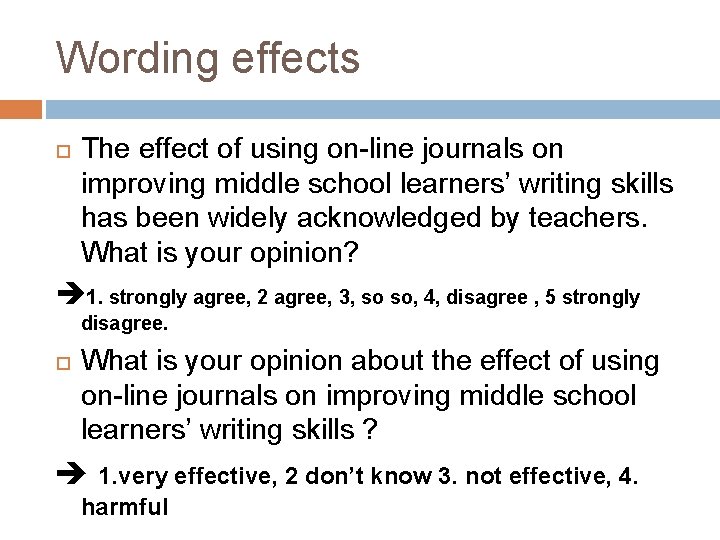
Wording effects The effect of using on-line journals on improving middle school learners’ writing skills has been widely acknowledged by teachers. What is your opinion? 1. strongly agree, 2 agree, 3, so so, 4, disagree , 5 strongly disagree. What is your opinion about the effect of using on-line journals on improving middle school learners’ writing skills ? 1. very effective, 2 don’t know 3. not effective, 4. harmful
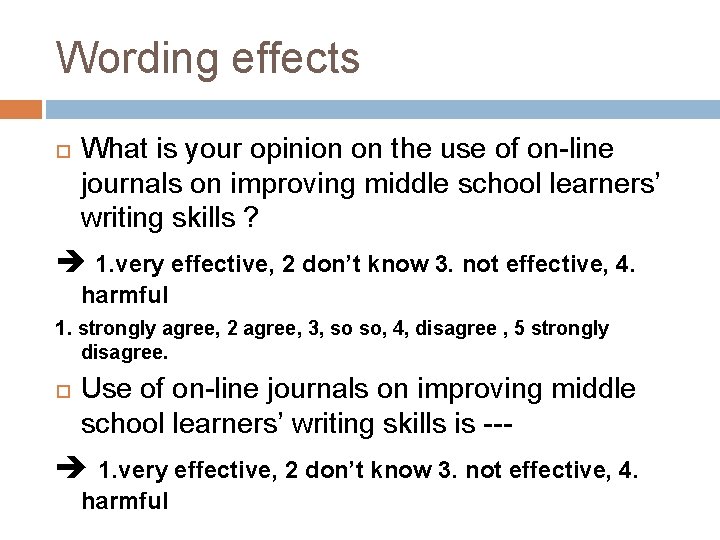
Wording effects What is your opinion on the use of on-line journals on improving middle school learners’ writing skills ? 1. very effective, 2 don’t know 3. not effective, 4. harmful 1. strongly agree, 2 agree, 3, so so, 4, disagree , 5 strongly disagree. Use of on-line journals on improving middle school learners’ writing skills is --- 1. very effective, 2 don’t know 3. not effective, 4. harmful
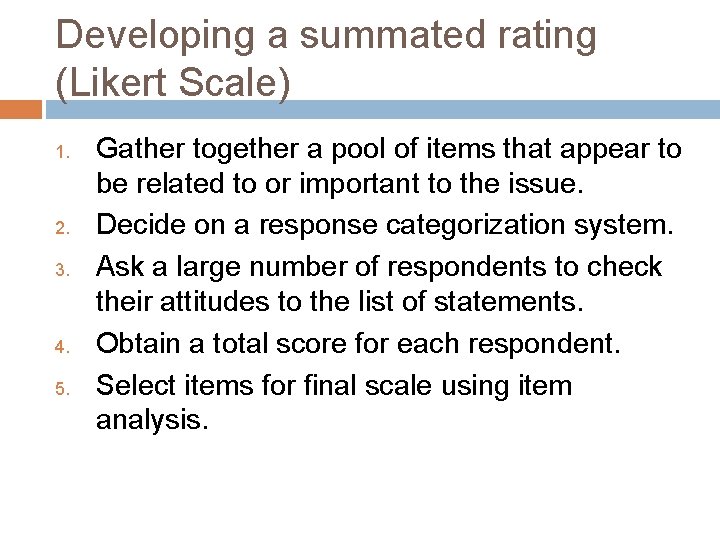
Developing a summated rating (Likert Scale) 1. 2. 3. 4. 5. Gather together a pool of items that appear to be related to or important to the issue. Decide on a response categorization system. Ask a large number of respondents to check their attitudes to the list of statements. Obtain a total score for each respondent. Select items for final scale using item analysis.
Gather together a pool of items that appear to be related to or important to the issue. Example
Decide on a response categorization system.
Ask a large number of respondents to check their attitudes to the list of statements.
Obtain a total score for each respondent.
Select items for final scale using item analysis.
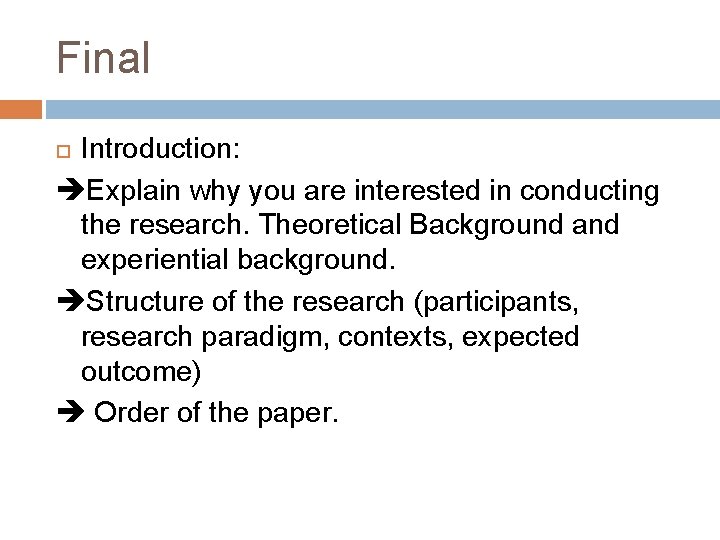
Final Introduction: Explain why you are interested in conducting the research. Theoretical Background and experiential background. Structure of the research (participants, research paradigm, contexts, expected outcome) Order of the paper.
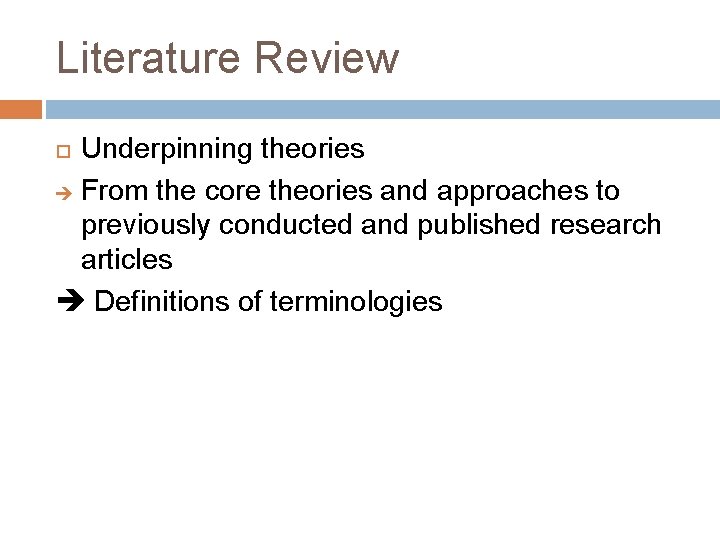
Literature Review Underpinning theories From the core theories and approaches to previously conducted and published research articles Definitions of terminologies
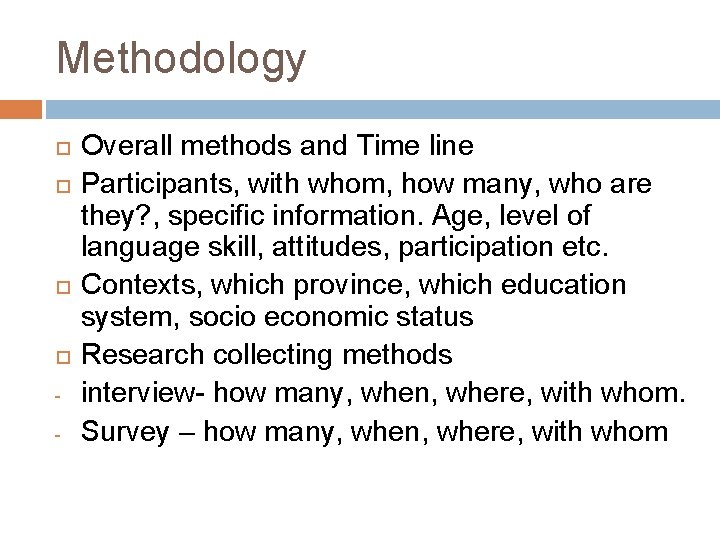
Methodology - Overall methods and Time line Participants, with whom, how many, who are they? , specific information. Age, level of language skill, attitudes, participation etc. Contexts, which province, which education system, socio economic status Research collecting methods interview- how many, when, where, with whom. Survey – how many, when, where, with whom
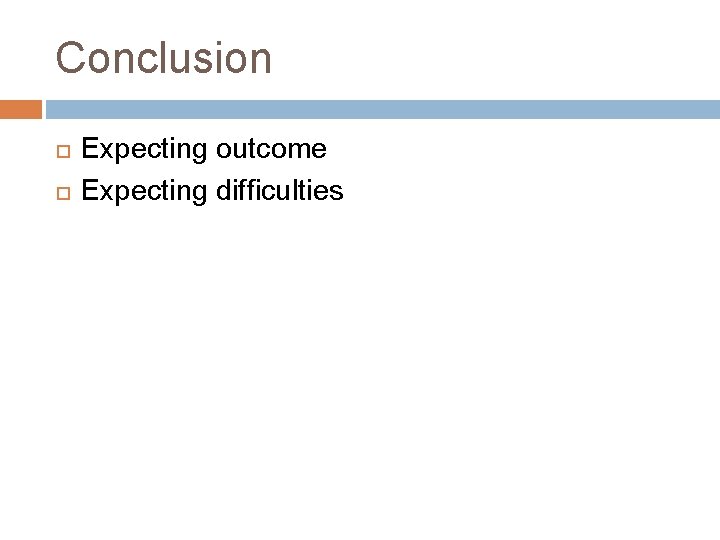
Conclusion Expecting outcome Expecting difficulties
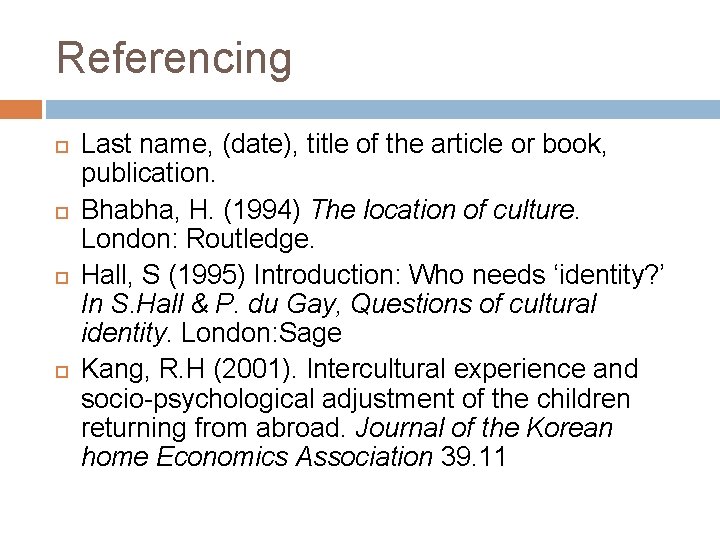
Referencing Last name, (date), title of the article or book, publication. Bhabha, H. (1994) The location of culture. London: Routledge. Hall, S (1995) Introduction: Who needs ‘identity? ’ In S. Hall & P. du Gay, Questions of cultural identity. London: Sage Kang, R. H (2001). Intercultural experience and socio-psychological adjustment of the children returning from abroad. Journal of the Korean home Economics Association 39. 11
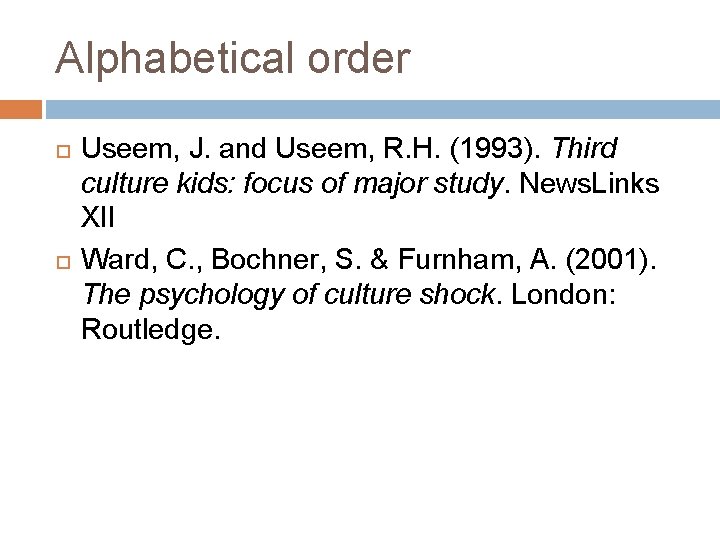
Alphabetical order Useem, J. and Useem, R. H. (1993). Third culture kids: focus of major study. News. Links XII Ward, C. , Bochner, S. & Furnham, A. (2001). The psychology of culture shock. London: Routledge.
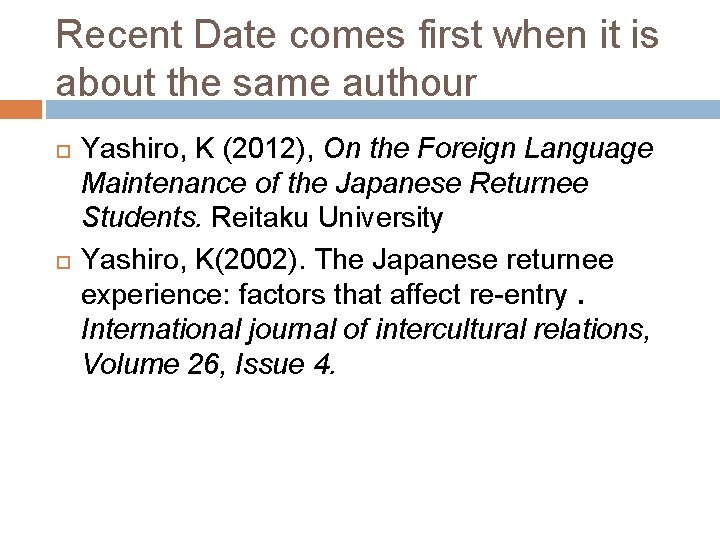
Recent Date comes first when it is about the same authour Yashiro, K (2012), On the Foreign Language Maintenance of the Japanese Returnee Students. Reitaku University Yashiro, K(2002). The Japanese returnee experience: factors that affect re-entry. International journal of intercultural relations, Volume 26, Issue 4.
Homework Find two different survey questionnaires. One good and the other bad example. Explanation is needed using the book. Read chapter 11.