
Interviews and Focus Groups Interview Types Structured Semistructured












- Slides: 37
Interviews and Focus Groups
Interview Types Structured, Semi-structured, Unstructured
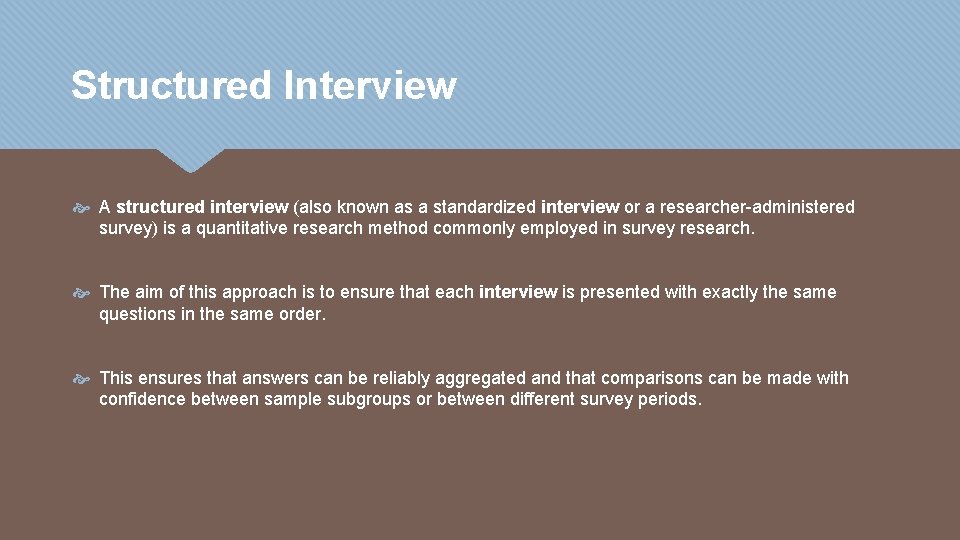
Structured Interview A structured interview (also known as a standardized interview or a researcher-administered survey) is a quantitative research method commonly employed in survey research. The aim of this approach is to ensure that each interview is presented with exactly the same questions in the same order. This ensures that answers can be reliably aggregated and that comparisons can be made with confidence between sample subgroups or between different survey periods.
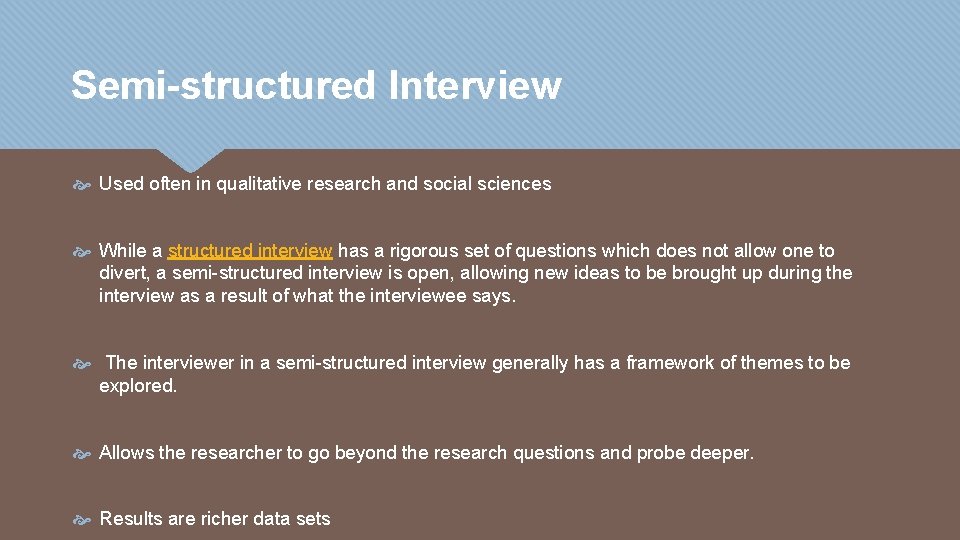
Semi-structured Interview Used often in qualitative research and social sciences While a structured interview has a rigorous set of questions which does not allow one to divert, a semi-structured interview is open, allowing new ideas to be brought up during the interview as a result of what the interviewee says. The interviewer in a semi-structured interview generally has a framework of themes to be explored. Allows the researcher to go beyond the research questions and probe deeper. Results are richer data sets
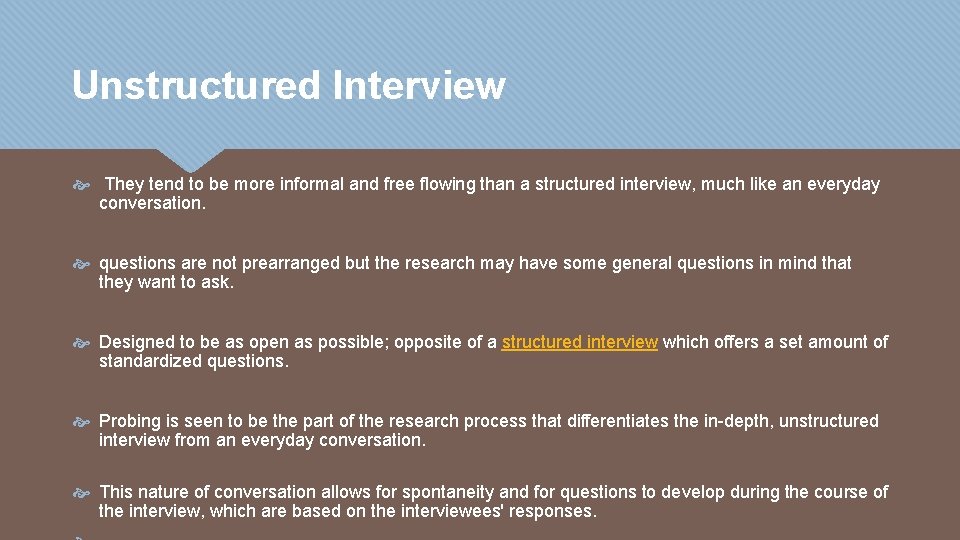
Unstructured Interview They tend to be more informal and free flowing than a structured interview, much like an everyday conversation. questions are not prearranged but the research may have some general questions in mind that they want to ask. Designed to be as open as possible; opposite of a structured interview which offers a set amount of standardized questions. Probing is seen to be the part of the research process that differentiates the in-depth, unstructured interview from an everyday conversation. This nature of conversation allows for spontaneity and for questions to develop during the course of the interview, which are based on the interviewees' responses.
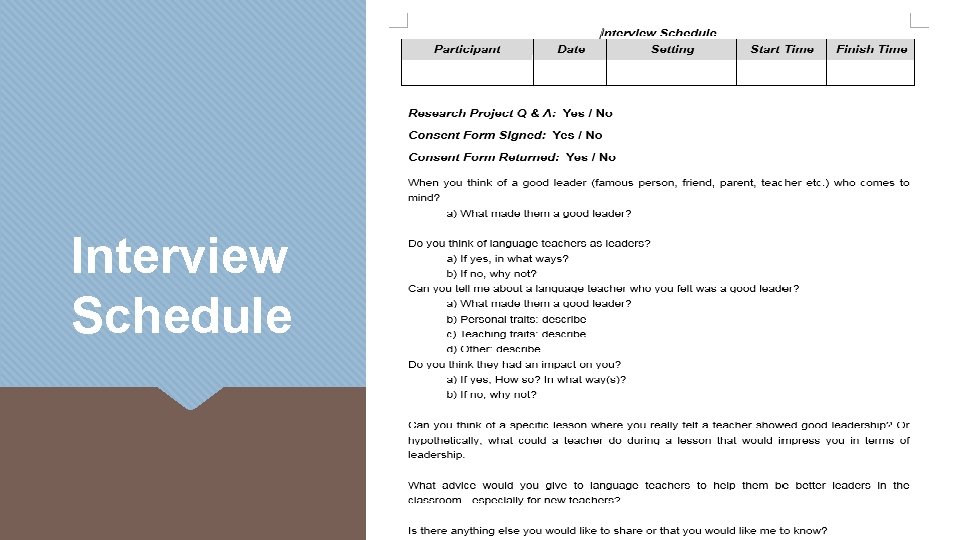
Creating an Interview Schedule
Interview Schedule
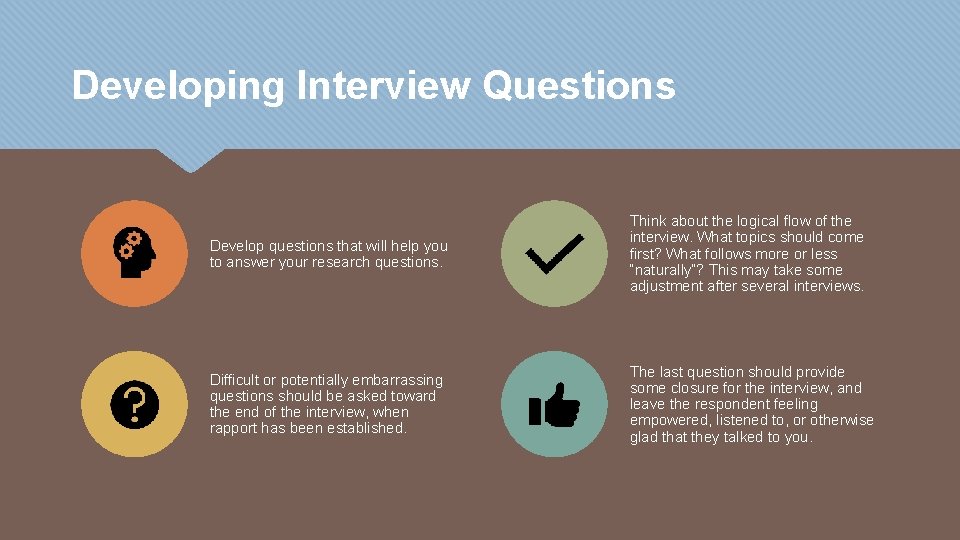
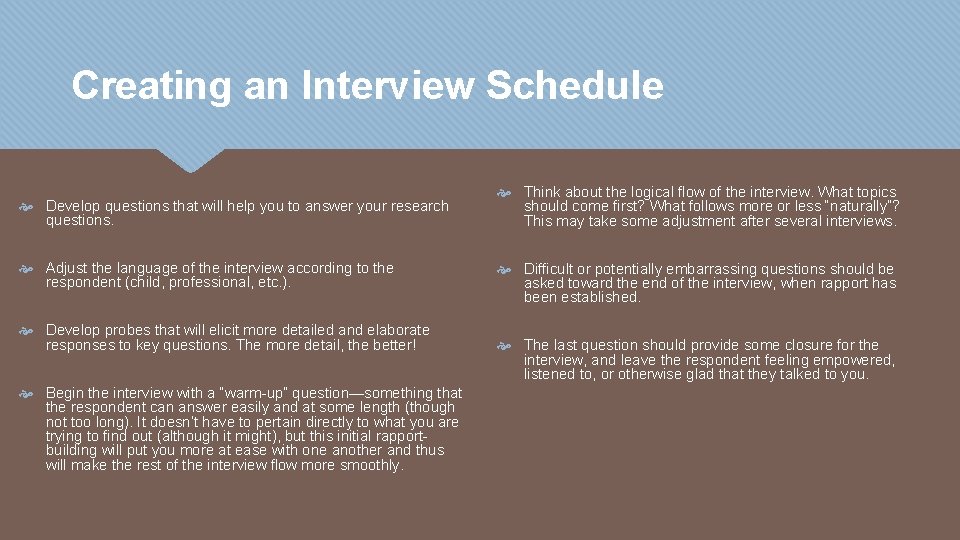
Developing Interview Questions Develop questions that will help you to answer your research questions. Think about the logical flow of the interview. What topics should come first? What follows more or less “naturally”? This may take some adjustment after several interviews. Difficult or potentially embarrassing questions should be asked toward the end of the interview, when rapport has been established. The last question should provide some closure for the interview, and leave the respondent feeling empowered, listened to, or otherwise glad that they talked to you.
Develop probes that will elicit more detailed and elaborate responses to key questions. The more detail, the better!
Adjust the language of the interview according to the respondent (child, professional, etc. ).
Begin the interview with a “warm-up” question—something that the respondent can answer easily and at some length (though not too long). It doesn’t have to pertain directly to what you are trying to find out (although it might), but this initial rapport-building will put you more at ease with one another and thus will make the rest of the interview flow more smoothly.
Creating an Interview Schedule Develop questions that will help you to answer your research questions. Adjust the language of the interview according to the respondent (child, professional, etc. ). Develop probes that will elicit more detailed and elaborate responses to key questions. The more detail, the better! Begin the interview with a “warm-up” question—something that the respondent can answer easily and at some length (though not too long). It doesn’t have to pertain directly to what you are trying to find out (although it might), but this initial rapportbuilding will put you more at ease with one another and thus will make the rest of the interview flow more smoothly. Think about the logical flow of the interview. What topics should come first? What follows more or less “naturally”? This may take some adjustment after several interviews. Difficult or potentially embarrassing questions should be asked toward the end of the interview, when rapport has been established. The last question should provide some closure for the interview, and leave the respondent feeling empowered, listened to, or otherwise glad that they talked to you.
Types of Questions
Direct questions Indirect questions Follow-up questions Probing questions Specifying questions Interpreting questions
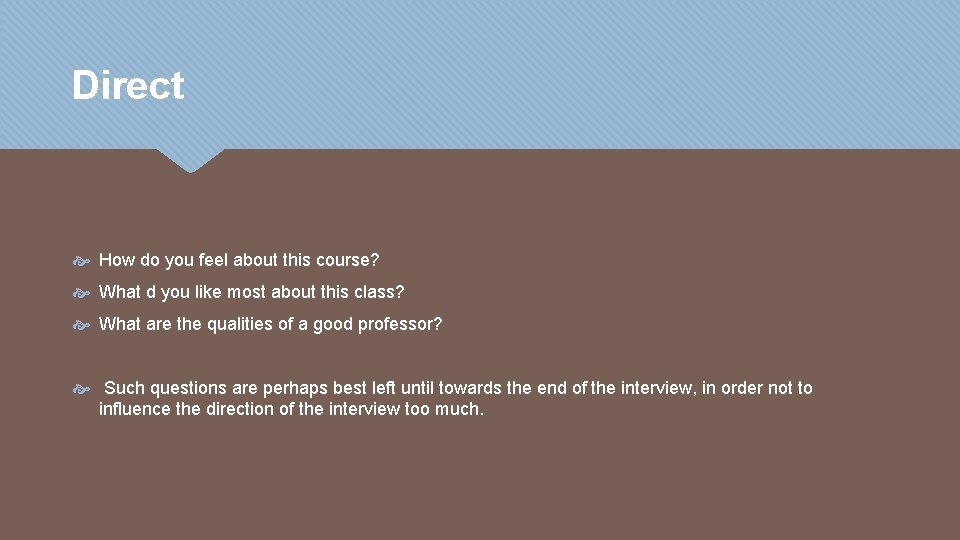
Direct How do you feel about this course? What d you like most about this class? What are the qualities of a good professor? Such questions are perhaps best left until towards the end of the interview, in order not to influence the direction of the interview too much.
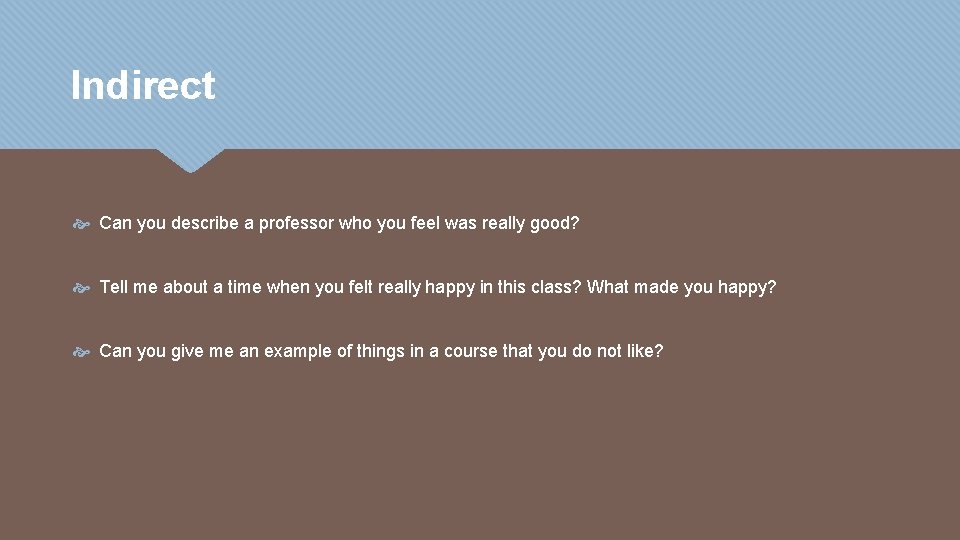
Indirect Can you describe a professor who you feel was really good? Tell me about a time when you felt really happy in this class? What made you happy? Can you give me an example of things in a course that you do not like?
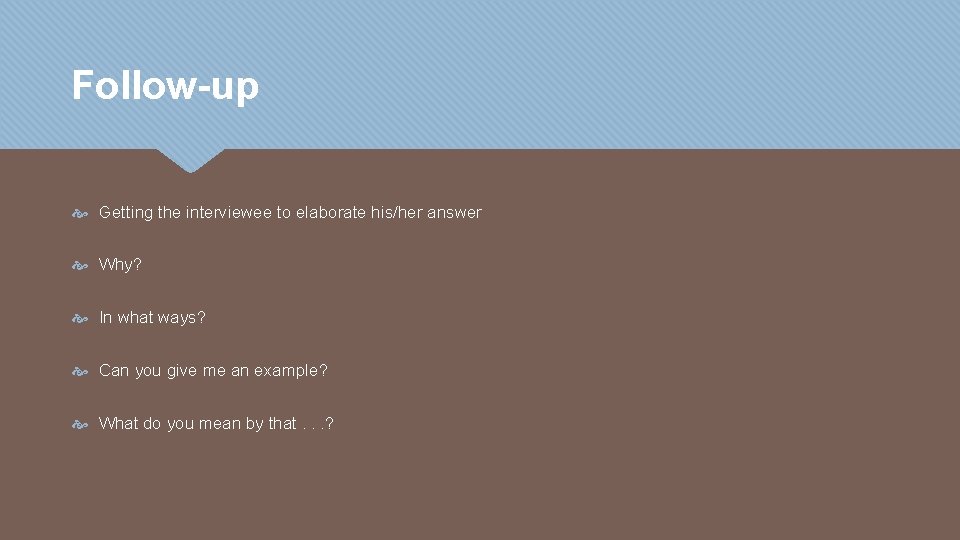
Follow-up Getting the interviewee to elaborate his/her answer Why? In what ways? Can you give me an example? What do you mean by that. . . ?
Probing Can you tell me more about that? Anything else you can think of?
Specifying questions What exactly do you mean by that?
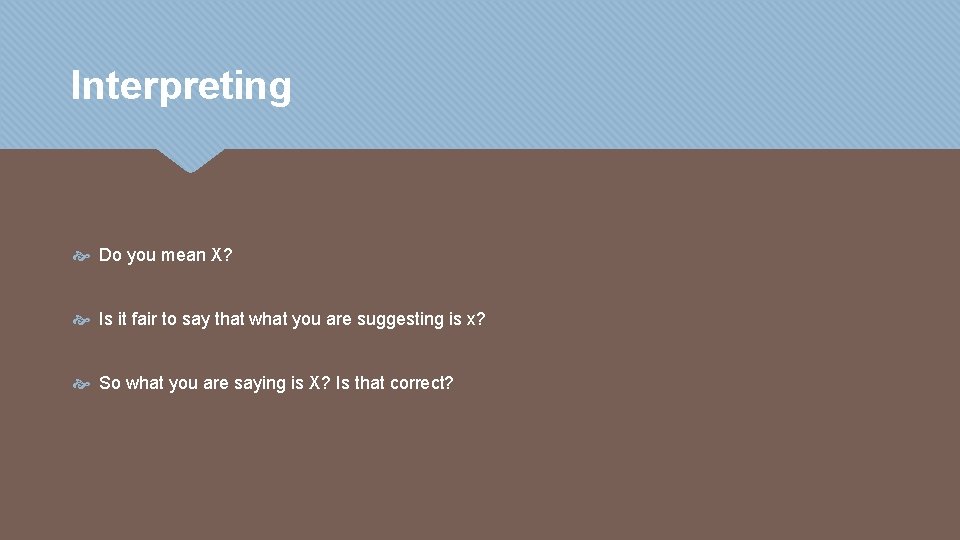
Interpreting Do you mean X? Is it fair to say that what you are suggesting is x? So what you are saying is X? Is that correct?
Direct questions Indirect questions Follow-up questions Probing questions Specifying questions Interpreting questions
Today’s Task Create your own interview schedule You can use the template I have provided You can download it from profgwhitehead. weebly. com
The Interview
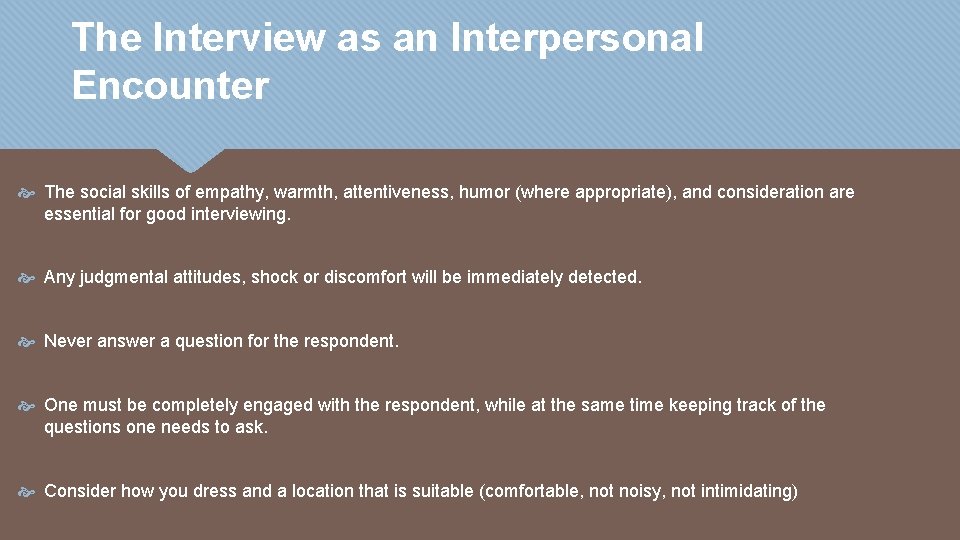
The Interview as an Interpersonal Encounter The social skills of empathy, warmth, attentiveness, humor (where appropriate), and consideration are essential for good interviewing. Any judgmental attitudes, shock or discomfort will be immediately detected. Never answer a question for the respondent. One must be completely engaged with the respondent, while at the same time keeping track of the questions one needs to ask. Consider how you dress and a location that is suitable (comfortable, not noisy, not intimidating)
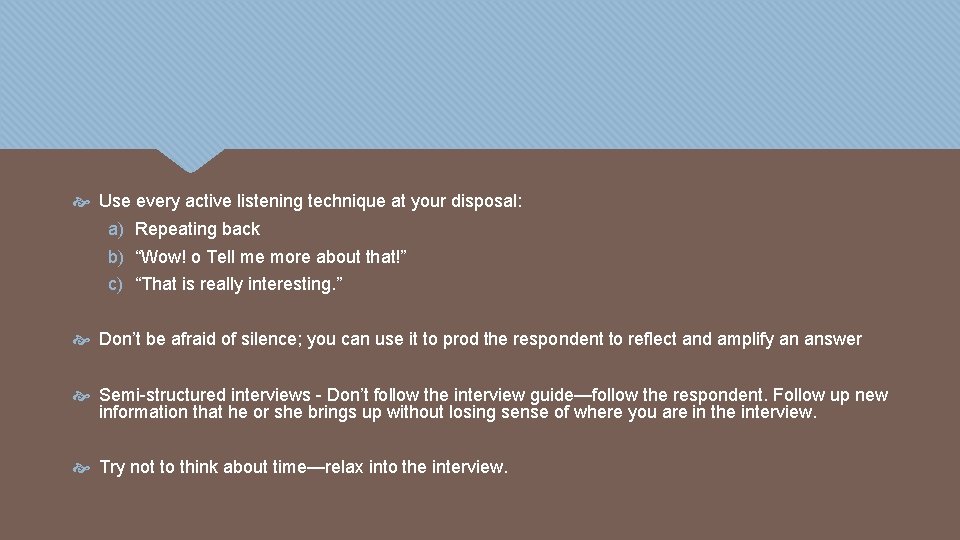
Use every active listening technique at your disposal: a) Repeating back b) “Wow! o Tell me more about that!” c) “That is really interesting. ” Don’t be afraid of silence; you can use it to prod the respondent to reflect and amplify an answer Semi-structured interviews - Don’t follow the interview guide—follow the respondent. Follow up new information that he or she brings up without losing sense of where you are in the interview. Try not to think about time—relax into the interview.
Steps in Conducting an Interview
Decide on who your respondents will be and how many you plan to interview.
Prepare an interview schedule that will guide you through the process.
1. Decide an appropriate location to conduct the interviews. a) Somewhere quiet b) Low distraction
Recruit participants
5. Conduct the Interview a) Explain the purpose of the study b) Get informed consent c) Proceed with the interview d) Debrief e) Thank them
Transcribe the interview
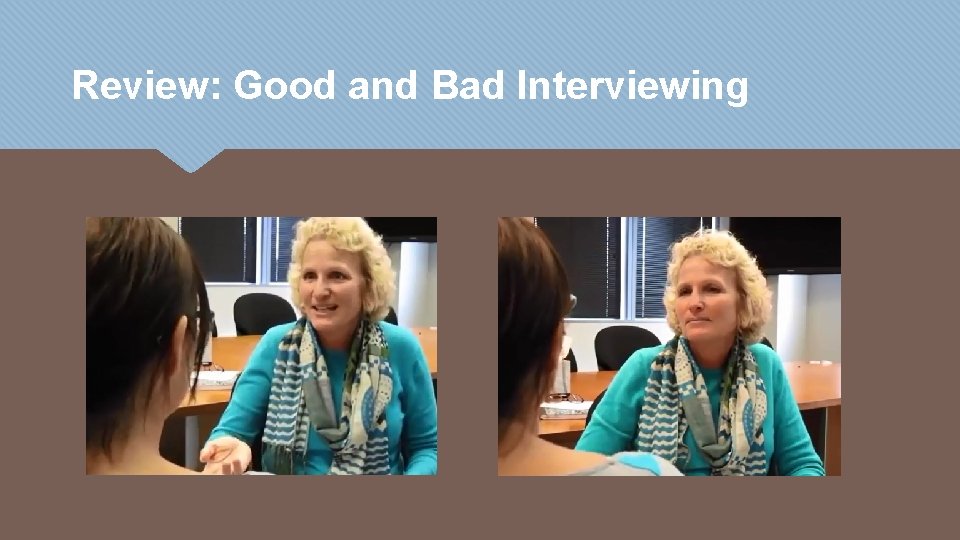
Review: Good and Bad Interviewing
Interviewing Practice What do you need to do before you interview?
Preparing for the interview Debriefing about the study Be sure to prepare an audio recording device and ask the participant if it is ok for you to record the interview Put the recorder in a non-intrusive place (that does not distract you or the interviewee but can still get a clear audio sample)
TIPS Make the participant feel relaxed Go with the flow of the conversation not necessarily the questions Be sure to ask follow up questions
After the interview Thank them for their time Give them time to ask you any other questions they may have