
Interviewing for Employment and Following Up Prentice Hall
- Slides: 26
Interviewing for Employment and Following Up © Prentice Hall, 2008 Excellence in Business Communication, 8 e 1
Employment Messages • • Application letters Inquiry letters Application forms Follow-up notes © Prentice Hall, 2008 Excellence in Business Communication, 8 e 2
Tips for Application Letters • • • Specify the kind of opportunity Know the company and the job Withhold salary information Keep it short Show some personality Check grammar, spelling, punctuation © Prentice Hall, 2008 Excellence in Business Communication, 8 e 3
Types of Application Letters • Solicited • Unsolicited – Getting attention – Building interest – Increasing desire – Motivating action © Prentice Hall, 2008 Excellence in Business Communication, 8 e 4
Application Follow-Ups • Exhibit interest • Show persistence • Update application © Prentice Hall, 2008 Excellence in Business Communication, 8 e 5
Employment Interviews • Organization’s objective – Match applicants with the organization • Applicant’s objective – Match goals and abilities with the job © Prentice Hall, 2008 Excellence in Business Communication, 8 e 6
Typical Interview Sequence • Screening stage • Selection stage • Final stage © Prentice Hall, 2008 Excellence in Business Communication, 8 e 7
Types of Interviews • Structured • Open-ended • Group • Situational • Behavioral • Working • Stress © Prentice Hall, 2008 Excellence in Business Communication, 8 e 8
Interview Media • • • E-mail Telephone Instant messaging Virtual online systems Videoconferencing © Prentice Hall, 2008 Excellence in Business Communication, 8 e 9
What Employers Look For • Fit with the organization – Personality – Background – Style • Qualifications for the job – Knowledge – Skills – Abilities © Prentice Hall, 2008 Excellence in Business Communication, 8 e 10
Preemployment Testing • Integrity tests • Personality tests • Job-skills tests • Substance tests • Background checks © Prentice Hall, 2008 Excellence in Business Communication, 8 e 11
Preparing for the Interview • • • Learn about the organization Think ahead about questions Build your confidence Polish your interview style Plan to look good Arrive prepared © Prentice Hall, 2008 Excellence in Business Communication, 8 e 12
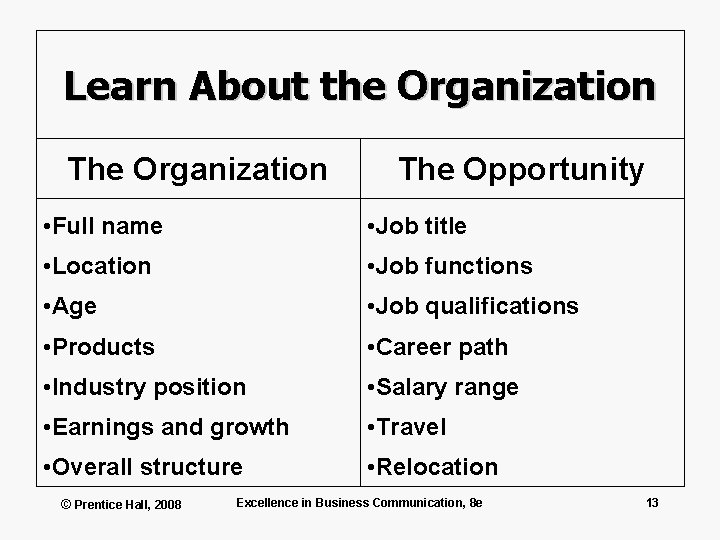
Learn About the Organization The Opportunity • Full name • Job title • Location • Job functions • Age • Job qualifications • Products • Career path • Industry position • Salary range • Earnings and growth • Travel • Overall structure • Relocation © Prentice Hall, 2008 Excellence in Business Communication, 8 e 13
Planning for Questions • Skills • Goals • Achievements • Interests • Attitudes • Relationships © Prentice Hall, 2008 Excellence in Business Communication, 8 e 14
Prepare Some Questions • • Are these my kind of people? Can I do this work? Will I enjoy the work? Do I want this job? Does the job pay what I’m worth? Who will be my supervisor? What kind of future can I expect? © Prentice Hall, 2008 Excellence in Business Communication, 8 e 15
Bolster Your Confidence • Manage your apprehension • Emphasize positive traits • Focus on your strengths © Prentice Hall, 2008 Excellence in Business Communication, 8 e 16
Polish Your Interview Style • Confidence • Poise • Good manners • Good judgment – Mock interviews – Nonverbal skills – Voice training © Prentice Hall, 2008 Excellence in Business Communication, 8 e 17
Plan to Look Good • Conservative clothing • Appropriate accessories • Good grooming © Prentice Hall, 2008 Excellence in Business Communication, 8 e 18
Be Ready When You Arrive • Paperwork • Travel time • Waiting time © Prentice Hall, 2008 Excellence in Business Communication, 8 e 19
The Interview Process • Screening interview – Differentiate yourself • Initial selection interview – Cover your strong points • Final interview – Emphasize your personality © Prentice Hall, 2008 Excellence in Business Communication, 8 e 20
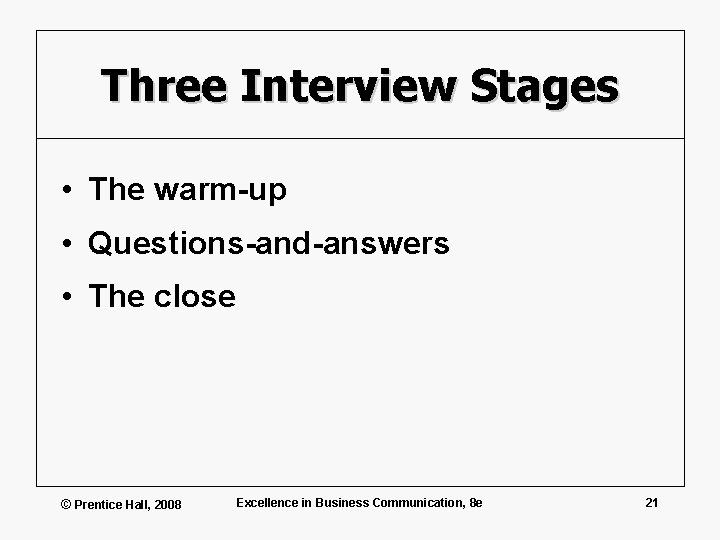
Three Interview Stages • The warm-up • Questions-and-answers • The close © Prentice Hall, 2008 Excellence in Business Communication, 8 e 21
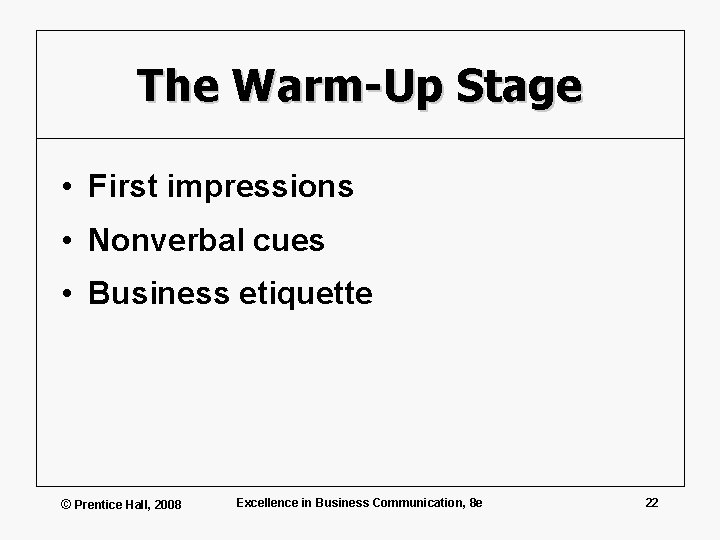
The Warm-Up Stage • First impressions • Nonverbal cues • Business etiquette © Prentice Hall, 2008 Excellence in Business Communication, 8 e 22
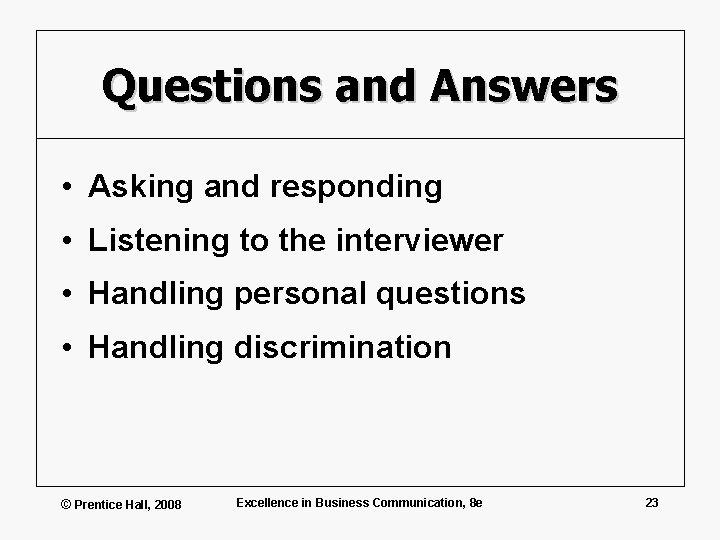
Questions and Answers • Asking and responding • Listening to the interviewer • Handling personal questions • Handling discrimination © Prentice Hall, 2008 Excellence in Business Communication, 8 e 23
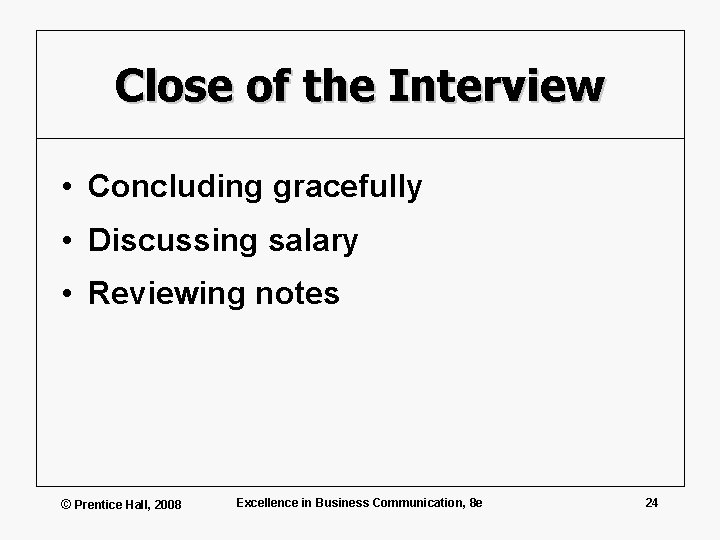
Close of the Interview • Concluding gracefully • Discussing salary • Reviewing notes © Prentice Hall, 2008 Excellence in Business Communication, 8 e 24
Following Up After the Interview • Thank-you messages • Inquiry messages © Prentice Hall, 2008 Excellence in Business Communication, 8 e 25
More Follow-up Messages • Requesting a time extension • Accepting a job offer • Declining a job offer • Resigning from a job © Prentice Hall, 2008 Excellence in Business Communication, 8 e 26