
Interview Two way conversation Interrogation Adversarial questioning Accusatory

- Slides: 32
• Interview – Two way conversation • Interrogation – Adversarial questioning – Accusatory
Interviews • Conducted as soon as possible after an incident • Separate witnesses to avoid melding of their recollection of the event • The witness talks and you listen – carefully • Introduce yourself • Have pertinent info about the case or the reason for the questioning before you begin the interview • Know as much as you can about the person you are interviewing – if possible
Interview • Schedule a time if possible – make sure it is enough time for a complete interview • Video or audio recording is best – take notes only if you have to • Signed statement upon conclusion of interview • Interviewee places initials at beginning and end of each paragraph
Interrogation • Miranda • MCJA mandate to record custodial interrogations • “Record” includes… – Digital – Electronic – Audio – Video – Other recording equipment
Custodial Interrogation • A reasonable person would consider that person to be in custody in view of the circumstances • The person is asked a question by a LEO that is likely to elicit an incriminating response
Serious Crimes • At a minimum, all Class A, B and C crimes in: Chapter 9 - Offenses Against the Person • Chapter 11 – Sexual Assaults • Chapter 12 – Sexual Exploitation of Minors • Chapter 13 – Kidnapping and Criminal Restraint • Chapter 27 – Robbery • Of the Maine Criminal Code and all corresponding juvenile offenses
Recording Requirement Exceptions • Not feasible – including equipment malfunction • Spontaneous statements not in response to interrogation • Statements made in response to questions routinely asked during the booking process • Statements made during custodial interrogation when the investigator is unaware that a serious crime has occurred • When the person who is the subject of the interrogation refuses to have the interrogation recorded – in writing or on a recording
• https: //www. youtube. com/watch? v=EUNJBw O 2 Bo. A
Suspect ID • Show ups – 99. 9% of time – don’t do them – Suggestive • Photo Line up – Sequential – one at a time – Simultaneous – all at once – Blind administrator – person showing does not know who is the suspect – On a scale of one to ten….
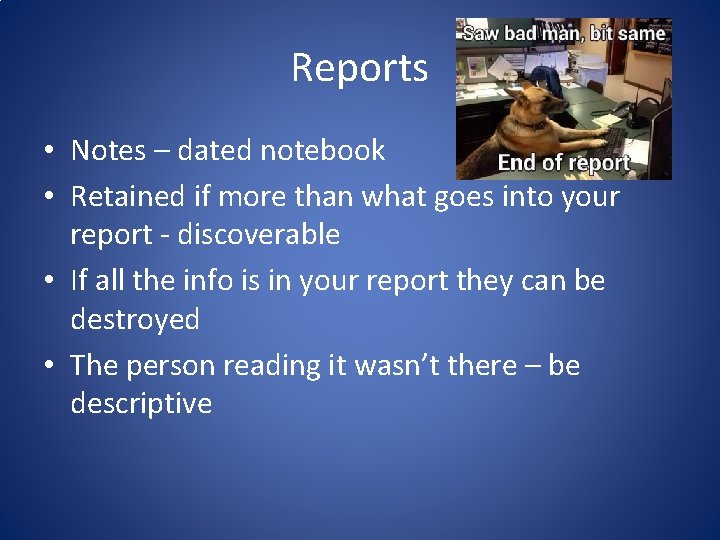
Reports • Notes – dated notebook • Retained if more than what goes into your report - discoverable • If all the info is in your report they can be destroyed • The person reading it wasn’t there – be descriptive
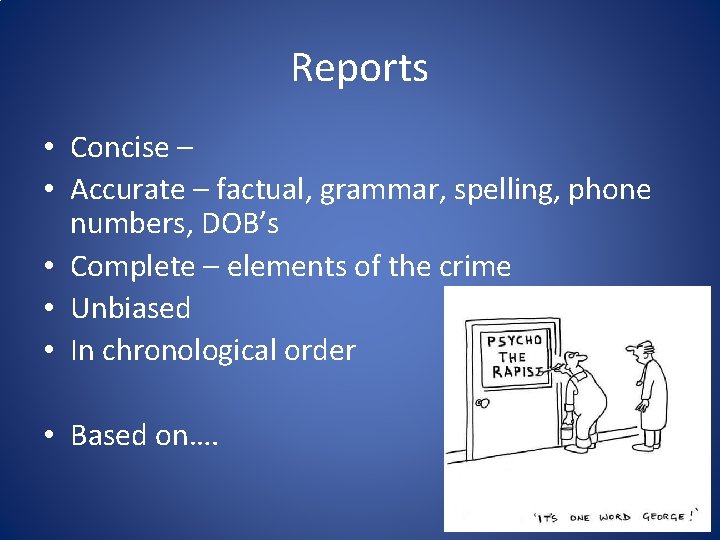
Reports • Concise – • Accurate – factual, grammar, spelling, phone numbers, DOB’s • Complete – elements of the crime • Unbiased • In chronological order • Based on….
Reports • Witness statements – written by the officer • First person – I went to… • Explain abbreviations the first time they are used – Cumberland County Jail (CCJ) • Proofread • Your reports are how you build a reputation – good or bad
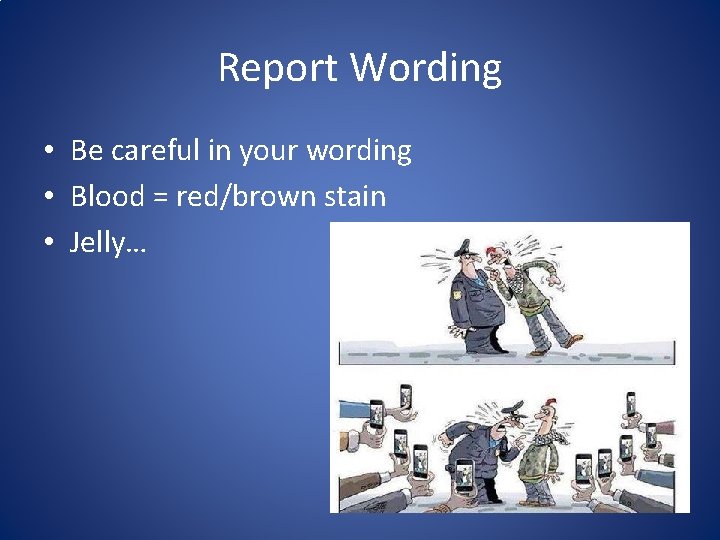
Report Wording • Be careful in your wording • Blood = red/brown stain • Jelly…
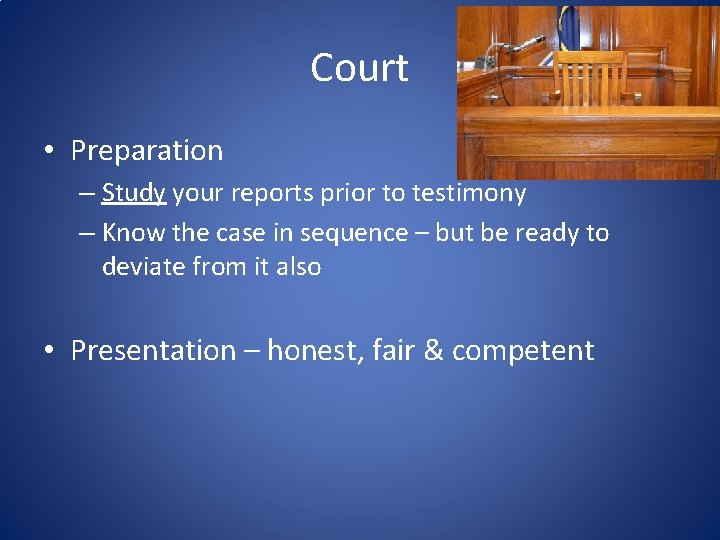
Court • Preparation – Study your reports prior to testimony – Know the case in sequence – but be ready to deviate from it also • Presentation – honest, fair & competent
Court • Know your report & have 2 copies • Defense has a right to review what you are referring to • Review any transcripts from previous testimony (hearings or Grand Jury)
Court • Grand Jury • Pretrial interviews with prosecutor – Specific questions – Potential defense questions – Make them aware of any mistakes • Meetings with defense attorney – Review of evidence – Prosecutor must be aware – Pay attention to what they pay attention to
• Testimony Court – Sequestration order in effect – Know the courtroom – Dress appropriately – no uniforms allowed in Superior Court – Refer to report if necessary – know if there are mistakes in that report – Listen to the question then look at the jury – look at the back row and scan – Multiple questions – “You’ve asked me several questions – which would you like me answer first? ”
Court • Be calm • Think about how the jury is looking at you • You build a reputation with the judges and attorneys based on your testimony • Don’t use police lingo – use simple, conversational English • Answer what you’re asked – don’t volunteer anything else • You are educating the jury
Court • Be aware of demeanor and body language when completing direct examination and beginning cross examination • Don’t become argumentative or confrontational when speaking with the defense attorney • Listen to their questions carefully and clarify if necessary • DO NOT take it personally – they are trying to knock you off balance
Court • More than a “yes” or “no” required… • Correct mistakes – with the permission of the judge • “To be honest with you…” • If the judge talks or an objection is made – stop talking • Overly friendly defense attorney = knife in the back • Prepare…Present…Leave
Mandatory Reporting of Officer’s Use of Deadly Force • Use of physical force that causes death or serious bodily injury • Use of physical force under circumstances that in fact create a substantial risk of causing death or serious bodily injury – even if they don’t result • Use of physical force when it is the officers intent to cause death or serious bodily injury – whether or not either actually occur
Mandatory Reporting of Officer’s Use of Deadly Force • The discharge of a firearm in the general direction of another person or at a moving vehicle; whether or not the projectile hits the person or vehicle – Less-lethal not necessary to report – Pointing – even loaded & cocked – not necessary to report • Ramming an occupied vehicle • A roadblock set up to terminate a pursuit when a risk of causing death or serious bodily injury to the fleeing vehicle AND results in either
Use of Force in Defense of Premises • A Person – In possession or control – Or licensed or privileged • Of a premise – Includes land, private ways and any buildings thereon • May use non-deadly force • Necessary to prevent or terminate criminal trespass
Use of Force in Defense of Premises • • A Person In possession or control Or licensed or privileged May use deadly force – To prevent arson – In defense of a person • Within a dwelling place – To prevent criminal trespass – To prevent the commission of a crime – Must demand the trespasser cease • Unless doing so would be dangerous
Physical Force in Defense of a Person • A person may use a reasonable degree of nondeadly force – To defend themselves or a third party from • A reasonable belief of the imminent use of unlawful, non-deadly force – Except: • When the person provoked – Unless the person withdrew and communicated that intent • The force was a product of agreed combat
Physical Force in Defense of a Person • A person is justified in using deadly force upon another person – When that person reasonably believes it necessary and reasonably believes such other person: • Is about to use unlawful, deadly force against the person or a 3 rd person • Is (or is about to) commit kidnapping or robbery against the person or a 3 rd person • Has entered a dwelling place (without consent or authorization) and deadly force is necessary to prevent bodily injury upon the person or a 3 rd person
Physical Force in Law Enforcement • A LEO is justified in using a reasonable degree of non-deadly force – To affect an arrest or prevent escape (reasonable belief) – In self-defense or defense of a 3 rd person (reasonable belief) • A LEO is justified in using deadly force only when the LEO reasonably believes it’s necessary – Self-defense or defense of a 3 rd person from the reasonable belief of the imminent use of unlawful deadly force
Non-deadly Force by LEO • Degree of non-deadly force must be reasonable – Reasonable officer @ scene not in hindsight • Officer must reasonably believe that nondeadly force is necessary to make an arrest or prevent escape • If the officer knows the arrest or detention is illegal – NO force is justified
Physical Force in Law Enforcement • A LEO is justified in using deadly force only when the LEO reasonably believes it’s necessary – To prevent the escape from arrest of a person • Who’s committed a dangerous crime • And who’s failure to apprehend is likely to result in more violence • The LEO must make a reasonable attempt to warn • The LEO reasonably believes the escapee knows the LEO is attempting to prevent the escape
Parker v. Gerrish (2008) • Court upholds jury verdict of $111 k for use of excessive force • Parker stopped for OUI – overall compliant • 3 officers on scene • Tased after not immediately unclasping his wrist after one wrist was handcuffed • Court decides based on: – Seriousness of the offense – Didn’t pose an immediate threat to officer safety – Not actively resisting or attempting to flee
21 Foot Rule • “How CLOSE is TOO CLOSE? ” • March 1983 issue of SWAT Magazine • Shooter and runner stand back to back • Runner breaks free and runs away • Upon sensing movement the shooter turns to shoot
21 Foot Rule • 21 feet is a conservative distance • Assumes first shot is on target – not always the case • Diagonal movement more effective • Practice…practice