
Interview Techniques The Basics Know where you are
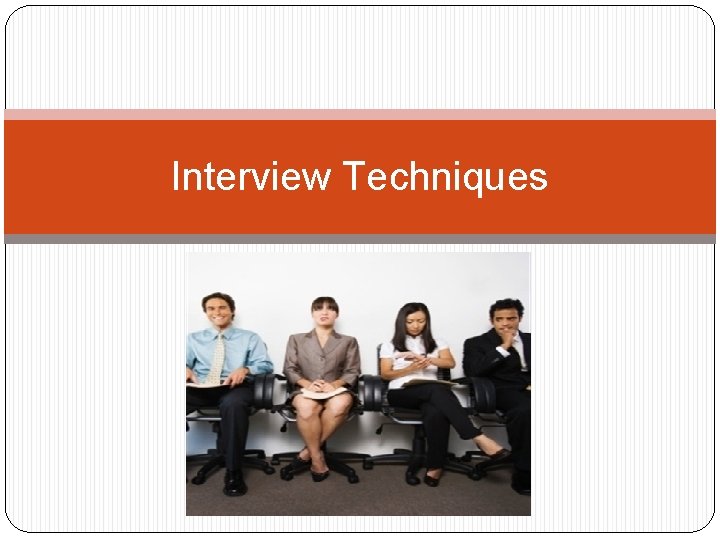
Interview Techniques
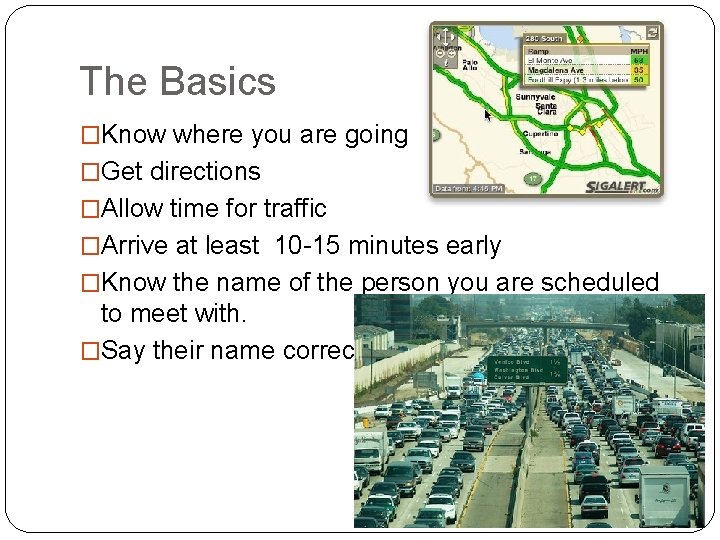
The Basics �Know where you are going �Get directions �Allow time for traffic �Arrive at least 10 -15 minutes early �Know the name of the person you are scheduled to meet with. �Say their name correctly
10 ways to win the interview � 1. Be prepared �Bring an extra copy of your resume �Arrive early � 2. Dress appropriately � 3. Be confident �don't mistake confidence for conceit/arrogance
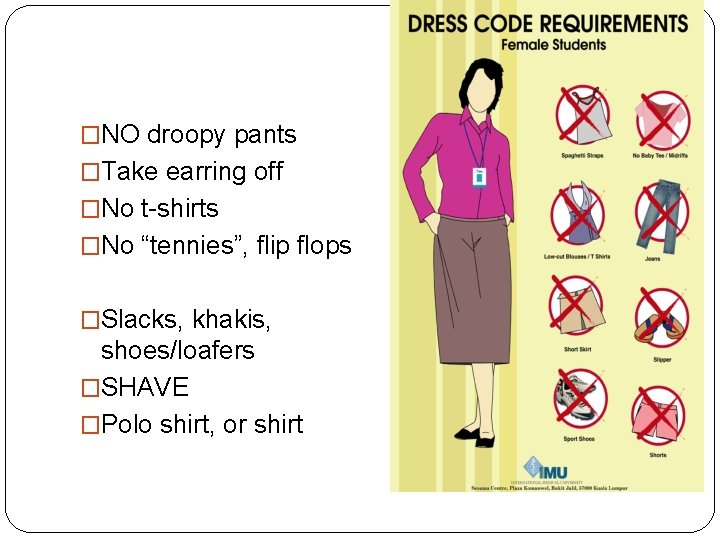
�NO droopy pants �Take earring off �No t-shirts �No “tennies”, flip flops �Slacks, khakis, shoes/loafers �SHAVE �Polo shirt, or shirt
10 ways to win the interview � 4. Make eye contact �Look the interviewer in the eye- but don’t stare �If more than one person, you must meet all eyes, and shift gaze � 5. Show your enthusiasm �Seem excited and energetic but not phony
10 ways to win an interview � 6. Know the position �Know something about the industry you’re applying for �Find out as much as you can about the position �Find out what your duties will be
10 ways to win an interview � 7. Know the industry/school � 8. Know the company �Add in a fact that you find on their website � 9. Practice �Practice answering questions they might ask. More on this later
10 ways to win an interview � 10. Follow up �After interview be sure to follow up with a short and friendly note thanking them for the interview �The note will help keep you name at the forefront of the interviewers mind. �Within 24 hours
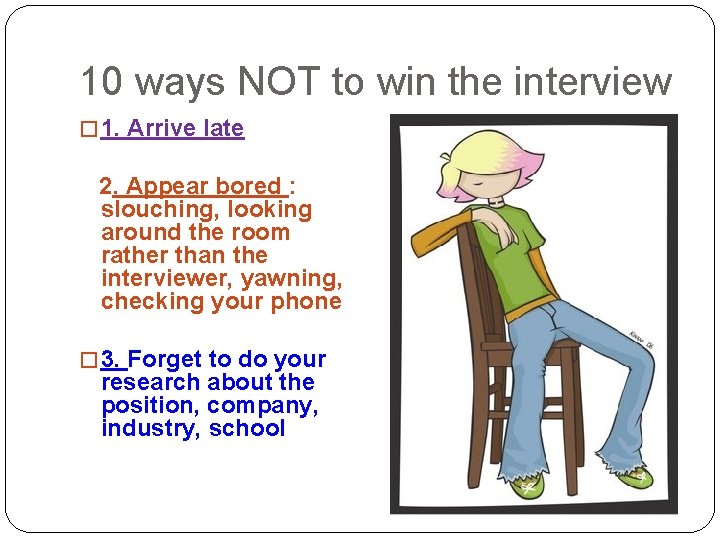
10 ways NOT to win the interview � 1. Arrive late 2. Appear bored : slouching, looking around the room rather than the interviewer, yawning, checking your phone � 3. Forget to do your research about the position, company, industry, school
Mrs. Flores’ tips �Have minty breath �Do a nose check
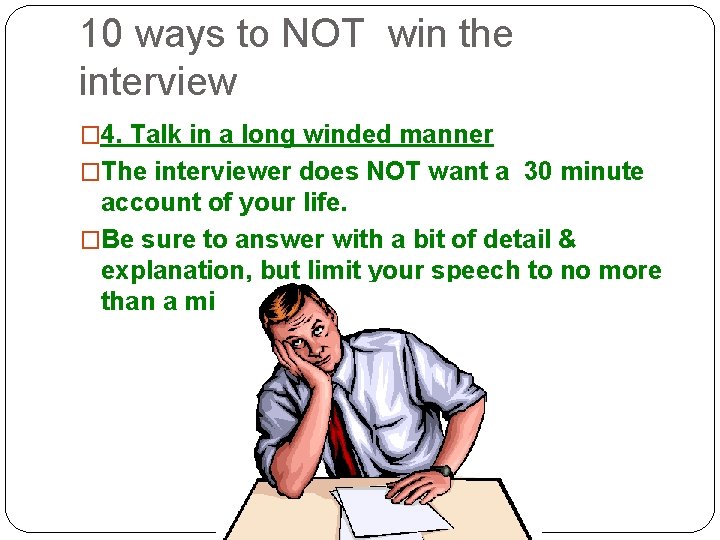
10 ways to NOT win the interview � 4. Talk in a long winded manner �The interviewer does NOT want a 30 minute account of your life. �Be sure to answer with a bit of detail & explanation, but limit your speech to no more than a minute of two
10 ways to NOT win an interview � 5. Speak too briefly. �Answers should be brief, but a simple yes or not is never enough � 6. Speak in a negative manner �Don’t bad mouth your current employer. This shows a negative attitude. �Always make a negative experience a positive learning experience.
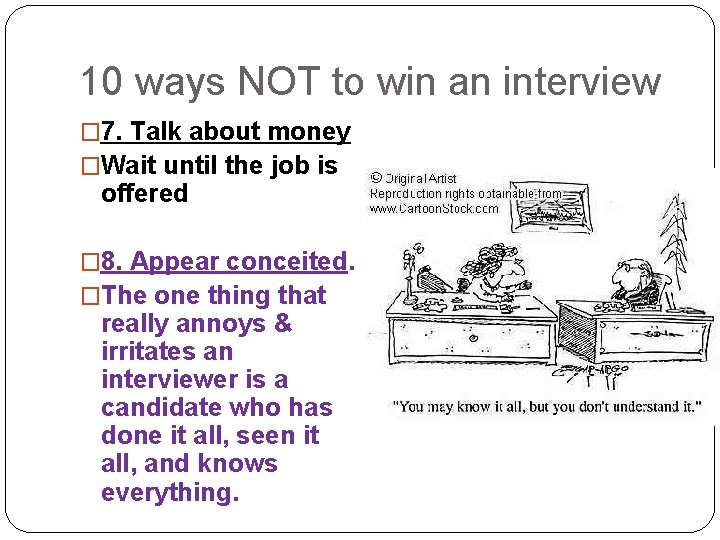
10 ways NOT to win an interview � 7. Talk about money �Wait until the job is offered � 8. Appear conceited. �The one thing that really annoys & irritates an interviewer is a candidate who has done it all, seen it all, and knows everything.
10 ways NOT to win an interview � 9. Share unrealistic goals. �Like saying you want to be the vice president of the company in five years- this shows the interviewer that you know nothing about the company or your job. � 10. Appear unkempt. �Don’t have dirty, wrinkled, torn clothes �Keep facial hair neat, brush hair, clean fingernails ( short for men)
17 things that turn them off immediately �Scratching your head �Biting your lips �Raising your eyebrows incredulously �Shifting in your seat �Crossing arms or displaying superior or conceited or overbearing body signals �Looking down/avoiding eye contact �Keeping hands in pockets �Not using any hand gestures �Rocking �Slouching �Self-touching �Jiggling your leg �Twisting your hair �Clicking your pen �Biting your nails
Waiting for the interview. �Go up to the front desk etc, and politely say “Hi, my name is ______. I have an interview for a job with ______. �Sit patiently with a book, no slouching. �Sit straight up. No slouching. �Smile at everyone. Be polite to everyone. You never know who you will be dealing or working with, or who has input. �When interviewer comes, get up, introduce yourself, shake hands, make eye contact. Thank them for opportunity to interview with them. �Walking demonstration. It matters!!!
Interview Don’ts �Don’t look at your watch, clock, or cell phone �Don’t mimic the body language or mannerisms of the interviewer ( people do this when they get nervous) �Don’t be negative �Don’t talk too much �Don’t ask about money, perks or things that are unrelated to the job or company �Don't interrogate the interviewer
The 1 st defining moments: 100 milliseconds or 10 th of a second �Wait patiently for the interview. Don’t fidget. Bring a book. �Introduce yourself. Shake their hand while looking them in the eye �Engage in small talk �Be prepared with something to say if you have to “walk down the hall” ( usually weather related) �Don’t sit down until asked or it is indicated
�If the interviewer asks “Did you have any problems finding us” or “how was your drive” they are NOT really interested in the traffic or if you got lost. The interviewer does NOT want to hear how your had trouble finding the place, your car has no air-conditioning, and parking is horrible �Respond �“Fine” or “no problem”
Qualities the interviewer is looking for Adaptability Competence Confidence Creativity Dedication dependability �Easygoingness �Enthusiasm �leadership ability �Motivation �Problem solving ability �resourcefulness
After the interview � Ask what the next step in the hiring process is? � Will they call you? � How long until they make a decision? � Get a card from the interviewer. � Send a short Thank you for the interview note. � This is done so rarely that it makes a big impression. � When is the interview over? � Interviewer will shuffle paperwork, gather things, and/or stand up. � That’s your cue. Stand up. Shake hands, thank them, and leave.
Mrs. Flores’ tips �Read their body language. �If an interview doesn’t think you have the social or perceiving skills to “read” and understand normal body language, they will also assume ( rightly) that you cannot use it effectively on the job. �Don’t � scratch �Pick lint off your clothes �Look at your nails �play with your hair �Self touching
Questions they may ask �What are your key skills? �Discuss specific key skills and how you will use them in the workplace. �Avoid clichés or generalities �What sets you apart from other applicants? �Your answer should show confidence in your abilities without sounding conceited. �A good way to illustrate your worth is to talk about what other past & present employers say about you.
Questions they may ask � What are your strengths? � Describe 2 or 3 skills you have that are most relevant to the position. Don’t say “ I’m a people person. ” � For each strength you give be prepared to back it up with an example � What are your weaknesses? � This is a trick!!!!!!! � This question is really one that can make or break you. � Be honest BUT don’t shoot yourself in the foot. Try to think of a weakness that is not too big of a deal, and discuss how you are overcoming it. � Or make your weakness a strength.
Questions they might ask �Tell me about yourself. �This is the perfect opportunity to sell yourself to an employer in just a few seconds. �You need to “package” yourself into one small paragraph in which you mention your experience, skills, accomplishments, goals, and personal qualities
Questions they might ask �Tell me about a situation that frustrated you at work. �This is a trick!!!!! �This is another question designed to probe the candidate’s professionalism. �The interviewer will want reassurance that you are able to withstand pressure on the job. � Describe how you remained diplomatic, objective , or professional in a difficult situation
Questions they might ask �Have you ever had to work with a manager who you thought was unfair to you, or who was just plain difficult to get along with? �Don’t fall for this either!!! �No matter how many times an interviewer gives you the opportunity to do so- NEVER criticize a current or past employer. �The employer is trying to discover how easily you are willing to badmouth people.
Questions they might ask �What are some of the things your supervisor has done that you dislike? �Another trick �Discuss a relatively minor example in which the interviewer is likely to empathize. �Put a positive spin on your answer by describing what you learned from this difficult situation
Questions they might ask �Describe a leader you admire. �Caution �Feel free to give personal or popular examples of leaders you believe to be effective. �Do not offend the interviewer & refrain from talking about your admiration for controversial leaders. �Talk about why you admire the person, what lessons you have learned for them, and how you will be able to incorporate those tactics into your own professional life
Most common interview complaints �The candidate : �Lacked enthusiasm �Did not ask the questions or did not ask the right questions �Too fidgety �Did not make enough eye contact �attire was too casual, inappropriate, �Talked too much or not enough

Internet applications
- Slides: 32