
Interventions Strategies Tactics Intervention Strategies Tactics Content and
- Slides: 48
Interventions Strategies & Tactics
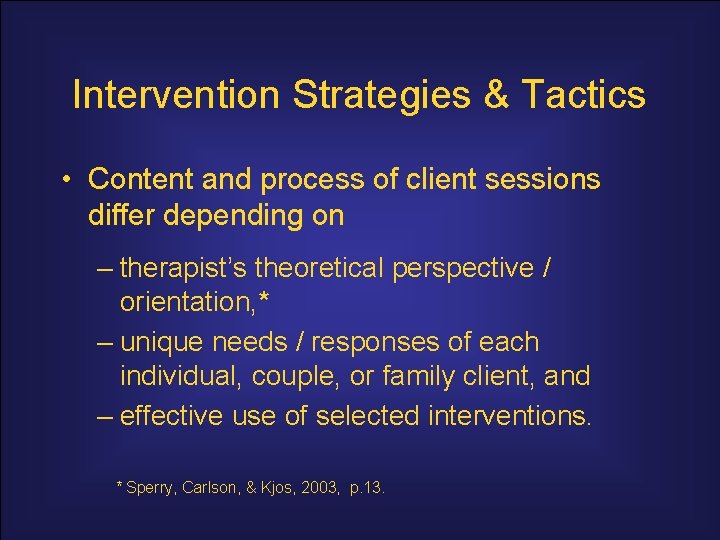
Intervention Strategies & Tactics • Content and process of client sessions differ depending on – therapist’s theoretical perspective / orientation, * – unique needs / responses of each individual, couple, or family client, and – effective use of selected interventions. * Sperry, Carlson, & Kjos, 2003, p. 13.
Interventions Affective
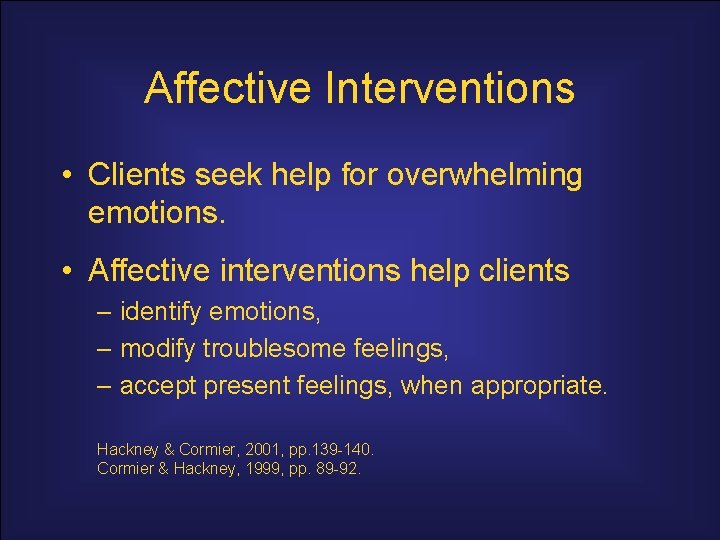
Affective Interventions • Clients seek help for overwhelming emotions. • Affective interventions help clients – identify emotions, – modify troublesome feelings, – accept present feelings, when appropriate. Hackney & Cormier, 2001, pp. 139 -140. Cormier & Hackney, 1999, pp. 89 -92.
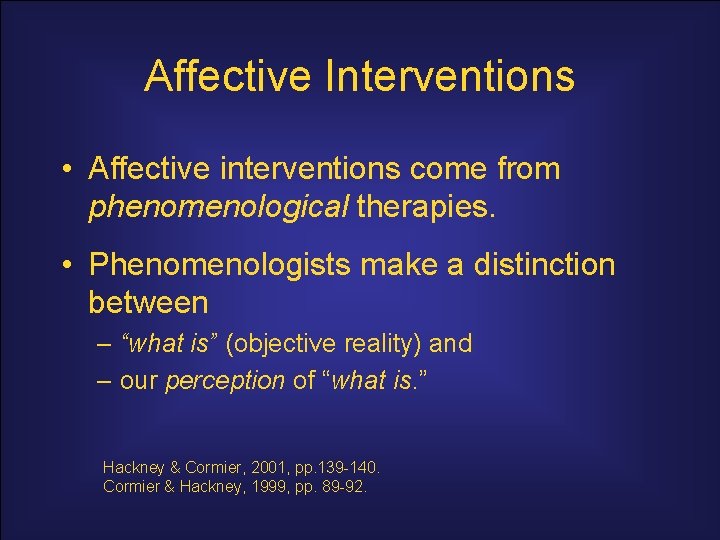
Affective Interventions • Affective interventions come from phenomenological therapies. • Phenomenologists make a distinction between – “what is” (objective reality) and – our perception of “what is. ” Hackney & Cormier, 2001, pp. 139 -140. Cormier & Hackney, 1999, pp. 89 -92.
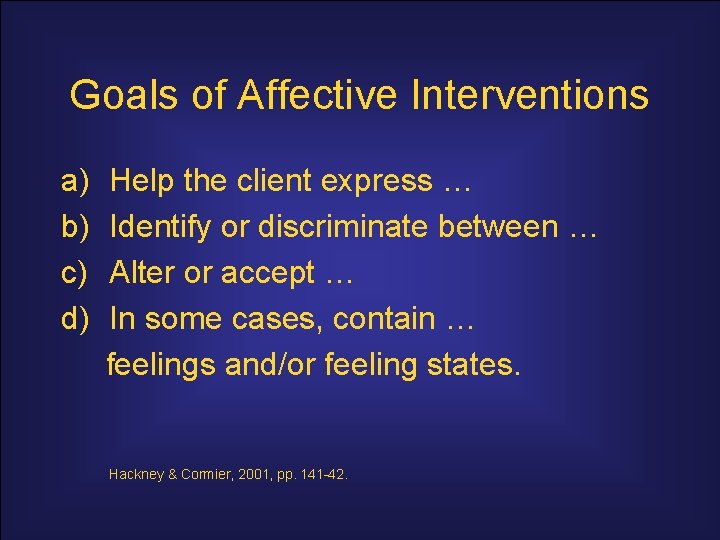
Goals of Affective Interventions a) b) c) d) Help the client express … Identify or discriminate between … Alter or accept … In some cases, contain … feelings and/or feeling states. Hackney & Cormier, 2001, pp. 141 -42.
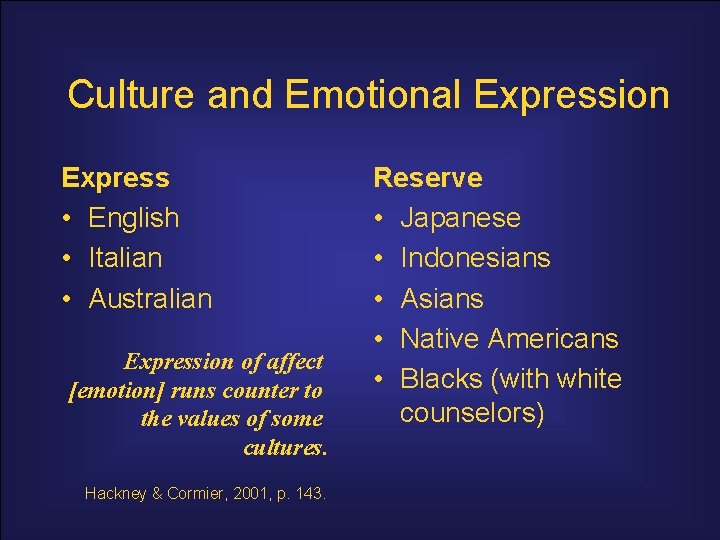
Culture and Emotional Expression Express • English • Italian • Australian Expression of affect [emotion] runs counter to the values of some cultures. Hackney & Cormier, 2001, p. 143. Reserve • Japanese • Indonesians • Asians • Native Americans • Blacks (with white counselors)
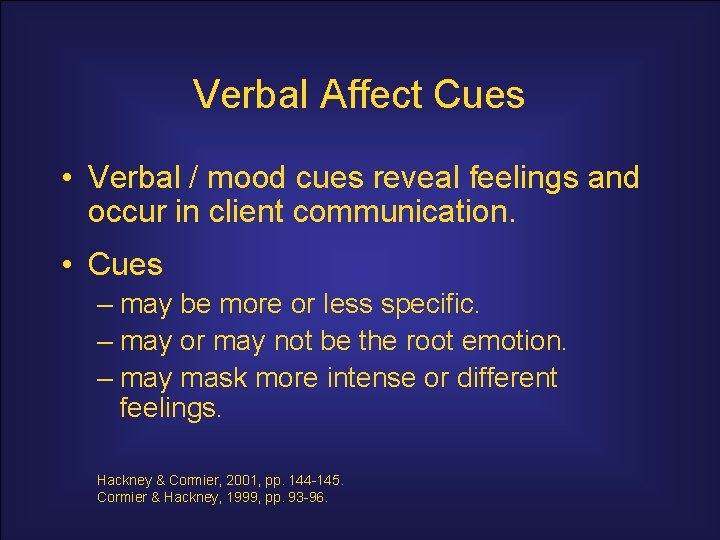
Verbal Affect Cues • Verbal / mood cues reveal feelings and occur in client communication. • Cues – may be more or less specific. – may or may not be the root emotion. – may mask more intense or different feelings. Hackney & Cormier, 2001, pp. 144 -145. Cormier & Hackney, 1999, pp. 93 -96.
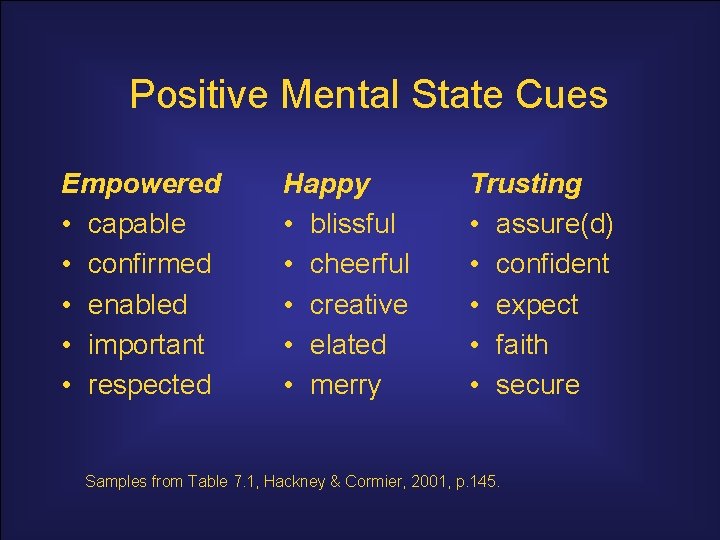
Positive Mental State Cues Empowered • capable • confirmed • enabled • important • respected Happy • blissful • cheerful • creative • elated • merry Trusting • assure(d) • confident • expect • faith • secure Samples from Table 7. 1, Hackney & Cormier, 2001, p. 145.
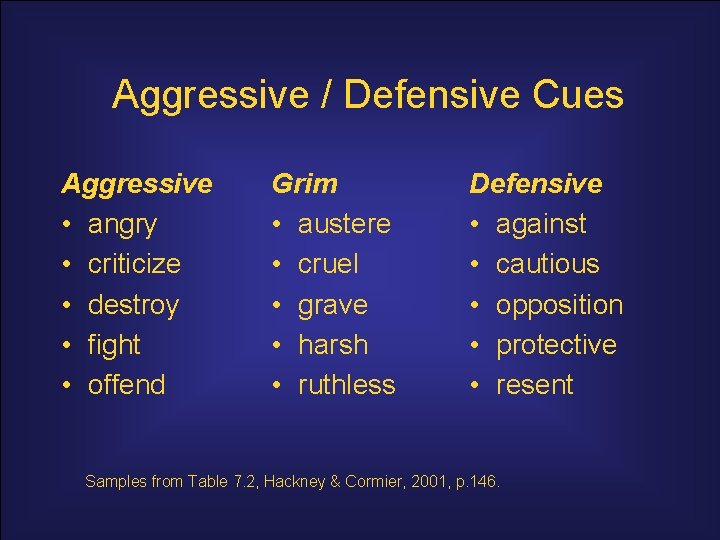
Aggressive / Defensive Cues Aggressive • angry • criticize • destroy • fight • offend Grim • austere • cruel • grave • harsh • ruthless Defensive • against • cautious • opposition • protective • resent Samples from Table 7. 2, Hackney & Cormier, 2001, p. 146.
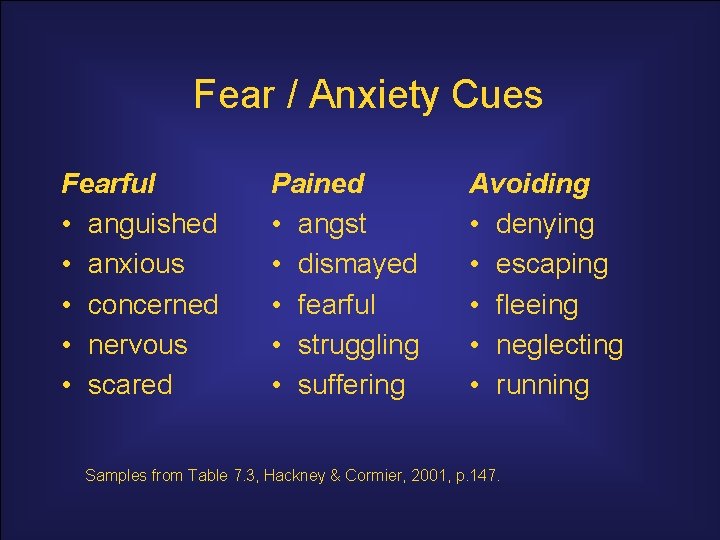
Fear / Anxiety Cues Fearful • anguished • anxious • concerned • nervous • scared Pained • angst • dismayed • fearful • struggling • suffering Avoiding • denying • escaping • fleeing • neglecting • running Samples from Table 7. 3, Hackney & Cormier, 2001, p. 147.
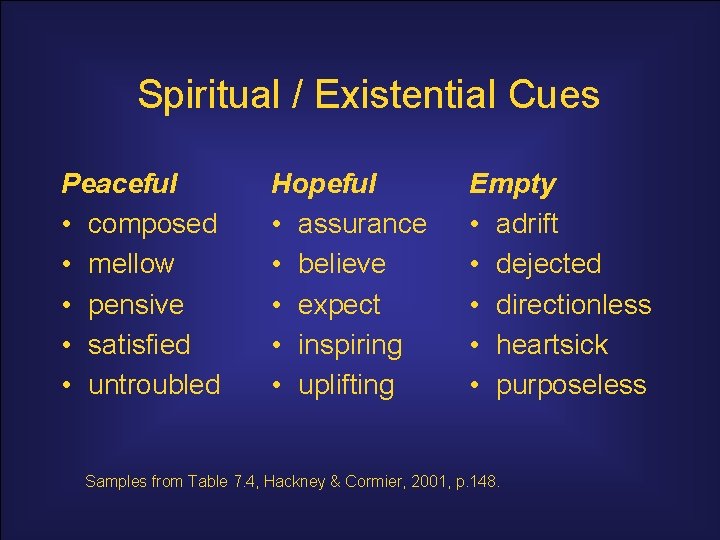
Spiritual / Existential Cues Peaceful • composed • mellow • pensive • satisfied • untroubled Hopeful • assurance • believe • expect • inspiring • uplifting Empty • adrift • dejected • directionless • heartsick • purposeless Samples from Table 7. 4, Hackney & Cormier, 2001, p. 148.
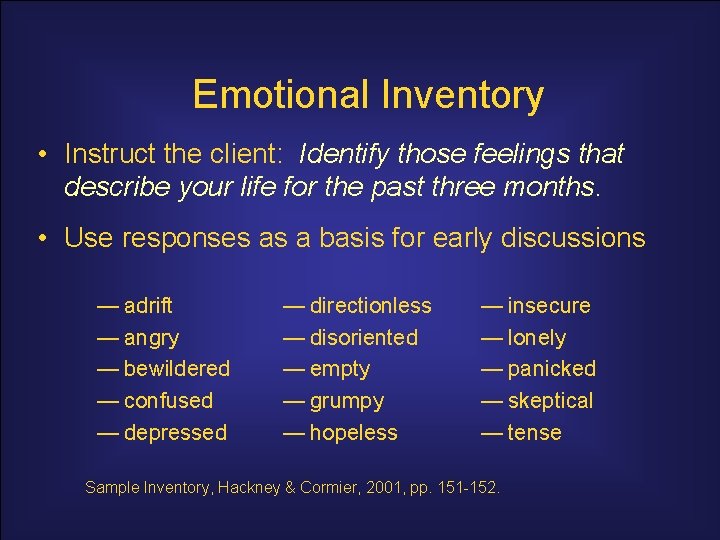
Emotional Inventory • Instruct the client: Identify those feelings that describe your life for the past three months. • Use responses as a basis for early discussions — adrift — angry — bewildered — confused — depressed — directionless — disoriented — empty — grumpy — hopeless — insecure — lonely — panicked — skeptical — tense Sample Inventory, Hackney & Cormier, 2001, pp. 151 -152.
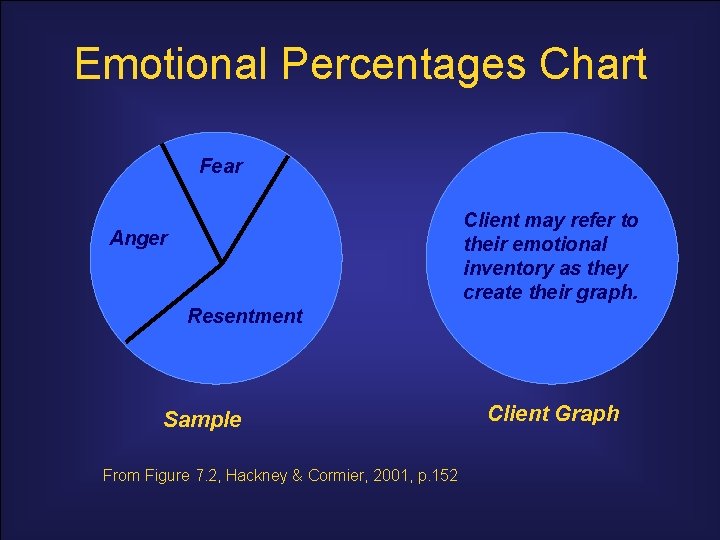
Emotional Percentages Chart • An exercise that allows the client to label the intensity of a particular set of emotions. • Provide the client with a copy of the Emotional Percentages Chart (next slide). • After seeing the sample graph, client completes one for him / herself. • Offers an opportunity to discuss emotional interrelationships. Samples from Table 7. 1, Hackney & Cormier, 2001, p. 145.
Emotional Percentages Chart Fear Client may refer to their emotional inventory as they create their graph. Anger Resentment Sample From Figure 7. 2, Hackney & Cormier, 2001, p. 152 Client Graph
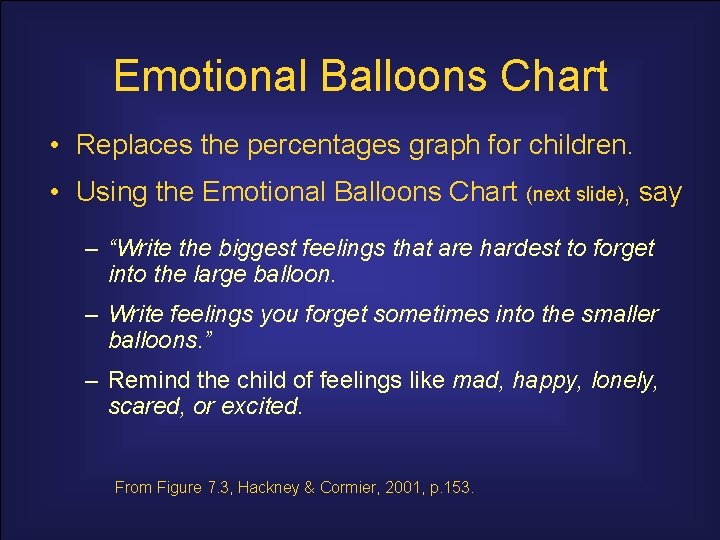
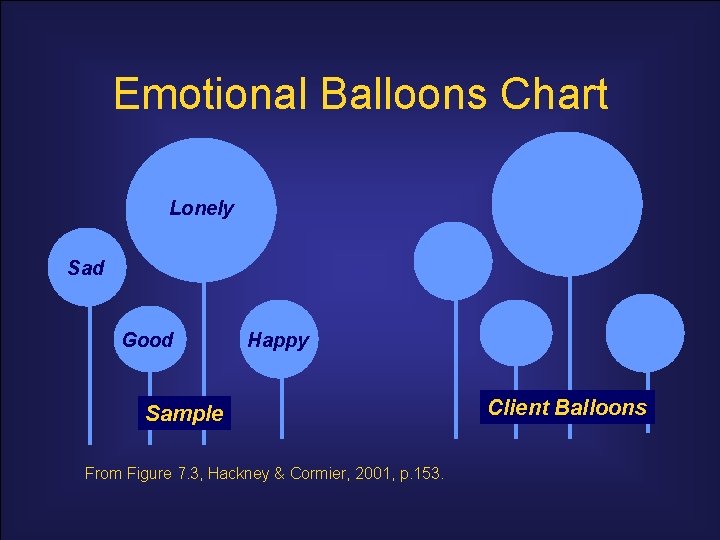
Emotional Balloons Chart • Replaces the percentages graph for children. • Using the Emotional Balloons Chart (next slide), say – “Write the biggest feelings that are hardest to forget into the large balloon. – Write feelings you forget sometimes into the smaller balloons. ” – Remind the child of feelings like mad, happy, lonely, scared, or excited. From Figure 7. 3, Hackney & Cormier, 2001, p. 153.
Emotional Balloons Chart Lonely Sad Good Happy Sample From Figure 7. 3, Hackney & Cormier, 2001, p. 153. Client Balloons
Interventions Cognitive
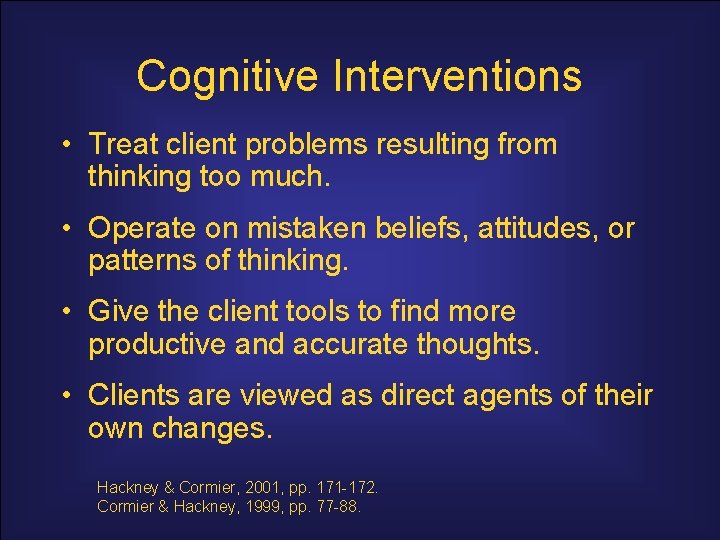
Cognitive Interventions • Treat client problems resulting from thinking too much. • Operate on mistaken beliefs, attitudes, or patterns of thinking. • Give the client tools to find more productive and accurate thoughts. • Clients are viewed as direct agents of their own changes. Hackney & Cormier, 2001, pp. 171 -172. Cormier & Hackney, 1999, pp. 77 -88.
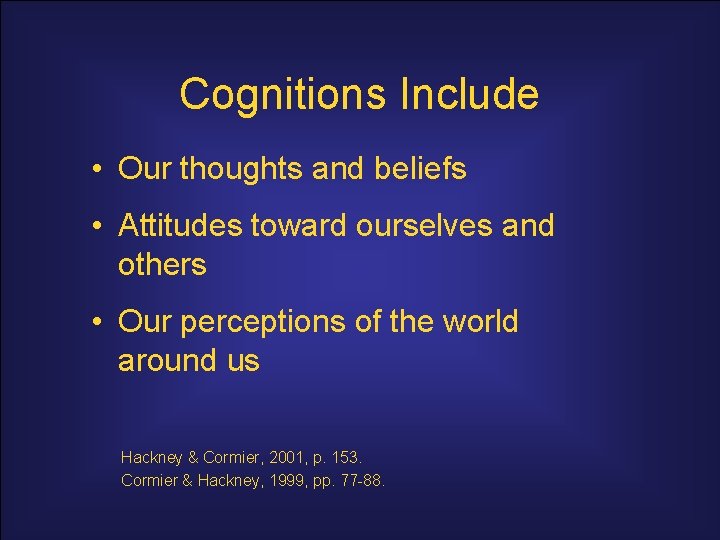
Cognitions Include • Our thoughts and beliefs • Attitudes toward ourselves and others • Our perceptions of the world around us Hackney & Cormier, 2001, p. 153. Cormier & Hackney, 1999, pp. 77 -88.
Cognitions Determine • Who we are. • What we do. • How we feel. Hackney & Cormier, 2001, p. 153. Cormier & Hackney, 1999, pp. 77 -88.
Cognitive Interventions • Clients must choose to – think a particular way, – change the way they think, and/or – participate in (cognitive) intervention(s). Hackney & Cormier, 2001, p. 153. Cormier & Hackney, 1999, pp. 77 -88.
Cognitive Distortions • Assume reality is constructed from childhood experiences. • Clients may have distorted perceptions of self and others. • Together, client and counselor identify and examine perception distortions. Hackney & Cormier, 2001, pp. 173 -174. Cormier & Hackney, 1999, pp. 77 -88.
Cognitive Distortions Identify Help change errors in thinking, • flaws, repair cognitive flaws, • errors, or correct inaccuracies. • inaccuracies. Hackney & Cormier, 2001, pp. 173 -174. Cormier & Hackney, 1999, pp. 77 -88.
Goals of Cognitive Interventions Alter client’s manner of thinking about a specific event, person, Reduce self, Emotional distress and life, etc. Maladaptive behavior patterns. Hackney & Cormier, 2001, p. 173. Cormier & Hackney, 1999, pp. 77 -88.
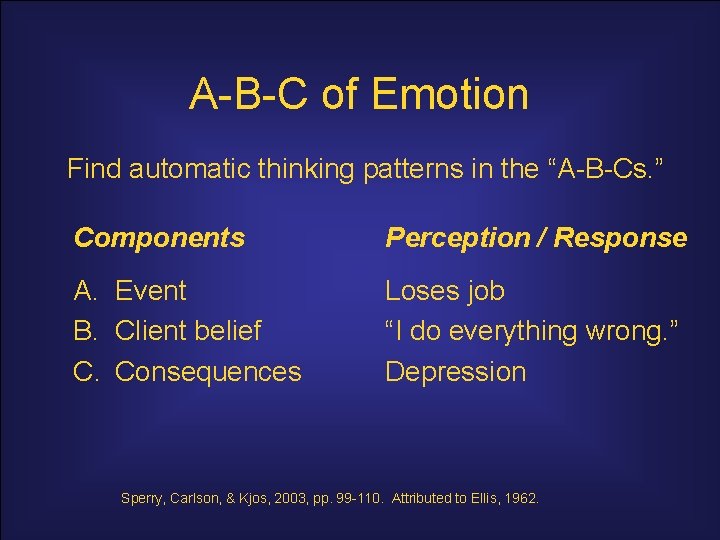
A-B-C of Emotion Find automatic thinking patterns in the “A-B-Cs. ” Components Perception / Response A. Event B. Client belief C. Consequences Loses job “I do everything wrong. ” Depression Sperry, Carlson, & Kjos, 2003, pp. 99 -110. Attributed to Ellis, 1962.
Imagery Reconstruction Ask directly, • • • “What exactly did she say to you? ” “How did you respond? ” “Please express just the same words? ” “How did you feel when you responded? ” “What did she do or say next? ” “What was your reaction. . . ? ” Sperry, Carlson, & Kjos, 2003, pp. 99 -110.
Imagery Reconstruction Reveals and examines patterns of behavior. Clients • • relive / remember an event. become aware of life events. better understand impact of life events. can replicate to create more awareness. Sperry, Carlson, & Kjos, 2003, pp. 99 -110.
Interventions Behavioral
Behavior • Is the outward manifestation of our inner selves. • Communicates to others how we feel and think and who we are. • Is the tool we use to accomplish goals. • May also prevent us from reaching goals. Hackney & Cormier, 2001, pp. 200 -241.
Behavioral Interventions • Examines patterns of consistent behavior – In place so long the client is not aware of when or how the patterns began. – That interfere with client goals. – Exclude helpful behaviors that may further client goals. Hackney & Cormier, 2001, pp. 200 -241.
Behavioral Interventions Share common elements: 1. Clients present learned, maladaptive behavior. 2. Adaptive behaviors can be learned / strengthened. Maladaptive behavior can be weakened or eliminated. Hackney & Cormier, 2001, pp. 200 -241.
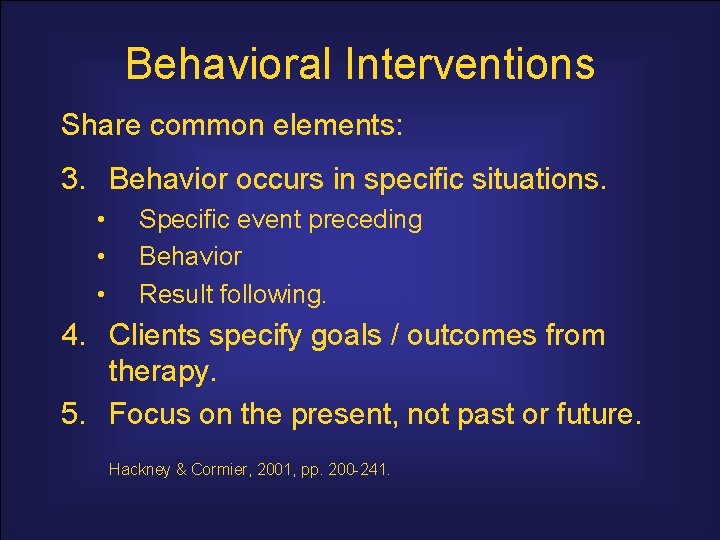
Behavioral Interventions Share common elements: 3. Behavior occurs in specific situations. • • • Specific event preceding Behavior Result following. 4. Clients specify goals / outcomes from therapy. 5. Focus on the present, not past or future. Hackney & Cormier, 2001, pp. 200 -241.
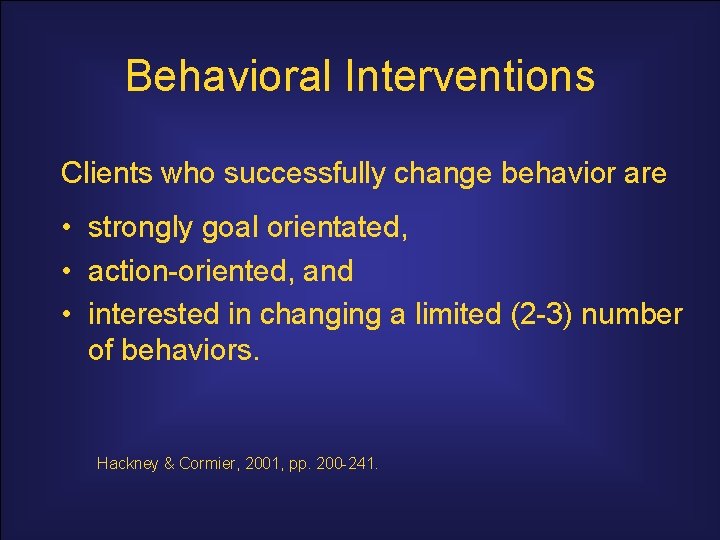
Behavioral Interventions Clients who successfully change behavior are • strongly goal orientated, • action-oriented, and • interested in changing a limited (2 -3) number of behaviors. Hackney & Cormier, 2001, pp. 200 -241.
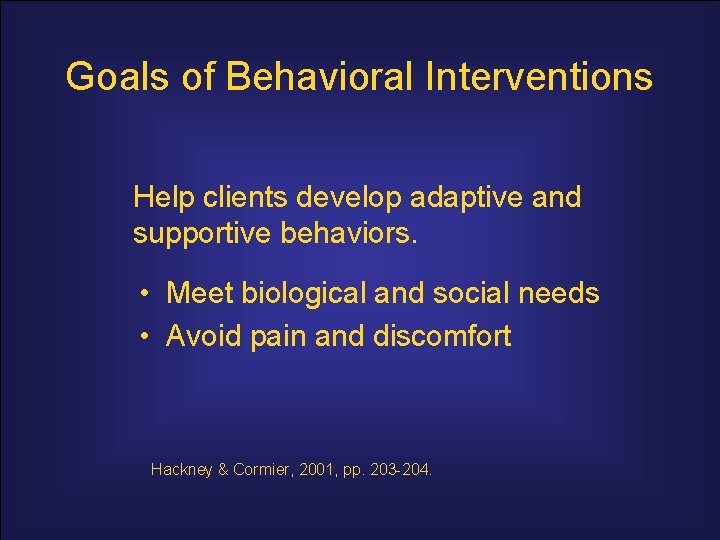
Goals of Behavioral Interventions Help clients develop adaptive and supportive behaviors. • Meet biological and social needs • Avoid pain and discomfort Hackney & Cormier, 2001, pp. 203 -204.
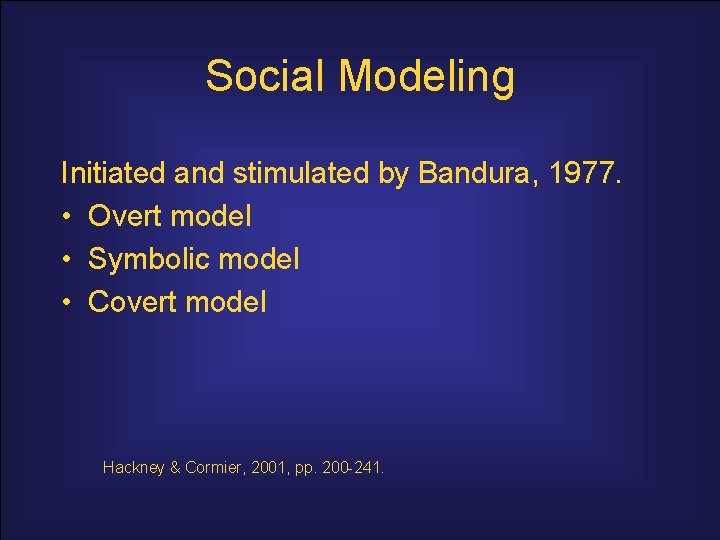
Social Modeling Initiated and stimulated by Bandura, 1977. • Overt model • Symbolic model • Covert model Hackney & Cormier, 2001, pp. 200 -241.
Overt Model • Presented to be observed and imitated. • May be live or video / audio playback. • Most versatile tool for – school counselors, – correctional counselors, – family counselors. Hackney & Cormier, 2001, pp. 200 -241.
Symbolic Model • The learner observes step-by-step process to teach a variety of skills - training video. • May use – Animated cartoons – Fantasy characters – Schematics – Narratives / slides Hackney & Cormier, 2001, pp. 200 -241.
Covert Model • Use imagination (imaging) to learn. • Imagines a scene where desired behavior is displayed. • Focus on appropriate behaviors. • Construct a success image into the self -concept. Hackney & Cormier, 2001, pp. 200 -241.
Social Skills Training • Assumes – Interpersonal behavior is based on set of learned skills. – Social skills are situation-specific. – Effective social skills require reinforcement. • Provides direct help to develop or learn new skills. Sperry, Carlson, & Kjos, 2003, pp. 107 -110.
Social Skills Training Includes, but not limited to • Assertiveness Training, • Problem-Solving Training, • Communication Skills Training. Sperry, Carlson, & Kjos, 2003, pp. 107 -110.
Assertiveness Training • Goal clarity is a pre-requisite of assertiveness training. • Clients learn how to – ask for feedback, – give feedback, – express acceptance of other points of view. Sperry, Carlson, & Kjos, 2003, pp. 107 -110.
Problem-Solving Training Three Skills 1. Receiving 2. Processing 3. Sending Sperry, Carlson, & Kjos, 2003, pp. 107 -110.
Receiving In interpersonal situations: • • Attend / listen Accurately perceive – Cues – Contextual elements Sperry, Carlson, & Kjos, 2003, pp. 107 -110.
Processing • Generate alternative responses. • Weigh the consequences of each response. • Select optimal response. Sperry, Carlson, & Kjos, 2003, pp. 107 -110.
Sending • Integrate verbal and nonverbal behaviors. • Use chosen optimal response. • Weigh impacts of response. • Learn effective social responses. Sperry, Carlson, & Kjos, 2003, pp. 107 -110.
Communication Skills Training Three Basics (Myers & Smith, 1995) 1. Give an understanding statement. Bring feeling (empathy) into a discussion. 2. Take partial responsibility for problemsolving. 3. Offer to help. Sperry, Carlson, & Kjos, 2003, pp. 107 -110.
References • Cormier, Sherry & Harold Hackney. Counseling Strategies and Interventions, 5 th Edition. Allyn & Bacon, 1999. • Hackney, Harold L. & L. Sherilyn Cormier. The Professional Counselor: A Process Guide to Helping, 4 th Edition. Allyn & Bacon, 2001. • Sperry, Len, John Carlson, & Diane Kjos. Becoming An Effective Therapist. Allyn & Bacon, 2003.