
Intervention Mapping Step 6 Evaluation Plan with Patricia
- Slides: 30
Intervention Mapping Step 6: Evaluation Plan with Patricia Dolan Mullen
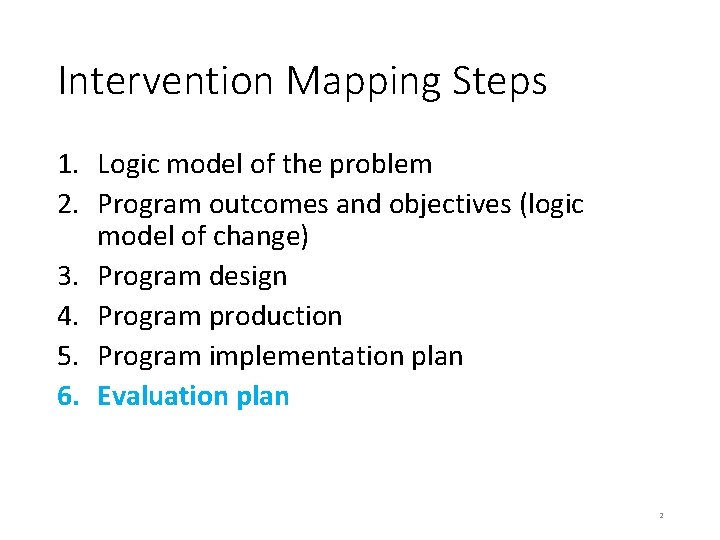
Intervention Mapping Steps 1. Logic model of the problem 2. Program outcomes and objectives (logic model of change) 3. Program design 4. Program production 5. Program implementation plan 6. Evaluation plan 2
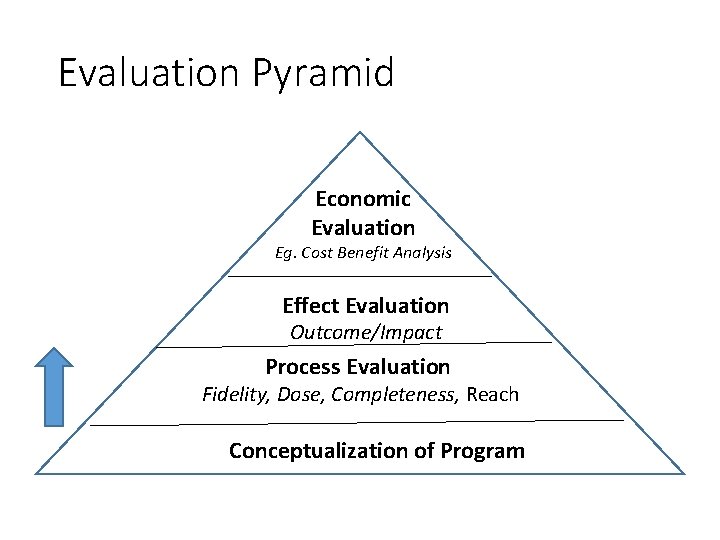
Evaluation Pyramid Economic Evaluation Eg. Cost Benefit Analysis Effect Evaluation Outcome/Impact Process Evaluation Fidelity, Dose, Completeness, Reach Conceptualization of Program
Reasons for Evaluation • Formative evaluation of program & materials • Summative evaluation of efficacy and effectiveness • Program management and improvement • Generation of new knowledge • Different reasons for different stakeholders
Involving Evaluation Stakeholders One important goal of evaluation is for someone to use the results • Identify stakeholders and involve them early • Plan structures for involving stakeholders in the ongoing evaluation process • Help stakeholders plan how to use evaluation data • Present evaluation results in multiple forms
Evaluation Stakeholders • Policymakers and decision-makers • Program sponsors • Evaluation sponsors • Target participants • Program managers • Program staff • Program competitors • Contextual stakeholders in program’s environment • Health education community • Evaluation & research community Source: Rossi, P. H. , Lipsey, M. W. , & Freeman, H. E. (2004). Evaluation: A systematic approach (7 th ed. , pp. 48– 49). Thousand Oaks, CA: Sage.
Step 6: Tasks 1. Write effect and process evaluation questions 2. Develop indicators and measures for assessment 3. Specify the evaluation design 4. Complete the evaluation plan 7
Task 1: Write Effect and Process Evaluation Questions Effect evaluation – describes program’s efficacy or effectiveness Process evaluation – describes program implementation These questions will come from a review of the program logic models, goals, objectives, and matrices (i. e. , from IM Steps 1 -5) 8
Intervention Logic Model INSERT FIGURE 9. 1 HERE Figure 9. 1 9
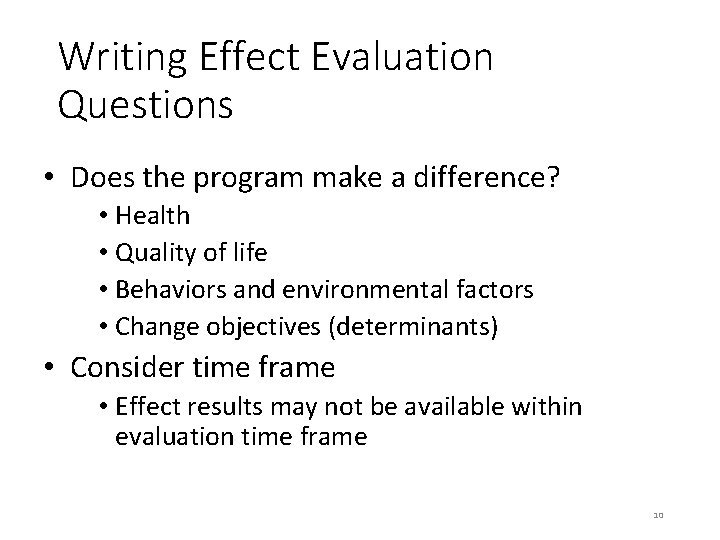
Writing Effect Evaluation Questions • Does the program make a difference? • Health • Quality of life • Behaviors and environmental factors • Change objectives (determinants) • Consider time frame • Effect results may not be available within evaluation time frame 10
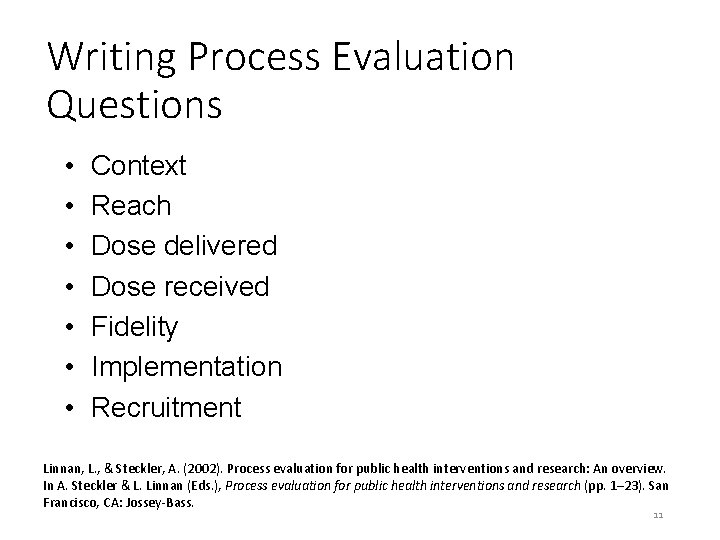
Writing Process Evaluation Questions • • Context Reach Dose delivered Dose received Fidelity Implementation Recruitment Linnan, L. , & Steckler, A. (2002). Process evaluation for public health interventions and research: An overview. In A. Steckler & L. Linnan (Eds. ), Process evaluation for public health interventions and research (pp. 1– 23). San Francisco, CA: Jossey-Bass. 11
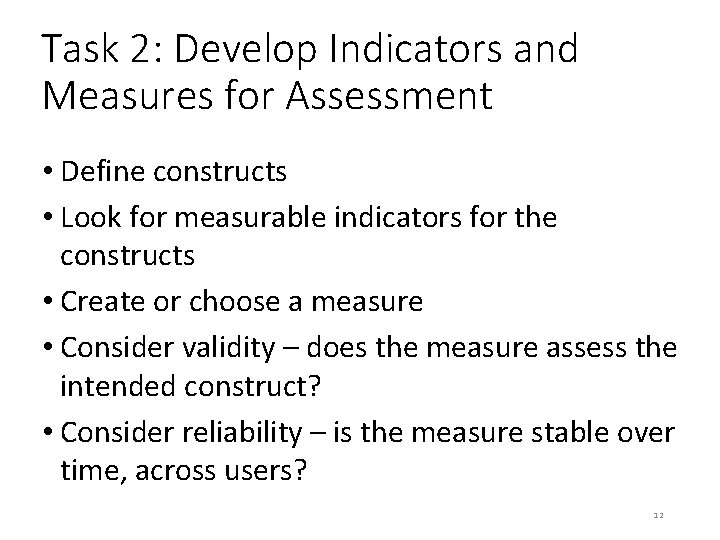
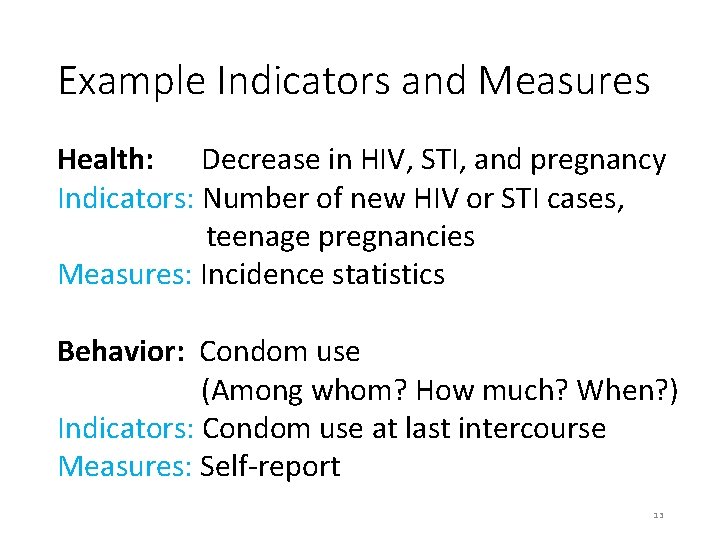
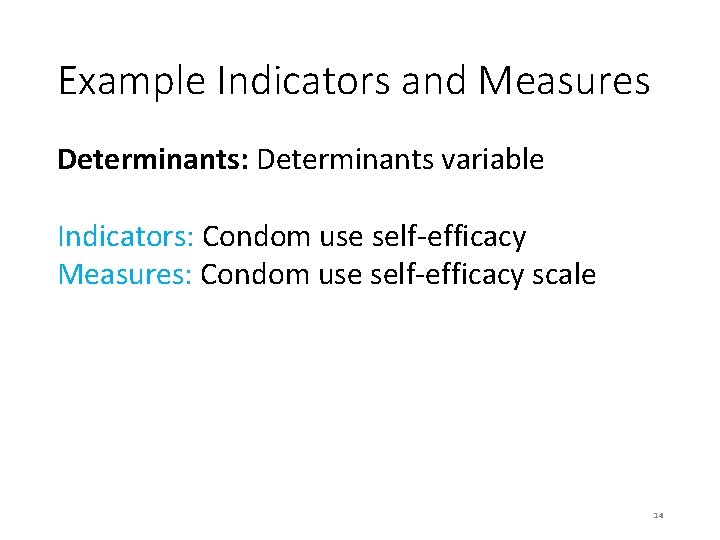
Task 2: Develop Indicators and Measures for Assessment • Define constructs • Look for measurable indicators for the constructs • Create or choose a measure • Consider validity – does the measure assess the intended construct? • Consider reliability – is the measure stable over time, across users? 12
Example Indicators and Measures Health: Decrease in HIV, STI, and pregnancy Indicators: Number of new HIV or STI cases, teenage pregnancies Measures: Incidence statistics Behavior: Condom use (Among whom? How much? When? ) Indicators: Condom use at last intercourse Measures: Self-report 13
Example Indicators and Measures Determinants: Determinants variable Indicators: Condom use self-efficacy Measures: Condom use self-efficacy scale 14
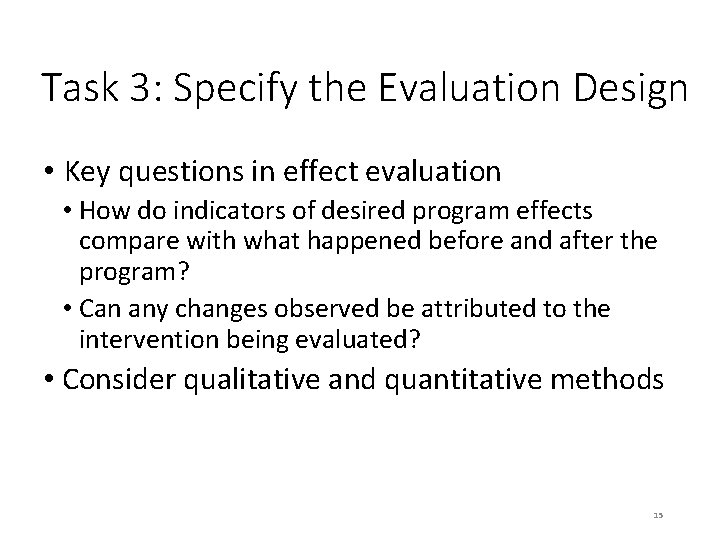
Task 3: Specify the Evaluation Design • Key questions in effect evaluation • How do indicators of desired program effects compare with what happened before and after the program? • Can any changes observed be attributed to the intervention being evaluated? • Consider qualitative and quantitative methods 15
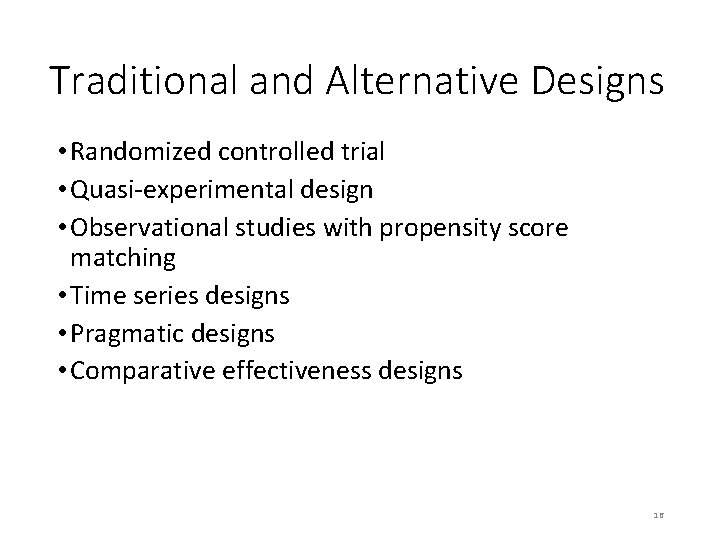
Traditional and Alternative Designs • Randomized controlled trial • Quasi-experimental design • Observational studies with propensity score matching • Time series designs • Pragmatic designs • Comparative effectiveness designs 16
Task 4: Complete the Evaluation Plan • Evaluation questions, design, indicators, measurement, timing • Statistical analyses and presentation of results • Description of how the evaluation will be carried out 17
Example It’s Your Game…Keep It Real (IYG) A sexual health education program for middle school students 18
Intervention Logic Model INSERT FIGURE 9. 3 HERE Figure 9. 3 19
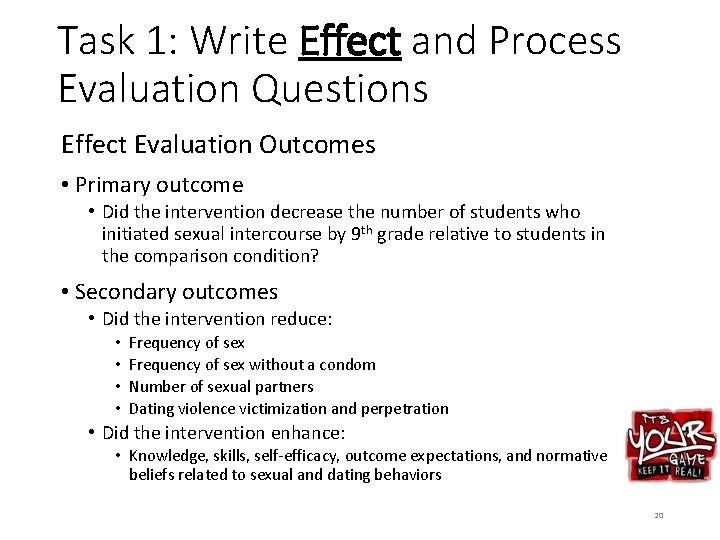
Task 1: Write Effect and Process Evaluation Questions Effect Evaluation Outcomes • Primary outcome • Did the intervention decrease the number of students who initiated sexual intercourse by 9 th grade relative to students in the comparison condition? • Secondary outcomes • Did the intervention reduce: • • Frequency of sex without a condom Number of sexual partners Dating violence victimization and perpetration • Did the intervention enhance: • Knowledge, skills, self-efficacy, outcome expectations, and normative beliefs related to sexual and dating behaviors 20
Task 1: Write Effect and Process Evaluation Questions • Reach: How many students received the program? • Dose: How many lessons did each student receive? • Fidelity: Was the program delivered as planned? • Cost: How much did the program cost to develop & implement? 21
Task 2: Develop Indicators and Measures for Assessment Effect evaluation measures (Self-report) • Sexual behavior (lifetime & past 3 months) • Oral, vaginal, anal sex • Condom & contraceptive use • Testing for & experience of HIV, STI, pregnancy • Sample determinants’ scales • Knowledge (HIV, STI, condoms) • Normative beliefs (sex, condoms) • Self-efficacy (refusing sex, condoms) • Avoiding risky situations • Parent-child communication 22
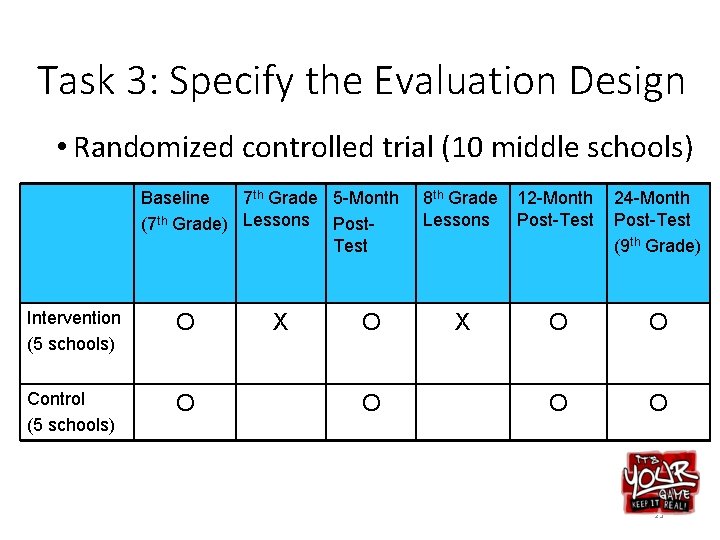
Task 3: Specify the Evaluation Design • Randomized controlled trial (10 middle schools) Baseline 7 th Grade 5 -Month (7 th Grade) Lessons Post. Test Intervention (5 schools) O Control (5 schools) O X O O 8 th Grade Lessons 12 -Month Post-Test 24 -Month Post-Test (9 th Grade) X O O 23
Task 4: Complete the Evaluation Plan INSERT FIRST PAGE OF TABLE 9. 8 HERE Table 9. 8 24
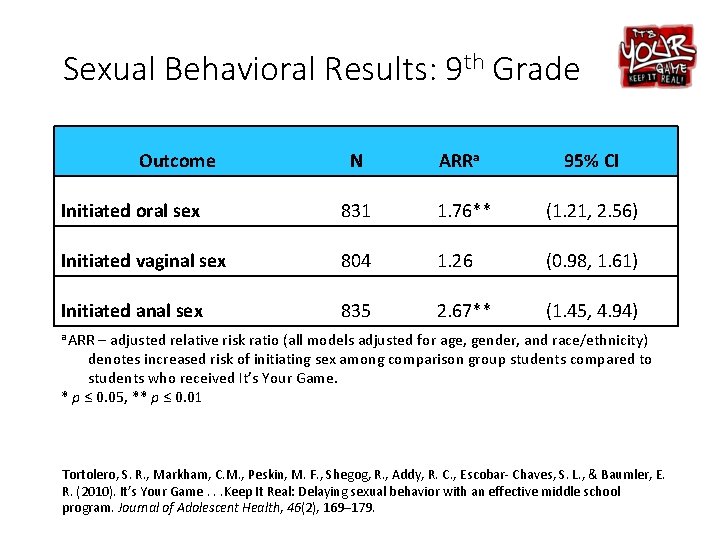
Sexual Behavioral Results: 9 th Grade Outcome N ARRa 95% CI Initiated oral sex 831 1. 76** (1. 21, 2. 56) Initiated vaginal sex 804 1. 26 (0. 98, 1. 61) Initiated anal sex 835 2. 67** (1. 45, 4. 94) a ARR – adjusted relative risk ratio (all models adjusted for age, gender, and race/ethnicity) denotes increased risk of initiating sex among comparison group students compared to students who received It’s Your Game. * p ≤ 0. 05, ** p ≤ 0. 01 Tortolero, S. R. , Markham, C. M. , Peskin, M. F. , Shegog, R. , Addy, R. C. , Escobar- Chaves, S. L. , & Baumler, E. R. (2010). It’s Your Game. . . Keep It Real: Delaying sexual behavior with an effective middle school program. Journal of Adolescent Health, 46(2), 169– 179.
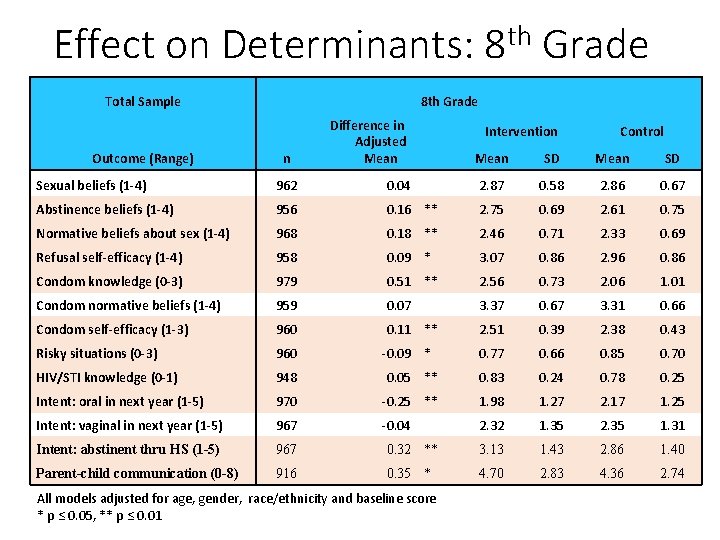
Effect on Determinants: 8 th Grade Total Sample Outcome (Range) 8 th Grade n Difference in Adjusted Mean Intervention Control Mean SD Sexual beliefs (1 -4) 962 0. 04 2. 87 0. 58 2. 86 0. 67 Abstinence beliefs (1 -4) 956 0. 16 ** 2. 75 0. 69 2. 61 0. 75 Normative beliefs about sex (1 -4) 968 0. 18 ** 2. 46 0. 71 2. 33 0. 69 Refusal self-efficacy (1 -4) 958 0. 09 * 3. 07 0. 86 2. 96 0. 86 Condom knowledge (0 -3) 979 0. 51 ** 2. 56 0. 73 2. 06 1. 01 Condom normative beliefs (1 -4) 959 0. 07 3. 37 0. 67 3. 31 0. 66 Condom self-efficacy (1 -3) 960 0. 11 ** 2. 51 0. 39 2. 38 0. 43 Risky situations (0 -3) 960 0. 77 0. 66 0. 85 0. 70 HIV/STI knowledge (0 -1) 948 0. 05 ** 0. 83 0. 24 0. 78 0. 25 Intent: oral in next year (1 -5) 970 -0. 25 ** 1. 98 1. 27 2. 17 1. 25 Intent: vaginal in next year (1 -5) 967 -0. 04 2. 32 1. 35 2. 35 1. 31 Intent: abstinent thru HS (1 -5) 967 0. 32 ** 3. 13 1. 43 2. 86 1. 40 Parent-child communication (0 -8) 916 0. 35 * 4. 70 2. 83 4. 36 2. 74 -0. 09 * All models adjusted for age, gender, race/ethnicity and baseline score * p ≤ 0. 05, ** p ≤ 0. 01
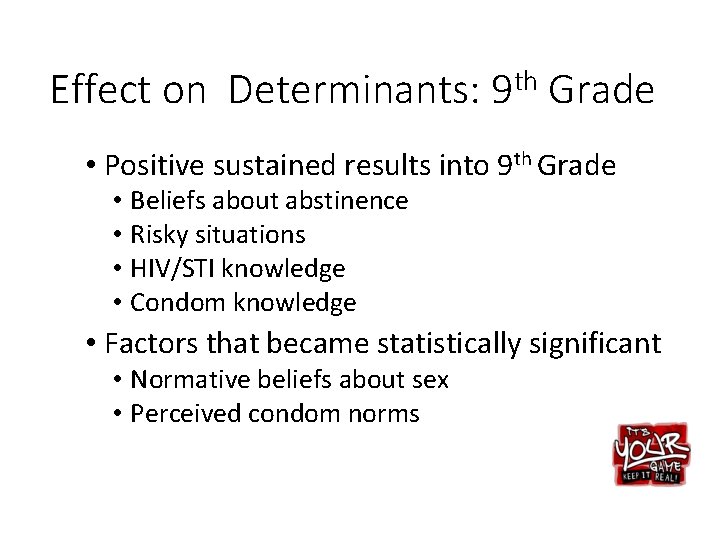
Effect on Determinants: 9 th Grade • Positive sustained results into 9 th Grade • Beliefs about abstinence • Risky situations • HIV/STI knowledge • Condom knowledge • Factors that became statistically significant • Normative beliefs about sex • Perceived condom norms
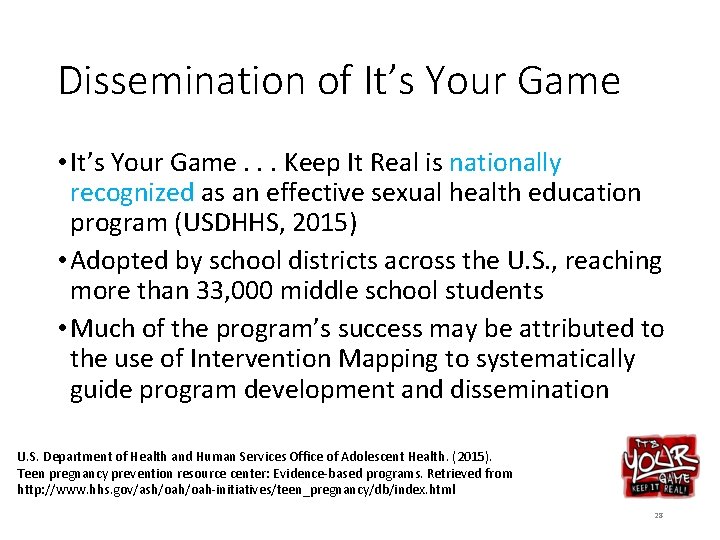
Dissemination of It’s Your Game • It’s Your Game. . . Keep It Real is nationally recognized as an effective sexual health education program (USDHHS, 2015) • Adopted by school districts across the U. S. , reaching more than 33, 000 middle school students • Much of the program’s success may be attributed to the use of Intervention Mapping to systematically guide program development and dissemination U. S. Department of Health and Human Services Office of Adolescent Health. (2015). Teen pregnancy prevention resource center: Evidence-based programs. Retrieved from http: //www. hhs. gov/ash/oah-initiatives/teen_pregnancy/db/index. html 28
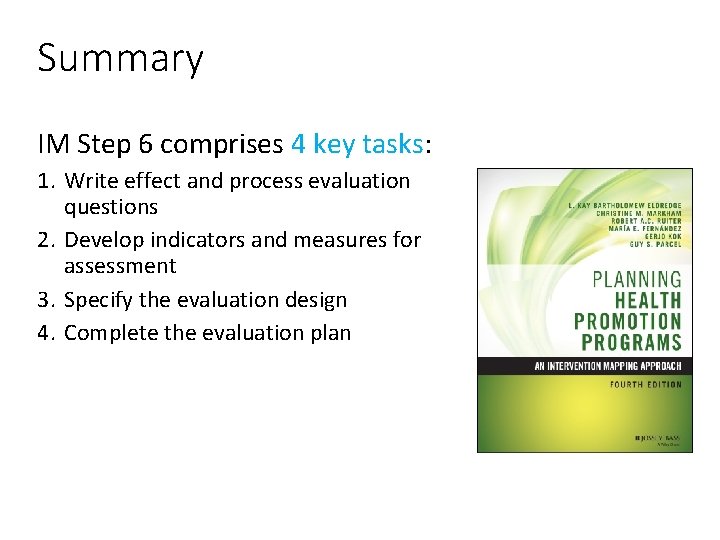
Summary IM Step 6 comprises 4 key tasks: 1. Write effect and process evaluation questions 2. Develop indicators and measures for assessment 3. Specify the evaluation design 4. Complete the evaluation plan
Questions?