
INTERVENTIO NS AND WHICH TYPES HOW TO POSITION
- Slides: 18
INTERVENTIO NS? (AND WHICH TYPES? HOW TO POSITION ONESELF TOWARDS LOCAL ACTORS? )
Root Causes: Breakdown of Societies
Root Causes, Contributing Factors & Justifications: Breakdown of Societies
Topics Last Week n n Sources of Conflict Continuation of Conflict Main Conclusion: Be specific about the meaning of political (structural factors, economic, ethnic, religious, etc. ) Today, we do the same for the word intervention.
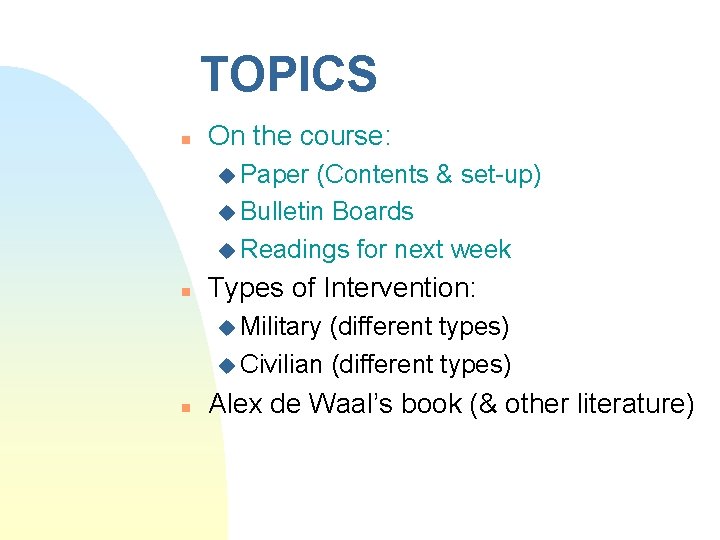
TOPICS n On the course: u Paper (Contents & set-up) u Bulletin Boards u Readings for next week n Types of Intervention: u Military (different types) u Civilian (different types) n Alex de Waal’s book (& other literature)
Common Themes: n n n n legal moral differences between military and civilian interventions evolution of intervention positioning of intervening actors towards the actors in the field lots of debate; lack of clarity Next classes: distinguishing different types of actors and their roles (e. g. , different types of NGOs, such as ICRC, MSF, OXFAM)
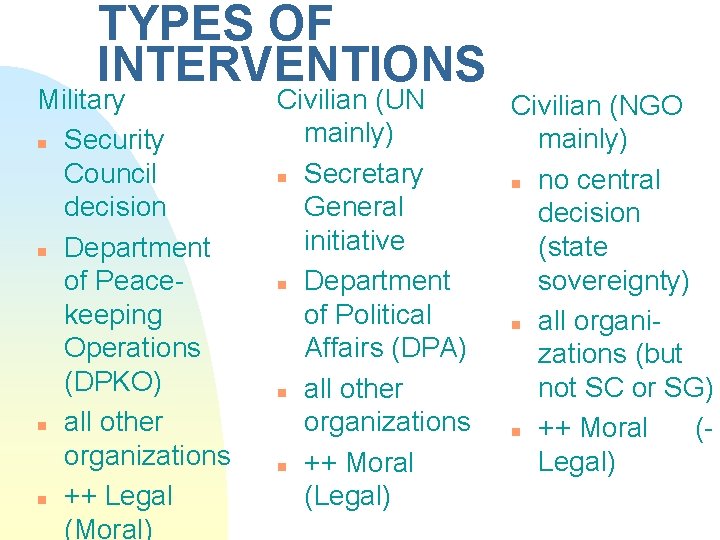
TYPES OF INTERVENTIONS Military n Security Council decision n Department of Peacekeeping Operations (DPKO) n all other organizations n ++ Legal (Moral) Civilian (UN mainly) n Secretary General initiative n Department of Political Affairs (DPA) n all other organizations n ++ Moral (Legal) Civilian (NGO mainly) n no central decision (state sovereignty) n all organizations (but not SC or SG) n ++ Moral (Legal)
MILITARY INTERVENTION n Double nature of the military: due to its power and technology, it is ua decisive threat to life & order, and u the instrument to protect both n When to use force? u Non-intervention is the norm: F non-intervention to prevent wars of religion; F non-intervention to protect selfdetermination and/or communal autonomy F non-intervention to prevent the subordination of small states to large states
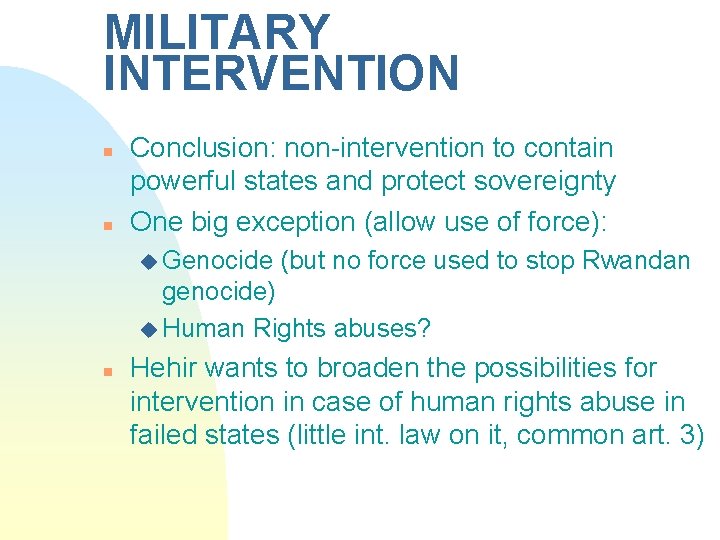
MILITARY INTERVENTION n n Conclusion: non-intervention to contain powerful states and protect sovereignty One big exception (allow use of force): u Genocide (but no force used to stop Rwandan genocide) u Human Rights abuses? n Hehir wants to broaden the possibilities for intervention in case of human rights abuse in failed states (little int. law on it, common art. 3)
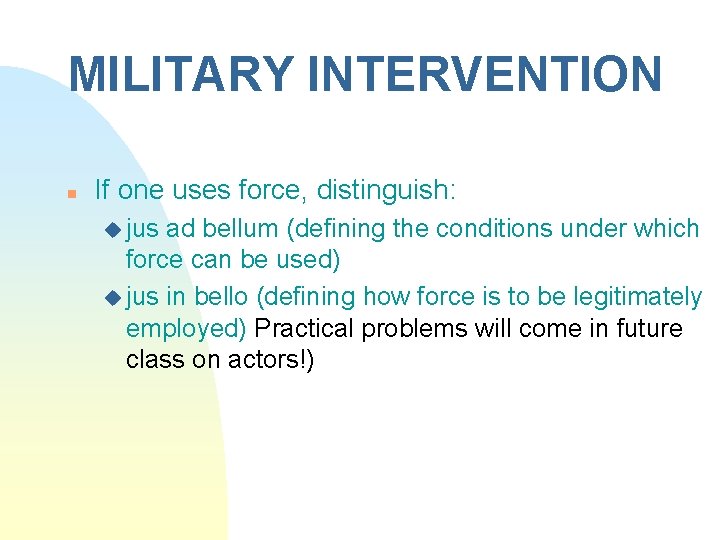
MILITARY INTERVENTION n If one uses force, distinguish: u jus ad bellum (defining the conditions under which force can be used) u jus in bello (defining how force is to be legitimately employed) Practical problems will come in future class on actors!)
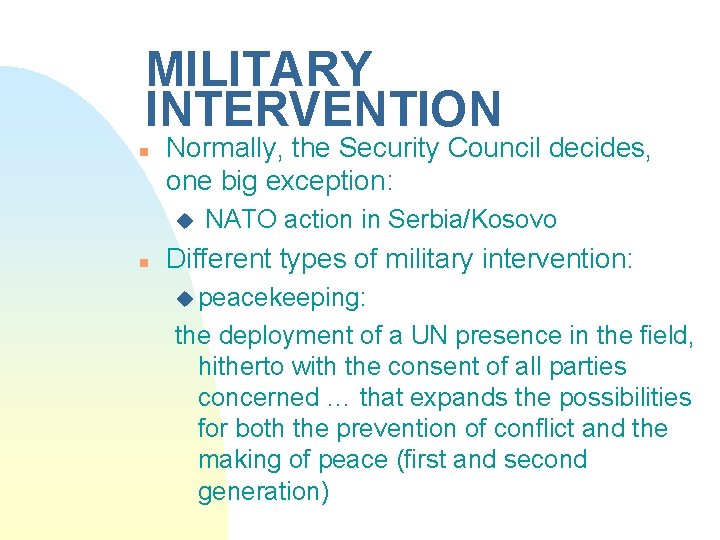
MILITARY INTERVENTION n Normally, the Security Council decides, one big exception: u n NATO action in Serbia/Kosovo Different types of military intervention: u peacekeeping: the deployment of a UN presence in the field, hitherto with the consent of all parties concerned … that expands the possibilities for both the prevention of conflict and the making of peace (first and second generation)
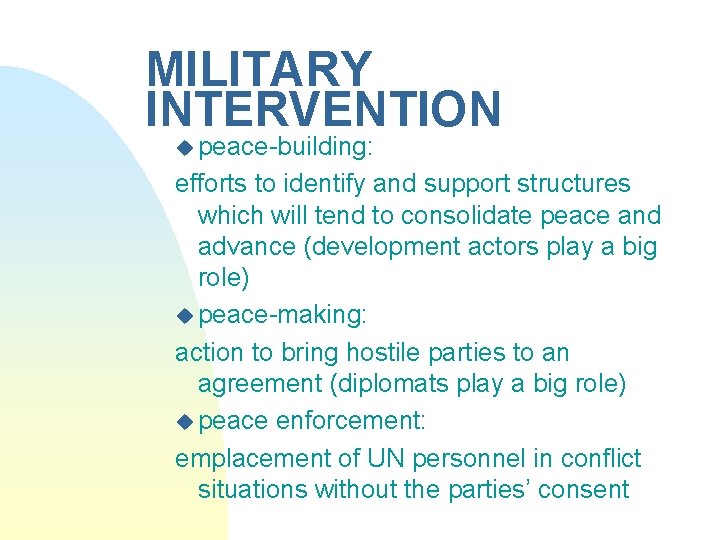
MILITARY INTERVENTION u peace-building: efforts to identify and support structures which will tend to consolidate peace and advance (development actors play a big role) u peace-making: action to bring hostile parties to an agreement (diplomats play a big role) u peace enforcement: emplacement of UN personnel in conflict situations without the parties’ consent
MILITARY INTERVENTION n n In all but peace-enforcement, consent of the parties is crucial peace enforcement has been the least successful in practice, e. g. , Somalia
MILITARY INTERVENTION Kofi Annan’s article: n problem of overlap (a different form of mission creep) n importance of clear criteria for action u mandates u consent (political will, negotiations) u impartiality u the use (or threat of use) of force: can it be effective. In Bosnia mix up peacekeeping and peace-enforcement u selectivity (disparities in allocation) n consent, impartiality, selectivity also important in other types of interventions
CIVILIAN INTERVENTION WITH UN SECRETARIAT Ideal once there is, or is a reasonable hope on a peace accord n Focus is on rebuilding after peace n Lead agency for the whole country and/or specific agency Don’t forget other instruments; n sanctions/conditionality n denunciations n denial of problematic privileges n development cooperation n
CIVILIAN INTERVENTION (WHO DECIDES? HOW? ) n n No peace accord No military These actors are poised to intervene, no such distinction as jus ad bellum and jus in bello What do the criteria in action become, in other words how does an organization position itself in conflict
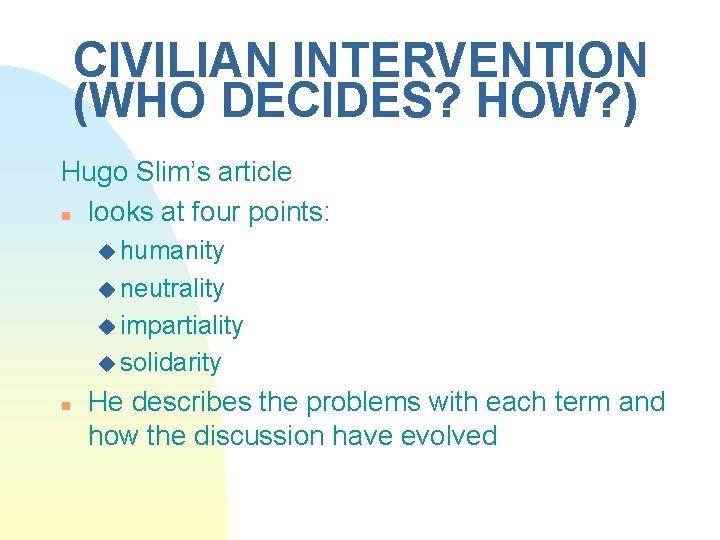
CIVILIAN INTERVENTION (WHO DECIDES? HOW? ) Hugo Slim’s article n looks at four points: u humanity u neutrality u impartiality u solidarity n He describes the problems with each term and how the discussion have evolved
TOPICS n On the course: u Paper (Contents & set-up) u Bulletin Boards u Readings for next week n Types of Intervention: u Military (different types) u Civilian (different types) n Alex de Waal’s book (& other literature)