
Intertidal Marine Biology Worksheet For this scavenger hunt

Intertidal Marine Biology Worksheet For this scavenger hunt please try and find as many of the plants and animals listed in BOLD below. Once you find them there a few questions to answer on their lives in the intertidal zone. A SHORE CRAB Why do you think that a crab has a hard shell? _______________________________________________ These crabs love to hang out under rocks. Why do you think they do this? _________________________________________________________________ Crabs rip apart their food with their claws. What else might they use their claws for? _________________________________________________________________ Draw a diagram of one of the front claws When a crab gets too big for its shell, its body swells and the crab molts or loses its shell. A crab molt looks just like a dead crab except that there is no dead crab inside. Find a MOLT OF A CRAB. Copyright Anne Todgham ©
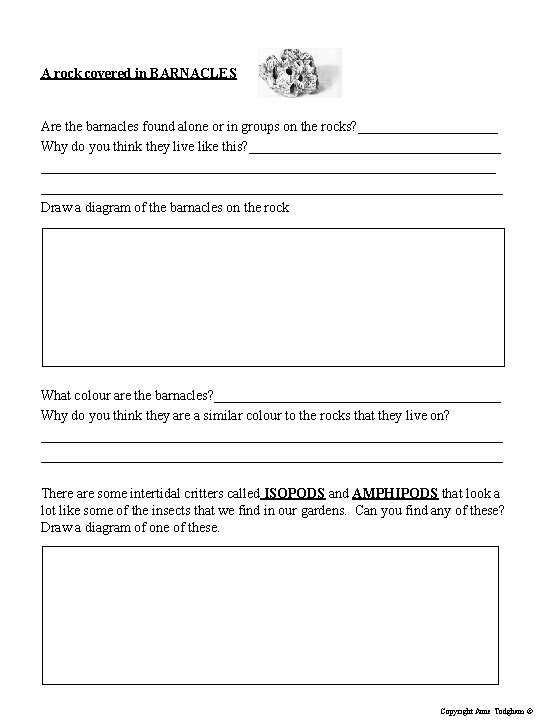
A rock covered in BARNACLES Are the barnacles found alone or in groups on the rocks? __________ Why do you think they live like this? ___________________________________________________ Draw a diagram of the barnacles on the rock What colour are the barnacles? _____________________ Why do you think they are a similar colour to the rocks that they live on? __________________________________________________________________ There are some intertidal critters called ISOPODS and AMPHIPODS that look a lot like some of the insects that we find in our gardens. Can you find any of these? Draw a diagram of one of these. Copyright Anne Todgham ©
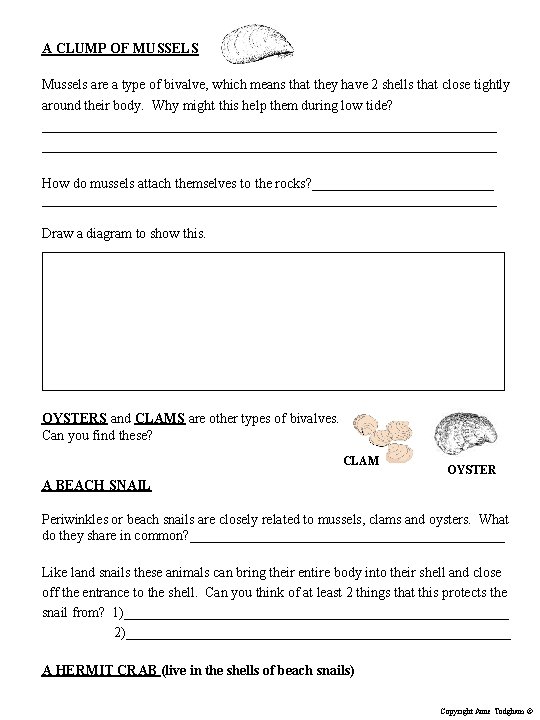
A CLUMP OF MUSSELS Mussels are a type of bivalve, which means that they have 2 shells that close tightly around their body. Why might this help them during low tide? _________________________________________________________________ How do mussels attach themselves to the rocks? ______________________________________________ Draw a diagram to show this. OYSTERS and CLAMS are other types of bivalves. Can you find these? CLAM OYSTER A BEACH SNAIL Periwinkles or beach snails are closely related to mussels, clams and oysters. What do they share in common? _______________________ Like land snails these animals can bring their entire body into their shell and close off the entrance to the shell. Can you think of at least 2 things that this protects the snail from? 1)____________________________ 2)____________________________ A HERMIT CRAB (live in the shells of beach snails) Copyright Anne Todgham ©
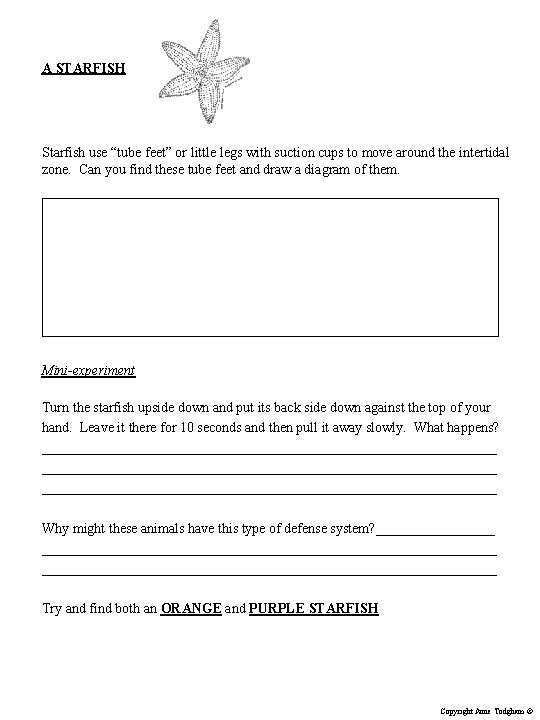
A STARFISH Starfish use “tube feet” or little legs with suction cups to move around the intertidal zone. Can you find these tube feet and draw a diagram of them. Mini-experiment Turn the starfish upside down and put its back side down against the top of your hand. Leave it there for 10 seconds and then pull it away slowly. What happens? _________________________________________________________________ Why might these animals have this type of defense system? _________________________________________ Try and find both an ORANGE and PURPLE STARFISH Copyright Anne Todgham ©
A variety of SEAWEEDS How many types of seaweed can you find? ________________ What colours are they? ________________________________________________________ Choose one to draw a diagram of. Can you point out what they use to attach to rocks? BONUS: These are difficult to find!!!!! A SHRIMP These shrimp are a lot smaller than the ones that you eat for dinner. If you can find them they will be in the tidepools. A TIDEPOOL FISH As their name suggests these fish can be found in tidepools…. but keep your eyes peeled as they are very quick! A WORM To find these slimy worms look under rocks between the barnacles or in between the clumps of mussels that are attached to the side of rocks or on the mud beach. Copyright Anne Todgham ©
- Slides: 5