
INTERTEMPORAL LIFECYCLE THEORY OF CONSUMPTION By Flora Mae
INTERTEMPORAL LIFE-CYCLE THEORY OF CONSUMPTION By: Flora Mae Z. Agustin, Patrisha Marie A. Ambrosio, Emerita Mhiro H. Mones and Eleanor P. Garoy Presented by: Emerita Mhiro H. Mones Saint Louis University 13 th National Convention on Statistics October 3 -4, 2016, EDSA Shangri-La Hotel, Mandaluyong City
Introduction Individuals plan their consumption and savings behavior over a long period of time with the intention of allocating their consumption in the best possible way over their lifetime. Similarly, individuals are willing to delay their consumption and gratification in order to increase their savings because these savings will be used for their future consumption specifically, for their retirement. This decision however assumes that the individual carries a degree of impatience and changes in savings choice, an intertemporal attitude that is linked to Modigliani and Brumberg’s Life-Cycle Hypothesis. 13 th National Convention on Statistics October 3 -4, 2016, EDSA Shangri-La Hotel, Mandaluyong City
This paper aims to expose an inter-temporal attitude of individuals’ choices on consumption and savings patterns. It uses questionnaire to gather the data needed for the study. The respondents were asked to answer a set of questionnaire in order to determine the individual’s age, consumption expenditure, savings, income (if ever the individual is an incomeearner), and assets. 13 th National Convention on Statistics October 3 -4, 2016, EDSA Shangri-La Hotel, Mandaluyong City
Theoretical Framework Inter-temporal Choice The consumer’s preferences and their opportunities to reach preferred positions are described to explain why consumers decide to borrow or lend at different points in time. The individual’s preferences can be described based on their attitudes toward bundles of goods available at different points in time. 13 th National Convention on Statistics October 3 -4, 2016, EDSA Shangri-La Hotel, Mandaluyong City
The consumption choice of an individual is subjected to the limitations of what he can afford. The assets already available and incomes that will be received are the resources where he can get for its consumption expenditure. Wealth is the value of available assets at a given time and consists of the market value of stocks of real durable goods and financial assets carried over from previous periods. Income is composed of wages, salaries, or other payments received. Considering a certainty world, the future income is known exactly at any time. But even if it is known, it cannot be used to finance present consumption unless the individual can borrow against it. 13 th National Convention on Statistics October 3 -4, 2016, EDSA Shangri-La Hotel, Mandaluyong City

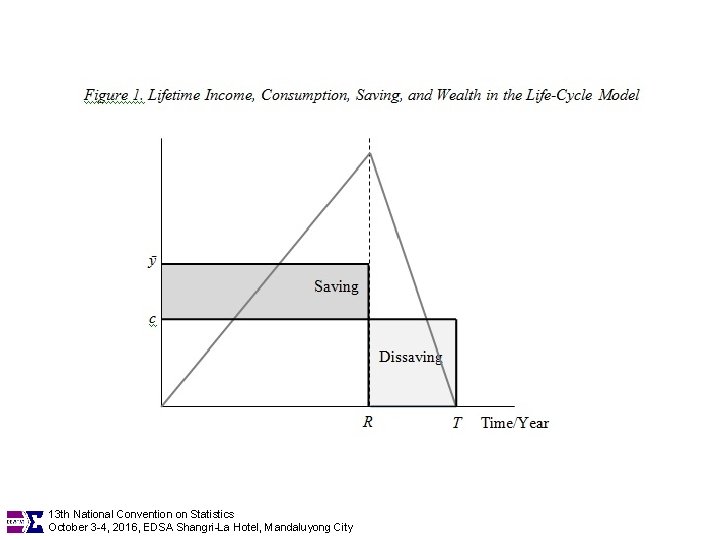
Life-Cycle Theory of Consumption and Savings Figure 1 shows the allocation of consumption and assets over the lifetime. Individuals accumulate wealth until retirement and draw down the stock of wealth until life ends to ensure a smooth path of consumption. The life cycle hypothesis predicts the following path of consumption and assets: before entering into the labor market, individuals should borrow; they should accumulate savings while working and dissave after they retire. 13 th National Convention on Statistics October 3 -4, 2016, EDSA Shangri-La Hotel, Mandaluyong City
13 th National Convention on Statistics October 3 -4, 2016, EDSA Shangri-La Hotel, Mandaluyong City
Methodology Data This study aims to determine the effect of savings, assets, income and demography to the consumption of an individual, considering also the impact of inter-temporal choice on their consumption decisions. Because of this, the researchers gathered the data through a structured questionnaire. It consists of the individual’s profile, specifically, its age, gender, civil status, and educational attainment; and questions about their consumption, savings and income. There are 150 respondents in the study. They are students and teachers of Saint Louis University. 13 th National Convention on Statistics October 3 -4, 2016, EDSA Shangri-La Hotel, Mandaluyong City
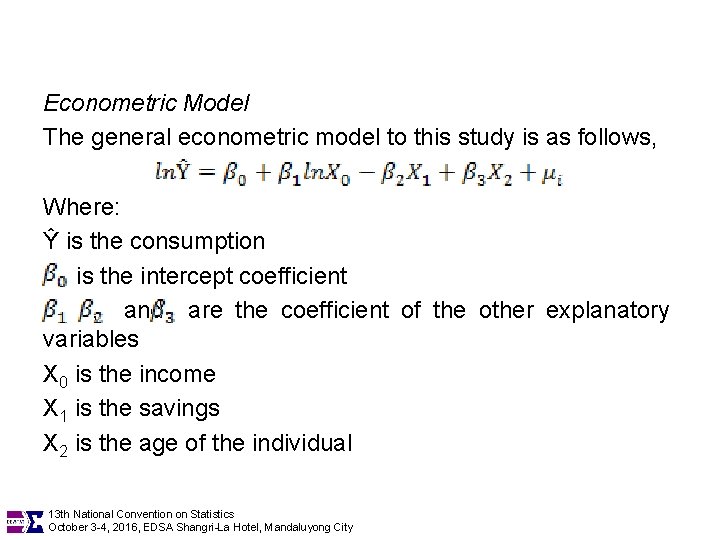
Econometric Model The general econometric model to this study is as follows, Where: Ŷ is the consumption is the intercept coefficient , and are the coefficient of the other explanatory variables X 0 is the income X 1 is the savings X 2 is the age of the individual 13 th National Convention on Statistics October 3 -4, 2016, EDSA Shangri-La Hotel, Mandaluyong City
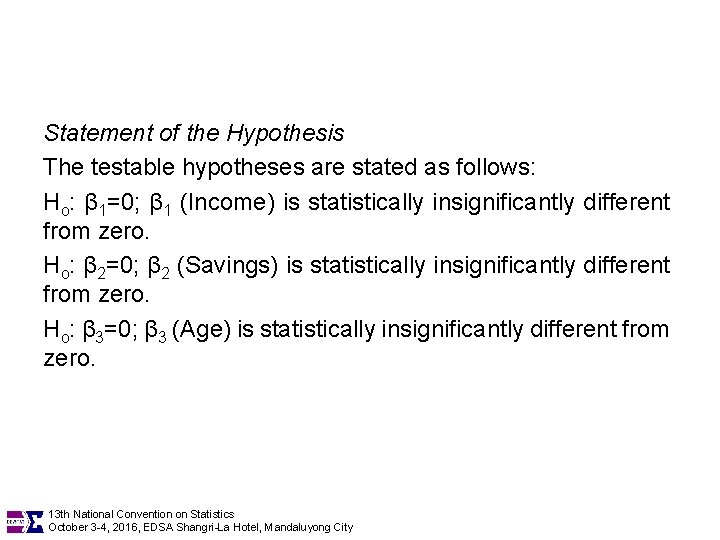
Statement of the Hypothesis The testable hypotheses are stated as follows: Ho: β 1=0; β 1 (Income) is statistically insignificantly different from zero. Ho: β 2=0; β 2 (Savings) is statistically insignificantly different from zero. Ho: β 3=0; β 3 (Age) is statistically insignificantly different from zero. 13 th National Convention on Statistics October 3 -4, 2016, EDSA Shangri-La Hotel, Mandaluyong City
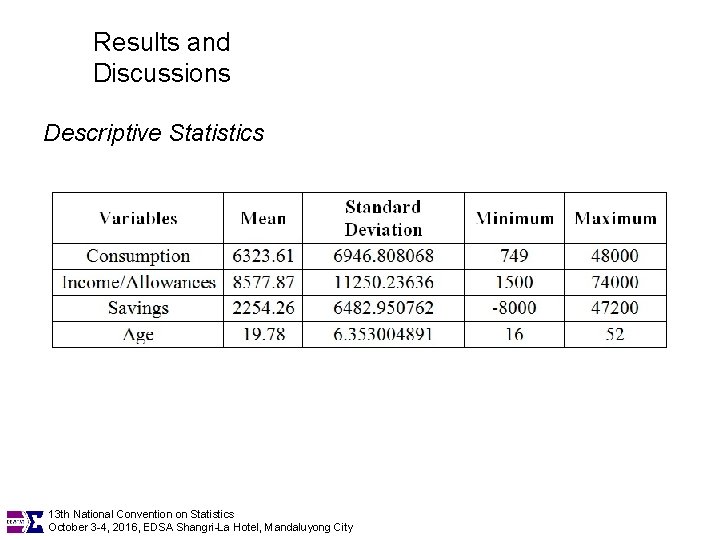
Results and Discussions Descriptive Statistics 13 th National Convention on Statistics October 3 -4, 2016, EDSA Shangri-La Hotel, Mandaluyong City
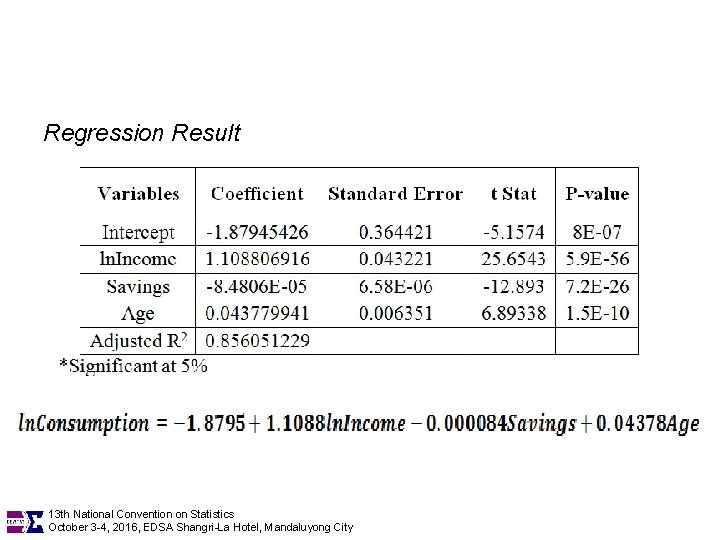
Regression Result 13 th National Convention on Statistics October 3 -4, 2016, EDSA Shangri-La Hotel, Mandaluyong City
13 th National Convention on Statistics October 3 -4, 2016, EDSA Shangri-La Hotel, Mandaluyong City
13 th National Convention on Statistics October 3 -4, 2016, EDSA Shangri-La Hotel, Mandaluyong City
13 th National Convention on Statistics October 3 -4, 2016, EDSA Shangri-La Hotel, Mandaluyong City
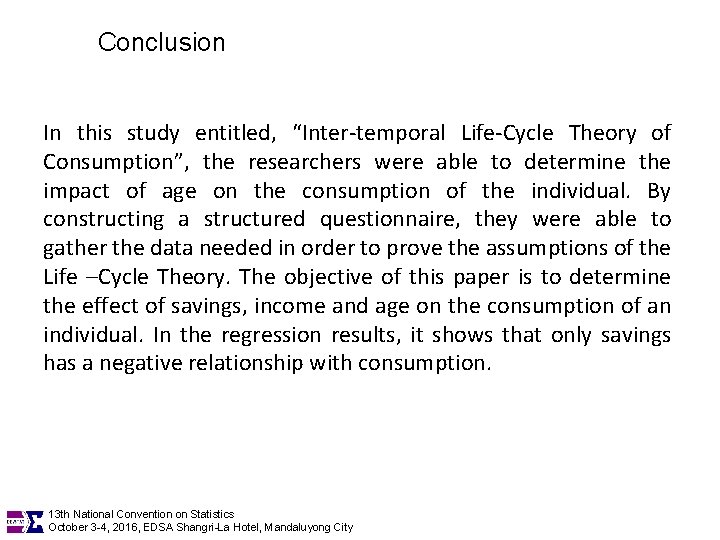
Conclusion In this study entitled, “Inter-temporal Life-Cycle Theory of Consumption”, the researchers were able to determine the impact of age on the consumption of the individual. By constructing a structured questionnaire, they were able to gather the data needed in order to prove the assumptions of the Life –Cycle Theory. The objective of this paper is to determine the effect of savings, income and age on the consumption of an individual. In the regression results, it shows that only savings has a negative relationship with consumption. 13 th National Convention on Statistics October 3 -4, 2016, EDSA Shangri-La Hotel, Mandaluyong City
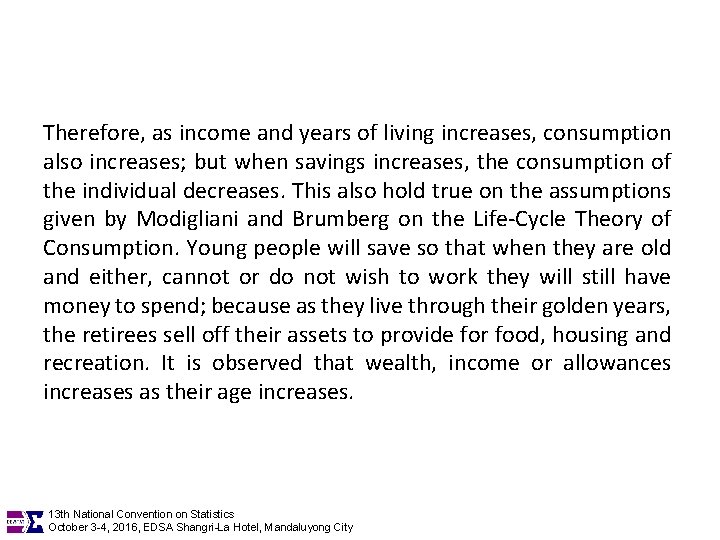
Therefore, as income and years of living increases, consumption also increases; but when savings increases, the consumption of the individual decreases. This also hold true on the assumptions given by Modigliani and Brumberg on the Life-Cycle Theory of Consumption. Young people will save so that when they are old and either, cannot or do not wish to work they will still have money to spend; because as they live through their golden years, the retirees sell off their assets to provide for food, housing and recreation. It is observed that wealth, income or allowances increases as their age increases. 13 th National Convention on Statistics October 3 -4, 2016, EDSA Shangri-La Hotel, Mandaluyong City
- Slides: 17