
Interspecific Interactions and Adaptation Coevolution is reciprocal evolutionary
- Slides: 20
Interspecific Interactions and Adaptation • Coevolution is reciprocal evolutionary adaptations of two interacting species • The term is often used too loosely in describing adaptations within a community • There is little evidence for true coevolution in most interspecific interactions Copyright © 2005 Pearson Education, Inc. publishing as Benjamin Cummings
Concept 53. 2: Dominant and keystone species exert strong controls on community structure • In general, a few species in a community exert strong control on that community’s structure • Two fundamental features of community structure are species diversity and feeding relationships Copyright © 2005 Pearson Education, Inc. publishing as Benjamin Cummings
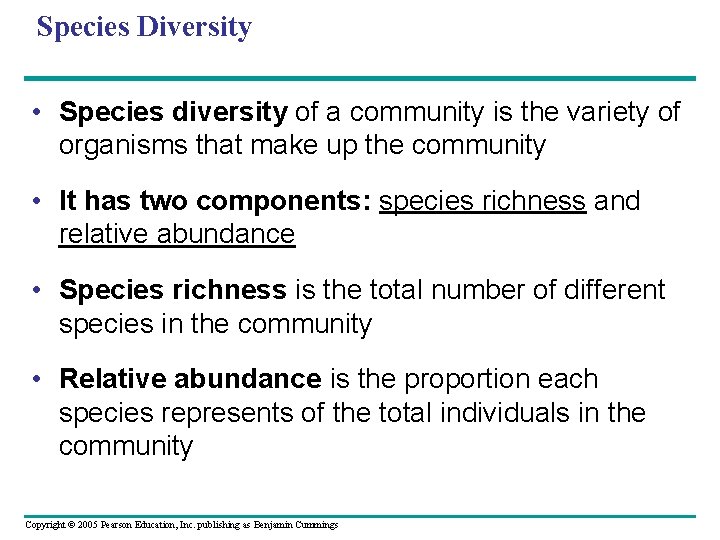
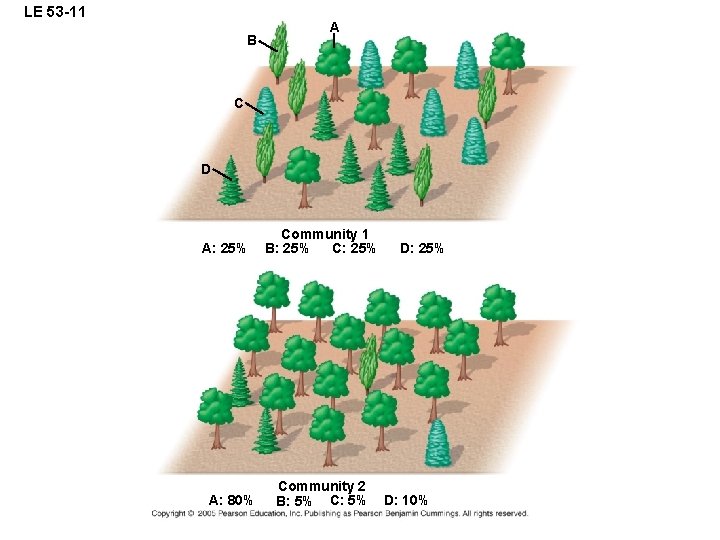
Species Diversity • Species diversity of a community is the variety of organisms that make up the community • It has two components: species richness and relative abundance • Species richness is the total number of different species in the community • Relative abundance is the proportion each species represents of the total individuals in the community Copyright © 2005 Pearson Education, Inc. publishing as Benjamin Cummings
LE 53 -11 B A C D A: 25% A: 80% Community 1 B: 25% Community 2 B: 5% C: 5% D: 25% D: 10%
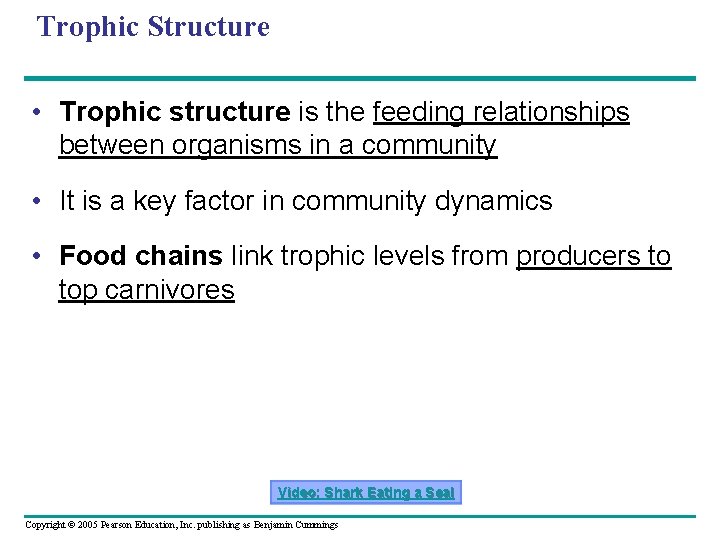
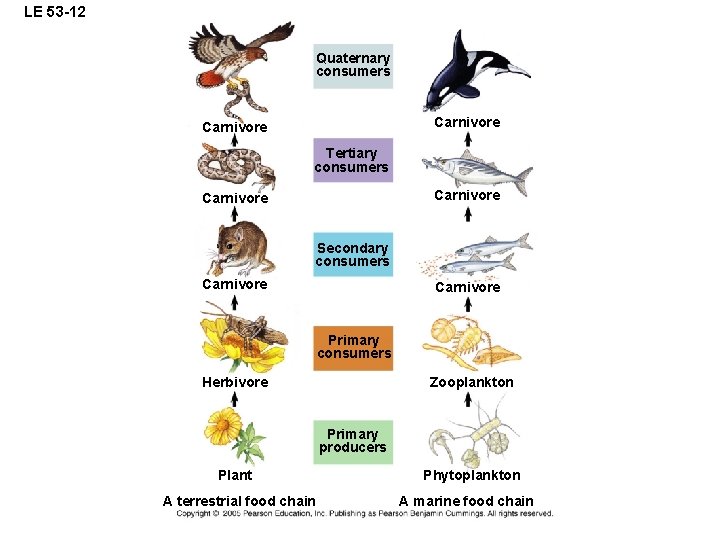
Trophic Structure • Trophic structure is the feeding relationships between organisms in a community • It is a key factor in community dynamics • Food chains link trophic levels from producers to top carnivores Video: Shark Eating a Seal Copyright © 2005 Pearson Education, Inc. publishing as Benjamin Cummings
LE 53 -12 Quaternary consumers Carnivore Tertiary consumers Carnivore Secondary consumers Carnivore Primary consumers Herbivore Zooplankton Primary producers Plant A terrestrial food chain Phytoplankton A marine food chain
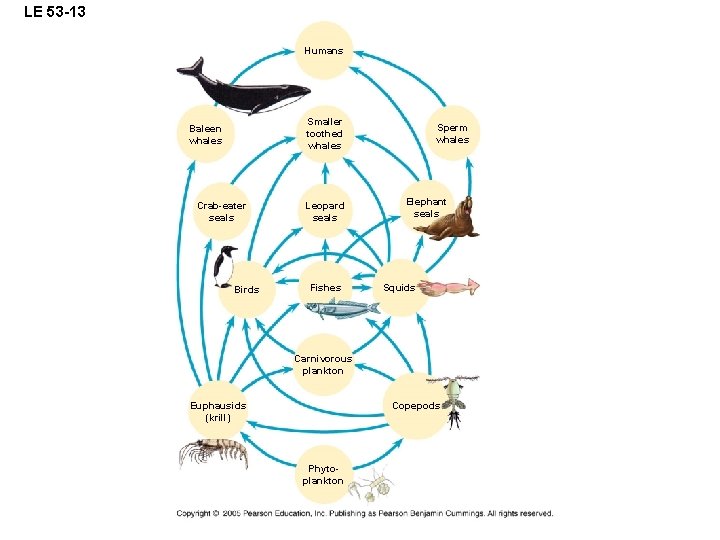
Food Webs • A food web is a branching food chain with complex trophic interactions Copyright © 2005 Pearson Education, Inc. publishing as Benjamin Cummings
LE 53 -13 Humans Smaller toothed whales Baleen whales Crab-eater seals Birds Leopard seals Fishes Sperm whales Elephant seals Squids Carnivorous plankton Copepods Euphausids (krill) Phytoplankton
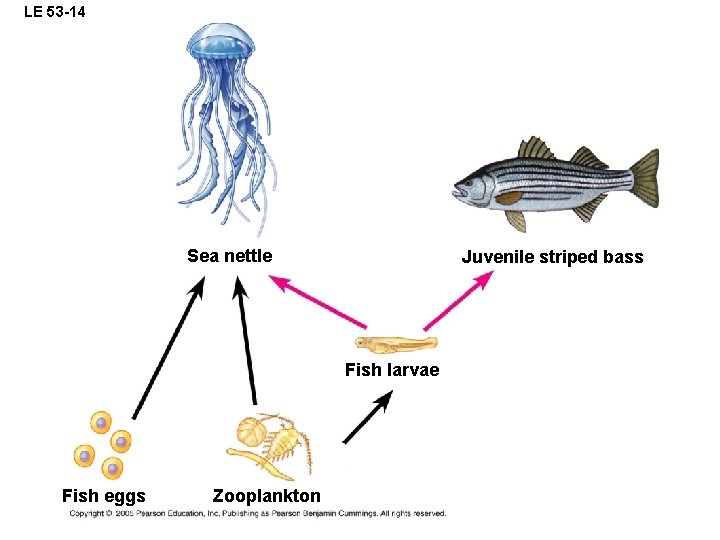
LE 53 -14 Sea nettle Juvenile striped bass Fish larvae Fish eggs Zooplankton
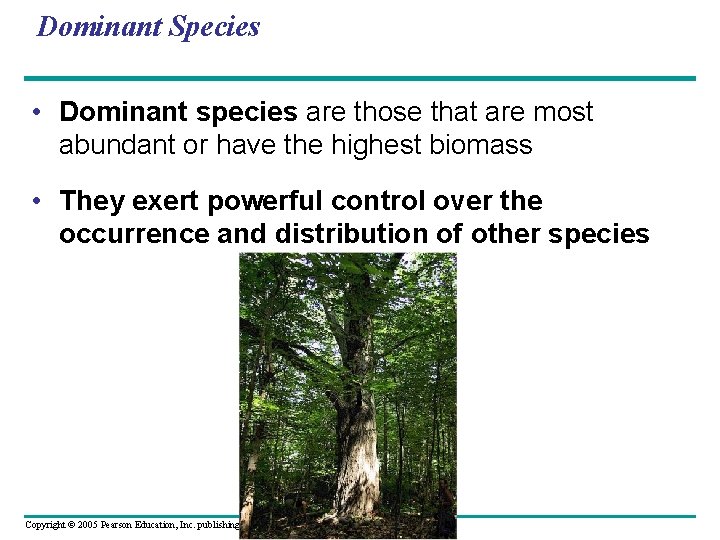
Dominant Species • Dominant species are those that are most abundant or have the highest biomass • They exert powerful control over the occurrence and distribution of other species Copyright © 2005 Pearson Education, Inc. publishing as Benjamin Cummings
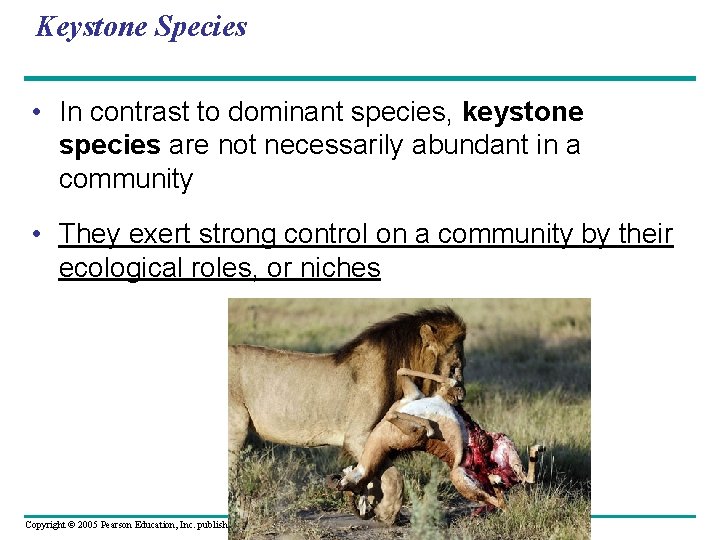
Keystone Species • In contrast to dominant species, keystone species are not necessarily abundant in a community • They exert strong control on a community by their ecological roles, or niches Copyright © 2005 Pearson Education, Inc. publishing as Benjamin Cummings
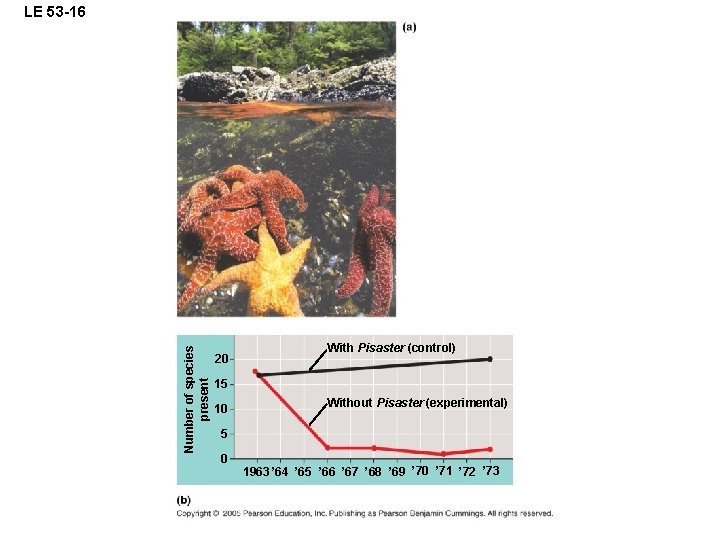
Number of species present LE 53 -16 20 With Pisaster (control) 15 10 Without Pisaster (experimental) 5 0 1963 ’ 64 ’ 65 ’ 66 ’ 67 ’ 68 ’ 69 ’ 70 ’ 71 ’ 72 ’ 73
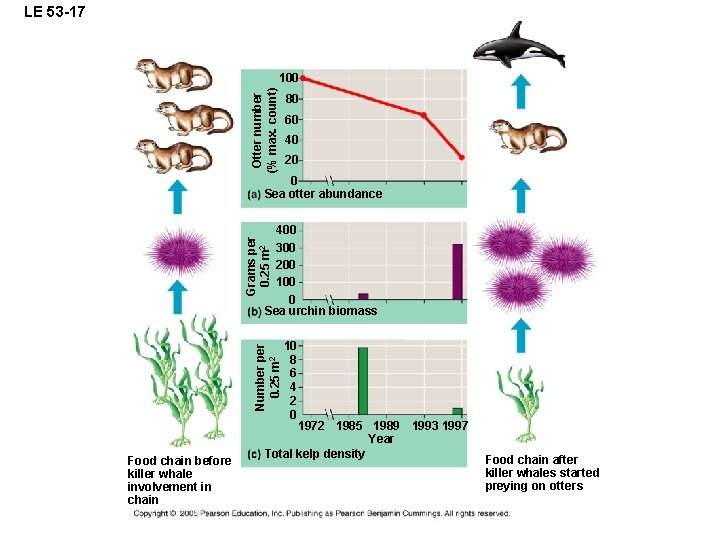
LE 53 -17 Otter number (% max. count) 100 80 60 40 20 0 Sea otter abundance Number per 0. 25 m 2 Grams per 0. 25 m 2 400 300 200 100 0 Sea urchin biomass Food chain before killer whale involvement in chain 10 8 6 4 2 0 1972 1985 1989 1993 1997 Year Total kelp density Food chain after killer whales started preying on otters
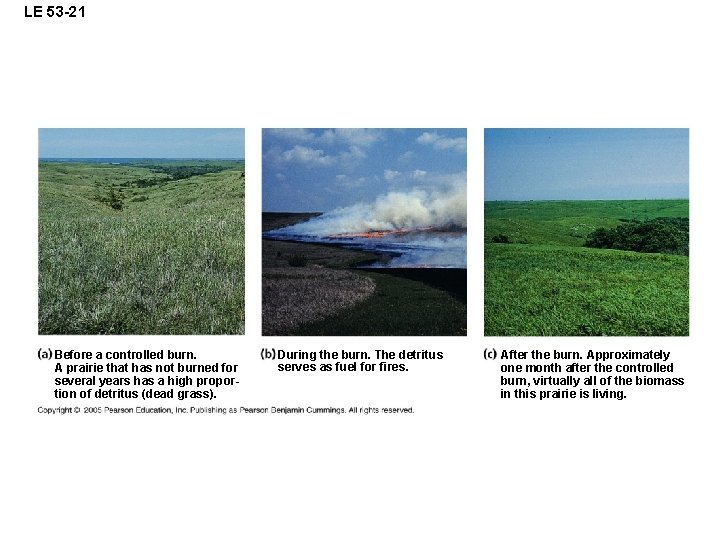
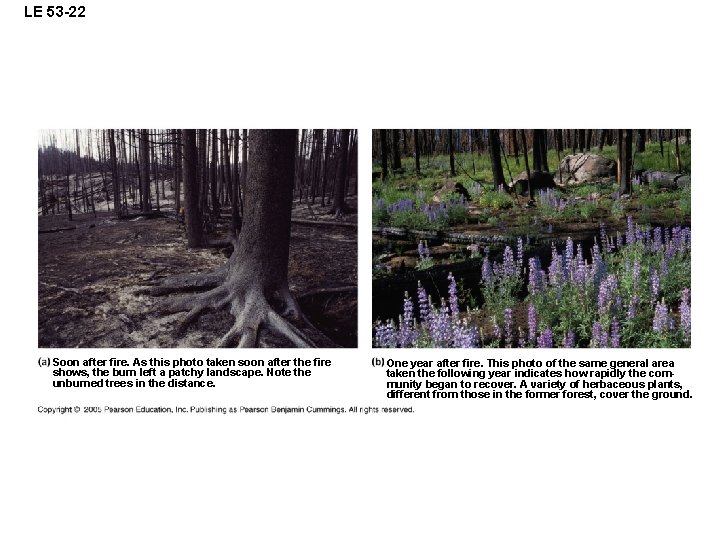
What Is Disturbance? • A disturbance is an event that changes a community, removes organisms from it, and alters resource availability • Fire is a significant disturbance in most terrestrial ecosystems • It is often a necessity in some communities Copyright © 2005 Pearson Education, Inc. publishing as Benjamin Cummings
LE 53 -21 Before a controlled burn. A prairie that has not burned for several years has a high proportion of detritus (dead grass). During the burn. The detritus serves as fuel for fires. After the burn. Approximately one month after the controlled burn, virtually all of the biomass in this prairie is living.
LE 53 -22 Soon after fire. As this photo taken soon after the fire shows, the burn left a patchy landscape. Note the unburned trees in the distance. One year after fire. This photo of the same general area taken the following year indicates how rapidly the community began to recover. A variety of herbaceous plants, different from those in the former forest, cover the ground.
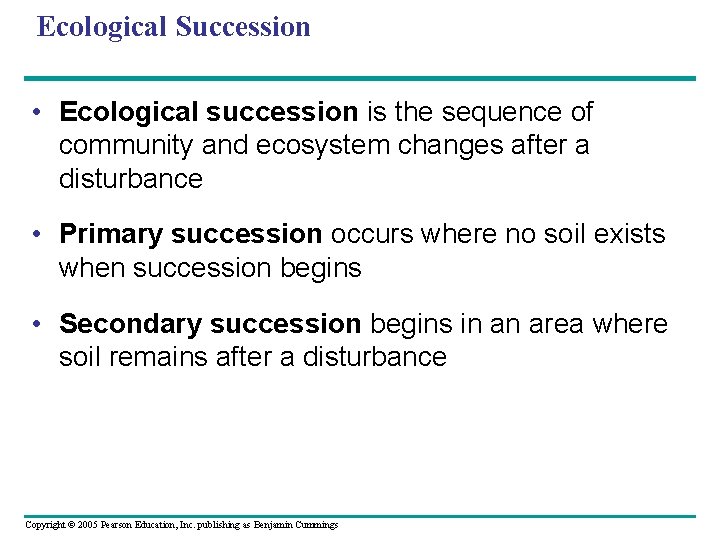
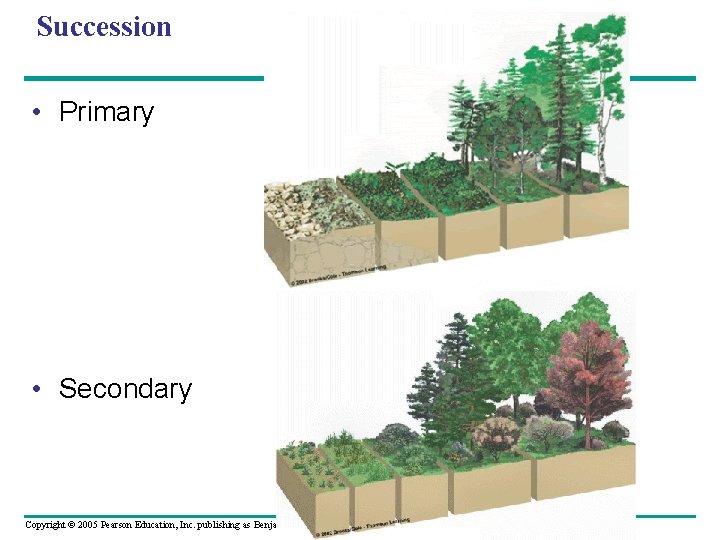
Ecological Succession • Ecological succession is the sequence of community and ecosystem changes after a disturbance • Primary succession occurs where no soil exists when succession begins • Secondary succession begins in an area where soil remains after a disturbance Copyright © 2005 Pearson Education, Inc. publishing as Benjamin Cummings
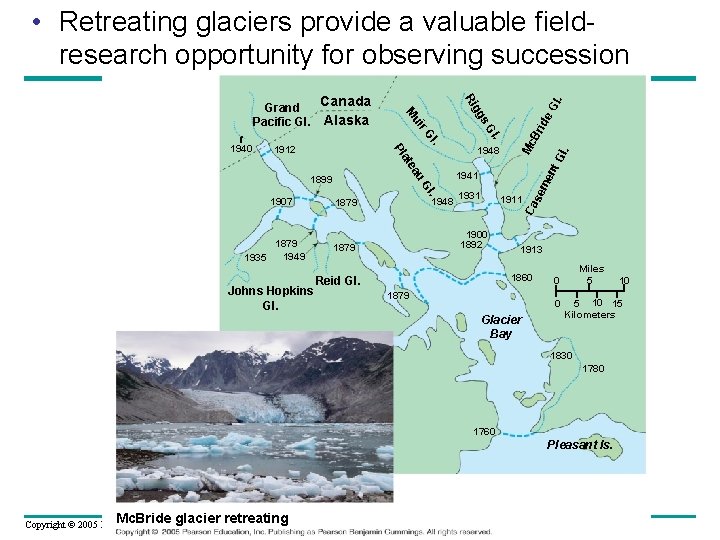
• Retreating glaciers provide a valuable fieldresearch opportunity for observing succession Johns Hopkins Gl. 1931 e. G rid nt Gl. 1911 1900 1892 1879 Mc B Ca se me . Gl 1879 1949 1935 1948 1879 1948 1941 au 1907 l. G e at 1899 s. G gg r ui 1912 Pl 1940 l. Ri M Canada Grand Pacific Gl. Alaska 1913 1860 Reid Gl. 1879 0 Glacier Bay Miles 5 0 5 10 15 Kilometers 1830 1780 1760 Pleasant Is. Mc. Bride glacier retreating Copyright © 2005 Pearson Education, Inc. publishing as Benjamin Cummings 10
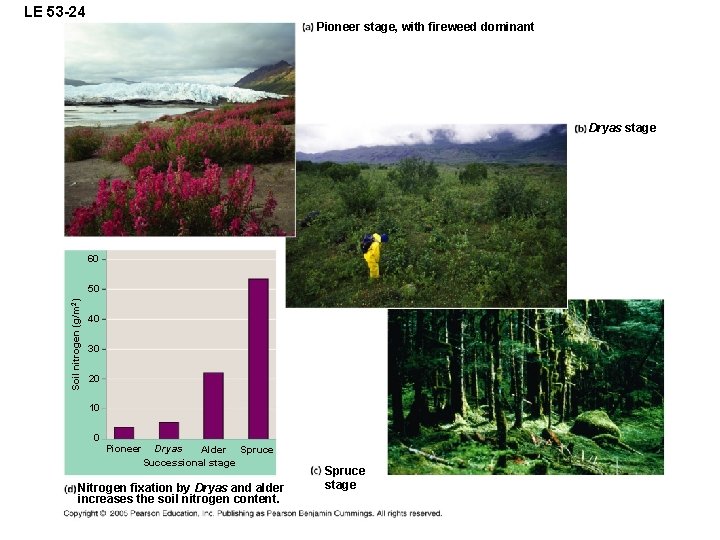
LE 53 -24 Pioneer stage, with fireweed dominant Dryas stage 60 Soil nitrogen (g/m 2) 50 40 30 20 10 0 Pioneer Dryas Alder Spruce Successional stage Nitrogen fixation by Dryas and alder increases the soil nitrogen content. Spruce stage
Succession • Primary • Secondary Copyright © 2005 Pearson Education, Inc. publishing as Benjamin Cummings