
Interspecies Communication A Brief History the Present and
Interspecies Communication: A Brief History, the Present, and a Possible Future Irene M. Pepperberg, Ph. D Harvard University The Alex Foundation
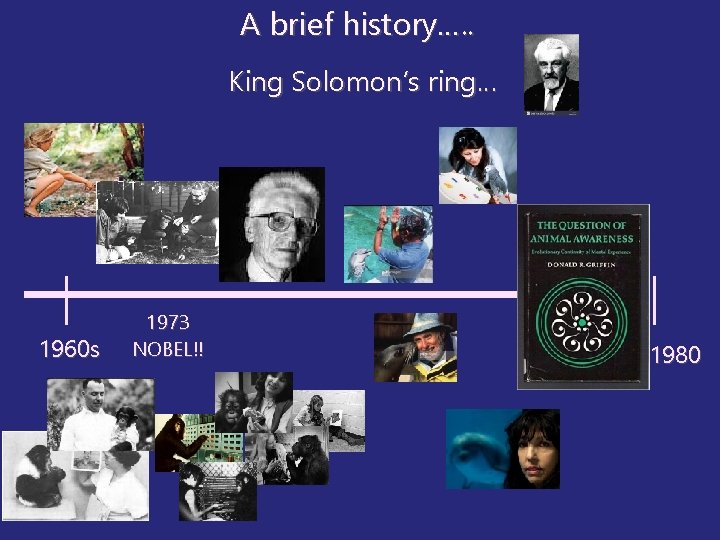
A brief history…. . King Solomon’s ring… 1960 s 1973 NOBEL!! 1980
Griffin emphasized the rationale for our studies… Premack took it further and argued that nonhumans processed information differently IF they had learned symbolic communication We were at time of unparalleled discovery
BUT…. 1980 The “language controversy” erupts….
Whether or not these nonhumans had learned human language was NOT the proper question or the crucial issue… SYMBOLIC COMMUNICATION! Breakthroughs in understanding nonhuman cognitive processing
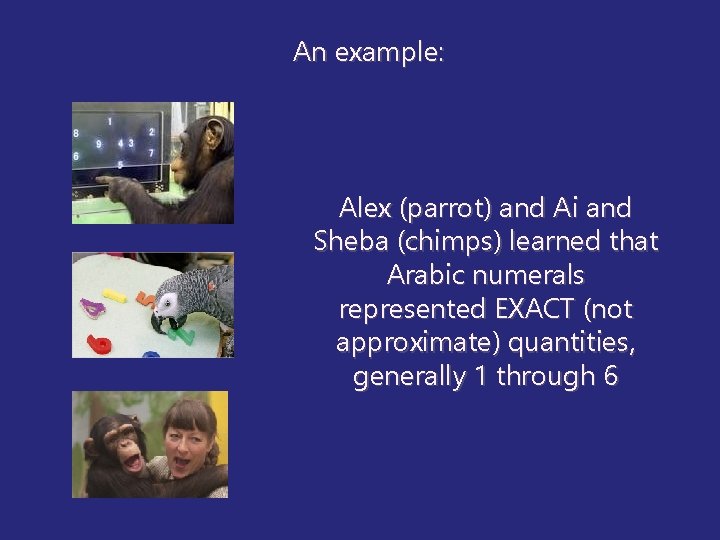
An example: Alex (parrot) and Ai and Sheba (chimps) learned that Arabic numerals represented EXACT (not approximate) quantities, generally 1 through 6
Numbers not taught in order, but Alex inferred the ordinality of his numbers… Then…. Learned 7 and 8 only with respect to Arabic symbols and their order with respect to other SYMBOLS… And inferred that they exactly represented set of seven and eight objects—cardinality from ordinality
Given that symbolic representation allows for advanced levels of cognitive processing… Advanced levels of cognitive processing could then lead to more complicated forms of symbolic representation…. combinatorial forms… Leading to further advances in cognitive processing—e. g. , a spiraling whereby each advance in one context leads to an advance in the other—over evolutionary time, complex communication and cognition
Limitations and other information… Ø Combinations in nonhuman symbolic communication are very simple and relatively rare ØRule-governed series are common in nonsymbolic nonhuman natural systems (whistle-trill-buzz) Ø Nonhumans most likely to use human systems when socially taught and needed for integration into human social systems Ø Cross-species information transfer is not uncommon in the wild—interspecies alarm calling (langurs-visual and deer-olfaction; hornbills and mongoose)
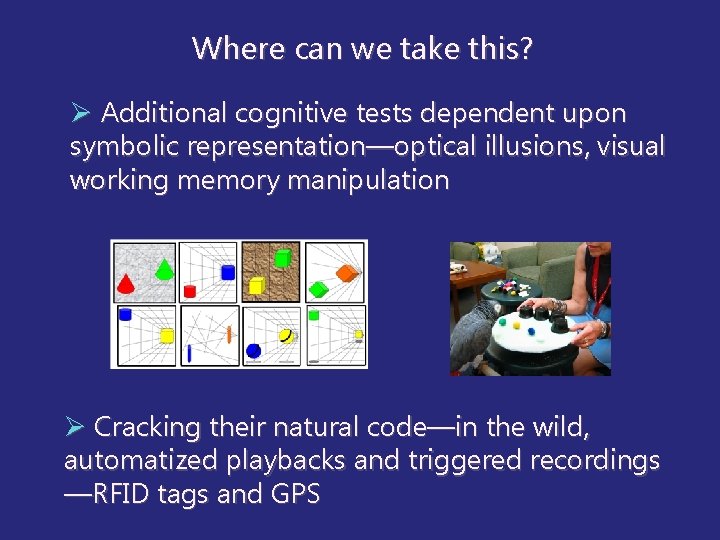
Where can we take this? Ø Additional cognitive tests dependent upon symbolic representation—optical illusions, visual working memory manipulation Ø Cracking their natural code—in the wild, automatized playbacks and triggered recordings —RFID tags and GPS
Where can we take this? Ø Additional web cams with technology to recreate/translate nonhuman senses—UV vision (birds), high-low frequency hearing (cetaceans, elephants), heat sensing (reptiles), olfaction (dogs, elephants) Ø For example: special VR systems to help humans understand nonhuman experiences…
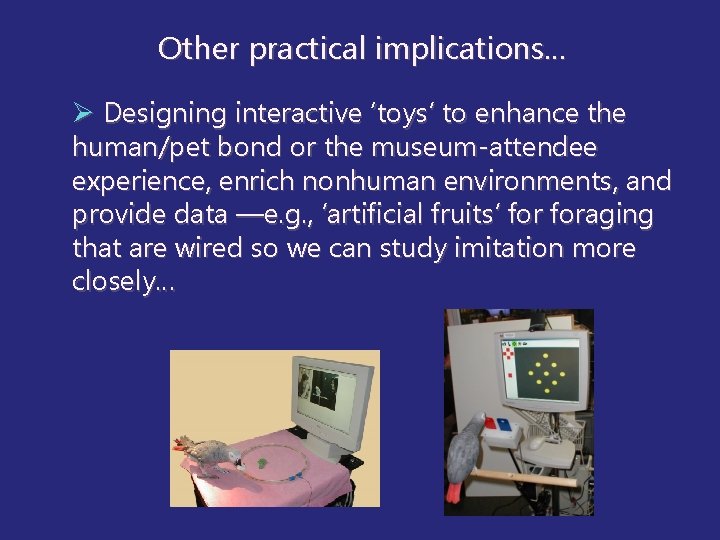
Other practical implications… Ø Designing interactive ‘toys’ to enhance the human/pet bond or the museum-attendee experience, enrich nonhuman environments, and provide data —e. g. , ’artificial fruits’ foraging that are wired so we can study imitation more closely…
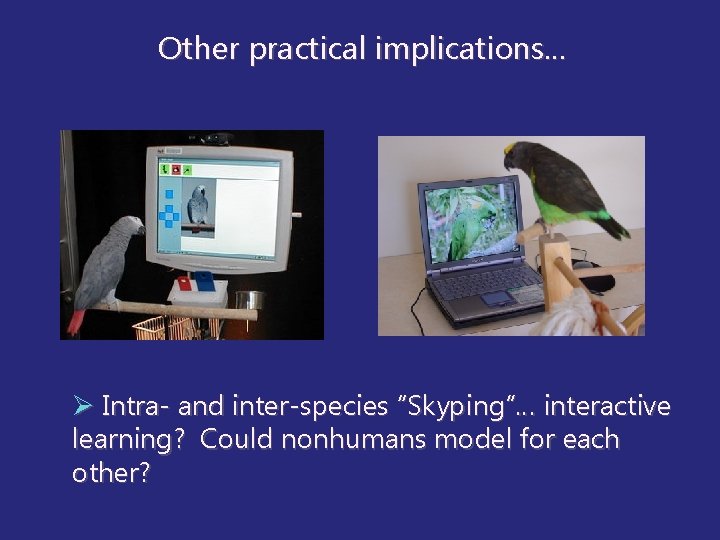
Other practical implications… Ø Intra- and inter-species “Skyping”… interactive learning? Could nonhumans model for each other?
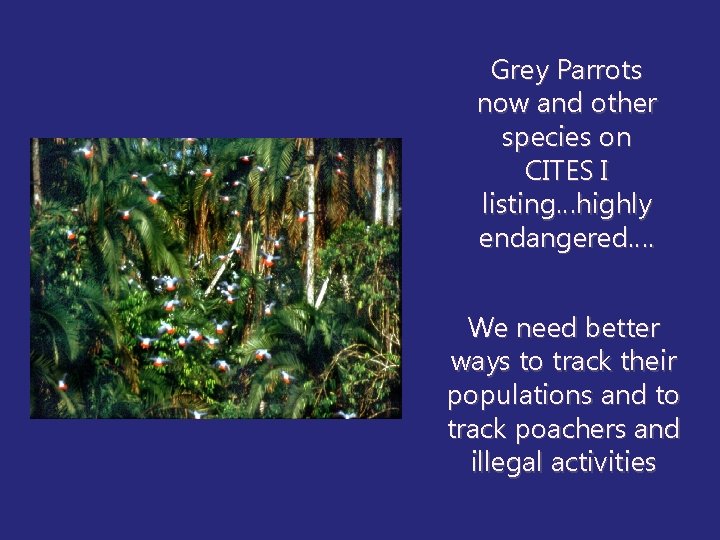
Grey Parrots now and other species on CITES I listing…highly endangered…. We need better ways to track their populations and to track poachers and illegal activities
Animal models for AI… Ø Nonhumans can immediately transfer from one learning set to novel instances Ø Nonhumans can learn via imitation Ø Nonhumans can engage in single-trial learning Ø Nonhumans engage in complex social interactions Ø Nonhumans decipher “messy” situations to extract relevant information quickly
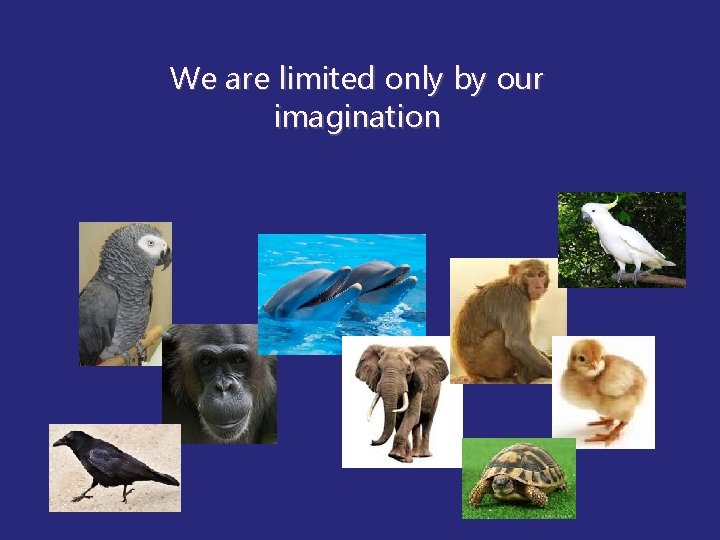
We are limited only by our imagination
- Slides: 17