
INTERSEX NARRATIVES GENDER MEDICINE AND IDENTITY Sharon E















- Slides: 31
INTERSEX NARRATIVES GENDER, MEDICINE, AND IDENTITY Sharon E. Preves, Ph. D. Amy J. Woeste
SHARON E. PREVES, PH. D. Associate Professor in the Department of Sociology at Hamline University. Education: § B. A. 1991, Hamline University § Ph. D. 1999, University of Minnesota Author of Intersex and Identity: The Contested Self.
INTERSEX NARRATIVES GENDER, MEDICINE, AND IDENTITY Preves was prompted to write the article because she recognized that intersex support groups were being organized, and decided it would be helpful to share their personal stories with people outside the intersex community. This article was specifically written for Sex, Gender, and Sexuality: The New Basics.
SUMMARY “This article explores what happens to people who, from the time of their birth or early adolescence, inhabit bodies that do not afford them an easy choice between the gender lines. ” B Y U SING first-person experiences and scientific background to describe intersexuals’ lives and challenges they overcome.
SEX VS. GENDER Sex: Determined by sexual organs. Gender: Chosen sexual identity in relation to society or culture. This means: Someone’s sex can differ from their chosen gender.
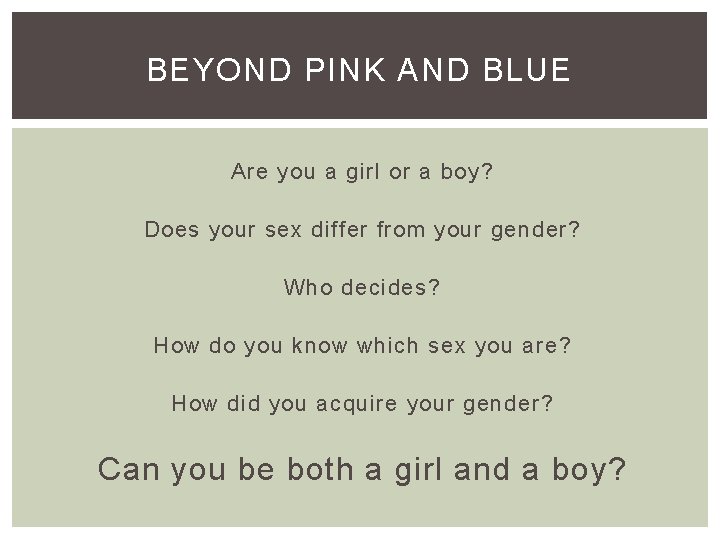
BEYOND PINK AND BLUE Are you a girl or a boy? Does your sex differ from your gender? Who decides? How do you know which sex you are? How did you acquire your gender? Can you be both a girl and a boy?
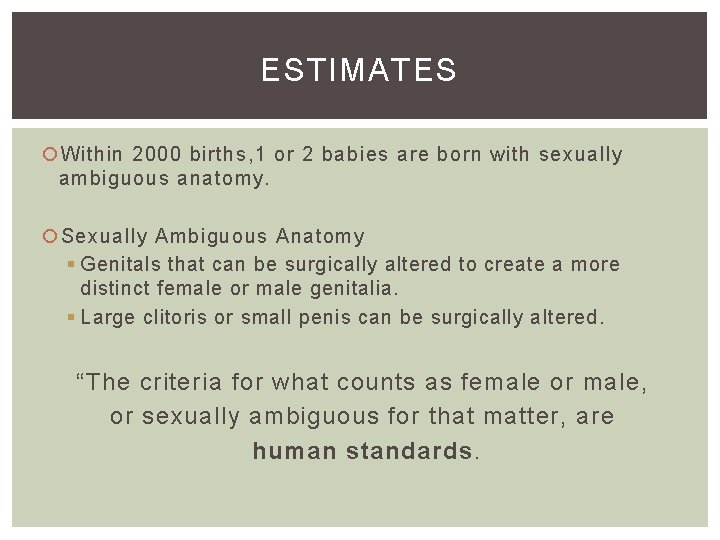
ESTIMATES Within 2000 births, 1 or 2 babies are born with sexually ambiguous anatomy. Sexually Ambiguous Anatomy § Genitals that can be surgically altered to create a more distinct female or male genitalia. § Large clitoris or small penis can be surgically altered. “The criteria for what counts as female or male, or sexually ambiguous for that matter, are human standards.
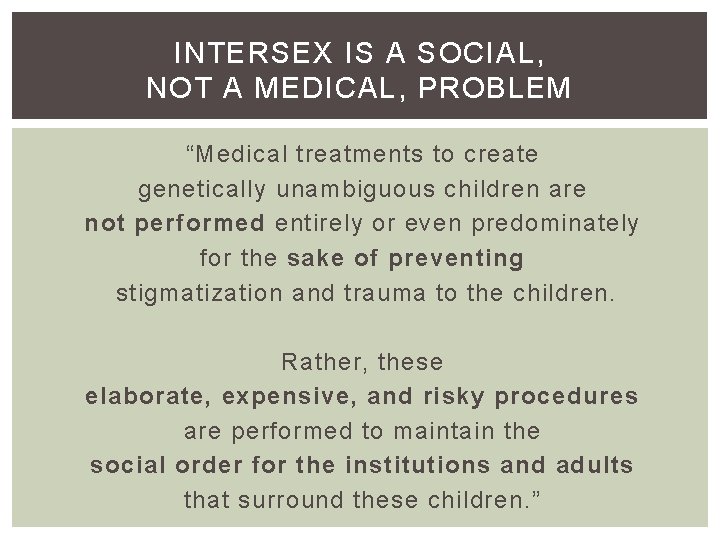
INTERSEX IS A SOCIAL, NOT A MEDICAL, PROBLEM “Medical treatments to create genetically unambiguous children are not performed entirely or even predominately for the sake of preventing stigmatization and trauma to the children. Rather, these elaborate, expensive, and risky procedures are performed to maintain the social order for the institutions and adults that surround these children. ”
CLAIRE
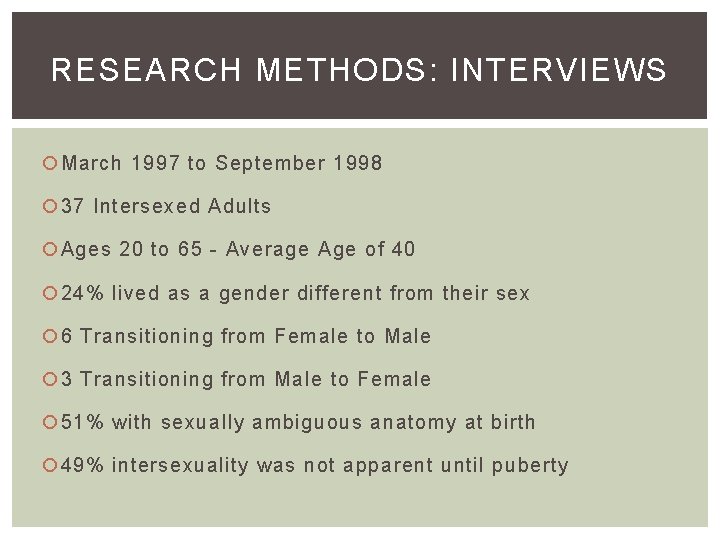
RESEARCH METHODS: INTERVIEWS March 1997 to September 1998 37 Intersexed Adults Ages 20 to 65 - Average Age of 40 24% lived as a gender different from their sex 6 Transitioning from Female to Male 3 Transitioning from Male to Female 51% with sexually ambiguous anatomy at birth 49% intersexuality was not apparent until puberty
MEDICALIZATION, STIGMA, SECRECY, AND SHAME “The participants’ experiences with medical attempts to “normalize” their bodies were amazingly consistent, despite the widespread variation of intersex diagnoses. ”
MEDICAL SEX ASSIGNMENT Three Messages Doctors Gave Participants I. They were objects of medical interest and treatment. II. They were not to know what was wrong with them or why they were receiving medical treatment. III. These procedures were in their best interest and should be accepted and kept secret.
BEING AN OBJECT OF STUDY How would you feel being studied like you’re an object without even knowing why? And if you asked, they would only tell you, “Don’t worry, it’s for your own good. ”
DREW
SUEGEE
CAROL
FEARING THE UNKNOWN: “WHAT KIND OF MONSTER AM I? ”
SARAH
FLORA
TIGER
FAYE
SEEDS OF CHANGE – SEEKING COMPREHENSIVE INFORMATION AND SIMILAR OTHERS Carol had to lie
JANA
ROBIN
MELODY, CLAIRE, MARTHA
HERMAPHRODITES WITH ATTITUDE: EVIDENCE OF INTERSEX PRIDE Intersex Society of North America Chose to embrace the alienating and shameful word hermaphrodite
IMPLICATIONS Intersex Society of North America Intersex Patient Advocacy Movement Cheryl Chase Intersex patient advocacy and medical reform movement
INTERSEX SOCIETY OF NORTH AMERICA Cheryl Chase § Executive Director of Intersex Society of North America
INTERSEX PATIENT ADVOCACY MOVEMENT Cheryl Chase § Executive Director of Intersex Society of North America Began in 1990 s
TO THE STORIES ONE LAST TIME
BIBLIOGRAPHY Chase, Cheryl. “What is the agenda of the intersex patient advocacy movement? ” First World Congress: Hormonal and Genetic Basis of Sexual Differentiation Disorders, 17 -18 May 2002, Tempe, Arizona. Ed. Maria New and Jean Wilson. Chevy Chase, Maryland: The Endocrine Society, 2002. Print. Preves, Sharon E. “Intersex Narratives. ” Sex, Gender, and Sexuality: The New Basics. Ed. Abby L. Ferber, Kimberly Holcomb, and Tre Wentling. New York: Oxford University Press, 2009. 32 -43. Print.