
INTERSECTIONS TOPOLOGY ACCURACY NUMERICS FOR GEOMETRIC OBJECTS NSFDARPA
INTERSECTIONS -- TOPOLOGY, ACCURACY, & NUMERICS FOR GEOMETRIC OBJECTS NSF/DARPA I-TANGO III
Intellectual Integration of Project Team • • • New conceptual model (Stewart - UConn) Intersection improvements (Sakkalis – MIT) Polynomial evaluation (Hoffmann – Purdue) Industrial view (Ferguson – DRF Associates) Key external interactions (Peters, UConn)

Stability Proofs with Uncertain Data Neil Stewart, Université de Montréal with L. -E. Andersson and M. Zidani Thanks: T. J. Peters and J. Bisceglio
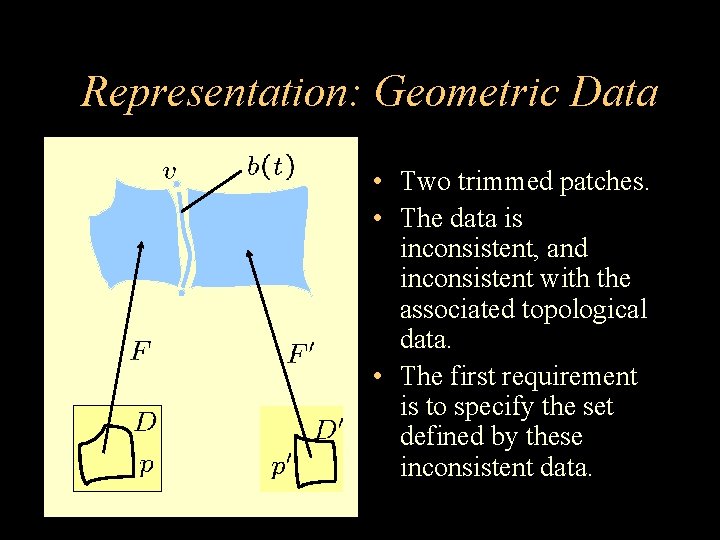
Representation: Geometric Data • Two trimmed patches. • The data is inconsistent, and inconsistent with the associated topological data. • The first requirement is to specify the set defined by these inconsistent data.
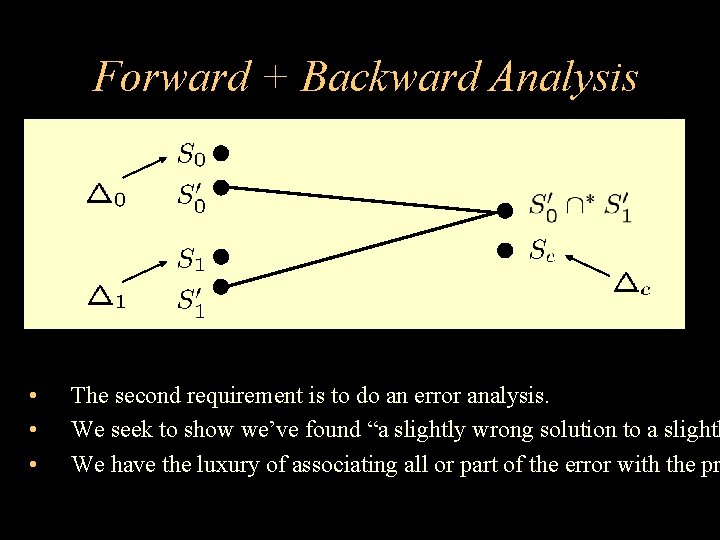
Forward + Backward Analysis • • • The second requirement is to do an error analysis. We seek to show we’ve found “a slightly wrong solution to a slightl We have the luxury of associating all or part of the error with the pr
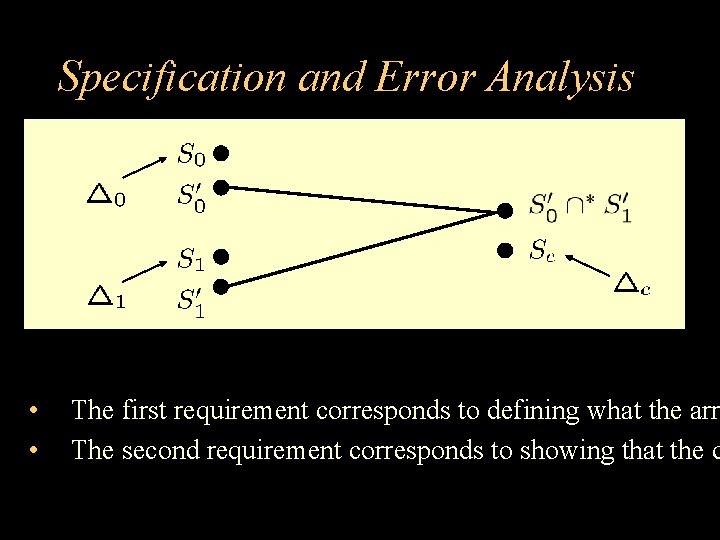
Specification and Error Analysis • • The first requirement corresponds to defining what the arr The second requirement corresponds to showing that the d
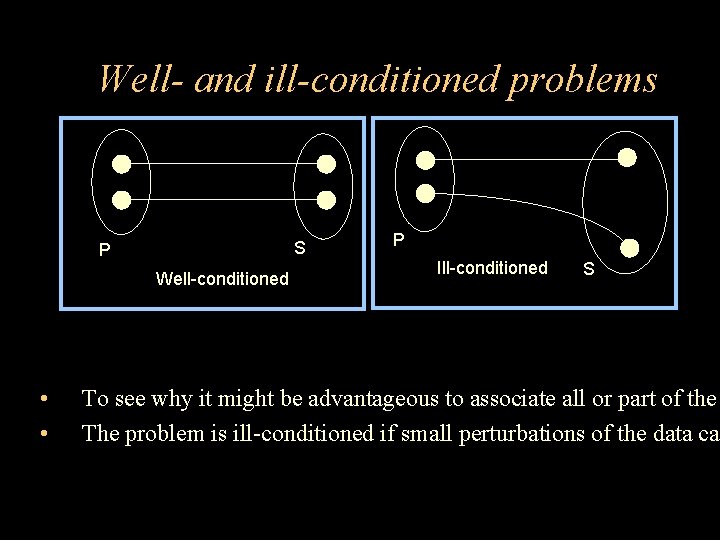
Well- and ill-conditioned problems S P Well-conditioned • • P Ill-conditioned S To see why it might be advantageous to associate all or part of the The problem is ill-conditioned if small perturbations of the data can
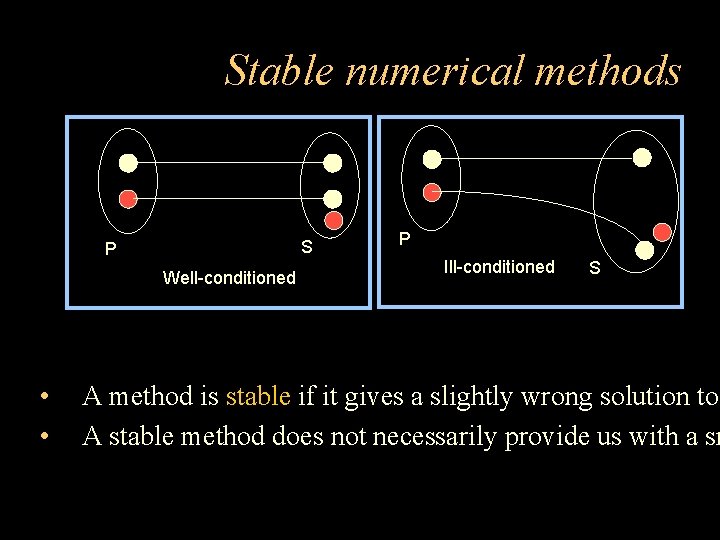
Stable numerical methods S P Well-conditioned • • P Ill-conditioned S A method is stable if it gives a slightly wrong solution to A stable method does not necessarily provide us with a sm
Appropriate goals • An often-used criterion for robustness is whether the program crashes. This is not sensible: we need an error metric. • Even with a metric, in the presence of uncertainty it is futile to use exact arithmetic, or other similar means, to provide a solution better than one that is already the exact answer to a slightly perturbed problem.
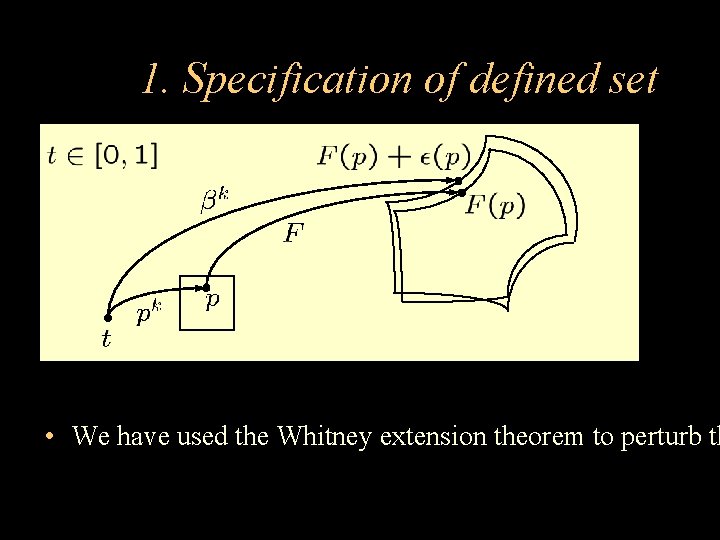
1. Specification of defined set • We have used the Whitney extension theorem to perturb th
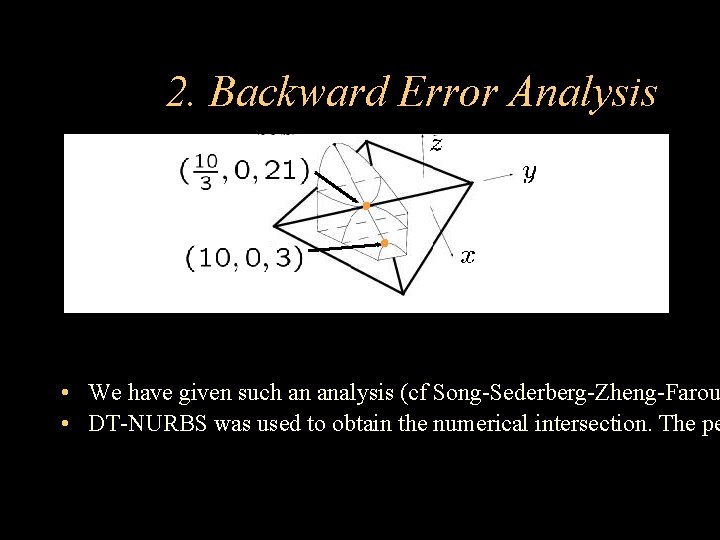
2. Backward Error Analysis • We have given such an analysis (cf Song-Sederberg-Zheng-Farou • DT-NURBS was used to obtain the numerical intersection. The pe
NSF/DARPA Project I-TANGO: Intersections-Topology, Accuracy and Numerics for Geometric Objects N. M. Patrikalakis T. Maekawa T. Sakkalis K. H. Ko H. Mukundan Massachusetts Institute of Technology May 2004
Surface to Surface Intersection • Obtaining an accurate starting point in each component – Roots of polynomials with accurate error bounds • Multiple roots with accurate error bounds • Tracing the given intersection correctly – An accurate estimate of error in 3 D model space – Transversal and tangential intersections
Achievements • Validated error bounds in 3 D model space which enclose the true curve of intersection : Interval Solid Modeling • Prevention of the phenomenon of straying or looping. • The scheme can accommodate the errors in: – Initial condition – Rounding during digital computation • Reduction of error bounds – Error bound reduction in parametric space. – Error bound reduction in model space. • Robust computation of roots and multiplicities for univariate and bivariate polynomial equations
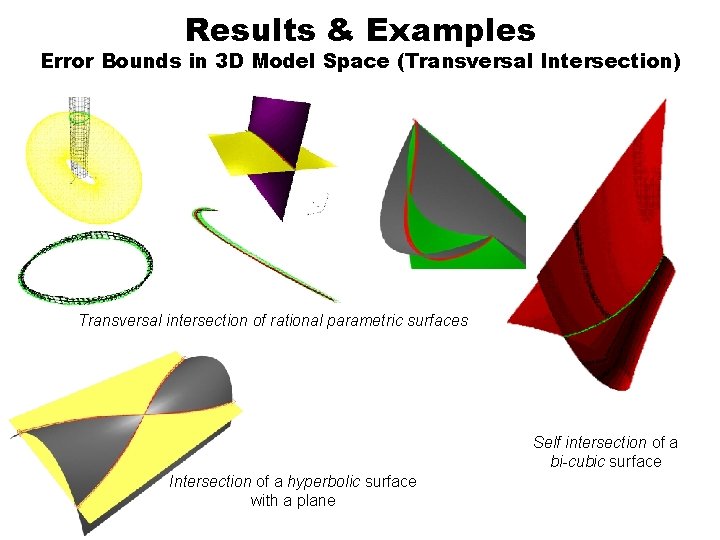
Results & Examples Error Bounds in 3 D Model Space (Transversal Intersection) 0. 02 Transversal intersection of rational parametric surfaces Self intersection of a bi-cubic surface Intersection of a hyperbolic surface with a plane
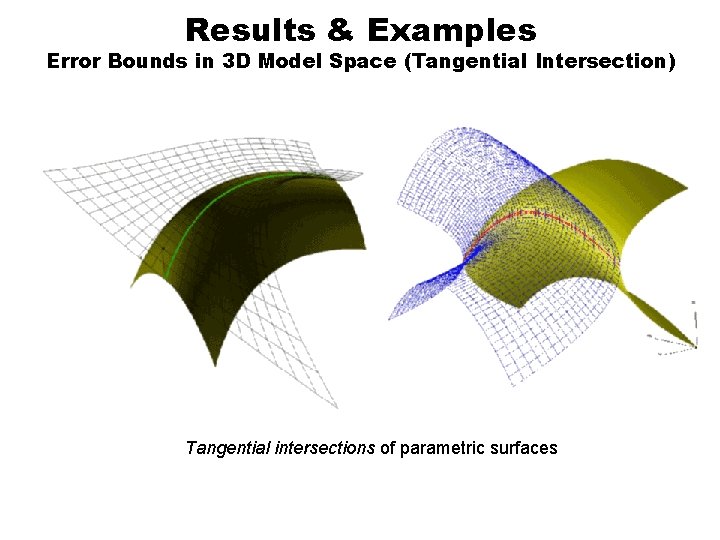
Results & Examples Error Bounds in 3 D Model Space (Tangential Intersection) Tangential intersections of parametric surfaces
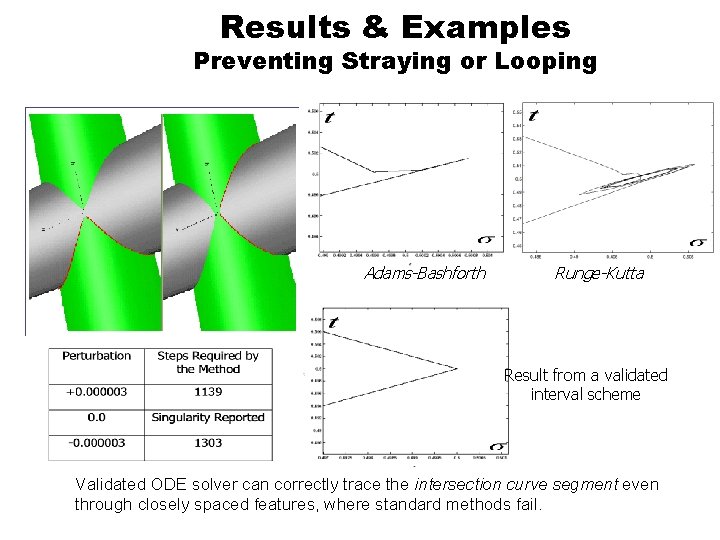
Results & Examples Preventing Straying or Looping Adams-Bashforth Runge-Kutta Result from a validated interval scheme Validated ODE solver can correctly trace the intersection curve segment even through closely spaced features, where standard methods fail.
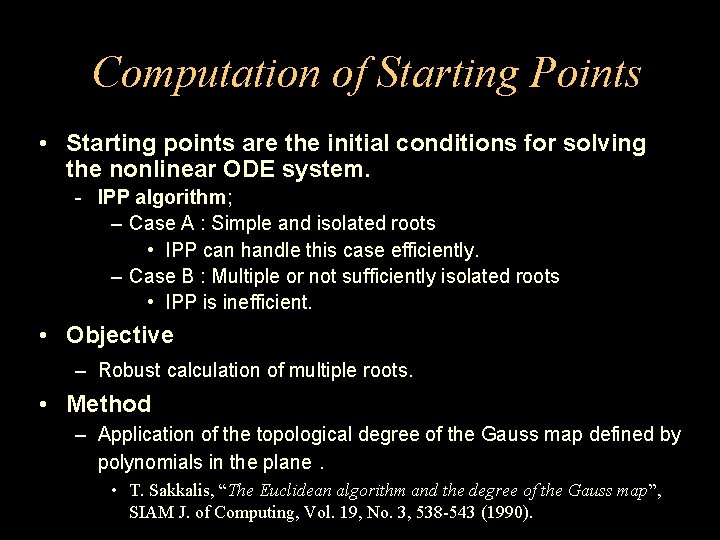
Computation of Starting Points • Starting points are the initial conditions for solving the nonlinear ODE system. - IPP algorithm; – Case A : Simple and isolated roots • IPP can handle this case efficiently. – Case B : Multiple or not sufficiently isolated roots • IPP is inefficient. • Objective – Robust calculation of multiple roots. • Method – Application of the topological degree of the Gauss map defined by polynomials in the plane. • T. Sakkalis, “The Euclidean algorithm and the degree of the Gauss map”, SIAM J. of Computing, Vol. 19, No. 3, 538 -543 (1990).
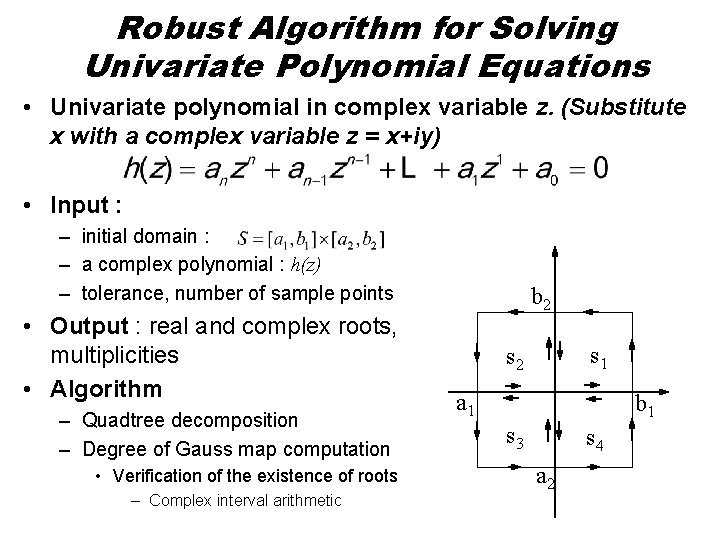
Robust Algorithm for Solving Univariate Polynomial Equations • Univariate polynomial in complex variable z. (Substitute x with a complex variable z = x+iy) • Input : – initial domain : – a complex polynomial : h(z) – tolerance, number of sample points • Output : real and complex roots, multiplicities • Algorithm – Quadtree decomposition – Degree of Gauss map computation • Verification of the existence of roots – Complex interval arithmetic b 2 s 1 s 2 a 1 b 1 s 3 s 4 a 2
Conclusions Future. Work • Strict error control code. • Research on the general problem of multiple roots of nonlinear polynomial systems in 3 or 4 variables. • Classification of the interval intersection curves.
Accurate Polynomial Evaluation Christoph Hoffmann, Purdue University Neil Stewart, University of Montreal Thanks Gahyun Park, Purdue J. -R. Simard, Montreal
Motivation • If evaluation is inaccurate, then surface intersection has a weakened foundation • Exact evaluation may be too costly • Traditional evaluation may be too loose • What is a good balance?
Evaluation Methods • Simple Horner • Residual iteration – Using fp arithmetic – Using accurate inner product • Compensating direct fp arithmetic • Distillation
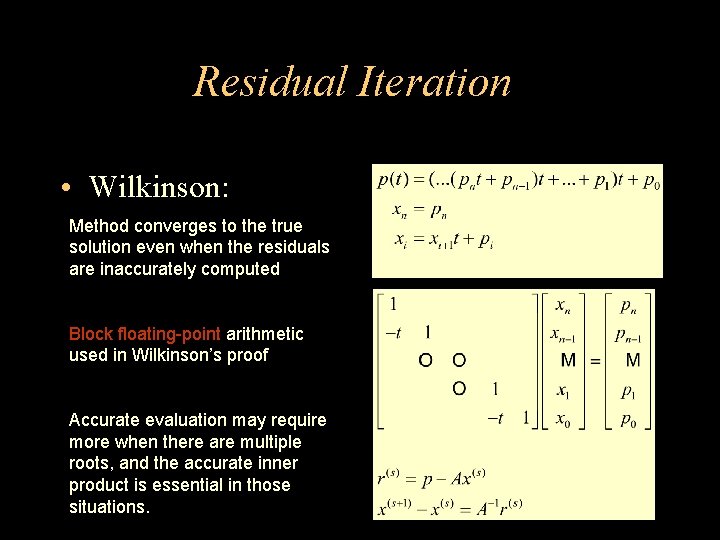
Residual Iteration • Wilkinson: Method converges to the true solution even when the residuals are inaccurately computed Block floating-point arithmetic used in Wilkinson’s proof Accurate evaluation may require more when there are multiple roots, and the accurate inner product is essential in those situations.
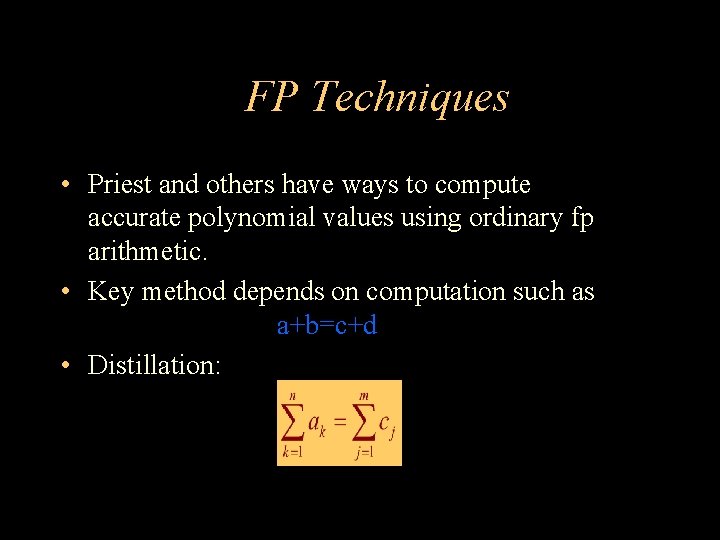
FP Techniques • Priest and others have ways to compute accurate polynomial values using ordinary fp arithmetic. • Key method depends on computation such as a+b=c+d • Distillation:
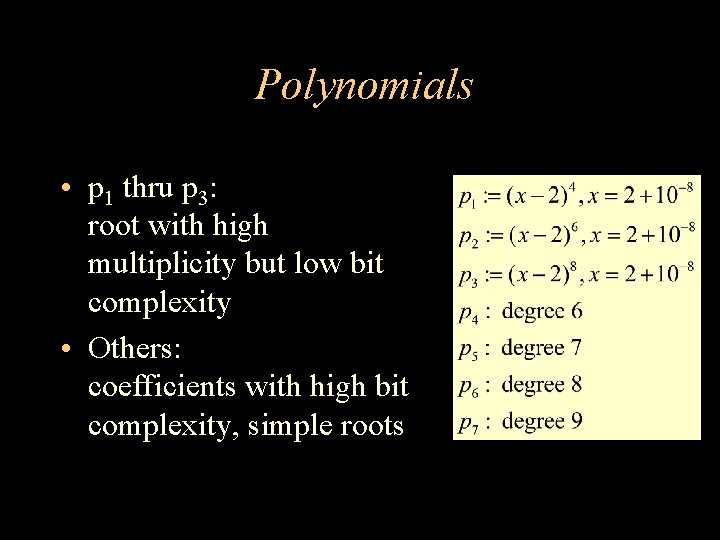
Polynomials • p 1 thru p 3: root with high multiplicity but low bit complexity • Others: coefficients with high bit complexity, simple roots
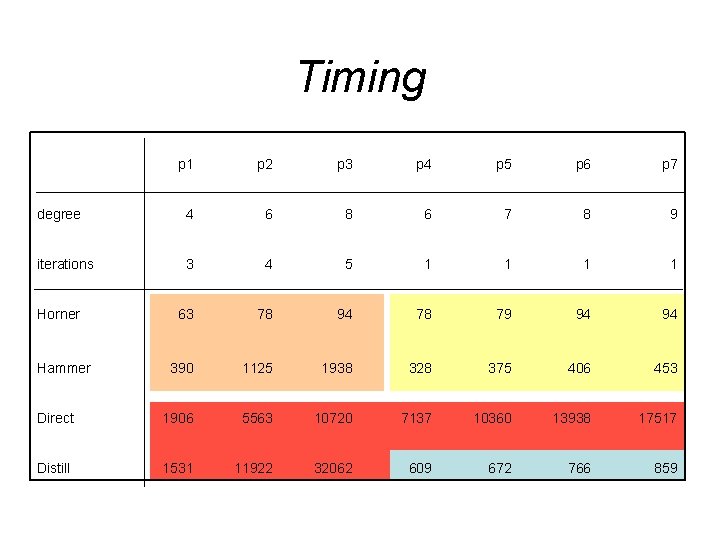
Timing p 1 p 2 p 3 p 4 p 5 p 6 p 7 degree 4 6 8 6 7 8 9 iterations 3 4 5 1 1 63 78 94 78 79 94 94 390 1125 1938 328 375 406 453 Direct 1906 5563 10720 7137 10360 13938 17517 Distill 1531 11922 32062 609 672 766 859 Horner Hammer
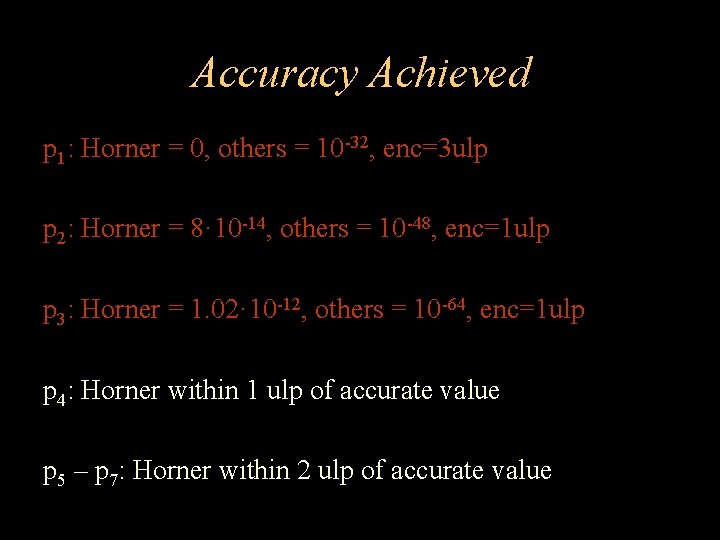
Accuracy Achieved p 1: Horner = 0, others = 10 -32, enc=3 ulp p 2: Horner = 8· 10 -14, others = 10 -48, enc=1 ulp p 3: Horner = 1. 02· 10 -12, others = 10 -64, enc=1 ulp p 4: Horner within 1 ulp of accurate value p 5 – p 7: Horner within 2 ulp of accurate value

Industrial Perspective David R Ferguson • • • Historical perspective Where we are now Why (really!) do we care What is being done and What should be done
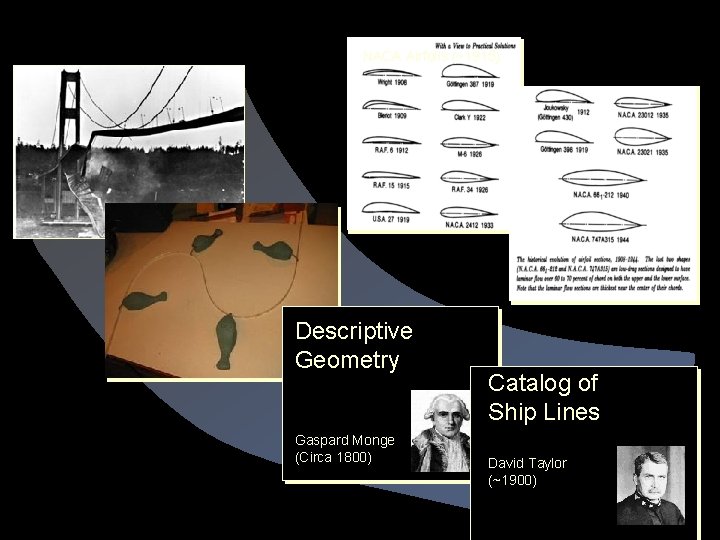
NACA Airfoils (~1915) Descriptive Geometry Gaspard Monge (Circa 1800) Catalog of Ship Lines David Taylor (~1900)
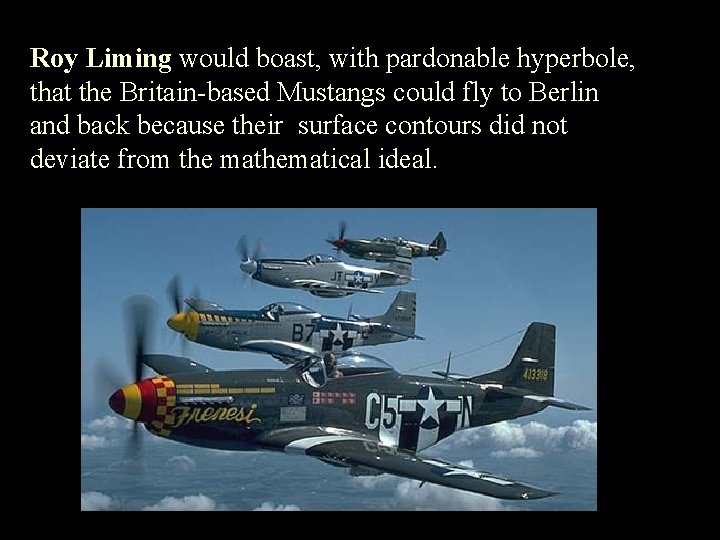
Roy Liming would boast, with pardonable hyperbole, that the Britain-based Mustangs could fly to Berlin and back because their surface contours did not deviate from the mathematical ideal.
Where we are now! • CAD systems getting better – perhaps but • Industry and government still reporting poor performance. Examples – Boeing CFD still reports 40 -60% loss of engineering productivity – US Auto industry spends in excess of a billion dollars / year mitigating the effects of bad geometry. – See report on an interdisciplinary workshop at UC Davis in April, 1999. But • Industry and government not interested. As long as they can do their job with current means they are willing to bumble along.

So, Why do we care? Simply put: The job is changing • The real issue is automation supporting advanced design and manufacture. • It’s all about – Virtual prototyping (driving out cost and time) – Studying families of designs for good solutions and – Finding feasibility where none is known at the time. • These mean seamless integration of CAD/CAM/CAE tools and robust, automatic, continuous variation of geometry is required.
Intersection plays a critical role • Surface intersections are the single greatest source of non-operator error in CAD and in grid generation for CFD and other analyses. – Tolerances vary from CAD system to CAD system – More importantly, tolerances vary from application to application • Algorithmic characteristics of surface intersection will wreck havoc with continuous variation (smooth morphing) of geometry in current CAD systems. – Nonlinear aspects may dictate different computational paths as the geometry changes.
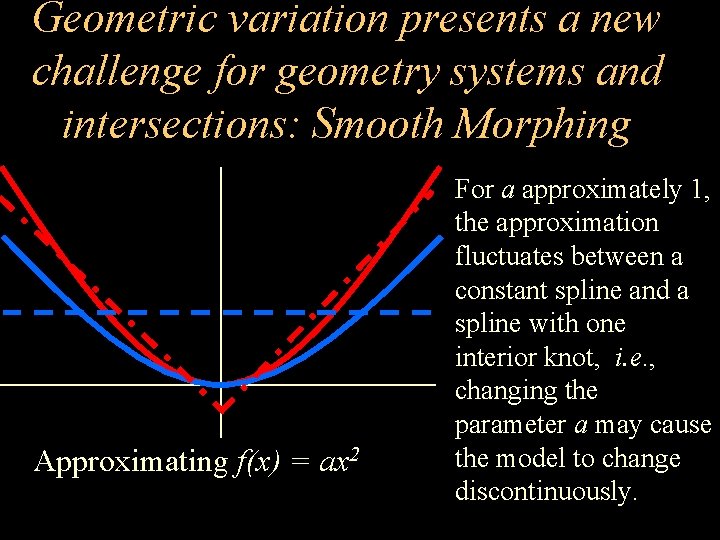
Geometric variation presents a new challenge for geometry systems and intersections: Smooth Morphing Approximating f(x) = ax 2 For a approximately 1, the approximation fluctuates between a constant spline and a spline with one interior knot, i. e. , changing the parameter a may cause the model to change discontinuously.

What’s being done and what should be done • Geometry repair – Farouki et al: Perturbation schemes for surface repair – Klein (and others): Practical tools – Commercial products: CADFix • Fundamentals of the intersection process – I-TANGO team • Unfortunately …

A Final Thought: We are seeing a fundamental change in the use of geometry Previously, geometry was used solely to document what was built. Geometry had to match the product. Now, it’s the product that has to match the geometry: Liming’s goal.
International Visibility 1. Invited tutorial: Effective Computational Geometry 2. Talk at ICIAM (Australia, 2003) 3. Upcoming a. Three papers, Italy, Solids & Shapes b. Dagstuhl Seminar
Technology Transfer • I-TANGO I – Existing GK interface in parametric domain – Taylor’s theorem for theory – New model space error bound prototype • CAGD paper • Transfer to Boeing through GEML

Topology • Computational Topology for Regular Closed Sets (within the I-TANGO Project) – Invited article, Topology Atlas – Entire team authors (including student) – I-TANGO interest from theory community
Diversity (Scientific & Human) • Sabbatical with Wesleyan (Chemistry) – Transition to molecular modeling – Mentoring through seminar – Submitted article CCCG 04 • Diversity recruitment – Majority women – Mixed post-docs, graduates & undergraduates
Summary • Broad Dissemination – Internationally – Industrially • Effective intellectual integration & synergy • Diversity recruitment • Poster tomorrow
- Slides: 42