
Intersectionality of HIV and Domestic Violence Alexis Roberts
Intersectionality of HIV and Domestic Violence Alexis Roberts, BSW Cassidy Stiles, MA
Conflict of Interest Disclosure Statement Speaker has no conflicts to disclose This project is supported by the Health Resources and Services Administration (HRSA) of the U. S. Department of Health and Human Services (HHS). Under grant number U 1 OHA 33225 (South Central AIDS Education and Training Center). It was awarded to the University of New Mexico. No percentage of this project was financed with non-governmental sources. This information or content and conclusions are those of the authors and should not be construed as the official position or policy of, nor should any endorsements be inferred by HRSA, HHS, or the U. S. Government.
What You Think You Know https: //create. kahoot. it/v 2/details/38 b 0 c 11 b-26 da-4726 -86 c 1 -6 be 478625 df 6
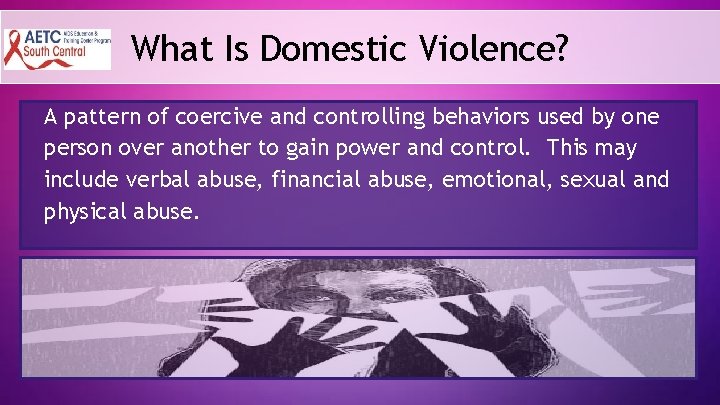
What Is Domestic Violence? A pattern of coercive and controlling behaviors used by one person over another to gain power and control. This may include verbal abuse, financial abuse, emotional, sexual and physical abuse.
Statistics on Domestic Violence ★ 1 in 4 women and 1 in 9 men experience severe intimate partner physical violence, intimate partner contact sexual violence, and/or intimate partner stalking with impacts such as injury, fearfulness, post-traumatic stress disorder, use of victim services, contraction of sexually transmitted diseases, etc. ★ 1 in 4 women and 1 in 7 men have been victims of severe physical violence (e. g. beating, burning, strangling) by an intimate partner in their lifetime. ★ 16% (about 1 in 6) of homicide victims are killed by an intimate partner ★ On a typical day, there are more than 20, 000 phone calls placed to domestic violence hotlines nationwide. ★ The presence of a gun in a domestic violence situation increases the risk of homicide by 500%. ★ Domestic victimization is correlated with a higher rate of depression and suicidal behavior. ★ Only 34% of people who are injured by intimate partners receive medical care for their injuries. ★ On average, nearly 20 people per minute are physically abused by an intimate partner in the United States. During one year, this equates to more than 10 million women and men. (NCADV, 2020)
Warning Signs of DV Dr. Jekyll/Mr. Hyde dual personality Cruelty to animals Breaking/striking objects Unrealistic expectations Blames others/never takes responsibility
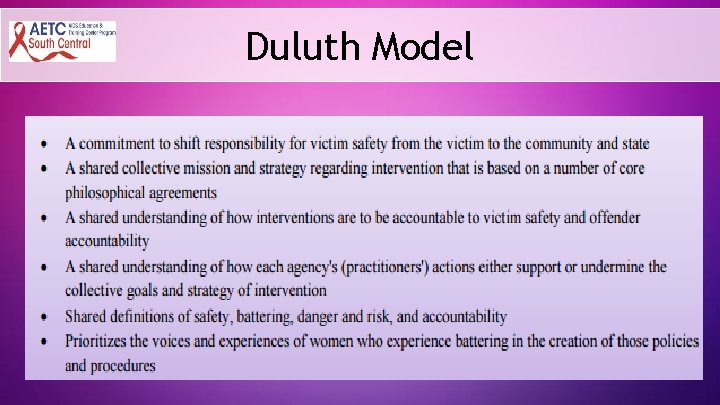
Duluth Model
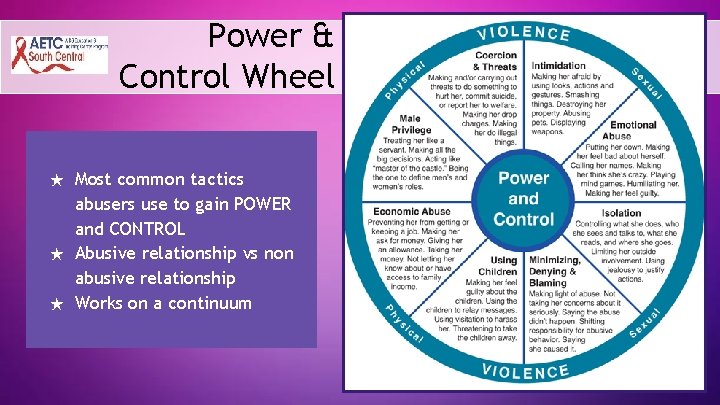
Power & Control Wheel ★ ★ ★ Most common tactics abusers use to gain POWER and CONTROL Abusive relationship vs non abusive relationship Works on a continuum
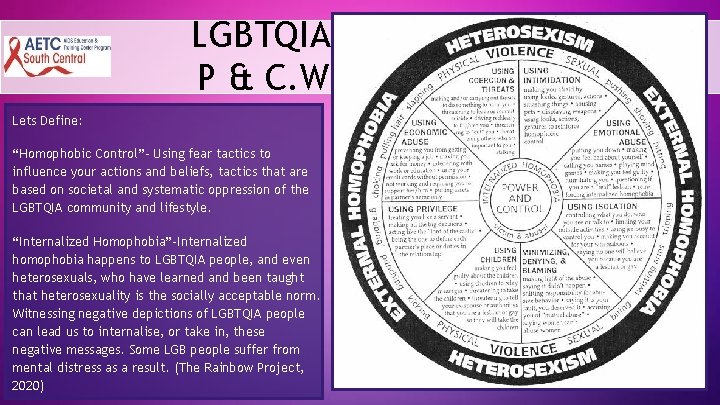
LGBTQIA P & C. W. Lets Define: “Homophobic Control”- Using fear tactics to influence your actions and beliefs, tactics that are based on societal and systematic oppression of the LGBTQIA community and lifestyle. “Internalized Homophobia”-Internalized homophobia happens to LGBTQIA people, and even heterosexuals, who have learned and been taught that heterosexuality is the socially acceptable norm. Witnessing negative depictions of LGBTQIA people can lead us to internalise, or take in, these negative messages. Some LGB people suffer from mental distress as a result. (The Rainbow Project, 2020)
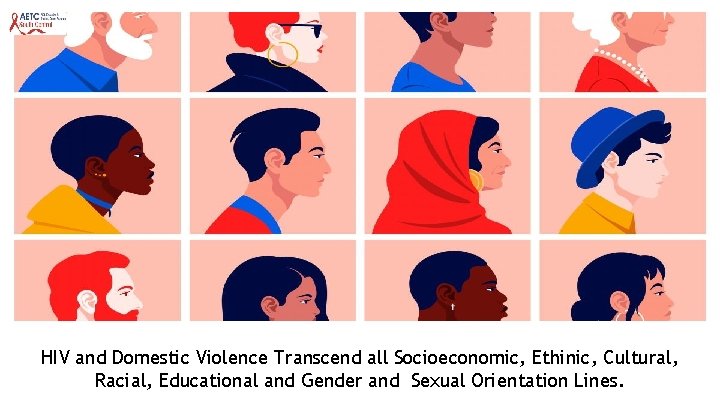
HIV and Domestic Violence Transcend all Socioeconomic, Ethinic, Cultural, Racial, Educational and Gender and Sexual Orientation Lines.
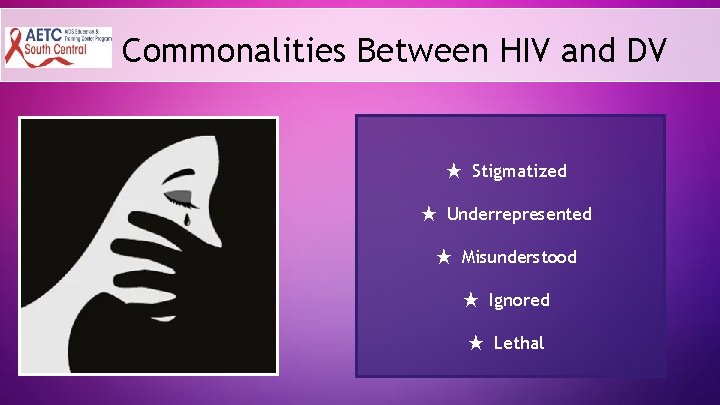
Commonalities Between HIV and DV ★ Stigmatized ★ Underrepresented ★ Misunderstood ★ Ignored ★ Lethal
Statistics ★ In a study of HIV service providers, 24% reported at least 1 patient who disclosed their HIV status and then experienced physical abuse. 45% of providers had patients who feared physical abuse upon disclosure. ★ People living with HIV may experience prolonged DV with increased severity when compared to people who are HIV-negative and experiencing DV. ★ Individuals experiencing DV are at higher risk for HIV/AIDS because they might. . ○ Be forced to have sex with an infected partner ○ Have limited ability to negotiatie safe sex practices (Fact Sheet About HIV/AIDS & Domestic Violence, 2018) & (Harrigan, 2019)
Domestic Violence & Risk of Contracting HIV Victims are often unable to negotiate the use of safer sex practices with coercive partners, as well as safer drug use. ★ Abusers may rape or sexually assault their victims as part of their pattern of control, making it unlikely that the abuser will use a condom. In fact, some abusers may intentionally infect their partners with HIV in an attempt to keep the victim from leaving. ★ Abusive partners who engage in sexual activity outside the relationship, potentially expose victims to STD’s including HIV. ★ (New York State, 2020)
Domestic Violence & Risk of Contracting HIV ★ Abusive partners may force victims to engage in sexual activities with others. ★ Victims of domestic violence often suffer a wide range of health-related problems caused or exacerbated by the abuse. This negative effect on their health may compromise their immune system in ways that increase their risk of HIV. ★ Abusers may prevent victims from receiving medical care which may, in turn, negatively impact their health and increase their risk of contracting HIV. (New York State, 2020)
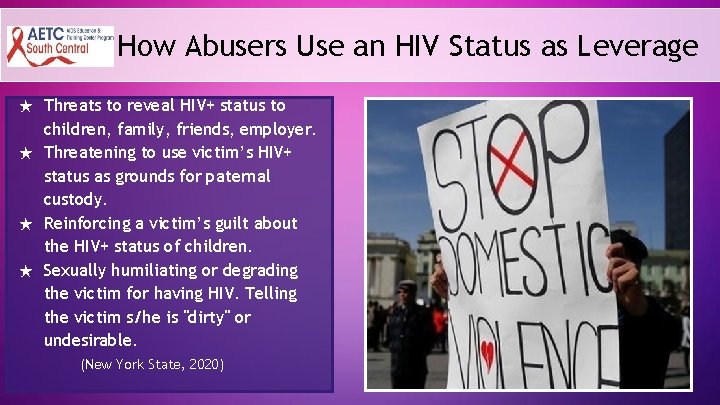
How Abusers Use an HIV Status as Leverage Threats to reveal HIV+ status to children, family, friends, employer. ★ Threatening to use victim’s HIV+ status as grounds for paternal custody. ★ Reinforcing a victim’s guilt about the HIV+ status of children. ★ Sexually humiliating or degrading the victim for having HIV. Telling the victim s/he is "dirty" or undesirable. ★ (New York State, 2020)
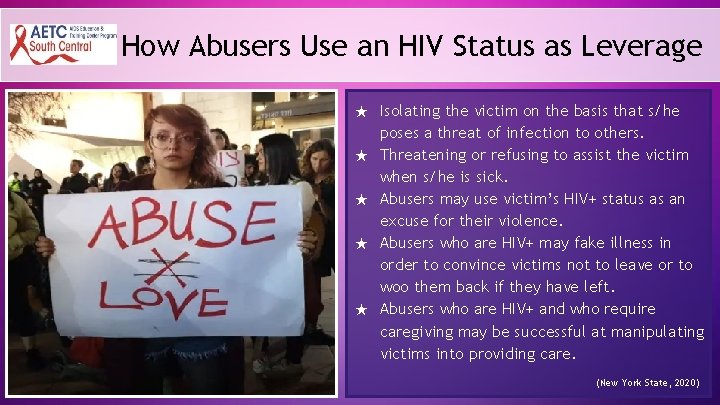
How Abusers Use an HIV Status as Leverage ★ ★ ★ Isolating the victim on the basis that s/he poses a threat of infection to others. Threatening or refusing to assist the victim when s/he is sick. Abusers may use victim’s HIV+ status as an excuse for their violence. Abusers who are HIV+ may fake illness in order to convince victims not to leave or to woo them back if they have left. Abusers who are HIV+ and who require caregiving may be successful at manipulating victims into providing care. (New York State, 2020)
DV as an obstacle to HIV treatment/care Access to medical care, finances, and support systems is often controlled by the abuser. ★ For victim with AIDS diagnosis, disability or fixed income may lead to financial dependency. ★ As the disease progresses, the ability to take care of oneself may diminish. In turn, the victim becomes more dependent on abuser & increasingly “trapped” in the relationship ★ (New York State, 2020)
DV as an obstacle to HIV treatment/care Partner notification practices may put victim who is HIV+ at further risk, therefore decreasing the likelihood they will seek services ★ LGBTQ victims may have less of a support system if they’ve been ostracized based on sexual orientation-causing dependency on abusive partner. ★ Reluctant to leave out of concern for care for children should HIV/AIDS incapacitate them ★ (New York State, 2020)
DV as an obstacle to HIV treatment/care ★ Women who experience DV were 21% less likely to be on treatment, reported 53% lower adherence to medication, and where 36% less likely to be virally suppressed than women who had not experience DV ★ Men who have experienced DV were 1. 95 x more likely to have had a clinically significant interruption in care (defined as having an undetectable viral load and leaving care for at least one year, then returning to care with a detectable viral load and 1. 55 x more likely to have had a hospitalization related to HIV
Assisting Our Clients Through Recovery Using Empowerment and Education
Reduce The Stigma 1. 2. 3. 4. 5. 6. 7. Know the facts. Educate yourself about the HIV and DV, as well as the intersectionality between the two. Be aware of your attitudes and behaviour. Be willing to confront your own biases. Change starts with “us”. Choose your words carefully. The way we speak can affect the attitudes of others. Educate others. Pass on facts and positive attitudes; challenge myths and stereotypes. Be willing to create and support an environment that holds space for empowering and educating dialogue. Focus on the positive. DV and HIV are only a part of anyone's larger picture. Treat everyone with dignity and respect; offer support and encouragement. Demand policies and space which nurture inclusivity.
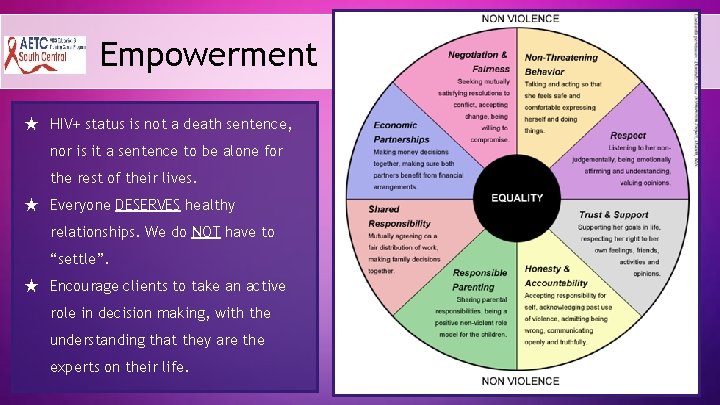
Empowerment ★ HIV+ status is not a death sentence, nor is it a sentence to be alone for the rest of their lives. ★ Everyone DESERVES healthy relationships. We do NOT have to “settle”. ★ Encourage clients to take an active role in decision making, with the understanding that they are the experts on their life.
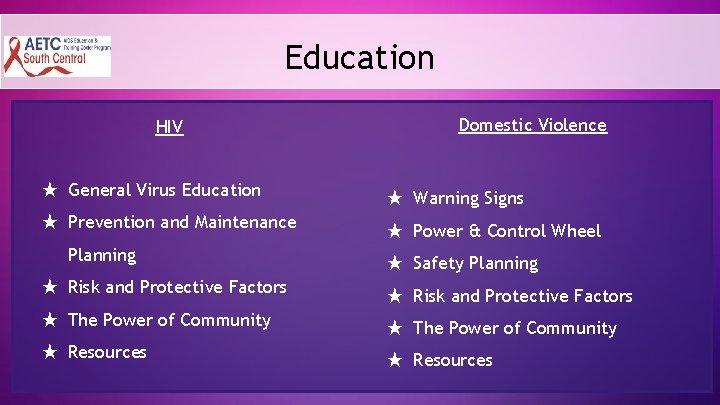
Education HIV Domestic Violence ★ General Virus Education ★ Warning Signs ★ Prevention and Maintenance ★ Power & Control Wheel Planning ★ Safety Planning ★ Risk and Protective Factors ★ The Power of Community ★ Resources
Education
Resources and Referrals It’s crucial that we familiarize ourselves with local resources to help our clients. Who in your community serves victims of domestic violence? Who in your community serves individuals with HIV? How can you help them get connected? Think about: Support groups, medical facilities (low cost or no insurance), financial help, crisis/advocacy center, emergency shelter, crisis hotlines
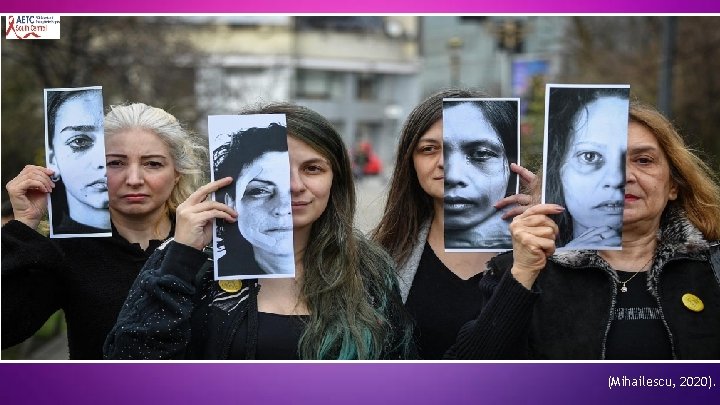
(Mihailescu, 2020).
References http: //www. mass. gov/eopss/crime-prev-personal-sfty/sexual-and-dom-viol/overview/definition-of-domesticviolence. html. MIHAILESCU, D. (2020). Domestic violence cases jump 30% during lockdown in France. Retrieved 5 October 2020, from https: //www. euronews. com/2020/03/28/domestic-violence-cases-jump-30 -during-lockdown-in-france New York State. (2020). Domestic Violence and HIV/AIDS - NYS OPDV. Retrieved 5 October 2020, from https: //opdv. ny. gov/professionals/health/hivaids. html Harrigan, M. (2019). The link between intimate partner violence and HIV. Retrieved 5 October 2020, from https: //www. catie. ca/en/pif/fall-2019/link-between-intimate-partner-violence-and-hiv What is The Duluth Model? (n. d. ). Retrieved October 05, 2020, from https: //www. theduluthmodel. org/what-is-the-duluth-model/ The Rainbow Project. (2020). Internalised Homophobia. Retrieved 5 October 2020, from https: //www. rainbow-project. org/internalisedhomophobia NCADV. (2020). NCADV | National Coalition Against Domestic Violence. Retrieved 5 October 2020, from https: //ncadv. org/STATISTICS
- Slides: 30