
Intersection of Prisms at Right Angles When a
- Slides: 3
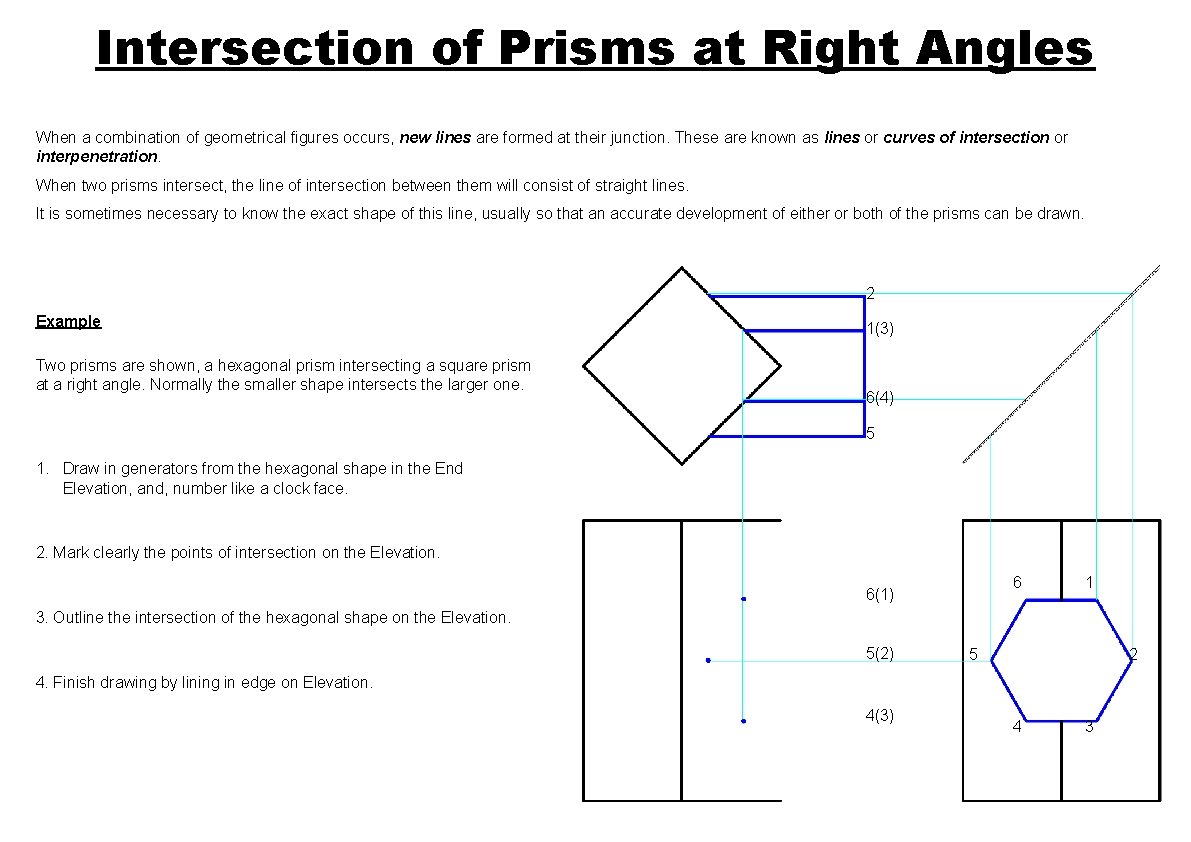
Intersection of Prisms at Right Angles When a combination of geometrical figures occurs, new lines are formed at their junction. These are known as lines or curves of intersection or interpenetration. When two prisms intersect, the line of intersection between them will consist of straight lines. It is sometimes necessary to know the exact shape of this line, usually so that an accurate development of either or both of the prisms can be drawn. 2 Example Two prisms are shown, a hexagonal prism intersecting a square prism at a right angle. Normally the smaller shape intersects the larger one. 1(3) 6(4) 5 1. Draw in generators from the hexagonal shape in the End Elevation, and, number like a clock face. 2. Mark clearly the points of intersection on the Elevation. 6 6(1) 1 3. Outline the intersection of the hexagonal shape on the Elevation. 5(2) 5 2 4. Finish drawing by lining in edge on Elevation. 4(3) 4 3
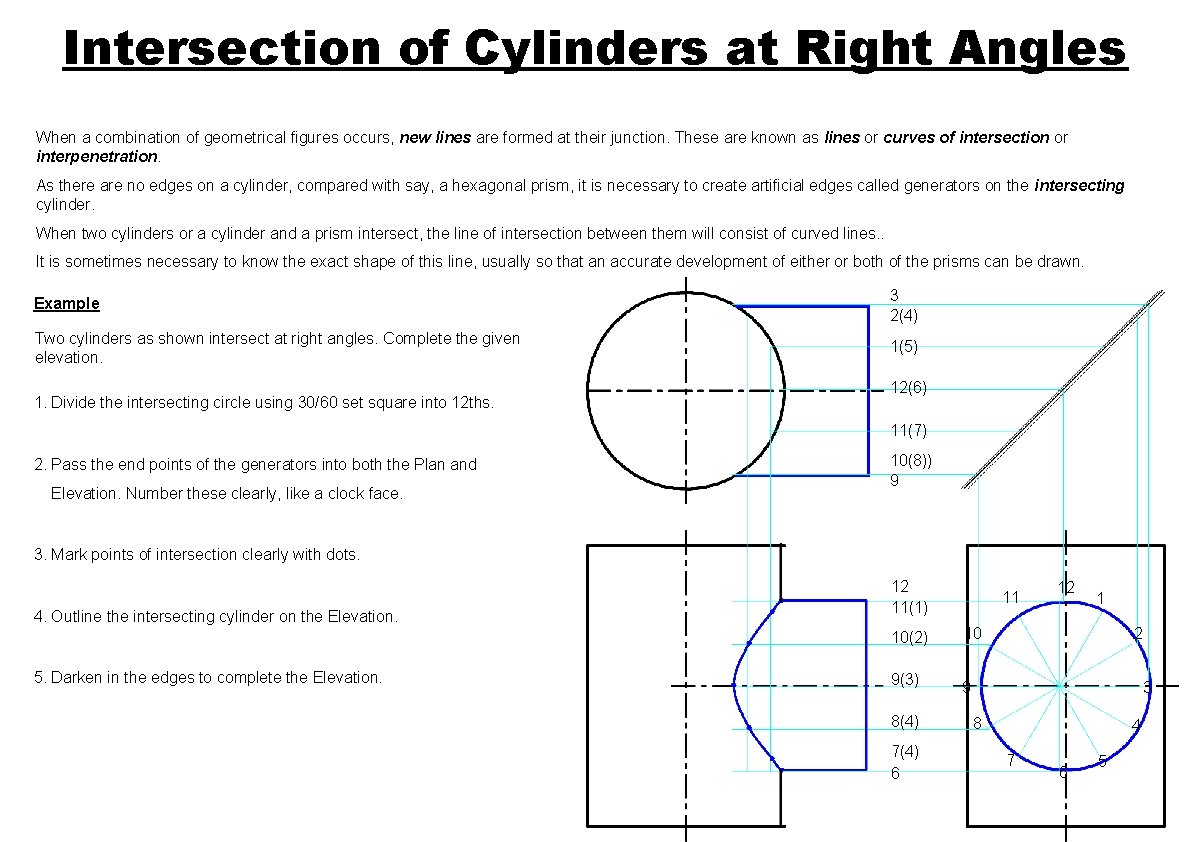
Intersection of Cylinders at Right Angles When a combination of geometrical figures occurs, new lines are formed at their junction. These are known as lines or curves of intersection or interpenetration. As there are no edges on a cylinder, compared with say, a hexagonal prism, it is necessary to create artificial edges called generators on the intersecting cylinder. When two cylinders or a cylinder and a prism intersect, the line of intersection between them will consist of curved lines. . It is sometimes necessary to know the exact shape of this line, usually so that an accurate development of either or both of the prisms can be drawn. Example 3 2(4) Two cylinders as shown intersect at right angles. Complete the given elevation. 1(5) 1. Divide the intersecting circle using 30/60 set square into 12 ths. 12(6) 11(7) 2. Pass the end points of the generators into both the Plan and Elevation. Number these clearly, like a clock face. 10(8)) 9 3. Mark points of intersection clearly with dots. 4. Outline the intersecting cylinder on the Elevation. 5. Darken in the edges to complete the Elevation. 12 11(1) 11 10(2) 10 9(3) 9 8(4) 7(4) 6 12 1 2 3 8 4 7 6 5
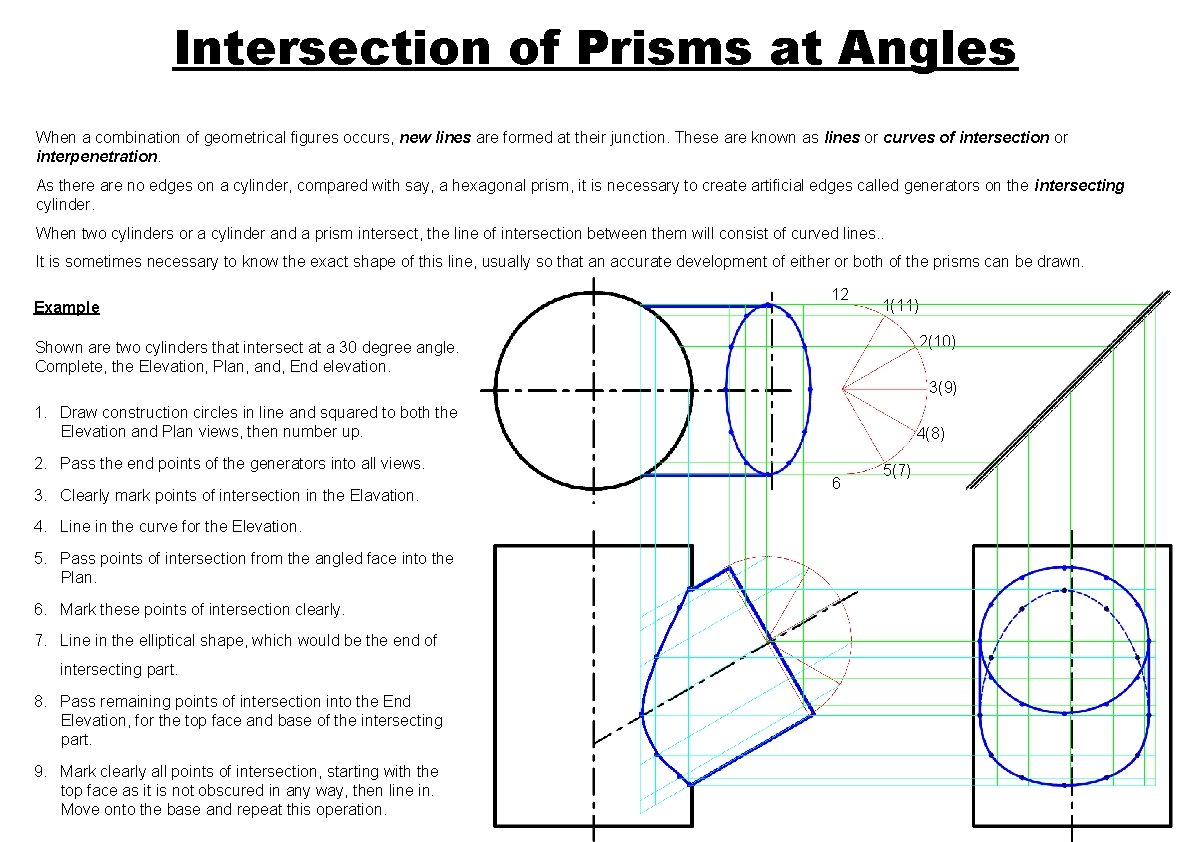
Intersection of Prisms at Angles When a combination of geometrical figures occurs, new lines are formed at their junction. These are known as lines or curves of intersection or interpenetration. As there are no edges on a cylinder, compared with say, a hexagonal prism, it is necessary to create artificial edges called generators on the intersecting cylinder. When two cylinders or a cylinder and a prism intersect, the line of intersection between them will consist of curved lines. . It is sometimes necessary to know the exact shape of this line, usually so that an accurate development of either or both of the prisms can be drawn. Example 12 1(11) 2(10) Shown are two cylinders that intersect at a 30 degree angle. Complete, the Elevation, Plan, and, End elevation. 3(9) 1. Draw construction circles in line and squared to both the Elevation and Plan views, then number up. 4(8) 2. Pass the end points of the generators into all views. 3. Clearly mark points of intersection in the Elavation. 4. Line in the curve for the Elevation. 5. Pass points of intersection from the angled face into the Plan. 6. Mark these points of intersection clearly. 7. Line in the elliptical shape, which would be the end of intersecting part. 8. Pass remaining points of intersection into the End Elevation, for the top face and base of the intersecting part. 9. Mark clearly all points of intersection, starting with the top face as it is not obscured in any way, then line in. Move onto the base and repeat this operation. 6 5(7)