
Intersection and Negation of strategies 152022 intersectionnegation 1
![Strategy expressions and regular expressions • • • [A, B] through edges bypassing edges](https://slidetodoc.com/presentation_image_h2/53afff718e1ead9b496ebaa0146bc222/image-17.jpg "Strategy expressions and regular expressions • • • [A, B] through edges bypassing edges")
 is empty](https://slidetodoc.com/presentation_image_h2/53afff718e1ead9b496ebaa0146bc222/image-21.jpg "Goals 1. Fast type checking: 1. 2. To check whether Path. Set[G](S) is empty")
 is](https://slidetodoc.com/presentation_image_h2/53afff718e1ead9b496ebaa0146bc222/image-22.jpg "Goals 1. Fast type checking: 1. 2. 3. To check whether Path. Set[G](S) is")
- Slides: 53
Intersection and Negation of strategies 1/5/2022 intersection/negation 1
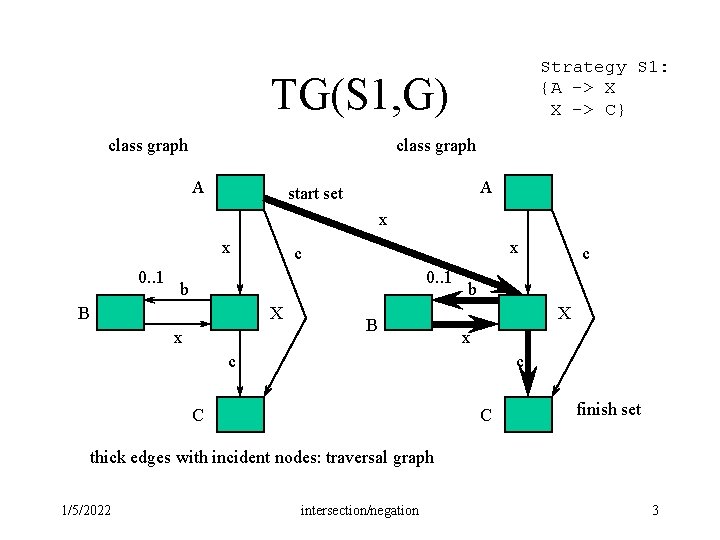
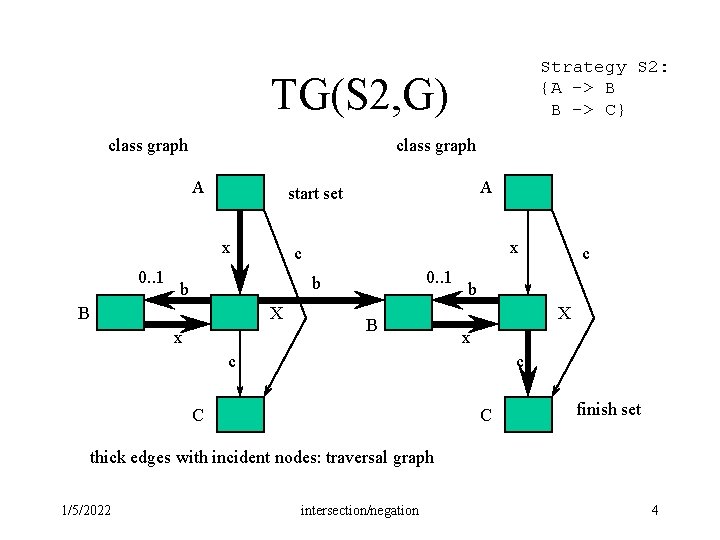
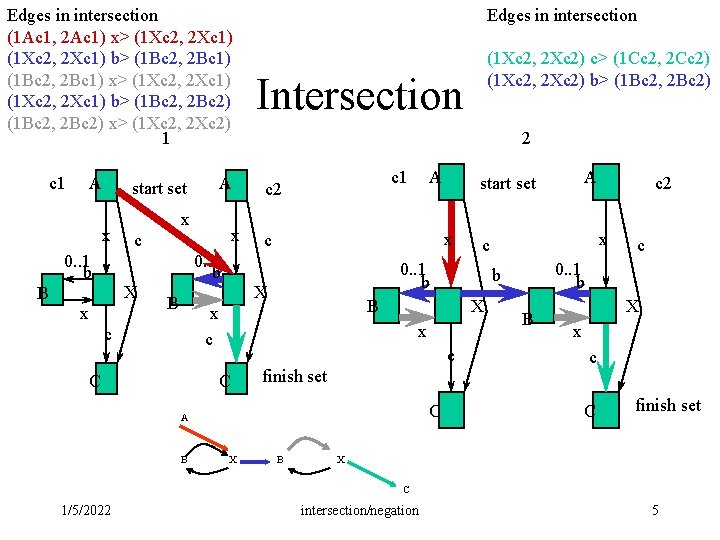
Intersection • Intersect(S 1, S 2) for G: – Product graph of TG(S 1, G) and TG(S 2, G) – Need to add a graph intersection function to AP Library 1/5/2022 intersection/negation 2
Strategy S 1: {A -> X X -> C} TG(S 1, G) class graph A A start set x x 0. . 1 x c 0. . 1 b B X x B c b X x c c C C finish set thick edges with incident nodes: traversal graph 1/5/2022 intersection/negation 3
Strategy S 2: {A -> B B -> C} TG(S 2, G) class graph A x 0. . 1 A start set x c 0. . 1 b b B X x B c b X x c c C C finish set thick edges with incident nodes: traversal graph 1/5/2022 intersection/negation 4
Edges in intersection (1 Ac 1, 2 Ac 1) x> (1 Xc 2, 2 Xc 1) b> (1 Bc 2, 2 Bc 2) x> (1 Xc 2, 2 Xc 2) 1 c 1 A A start set x x x c Edges in intersection Intersection 2 c 1 c 2 X B x c C X x c C finish set C A B X B c 0. . 1 b b B c 2 x c 0. . 1 b x c A start set x X B A c 0. . 1 b (1 Xc 2, 2 Xc 2) c> (1 Cc 2, 2 Cc 2) (1 Xc 2, 2 Xc 2) b> (1 Bc 2, 2 Bc 2) B X x c C finish set X C 1/5/2022 intersection/negation 5
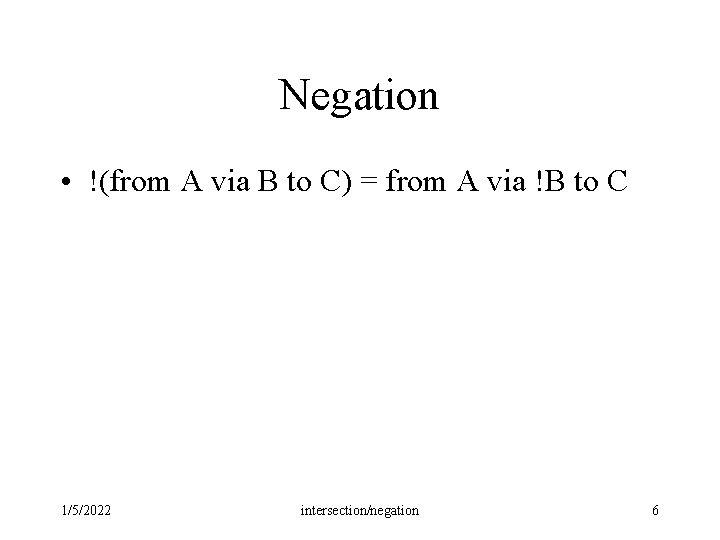
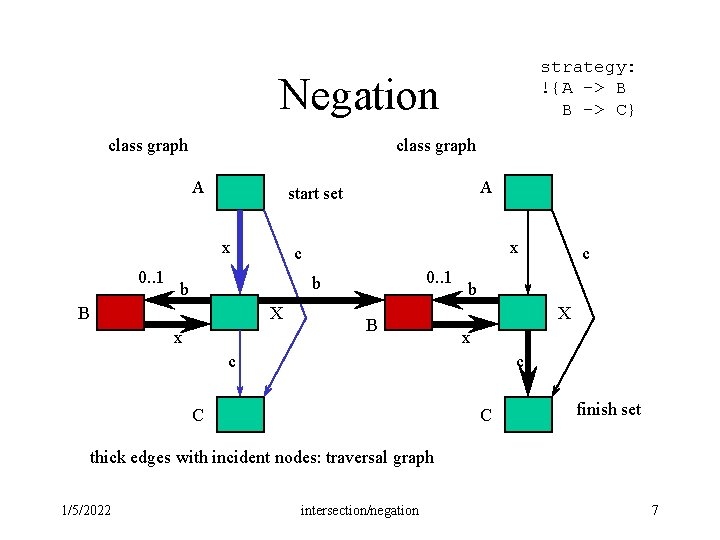
Negation • !(from A via B to C) = from A via !B to C 1/5/2022 intersection/negation 6
strategy: !{A -> B B -> C} Negation class graph A x 0. . 1 A start set x c 0. . 1 b b B X x B c b X x c c C C finish set thick edges with incident nodes: traversal graph 1/5/2022 intersection/negation 7
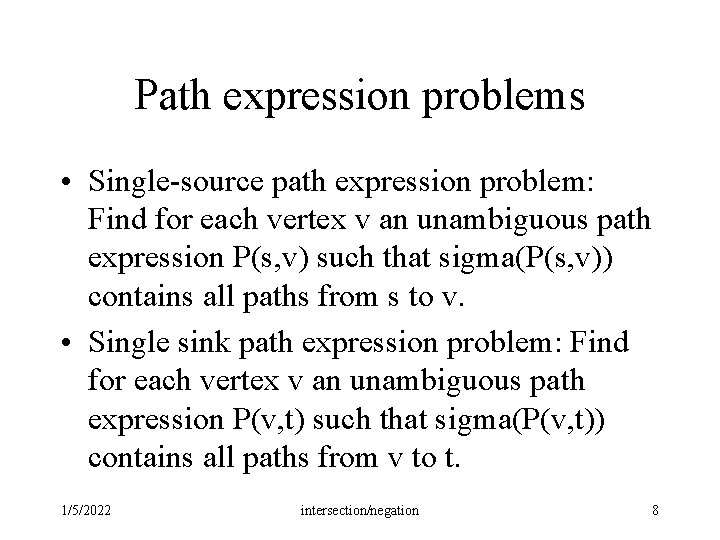
Path expression problems • Single-source path expression problem: Find for each vertex v an unambiguous path expression P(s, v) such that sigma(P(s, v)) contains all paths from s to v. • Single sink path expression problem: Find for each vertex v an unambiguous path expression P(v, t) such that sigma(P(v, t)) contains all paths from v to t. 1/5/2022 intersection/negation 8
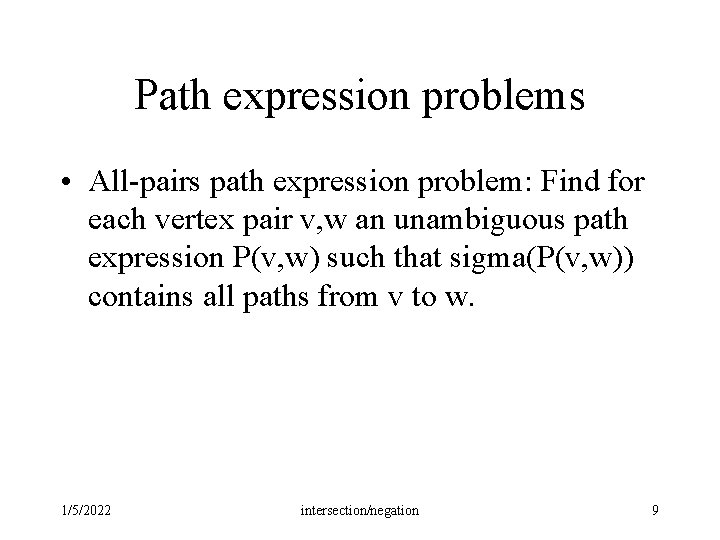
Path expression problems • All-pairs path expression problem: Find for each vertex pair v, w an unambiguous path expression P(v, w) such that sigma(P(v, w)) contains all paths from v to w. 1/5/2022 intersection/negation 9
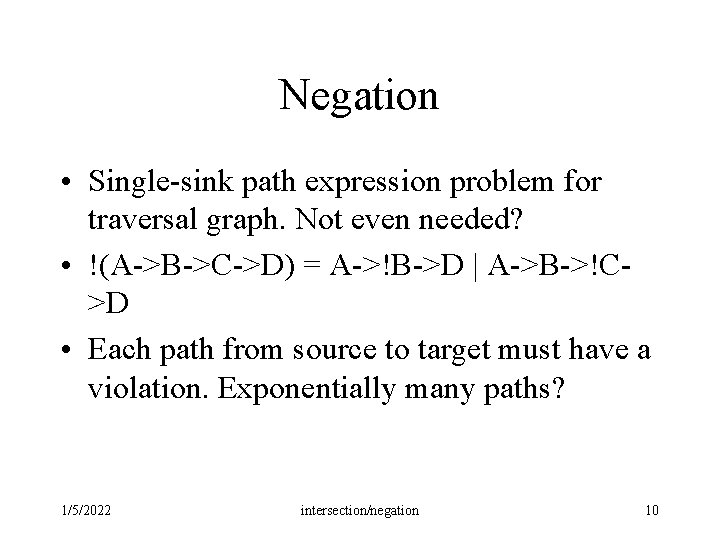
Negation • Single-sink path expression problem for traversal graph. Not even needed? • !(A->B->C->D) = A->!B->D | A->B->!C>D • Each path from source to target must have a violation. Exponentially many paths? 1/5/2022 intersection/negation 10
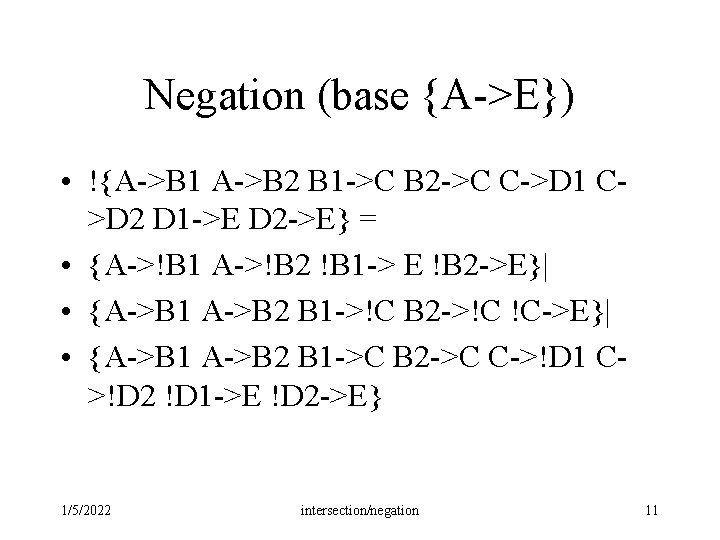
Negation (base {A->E}) • !{A->B 1 A->B 2 B 1 ->C B 2 ->C C->D 1 C>D 2 D 1 ->E D 2 ->E} = • {A->!B 1 A->!B 2 !B 1 -> E !B 2 ->E}| • {A->B 1 A->B 2 B 1 ->!C B 2 ->!C !C->E}| • {A->B 1 A->B 2 B 1 ->C B 2 ->C C->!D 1 C>!D 2 !D 1 ->E !D 2 ->E} 1/5/2022 intersection/negation 11
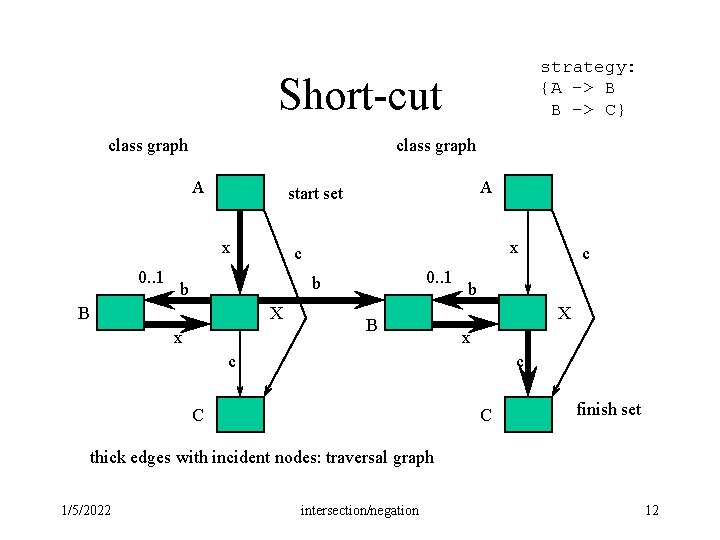
strategy: {A -> B B -> C} Short-cut class graph A x 0. . 1 A start set x c 0. . 1 b b B X x B c b X x c c C C finish set thick edges with incident nodes: traversal graph 1/5/2022 intersection/negation 12
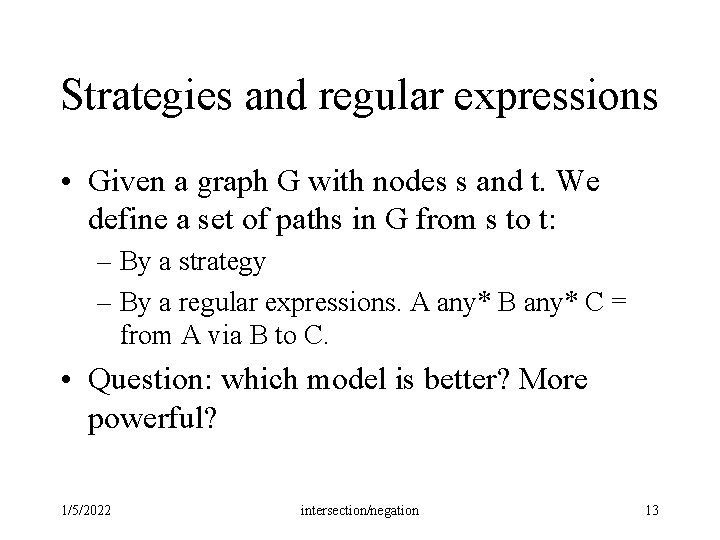
Strategies and regular expressions • Given a graph G with nodes s and t. We define a set of paths in G from s to t: – By a strategy – By a regular expressions. A any* B any* C = from A via B to C. • Question: which model is better? More powerful? 1/5/2022 intersection/negation 13
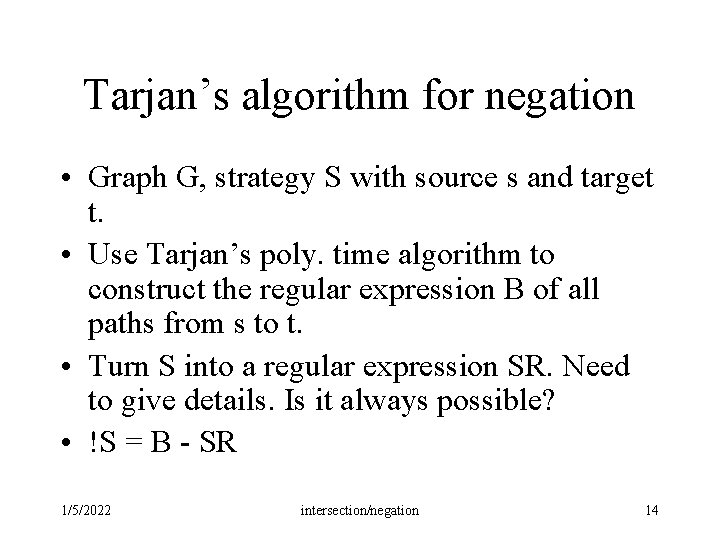
Tarjan’s algorithm for negation • Graph G, strategy S with source s and target t. • Use Tarjan’s poly. time algorithm to construct the regular expression B of all paths from s to t. • Turn S into a regular expression SR. Need to give details. Is it always possible? • !S = B - SR 1/5/2022 intersection/negation 14
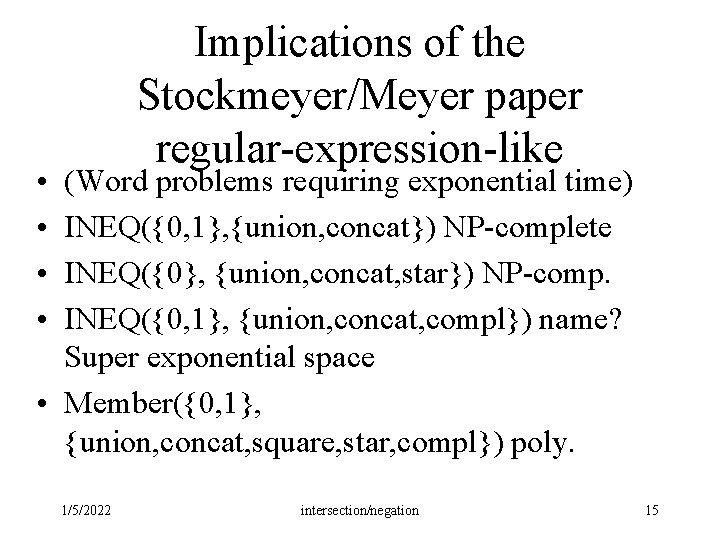
Implications of the Stockmeyer/Meyer paper regular-expression-like • • (Word problems requiring exponential time) INEQ({0, 1}, {union, concat}) NP-complete INEQ({0}, {union, concat, star}) NP-comp. INEQ({0, 1}, {union, concat, compl}) name? Super exponential space • Member({0, 1}, {union, concat, square, star, compl}) poly. 1/5/2022 intersection/negation 15
Implications of the Stockmeyer/Meyer paper • Note: intersection is absent, use complement and union • INEQ({0}, {union, concat, compl}) poly 1/5/2022 intersection/negation 16
Strategy expressions and regular expressions • • • [A, B] through edges bypassing edges through vertices bypassing vertices d 1 join d 2 d 1 merge d 2 d 1 intersect d 2 not d 1 1/5/2022 Only-through A. any*. B any*. lnk. any* not(any*. lnk. any*) any*. A. any* not(any*. A. any*) [d 1]. [d 2] (eliminate join point) [d 1]cup[d 2] [d 1]cap[d 2] not([d 1]) intersection/negation 17 ? ?
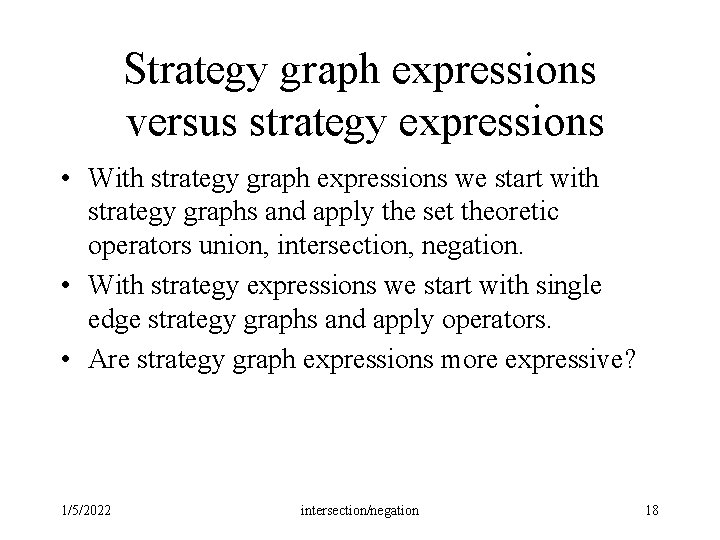
Strategy graph expressions versus strategy expressions • With strategy graph expressions we start with strategy graphs and apply the set theoretic operators union, intersection, negation. • With strategy expressions we start with single edge strategy graphs and apply operators. • Are strategy graph expressions more expressive? 1/5/2022 intersection/negation 18
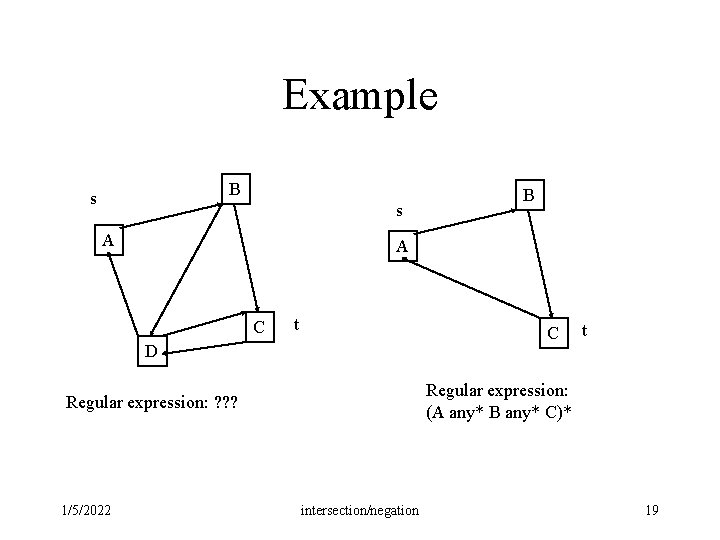
Example B s s A A C t C D t Regular expression: (A any* B any* C)* Regular expression: ? ? ? 1/5/2022 B intersection/negation 19
Goals • Want to avoid spending an exponential amount of time in the size of the class graph (and strategy graph) to do a traversal on an object graph. • Linear in size of object graph. 1/5/2022 intersection/negation 20
Goals 1. Fast type checking: 1. 2. To check whether Path. Set[G](S) is empty is polynomial in G (and hopefully S). Quantified: To check whether Path. Set[G](S) is empty for all G is exponential in S. Fast traversal: The decision in the object graph whether to follow branch l after we have done prefix p is a constant time lookup in Path. Set[G](S) (S considered a constant). Path. Set[G](S) has a polynomial representation in G (and hopefully S). 1/5/2022 intersection/negation 21
Goals 1. Fast type checking: 1. 2. 3. To check whether Path. Set[G](S) is empty is polynomial in G (and hopefully S). ? ? Quantified: To check whether Path. Set[G](S) is empty for all G is exponential in S. Fast compilation: Compilation time should be polynomial time in the size of G and S. Fast traversal: Given a startegy S and a class graph S and an object graph O, return the object graph O’ selected by S. This should be polynomial in the size of S, G and O. 1/5/2022 intersection/negation 22
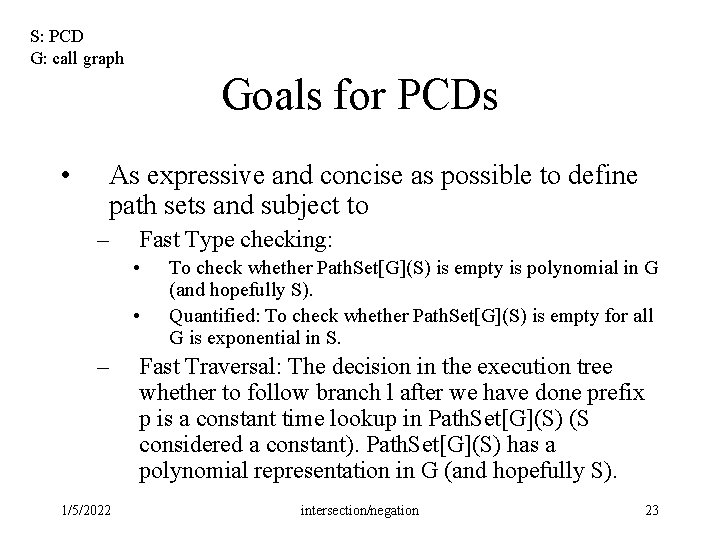
S: PCD G: call graph Goals for PCDs • As expressive and concise as possible to define path sets and subject to – Fast Type checking: • • – 1/5/2022 To check whether Path. Set[G](S) is empty is polynomial in G (and hopefully S). Quantified: To check whether Path. Set[G](S) is empty for all G is exponential in S. Fast Traversal: The decision in the execution tree whether to follow branch l after we have done prefix p is a constant time lookup in Path. Set[G](S) (S considered a constant). Path. Set[G](S) has a polynomial representation in G (and hopefully S). intersection/negation 23
Goals • Conjecture: If we use strategy graphs with the operations (on path sets): union, intersection, complement, we have the desired properties. 1/5/2022 intersection/negation 24
Proof • If we use strategy graphs with the operations (on path sets): union, intersection we have the desired properties. • Union: easy. Intersection: assume only a constant number of intersections. Product of traversal graphs. 1/5/2022 intersection/negation 25
Add negation • If we use strategy graphs with the operations (on path sets): union, intersection, negation we have the desired properties. • Negation: Ravi or Tarjan+? Warning: the standard way of constructing the automaton for negation requires a deterministic automaton! (complement acceptance states). 1/5/2022 intersection/negation 26
Tarjan + turning strategies into regular expressions • We also need to address goal 3: quick lookup where to go. If we have a complex regular expression and we need to know what the possible continuations are for prefix p, can we get it in constant time? • If we have an NFA we can simulate it and see what the possible next states are. But for turning negation into an automaton, we get an exponential cost? 1/5/2022 intersection/negation 27
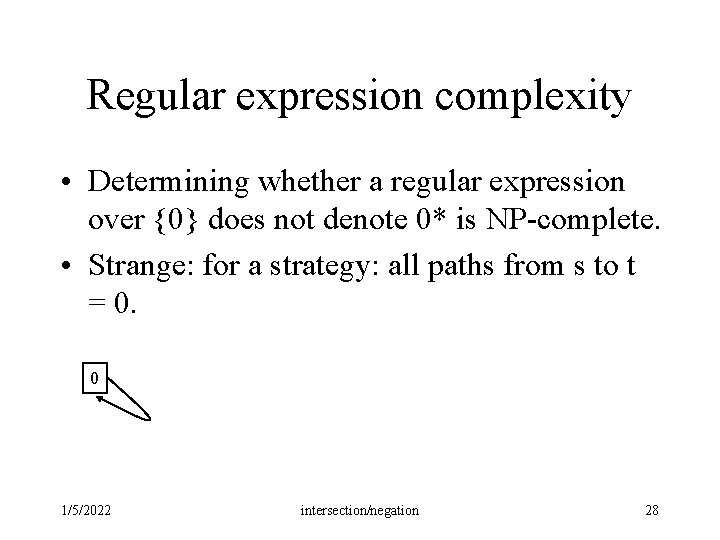
Regular expression complexity • Determining whether a regular expression over {0} does not denote 0* is NP-complete. • Strange: for a strategy: all paths from s to t = 0. 0 1/5/2022 intersection/negation 28
Complexity of Compiling traversal strategies and pointcut designators • Problem: Union-Join-Intersection. Non. Emptyness – Input: Strategy graph S and class graph G. – Question: Is Pathset[G](S) nonempty? • Union-Join-Intersection emptyness is NPcomplete. 1/5/2022 intersection/negation 29
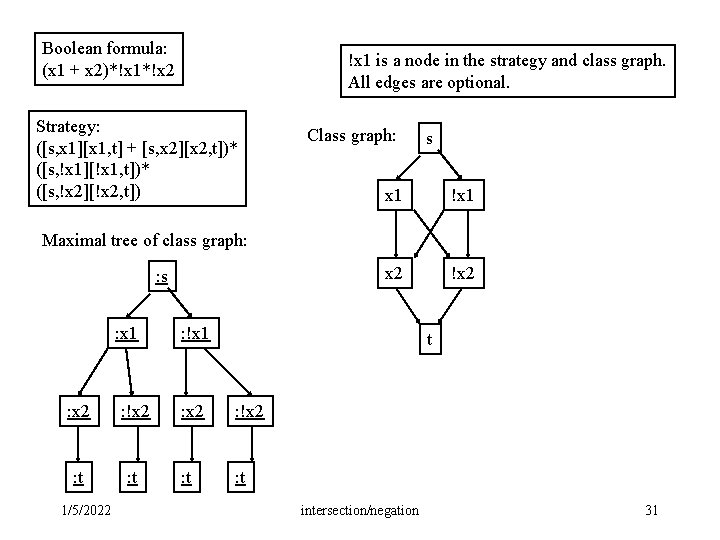
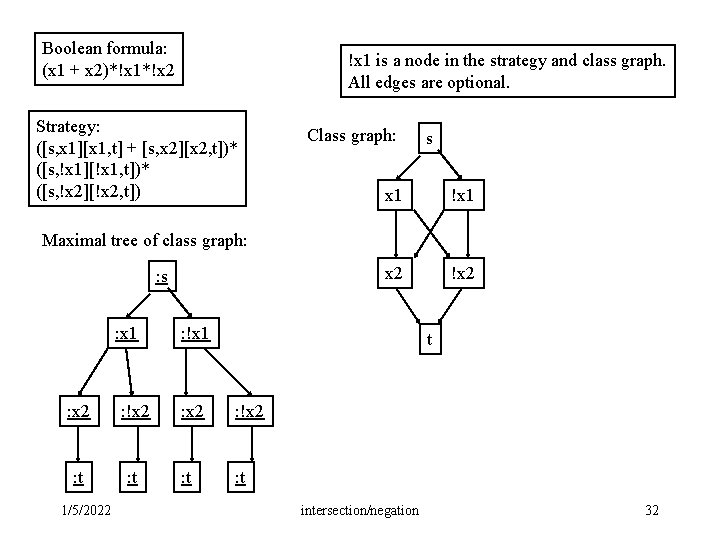
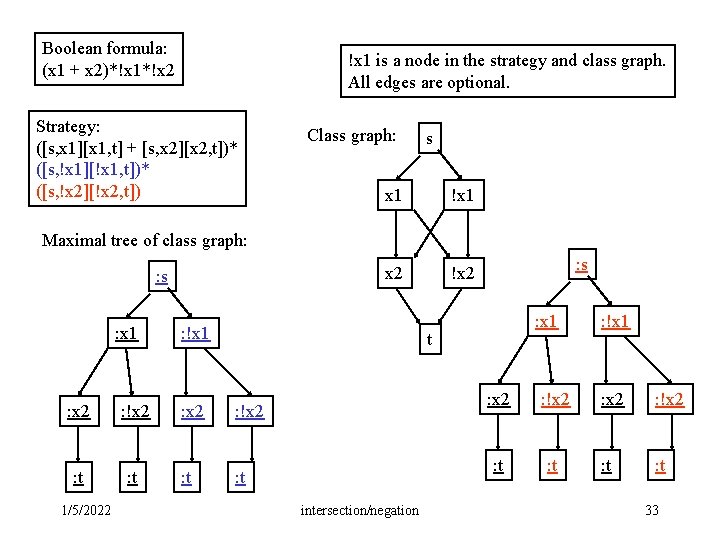
Proof • We show the construction by an example. We start with a satisfiable boolean formula and translate it into a strategy and a class graph with source s and target t. The class graph is acyclic. • The class graph is constructed in such a way that a path from s to t does not visit both x 1 and !x 1. 1/5/2022 intersection/negation 30
Boolean formula: (x 1 + x 2)*!x 1*!x 2 !x 1 is a node in the strategy and class graph. All edges are optional. Strategy: ([s, x 1][x 1, t] + [s, x 2][x 2, t])* ([s, !x 1][!x 1, t])* ([s, !x 2][!x 2, t]) Class graph: s x 1 !x 1 x 2 !x 2 Maximal tree of class graph: : s : x 1 : x 2 : !x 2 : t 1/5/2022 : !x 1 t : x 2 : !x 2 : t intersection/negation 31
Boolean formula: (x 1 + x 2)*!x 1*!x 2 !x 1 is a node in the strategy and class graph. All edges are optional. Strategy: ([s, x 1][x 1, t] + [s, x 2][x 2, t])* ([s, !x 1][!x 1, t])* ([s, !x 2][!x 2, t]) Class graph: s x 1 !x 1 x 2 !x 2 Maximal tree of class graph: : s : x 1 : x 2 : !x 2 : t 1/5/2022 : !x 1 t : x 2 : !x 2 : t intersection/negation 32
Boolean formula: (x 1 + x 2)*!x 1*!x 2 !x 1 is a node in the strategy and class graph. All edges are optional. Strategy: ([s, x 1][x 1, t] + [s, x 2][x 2, t])* ([s, !x 1][!x 1, t])* ([s, !x 2][!x 2, t]) Class graph: s x 1 !x 1 x 2 !x 2 Maximal tree of class graph: : s : x 1 : x 2 : !x 2 : t 1/5/2022 : !x 1 : s : x 1 t : x 2 : !x 2 : t intersection/negation : x 2 : !x 2 : t : !x 1 : x 2 : !x 2 : t 33
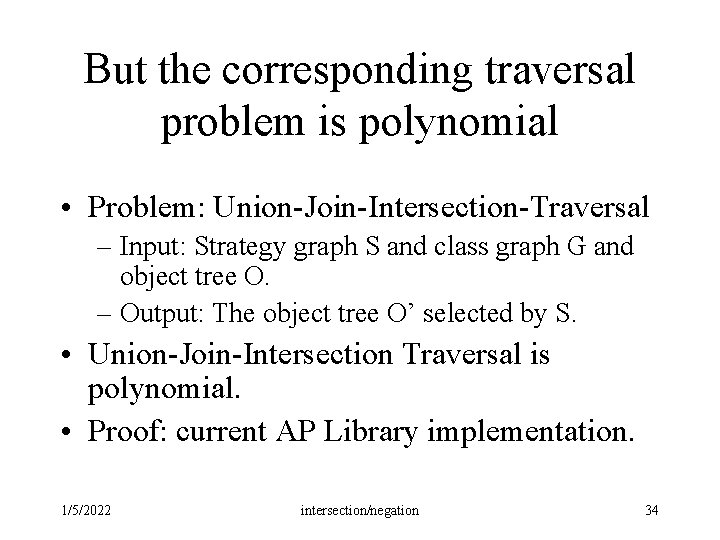
But the corresponding traversal problem is polynomial • Problem: Union-Join-Intersection-Traversal – Input: Strategy graph S and class graph G and object tree O. – Output: The object tree O’ selected by S. • Union-Join-Intersection Traversal is polynomial. • Proof: current AP Library implementation. 1/5/2022 intersection/negation 34
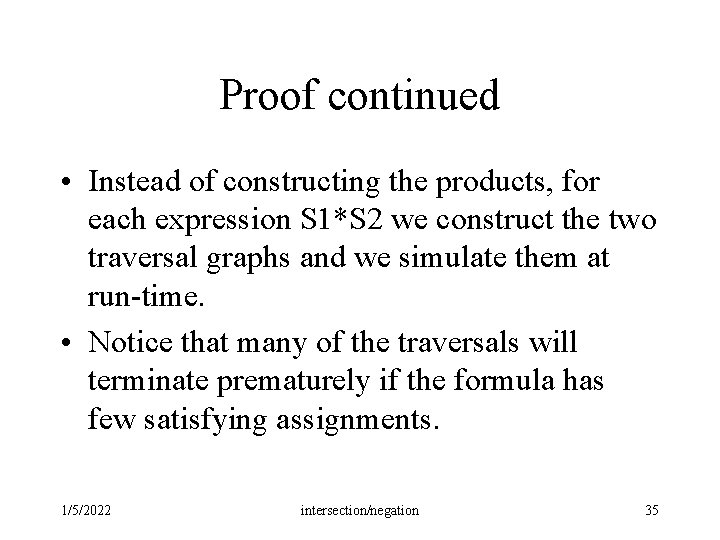
Proof continued • Instead of constructing the products, for each expression S 1*S 2 we construct the two traversal graphs and we simulate them at run-time. • Notice that many of the traversals will terminate prematurely if the formula has few satisfying assignments. 1/5/2022 intersection/negation 35
Interesting connections • It is surprising that Union-Join-Intersection Traversal is polynomial while Union-Join. Intersection Emptyness is NP-complete. • The object tree represents the possible assignments. The traversal will try to find a path from s to t. • The maximal tree is big but the size of it is part of the input. 1/5/2022 intersection/negation 36
The following problem is also NP -complete • Problem: Union-Join-Intersection-Traversal. Success – Input: Strategy graph S and class graph G. – Question: Is there an object graph O so that O’ contains t. • Union-Join-Intersection-Traversal-Success is NP-complete. 1/5/2022 intersection/negation 37
What is the complexity of: • Negation-Union-Join-Intersection-Traversal -Success • Negation-Union-Join-Intersection-Traversal • Negation-Union-Join-Intersection. Non. Emptyness 1/5/2022 intersection/negation 38
Justification • Now we have justification for the current design of the AP Library. – If we would construct intersections of traversal graphs, the compiler would have to solve an NP -complete problem. – Are there still benefits to constructing the product? 1/5/2022 intersection/negation 39
Ravi’s construction of subtree • Consider all leaves and all paths to them from the source. • Check each path whether it satisfies strategy. The subtree is the union of all satisfying paths. • This is polynomial. 1/5/2022 intersection/negation 40
NP completeness proofs • Ravi’s prrofs are in the wiki: node Satisfiablility Hardness 1/5/2022 intersection/negation 41
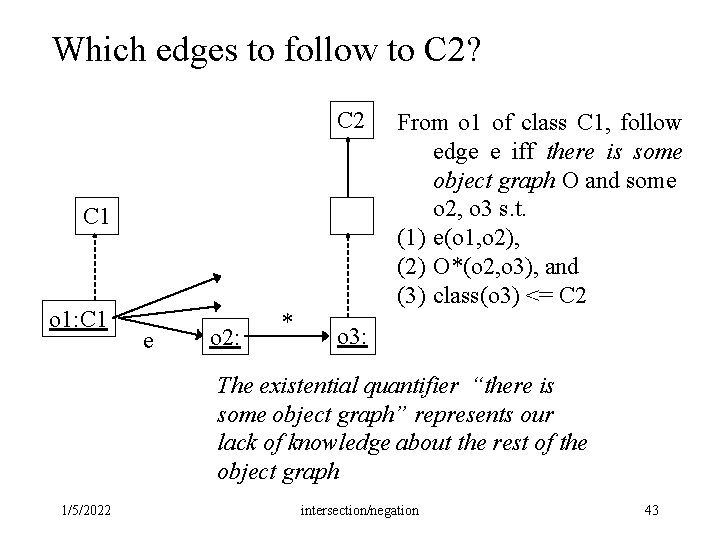
Intersection and DAJ • Intersection is central to DAJ. • The problem: Consider the viewgraphs in: • http: //www. ccs. neu. edu/home/lieber/courses /csu 670/sp 04/lectures/lec 1 b-short-navigobject-graphs-csu 670 -sp 04. ppt • The crucial one is shown on the next slide. 1/5/2022 intersection/negation 42
Which edges to follow to C 2? C 2 C 1 o 1: C 1 e o 2: * From o 1 of class C 1, follow edge e iff there is some object graph O and some o 2, o 3 s. t. (1) e(o 1, o 2), (2) O*(o 2, o 3), and (3) class(o 3) <= C 2 o 3: The existential quantifier “there is some object graph” represents our lack of knowledge about the rest of the object graph 1/5/2022 intersection/negation 43
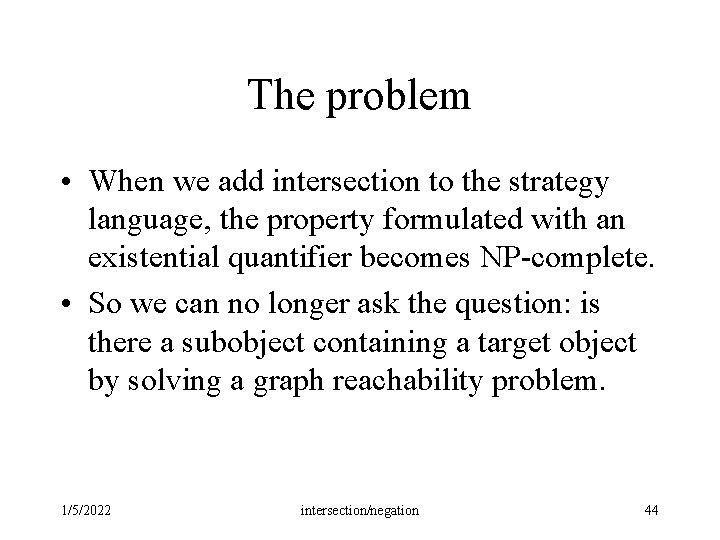
The problem • When we add intersection to the strategy language, the property formulated with an existential quantifier becomes NP-complete. • So we can no longer ask the question: is there a subobject containing a target object by solving a graph reachability problem. 1/5/2022 intersection/negation 44
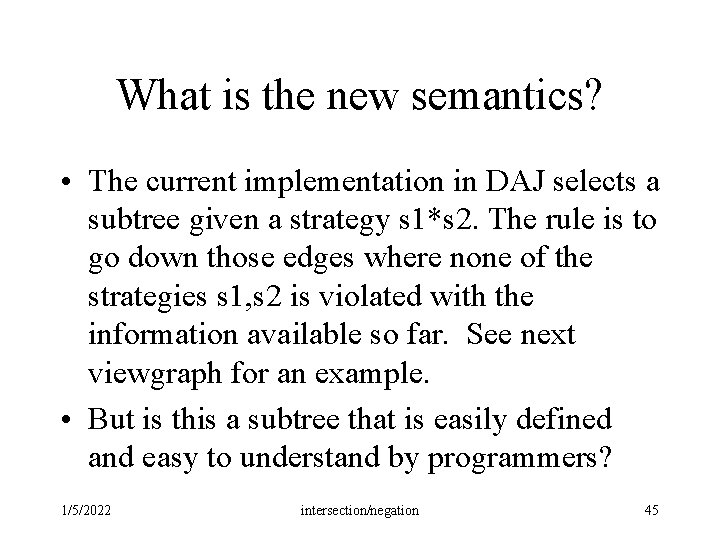
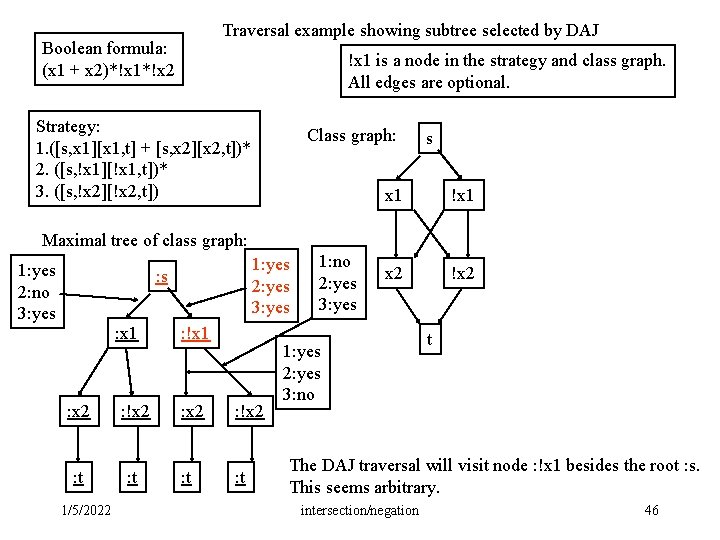
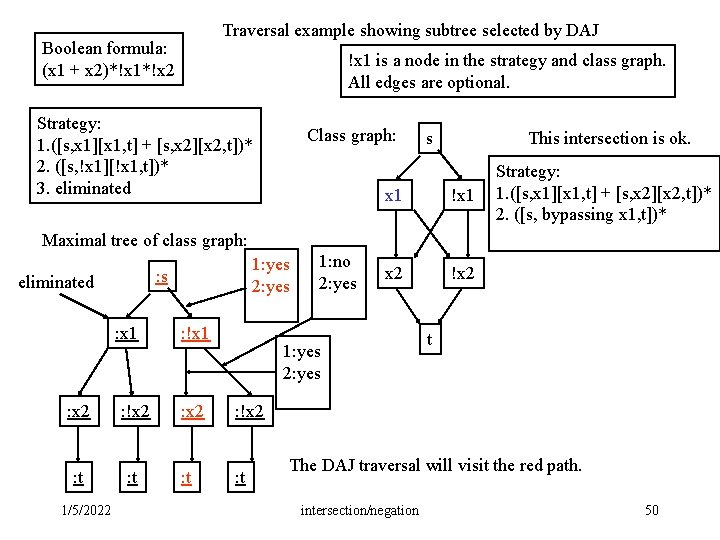
What is the new semantics? • The current implementation in DAJ selects a subtree given a strategy s 1*s 2. The rule is to go down those edges where none of the strategies s 1, s 2 is violated with the information available so far. See next viewgraph for an example. • But is this a subtree that is easily defined and easy to understand by programmers? 1/5/2022 intersection/negation 45
Traversal example showing subtree selected by DAJ Boolean formula: (x 1 + x 2)*!x 1*!x 2 !x 1 is a node in the strategy and class graph. All edges are optional. Strategy: 1. ([s, x 1][x 1, t] + [s, x 2][x 2, t])* 2. ([s, !x 1][!x 1, t])* 3. ([s, !x 2][!x 2, t]) Class graph: s x 1 !x 1 x 2 !x 2 Maximal tree of class graph: 1: yes 2: no 3: yes 1: yes 2: yes 3: yes : x 1 : x 2 : !x 2 : t 1/5/2022 : !x 1 : x 2 : !x 2 : t 1: no 2: yes 3: yes 1: yes 2: yes 3: no t The DAJ traversal will visit node : !x 1 besides the root : s. This seems arbitrary. intersection/negation 46
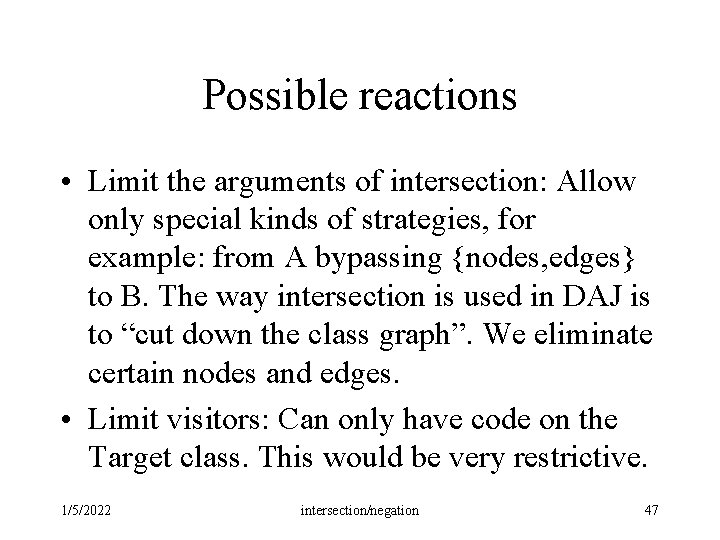
Possible reactions • Limit the arguments of intersection: Allow only special kinds of strategies, for example: from A bypassing {nodes, edges} to B. The way intersection is used in DAJ is to “cut down the class graph”. We eliminate certain nodes and edges. • Limit visitors: Can only have code on the Target class. This would be very restrictive. 1/5/2022 intersection/negation 47
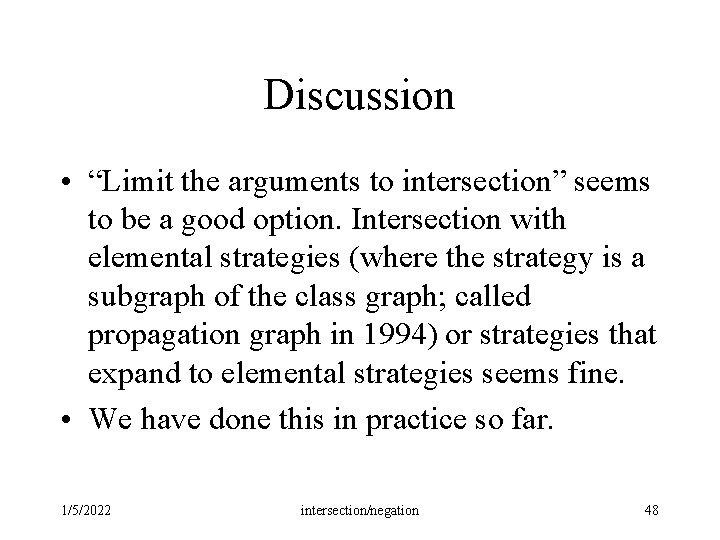
Discussion • “Limit the arguments to intersection” seems to be a good option. Intersection with elemental strategies (where the strategy is a subgraph of the class graph; called propagation graph in 1994) or strategies that expand to elemental strategies seems fine. • We have done this in practice so far. 1/5/2022 intersection/negation 48
Discussion • What is the impact of this on PCDs? Pengcheng and Jeff? 1/5/2022 intersection/negation 49
Traversal example showing subtree selected by DAJ Boolean formula: (x 1 + x 2)*!x 1*!x 2 !x 1 is a node in the strategy and class graph. All edges are optional. Strategy: 1. ([s, x 1][x 1, t] + [s, x 2][x 2, t])* 2. ([s, !x 1][!x 1, t])* 3. eliminated Class graph: s This intersection is ok. x 1 !x 1 x 2 !x 2 Strategy: 1. ([s, x 1][x 1, t] + [s, x 2][x 2, t])* 2. ([s, bypassing x 1, t])* Maximal tree of class graph: : s eliminated : x 1 : x 2 : !x 2 : t 1/5/2022 1: yes 2: yes : !x 1 1: no 2: yes 1: yes 2: yes : x 2 : !x 2 : t t The DAJ traversal will visit the red path. intersection/negation 50
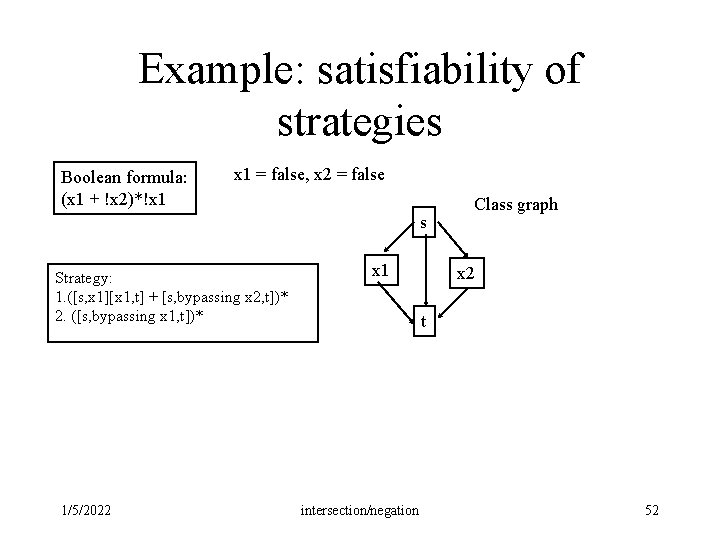
New topic: Complexity of: given a strategy S, is there a class graph so that Path. Set[G](S) is non-empty. • Ravi proves this in the wiki: node Satisfiablility Hardness • Example follows. 1/5/2022 intersection/negation 51
Example: satisfiability of strategies Boolean formula: (x 1 + !x 2)*!x 1 = false, x 2 = false s Strategy: 1. ([s, x 1][x 1, t] + [s, bypassing x 2, t])* 2. ([s, bypassing x 1, t])* 1/5/2022 x 1 Class graph x 2 t intersection/negation 52
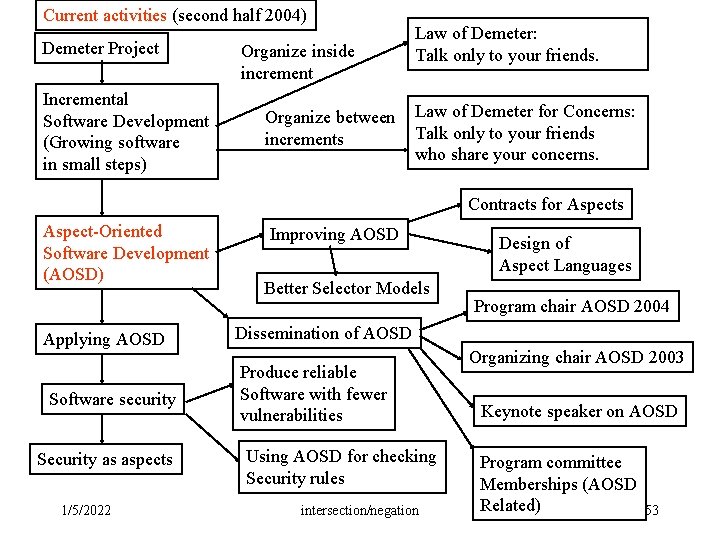
Current activities (second half 2004) Demeter Project Incremental Software Development (Growing software in small steps) Organize inside increment Organize between increments Law of Demeter: Talk only to your friends. Law of Demeter for Concerns: Talk only to your friends who share your concerns. Contracts for Aspects Aspect-Oriented Software Development (AOSD) Applying AOSD Software security Security as aspects 1/5/2022 Improving AOSD Better Selector Models Design of Aspect Languages Program chair AOSD 2004 Dissemination of AOSD Produce reliable Software with fewer vulnerabilities Using AOSD for checking Security rules intersection/negation Organizing chair AOSD 2003 Keynote speaker on AOSD Program committee Memberships (AOSD Related) 53