
InterruptDriven Serial Communication Lecture 12 Embedded Systems 12
Interrupt-Driven Serial Communication Lecture 12 Embedded Systems 12 -1
In these notes. . . Interrupt design guidelines Interrupt-driven serial I/O device driver design – Interrupt map for system – Enabling interrupts – Queue concepts and implementation Embedded Systems 12 -2
Interrupt Design Guidelines (Ganssle, p. 57) Create and Maintain an Interrupt Map – Make a spreadsheet showing interrupts for system, maximum rate, maximum latency allowed. Fill in with execution time measurements during development. – This provides a CPU time budget to follow, and lets us predict worst-case values: • CPU utilization from interrupts • Time interrupts are disabled Keep ISRs short. Leave lengthy work to task code when possible. E. g. converting time ticks to H: M: S Keep ISRs so trivially simple that bugs are rare. Fill all unused interrupt vectors with a pointer to a debug routine which hangs and flashes a light. This way you’ll find out about unplanned interrupts immediately. Embedded Systems 12 -3
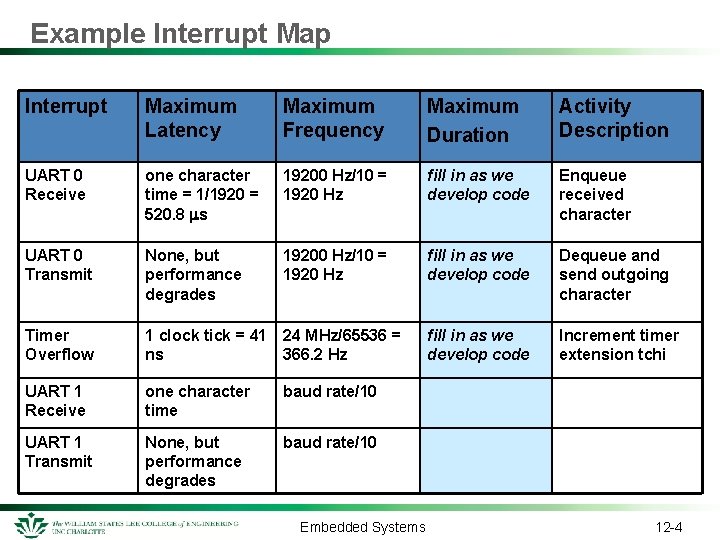
Example Interrupt Map Interrupt Maximum Latency Maximum Frequency Maximum Duration Activity Description UART 0 Receive one character time = 1/1920 = 520. 8 ms 19200 Hz/10 = 1920 Hz fill in as we develop code Enqueue received character UART 0 Transmit None, but performance degrades 19200 Hz/10 = 1920 Hz fill in as we develop code Dequeue and send outgoing character Timer Overflow 1 clock tick = 41 24 MHz/65536 = ns 366. 2 Hz fill in as we develop code Increment timer extension tchi UART 1 Receive one character time baud rate/10 UART 1 Transmit None, but performance degrades baud rate/10 Embedded Systems 12 -4
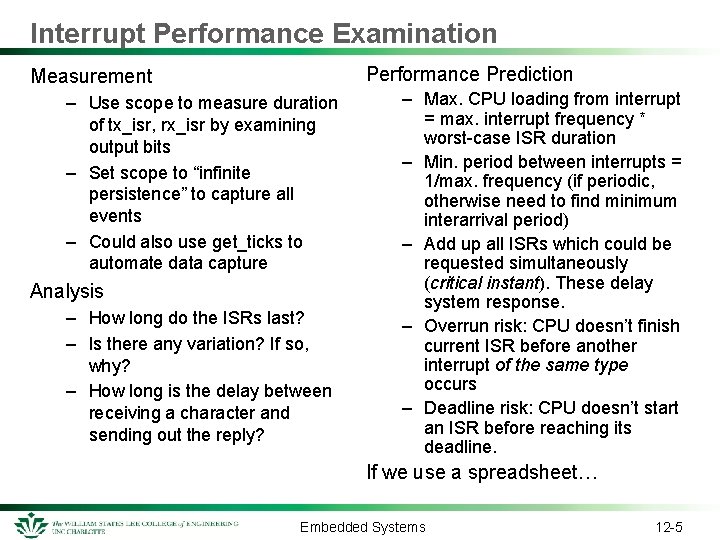
Interrupt Performance Examination Performance Prediction Measurement – Use scope to measure duration of tx_isr, rx_isr by examining output bits – Set scope to “infinite persistence” to capture all events – Could also use get_ticks to automate data capture Analysis – How long do the ISRs last? – Is there any variation? If so, why? – How long is the delay between receiving a character and sending out the reply? – Max. CPU loading from interrupt = max. interrupt frequency * worst-case ISR duration – Min. period between interrupts = 1/max. frequency (if periodic, otherwise need to find minimum interarrival period) – Add up all ISRs which could be requested simultaneously (critical instant). These delay system response. – Overrun risk: CPU doesn’t finish current ISR before another interrupt of the same type occurs – Deadline risk: CPU doesn’t start an ISR before reaching its deadline. If we use a spreadsheet… Embedded Systems 12 -5
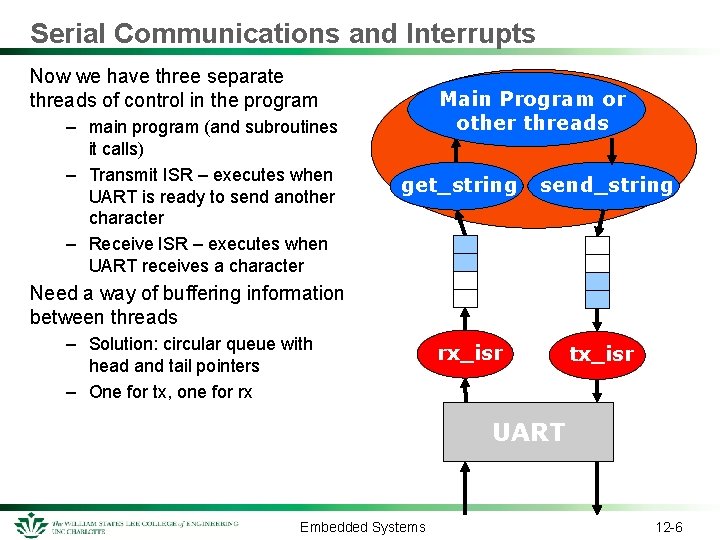
Serial Communications and Interrupts Now we have three separate threads of control in the program – main program (and subroutines it calls) – Transmit ISR – executes when UART is ready to send another character – Receive ISR – executes when UART receives a character Main Program or other threads get_string send_string Need a way of buffering information between threads – Solution: circular queue with head and tail pointers – One for tx, one for rx rx_isr tx_isr UART Embedded Systems 12 -6
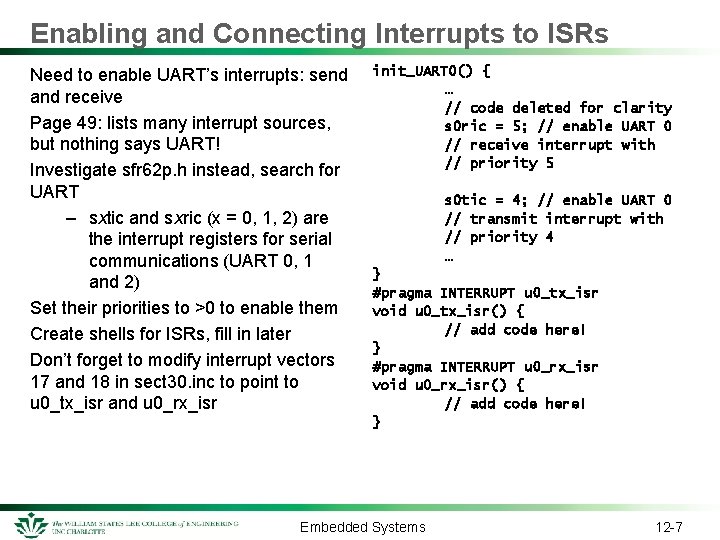
Enabling and Connecting Interrupts to ISRs Need to enable UART’s interrupts: send and receive Page 49: lists many interrupt sources, but nothing says UART! Investigate sfr 62 p. h instead, search for UART – sxtic and sxric (x = 0, 1, 2) are the interrupt registers for serial communications (UART 0, 1 and 2) Set their priorities to >0 to enable them Create shells for ISRs, fill in later Don’t forget to modify interrupt vectors 17 and 18 in sect 30. inc to point to u 0_tx_isr and u 0_rx_isr init_UART 0() { … // code deleted for clarity s 0 ric = 5; // enable UART 0 // receive interrupt with // priority 5 s 0 tic = 4; // enable UART 0 // transmit interrupt with // priority 4 … } #pragma INTERRUPT u 0_tx_isr void u 0_tx_isr() { // add code here! } #pragma INTERRUPT u 0_rx_isr void u 0_rx_isr() { // add code here! } Embedded Systems 12 -7
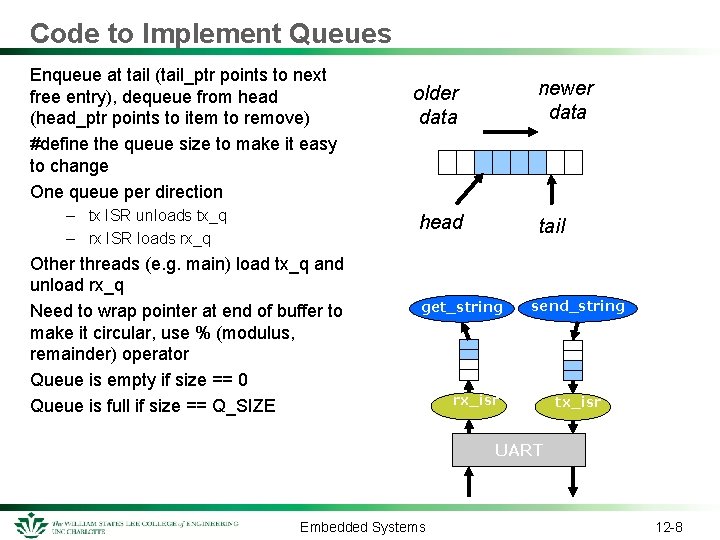
Code to Implement Queues Enqueue at tail (tail_ptr points to next free entry), dequeue from head (head_ptr points to item to remove) #define the queue size to make it easy to change One queue per direction – tx ISR unloads tx_q – rx ISR loads rx_q Other threads (e. g. main) load tx_q and unload rx_q Need to wrap pointer at end of buffer to make it circular, use % (modulus, remainder) operator Queue is empty if size == 0 Queue is full if size == Q_SIZE older data newer data head tail get_string send_string rx_isr tx_isr UART Embedded Systems 12 -8
![Defining the Queues #define Q_SIZE (32) typedef struct { unsigned char Data[Q_SIZE]; unsigned int](http://slidetodoc.com/presentation_image_h2/03e230d9f5265481fda68cc3a57380ad/image-9.jpg "Defining the Queues #define Q_SIZE (32) typedef struct { unsigned char Data[Q_SIZE]; unsigned int")
Defining the Queues #define Q_SIZE (32) typedef struct { unsigned char Data[Q_SIZE]; unsigned int Head; // points to oldest data element unsigned int Tail; // points to next free space unsigned int Size; // quantity of elements in queue } Q_T; Q_T tx_q, rx_q; Embedded Systems 12 -9
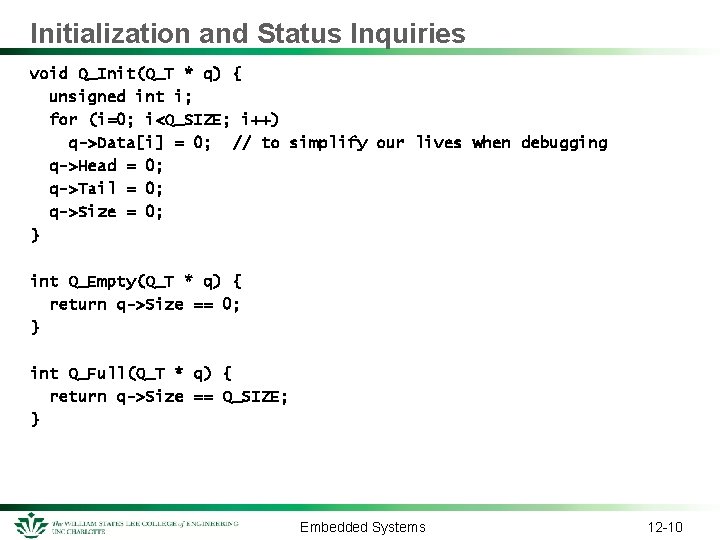
Initialization and Status Inquiries void Q_Init(Q_T * q) { unsigned int i; for (i=0; i<Q_SIZE; i++) q->Data[i] = 0; // to simplify our lives when debugging q->Head = 0; q->Tail = 0; q->Size = 0; } int Q_Empty(Q_T * q) { return q->Size == 0; } int Q_Full(Q_T * q) { return q->Size == Q_SIZE; } Embedded Systems 12 -10
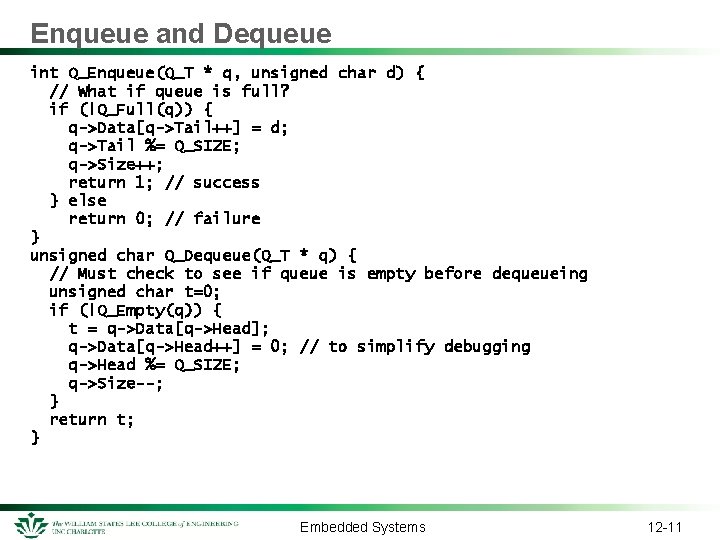
Enqueue and Dequeue int Q_Enqueue(Q_T * q, unsigned char d) { // What if queue is full? if (!Q_Full(q)) { q->Data[q->Tail++] = d; q->Tail %= Q_SIZE; q->Size++; return 1; // success } else return 0; // failure } unsigned char Q_Dequeue(Q_T * q) { // Must check to see if queue is empty before dequeueing unsigned char t=0; if (!Q_Empty(q)) { t = q->Data[q->Head]; q->Data[q->Head++] = 0; // to simplify debugging q->Head %= Q_SIZE; q->Size--; } return t; } Embedded Systems 12 -11
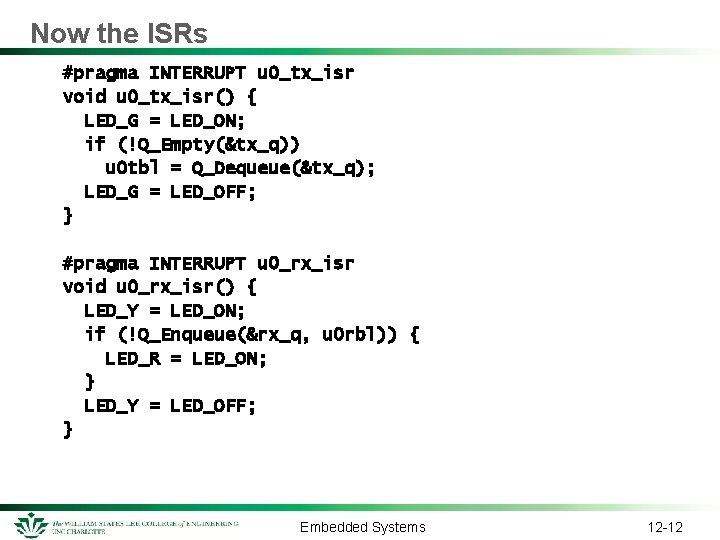
Now the ISRs #pragma INTERRUPT u 0_tx_isr void u 0_tx_isr() { LED_G = LED_ON; if (!Q_Empty(&tx_q)) u 0 tbl = Q_Dequeue(&tx_q); LED_G = LED_OFF; } #pragma INTERRUPT u 0_rx_isr void u 0_rx_isr() { LED_Y = LED_ON; if (!Q_Enqueue(&rx_q, u 0 rbl)) { LED_R = LED_ON; } LED_Y = LED_OFF; } Embedded Systems 12 -12
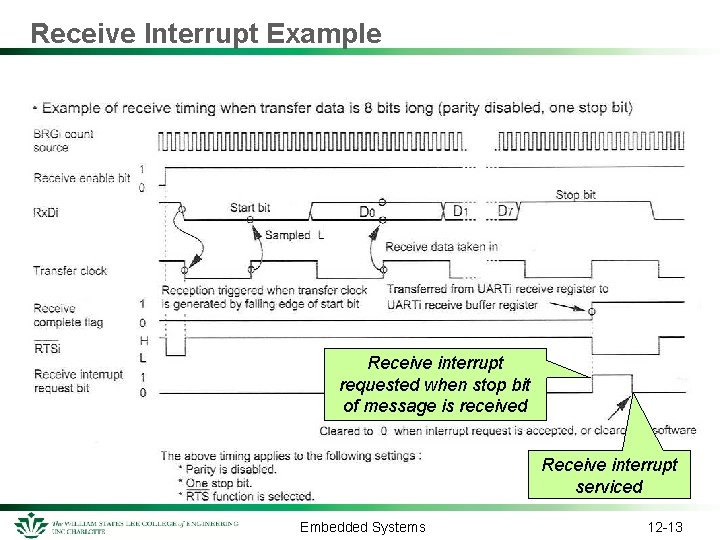
Receive Interrupt Example Receive interrupt requested when stop bit of message is received Receive interrupt serviced Embedded Systems 12 -13
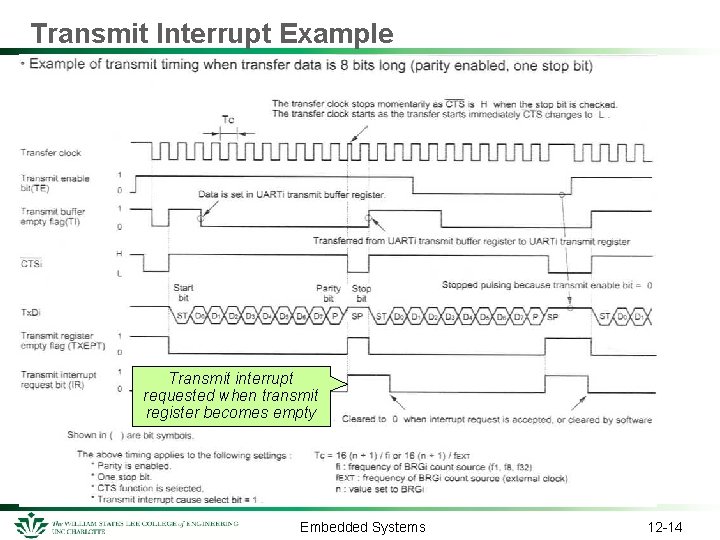
Transmit Interrupt Example Transmit interrupt requested when transmit register becomes empty Embedded Systems 12 -14
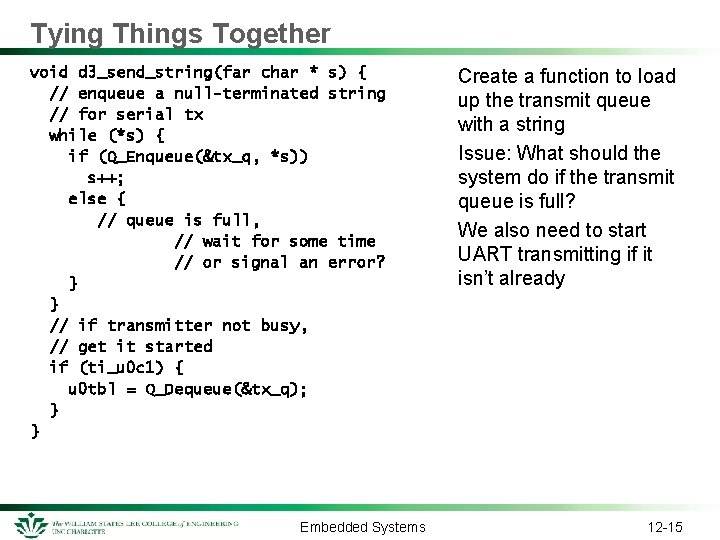
Tying Things Together void d 3_send_string(far char * s) { // enqueue a null-terminated string // for serial tx while (*s) { if (Q_Enqueue(&tx_q, *s)) s++; else { // queue is full, // wait for some time // or signal an error? } } // if transmitter not busy, // get it started if (ti_u 0 c 1) { u 0 tbl = Q_Dequeue(&tx_q); } } Embedded Systems Create a function to load up the transmit queue with a string Issue: What should the system do if the transmit queue is full? We also need to start UART transmitting if it isn’t already 12 -15
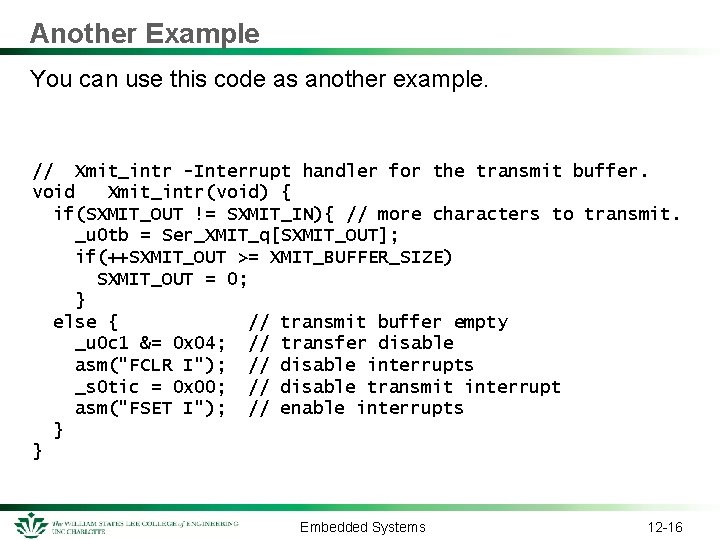
Another Example You can use this code as another example. // Xmit_intr -Interrupt handler for the transmit buffer. void Xmit_intr(void) { if(SXMIT_OUT != SXMIT_IN){ // more characters to transmit. _u 0 tb = Ser_XMIT_q[SXMIT_OUT]; if(++SXMIT_OUT >= XMIT_BUFFER_SIZE) SXMIT_OUT = 0; } else { // transmit buffer empty _u 0 c 1 &= 0 x 04; // transfer disable asm("FCLR I"); // disable interrupts _s 0 tic = 0 x 00; // disable transmit interrupt asm("FSET I"); // enable interrupts } } Embedded Systems 12 -16
- Slides: 16