
Interprofessional work and teamwork Malcolm Payne Emeritus Professor
- Slides: 27
Interprofessional work and teamwork Malcolm Payne Emeritus Professor, Manchester Metropolitan University Honorary Professor, Kingston University/St George’s University of London
Terminology § § § § Alliances Collaboration Cooperation Co-production Coordination Joined-up working Joint planning § § § § Interagency… Interdisciplinary… Interorganisational… Interprofessional… Networking Partnership Teamwork
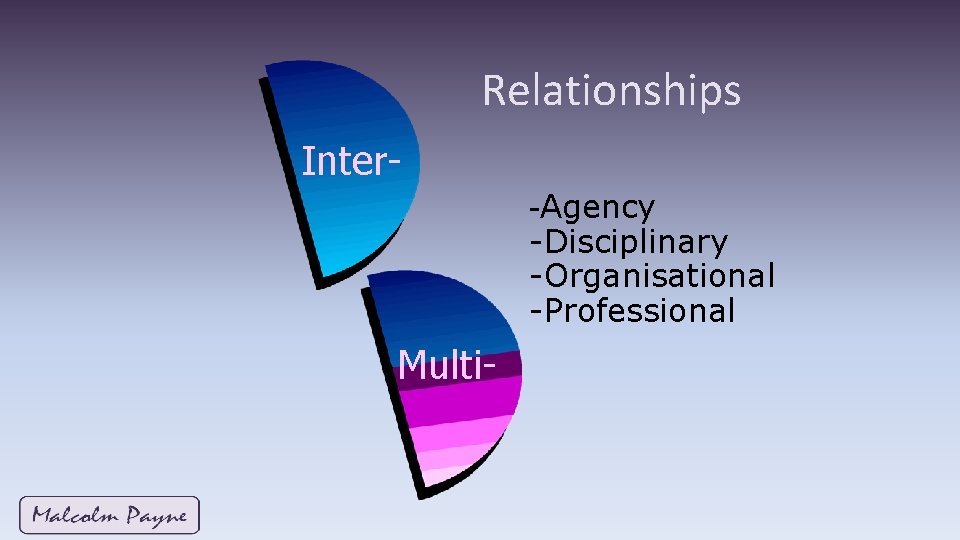
Relationships Inter-Agency -Disciplinary -Organisational -Professional Multi-
Why have policy on interprofessional work? § § § § § Deliver coordinated (packages of) services to individuals Tackle ‘wicked issues’ Reduce impact of organisational fragmentation, minimise perverse incentives Bid for or gain access to new resources Meet a statutory/regulatory requirement Audit Commission, 1998 Fragmentation of services because of market-based approaches Emphasis on consumer satisfaction/participation Civil rights movements – race, gender, disability, sexuality Demographic change Rise in public expectations, challenges to professional power Glasby and Dickinson, 2014
Issues § Professions: • Naturalistic: differentiation of occupations in industrialisation • Particular (altruistic, socially valued, privileged) occupations, justified by social controls (eg knowledge, ethics) • Occupational control: structures relationships between experts, patrons and clients § § Professional, personal, social identities Information – access, governance Medicalisation, evidence-based practice ‘Expert’ users, carers • Volunteers
Issues with inter-, multi-professionalism § Separate education • Knowledge and value assumptions differ • But are also shared § Status and power differences and competition § Specialists less available than everyday carers § When to transfer specialised work • Intake • Levels
Professions and power relations: medicine § Coombs • Medical staff have recognised power in clinical decision-making § Doctors had firmly held, shared ‘opinionated standpoints’, nurses had ‘atrocity stories’ • Areas of knowledge, some shared, some acknowledged • Nursing areas of knowledge consistent with holistic, person-centred care • Live with uncertainty not in uncertainty § Montgomery: Teaching and education Accountancy • Illness is uncertain, but patients and families need certainty; confidence in diagnosis and treatment encourages claims of certainty; the performance of certainty take place through medical ritual • Medicine needs to be reliable and predictable, physicians are agents of accumulated scientific knowledge • ‘Scientific’ is a synonym for ‘rational’, even though clinical reasoning is contextual, interpretive, provisional, taught by aphorism and interpreted through a hierarchy of expertise • Statistical risks are assumed to apply to the individual • ‘the clinical usefulness of the assumption that medicine is a science…(192)’ And organisational? • Seeing medicine as a moral science-using practice would aid communication about risks and desires
Governance in partnerships § Hierarchy • single organisation • ‘top-down’ procedures • statutes govern processes § Network • Multiple organisations • Coming together informally • Shared outlook, priorities or interpersonal relationships § Market • Multiple organisations • Competitively trading on price Glasby and Dickinson, 2014
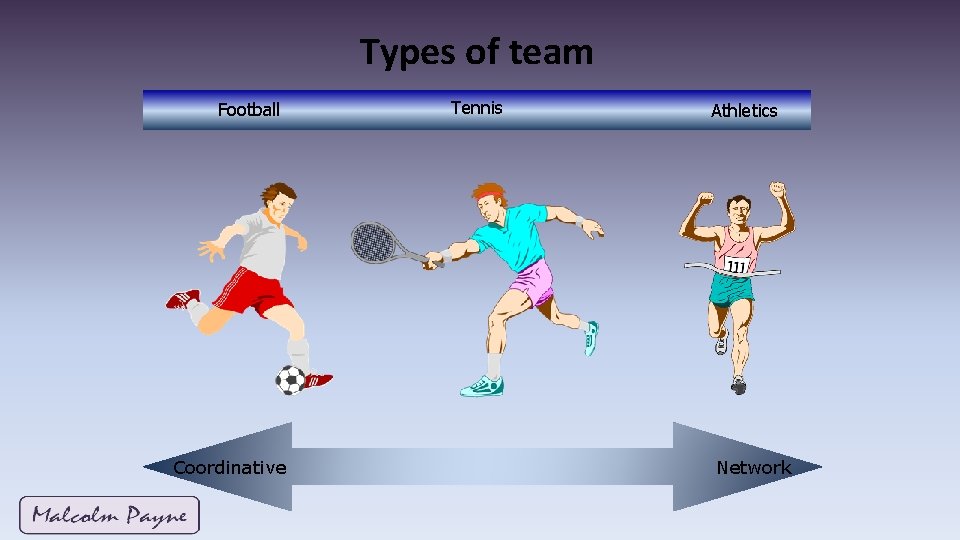
Types of team Football Coordinative Tennis Athletics Network
Teamwork sources: management thinking § Military • Original large organisation § Human relations management • Hawthorn studies • Leadership § 1970 s-80 s • Japan – quality circles § More recently • Strategic – cf policy
Teamwork sources: healthcare § Individual professional responsibility § Development of nursing • Crimea – military analogy § 1960 s • Development of large healthcare organisations • Development of community healthcare § Community mental health centers (USA) § Interprofessional working
Teamwork sources: policy thinking § Bureaucratic management (cf sociology of power, professions) § Bureau-professionals • Social work in healthcare § Coordination-collaboration • Primarily organisational § Para-, Non-professionals • cf peer support in mental health § Development of social services • 1970 -80 s: social services teamwork • 1970 s-80 s: child protection • 1990 s: mental health § Interprofessional working/education § Governance: • Citizenship, civil society, social inclusion • Interests, stakeholders • Public/private/third sector
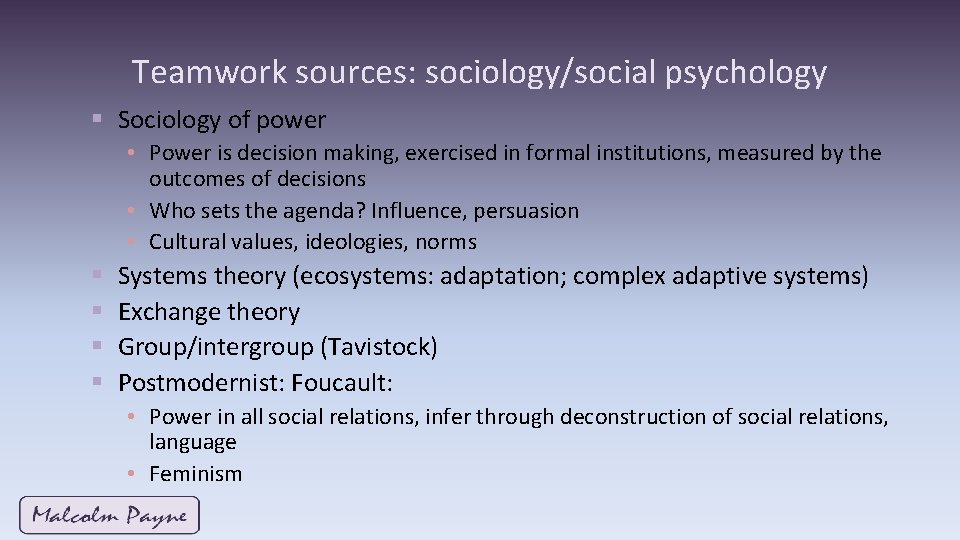
Teamwork sources: sociology/social psychology § Sociology of power • Power is decision making, exercised in formal institutions, measured by the outcomes of decisions • Who sets the agenda? Influence, persuasion • Cultural values, ideologies, norms § § Systems theory (ecosystems: adaptation; complex adaptive systems) Exchange theory Group/intergroup (Tavistock) Postmodernist: Foucault: • Power in all social relations, infer through deconstruction of social relations, language • Feminism
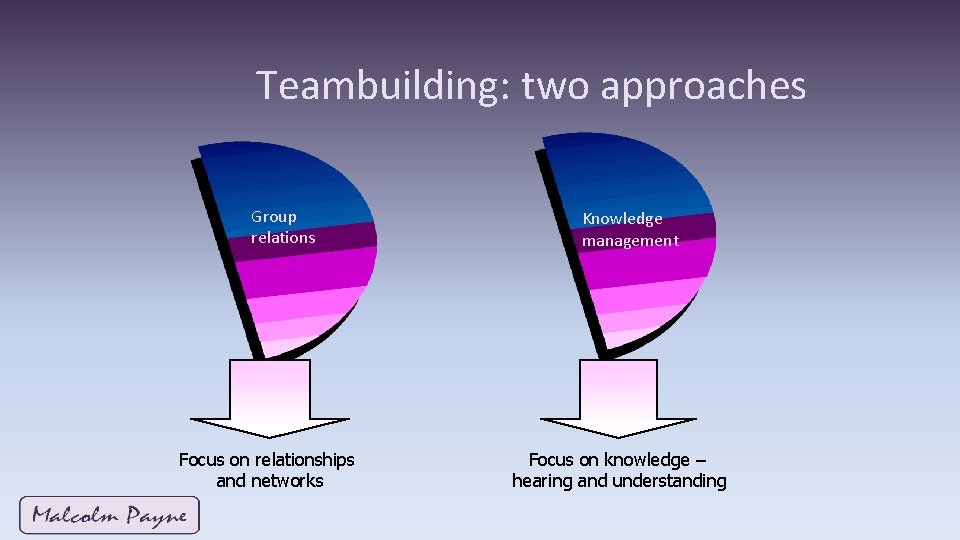
Teambuilding: two approaches Group relations Focus on relationships and networks Knowledge management Focus on knowledge – hearing and understanding
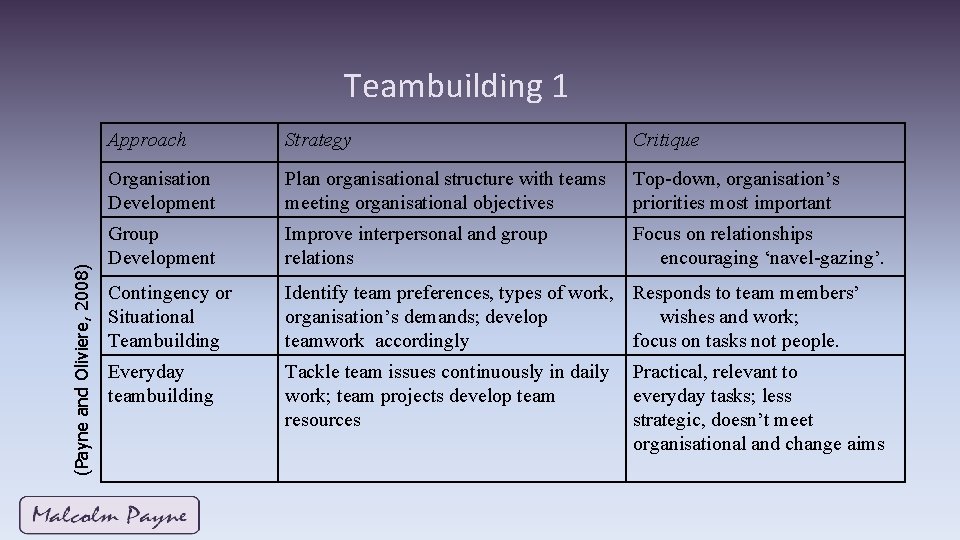
(Payne and Oliviere, 2008) Teambuilding 1 Approach Strategy Critique Organisation Development Plan organisational structure with teams meeting organisational objectives Top-down, organisation’s priorities most important Group Development Improve interpersonal and group relations Focus on relationships encouraging ‘navel-gazing’. Contingency or Situational Teambuilding Identify team preferences, types of work, Responds to team members’ organisation’s demands; develop wishes and work; teamwork accordingly focus on tasks not people. Everyday teambuilding Tackle team issues continuously in daily work; team projects develop team resources Practical, relevant to everyday tasks; less strategic, doesn’t meet organisational and change aims
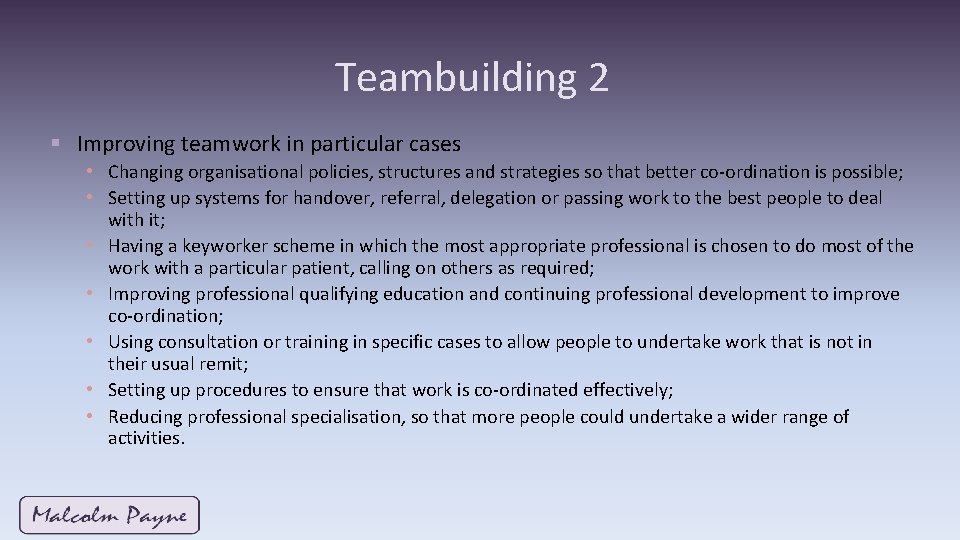
Teambuilding 2 § Improving teamwork in particular cases • Changing organisational policies, structures and strategies so that better co-ordination is possible; • Setting up systems for handover, referral, delegation or passing work to the best people to deal with it; • Having a keyworker scheme in which the most appropriate professional is chosen to do most of the work with a particular patient, calling on others as required; • Improving professional qualifying education and continuing professional development to improve co-ordination; • Using consultation or training in specific cases to allow people to undertake work that is not in their usual remit; • Setting up procedures to ensure that work is co-ordinated effectively; • Reducing professional specialisation, so that more people could undertake a wider range of activities.
Practice strategies: working with older people § Quality improvement is often new practice in existing roles § Practice strategy focuses on service innovations that shift how you take on existing responsibilities. § Partnership practice strategies: • Continuity in life experience for patients/clients • Policy and structural coordination • Setting: admission/intake, discharge/transfer, multiprofessional teams, family meetings/conferences • Interpersonal: relationship and group, cooperation systems, shared aims and quality/innovation focus § § Everyday teamwork: take informal opportunities Generosity with informal interpersonal help Participate in patient teams Participate in problem-solving § Personal, career and team strategies Payne, 2017
Supportive teams § § Frequent interaction Sense of stability and continuity Mutual support and concern Freedom from chronic conflict. (Baumeister and Leary, 1995)
Support in teamwork § Social support • • emotional support, informational support, instrumental support, appraisal support § Social climate § Support for team member growth and development. (West, 2004)
Research into teamwork 1 § NHS Team Effectiveness Study - The clearer the team's objectives - The higher the level of participation in the team - The higher the level of commitment to quality - The higher the level of support of innovation • …. the more effective are health care teams across virtually all domains of functioning • …. . the more innovative are health care teams across virtually all domains of functioning • … the better the mental health of team members across all domains of health care. (Borrill et al, 2001)
Research into teamwork 2 § Typical effective team had: • few part-timers, positive team climate, single clear leader, low stress levels § Poorly functioning teams had: • unclear objectives associated with absence of clear team leader or conflict about leadership
Communities of practice § ‘Practice is about meaning as an experience of everyday life’ • Participation – ways of engaging • Reification – giving meaning to practice § Community of practice is • Mutual engagement… • …in a joint enterprise… • …through a shared repertoire of behaviour § ‘Communities of practice are shared histories of learning’ (Wenger, 1998)
Opie: Knowledge-based work 1 § Providing the focused orientation to client § Spiralling knowledge: issues discussed and developed § Identification and recording issues, members tasks/goals with evolving team aim § Focused closure: recording/confirmation § Engagement with knowledge and perspectives of clients, including inflection by ethnicity and cultural difference
Opie: Knowledge-based work 2 § Working knowledgeably • • • Questioning/elaborating/focusing Recognising and managing differences Working towards disciplinary intersections Theorising the team’s work Developing team objectives
References Books § Audit Commission for Local Authorities, & the National Health Service in England. (1998). A fruitful partnership: effective partnership working. London: Audit Commission. § Coombs, M. A. (2004) Power and Conflict between Doctors and Nurses. London; Rourtledge. § Glasby, J. and Dickinson, H. (2014) Partnership Working in Health and Social Care: What Is Integrated Care and How Can We Deliver It? (2 nd edn) Bristol: Policy Press. § Hunter, D. J. and Perkins, N. (2014) Partnership Working in Public Health. Bristol: Policy Press. § Montgomery, K. (2006) How Doctors Think: Clinical judgement and the practice of medicine. Oxford: Oxford University Press. § Payne, M. (2000) Teamwork in Multiprofessional Care, (Basingstoke: Palgrave) § Payne, M. (2017) Older Citizens and End-of-Life Care: Social work practice strategies for adults in later life. London: Routledge Articles § Kirkpatrick, I. et al (2015) Clinical management and professionalism. In Kuhlmann, E. et al (eds) The Palgrave International Handbook of Healthcare Policy and Governance. Basingstoke: Palgrave Macmillan. § Payne, M. and Oliviere, D. (2008) The Interdisciplinary Team, in Walsh, D. (ed. ) Palliative Medicine, New York: Saunders Elsevier, 253 -9.
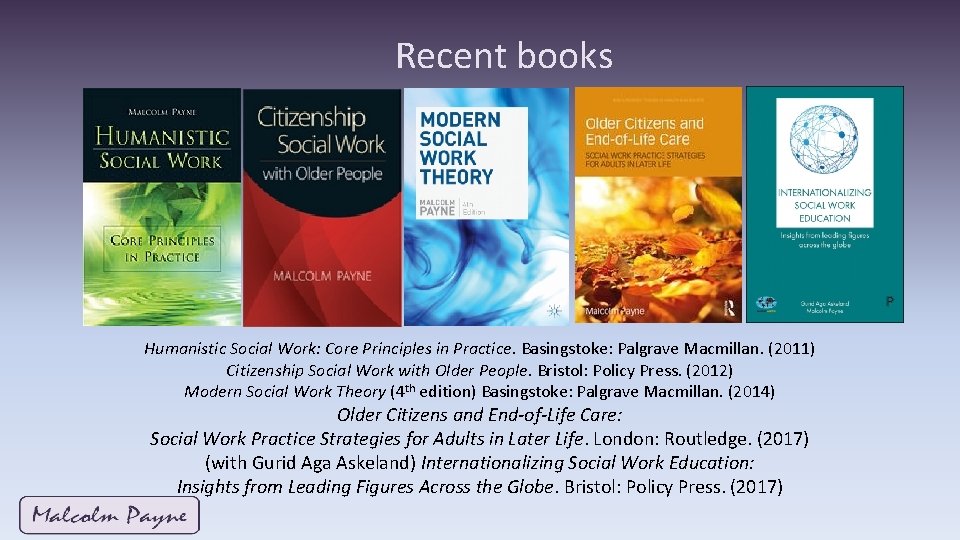
Recent books Humanistic Social Work: Core Principles in Practice. Basingstoke: Palgrave Macmillan. (2011) Citizenship Social Work with Older People. Bristol: Policy Press. (2012) Modern Social Work Theory (4 th edition) Basingstoke: Palgrave Macmillan. (2014) Older Citizens and End-of-Life Care: Social Work Practice Strategies for Adults in Later Life. London: Routledge. (2017) (with Gurid Aga Askeland) Internationalizing Social Work Education: Insights from Leading Figures Across the Globe. Bristol: Policy Press. (2017)
malcolmpayne 5@gmail. com @malcolmpayne https: //www. facebook. com/Malcolm. Payne 47