
Interprofessional Health Care Team Meetings OBJECTIVES Identify key

Interprofessional Health Care Team Meetings OBJECTIVES: • Identify key principles and characteristics of effective interprofessional team meetings • Identify strategies for addressing dysfunctional teamwork behaviours and improving interprofessional team meetings 1
Importance of Team Meetings • Why are team meetings so important ? • What have been your positive or negative experiences in team meetings? • What strategies have you used in addressing dysfunctional team behaviour? 2

Interprofessional Team Meetings: Roles and Responsibilities • Team leader – Schedules and conducts meeting – Prepares, distributes agenda; ensures it is adhered to and identifies amount of time required for each item – Clarifies purpose of team and helps identify goals – Encourages participation – Identifies themes in discussion – Clarifies and restates when appropriate – Ensures that closure is reached on each agenda item – Encourages integration of new members 3
Interprofessional Team Meetings: Roles and Responsibilities (Cont’d) • Recorder – Documents the work of the group (summaries of decisions, action items and deadlines) – Maintains focus and direction – Clarifies the group's progress by summarizing and seeking clarification or detail – Produces written summaries (minutes) 4

Interprofessional Team Meetings: Roles and Responsibilities (Cont’d) • Timekeeper – Informs the group of start and end times for each agenda item – Indicates when the group is going over the allotted time for each item – Reminds team of issues still on the agenda and the time remaining to deal with them 5

Principles of Effective Team Meetings Key elements of a structured meeting are: • Agenda (what do we expect to accomplish? ) • Estimated timeline for completing agenda • Establishment of roles at meeting – Leader (calls meeting to order, has agenda, sets expectations) – Timekeeper (keeps group on task) – Recorder (records agreed upon changes to the care plan and responsibility for actionable items ) • Summary of agreements (Recorder reports on agreements) • Evaluation/reflection on team process/outcome ( an opportunity to address problems arising in the meeting before it gets addressed in less constructive way) 6

The Seven-Step Meeting Process Step 1 Clarify Objectives » All understand are in agreement with objectives Step 2 Review Roles » Who is recorder, leader, timekeeper Step 3 Review Agenda » Clarify and make any additions to / deletions from agenda Step 4 Work Through Agenda Items » Timekeeper ensures team stays on target for each item Step 5 Review Meeting Record » Have recorder summarize meeting notes Step 6 Plan Next Steps and Next Agenda » Recorder notes responsibilities for actions and asks for items for next meeting Step 7 Evaluate Meeting » What is working well – what needs to done differently ? 7
Evaluating Team Process Participation • Did each team member adequately participate in the discussion, contribute to the problem? to the care plan? • Did members express themselves clearly? • Did members follow-up/ask for clarification on vague comments or positions by others? • Did the team process business in a way that allowed each member to contribute his or her viewpoint/role? • Was there leadership to create the necessary structure and organization for the team to complete its business? • Was there adequate leadership to allow for the emergence of new ideas and ways of working together that will improve patient care? 8
Evaluating Team Process Conflict • Was there conflict? If not, should there have been? If yes, why didn’t it occur? • When there was conflict or disagreement – Did some members dominate? – Did some withdraw not voicing their position? – Was the team able to reach an agreement? – Did the team move too quickly to reach agreement? 9
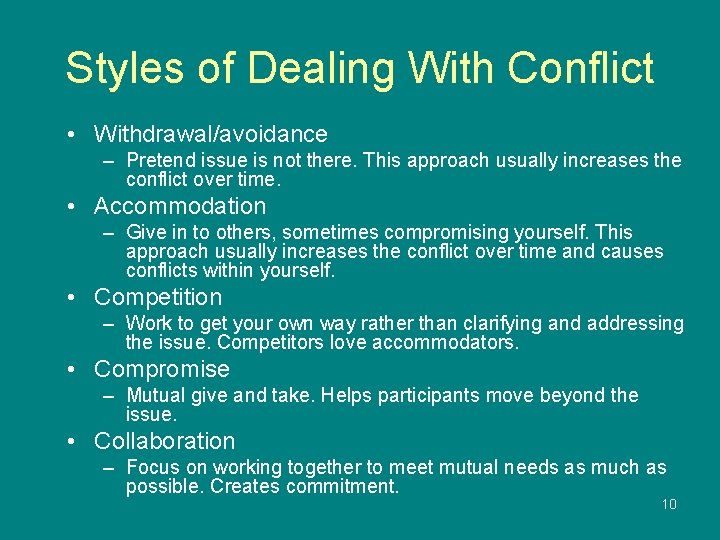
Styles of Dealing With Conflict • Withdrawal/avoidance – Pretend issue is not there. This approach usually increases the conflict over time. • Accommodation – Give in to others, sometimes compromising yourself. This approach usually increases the conflict over time and causes conflicts within yourself. • Competition – Work to get your own way rather than clarifying and addressing the issue. Competitors love accommodators. • Compromise – Mutual give and take. Helps participants move beyond the issue. • Collaboration – Focus on working together to meet mutual needs as much as possible. Creates commitment. 10

Exercise: Interprofessional Health Care Team Meetings • We will view a video of a team meeting with some effective and ineffective behaviours and processes • Record your observations on the worksheet 11
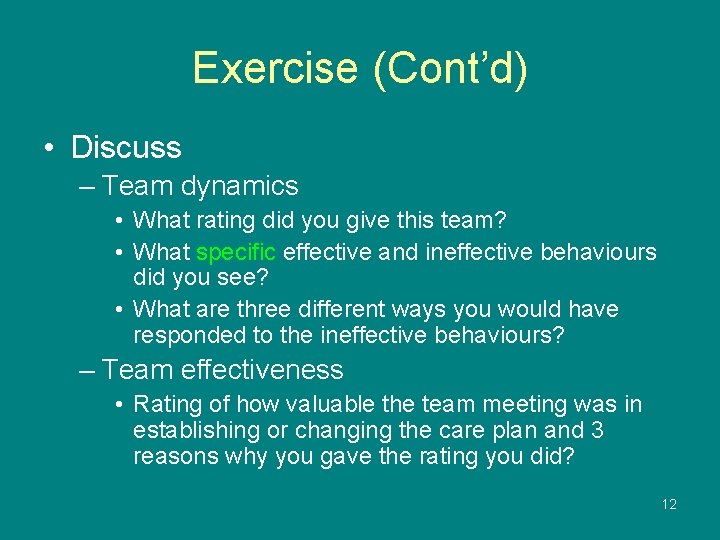
Exercise (Cont’d) • Discuss – Team dynamics • What rating did you give this team? • What specific effective and ineffective behaviours did you see? • What are three different ways you would have responded to the ineffective behaviours? – Team effectiveness • Rating of how valuable the team meeting was in establishing or changing the care plan and 3 reasons why you gave the rating you did? 12

Acknowledgements • Curriculum materials were developed through the Building a Better Tomorrow Initiative, an Atlantic Provincial Primary Health Care Initiative. • Video scenarios were produced by the Centre for Collaborative Health Professional Education, Memorial University of Newfoundland. 13
- Slides: 13