
Interpretive Skills Basic Approach to a Brain MRI
Interpretive Skills Basic Approach to a Brain MRI Introduction to Neuroradiology Concepts
Before You Begin This module, intended for pre-clinical medical students transitioning to the clinical years, assumes familiarity with fundamental anatomy and pathology concepts. Please review our website sections: • “Anatomy” • “Radiology-Pathology” If you need to learn or review these core concepts prior to initiating this interpretive skills module. If material is repeated from another module, it will be outlined as this text is so that you are aware
Module Objectives • Systematic approach to brain MRI interpretation • Identify the following • • • Acute infarct Mass effect Intra-axial vs. extra-axial mass Abnormal enhancement Hemorrhage

General Concepts
Magnetic Resonance Imaging – “MRI” • Utilizes powerful magnetic fields and radio-frequency pulses to excite water molecules within tissues • The energy released by atoms as they return to baseline can be captured to produce an image • By varying parameters such as pulse frequency and implementing software-based image manipulation strategies, image qualities can be modulated (i. e. T 1 vs T 2 weighted, Diffusion Weighted Imaging (DWI), etc. ) • MRI can highlight structures that may not be apparent in CT imaging • MRIs are particularly apt when imaging soft tissues • As they do not rely on X-rays, MRI studies do not expose patients to radiation
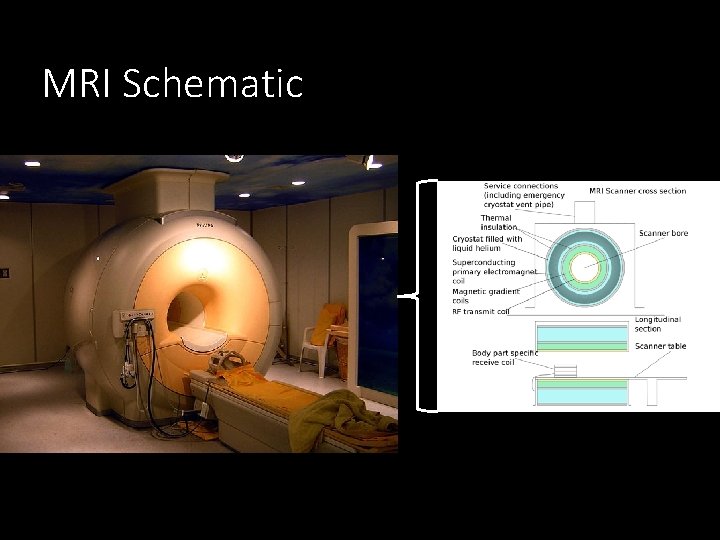
MRI Schematic
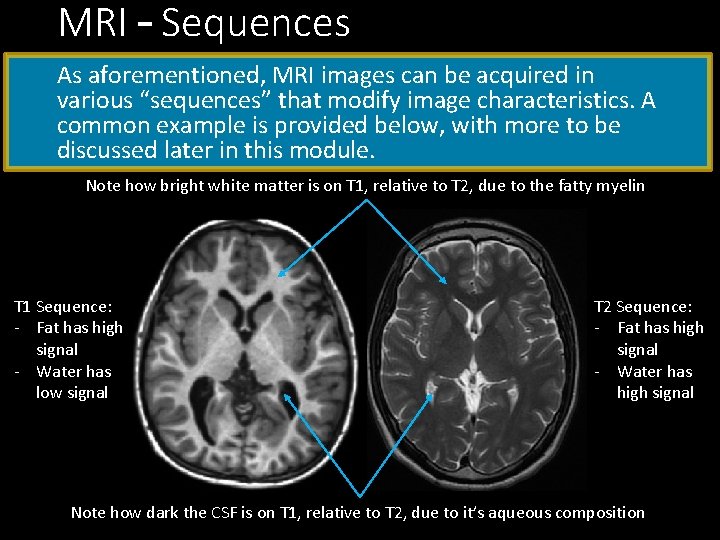
MRI – Sequences As aforementioned, MRI images can be acquired in various “sequences” that modify image characteristics. A common example is provided below, with more to be discussed later in this module. Note how bright white matter is on T 1, relative to T 2, due to the fatty myelin T 1 Sequence: - Fat has high signal - Water has low signal T 2 Sequence: - Fat has high signal - Water has high signal Note how dark the CSF is on T 1, relative to T 2, due to it’s aqueous composition
CT vs MRI Consider the following when evaluating why one modality may be preferred in specific scenarios: • Time: CT scans are fairly quick (usually <10 minutes), relative to MRI (can be >1 hour) • Cost: CT imaging is significantly cheaper than MRI imaging • Image Characteristics: CTs offer excellent resolution of bones and soft tissue; MRIs traditionally offer different image qualities, including higher quality resolution of soft tissue such as white-grey matter interfaces or ligaments • Utility: CTs require the use of ionizing radiation, requiring evaluation of risks vs. benefits in certain populations (i. e. children). MRIs utilize a magnetic field, which limits their use when imaging patient’s with metal implants
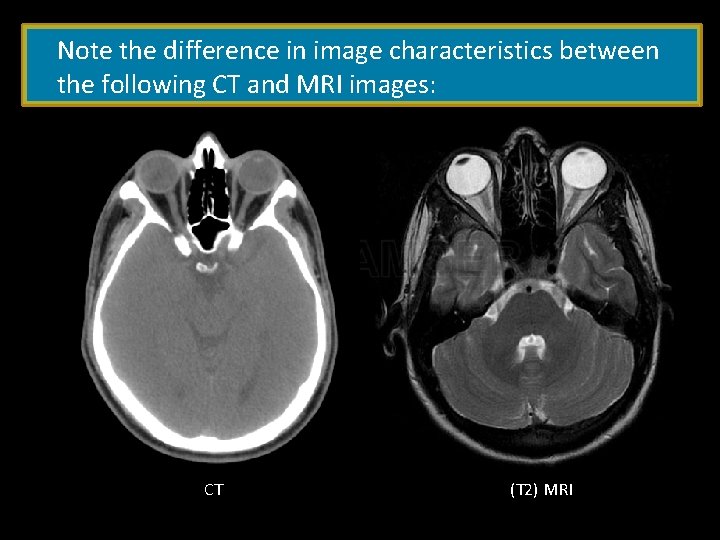
Note the difference in image characteristics between the following CT and MRI images: CT (T 2) MRI
General Approach to a Brain MRI
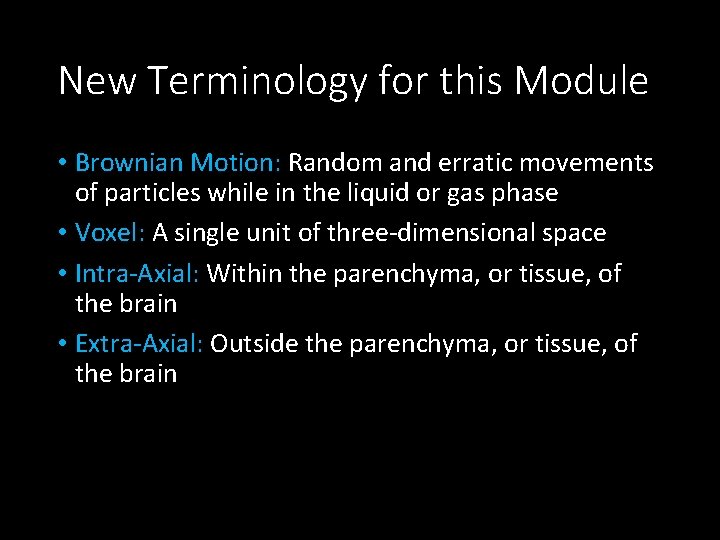
New Terminology for this Module • Brownian Motion: Random and erratic movements of particles while in the liquid or gas phase • Voxel: A single unit of three-dimensional space • Intra-Axial: Within the parenchyma, or tissue, of the brain • Extra-Axial: Outside the parenchyma, or tissue, of the brain
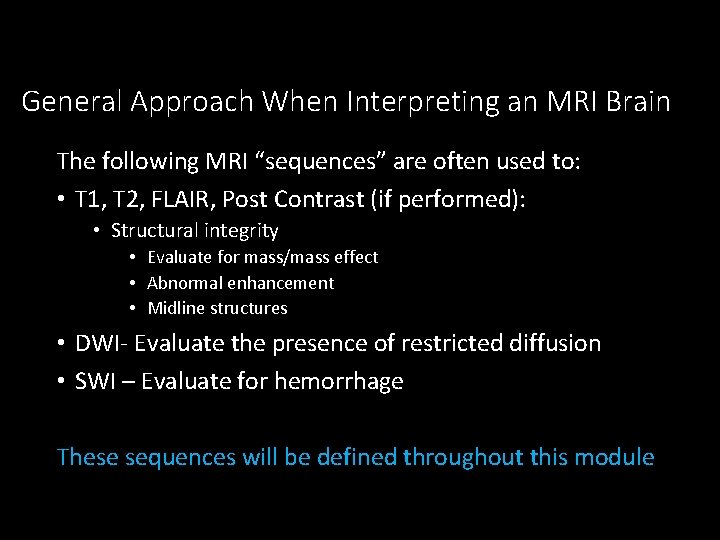
General Approach When Interpreting an MRI Brain The following MRI “sequences” are often used to: • T 1, T 2, FLAIR, Post Contrast (if performed): • Structural integrity • Evaluate for mass/mass effect • Abnormal enhancement • Midline structures • DWI- Evaluate the presence of restricted diffusion • SWI – Evaluate for hemorrhage These sequences will be defined throughout this module
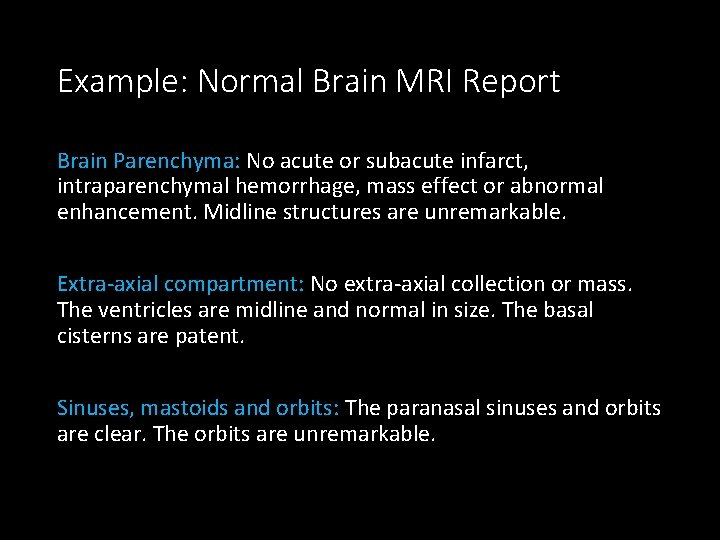
Example: Normal Brain MRI Report Brain Parenchyma: No acute or subacute infarct, intraparenchymal hemorrhage, mass effect or abnormal enhancement. Midline structures are unremarkable. Extra-axial compartment: No extra-axial collection or mass. The ventricles are midline and normal in size. The basal cisterns are patent. Sinuses, mastoids and orbits: The paranasal sinuses and orbits are clear. The orbits are unremarkable.

Identifying Pathology via MRI sequences
Diffusion Weighted Imaging (DWI) • Form of MR imaging based upon measuring the random Brownian motion of water molecules within a voxel of tissue. • Highly cellular tissues or those with cellular swelling exhibit lower diffusion coefficients (restricted diffusion) • Diffusion is thus particularly useful in tumor characterization and cerebral ischemia. For more information, please see: https: //radiopaedia. org/articles/diffusion-weighted-imaging-1
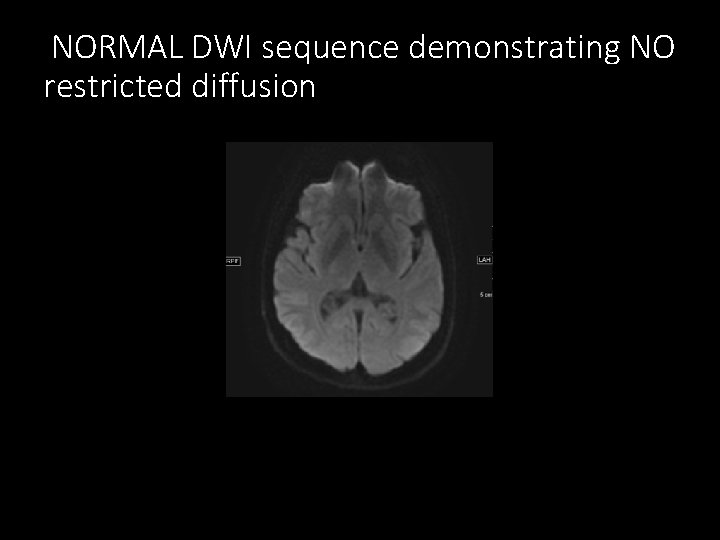
NORMAL DWI sequence demonstrating NO restricted diffusion
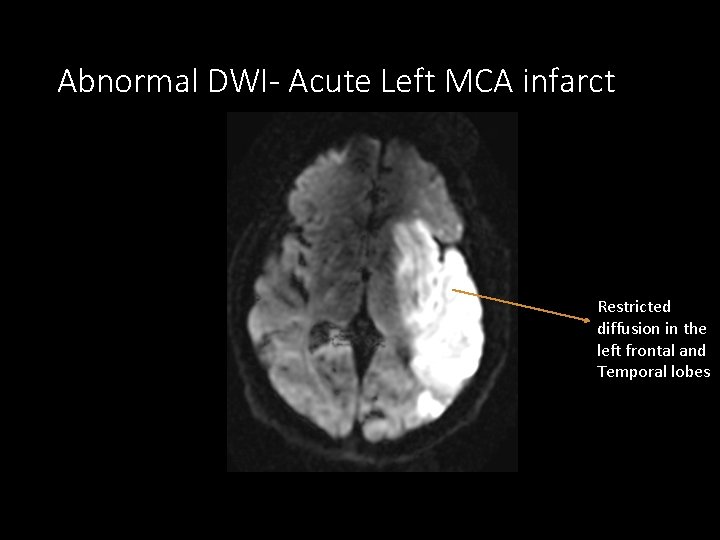
Abnormal DWI- Acute Left MCA infarct Restricted diffusion in the left frontal and Temporal lobes
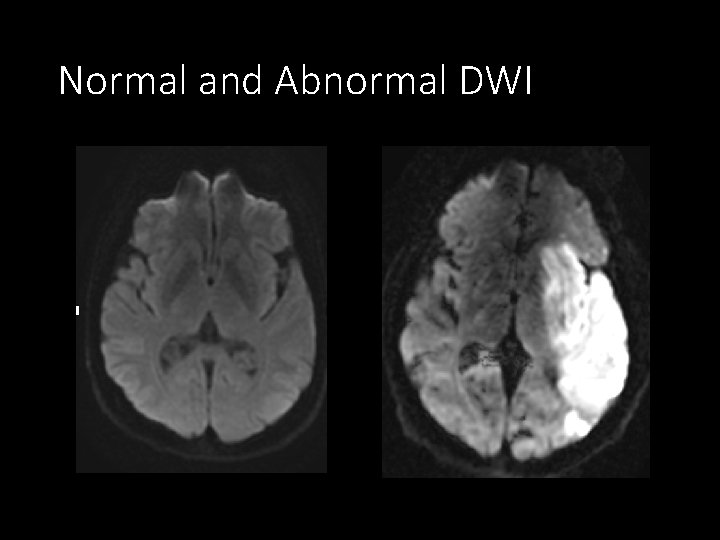
Normal and Abnormal DWI
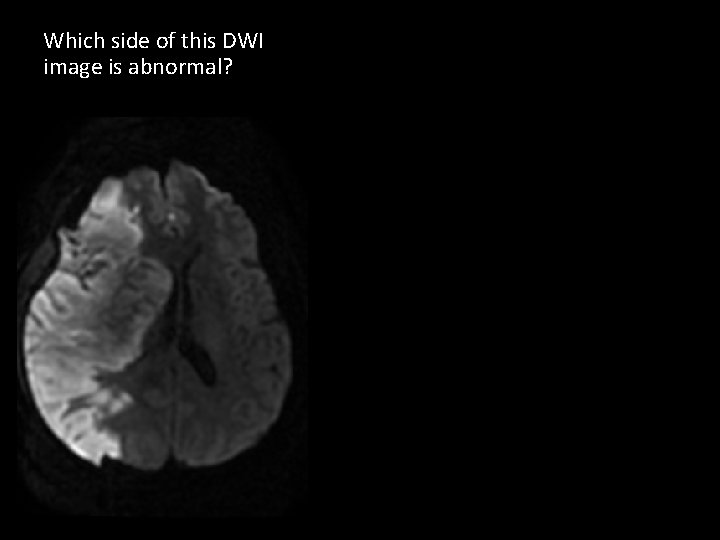
Which side of this DWI image is abnormal?
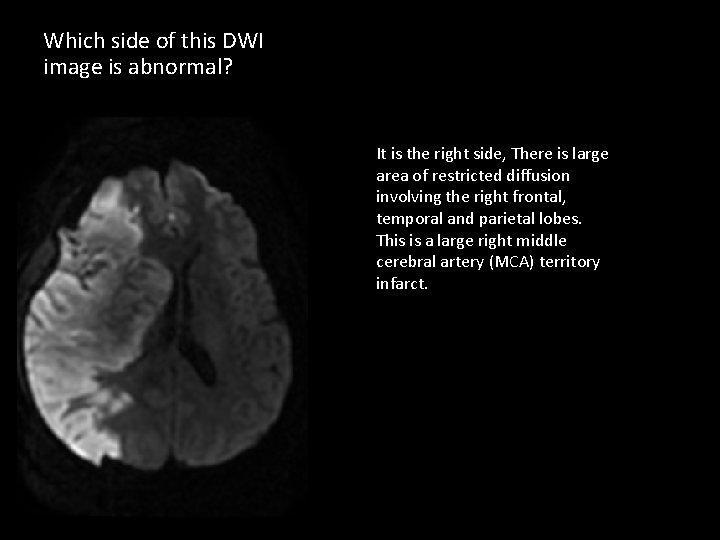
Which side of this DWI image is abnormal? It is the right side, There is large area of restricted diffusion involving the right frontal, temporal and parietal lobes. This is a large right middle cerebral artery (MCA) territory infarct.
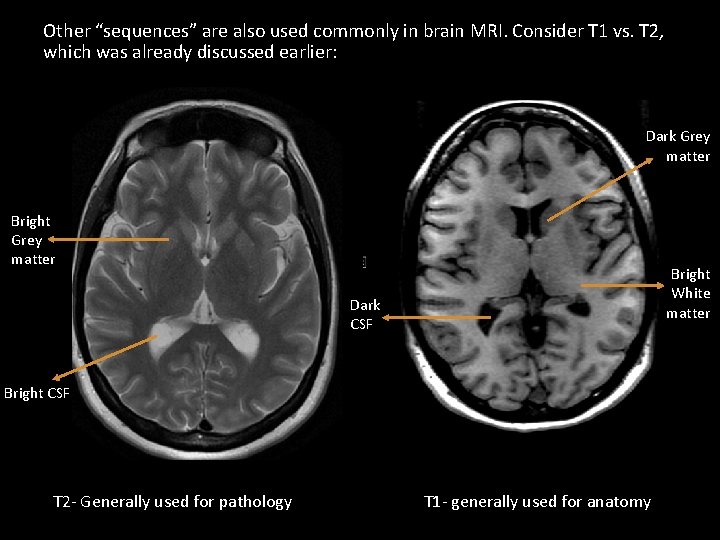
Other “sequences” are also used commonly in brain MRI. Consider T 1 vs. T 2, which was already discussed earlier: Dark Grey matter Bright White matter Dark CSF Bright CSF T 2 - Generally used for pathology T 1 - generally used for anatomy
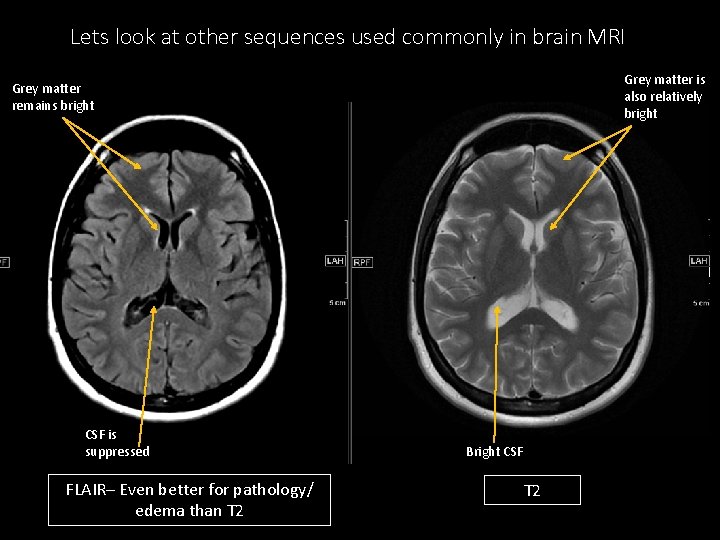
Lets look at other sequences used commonly in brain MRI Grey matter is also relatively bright Grey matter remains bright CSF is suppressed FLAIR– Even better for pathology/ edema than T 2 Bright CSF T 2
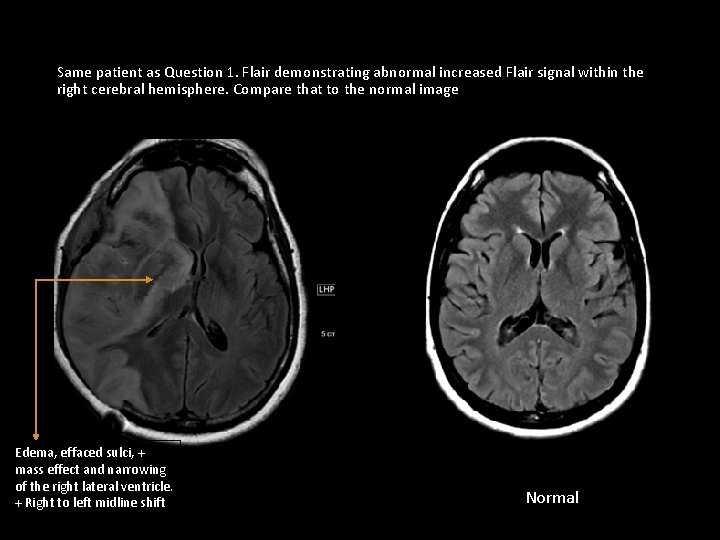
Same patient as Question 1. Flair demonstrating abnormal increased Flair signal within the right cerebral hemisphere. Compare that to the normal image Edema, effaced sulci, + mass effect and narrowing of the right lateral ventricle. + Right to left midline shift Normal
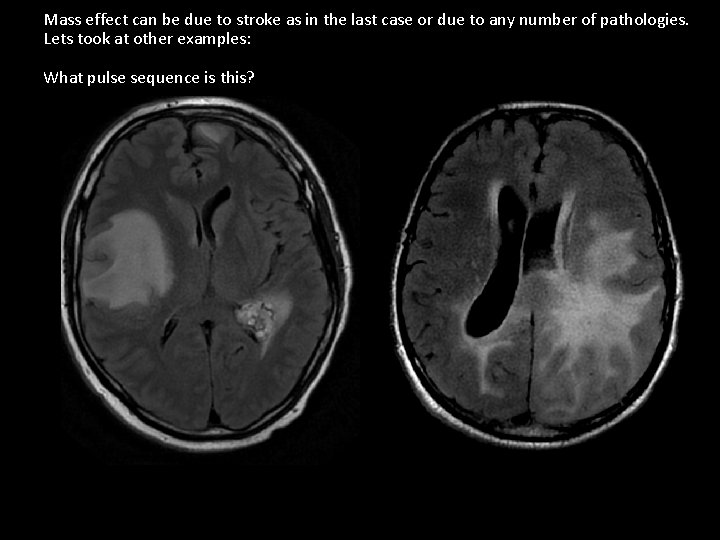
Mass effect can be due to stroke as in the last case or due to any number of pathologies. Lets took at other examples: What pulse sequence is this?
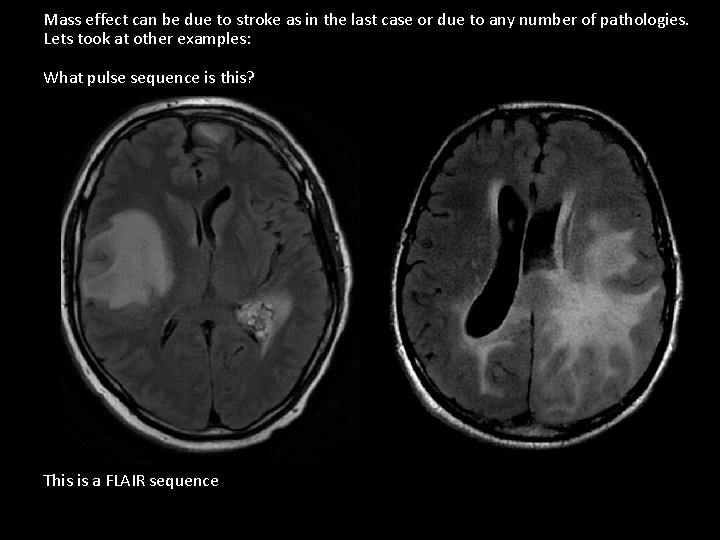
Mass effect can be due to stroke as in the last case or due to any number of pathologies. Lets took at other examples: What pulse sequence is this? This is a FLAIR sequence
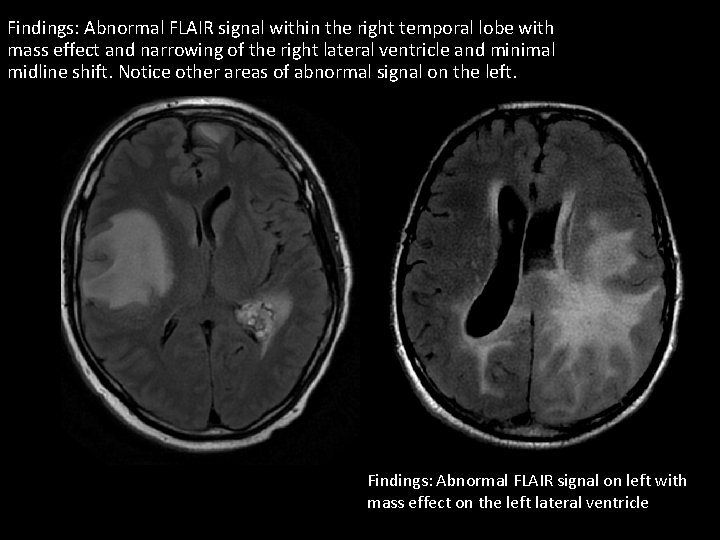
Findings: Abnormal FLAIR signal within the right temporal lobe with mass effect and narrowing of the right lateral ventricle and minimal midline shift. Notice other areas of abnormal signal on the left. Findings: Abnormal FLAIR signal on left with mass effect on the left lateral ventricle
The pattern of edema will give us a clue as to the pathology. Many times we have to use other information such as restricted diffusion (DWI); contrast enhancement pattern and location to figure out the pathology and formulate a differential diagnosis.
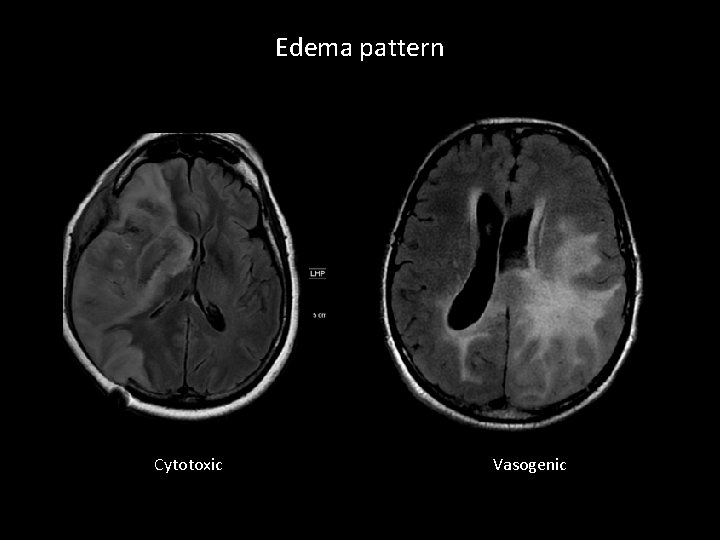
Edema pattern Cytotoxic Vasogenic
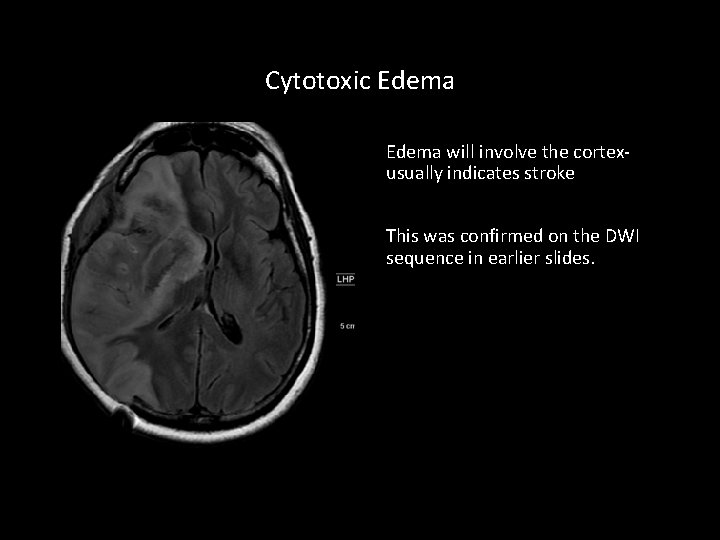
Cytotoxic Edema will involve the cortexusually indicates stroke This was confirmed on the DWI sequence in earlier slides.
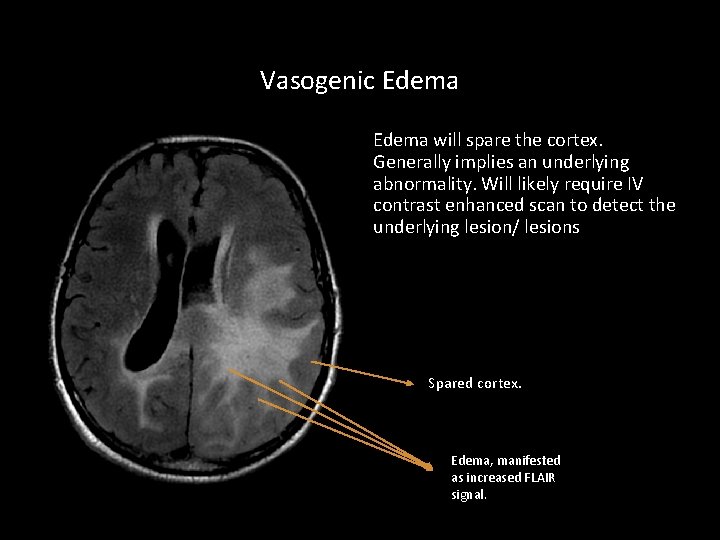
Vasogenic Edema will spare the cortex. Generally implies an underlying abnormality. Will likely require IV contrast enhanced scan to detect the underlying lesion/ lesions Spared cortex. Edema, manifested as increased FLAIR signal.
IV Gadolinium In contrast to body imaging, most of the brain parenchyma will not enhance following contrast enhancement. By convention – All post contrast images are T 1 Why will a normal patient’s brain not enhance?
IV Gadolinium In contrast to body imaging, most of the brain parenchyma will not enhance following contrast enhancement. By convention – All post contrast images are T 1 Why will a normal patient’s brain not enhance? The blood brain barrier There a few structures that lack a BBB and hence will enhance. Can you think of them?
IV Gadolinium In contrast to body imaging, most of the brain parenchyma will not enhance following contrast enhancement. By convention – All post contrast images are T 1 Why will a normal patient’s brain not enhance? The blood brain barrier There a few structures that lack a BBB and hence will enhance. Can you think of them? Pituitary gland, pineal gland, choroid plexus, and vessels
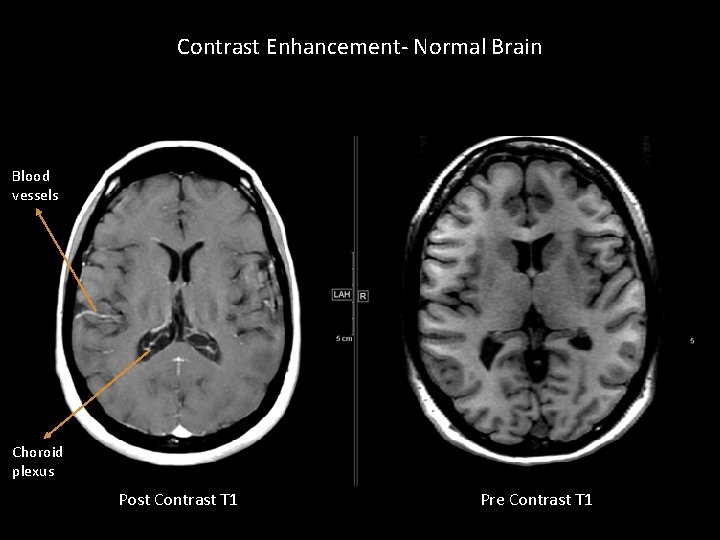
Contrast Enhancement- Normal Brain Blood vessels Choroid plexus Post Contrast T 1 Pre Contrast T 1
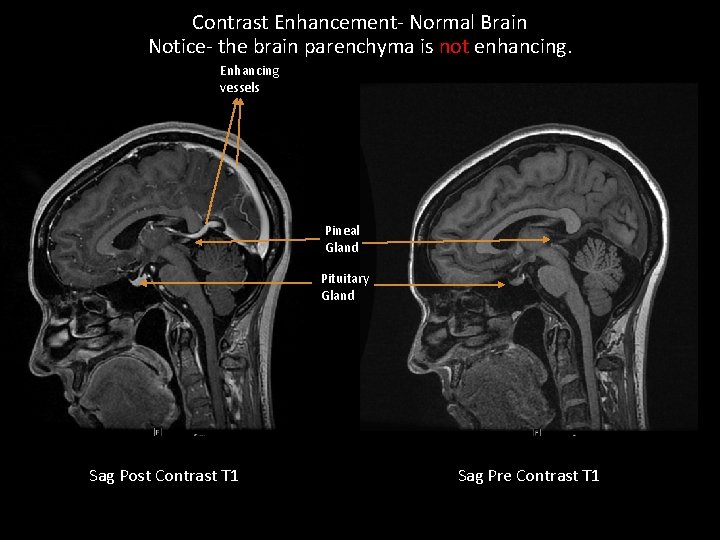
Contrast Enhancement- Normal Brain Notice- the brain parenchyma is not enhancing. Enhancing vessels Pineal Gland Pituitary Gland Sag Post Contrast T 1 Sag Pre Contrast T 1
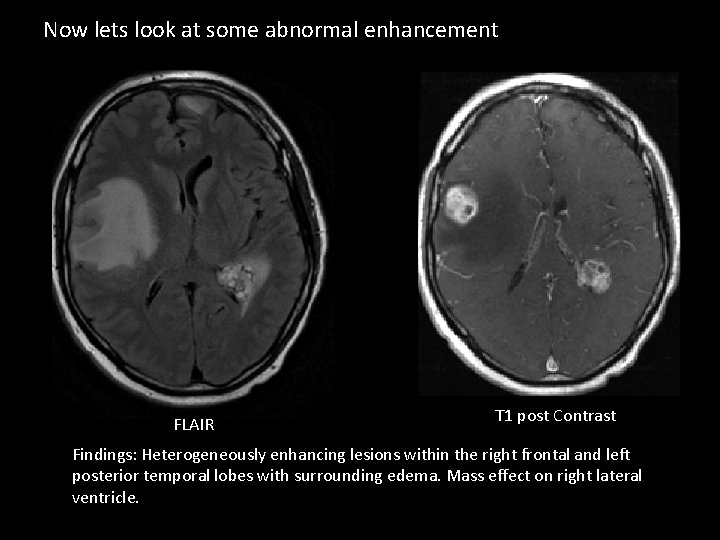
Now lets look at some abnormal enhancement FLAIR T 1 post Contrast Findings: Heterogeneously enhancing lesions within the right frontal and left posterior temporal lobes with surrounding edema. Mass effect on right lateral ventricle. --Renal cell metastases--
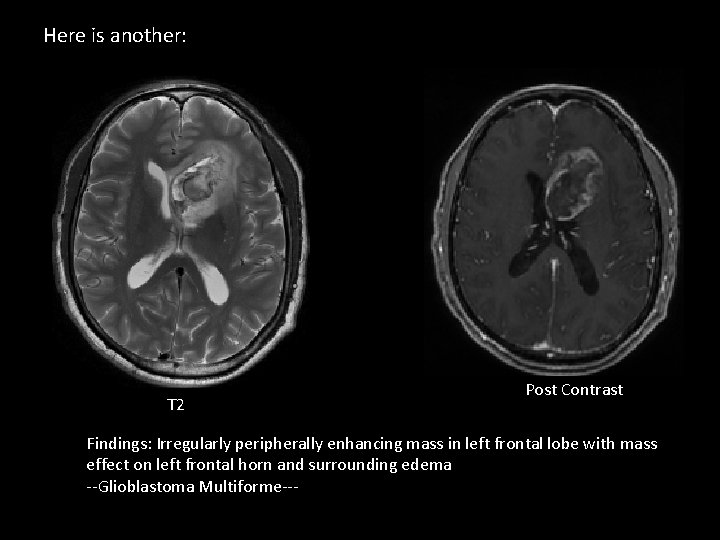
Here is another: T 2 Post Contrast Findings: Irregularly peripherally enhancing mass in left frontal lobe with mass effect on left frontal horn and surrounding edema --Glioblastoma Multiforme---
Patterns of Enhancement Too complex to cover in one slide but briefly: • Homogenous or heterogeneous diffuse enhancement indicates a more solid lesion • Peripheral enhancement generally indicates abscess with pus in the center, central necrosis or active demyelination.
SWAN, GRE or SWE Sequence - Called any one of the above: - This sequence detects the presence of hemorrhage. - Appears as dark signal - Area of abnormality can be larger than the enhancing portion—referred as “blooming artifact. ” - Let’s take a look at a couple of examples:
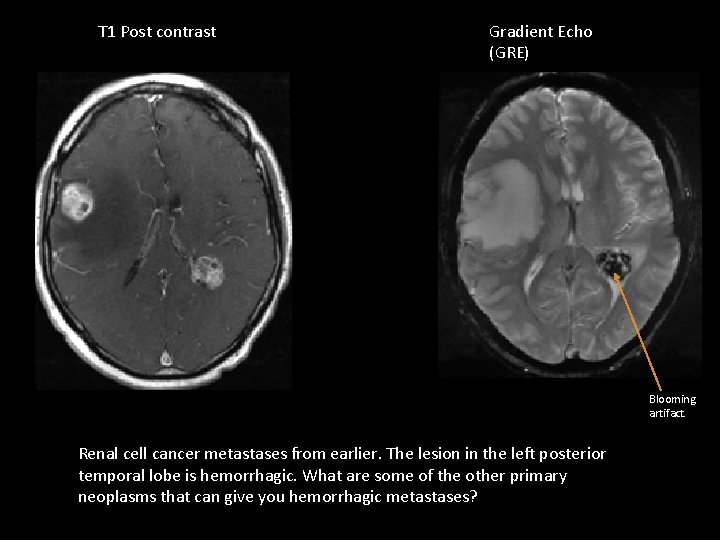
T 1 Post contrast Gradient Echo (GRE) Blooming artifact. Renal cell cancer metastases from earlier. The lesion in the left posterior temporal lobe is hemorrhagic. What are some of the other primary neoplasms that can give you hemorrhagic metastases?
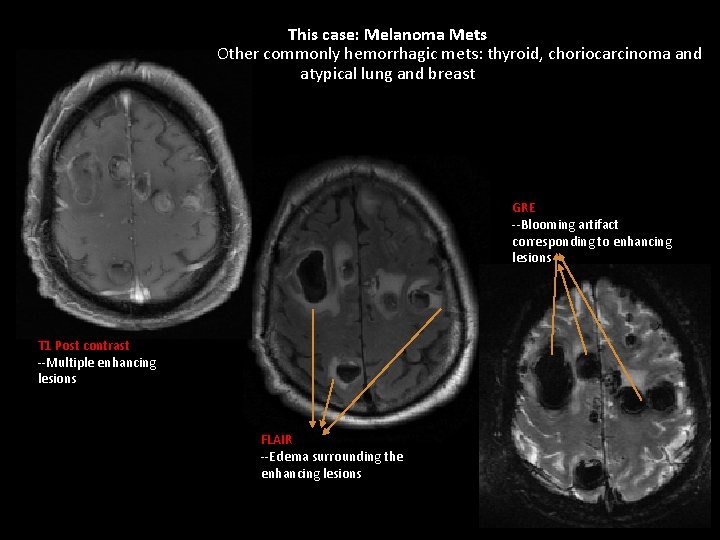
This case: Melanoma Mets Other commonly hemorrhagic mets: thyroid, choriocarcinoma and atypical lung and breast GRE --Blooming artifact corresponding to enhancing lesions T 1 Post contrast --Multiple enhancing lesions FLAIR --Edema surrounding the enhancing lesions
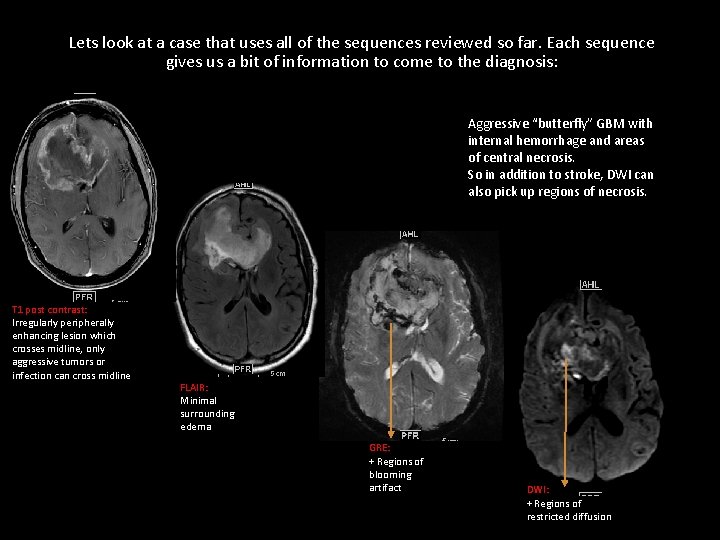
Lets look at a case that uses all of the sequences reviewed so far. Each sequence gives us a bit of information to come to the diagnosis: Aggressive “butterfly” GBM with internal hemorrhage and areas of central necrosis. So in addition to stroke, DWI can also pick up regions of necrosis. T 1 post contrast: Irregularly peripherally enhancing lesion which crosses midline, only aggressive tumors or infection can cross midline FLAIR: Minimal surrounding edema GRE: + Regions of blooming artifact DWI: + Regions of restricted diffusion
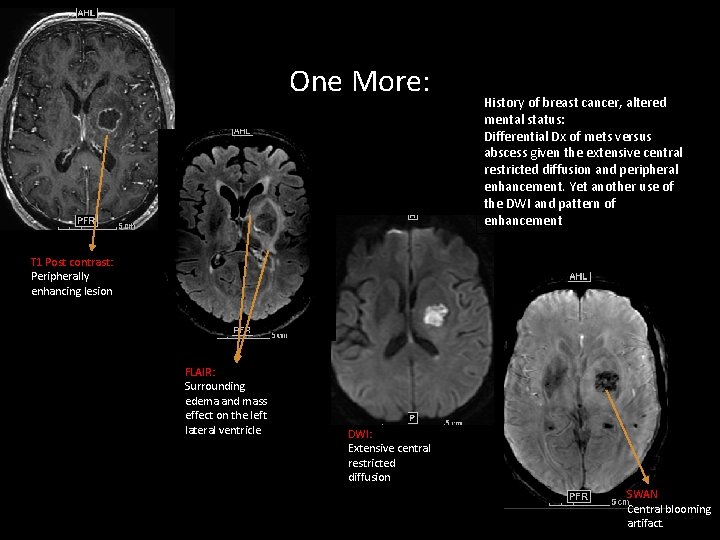
One More: History of breast cancer, altered mental status: Differential Dx of mets versus abscess given the extensive central restricted diffusion and peripheral enhancement. Yet another use of the DWI and pattern of enhancement T 1 Post contrast: Peripherally enhancing lesion FLAIR: Surrounding edema and mass effect on the left lateral ventricle DWI: Extensive central restricted diffusion SWAN: Central blooming artifact.
Location All of the previous cases have been intra-parenchymal or within the brain parenchyma: Why is this important? In an adult an intra-axial tumor will be a metastasis or astrocytoma in 75% of cases. For more information, please see: http: //www. radiologyassistant. nl/en/p 47 f 86 aa 182 b 3 a/brain-tumor-systematicapproach. html#i 47 f 86 b 18 db 49 d
Location Extra Axial: If a lesion outside the brain or extra-axial, then the lesion is not actually a brain tumor, but derived from the lining of the brain or surrounding structures. 80% of these extra-axial lesions will be either a meningioma or a schwannoma. Knowing the location helps us figure out the etiology of the lesion much better. For more information, please see: http: //www. radiologyassistant. nl/en/p 47 f 86 aa 182 b 3 a/brain-tumor-systematicapproach. html#i 47 f 86 b 18 db 49 d
Extra-Axial lesions Characteristics • CSF cleft • Displaced subarachnoid vessels • Displace and expand subarachnoid space • Cortical grey matter between the mass and white matter • Broad Dural base • May have a bony reaction
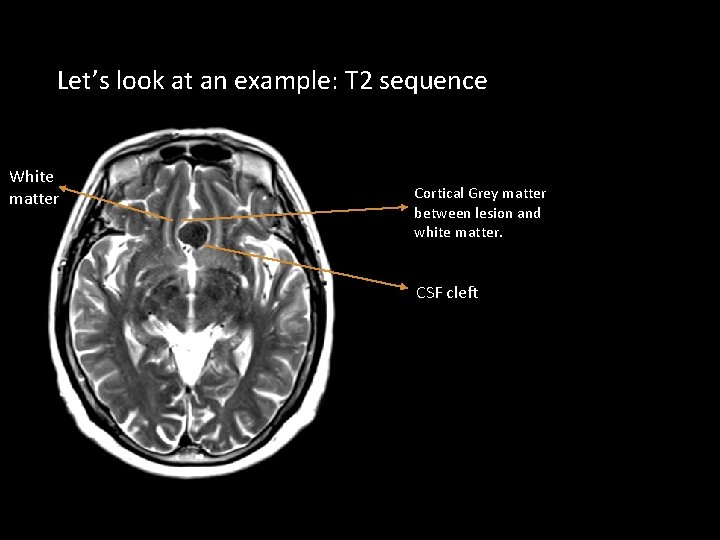
Let’s look at an example: T 2 sequence White matter Cortical Grey matter between lesion and white matter. CSF cleft
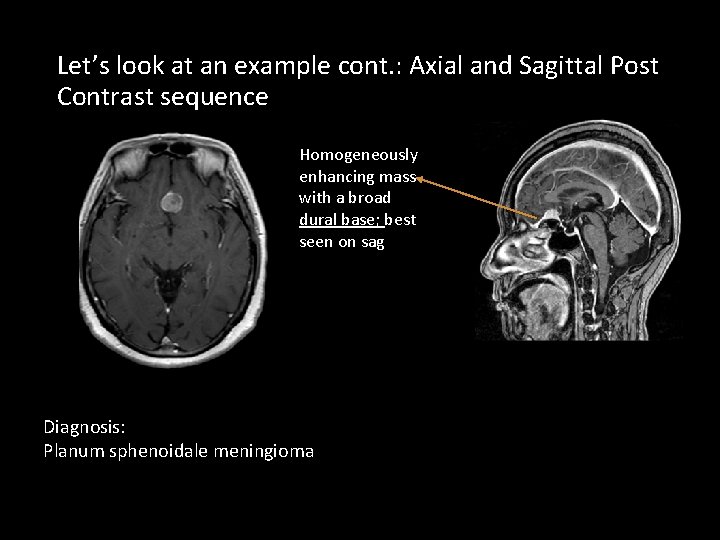
Let’s look at an example cont. : Axial and Sagittal Post Contrast sequence Homogeneously enhancing mass with a broad dural base; best seen on sag Diagnosis: Planum sphenoidale meningioma.
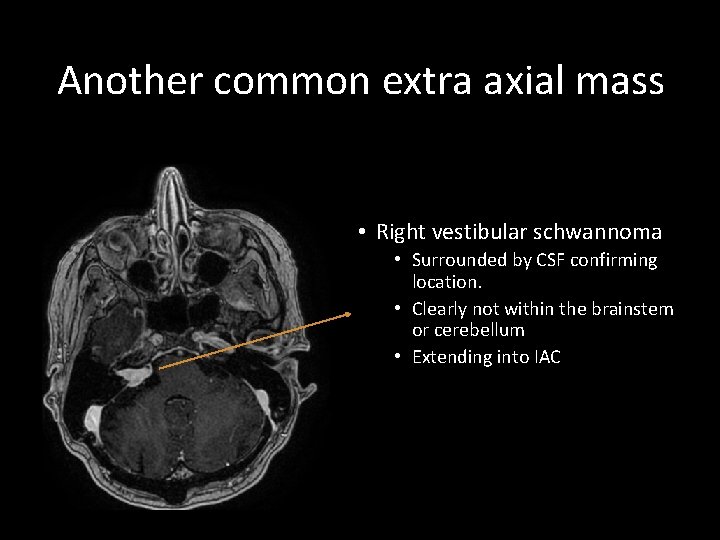
Another common extra axial mass • Right vestibular schwannoma • Surrounded by CSF confirming location. • Clearly not within the brainstem or cerebellum • Extending into IAC
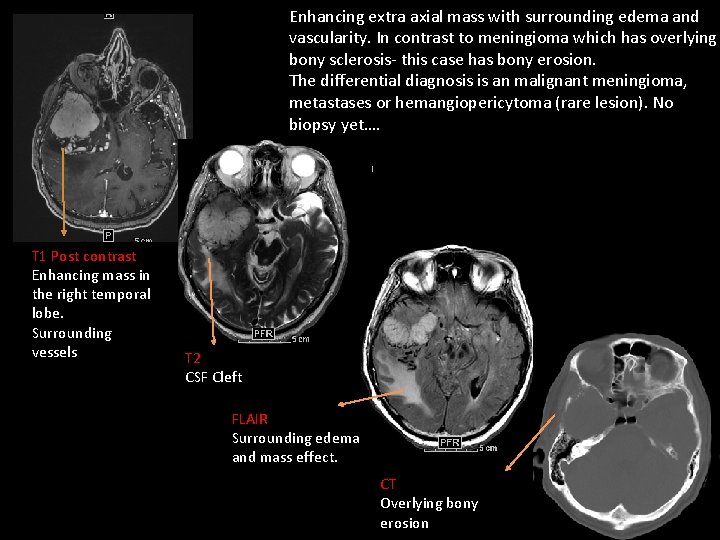
Enhancing extra axial mass with surrounding edema and vascularity. In contrast to meningioma which has overlying bony sclerosis- this case has bony erosion. The differential diagnosis is an malignant meningioma, metastases or hemangiopericytoma (rare lesion). No biopsy yet…. T 1 Post contrast Enhancing mass in the right temporal lobe. Surrounding vessels T 2 CSF Cleft FLAIR Surrounding edema and mass effect. CT Overlying bony erosion
Summary • MRI interpretation can be complicated • Taking a step by step approach by gathering information from each sequence will aid in the diagnosis • Location – Intra axial versus extra axial • Remember what each sequence tells you: • DWI- restricted diffusion • SWI etc. – hemorrhage • Flair – mass effect • Patterns of enhancement and edema will also add information.

END
- Slides: 52