
Interpreting Psycho Educational Reports An overview of the
- Slides: 29
Interpreting Psycho. Educational Reports An overview of the purposes and content of typical psycho-educational reports Dr John Worthington Educational Consultant and Psychologist © Text, format, graphics and data Copyright Dr John Worthington all rights reserved 2004 © www. jweducation. com
Aims of the Presentation n What is a psycho-educational report / assessment? n What elements should we first consider the report? (the who, when, where, what, why and how of the process). n What is the typical structure of a ‘good’ psycho-educational report? n To refresh our understanding of the strengths and limitations of intellectual assessment tools n To take an overview of the WISC-IV, its structure and its use in identifying and supporting individuals with learning disability n Presenting different results in a Developmental Learning Profile (DLP) © Text, format, graphics and data Copyright Dr John Worthington all rights reserved 2004 © www. jweducation. com
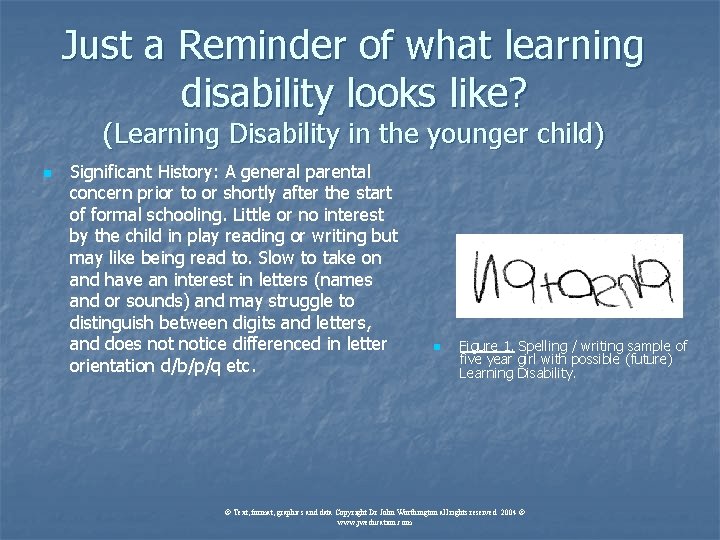
Just a Reminder of what learning disability looks like? (Learning Disability in the younger child) n Significant History: A general parental concern prior to or shortly after the start of formal schooling. Little or no interest by the child in play reading or writing but may like being read to. Slow to take on and have an interest in letters (names and or sounds) and may struggle to distinguish between digits and letters, and does notice differenced in letter orientation d/b/p/q etc. n Figure 1. Spelling / writing sample of five year girl with possible (future) Learning Disability. © Text, format, graphics and data Copyright Dr John Worthington all rights reserved 2004 © www. jweducation. com
What is a psycho-educational assessment? n n n Essentially psychological assessment involves testing the ‘mind’ usually ‘cognitive’ functioning, the ability of the mind to do certain things. Typically this means testing intelligence but assessment may also be focused on functions such as auditory or visual memory, short term memory and or working memory. The educational part usually refers to academic skills (e. g. reading comprehension, spelling, mathematics etc. ) but often also includes elements of language skills (e. g. receptive vocabulary), fine motor skills and visual perception. Many skills especially in younger children such as phonemic awareness, fine motor and visual perception skills, sit within both the educational and therapy models and sometimes in the psychological model. Clinical psychologist also do assessments involving higher level (executive) functioning, personality types, ‘assessments’ of psychological disorders (e. g. OCD, personality disorders, conduct disorders etc. ) © Text, format, graphics and data Copyright Dr John Worthington all rights reserved 2004 © www. jweducation. com
What elements should we look for in first considering the report? n n n While it might sound a little trite, psych-educational reports should be in writing. My experience and reading makes it very clear oral reports by parents and others, of psycho-educational assessments are not reliable. This is because even in ideal circumstances parents are under stress when listening to results, they can be selective about what they ‘choose’ to remember and they are likely to forget and or confuse detail. Check the report is actually about the child your are interested in (check at least the full name and date of birth). How old in the information? check when the assessment was done (DOA) and the date the report was written and signed as sometimes there is a long gap. The written report should be complete (numbered pages with no missing pages or missing attached sheets), signed by the responsible professional with their ‘title’ / position clearly indicated. © Text, format, graphics and data Copyright Dr John Worthington all rights reserved 2004 © www. jweducation. com
What elements should we look for in first considering the report? (continued) n n Make sure you have received the report in an ‘ethical’ way and that you have an appropriate professional reason for reading it. Check why the report written and the reasons leading to the assessment / referral. Look at the reasons for the assessment and look for the process that was followed. This may parallel your need for understanding the child or be completely different. Remember psychological assessment is as much an art as a science the precautionary notes and confidence intervals need to be considered. Remember you don’t have an exact IQ you have a score representing performance within a confidence range. © Text, format, graphics and data Copyright Dr John Worthington all rights reserved 2004 © www. jweducation. com
What is the typical structure of a ‘good’ psycho-educational report? n n Essentially a ‘good’ psycho-educational report should present as a structured story. The report should initially identify the person who wrote the report and the person about whom the report was written (full name and DOB). There should be additional sufficient information to allow the reader to know the physical and professional source and how that place and organization can be contacted. After the identification there should be an introduction outlining the reasons the report was written and its purpose. There there should be a concise description of the process (of assessment), the results and the conclusions. © Text, format, graphics and data Copyright Dr John Worthington all rights reserved 2004 © www. jweducation. com
Interpreting Psycho-Educational Reports the Detail n n n Essentially psycho-educational reports summarize the results of assessments typically standardized assessments. They should have an introduction (often with a history) and details of any special features or issues influencing the assessment and or the results. There may also be detailed of different types of ‘observations’ of behaviour and functioning. Psycho-educational reports may link the psychological results (QI = potential to learn academically) to academic results. Some reports may also go on to identify which specific elements of the IQ testing (usually at the subtest level) that are implicated in learning issues or learning styles. © Text, format, graphics and data Copyright Dr John Worthington all rights reserved 2004 © www. jweducation. com
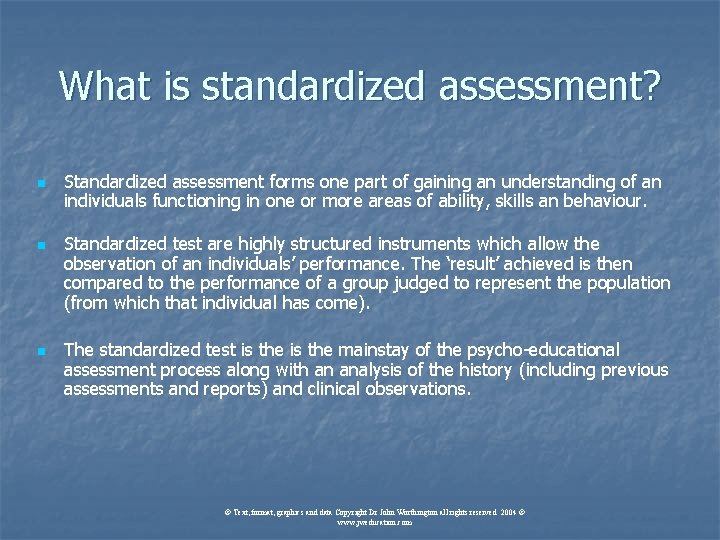
What is standardized assessment? n n n Standardized assessment forms one part of gaining an understanding of an individuals functioning in one or more areas of ability, skills an behaviour. Standardized test are highly structured instruments which allow the observation of an individuals’ performance. The ‘result’ achieved is then compared to the performance of a group judged to represent the population (from which that individual has come). The standardized test is the mainstay of the psycho-educational assessment process along with an analysis of the history (including previous assessments and reports) and clinical observations. © Text, format, graphics and data Copyright Dr John Worthington all rights reserved 2004 © www. jweducation. com
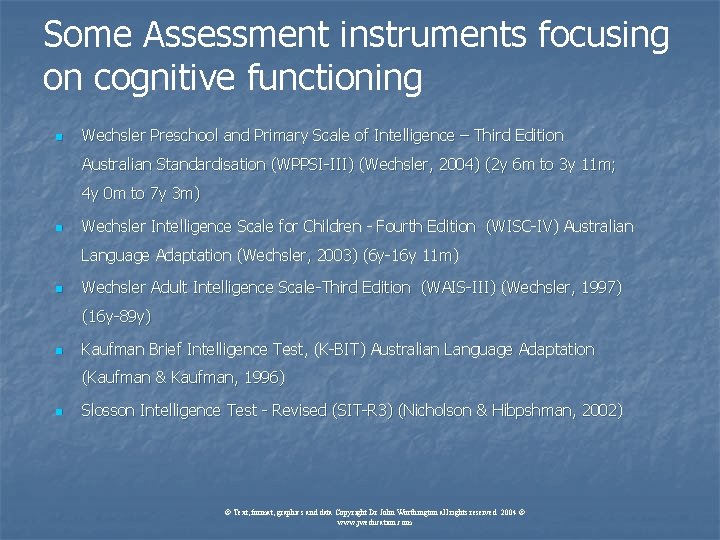
Some Assessment instruments focusing on cognitive functioning n Wechsler Preschool and Primary Scale of Intelligence – Third Edition Australian Standardisation (WPPSI-III) (Wechsler, 2004) (2 y 6 m to 3 y 11 m; 4 y 0 m to 7 y 3 m) n Wechsler Intelligence Scale for Children - Fourth Edition (WISC-IV) Australian Language Adaptation (Wechsler, 2003) (6 y-16 y 11 m) n Wechsler Adult Intelligence Scale-Third Edition (WAIS-III) (Wechsler, 1997) (16 y-89 y) n Kaufman Brief Intelligence Test, (K-BIT) Australian Language Adaptation (Kaufman & Kaufman, 1996) n Slosson Intelligence Test - Revised (SIT-R 3) (Nicholson & Hibpshman, 2002) © Text, format, graphics and data Copyright Dr John Worthington all rights reserved 2004 © www. jweducation. com
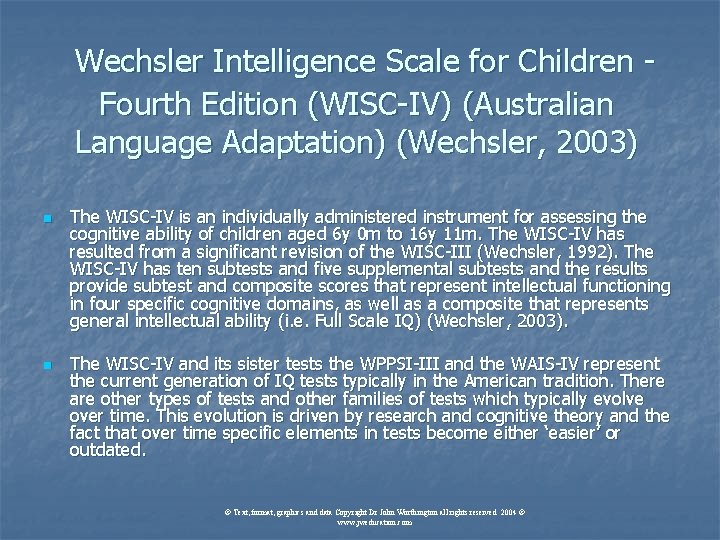
Wechsler Intelligence Scale for Children Fourth Edition (WISC-IV) (Australian Language Adaptation) (Wechsler, 2003) n n The WISC-IV is an individually administered instrument for assessing the cognitive ability of children aged 6 y 0 m to 16 y 11 m. The WISC-IV has resulted from a significant revision of the WISC-III (Wechsler, 1992). The WISC-IV has ten subtests and five supplemental subtests and the results provide subtest and composite scores that represent intellectual functioning in four specific cognitive domains, as well as a composite that represents general intellectual ability (i. e. Full Scale IQ) (Wechsler, 2003). The WISC-IV and its sister tests the WPPSI-III and the WAIS-IV represent the current generation of IQ tests typically in the American tradition. There are other types of tests and other families of tests which typically evolve over time. This evolution is driven by research and cognitive theory and the fact that over time specific elements in tests become either ‘easier’ or outdated. © Text, format, graphics and data Copyright Dr John Worthington all rights reserved 2004 © www. jweducation. com
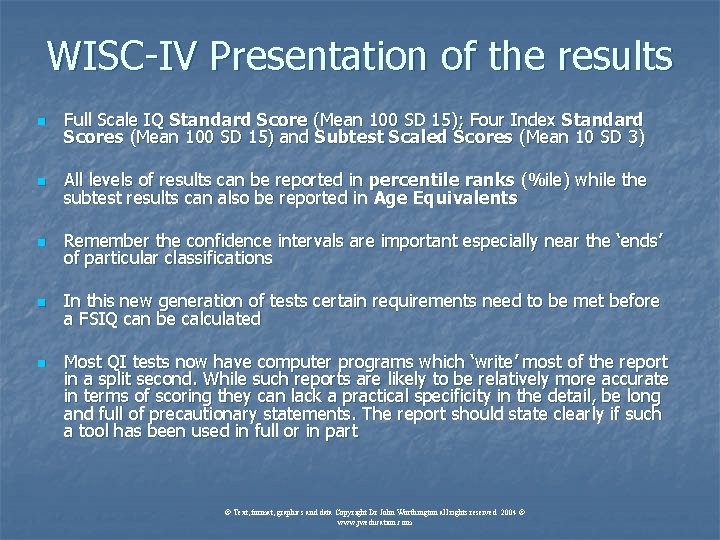
WISC-IV Presentation of the results n Full Scale IQ Standard Score (Mean 100 SD 15); Four Index Standard Scores (Mean 100 SD 15) and Subtest Scaled Scores (Mean 10 SD 3) n All levels of results can be reported in percentile ranks (%ile) while the subtest results can also be reported in Age Equivalents n Remember the confidence intervals are important especially near the ‘ends’ of particular classifications n In this new generation of tests certain requirements need to be met before a FSIQ can be calculated n Most QI tests now have computer programs which ‘write’ most of the report in a split second. While such reports are likely to be relatively more accurate in terms of scoring they can lack a practical specificity in the detail, be long and full of precautionary statements. The report should state clearly if such a tool has been used in full or in part © Text, format, graphics and data Copyright Dr John Worthington all rights reserved 2004 © www. jweducation. com
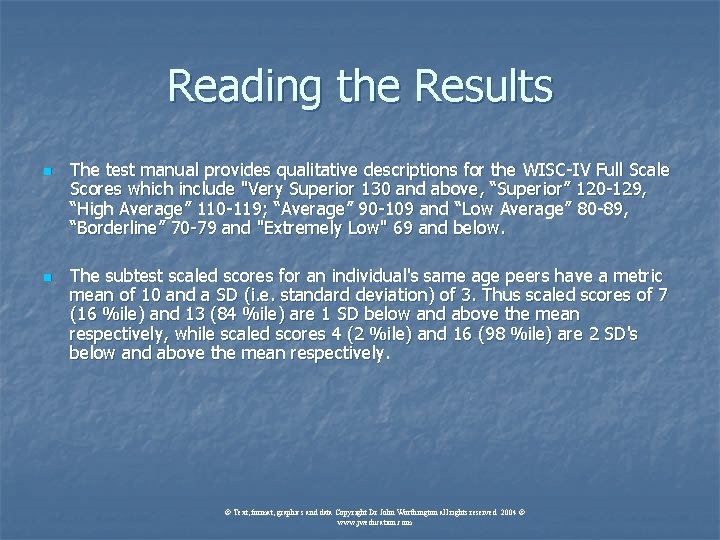
Reading the Results n n The test manual provides qualitative descriptions for the WISC-IV Full Scale Scores which include "Very Superior 130 and above, “Superior” 120 -129, “High Average” 110 -119; “Average” 90 -109 and “Low Average” 80 -89, “Borderline” 70 -79 and "Extremely Low" 69 and below. The subtest scaled scores for an individual's same age peers have a metric mean of 10 and a SD (i. e. standard deviation) of 3. Thus scaled scores of 7 (16 %ile) and 13 (84 %ile) are 1 SD below and above the mean respectively, while scaled scores 4 (2 %ile) and 16 (98 %ile) are 2 SD's below and above the mean respectively. © Text, format, graphics and data Copyright Dr John Worthington all rights reserved 2004 © www. jweducation. com
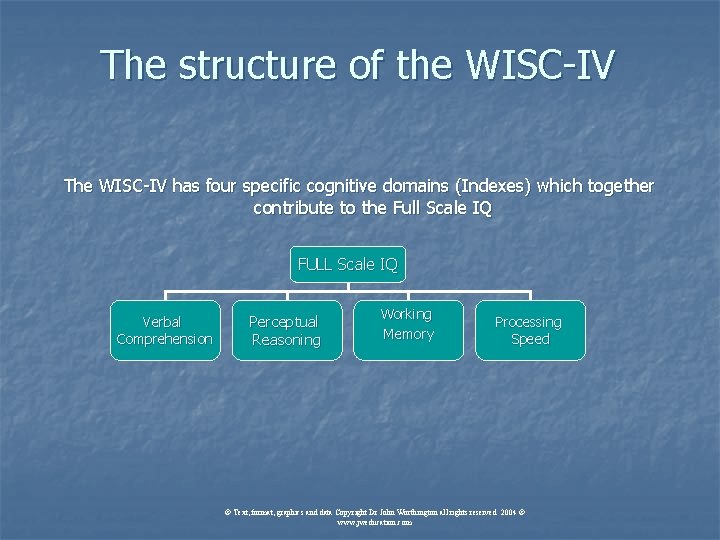
The structure of the WISC-IV The WISC-IV has four specific cognitive domains (Indexes) which together contribute to the Full Scale IQ FULL Scale IQ Verbal Comprehension Perceptual Reasoning Working Memory Processing Speed © Text, format, graphics and data Copyright Dr John Worthington all rights reserved 2004 © www. jweducation. com
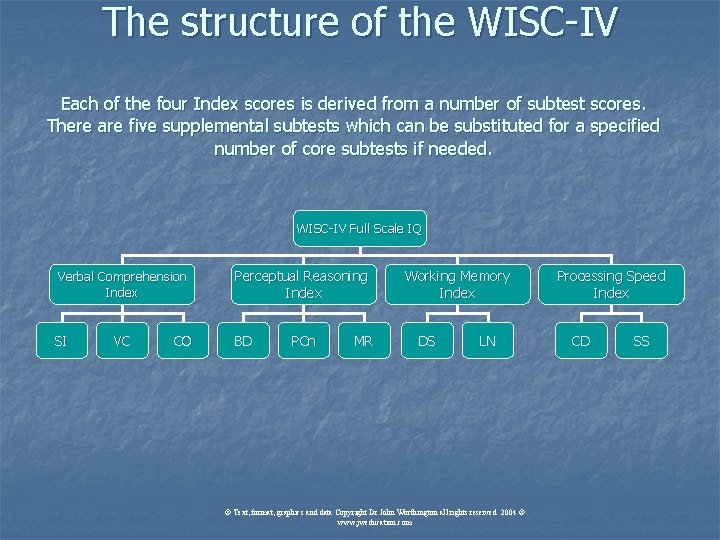
The structure of the WISC-IV Each of the four Index scores is derived from a number of subtest scores. There are five supplemental subtests which can be substituted for a specified number of core subtests if needed. WISC-IV Full Scale IQ Verbal Comprehension Index Perceptual Reasoning Index SI BD VC CO PCn MR Working Memory Index DS LN © Text, format, graphics and data Copyright Dr John Worthington all rights reserved 2004 © www. jweducation. com Processing Speed Index CD SS
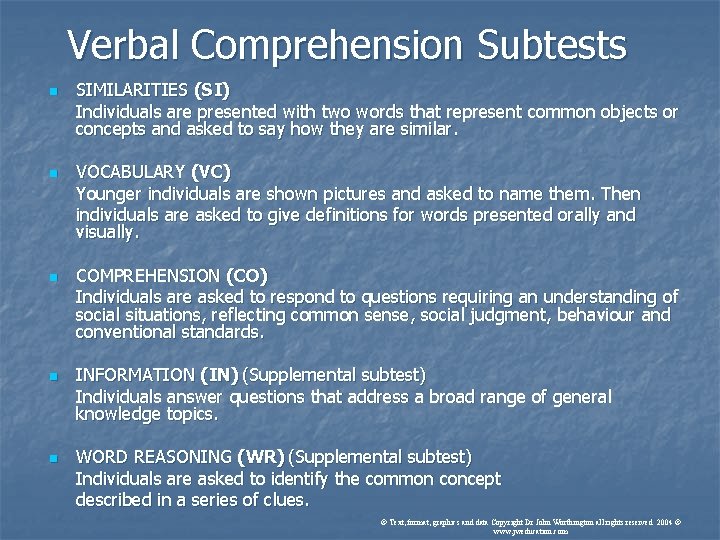
Verbal Comprehension Subtests n n n SIMILARITIES (SI) Individuals are presented with two words that represent common objects or concepts and asked to say how they are similar. VOCABULARY (VC) Younger individuals are shown pictures and asked to name them. Then individuals are asked to give definitions for words presented orally and visually. COMPREHENSION (CO) Individuals are asked to respond to questions requiring an understanding of social situations, reflecting common sense, social judgment, behaviour and conventional standards. INFORMATION (IN) (Supplemental subtest) Individuals answer questions that address a broad range of general knowledge topics. WORD REASONING (WR) (Supplemental subtest) Individuals are asked to identify the common concept described in a series of clues. © Text, format, graphics and data Copyright Dr John Worthington all rights reserved 2004 © www. jweducation. com
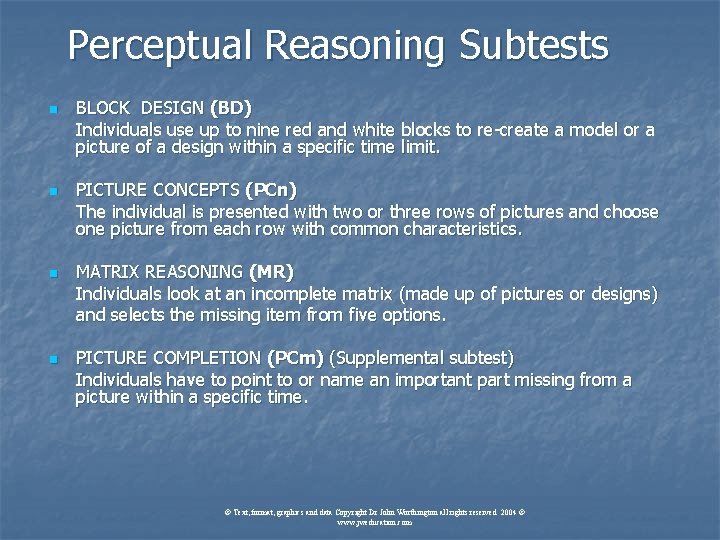
Perceptual Reasoning Subtests n n BLOCK DESIGN (BD) Individuals use up to nine red and white blocks to re-create a model or a picture of a design within a specific time limit. PICTURE CONCEPTS (PCn) The individual is presented with two or three rows of pictures and choose one picture from each row with common characteristics. MATRIX REASONING (MR) Individuals look at an incomplete matrix (made up of pictures or designs) and selects the missing item from five options. PICTURE COMPLETION (PCm) (Supplemental subtest) Individuals have to point to or name an important part missing from a picture within a specific time. © Text, format, graphics and data Copyright Dr John Worthington all rights reserved 2004 © www. jweducation. com
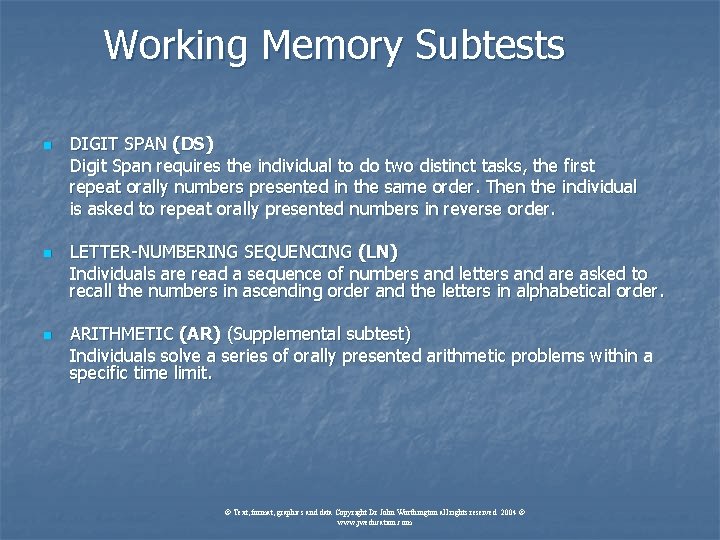
Working Memory Subtests n n n DIGIT SPAN (DS) Digit Span requires the individual to do two distinct tasks, the first repeat orally numbers presented in the same order. Then the individual is asked to repeat orally presented numbers in reverse order. LETTER-NUMBERING SEQUENCING (LN) Individuals are read a sequence of numbers and letters and are asked to recall the numbers in ascending order and the letters in alphabetical order. ARITHMETIC (AR) (Supplemental subtest) Individuals solve a series of orally presented arithmetic problems within a specific time limit. © Text, format, graphics and data Copyright Dr John Worthington all rights reserved 2004 © www. jweducation. com
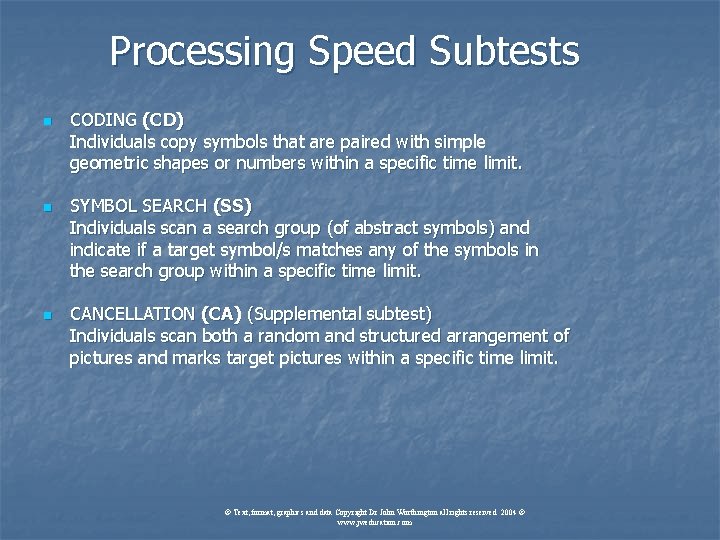
Processing Speed Subtests n n n CODING (CD) Individuals copy symbols that are paired with simple geometric shapes or numbers within a specific time limit. SYMBOL SEARCH (SS) Individuals scan a search group (of abstract symbols) and indicate if a target symbol/s matches any of the symbols in the search group within a specific time limit. CANCELLATION (CA) (Supplemental subtest) Individuals scan both a random and structured arrangement of pictures and marks target pictures within a specific time limit. © Text, format, graphics and data Copyright Dr John Worthington all rights reserved 2004 © www. jweducation. com
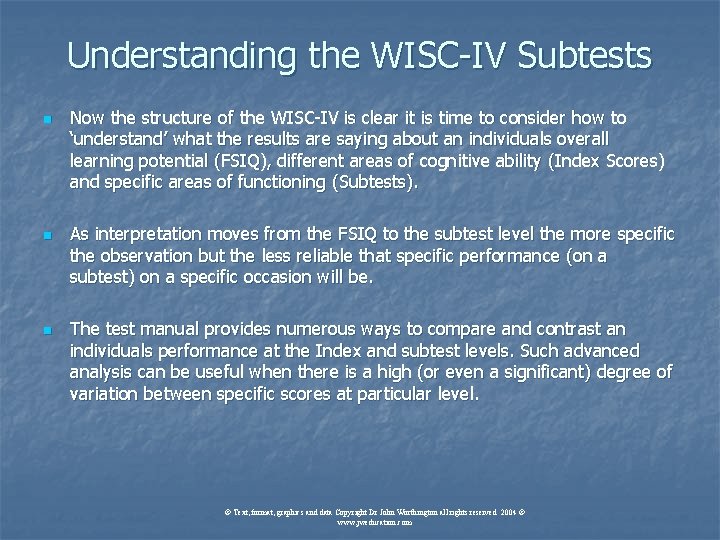
Understanding the WISC-IV Subtests n n n Now the structure of the WISC-IV is clear it is time to consider how to ‘understand’ what the results are saying about an individuals overall learning potential (FSIQ), different areas of cognitive ability (Index Scores) and specific areas of functioning (Subtests). As interpretation moves from the FSIQ to the subtest level the more specific the observation but the less reliable that specific performance (on a subtest) on a specific occasion will be. The test manual provides numerous ways to compare and contrast an individuals performance at the Index and subtest levels. Such advanced analysis can be useful when there is a high (or even a significant) degree of variation between specific scores at particular level. © Text, format, graphics and data Copyright Dr John Worthington all rights reserved 2004 © www. jweducation. com
WISC-IV Subtests (The fine detail) n n n Children with learning delays will usually have an unusual (read variable) subtest profile, the overall result (FSIQ) will be the first clue, the Index scores the next and the subtest results the final evidence. From my experience the Working Memory Index and the Processing Speed Index scores are often implicated in learning difficulties (dyslexic) profiles. Within Working Memory the differences between digits forwards, digits reversed and letter numbering sequencing needs close examination. The Processing Speed can identify children who are referred for ‘not being able to get their ideas down’. Remember that while instruments like the WISC-IV can be a source of valuable information about an individuals cognition and to a lesser extent learning style, IQ tests are not designed to identify dyslexia or diagnose general or specific learning difficulties. They are tests of cognitive functioning and any link between any part of a WISC-IV ‘result’ and a learning issue needs careful consideration. © Text, format, graphics and data Copyright Dr John Worthington all rights reserved 2004 © www. jweducation. com
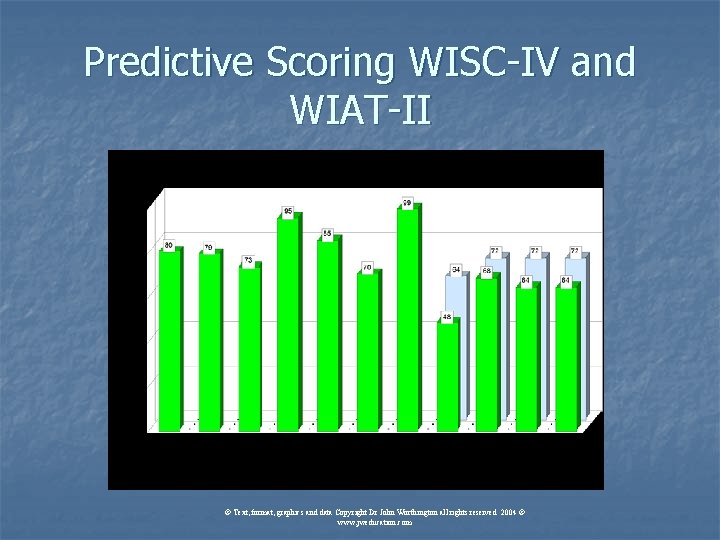
WISC-IV / WPPSI-III /WAIS-III and the WIAT-II n n There are tests of academic skills which can provide a direct relationship between measured intelligence (QI) (seen as a good measure of the potential to learn academic skills) and academic attainments (academic skills). Comparisons between ‘predicted’ learning levels and measured learning levels now provides an additional tool to measure and understand delays in specific learning and to track learning over time and relative to measured ability. © Text, format, graphics and data Copyright Dr John Worthington all rights reserved 2004 © www. jweducation. com
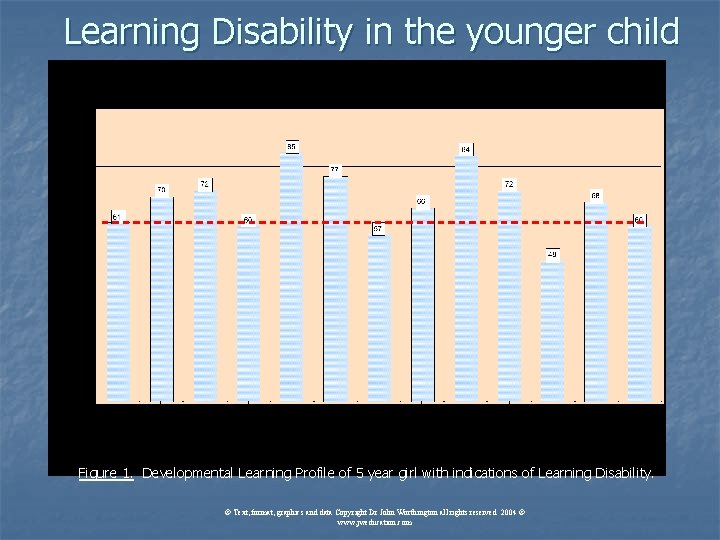
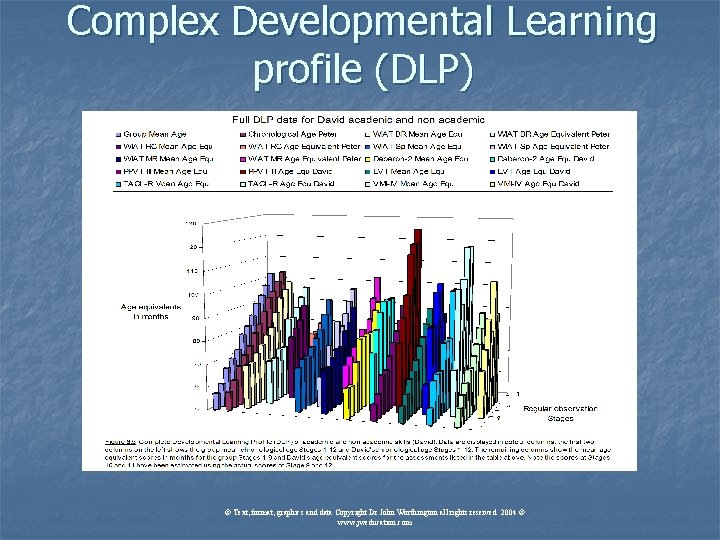
Profiling Results The Developmental Learning Profile (DLP) n n n In describing and ‘reading’ the patterns of results from different types of assessments it is possible in an approximate way to present an overall picture by plotting scores which are on the same scale. In my practice by way of summarizing results I use age equivalent scores and present them with ‘predicted scores’. These DLP’s can be used to help diagnose different types of learning delays (or acceleration) and over time combined as one way of tracking a child’s learning development.
Learning Disability in the younger child Figure 1. Developmental Learning Profile of 5 year girl with indications of Learning Disability. © Text, format, graphics and data Copyright Dr John Worthington all rights reserved 2004 © www. jweducation. com
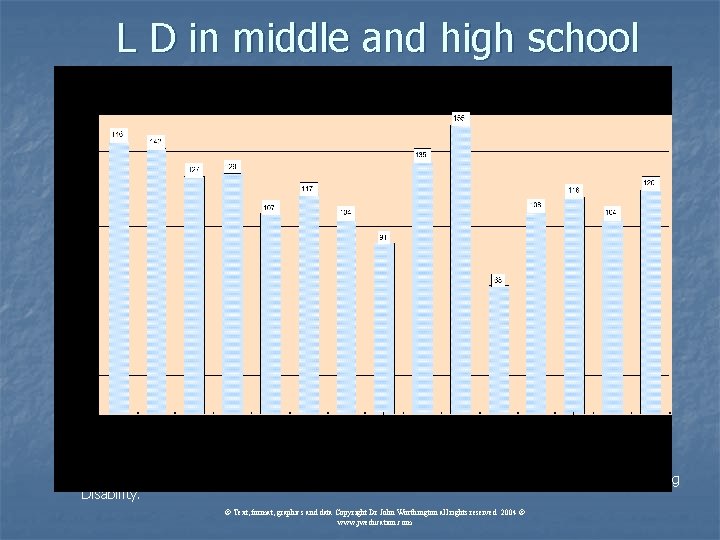
L D in middle and high school Figure 2. Developmental Learning Profile of 12 year 2 months old boy with evidence of Learning Disability. © Text, format, graphics and data Copyright Dr John Worthington all rights reserved 2004 © www. jweducation. com
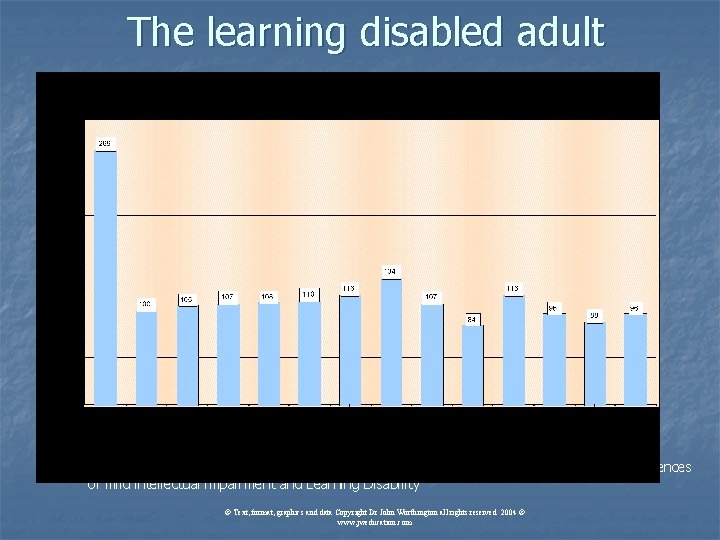
The learning disabled adult Figure 3. Developmental Learning Profile of woman aged 22 year 5 month showing consequences of mild intellectual impairment and Learning Disability © Text, format, graphics and data Copyright Dr John Worthington all rights reserved 2004 © www. jweducation. com
Predictive Scoring WISC-IV and WIAT-II © Text, format, graphics and data Copyright Dr John Worthington all rights reserved 2004 © www. jweducation. com
Complex Developmental Learning profile (DLP) © Text, format, graphics and data Copyright Dr John Worthington all rights reserved 2004 © www. jweducation. com
Conclusions n We have looked at what makes up a psycho-educational report / assessment? n We have seen there needs to be consideration of the who, when, where, what, why and how of the report and the overall process. n We have looked at the structure of a ‘good’ psycho-educational report. n We have refreshed our understanding of the strengths and limitations of intellectual assessment tools n We have taken an overview of the WISC-IV, its structure and its use in identifying and supporting individuals with learning disability n We have looked at one way for presenting different results in a Developmental Learning Profile (DLP)