
INTERPRETING CULTURE AND SENSITIVITY DATA WHAT THE DOES
- Slides: 23
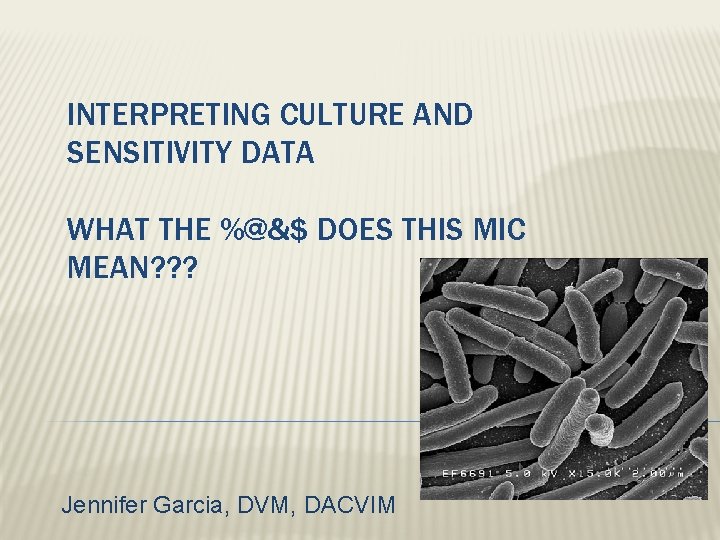
INTERPRETING CULTURE AND SENSITIVITY DATA WHAT THE %@&$ DOES THIS MIC MEAN? ? ? Jennifer Garcia, DVM, DACVIM
WHY SHOULD WE CULTURE? � Is there a bacterial infection there to begin with? � What bacteria is it and what should I use to treat it? � Have I successfully treated the infection? � To recognize and address antimicrobial resistance
CLINICAL AND LABORATORY STANDARDS INSTITUTE (CLSI) � Provides � Quality standardized guidelines for lab quality control procedures, culture methods � Publishes guidelines for the methods of susceptibility testing and the interpretive criteria for each drug � Drug manufacturers must submit the appropriate data to CLSI for determination of interpretive data, so not all drugs will have MIC info. If the drug company has not pursued validation, then the drug will not be available for microbiological testing.
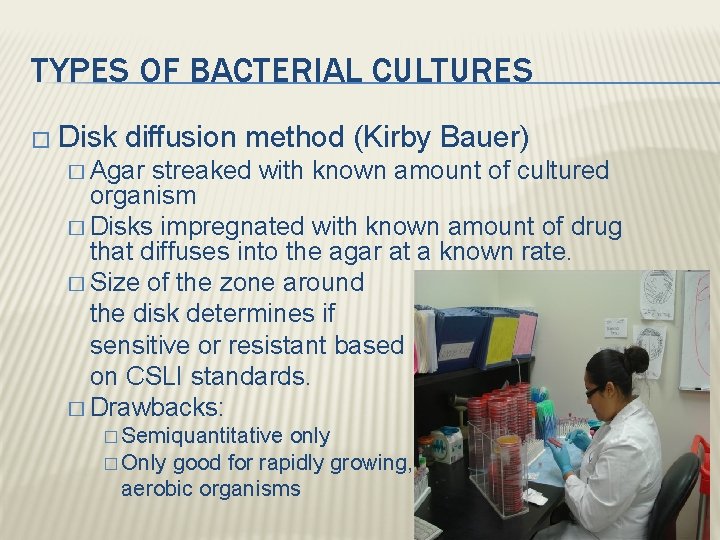
TYPES OF BACTERIAL CULTURES � Disk diffusion method (Kirby Bauer) � Agar streaked with known amount of cultured organism � Disks impregnated with known amount of drug that diffuses into the agar at a known rate. � Size of the zone around the disk determines if sensitive or resistant based on CSLI standards. � Drawbacks: � Semiquantitative only � Only good for rapidly growing, aerobic organisms
TYPES OF BACTERIAL CULTURES � Tube dilution method � Provides quantitative data regarding the amount of drug needed to inhibit bacterial growth � Tubes of liquid media with increasing concentration of drug are inoculated with a known amount of infecting organism � Tubes are observed for growth over a standard period of time (24 -48 hours) � Tube with the lowest concentration of drug at which there is no visible bacterial growth = minimum inhibitory concentration (MIC)
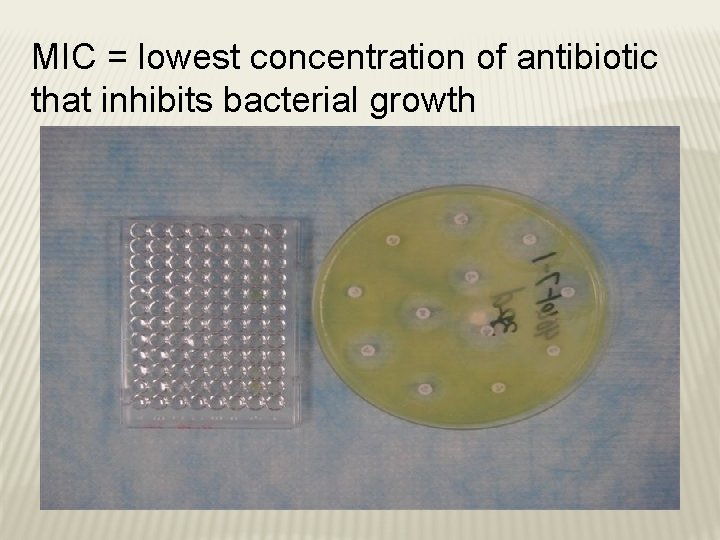
MIC = lowest concentration of antibiotic that inhibits bacterial growth
MIC � In order to be effective, the drug you choose needs to reach this Minimum Inhibitory Concentration at the site of the infection. � Pharmacokinetics of the drug � Toxicity � Host factors � “breakpoint MIC” – takes into account the clinical pharmacology of the drug as well as the susceptibility of the organism = approximation of drug concentration that can be safely achieved using std dose and route.
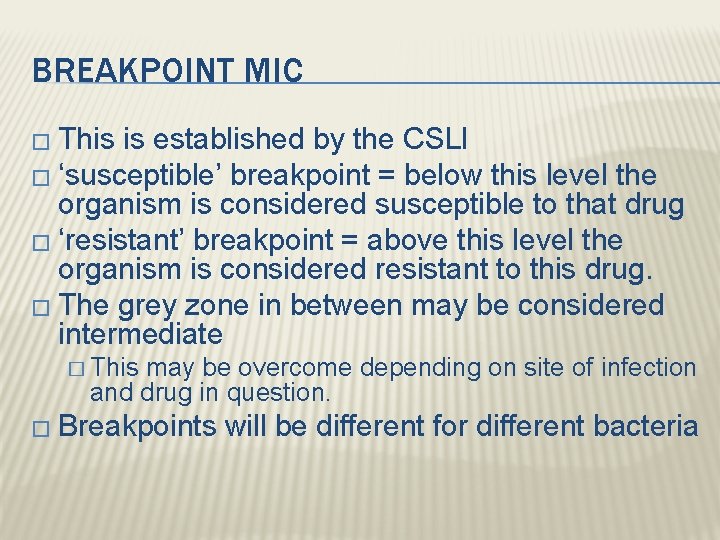
BREAKPOINT MIC � This is established by the CSLI � ‘susceptible’ breakpoint = below this level the organism is considered susceptible to that drug � ‘resistant’ breakpoint = above this level the organism is considered resistant to this drug. � The grey zone in between may be considered intermediate � This may be overcome depending on site of infection and drug in question. � Breakpoints will be different for different bacteria
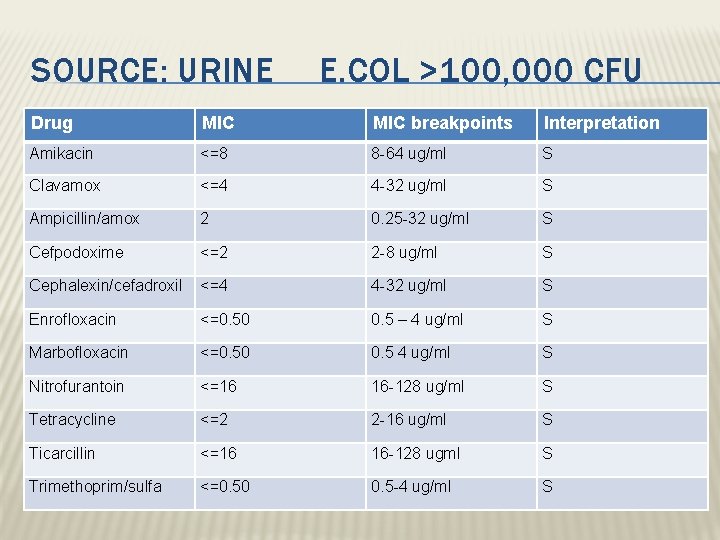
SOURCE: URINE E. COL >100, 000 CFU Drug MIC breakpoints Interpretation Amikacin <=8 8 -64 ug/ml S Clavamox <=4 4 -32 ug/ml S Ampicillin/amox 2 0. 25 -32 ug/ml S Cefpodoxime <=2 2 -8 ug/ml S Cephalexin/cefadroxil <=4 4 -32 ug/ml S Enrofloxacin <=0. 50 0. 5 – 4 ug/ml S Marbofloxacin <=0. 50 0. 5 4 ug/ml S Nitrofurantoin <=16 16 -128 ug/ml S Tetracycline <=2 2 -16 ug/ml S Ticarcillin <=16 16 -128 ugml S Trimethoprim/sulfa <=0. 50 0. 5 -4 ug/ml S
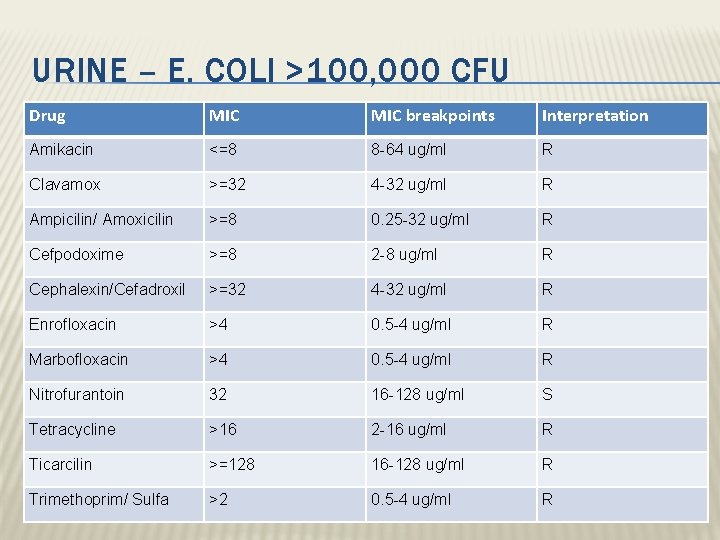
URINE – E. COLI >100, 000 CFU Drug MIC breakpoints Interpretation Amikacin <=8 8 -64 ug/ml R Clavamox >=32 4 -32 ug/ml R Ampicilin/ Amoxicilin >=8 0. 25 -32 ug/ml R Cefpodoxime >=8 2 -8 ug/ml R Cephalexin/Cefadroxil >=32 4 -32 ug/ml R Enrofloxacin >4 0. 5 -4 ug/ml R Marbofloxacin >4 0. 5 -4 ug/ml R Nitrofurantoin 32 16 -128 ug/ml S Tetracycline >16 2 -16 ug/ml R Ticarcilin >=128 16 -128 ug/ml R Trimethoprim/ Sulfa >2 0. 5 -4 ug/ml R
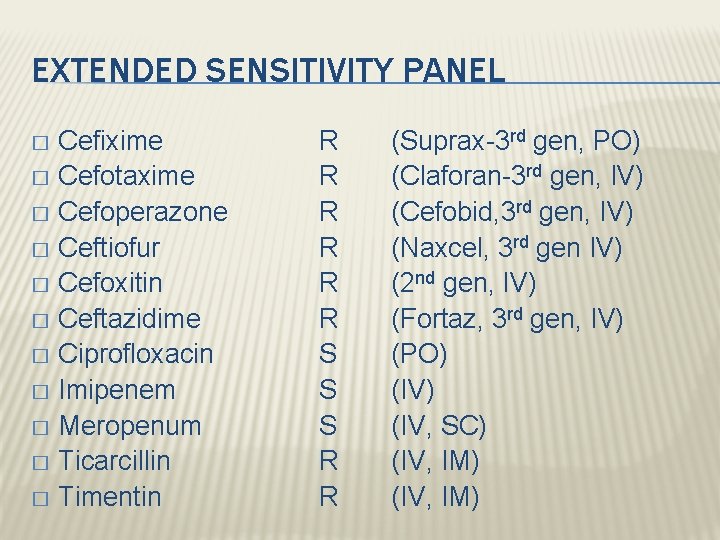
EXTENDED SENSITIVITY PANEL Cefixime � Cefotaxime � Cefoperazone � Ceftiofur � Cefoxitin � Ceftazidime � Ciprofloxacin � Imipenem � Meropenum � Ticarcillin � Timentin � R R R S S S R R (Suprax-3 rd gen, PO) (Claforan-3 rd gen, IV) (Cefobid, 3 rd gen, IV) (Naxcel, 3 rd gen IV) (2 nd gen, IV) (Fortaz, 3 rd gen, IV) (PO) (IV, SC) (IV, IM)
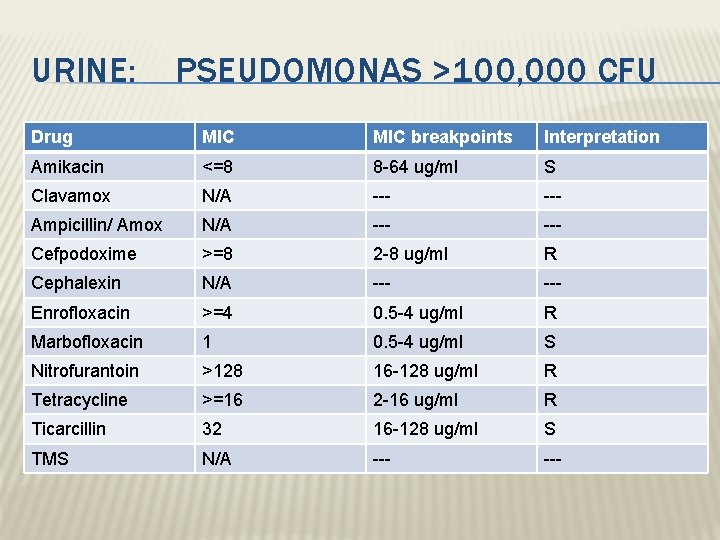
URINE: PSEUDOMONAS >100, 000 CFU Drug MIC breakpoints Interpretation Amikacin <=8 8 -64 ug/ml S Clavamox N/A --- Ampicillin/ Amox N/A --- Cefpodoxime >=8 2 -8 ug/ml R Cephalexin N/A --- Enrofloxacin >=4 0. 5 -4 ug/ml R Marbofloxacin 1 0. 5 -4 ug/ml S Nitrofurantoin >128 16 -128 ug/ml R Tetracycline >=16 2 -16 ug/ml R Ticarcillin 32 16 -128 ug/ml S TMS N/A ---
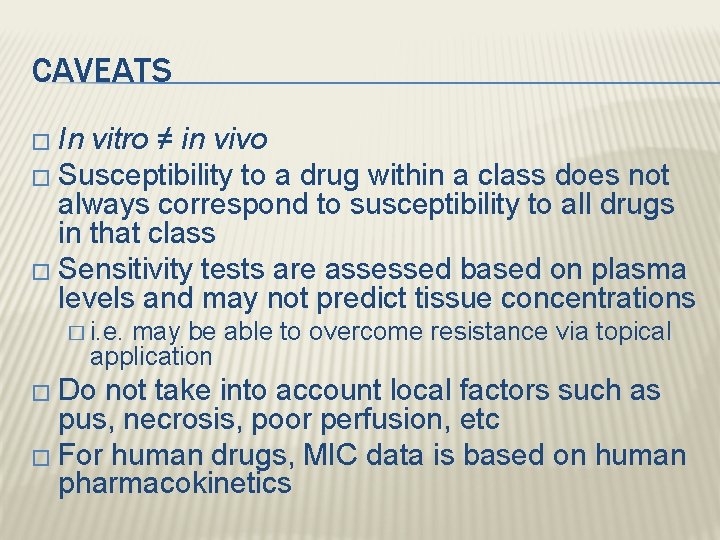
CAVEATS � In vitro ≠ in vivo � Susceptibility to a drug within a class does not always correspond to susceptibility to all drugs in that class � Sensitivity tests are assessed based on plasma levels and may not predict tissue concentrations � i. e. may be able to overcome resistance via topical application � Do not take into account local factors such as pus, necrosis, poor perfusion, etc � For human drugs, MIC data is based on human pharmacokinetics
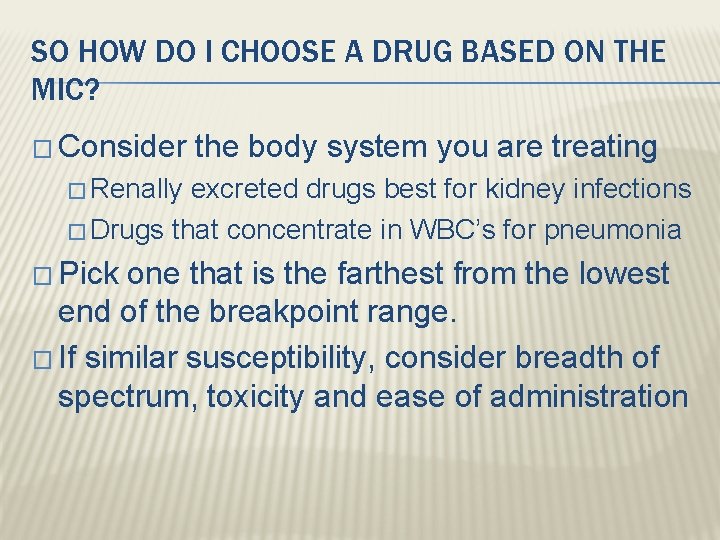
SO HOW DO I CHOOSE A DRUG BASED ON THE MIC? � Consider the body system you are treating � Renally excreted drugs best for kidney infections � Drugs that concentrate in WBC’s for pneumonia � Pick one that is the farthest from the lowest end of the breakpoint range. � If similar susceptibility, consider breadth of spectrum, toxicity and ease of administration
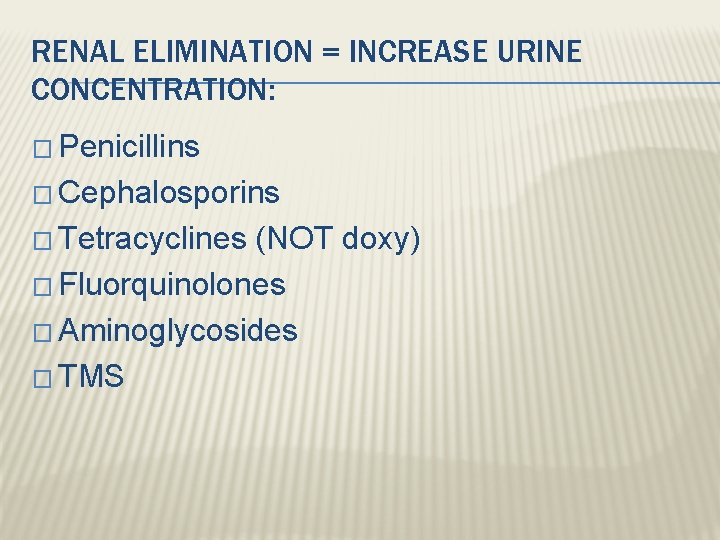
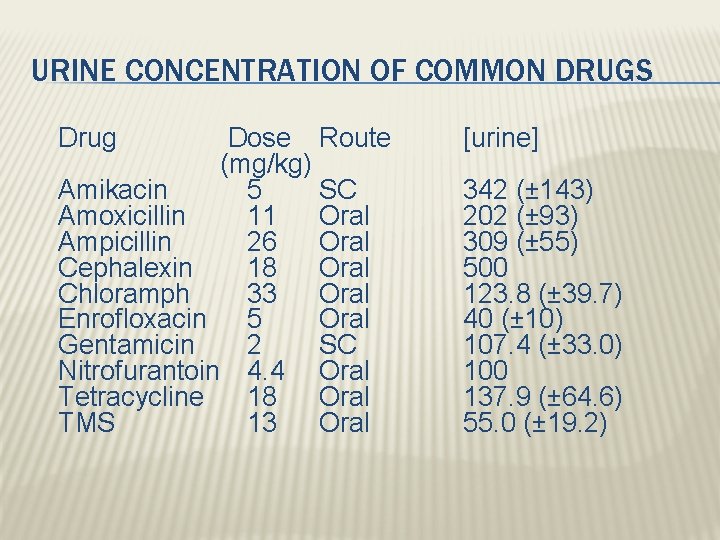
RENAL ELIMINATION = INCREASE URINE CONCENTRATION: � Penicillins � Cephalosporins � Tetracyclines (NOT doxy) � Fluorquinolones � Aminoglycosides � TMS
URINE CONCENTRATION OF COMMON DRUGS Drug Dose Route (mg/kg) Amikacin 5 SC Amoxicillin 11 Oral Ampicillin 26 Oral Cephalexin 18 Oral Chloramph 33 Oral Enrofloxacin 5 Oral Gentamicin 2 SC Nitrofurantoin 4. 4 Oral Tetracycline 18 Oral TMS 13 Oral [urine] 342 (± 143) 202 (± 93) 309 (± 55) 500 123. 8 (± 39. 7) 40 (± 10) 107. 4 (± 33. 0) 100 137. 9 (± 64. 6) 55. 0 (± 19. 2)
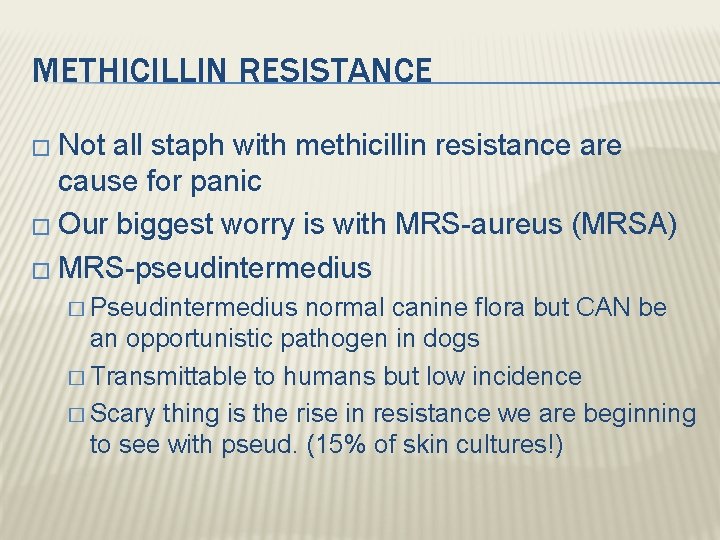
METHICILLIN RESISTANCE � Not all staph with methicillin resistance are cause for panic � Our biggest worry is with MRS-aureus (MRSA) � MRS-pseudintermedius � Pseudintermedius normal canine flora but CAN be an opportunistic pathogen in dogs � Transmittable to humans but low incidence � Scary thing is the rise in resistance we are beginning to see with pseud. (15% of skin cultures!)
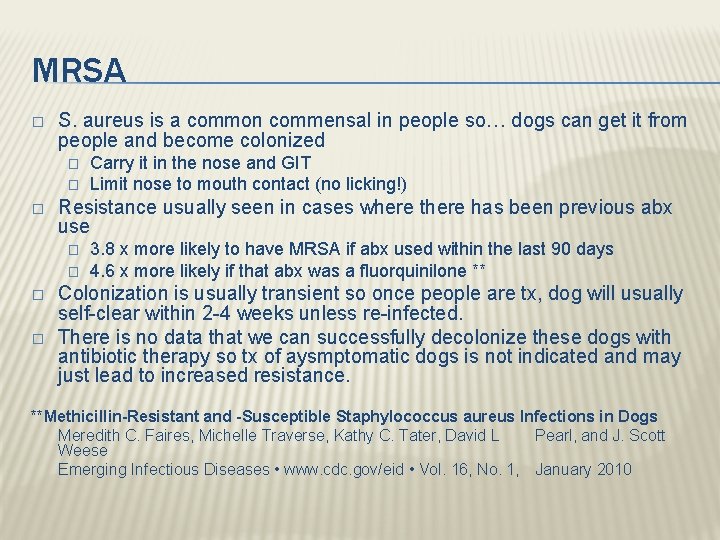
MRSA � S. aureus is a common commensal in people so… dogs can get it from people and become colonized � � � Resistance usually seen in cases where there has been previous abx use � � Carry it in the nose and GIT Limit nose to mouth contact (no licking!) 3. 8 x more likely to have MRSA if abx used within the last 90 days 4. 6 x more likely if that abx was a fluorquinilone ** Colonization is usually transient so once people are tx, dog will usually self-clear within 2 -4 weeks unless re-infected. There is no data that we can successfully decolonize these dogs with antibiotic therapy so tx of aysmptomatic dogs is not indicated and may just lead to increased resistance. **Methicillin-Resistant and -Susceptible Staphylococcus aureus Infections in Dogs Meredith C. Faires, Michelle Traverse, Kathy C. Tater, David L Pearl, and J. Scott Weese Emerging Infectious Diseases • www. cdc. gov/eid • Vol. 16, No. 1, January 2010
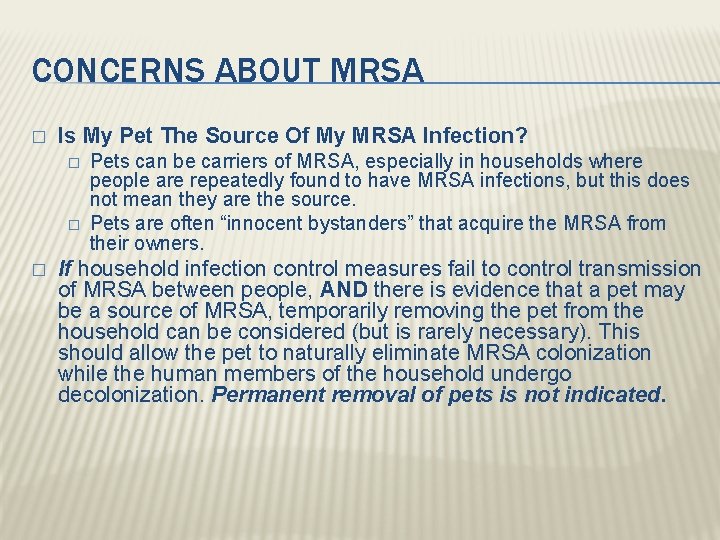
CONCERNS ABOUT MRSA � Is My Pet The Source Of My MRSA Infection? � � � Pets can be carriers of MRSA, especially in households where people are repeatedly found to have MRSA infections, but this does not mean they are the source. Pets are often “innocent bystanders” that acquire the MRSA from their owners. If household infection control measures fail to control transmission of MRSA between people, AND there is evidence that a pet may be a source of MRSA, temporarily removing the pet from the household can be considered (but is rarely necessary). This should allow the pet to naturally eliminate MRSA colonization while the human members of the household undergo decolonization. Permanent removal of pets is not indicated.
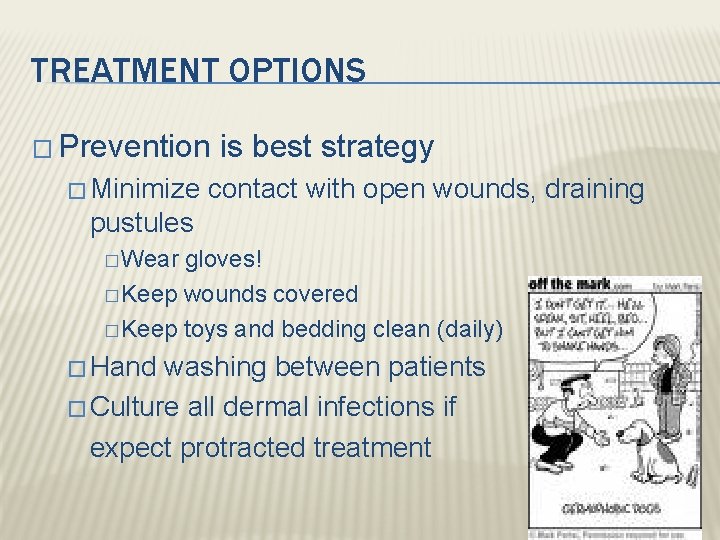
TREATMENT OPTIONS � Prevention � Minimize is best strategy contact with open wounds, draining pustules � Wear gloves! � Keep wounds covered � Keep toys and bedding clean (daily) � Hand washing between patients � Culture all dermal infections if expect protracted treatment
TREATMENT OPTIONS � Antibiotics � Chloramphenicol and amikacin are the only drugs that have retained sensitivity � Maybe TMS and doxy � No good options on the horizon � Good news is that systemic infections in dog with MRSA are rare
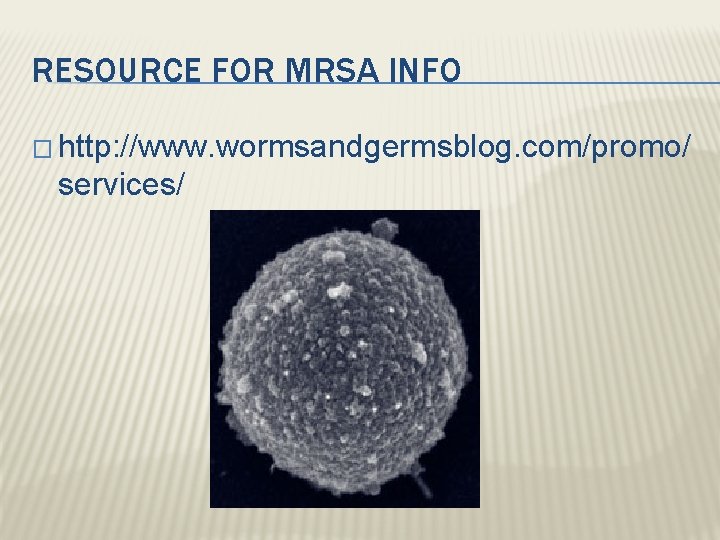
RESOURCE FOR MRSA INFO � http: //www. wormsandgermsblog. com/promo/ services/