
Interpretation Training for Volunteers Interns and new staff
- Slides: 29
Interpretation Training for Volunteers & Interns (and new staff) The IRC in New York 1 From Harm to Home | Rescue. org
For staff/volunteers 1. What is the role of an interpreter? 2. Role of staff in working with interpreters 3. Pre/post session and engaging the client 4. Mental health interpreting 5. Arranging interpretation For people who will interpret: 1. Interpretation tips 2. Ethics of Interpretation 3. Scenarios 2 From Harm to Home | Rescue. org
What is the difference between interpretation and translation? 3 From Harm to Home | Rescue. org
Interpretation vs. Translation v Interpretation: A service that facilitates spoken communication between two parties who speak different languages. v Translation: When a written document in one language is converted into a different language. 4 From Harm to Home | Rescue. org
What is the role of an interpreter? 5 From Harm to Home | Rescue. org
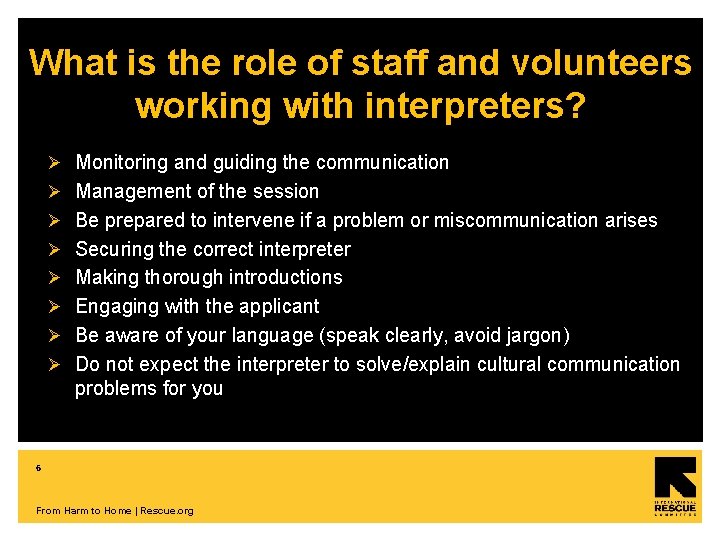
What is the role of staff and volunteers working with interpreters? Ø Monitoring and guiding the communication Ø Management of the session Ø Be prepared to intervene if a problem or miscommunication arises Ø Securing the correct interpreter Ø Making thorough introductions Ø Engaging with the applicant Ø Be aware of your language (speak clearly, avoid jargon) Ø Do not expect the interpreter to solve/explain cultural communication problems for you 6 From Harm to Home | Rescue. org
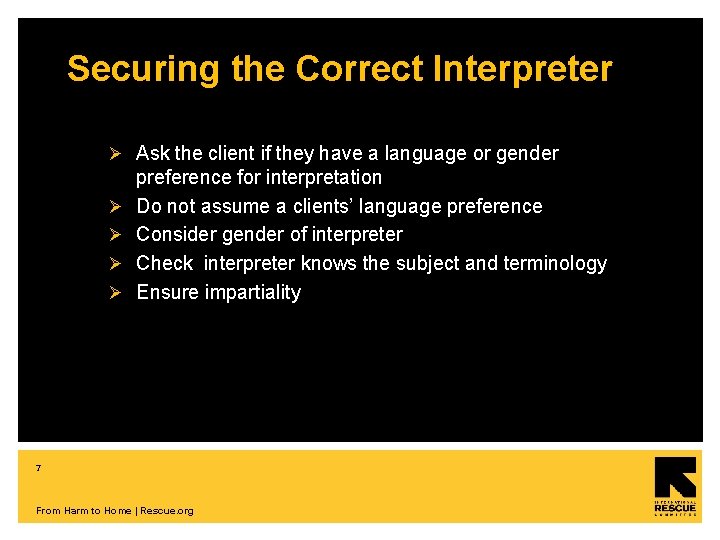
Securing the Correct Interpreter Ø Ask the client if they have a language or gender Ø Ø preference for interpretation Do not assume a clients’ language preference Consider gender of interpreter Check interpreter knows the subject and terminology Ensure impartiality 7 From Harm to Home | Rescue. org
Phone vs. In-Person 8 From Harm to Home | Rescue. org
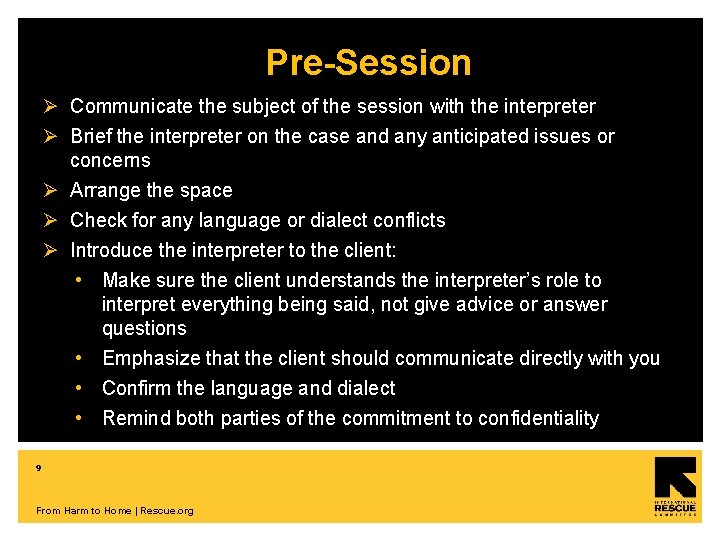
Pre-Session Ø Communicate the subject of the session with the interpreter Ø Brief the interpreter on the case and any anticipated issues or concerns Ø Arrange the space Ø Check for any language or dialect conflicts Ø Introduce the interpreter to the client: • Make sure the client understands the interpreter’s role to interpret everything being said, not give advice or answer questions • Emphasize that the client should communicate directly with you • Confirm the language and dialect • Remind both parties of the commitment to confidentiality 9 From Harm to Home | Rescue. org
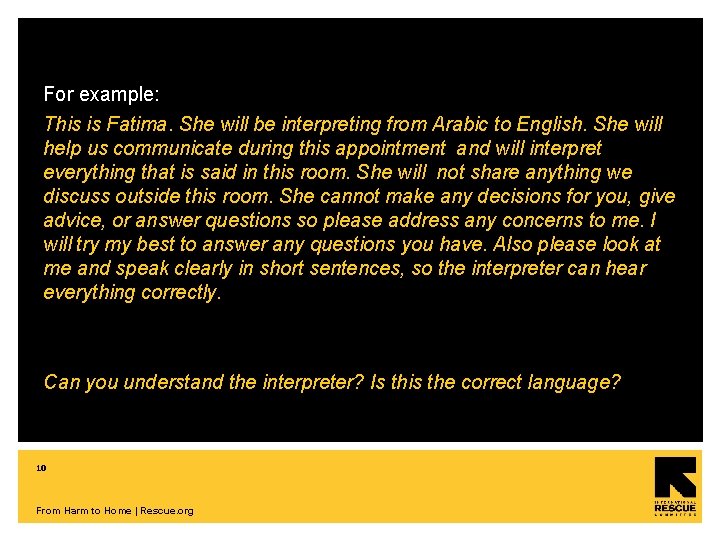
For example: This is Fatima. She will be interpreting from Arabic to English. She will help us communicate during this appointment and will interpret everything that is said in this room. She will not share anything we discuss outside this room. She cannot make any decisions for you, give advice, or answer questions so please address any concerns to me. I will try my best to answer any questions you have. Also please look at me and speak clearly in short sentences, so the interpreter can hear everything correctly. Can you understand the interpreter? Is this the correct language? 10 From Harm to Home | Rescue. org
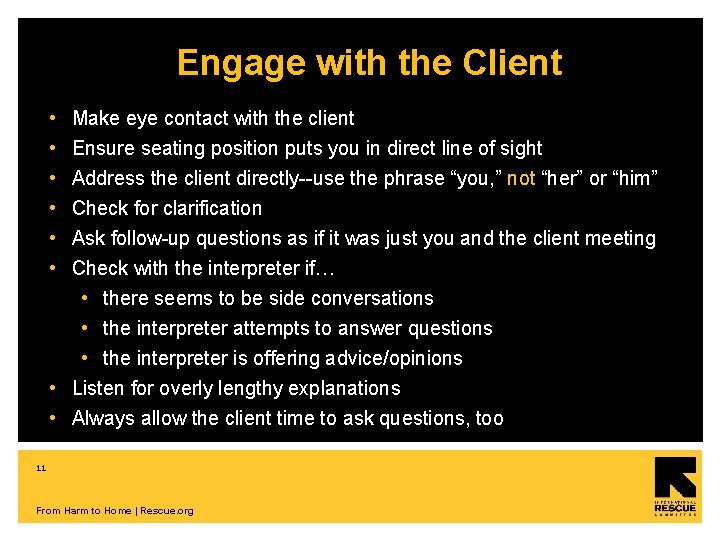
Engage with the Client • • • Make eye contact with the client Ensure seating position puts you in direct line of sight Address the client directly--use the phrase “you, ” not “her” or “him” Check for clarification Ask follow-up questions as if it was just you and the client meeting Check with the interpreter if… • there seems to be side conversations • the interpreter attempts to answer questions • the interpreter is offering advice/opinions • Listen for overly lengthy explanations • Always allow the client time to ask questions, too 11 From Harm to Home | Rescue. org
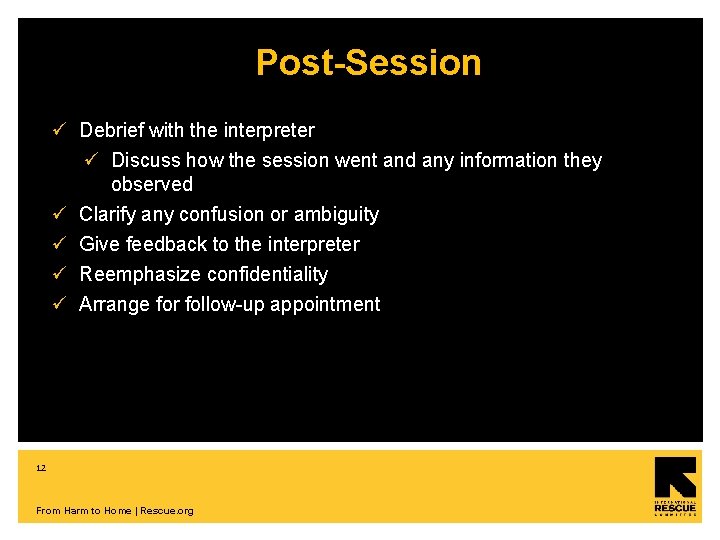
Post-Session ü Debrief with the interpreter ü Discuss how the session went and any information they observed ü Clarify any confusion or ambiguity ü Give feedback to the interpreter ü Reemphasize confidentiality ü Arrange for follow-up appointment 12 From Harm to Home | Rescue. org
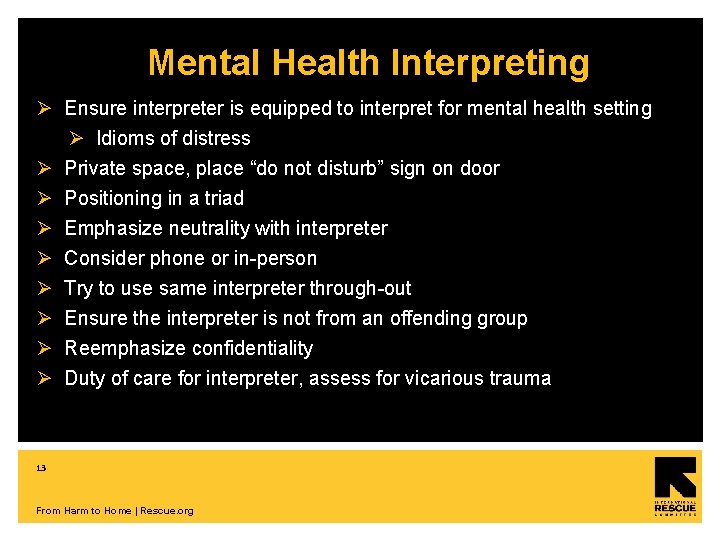
Mental Health Interpreting Ø Ensure interpreter is equipped to interpret for mental health setting Ø Idioms of distress Ø Private space, place “do not disturb” sign on door Ø Positioning in a triad Ø Emphasize neutrality with interpreter Ø Consider phone or in-person Ø Try to use same interpreter through-out Ø Ensure the interpreter is not from an offending group Ø Reemphasize confidentiality Ø Duty of care for interpreter, assess for vicarious trauma 13 From Harm to Home | Rescue. org
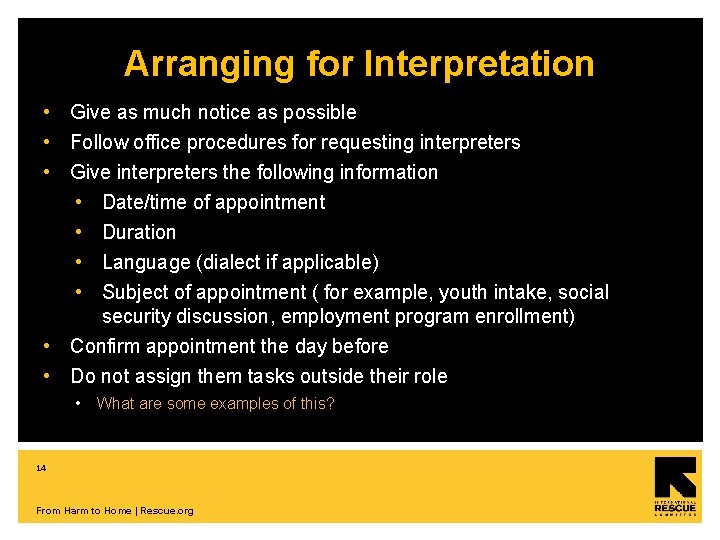
Arranging for Interpretation • Give as much notice as possible • Follow office procedures for requesting interpreters • Give interpreters the following information • Date/time of appointment • Duration • Language (dialect if applicable) • Subject of appointment ( for example, youth intake, social security discussion, employment program enrollment) • Confirm appointment the day before • Do not assign them tasks outside their role • What are some examples of this? 14 From Harm to Home | Rescue. org
Tips for people serving as interpreters 15 From Harm to Home | Rescue. org
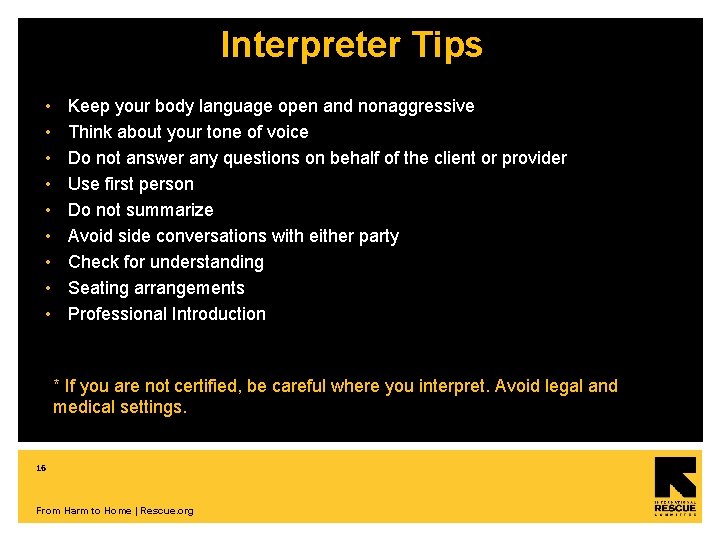
Interpreter Tips • Keep your body language open and nonaggressive • Think about your tone of voice • Do not answer any questions on behalf of the client or provider • Use first person • Do not summarize • Avoid side conversations with either party • Check for understanding • Seating arrangements • Professional Introduction * If you are not certified, be careful where you interpret. Avoid legal and medical settings. 16 From Harm to Home | Rescue. org
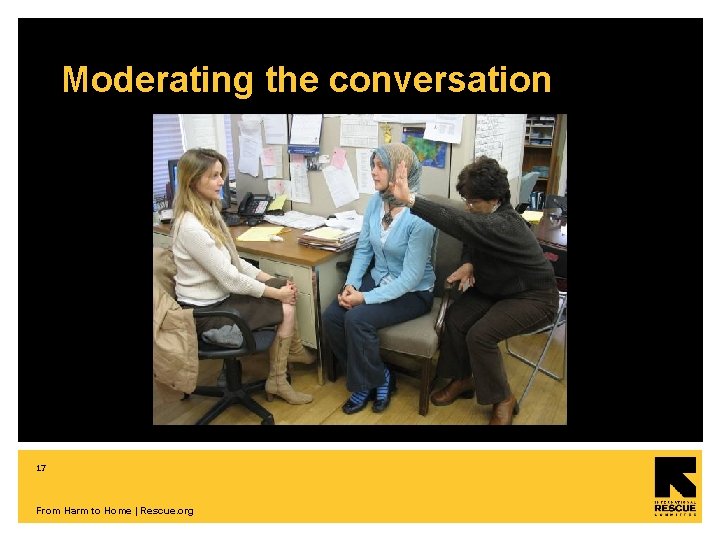
Moderating the conversation 17 From Harm to Home | Rescue. org
Interpreter Standards of Ethics v Confidentiality v Accuracy v Impartiality v Transparency v Direct communication v Role Boundaries v Cultural Awareness/communication v Professionalism 18 From Harm to Home | Rescue. org
Confidentiality The interpreter does not disclose private or proprietary information learned during the execution of his or her professional duties, except where disclosure is required by institutional regulations or by law. • The interpreter maintains confidentiality and does not disclose information outside the conversation. • The interpreter protects written client information in his or her possession. • When do you think it’s appropriate to disclose information to an outside party? 19 From Harm to Home | Rescue. org
Accuracy The interpreter strives to interpret every message without omissions, additions, distortions, or any other changes to the original message. • The interpreter renders all messages accurately and completely, without adding, omitting or substituting. • The interpreter manages the flow of communication. • The interpreter interprets everything being said to both parties. • The interpreter corrects errors and maintains transparency. 20 From Harm to Home | Rescue. org
Impartiality The interpreter refrains from allowing personal beliefs to manifest in his or her professional conduct, especially when rendering the content and tone of the message. • The interpreter does not allow personal judgments or cultural values to influence objectivity. • The interpreter discloses potential conflicts of interest, withdrawing from assignments as necessary. 21 From Harm to Home | Rescue. org
Transparency The interpreter interprets everything that is said to ensure that all messages are expressed during the encounter are communicated to all parties. • • Be clear to everyone present exactly what is being said by the other party If you want to add/correct information, ask the staff 22 From Harm to Home | Rescue. org
Direct Communication The interpreter initiates and actively supports practices that enable service users and providers to engage in direct communication. • • • Maintain your role as a facilitator (it is not your conversation) Do not answer clients’ questions or answer on behalf of the client Identifying vs. explaining communication barriers Intervene if there is miscommunication Make sure flow of communication smooth 23 From Harm to Home | Rescue. org
Role Boundaries The interpreter should maintain professional boundaries, both during and outside the interpreter encounter. • The interpreter limits personal involvement with all parties. • The interpreter limits his or her personal opinions and only acts in a professional capacity. • The interpreter with an additional role adheres to all interpreting standards of practice while interpreting. 24 From Harm to Home | Rescue. org
Cultural Awareness The interpreter intervenes to promote meaningful communication across cultural differences only when necessary for clear communication and without articulating either the interpreter’s beliefs or speculation about the parties’ cultures. • The interpreter strives to understand the cultures associated with the languages he or she interprets for. • The interpreter alerts all parties to any significant cultural misunderstanding that arises. • The interpreter uses professional, culturally appropriate ways of showing respect. 25 From Harm to Home | Rescue. org
Professionalism The interpreter’s conduct should reflect the highest standards of profession by showing adherence to professional ethics and best practices. • The interpreter is honest and ethical. • The interpreter is prepared for all assignments. • The interpreter discloses skill limitations with respect to particular assignments. • The interpreter is accountable for professional performance. • The interpreter advocates for working conditions that support quality interpreting. • The interpreter shows respect for professionals with whom he or she works. • The interpreter acts in a manner befitting the dignity of the profession and appropriate to the setting. 26 From Harm to Home | Rescue. org
Professional Introduction q Name q Role q Confidentiality q Interpret Everything q How you will pause the conversation 27 From Harm to Home | Rescue. org
Role Play 28 From Harm to Home | Rescue. org
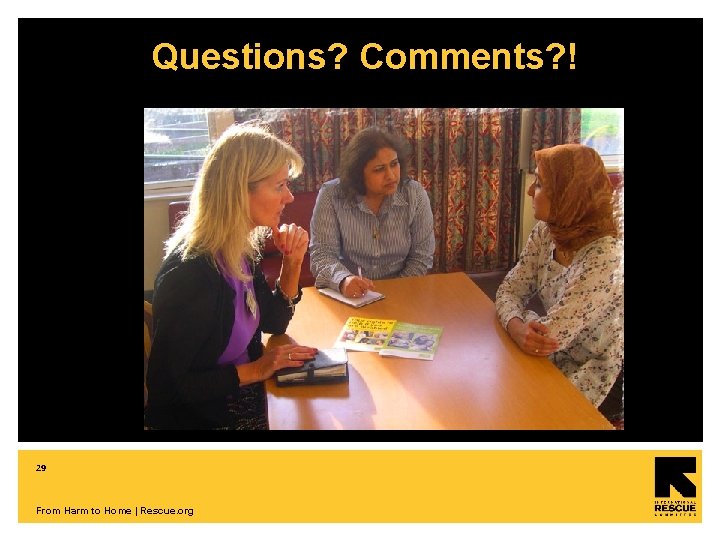
Questions? Comments? ! 29 From Harm to Home | Rescue. org