
Interpretation and Construction Interpretation Determine testators actual intent
![Interpretation and Construction [continued]](https://slidetodoc.com/presentation_image/3862f3680b4002eed8369c6ada8b06b6/image-24.jpg "Interpretation and Construction [continued]")

- Slides: 62
Interpretation and Construction
Interpretation �Determine testator’s actual intent from will or permissible extrinsic evidence.
Construction �Determine testator’s presumed intent will or permissible extrinsic evidence. from
When issue arises? � 1. Before probate (not often) � 2. After probate (most common)
Who raises issue? � 1. Personal Representative � 2. Beneficiaries and heirs
Ambiguity
1. Patent Ambiguity �Ambiguous on its face “I leave &^, #@( to Erica Evans. ” “I leave my zdcix to Chad Decker. ” “I leave _______ to Ryan Nichols. ”
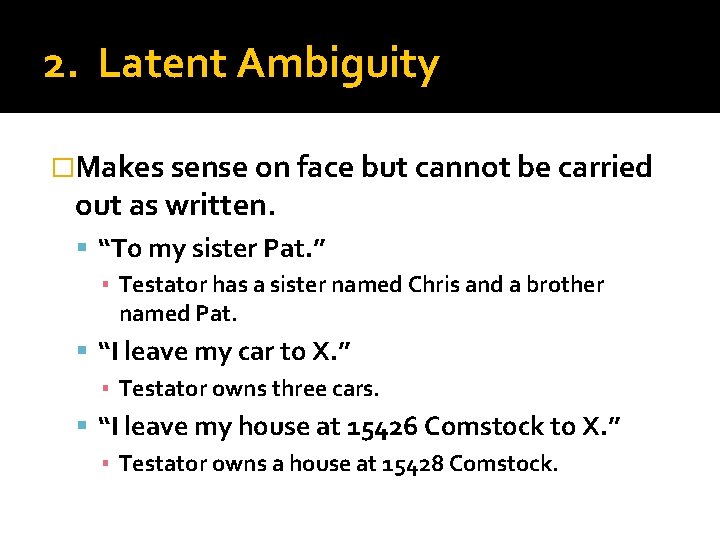
2. Latent Ambiguity �Makes sense on face but cannot be carried out as written. “To my sister Pat. ” ▪ Testator has a sister named Chris and a brother named Pat. “I leave my car to X. ” ▪ Testator owns three cars. “I leave my house at 15426 Comstock to X. ” ▪ Testator owns a house at 15428 Comstock.
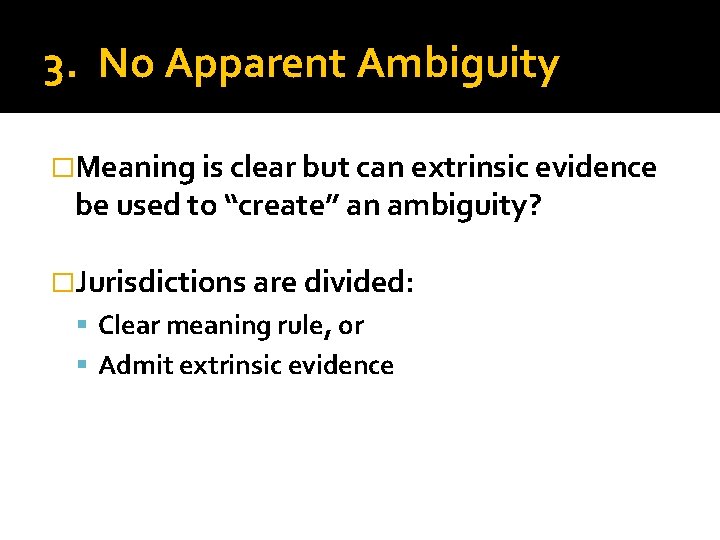
3. No Apparent Ambiguity �Meaning is clear but can extrinsic evidence be used to “create” an ambiguity? �Jurisdictions are divided: Clear meaning rule, or Admit extrinsic evidence
Integration
1. External Integration �Putting together different documents to create testator’s will. �How to avoid problems?
2. Internal Integration �Continuity within instrument. �Goal = avoid fraudulent page insertion/substitution �How to avoid problems? See pp. 182 -183
Incorporation by Reference
Basic Idea �Treat written material that is not physically part of the text of the will text as being in the will. �A “legal fiction” (pretending).
Requirements � 1. Testator must intend to incorporate.
Requirements � 2. Incorporated writing must be in existence when testator executes the will.
Requirements � 3. Incorporated writing must be reasonably identified.
Issues � 1. Validity of incorporated writing irrelevant.
Issues � 2. Codicil incorporates will (basis of republication)
Issues � 2. Codicil incorporates will (basis of republication) What result if: a. Valid will + Valid codicil
Issues � 2. Codicil incorporates will (basis of republication) What result if: b. Valid will + Invalid codicil
Issues � 2. Codicil incorporates will (basis of republication) What result if: c. Invalid will + valid codicil
Interpretation and Construction [continued]
Facts of Independent Significance
Basic Idea �Can we look outside the four corners of the will to ascertain at-death property distribution?
Defined �Something which has a legal purpose independent of disposing of property at death. �Thus, can be effective to impact new owner of property without compliance with will formalities.
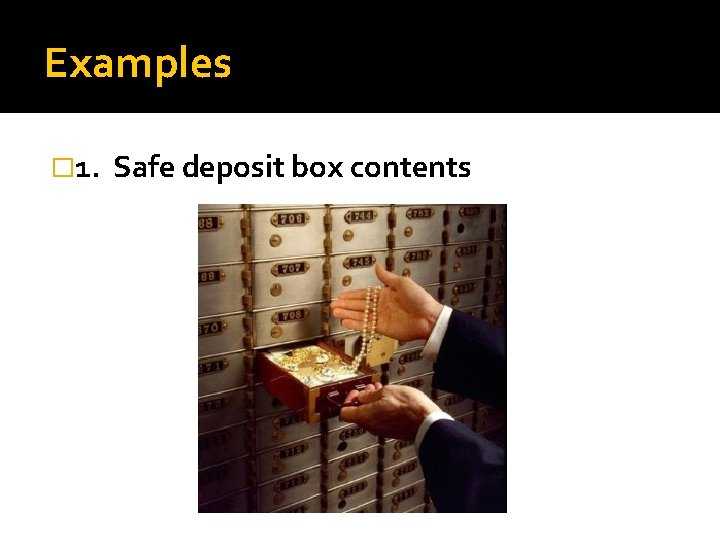
Examples � 1. Safe deposit box contents
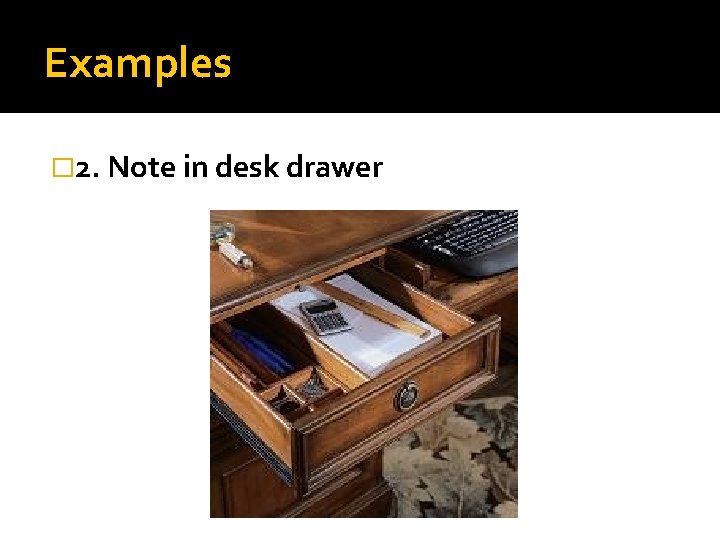
Examples � 2. Note in desk drawer
Examples � 3. Identity of class gift members
Examples � 4. Evidence to resolve ambiguities
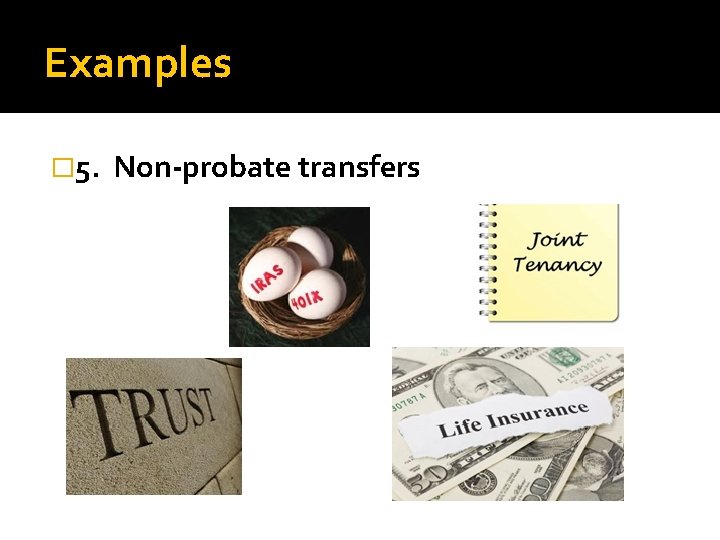
Examples � 5. Non-probate transfers
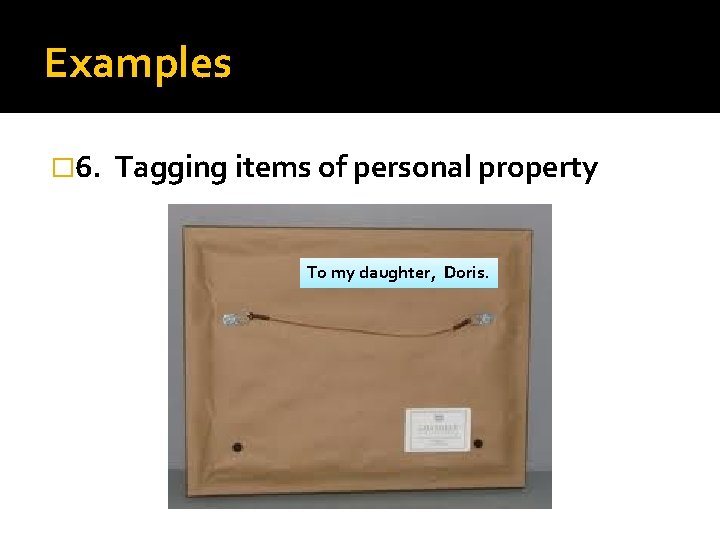
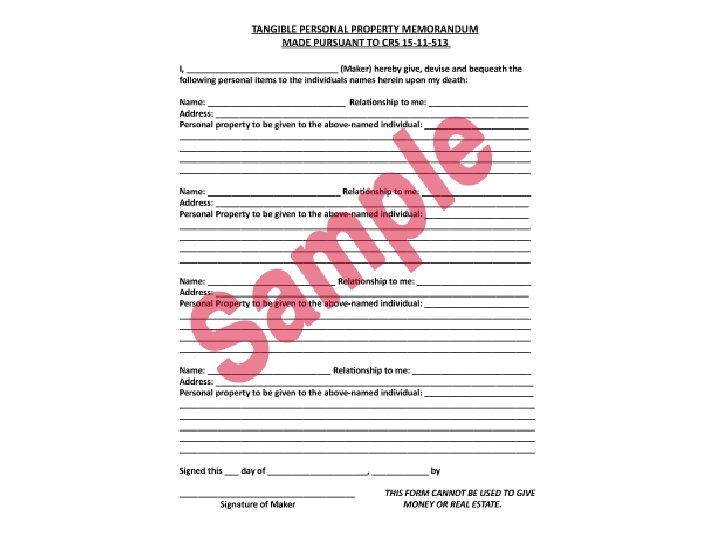
Examples � 6. Tagging items of personal property To my daughter, Doris.
Tangible Personal Property Document
Pour Over Provisions
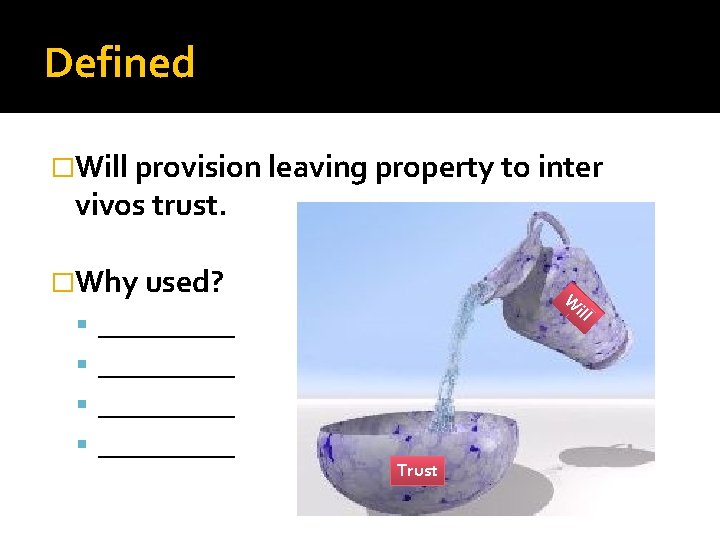
Defined �Will provision leaving property to inter vivos trust. �Why used? W ill __________ Trust
Historical Development � 1. Not allowed.
Historical Development � 2. Incorporation by reference.
Historical Development � 3. Facts of independent significance.
Historical Development � 4. Codification Uniform Testamentary Additions to Trusts Act (1960) Uniform Testamentary Additions to Trusts Act (1991) State tinkering with Uniform Act (Ohio § 2107. 03)
Authorization of Technique �Expressly authorizes pour over technique.
Types of trusts into which pour overs allowed � 1. Trust created by testator Before or at time of will execution = OK After will execution = ? ?
Types of trusts into which pour overs allowed � 2. Trust created by another person Before or at time of will execution = OK After will execution = ? ?
Types of trusts into which pour overs allowed � 3. Can pour over funds be the initial trust funding? Traditional/Ohio view = no Modern view =yes
Types of trusts into which pour overs allowed � 4. Cannot pour over into revoked or terminated trust.
Governance of poured-over property �Amendments made after will execution: Before the testator’s death? After the testator’s death?
Precatory Language
Defined �Serious request but not legally binding. �Examples: “I hope” “I would like” “I recommend” “I wish”
Ramifications � 1. To restrict or limit gifts Generally ineffective.
Ramifications � 2. To instruct personal representative Likely to be effective.
Class Gifts
Defined �Beneficiaries described generically. �Examples: “Children” “Grandchildren” “Brothers” “Siblings”
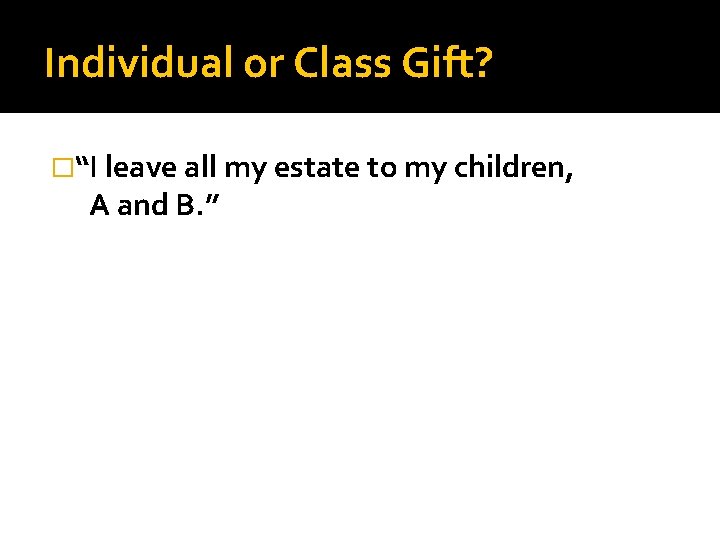
Individual or Class Gift? �“I leave all my estate to my children, A and B. ”
Time of Determining Class Membership � 1. Express language in will.
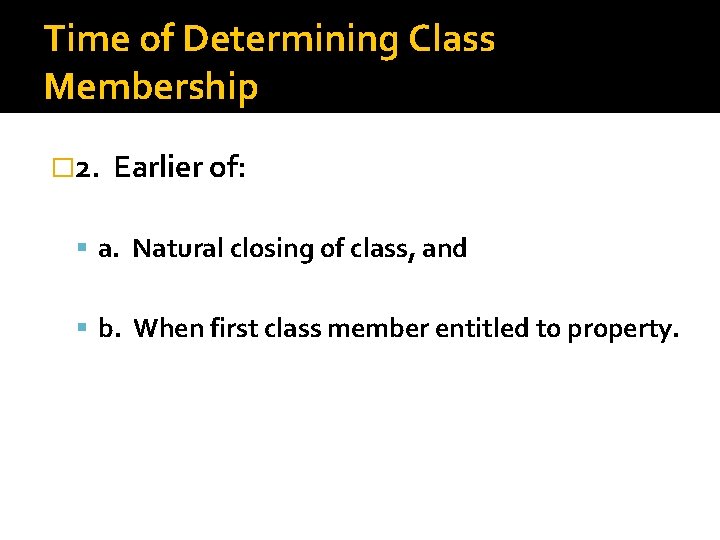
Time of Determining Class Membership � 2. Earlier of: a. Natural closing of class, and b. When first class member entitled to property.
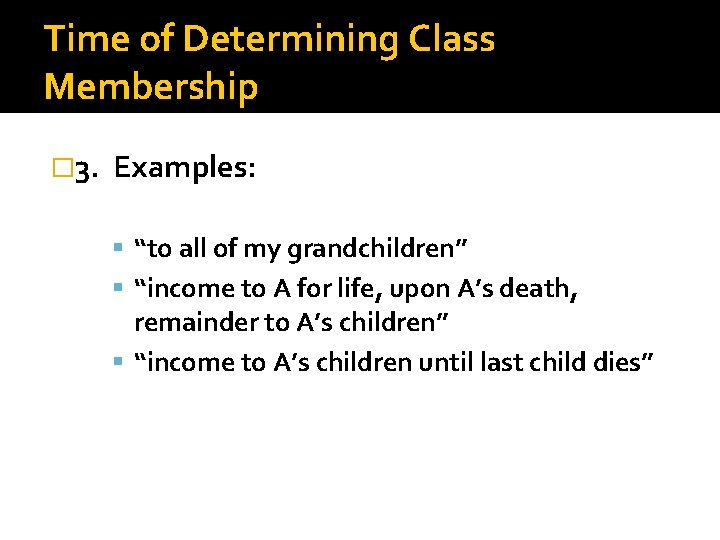
Time of Determining Class Membership � 3. Examples: “to all of my grandchildren” “income to A for life, upon A’s death, remainder to A’s children” “income to A’s children until last child dies”
Adopted children as class members �Generally included. �But, some states may exclude if adopted as adult.
Practice Tip �Explain how testator wants class membership determined: Adopted individuals? ▪ If yes, by what age? Non-marital individuals? ART individuals?
Dead Persons Statute
Issue �Can evidence of what testator said or did be used as evidence in will litigation? Traditional approach Modern view Ohio Rule of Evidence 601