
Interpolation Chapter 18 Estimation of intermediate values between
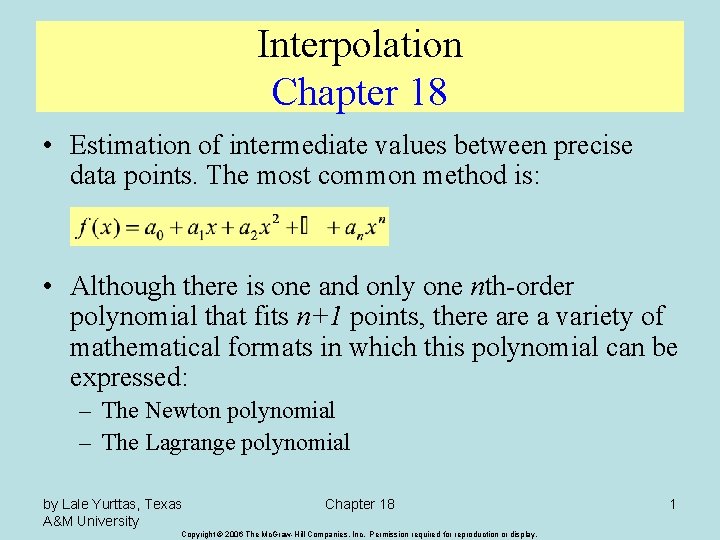
Interpolation Chapter 18 • Estimation of intermediate values between precise data points. The most common method is: • Although there is one and only one nth-order polynomial that fits n+1 points, there a variety of mathematical formats in which this polynomial can be expressed: – The Newton polynomial – The Lagrange polynomial by Lale Yurttas, Texas A&M University Chapter 18 Copyright © 2006 The Mc. Graw-Hill Companies, Inc. Permission required for reproduction or display. 1
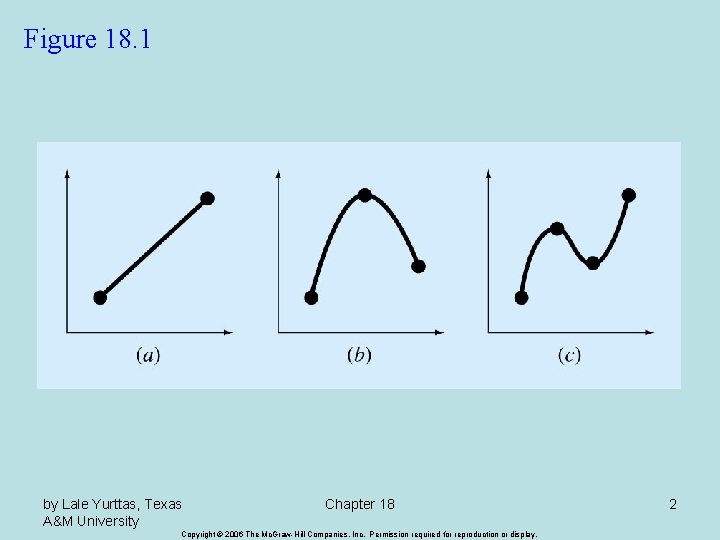
Figure 18. 1 by Lale Yurttas, Texas A&M University Chapter 18 Copyright © 2006 The Mc. Graw-Hill Companies, Inc. Permission required for reproduction or display. 2
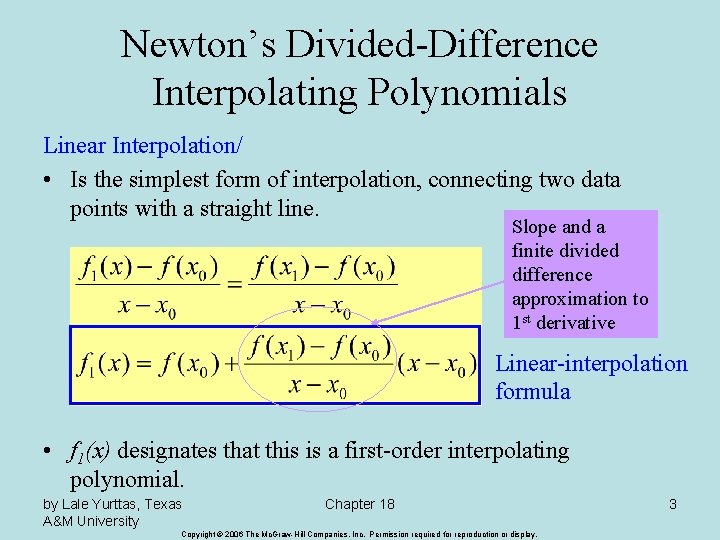
Newton’s Divided-Difference Interpolating Polynomials Linear Interpolation/ • Is the simplest form of interpolation, connecting two data points with a straight line. Slope and a finite divided difference approximation to 1 st derivative Linear-interpolation formula • f 1(x) designates that this is a first-order interpolating polynomial. by Lale Yurttas, Texas A&M University Chapter 18 Copyright © 2006 The Mc. Graw-Hill Companies, Inc. Permission required for reproduction or display. 3
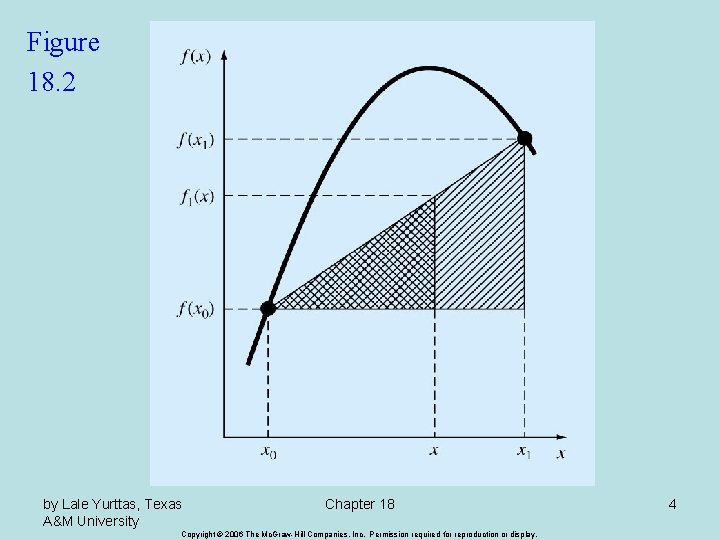
Figure 18. 2 by Lale Yurttas, Texas A&M University Chapter 18 Copyright © 2006 The Mc. Graw-Hill Companies, Inc. Permission required for reproduction or display. 4

Quadratic Interpolation/ • If three data points are available, the estimate is improved by introducing some curvature into the line connecting the points. • A simple procedure can be used to determine the values of the coefficients. 5 Copyright © 2006 The Mc. Graw-Hill Companies, Inc. Permission required for reproduction or display.
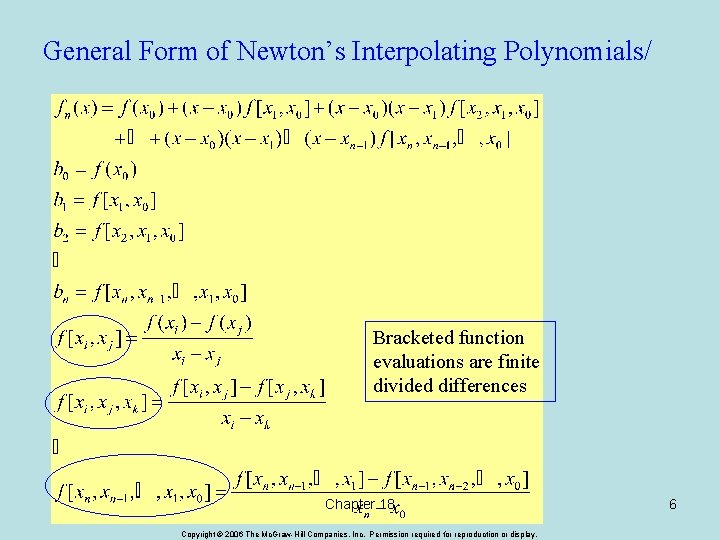
General Form of Newton’s Interpolating Polynomials/ Bracketed function evaluations are finite divided differences Chapter 18 Copyright © 2006 The Mc. Graw-Hill Companies, Inc. Permission required for reproduction or display. 6
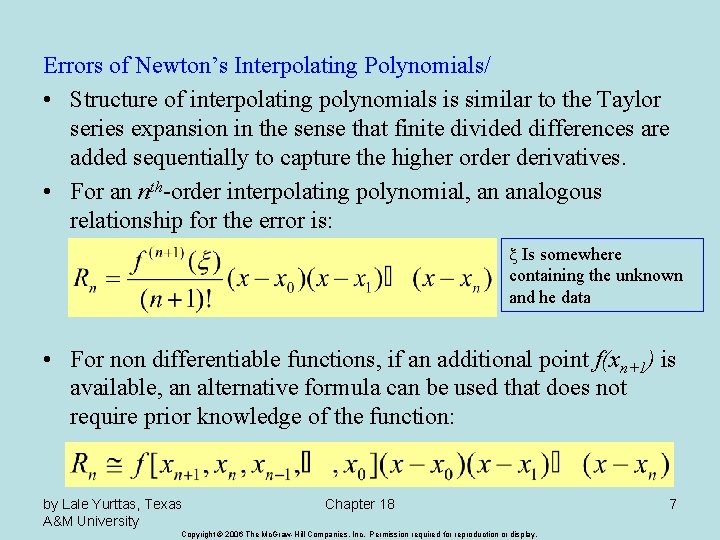
Errors of Newton’s Interpolating Polynomials/ • Structure of interpolating polynomials is similar to the Taylor series expansion in the sense that finite divided differences are added sequentially to capture the higher order derivatives. • For an nth-order interpolating polynomial, an analogous relationship for the error is: x Is somewhere containing the unknown and he data • For non differentiable functions, if an additional point f(xn+1) is available, an alternative formula can be used that does not require prior knowledge of the function: by Lale Yurttas, Texas A&M University Chapter 18 Copyright © 2006 The Mc. Graw-Hill Companies, Inc. Permission required for reproduction or display. 7
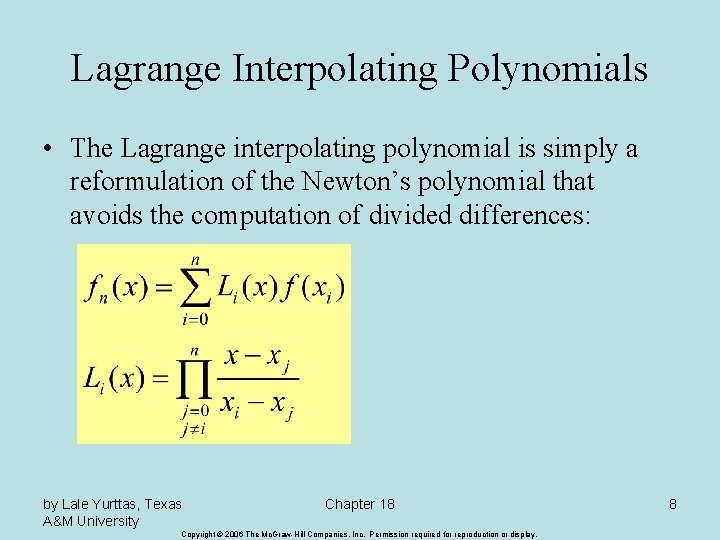
Lagrange Interpolating Polynomials • The Lagrange interpolating polynomial is simply a reformulation of the Newton’s polynomial that avoids the computation of divided differences: by Lale Yurttas, Texas A&M University Chapter 18 Copyright © 2006 The Mc. Graw-Hill Companies, Inc. Permission required for reproduction or display. 8
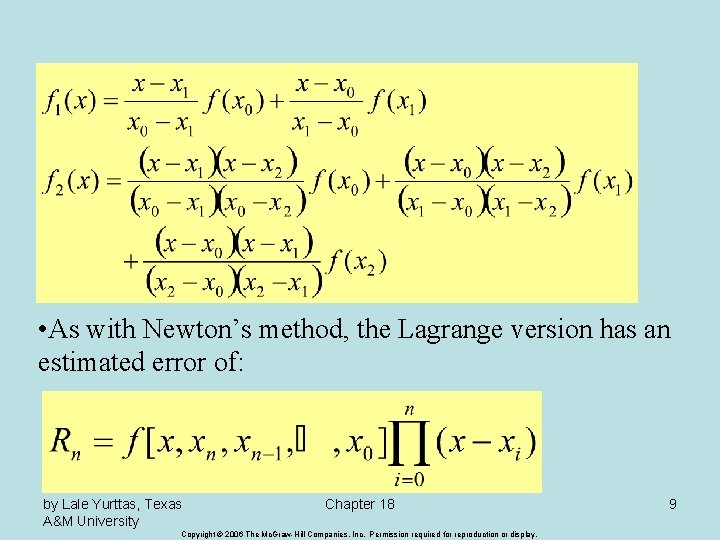
• As with Newton’s method, the Lagrange version has an estimated error of: by Lale Yurttas, Texas A&M University Chapter 18 Copyright © 2006 The Mc. Graw-Hill Companies, Inc. Permission required for reproduction or display. 9
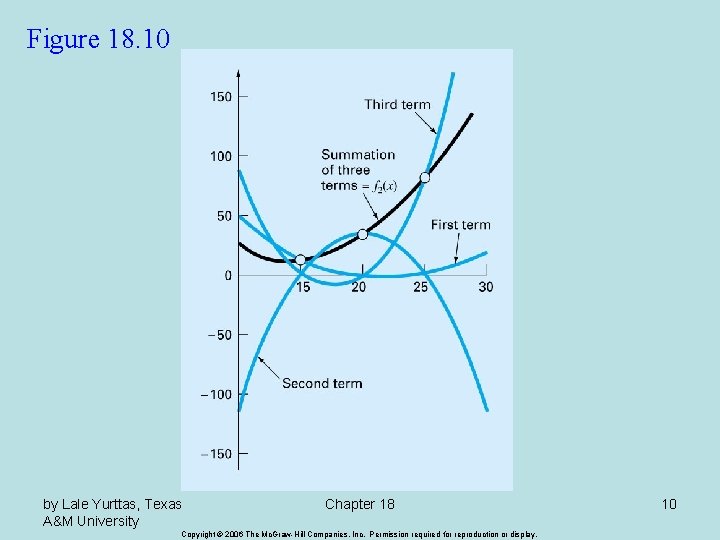
Figure 18. 10 by Lale Yurttas, Texas A&M University Chapter 18 Copyright © 2006 The Mc. Graw-Hill Companies, Inc. Permission required for reproduction or display. 10
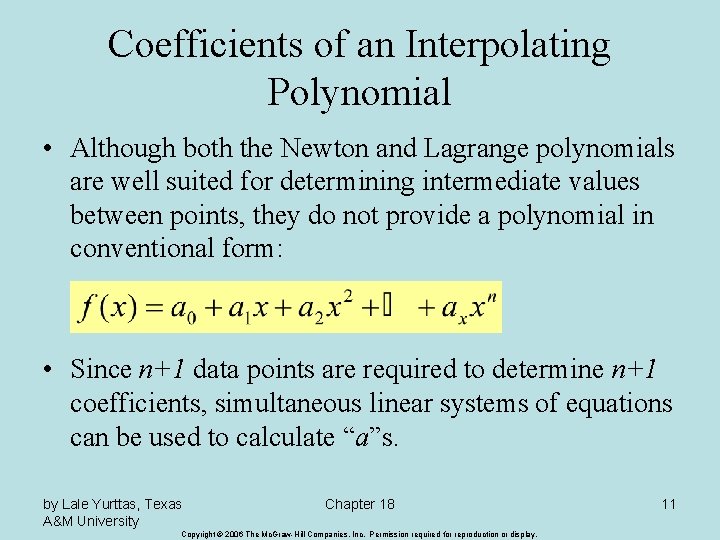
Coefficients of an Interpolating Polynomial • Although both the Newton and Lagrange polynomials are well suited for determining intermediate values between points, they do not provide a polynomial in conventional form: • Since n+1 data points are required to determine n+1 coefficients, simultaneous linear systems of equations can be used to calculate “a”s. by Lale Yurttas, Texas A&M University Chapter 18 Copyright © 2006 The Mc. Graw-Hill Companies, Inc. Permission required for reproduction or display. 11
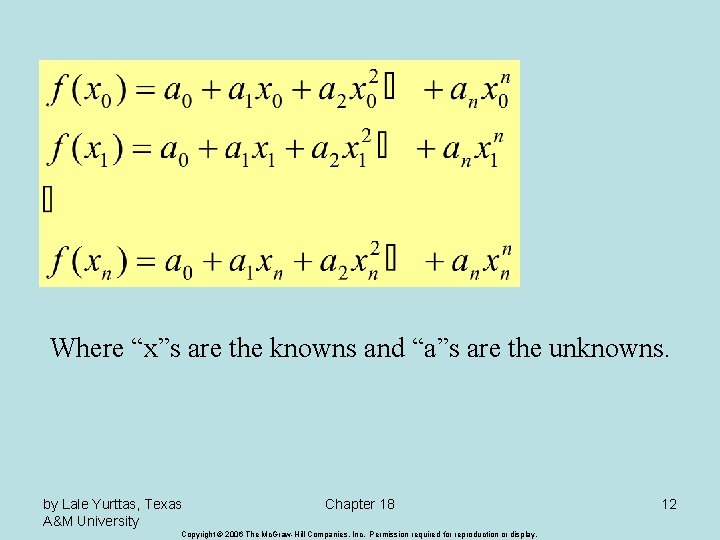
Where “x”s are the knowns and “a”s are the unknowns. by Lale Yurttas, Texas A&M University Chapter 18 Copyright © 2006 The Mc. Graw-Hill Companies, Inc. Permission required for reproduction or display. 12
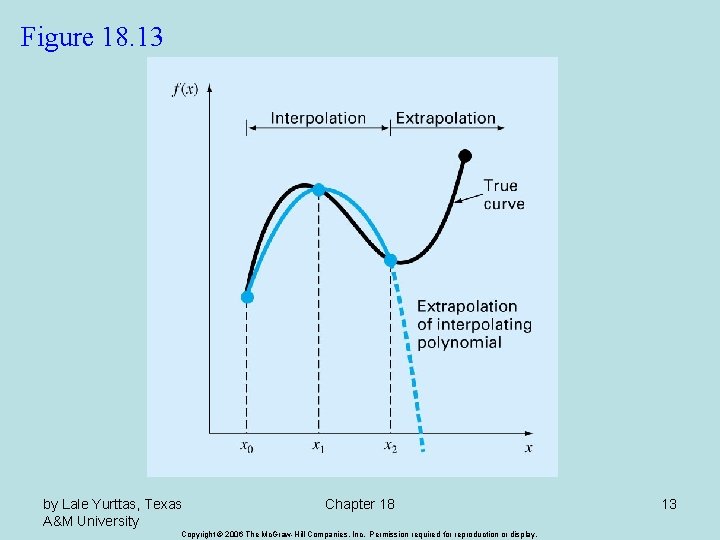
Figure 18. 13 by Lale Yurttas, Texas A&M University Chapter 18 Copyright © 2006 The Mc. Graw-Hill Companies, Inc. Permission required for reproduction or display. 13
Spline Interpolation • There are cases where polynomials can lead to erroneous results because of round off error and overshoot. • Alternative approach is to apply lower-order polynomials to subsets of data points. Such connecting polynomials are called spline functions. by Lale Yurttas, Texas A&M University Chapter 18 Copyright © 2006 The Mc. Graw-Hill Companies, Inc. Permission required for reproduction or display. 14
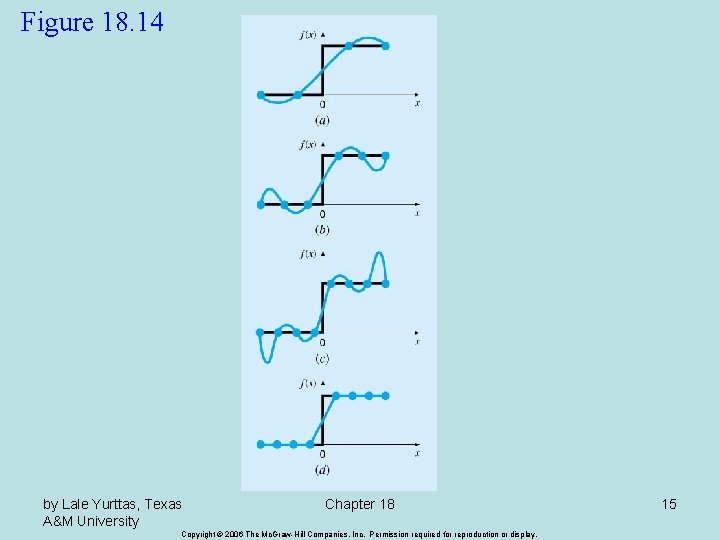
Figure 18. 14 by Lale Yurttas, Texas A&M University Chapter 18 Copyright © 2006 The Mc. Graw-Hill Companies, Inc. Permission required for reproduction or display. 15
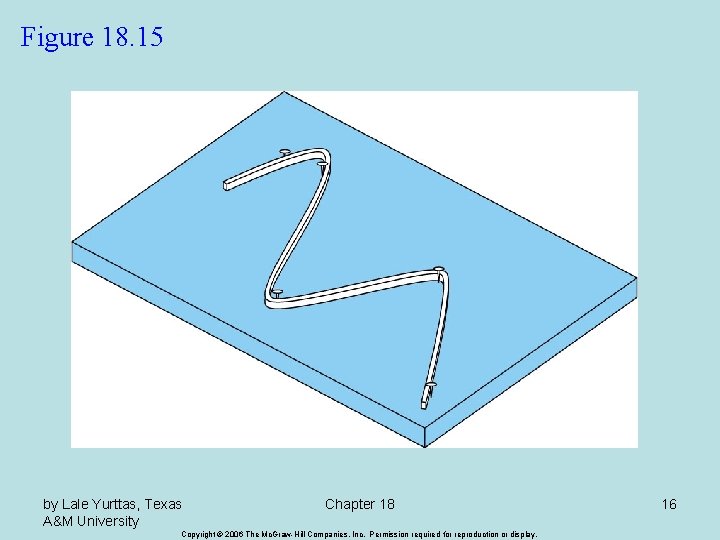
Figure 18. 15 by Lale Yurttas, Texas A&M University Chapter 18 Copyright © 2006 The Mc. Graw-Hill Companies, Inc. Permission required for reproduction or display. 16
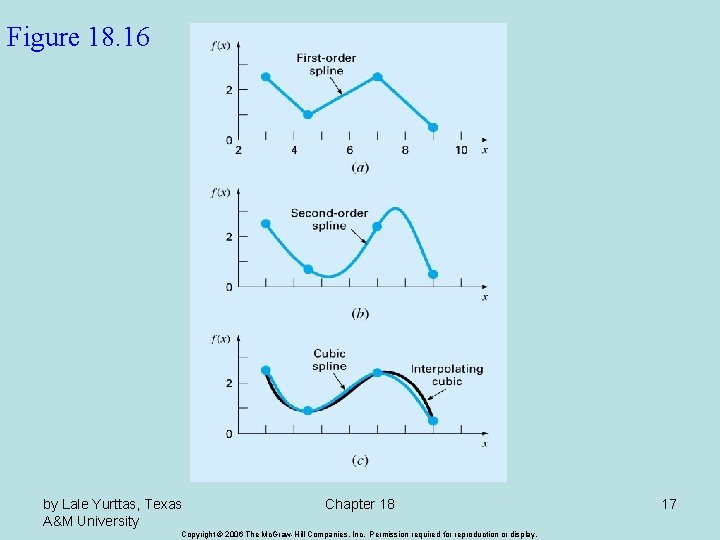
Figure 18. 16 by Lale Yurttas, Texas A&M University Chapter 18 Copyright © 2006 The Mc. Graw-Hill Companies, Inc. Permission required for reproduction or display. 17
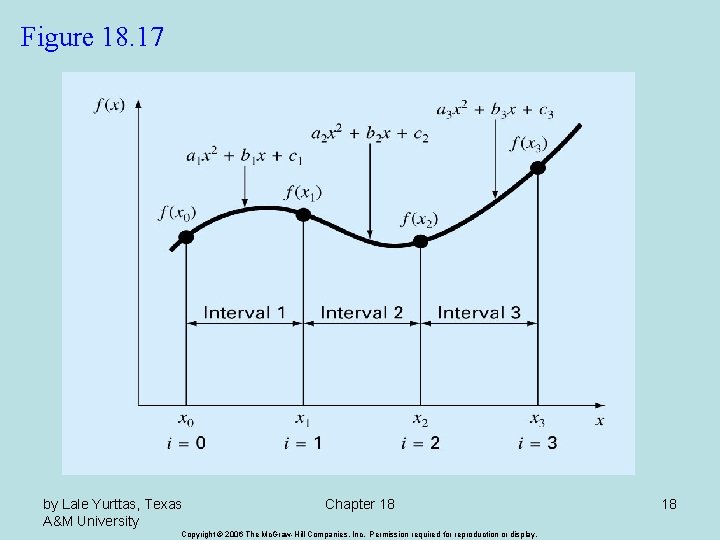
Figure 18. 17 by Lale Yurttas, Texas A&M University Chapter 18 Copyright © 2006 The Mc. Graw-Hill Companies, Inc. Permission required for reproduction or display. 18
- Slides: 18