
Interplay of physicochemical and structural features in ionic



- Slides: 30
Interplay of physicochemical and structural features in ionic compounds and melts Marcelle Gaune-Escarda, Leszek Rycerzb , Slobodan Gadzurica, c a. Ecole Polytechnique, IUSTI CNRS 6595, 5 rue Enrico Fermi, 13453 Marseille Cedex 13, France b. Wroclaw University of Technology, 50 -370 Wroclaw, Poland c. University of Novi Sad, 21000 Novi Sad, Serbia Marcelle. Gaune-Escard@polytech. univ-mrs. fr
Why lanthanide halides? • • Increasing technological importance Alloys production Lighting industry Nuclear waste processing Recycling of spent nuclear fuel Energy of future Electrodeposition of metals etc.
Outlines • New experimental data on selected divalent and trivalent lanthanide halide mixtures with MX • Topology of phase diagrams • Modeling and processing by statistical techniques of large data sets where our original results have been incorporated
Experimental techniques • High temperature calorimetry – Calvet Microcalorimetry • Differential Scanning Calorimetry (DSC) • Electrical conductivity measurements • Reflectance and Raman spectroscopy
M 3 Ln. X 6 compounds (3 1 compounds) • Compounds formed at higher temperatures in reaction between M 2 Ln. X 5 and MX - (reconstructive phase transition) • Compounds stable or metastable at low temperatures (non-reconstructive phase transition)
• Compounds formed at higher temperatures have only high-temperature crystal structure (cubic, elpasolite-type) • Formation of compounds at higher temperatures (reconstructive phase transition) is followed by high molar enthalpy( 30 -50 k. J mol-1)
• Compounds stable or metastable at low temperatures have low-temperature (monoclinic, Cs 3 Bi. Cl 6 - type) and hightemperature (cubic, elpasolite-type) crystal structures • Transition from low- to high-temperature modification (non-reconstructive phase transition) is followed by significantly lower molar enthalpy ( 6 -10 k. J mol-1)
Heat capacity of K 3 Nd. Cl 6
Heat capacity of K 3 Tb. Cl 6
Heat capacity of Cs 3 Tb. Cl 6
O ’Keeffe and Hyde «The Solid Electrolyte Transition and Melting in Salts» • Simple, quantitative model of solid electrolyte - electrolyte properties are the result of existing of disordered phase with ionic conductivity • Crystals with solid electrolyte phases pass, either gradually, or through a series of phase transitions, from normal ionic conductivity (0. 1 Sm-1) to liquidlike values while still solid.
O ’Keeffe and Hyde «The Solid Electrolyte Transition and Melting in Salts» • Superionic phase is a result of sublattice « melting » , that is, atoms on a certain set of lattice positions become mobile, almost liquidlike, while the remaining atoms retain their normal lattice positions
Heat capacity and electrical conductivity of K 3 Nd. Cl 6
Heat capacity and electrical conductivity of K 3 Tb. Br 6
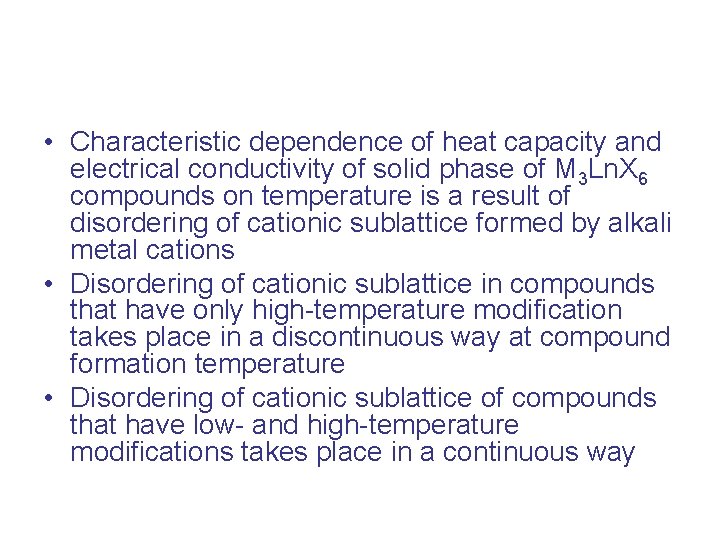
• Characteristic dependence of heat capacity and electrical conductivity of solid phase of M 3 Ln. X 6 compounds on temperature is a result of disordering of cationic sublattice formed by alkali metal cations • Disordering of cationic sublattice in compounds that have only high-temperature modification takes place in a discontinuous way at compound formation temperature • Disordering of cationic sublattice of compounds that have low- and high-temperature modifications takes place in a continuous way
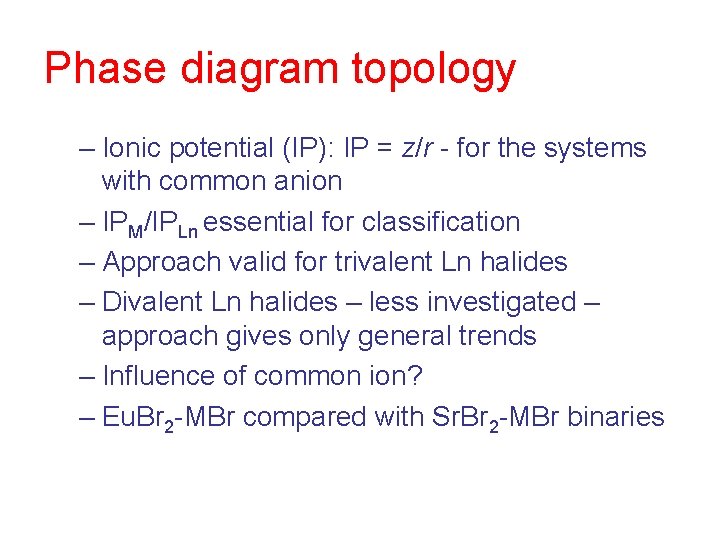
Phase diagram topology – Ionic potential (IP): IP = z/r - for the systems with common anion – IPM/IPLn essential for classification – Approach valid for trivalent Ln halides – Divalent Ln halides – less investigated – approach gives only general trends – Influence of common ion? – Eu. Br 2 -MBr compared with Sr. Br 2 -MBr binaries
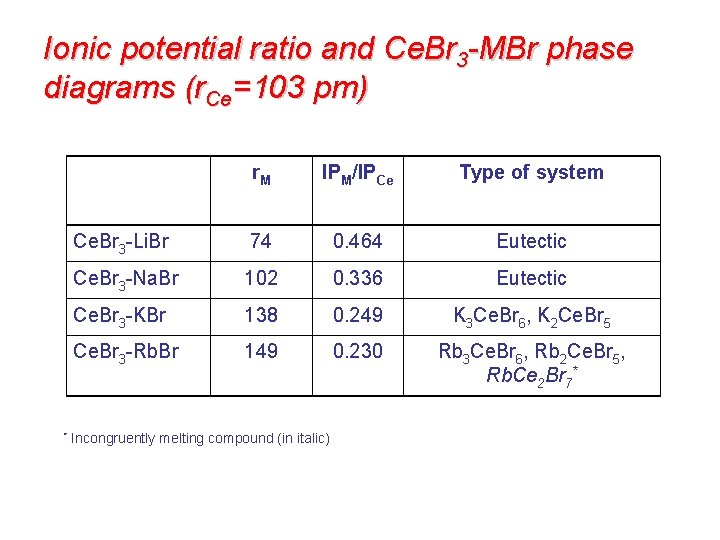
Ionic potential ratio and Ce. Br 3 -MBr phase diagrams (r. Ce=103 pm) r. M IPM/IPCe Type of system Ce. Br 3 -Li. Br 74 0. 464 Eutectic Ce. Br 3 -Na. Br 102 0. 336 Eutectic Ce. Br 3 -KBr 138 0. 249 K 3 Ce. Br 6, K 2 Ce. Br 5 Ce. Br 3 -Rb. Br 149 0. 230 Rb 3 Ce. Br 6, Rb 2 Ce. Br 5, Rb. Ce 2 Br 7* * Incongruently melting compound (in italic)
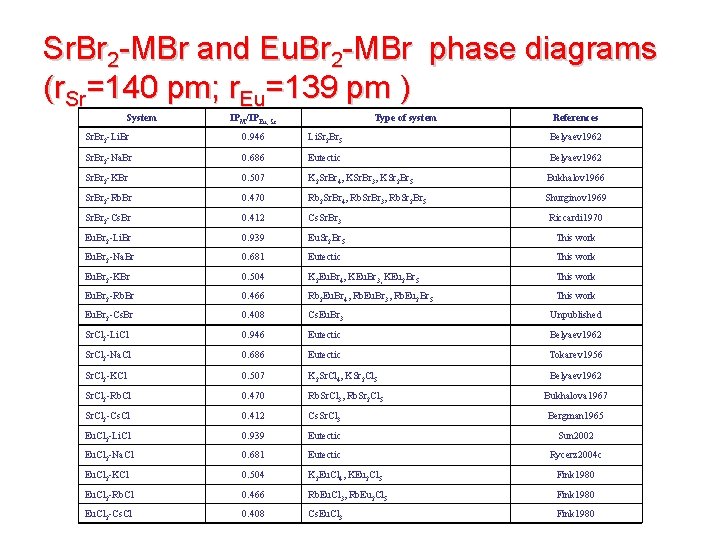
Sr. Br 2 -MBr and Eu. Br 2 -MBr phase diagrams (r. Sr=140 pm; r. Eu=139 pm ) System IPM/IPEu, Sr Type of system References Sr. Br 2 -Li. Br 0. 946 Li. Sr 2 Br 5 Belyaev 1962 Sr. Br 2 -Na. Br 0. 686 Eutectic Belyaev 1962 Sr. Br 2 -KBr 0. 507 K 2 Sr. Br 4, KSr. Br 3, KSr 2 Br 5 Bukhalov 1966 Sr. Br 2 -Rb. Br 0. 470 Rb 2 Sr. Br 4, Rb. Sr. Br 3, Rb. Sr 2 Br 5 Shurginov 1969 Sr. Br 2 -Cs. Br 0. 412 Cs. Sr. Br 3 Riccardi 1970 Eu. Br 2 -Li. Br 0. 939 Eu. Sr 2 Br 5 This work Eu. Br 2 -Na. Br 0. 681 Eutectic This work Eu. Br 2 -KBr 0. 504 K 2 Eu. Br 4, KEu. Br 3, KEu 2 Br 5 This work Eu. Br 2 -Rb. Br 0. 466 Rb 2 Eu. Br 4, Rb. Eu. Br 3, Rb. Eu 2 Br 5 This work Eu. Br 2 -Cs. Br 0. 408 Cs. Eu. Br 3 Unpublished Sr. Cl 2 -Li. Cl 0. 946 Eutectic Belyaev 1962 Sr. Cl 2 -Na. Cl 0. 686 Eutectic Tokarev 1956 Sr. Cl 2 -KCl 0. 507 K 2 Sr. Cl 4, KSr 2 Cl 5 Belyaev 1962 Sr. Cl 2 -Rb. Cl 0. 470 Rb. Sr. Cl 3, Rb. Sr 2 Cl 5 Bukhalova 1967 Sr. Cl 2 -Cs. Cl 0. 412 Cs. Sr. Cl 3 Bergman 1965 Eu. Cl 2 -Li. Cl 0. 939 Eutectic Sun 2002 Eu. Cl 2 -Na. Cl 0. 681 Eutectic Rycerz 2004 c Eu. Cl 2 -KCl 0. 504 K 2 Eu. Cl 4, KEu 2 Cl 5 Fink 1980 Eu. Cl 2 -Rb. Cl 0. 466 Rb. Eu. Cl 3, Rb. Eu 2 Cl 5 Fink 1980 Eu. Cl 2 -Cs. Cl 0. 408 Cs. Eu. Cl 3 Fink 1980
• The complete experimental investigation of all properties for the whole lanthanide series of bromides, either in the (III) and (II) valence state would be of course of unrealistic duration. • Need for such data was claimed in a number of modern technologies • This context was the trigger of the second part of this work, with the ultimate goal of predictions being the global properties of these materials
• Several informatic and statistical techniques play a significant role in data analysis and estimation of missing properties • Chemometrics (data-based sub-discipline of chemistry) • Molten salt systems are multivariate – data collected by Janz can be transformed by multivariate analysis into dynamic dataset for analysis and intercorrelation of the properties
• Two techniques: • Principal Component Analysis (PCA) and • Partial Least Squares (PLS) In cooperation with Krishna Rajan Combinatorial Sciences and Materials Informatics Collaboratory (Co. SMIC), NSF International Materials Institute, Department of Materials Science and Engineering, Iowa State University, Ames, IA 50011, USA
Principal Component Analysis (PCA) • Useful tool for data compression • Data compressed into more compact space • To identify patterns among the data and connections between variables
Partial Least Squares (PLS) • Recent technique that generalizes and combines features from PCA • Useful to make predictions • In this work, two essential thermodynamic properties were predicted for the set of 14 lanthanide halides
PCA results • Used data set derived from Janz, composed of seven variables for 1658 samples • Results are PCs – linear combination of 7 descriptors (Equivalent weight, melting point, temperature, equivalent conductivity, specific conductivity, density and viscosity) • Data from the matrix are compressed and visualized in three dimensional space • This helps to identify compound/property relationship in a dataset of molten salts
The 3 dimensional score plots for complete data
Two interesting projections
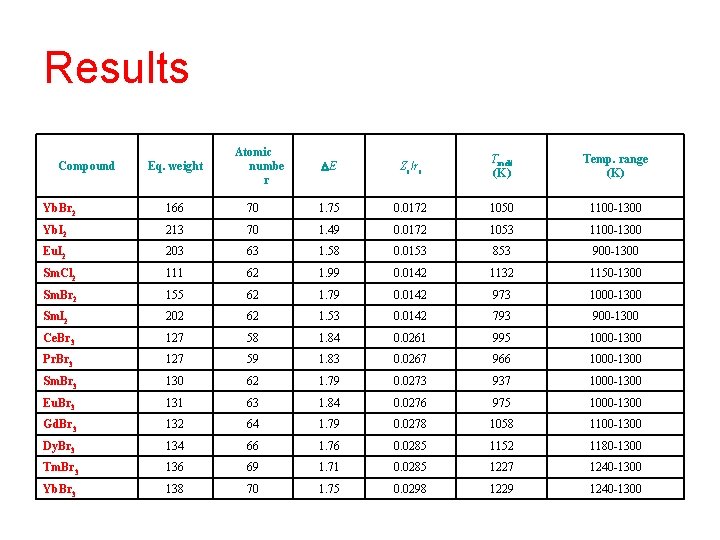
PLS results • Data set for 19 different lanthanide halides obtained during our thermodynamic investigations was used for a multivariate analysis on H 0 form and G 0 form behavior • Descriptors: equivalent weight, atomic number, electronegativity difference, cationic charge/radius ratio, melting temperature, H 0 form and G 0 form
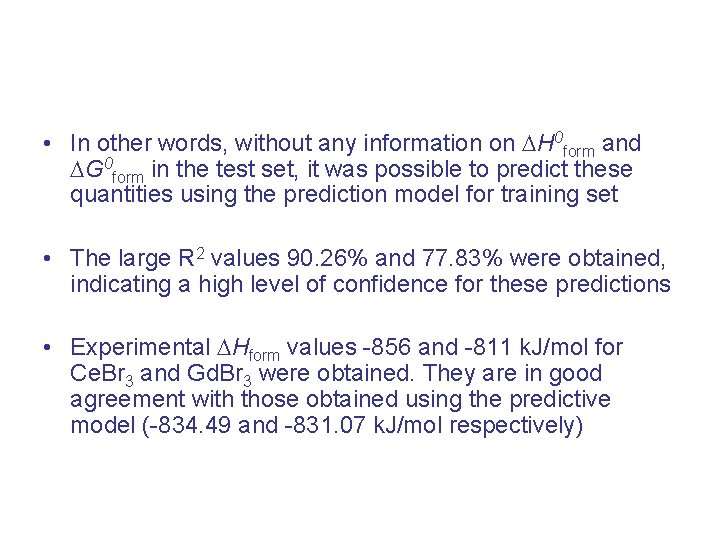
• In other words, without any information on H 0 form and G 0 form in the test set, it was possible to predict these quantities using the prediction model for training set • The large R 2 values 90. 26% and 77. 83% were obtained, indicating a high level of confidence for these predictions • Experimental Hform values -856 and -811 k. J/mol for Ce. Br 3 and Gd. Br 3 were obtained. They are in good agreement with those obtained using the predictive model (-834. 49 and -831. 07 k. J/mol respectively)
Results Compound Eq. weight Atomic numbe r E Zc/rc Tmelt (K) Temp. range (K) Yb. Br 2 166 70 1. 75 0. 0172 1050 1100 -1300 Yb. I 2 213 70 1. 49 0. 0172 1053 1100 -1300 Eu. I 2 203 63 1. 58 0. 0153 853 900 -1300 Sm. Cl 2 111 62 1. 99 0. 0142 1132 1150 -1300 Sm. Br 2 155 62 1. 79 0. 0142 973 1000 -1300 Sm. I 2 202 62 1. 53 0. 0142 793 900 -1300 Ce. Br 3 127 58 1. 84 0. 0261 995 1000 -1300 Pr. Br 3 127 59 1. 83 0. 0267 966 1000 -1300 Sm. Br 3 130 62 1. 79 0. 0273 937 1000 -1300 Eu. Br 3 131 63 1. 84 0. 0276 975 1000 -1300 Gd. Br 3 132 64 1. 79 0. 0278 1058 1100 -1300 Dy. Br 3 134 66 1. 76 0. 0285 1152 1180 -1300 Tm. Br 3 136 69 1. 71 0. 0285 1227 1240 -1300 Yb. Br 3 138 70 1. 75 0. 0298 1229 1240 -1300
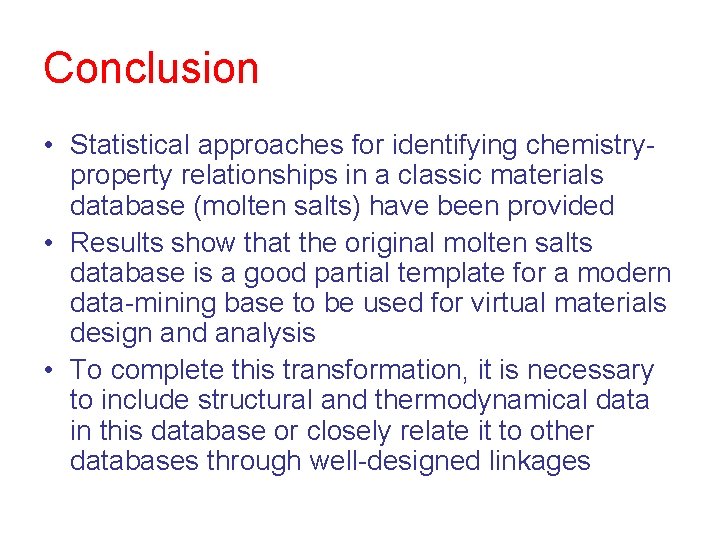
Conclusion • Statistical approaches for identifying chemistryproperty relationships in a classic materials database (molten salts) have been provided • Results show that the original molten salts database is a good partial template for a modern data-mining base to be used for virtual materials design and analysis • To complete this transformation, it is necessary to include structural and thermodynamical data in this database or closely relate it to other databases through well-designed linkages