
Interplay 12 th Edition AdlerRosenfeldProctor Copyright 2012 by
Interplay, 12 th Edition, Adler/Rosenfeld/Proctor Copyright © 2012 by Oxford University Press, Inc. CHAPTER 9 Dynamics of Interpersonal Relationships
Interplay Section 1 WHY WE FORM RELATIONSHIPS Interplay, 12 th Edition, Adler/Rosenfeld/Proctor Copyright © 2012 by Oxford University Press, Inc.
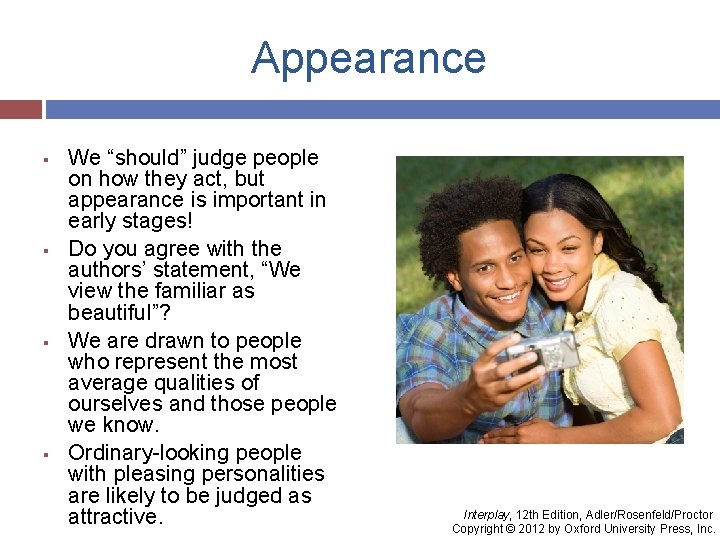
Appearance § § We “should” judge people on how they act, but appearance is important in early stages! Do you agree with the authors’ statement, “We view the familiar as beautiful”? We are drawn to people who represent the most average qualities of ourselves and those people we know. Ordinary-looking people with pleasing personalities are likely to be judged as attractive. Interplay, 12 th Edition, Adler/Rosenfeld/Proctor Copyright © 2012 by Oxford University Press, Inc.
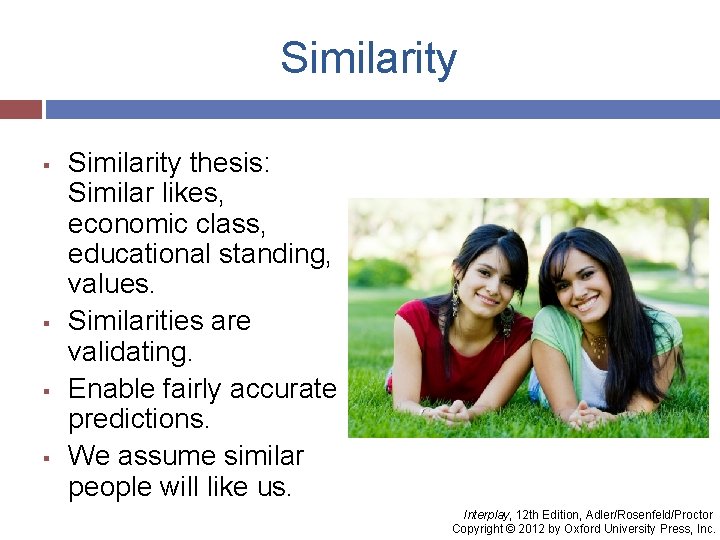
Similarity § § Similarity thesis: Similar likes, economic class, educational standing, values. Similarities are validating. Enable fairly accurate predictions. We assume similar people will like us. Interplay, 12 th Edition, Adler/Rosenfeld/Proctor Copyright © 2012 by Oxford University Press, Inc.
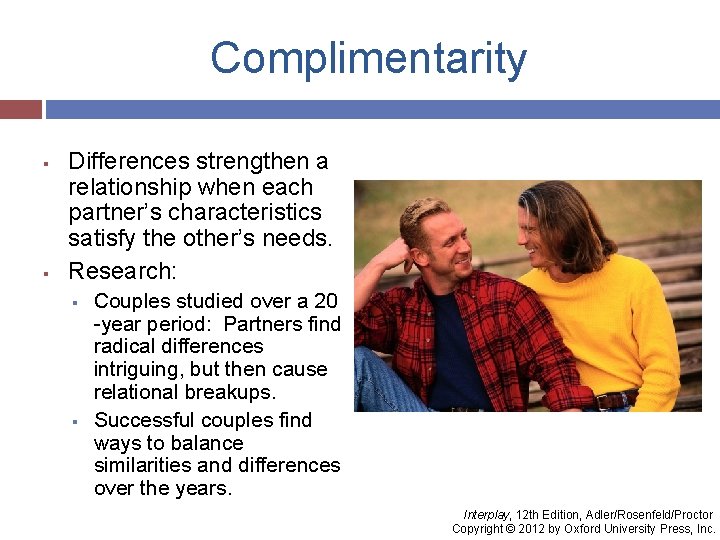
Complimentarity § § Differences strengthen a relationship when each partner’s characteristics satisfy the other’s needs. Research: § § Couples studied over a 20 -year period: Partners find radical differences intriguing, but then cause relational breakups. Successful couples find ways to balance similarities and differences over the years. Interplay, 12 th Edition, Adler/Rosenfeld/Proctor Copyright © 2012 by Oxford University Press, Inc.
Rewards § § Exchange theory: We often seek out people who can give us rewards that are greater than or equal to the costs we encounter in dealing with them. Rewards: outcomes that we desire; costs: undesirable outcomes. Rewards + Costs = Outcome Interplay, 12 th Edition, Adler/Rosenfeld/Proctor Copyright © 2012 by Oxford University Press, Inc.
Rewards Gloria + Raymond: Should she stay or go? Raymond loves Gloria, but has temper, is verbally abusive, has history of unfaithfulness. Gloria uses comparison level: Minimum standard of acceptable behavior OR comparison level of alternatives: comparison between the rewards she receives and those she could expect from others. Interplay, 12 th Edition, Adler/Rosenfeld/Proctor Copyright © 2012 by Oxford University Press, Inc.
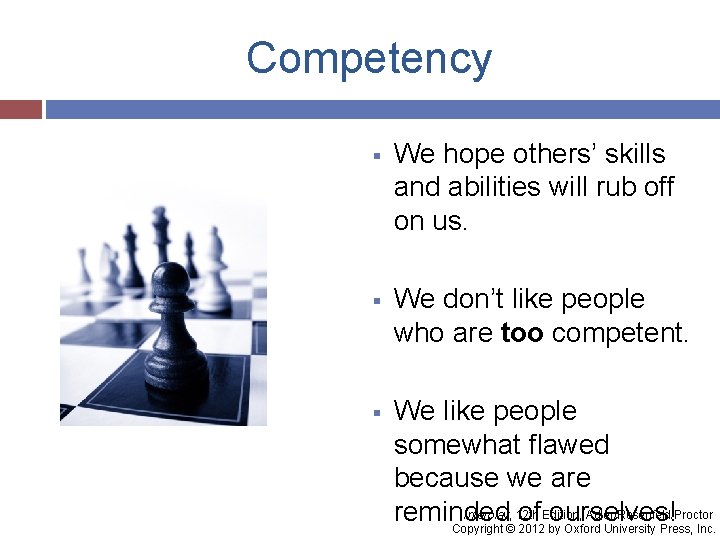
Competency § We hope others’ skills and abilities will rub off on us. § We don’t like people who are too competent. § We like people somewhat flawed because we are Interplay, 12 th Edition, Adler/Rosenfeld/Proctor reminded of ourselves! Copyright © 2012 by Oxford University Press, Inc.
Proximity § We develop relationships with people with whom we interact frequently— even in cyberspace. § Proximity enables more information about others and benefit from relationships with them. Interplay, 12 th Edition, Adler/Rosenfeld/Proctor Copyright © 2012 by Oxford University Press, Inc.
Disclosure § § § Telling important information about ourselves breeds liking based on respect and trust. Reciprocity is key: We like to get back an amount and kind of information equivalent to that which we reveal. Timing is important: Information should be appropriate to the stage of the relationship and the setting. Interplay, 12 th Edition, Adler/Rosenfeld/Proctor Copyright © 2012 by Oxford University Press, Inc.
Interplay END OF SECTION CHAPTER CONTINUES IN PART TWO Interplay, 12 th Edition, Adler/Rosenfeld/Proctor Copyright © 2012 by Oxford University Press, Inc.
- Slides: 11