
Interplay 12 th Edition AdlerRosenfeldProctor Copyright 2012 by
Interplay, 12 th Edition, Adler/Rosenfeld/Proctor Copyright © 2012 by Oxford University Press, Inc. CHAPTER 1 Interpersonal Process
Interplay Section 1 WHY STUDY COMMUNICATION? Interplay, 12 th Edition, Adler/Rosenfeld/Proctor Copyright © 2012 by Oxford University Press, Inc.
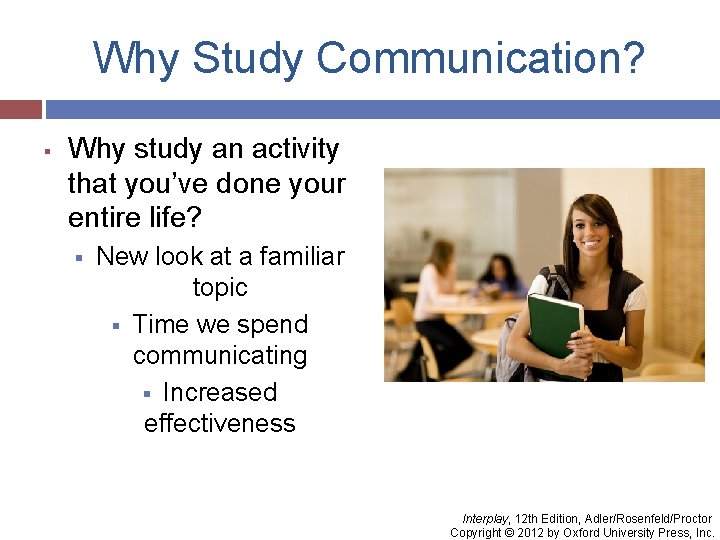
Why Study Communication? § Why study an activity that you’ve done your entire life? § New look at a familiar topic § Time we spend communicating § Increased effectiveness Interplay, 12 th Edition, Adler/Rosenfeld/Proctor Copyright © 2012 by Oxford University Press, Inc.
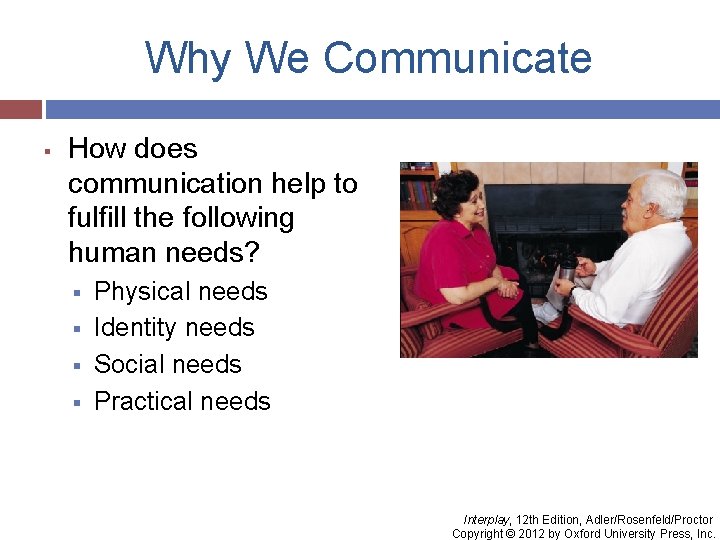
Why We Communicate § How does communication help to fulfill the following human needs? § § Physical needs Identity needs Social needs Practical needs Interplay, 12 th Edition, Adler/Rosenfeld/Proctor Copyright © 2012 by Oxford University Press, Inc.
Interplay Section 2 THE COMMUNICATION PROCESS Interplay, 12 th Edition, Adler/Rosenfeld/Proctor Copyright © 2012 by Oxford University Press, Inc.
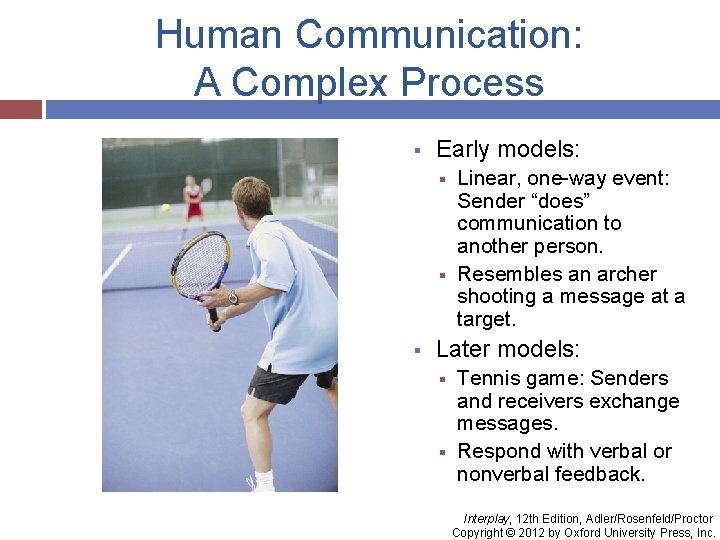
Human Communication: A Complex Process § Early models: § § § Linear, one-way event: Sender “does” communication to another person. Resembles an archer shooting a message at a target. Later models: § § Tennis game: Senders and receivers exchange messages. Respond with verbal or nonverbal feedback. Interplay, 12 th Edition, Adler/Rosenfeld/Proctor Copyright © 2012 by Oxford University Press, Inc.
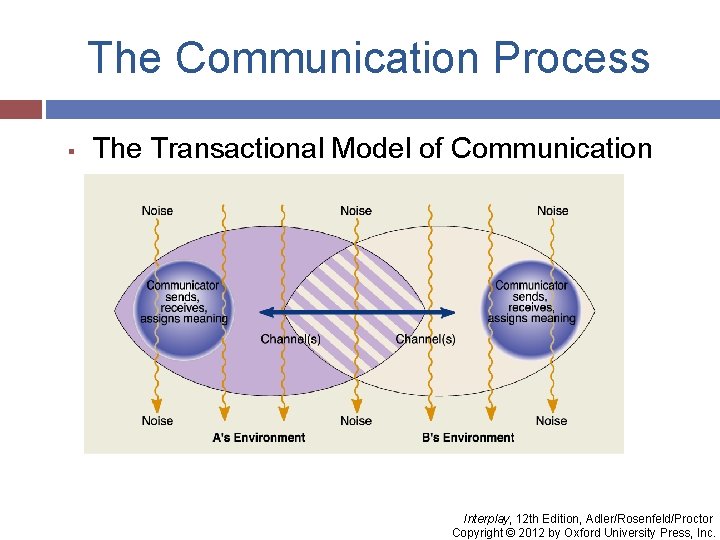
The Communication Process § The Transactional Model of Communication Interplay, 12 th Edition, Adler/Rosenfeld/Proctor Copyright © 2012 by Oxford University Press, Inc.
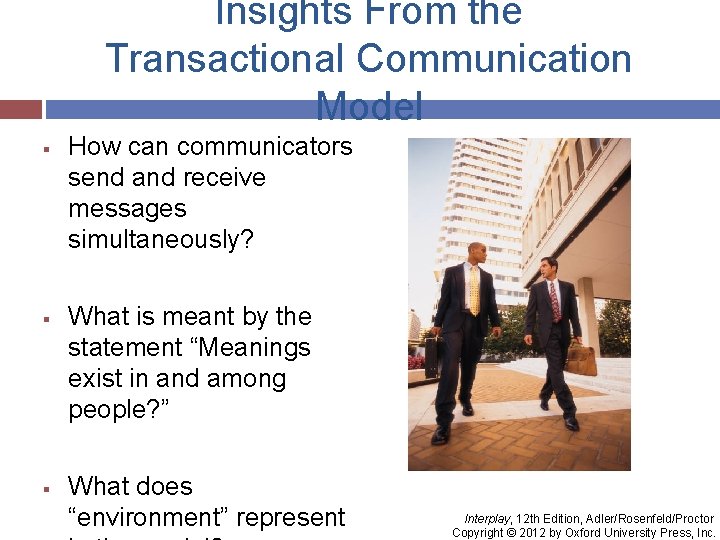
Insights From the Transactional Communication Model § § § How can communicators send and receive messages simultaneously? What is meant by the statement “Meanings exist in and among people? ” What does “environment” represent Interplay, 12 th Edition, Adler/Rosenfeld/Proctor Copyright © 2012 by Oxford University Press, Inc.
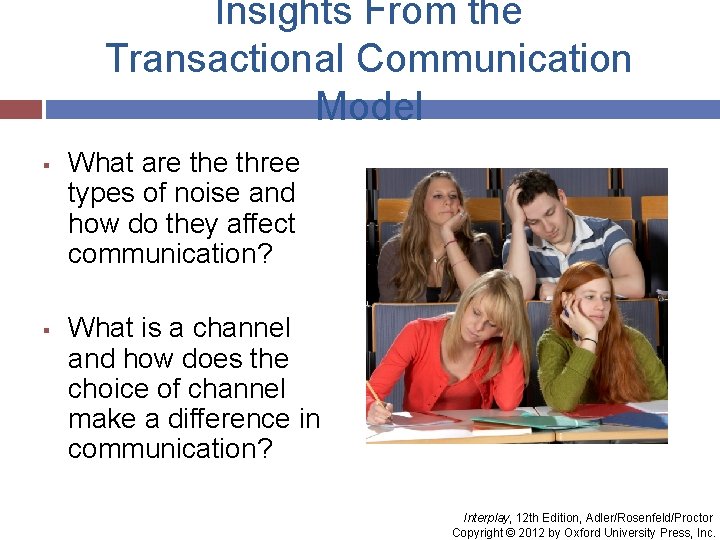
Insights From the Transactional Communication Model § § What are three types of noise and how do they affect communication? What is a channel and how does the choice of channel make a difference in communication? Interplay, 12 th Edition, Adler/Rosenfeld/Proctor Copyright © 2012 by Oxford University Press, Inc.
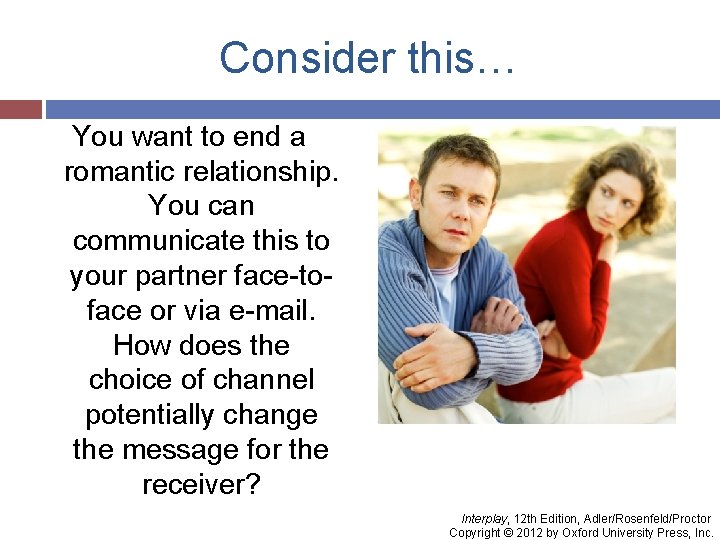
Consider this… You want to end a romantic relationship. You can communicate this to your partner face-toface or via e-mail. How does the choice of channel potentially change the message for the receiver? Interplay, 12 th Edition, Adler/Rosenfeld/Proctor Copyright © 2012 by Oxford University Press, Inc.
Communication Principles § Principles that guide our understanding of communication: § Communication is transactional Mutual influence Interdependent behaviors § Uniquely created § § § Content and relational dimension § Intentional versus unintentional § Irreversible § Unrepeatable Interplay, 12 th Edition, Adler/Rosenfeld/Proctor Copyright © 2012 by Oxford University Press, Inc.
Interplay Section 3 COMMUNICATION MISCONCEPTIONS Interplay, 12 th Edition, Adler/Rosenfeld/Proctor Copyright © 2012 by Oxford University Press, Inc.
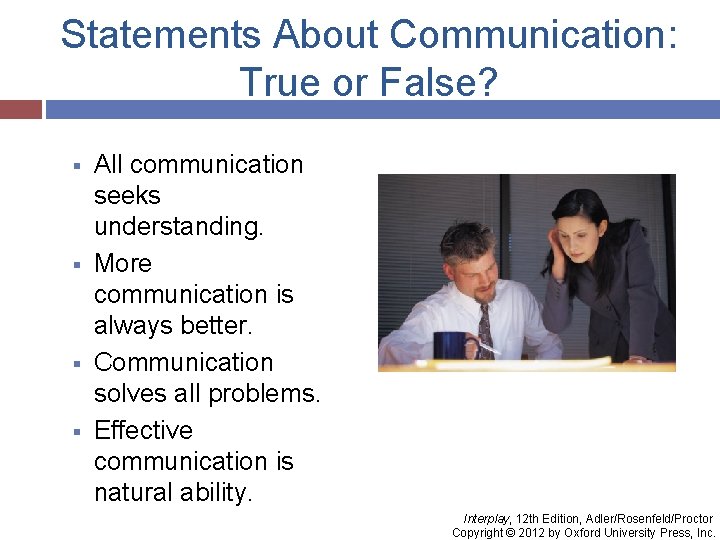
Statements About Communication: True or False? § § All communication seeks understanding. More communication is always better. Communication solves all problems. Effective communication is natural ability. Interplay, 12 th Edition, Adler/Rosenfeld/Proctor Copyright © 2012 by Oxford University Press, Inc.
Interplay Section 4 INTERPERSONAL COMMUNICATION, DEFINED Interplay, 12 th Edition, Adler/Rosenfeld/Proctor Copyright © 2012 by Oxford University Press, Inc.
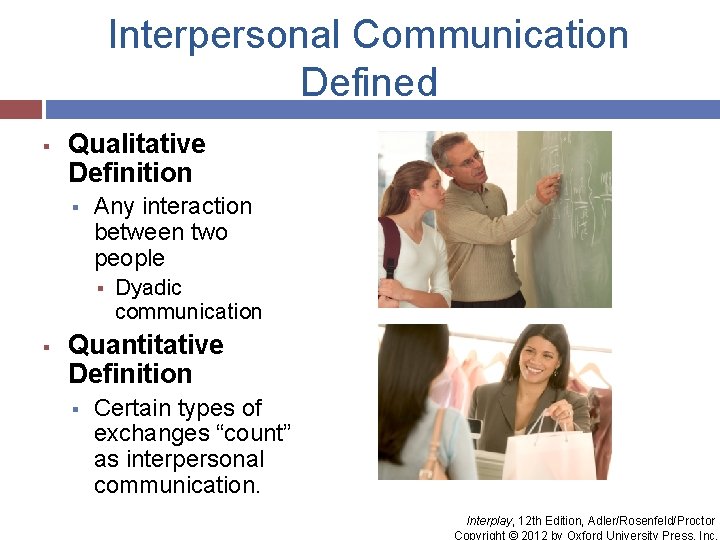
Interpersonal Communication Defined § Qualitative Definition § Any interaction between two people § § Dyadic communication Quantitative Definition § Certain types of exchanges “count” as interpersonal communication. Interplay, 12 th Edition, Adler/Rosenfeld/Proctor Copyright © 2012 by Oxford University Press, Inc.
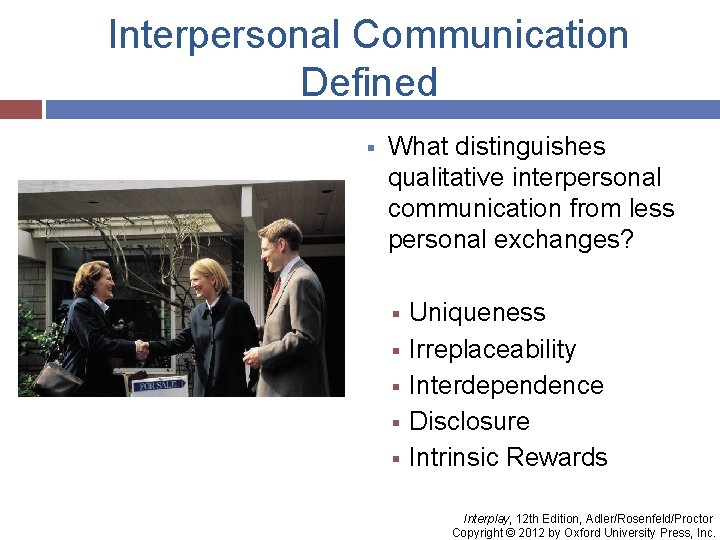
Interpersonal Communication Defined § What distinguishes qualitative interpersonal communication from less personal exchanges? § § § Uniqueness Irreplaceability Interdependence Disclosure Intrinsic Rewards Interplay, 12 th Edition, Adler/Rosenfeld/Proctor Copyright © 2012 by Oxford University Press, Inc.
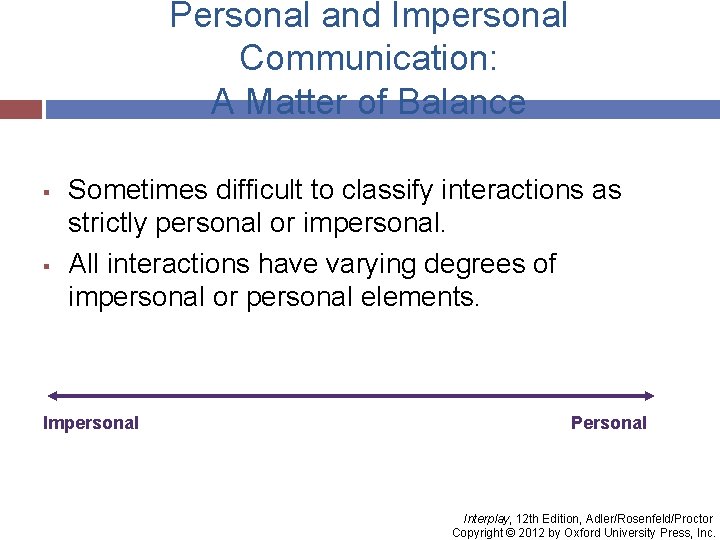
Personal and Impersonal Communication: A Matter of Balance § § Sometimes difficult to classify interactions as strictly personal or impersonal. All interactions have varying degrees of impersonal or personal elements. Impersonal Personal Interplay, 12 th Edition, Adler/Rosenfeld/Proctor Copyright © 2012 by Oxford University Press, Inc.
Interplay Section 5 COMMUNICATION COMPETENCE Interplay, 12 th Edition, Adler/Rosenfeld/Proctor Copyright © 2012 by Oxford University Press, Inc.
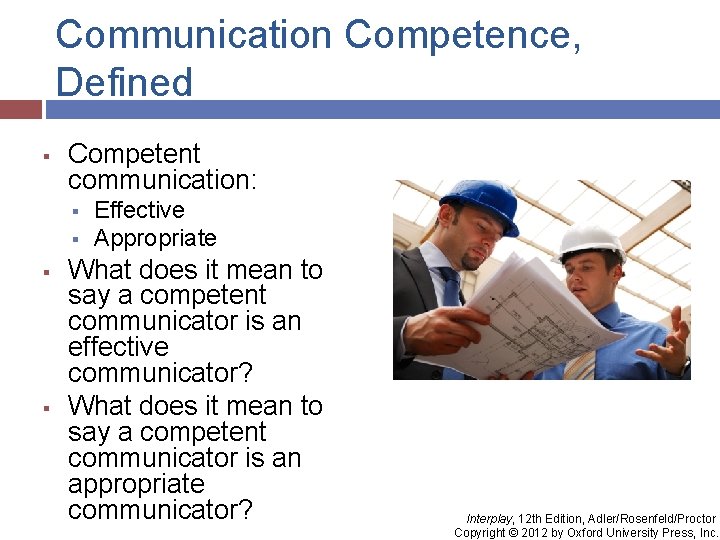
Communication Competence, Defined § Competent communication: § § Effective Appropriate What does it mean to say a competent communicator is an effective communicator? What does it mean to say a competent communicator is an appropriate communicator? Interplay, 12 th Edition, Adler/Rosenfeld/Proctor Copyright © 2012 by Oxford University Press, Inc.
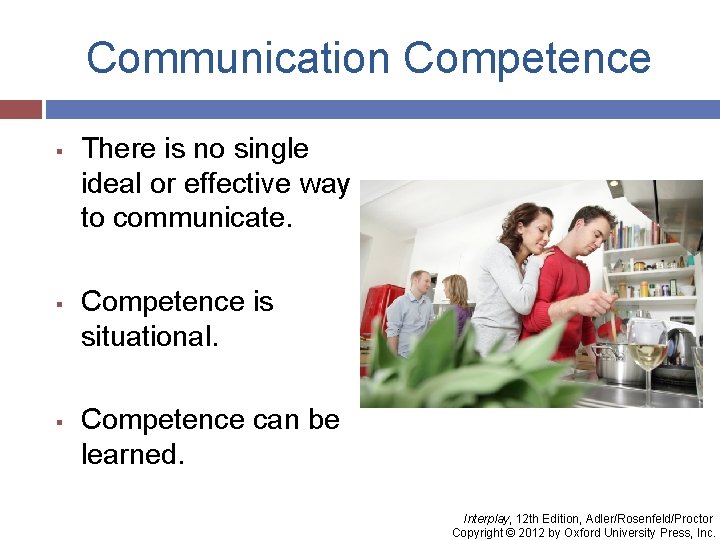
Communication Competence § § § There is no single ideal or effective way to communicate. Competence is situational. Competence can be learned. Interplay, 12 th Edition, Adler/Rosenfeld/Proctor Copyright © 2012 by Oxford University Press, Inc.
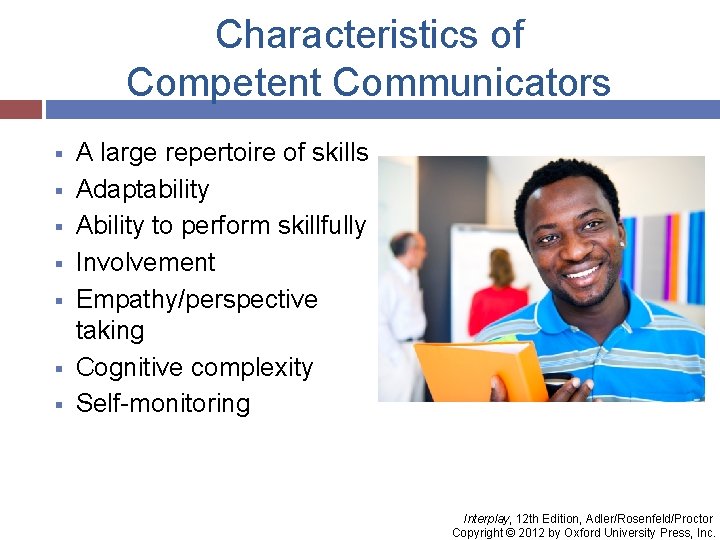
Characteristics of Competent Communicators § § § § A large repertoire of skills Adaptability Ability to perform skillfully Involvement Empathy/perspective taking Cognitive complexity Self-monitoring Interplay, 12 th Edition, Adler/Rosenfeld/Proctor Copyright © 2012 by Oxford University Press, Inc.
Interplay END OF SECTION Interplay, 12 th Edition, Adler/Rosenfeld/Proctor Copyright © 2012 by Oxford University Press, Inc.
- Slides: 22