
Interplanetary Electron Beams SIRA Imaging and Science Prospects
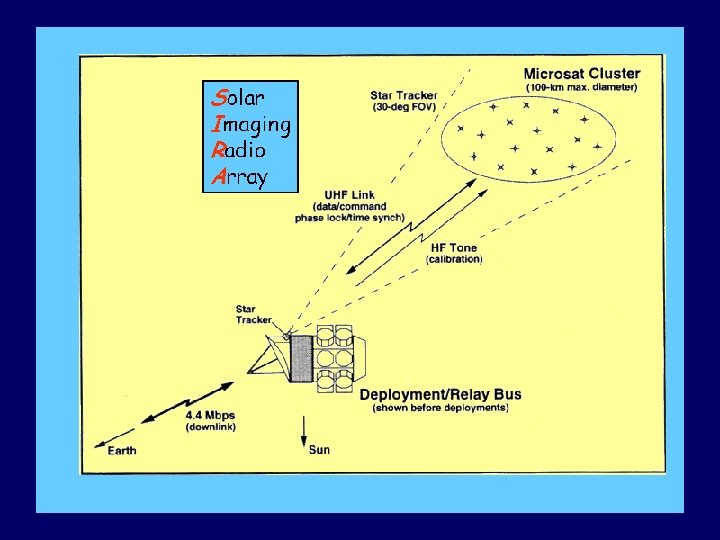
Interplanetary Electron Beams : SIRA Imaging and Science Prospects Markus J. Aschwanden (LMSAL) Solar Imaging Radio Array (SIRA) Workshop, May 13 -14, 2003 CSC – Greentech IV Auditorium, Lanham MD - NASA/GSFC
Talk contents : 1) Basic Physcial Processes of Electron Beams 2) Key Observations and Open Problems 3) Science Tasks and Prospects of SIRA
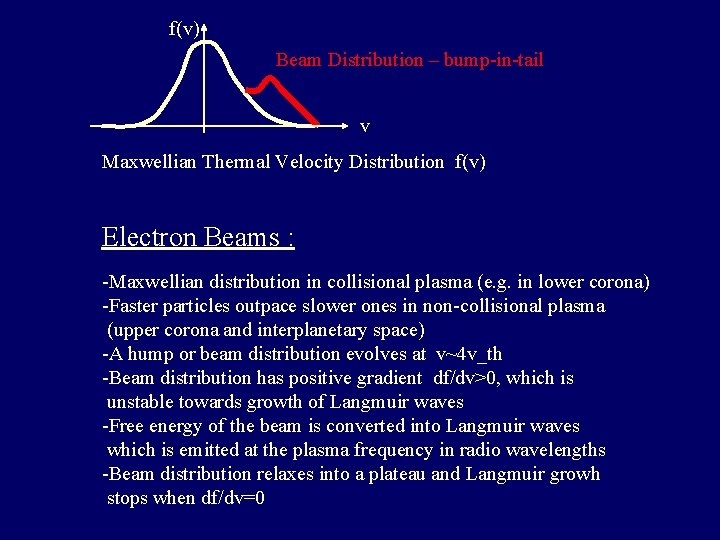
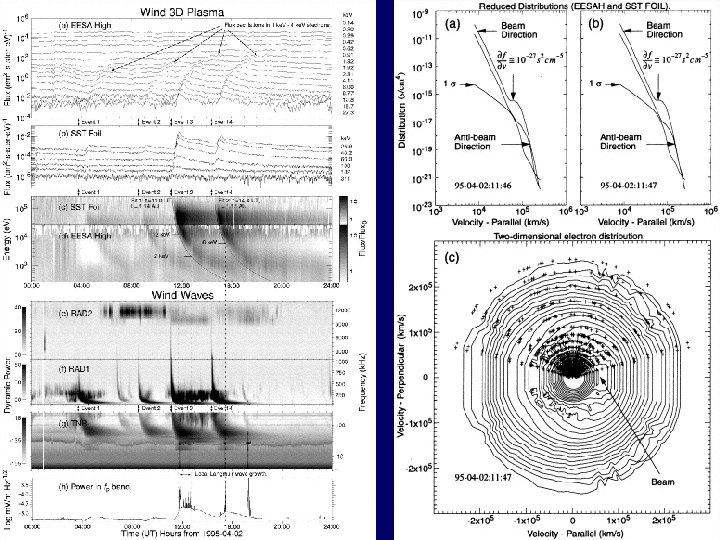
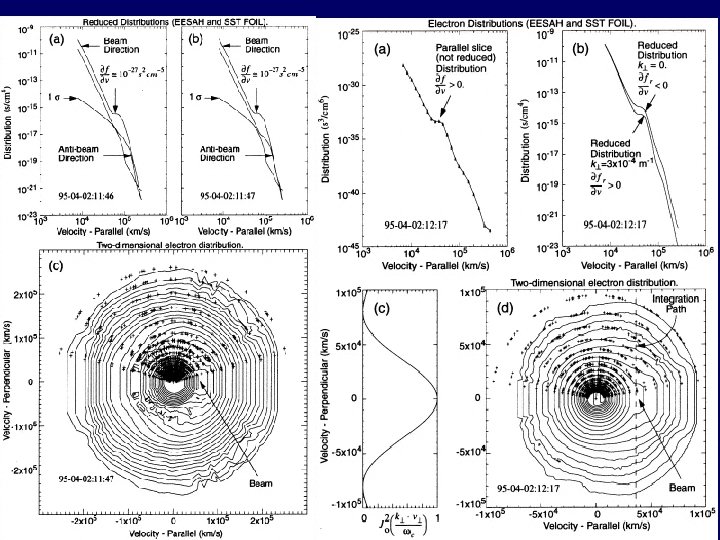
f(v) Beam Distribution – bump-in-tail v Maxwellian Thermal Velocity Distribution f(v) Electron Beams : -Maxwellian distribution in collisional plasma (e. g. in lower corona) -Faster particles outpace slower ones in non-collisional plasma (upper corona and interplanetary space) -A hump or beam distribution evolves at v~4 v_th -Beam distribution has positive gradient df/dv>0, which is unstable towards growth of Langmuir waves -Free energy of the beam is converted into Langmuir waves which is emitted at the plasma frequency in radio wavelengths -Beam distribution relaxes into a plateau and Langmuir growh stops when df/dv=0
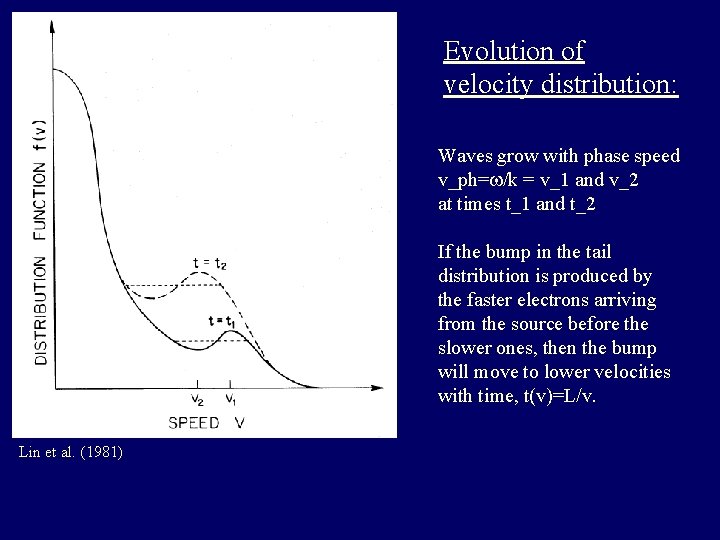
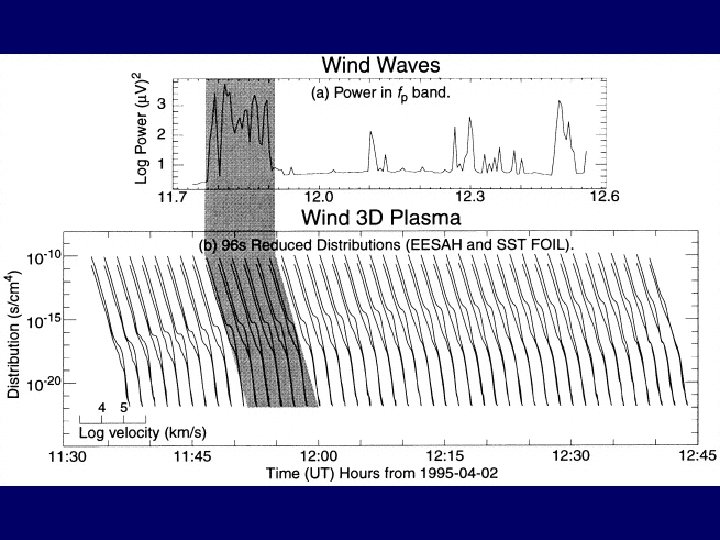
Evolution of velocity distribution: Waves grow with phase speed v_ph= /k = v_1 and v_2 at times t_1 and t_2 If the bump in the tail distribution is produced by the faster electrons arriving from the source before the slower ones, then the bump will move to lower velocities with time, t(v)=L/v. Lin et al. (1981)
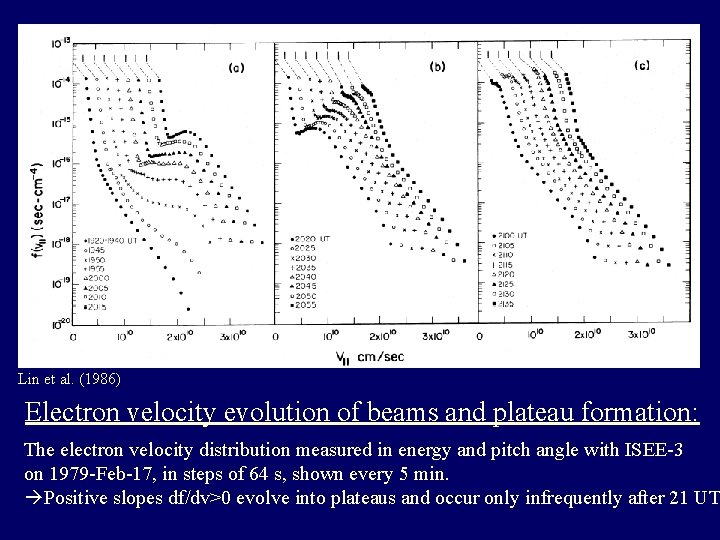
Lin et al. (1986) Electron velocity evolution of beams and plateau formation: The electron velocity distribution measured in energy and pitch angle with ISEE-3 on 1979 -Feb-17, in steps of 64 s, shown every 5 min. Positive slopes df/dv>0 evolve into plateaus and occur only infrequently after 21 UT

f(v) Beam distribution – bump-in-tail v Maxwellian thermal velocity distribution f(v) = f_th(v) + f_b(v-v_b) Dispersion relation for plasma Langmuir waves Growth Rate of Langmuir Waves : Conditions for growth : v_b > 3 * v_th
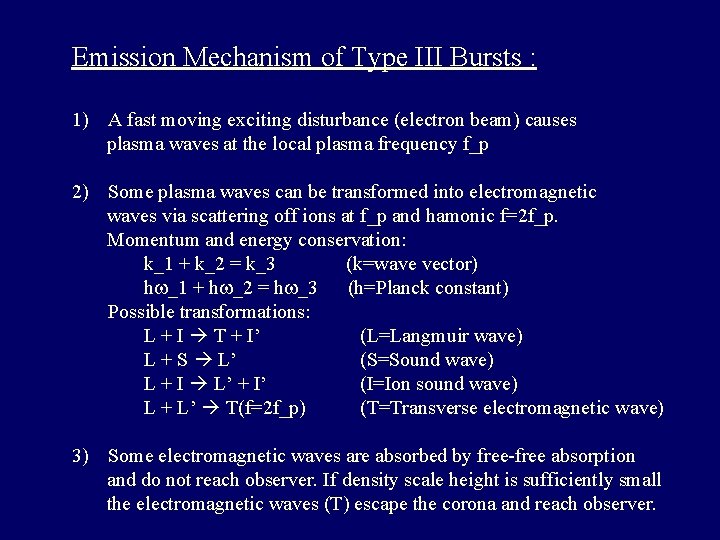
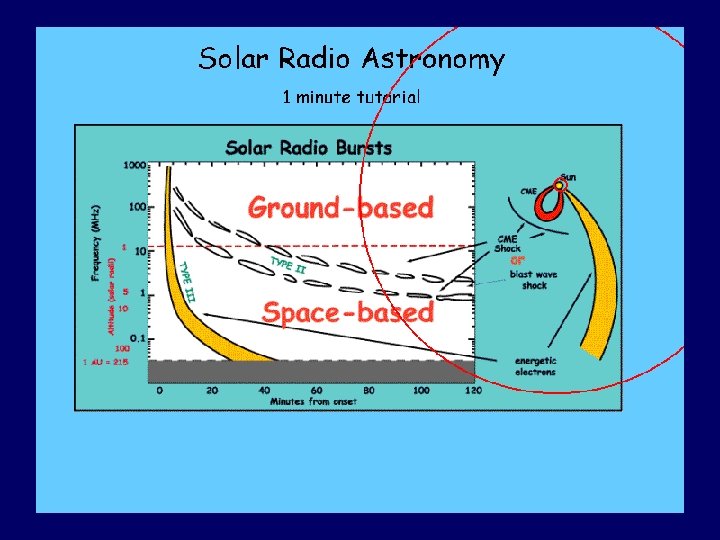
Emission Mechanism of Type III Bursts : 1) A fast moving exciting disturbance (electron beam) causes plasma waves at the local plasma frequency f_p 2) Some plasma waves can be transformed into electromagnetic waves via scattering off ions at f_p and hamonic f=2 f_p. Momentum and energy conservation: k_1 + k_2 = k_3 (k=wave vector) h _1 + h _2 = h _3 (h=Planck constant) Possible transformations: L + I T + I’ (L=Langmuir wave) L + S L’ (S=Sound wave) L + I L’ + I’ (I=Ion sound wave) L + L’ T(f=2 f_p) (T=Transverse electromagnetic wave) 3) Some electromagnetic waves are absorbed by free-free absorption and do not reach observer. If density scale height is sufficiently small the electromagnetic waves (T) escape the corona and reach observer.
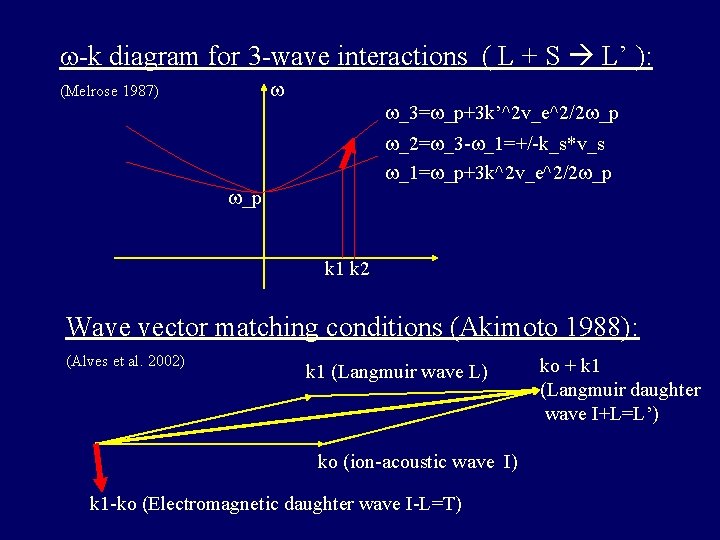
-k diagram for 3 -wave interactions ( L + S L’ ): (Melrose 1987) _3= _p+3 k’^2 v_e^2/2 _p _2= _3 - _1=+/-k_s*v_s _1= _p+3 k^2 v_e^2/2 _p k 1 k 2 Wave vector matching conditions (Akimoto 1988): (Alves et al. 2002) k 1 (Langmuir wave L) ko (ion-acoustic wave I) k 1 -ko (Electromagnetic daughter wave I-L=T) ko + k 1 (Langmuir daughter wave I+L=L’)
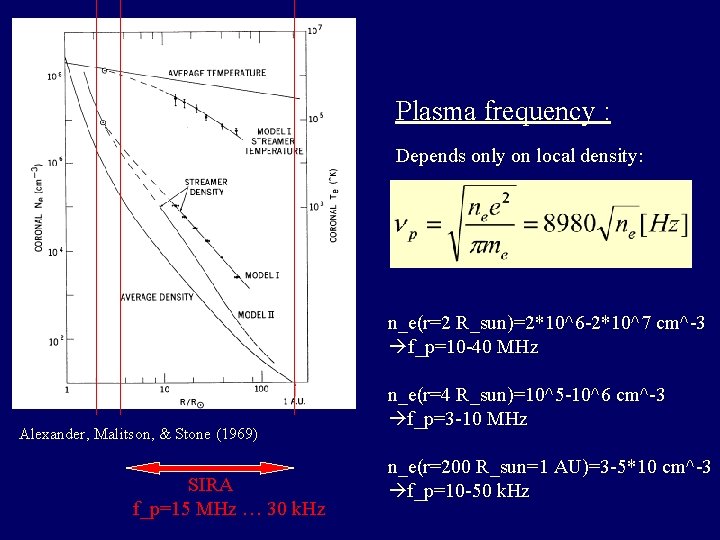
Plasma frequency : Depends only on local density: n_e(r=2 R_sun)=2*10^6 -2*10^7 cm^-3 f_p=10 -40 MHz Alexander, Malitson, & Stone (1969) SIRA f_p=15 MHz … 30 k. Hz n_e(r=4 R_sun)=10^5 -10^6 cm^-3 f_p=3 -10 MHz n_e(r=200 R_sun=1 AU)=3 -5*10 cm^-3 f_p=10 -50 k. Hz
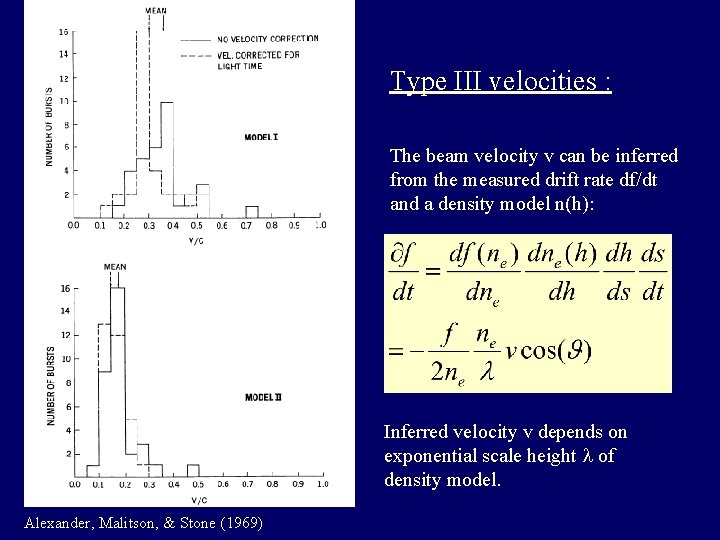
Type III velocities : The beam velocity v can be inferred from the measured drift rate df/dt and a density model n(h): Inferred velocity v depends on exponential scale height of density model. Alexander, Malitson, & Stone (1969)
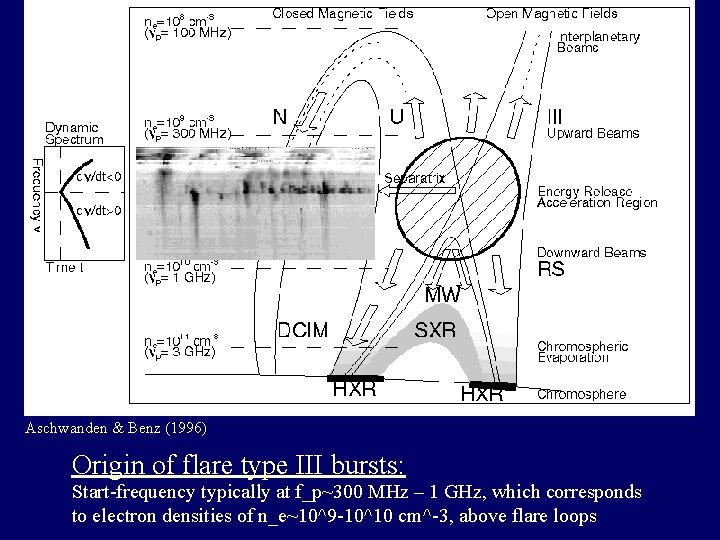
Aschwanden & Benz (1996) Origin of flare type III bursts: Start-frequency typically at f_p~300 MHz – 1 GHz, which corresponds to electron densities of n_e~10^9 -10^10 cm^-3, above flare loops
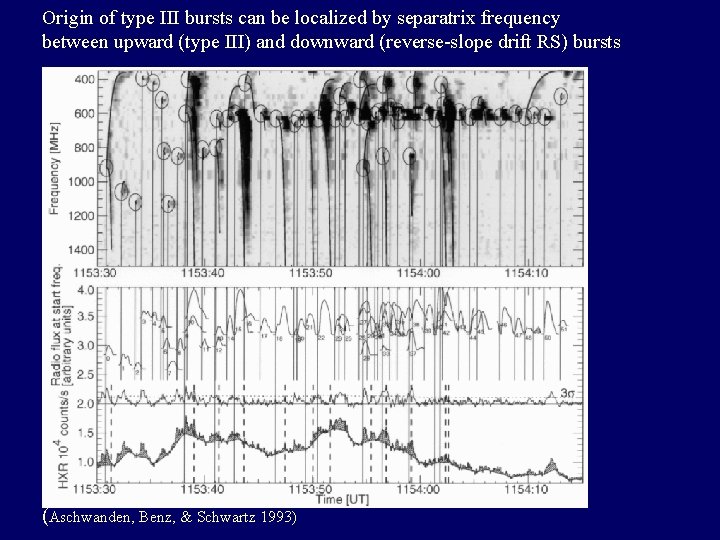
Origin of type III bursts can be localized by separatrix frequency between upward (type III) and downward (reverse-slope drift RS) bursts (Aschwanden, Benz, & Schwartz 1993)
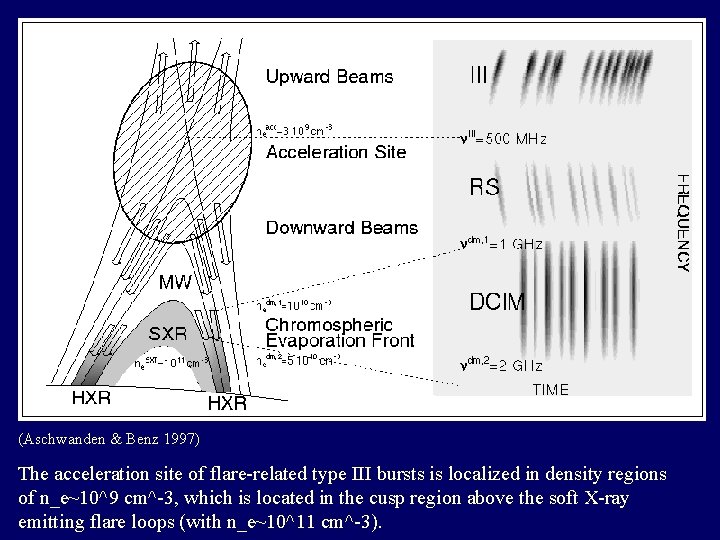
(Aschwanden & Benz 1997) The acceleration site of flare-related type III bursts is localized in density regions of n_e~10^9 cm^-3, which is located in the cusp region above the soft X-ray emitting flare loops (with n_e~10^11 cm^-3).
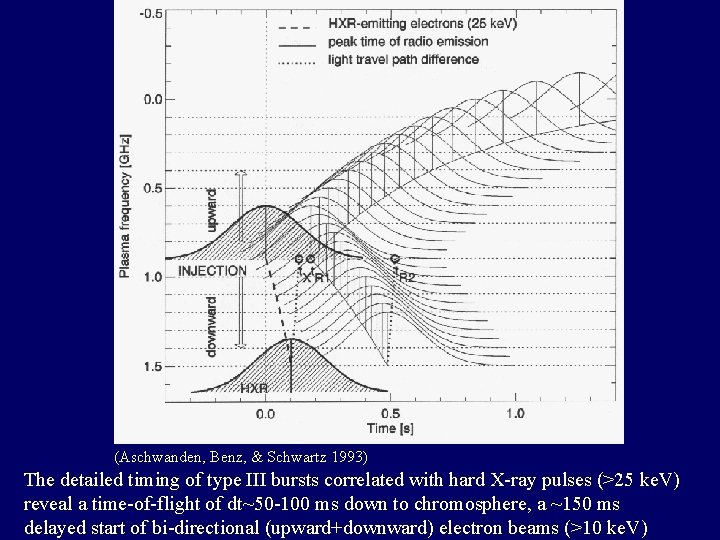
(Aschwanden, Benz, & Schwartz 1993) The detailed timing of type III bursts correlated with hard X-ray pulses (>25 ke. V) reveal a time-of-flight of dt~50 -100 ms down to chromosphere, a ~150 ms delayed start of bi-directional (upward+downward) electron beams (>10 ke. V)
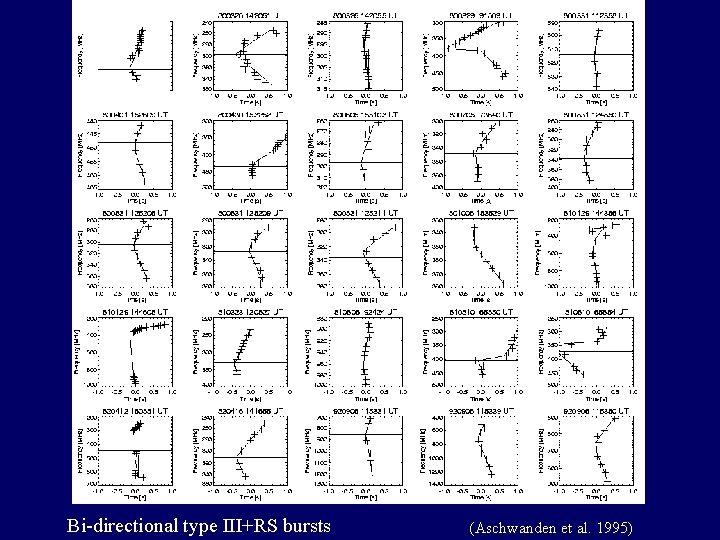
Bi-directional type III+RS bursts (Aschwanden et al. 1995)
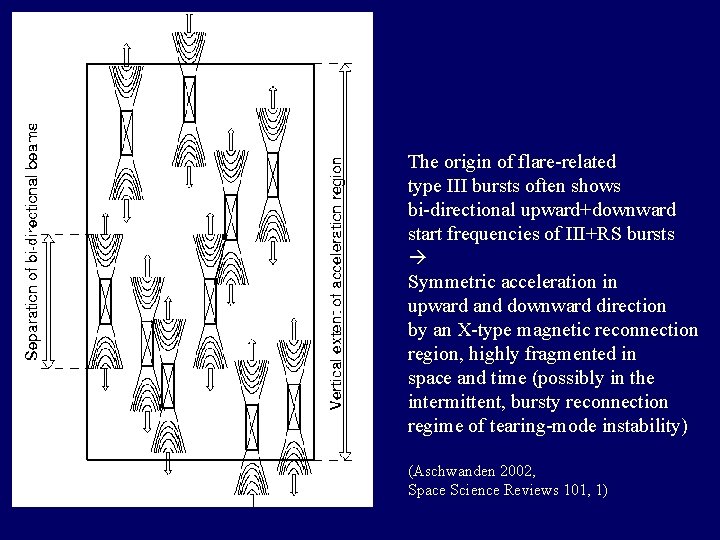
The origin of flare-related type III bursts often shows bi-directional upward+downward start frequencies of III+RS bursts Symmetric acceleration in upward and downward direction by an X-type magnetic reconnection region, highly fragmented in space and time (possibly in the intermittent, bursty reconnection regime of tearing-mode instability) (Aschwanden 2002, Space Science Reviews 101, 1)
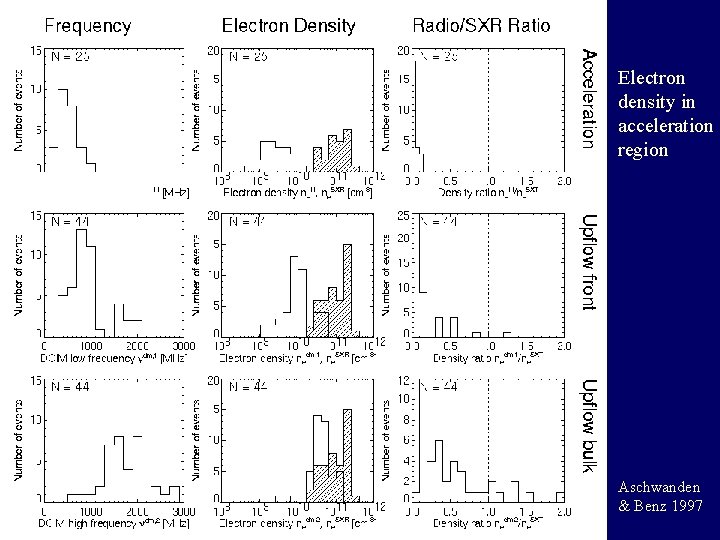
Electron density in acceleration region Aschwanden & Benz 1997
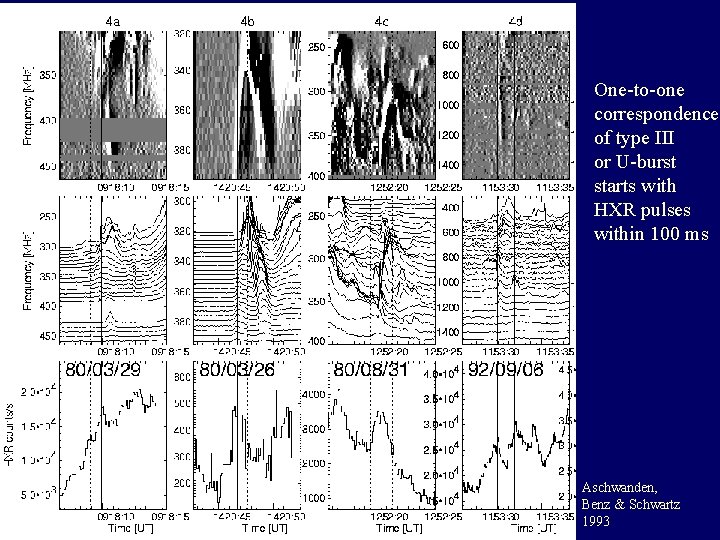
One-to-one correspondence of type III or U-burst starts with HXR pulses within 100 ms Aschwanden, Benz & Schwartz 1993
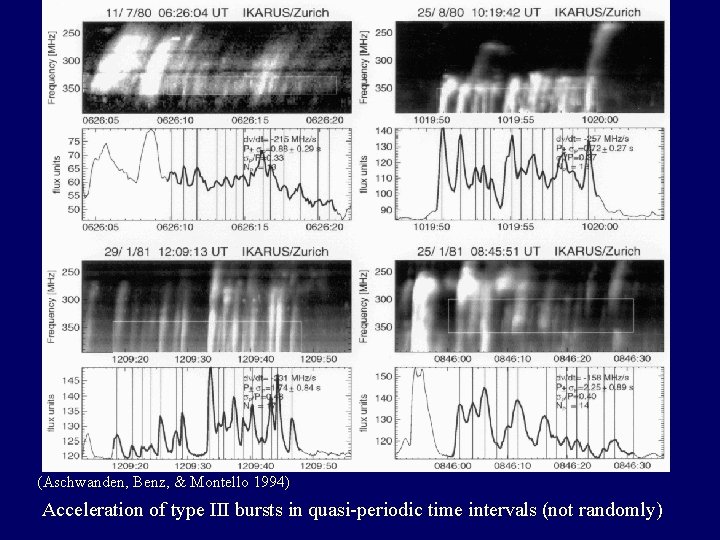
(Aschwanden, Benz, & Montello 1994) Acceleration of type III bursts in quasi-periodic time intervals (not randomly)
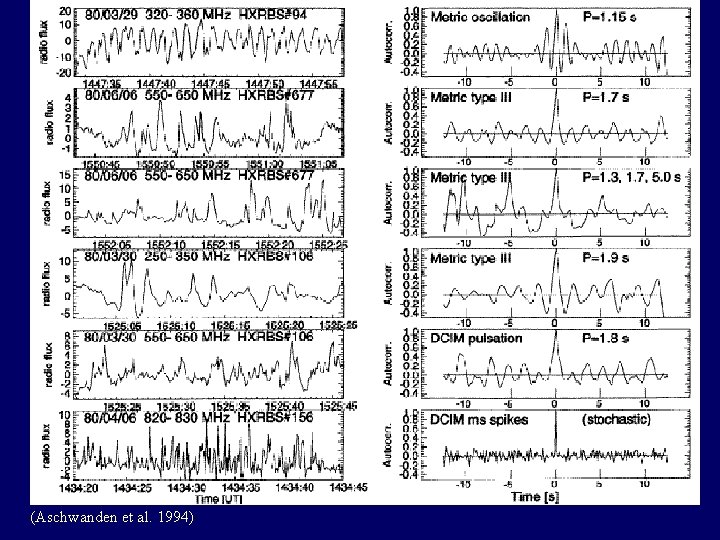
(Aschwanden et al. 1994)
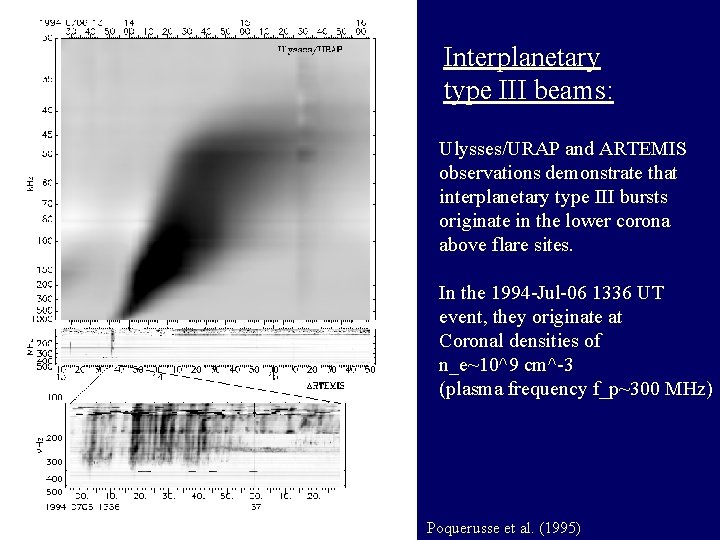
Interplanetary type III beams: Ulysses/URAP and ARTEMIS observations demonstrate that interplanetary type III bursts originate in the lower corona above flare sites. In the 1994 -Jul-06 1336 UT event, they originate at Coronal densities of n_e~10^9 cm^-3 (plasma frequency f_p~300 MHz) Poquerusse et al. (1995)
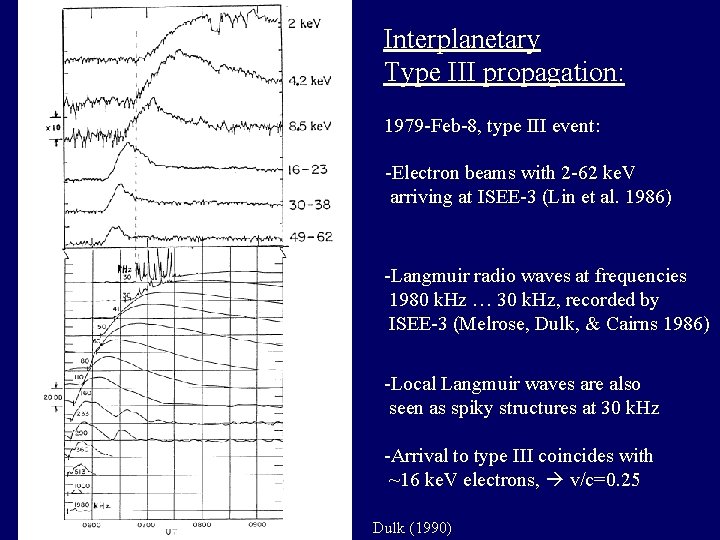
Interplanetary Type III propagation: 1979 -Feb-8, type III event: -Electron beams with 2 -62 ke. V arriving at ISEE-3 (Lin et al. 1986) -Langmuir radio waves at frequencies 1980 k. Hz … 30 k. Hz, recorded by ISEE-3 (Melrose, Dulk, & Cairns 1986) -Local Langmuir waves are also seen as spiky structures at 30 k. Hz -Arrival to type III coincides with ~16 ke. V electrons, v/c=0. 25 Dulk (1990)
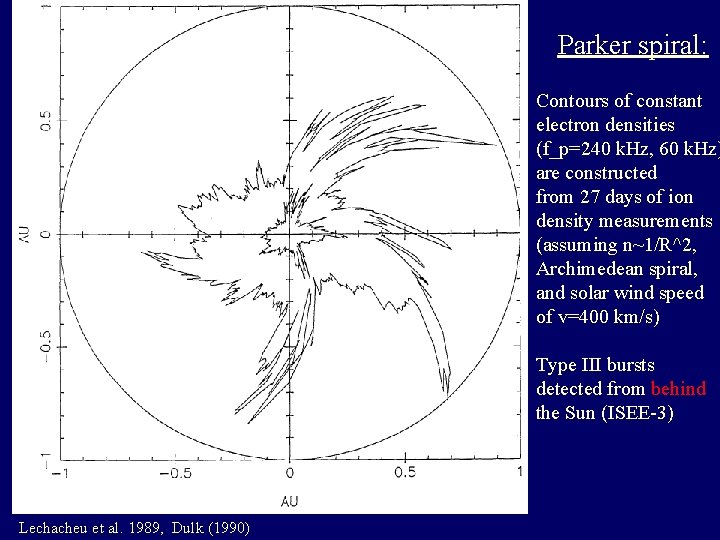
Parker spiral: Contours of constant electron densities (f_p=240 k. Hz, 60 k. Hz) are constructed from 27 days of ion density measurements (assuming n~1/R^2, Archimedean spiral, and solar wind speed of v=400 km/s) Type III bursts detected from behind the Sun (ISEE-3) Lechacheu et al. 1989, Dulk (1990)
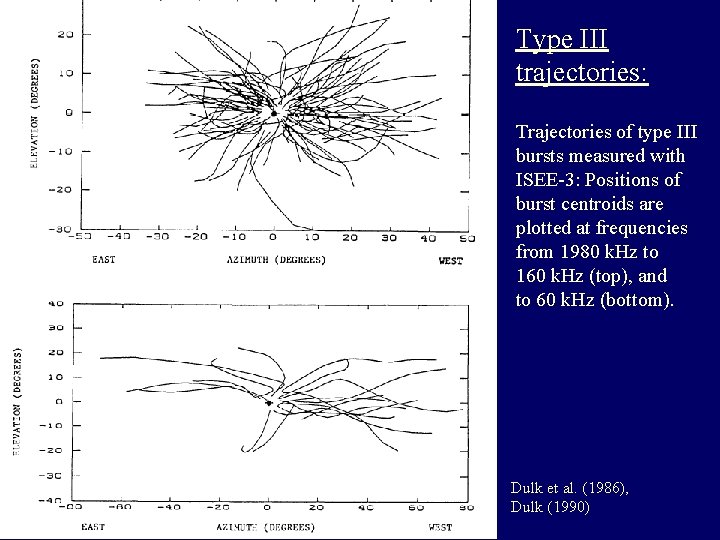
Type III trajectories: Trajectories of type III bursts measured with ISEE-3: Positions of burst centroids are plotted at frequencies from 1980 k. Hz to 160 k. Hz (top), and to 60 k. Hz (bottom). Dulk et al. (1986), Dulk (1990)
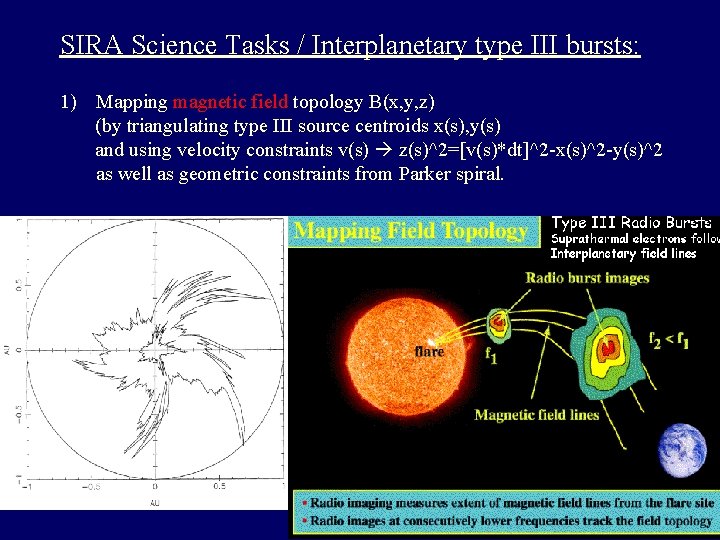
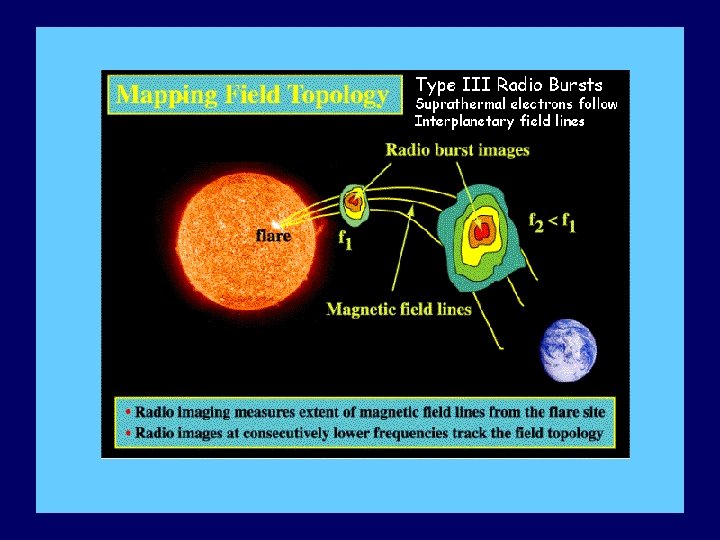
SIRA Science Tasks / Interplanetary type III bursts: 1) Mapping magnetic field topology B(x, y, z) (by triangulating type III source centroids x(s), y(s) and using velocity constraints v(s) z(s)^2=[v(s)*dt]^2 -x(s)^2 -y(s)^2 as well as geometric constraints from Parker spiral.
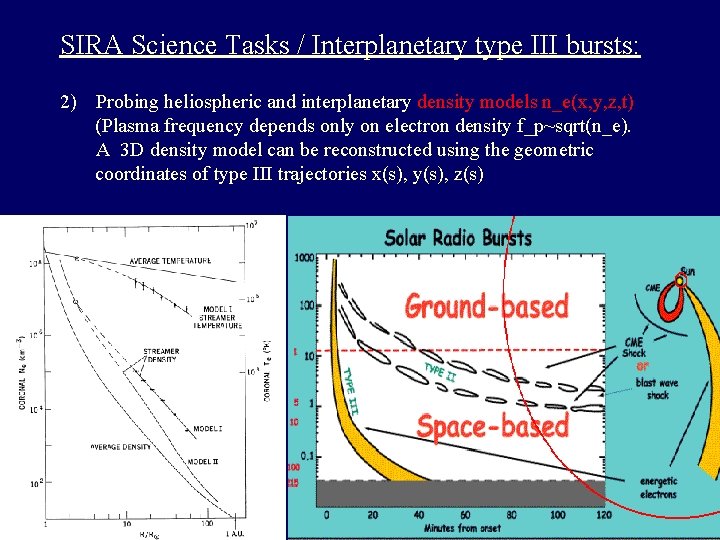
SIRA Science Tasks / Interplanetary type III bursts: 2) Probing heliospheric and interplanetary density models n_e(x, y, z, t) (Plasma frequency depends only on electron density f_p~sqrt(n_e). A 3 D density model can be reconstructed using the geometric coordinates of type III trajectories x(s), y(s), z(s)
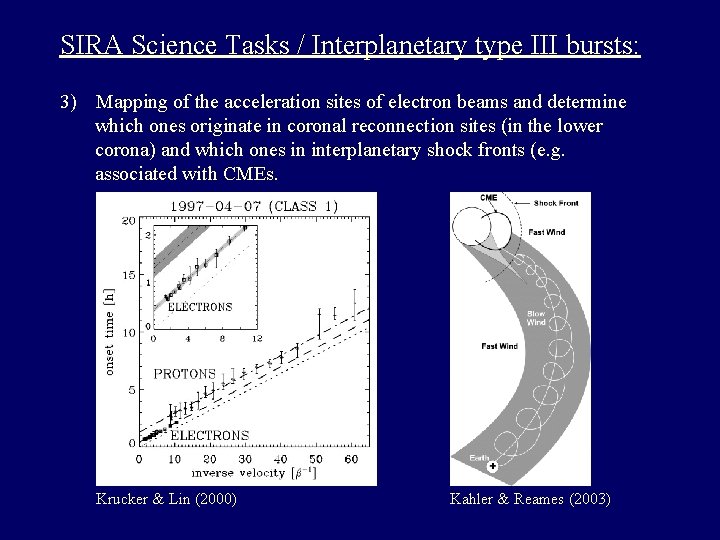
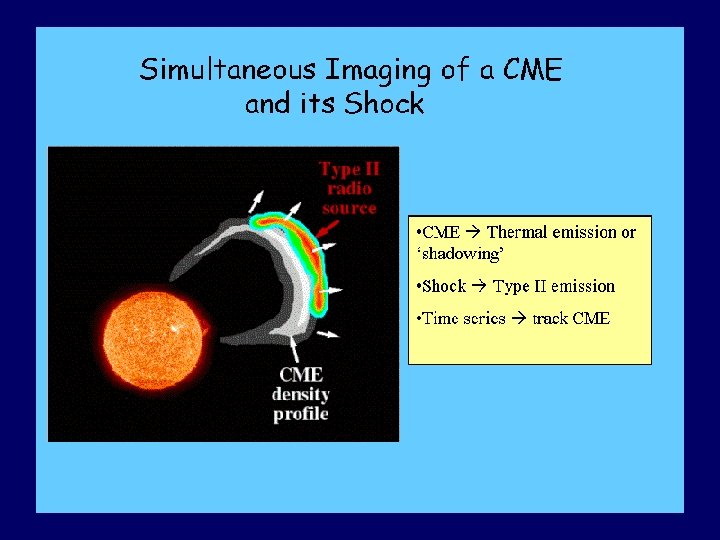
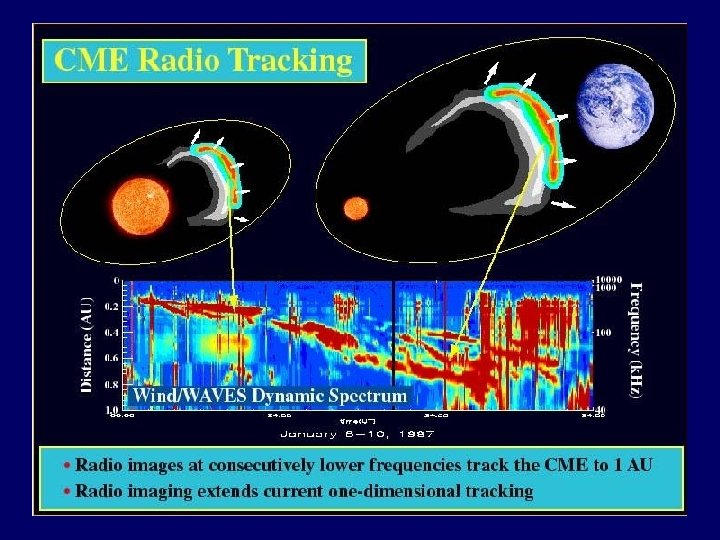
SIRA Science Tasks / Interplanetary type III bursts: 3) Mapping of the acceleration sites of electron beams and determine which ones originate in coronal reconnection sites (in the lower corona) and which ones in interplanetary shock fronts (e. g. associated with CMEs. Krucker & Lin (2000) Kahler & Reames (2003)
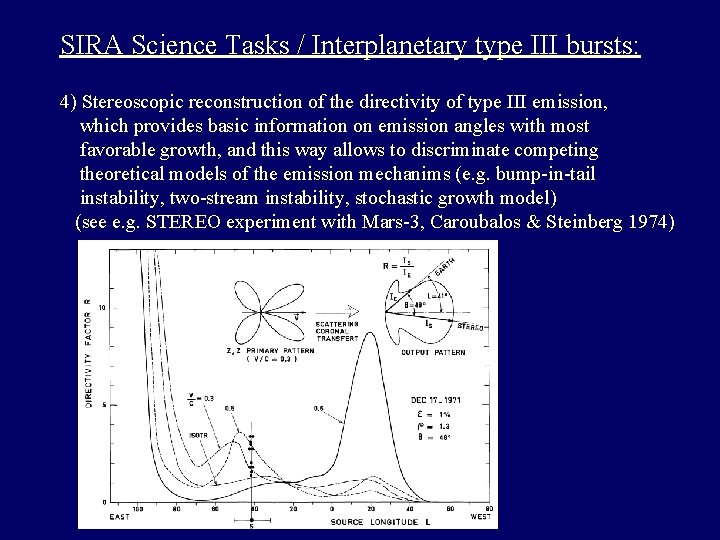
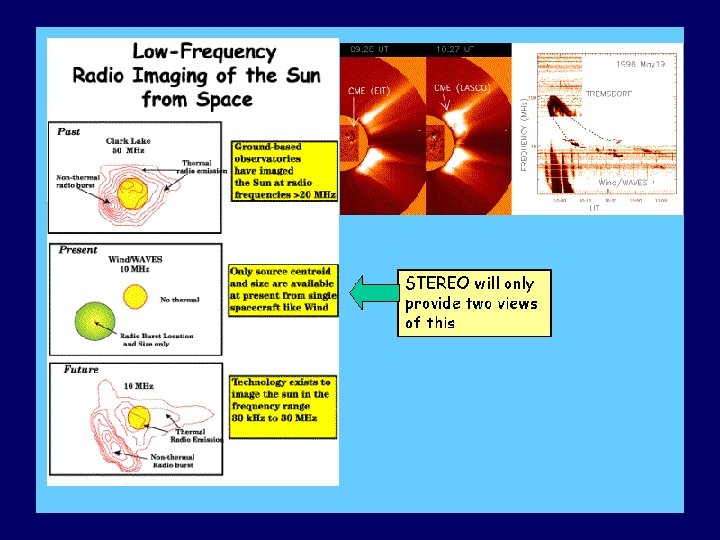
SIRA Science Tasks / Interplanetary type III bursts: 4) Stereoscopic reconstruction of the directivity of type III emission, which provides basic information on emission angles with most favorable growth, and this way allows to discriminate competing theoretical models of the emission mechanims (e. g. bump-in-tail instability, two-stream instability, stochastic growth model) (see e. g. STEREO experiment with Mars-3, Caroubalos & Steinberg 1974)
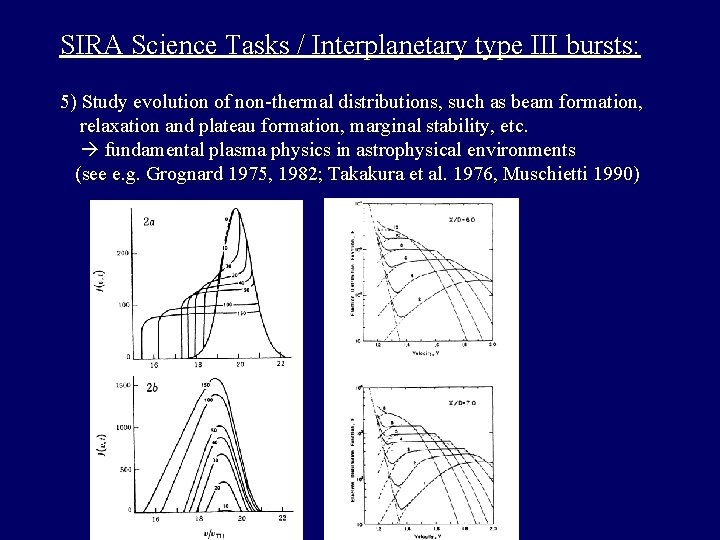
SIRA Science Tasks / Interplanetary type III bursts: 5) Study evolution of non-thermal distributions, such as beam formation, relaxation and plateau formation, marginal stability, etc. fundamental plasma physics in astrophysical environments (see e. g. Grognard 1975, 1982; Takakura et al. 1976, Muschietti 1990)
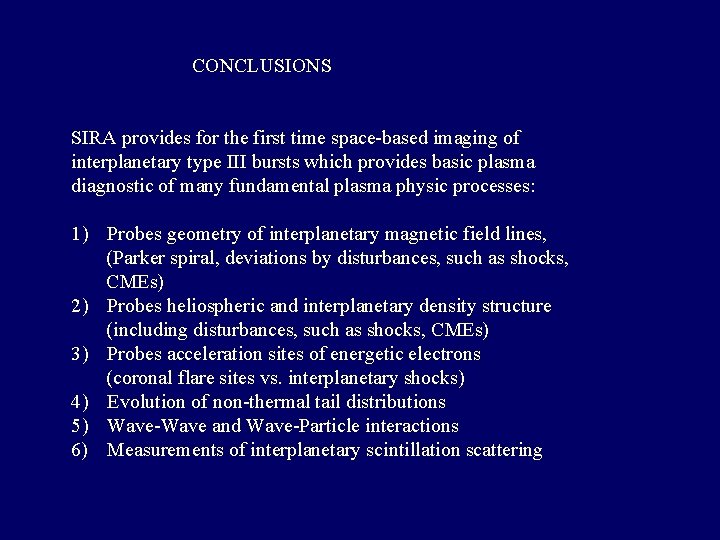
CONCLUSIONS SIRA provides for the first time space-based imaging of interplanetary type III bursts which provides basic plasma diagnostic of many fundamental plasma physic processes: 1) Probes geometry of interplanetary magnetic field lines, (Parker spiral, deviations by disturbances, such as shocks, CMEs) 2) Probes heliospheric and interplanetary density structure (including disturbances, such as shocks, CMEs) 3) Probes acceleration sites of energetic electrons (coronal flare sites vs. interplanetary shocks) 4) Evolution of non-thermal tail distributions 5) Wave-Wave and Wave-Particle interactions 6) Measurements of interplanetary scintillation scattering
- Slides: 41