
Interoperability Roadmap Early Draft Material Joint HITPC and
Interoperability Roadmap: Early Draft Material Joint HITPC and HITSC Meeting October 15, 2014 Erica Galvez Interoperability Portfolio Manager ONC
10 Year Interoperability Vision • Leverage health IT to increase health care quality, lower health care costs and improve population health • Support health - not limited to care delivery • Build incrementally from current technology • Establish best minimum possible • Create opportunities for innovation • Empower individuals DRAFT Materials, For Discussion Only 1

Interoperability Roadmap • ONC’s 10 year vision committed us to leading the development of a shared, nationwide interoperability roadmap – This is not just an HHS or federal government roadmap • Who should do what by when so it is clear how we will meet the country’s expectations • Unprecedented collaboration is necessary • All stakeholders should be able to see their responsibilities in the roadmap DRAFT Materials, For Discussion Only 2
What Should the Roadmap do? • Help stakeholders make decisions in the short run that build to an interoperable future • Describe a path to get from current state to the desired future state • Describe actions required to make that path a reality and who must take them • Serve as a living document - updated regularly to reflect change over time DRAFT Materials, For Discussion Only 3
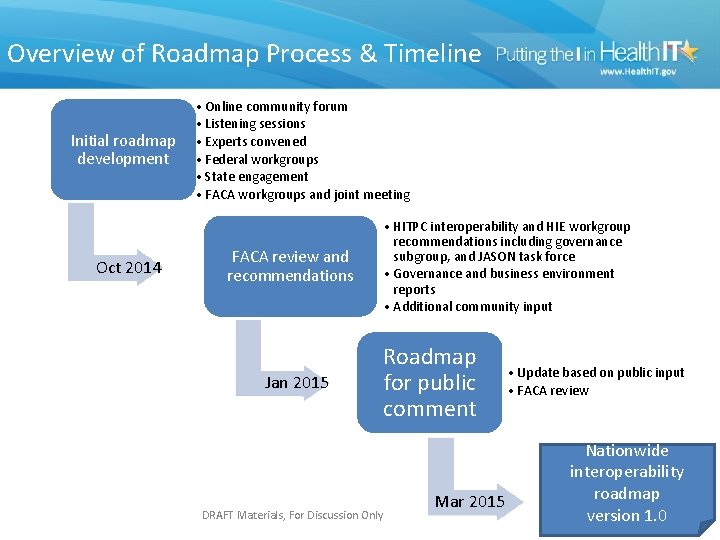
Overview of Roadmap Process & Timeline Initial roadmap development Oct 2014 • Online community forum • Listening sessions • Experts convened • Federal workgroups • State engagement • FACA workgroups and joint meeting • HITPC interoperability and HIE workgroup recommendations including governance subgroup, and JASON task force • Governance and business environment reports • Additional community input FACA review and recommendations Jan 2015 Roadmap for public comment DRAFT Materials, For Discussion Only • Update based on public input • FACA review Mar 2015 Mar Nationwide interoperability roadmap version 1. 0 4
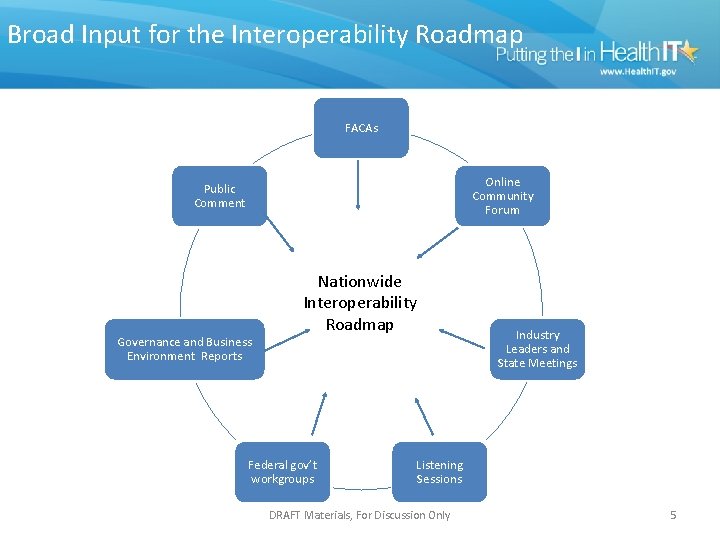
Broad Input for the Interoperability Roadmap FACAs Online Community Forum Public Comment Governance and Business Environment Reports Nationwide Interoperability Roadmap Federal gov’t workgroups Industry Leaders and State Meetings Listening Sessions DRAFT Materials, For Discussion Only 5
Purpose of Today’s Presentation • Share early strategic elements of the draft roadmap • Invite feedback and discussion from the FACAs and the public • This is a checkpoint – there are still 3 months of work DRAFT Materials, For Discussion Only 6
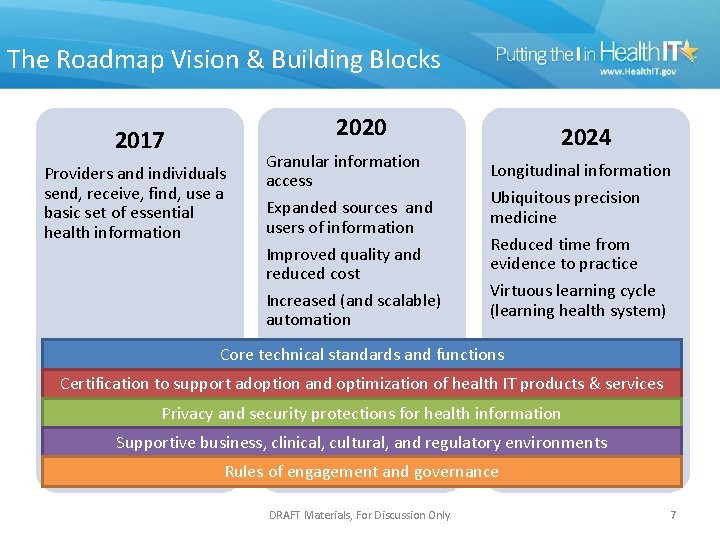
The Roadmap Vision & Building Blocks 2020 2017 Providers and individuals send, receive, find, use a basic set of essential health information Granular information access Expanded sources and users of information Improved quality and reduced cost Increased (and scalable) automation 2024 Longitudinal information Ubiquitous precision medicine Reduced time from evidence to practice Virtuous learning cycle (learning health system) Core technical standards and functions Certification to support adoption and optimization of health IT products & services Privacy and security protections for health information Supportive business, clinical, cultural, and regulatory environments Rules of engagement and governance DRAFT Materials, For Discussion Only 7
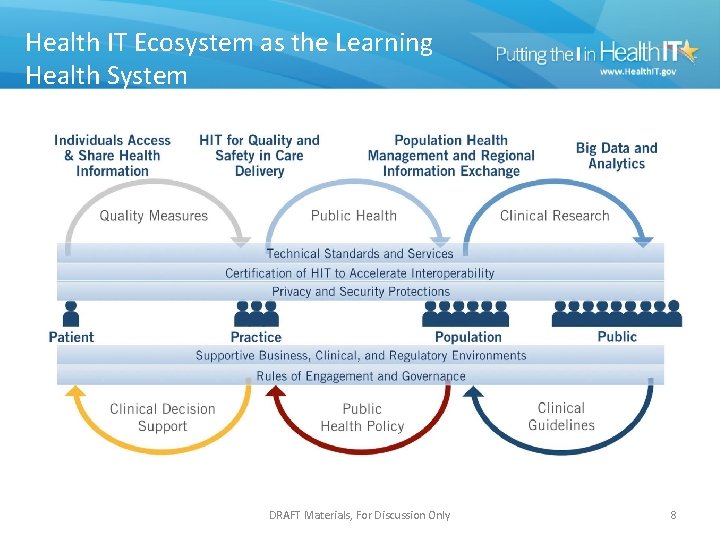
Health IT Ecosystem as the Learning Health System DRAFT Materials, For Discussion Only 8
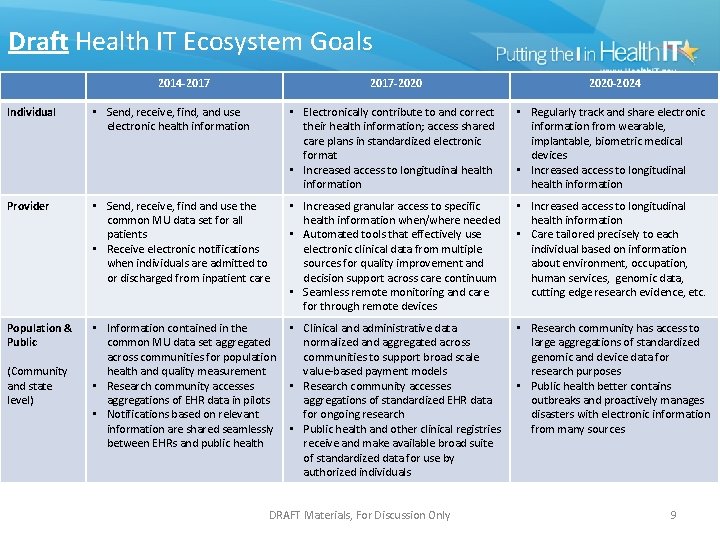
Draft Health IT Ecosystem Goals 2014 -2017 -2020 -2024 Individual • Send, receive, find, and use electronic health information • Electronically contribute to and correct their health information; access shared care plans in standardized electronic format • Increased access to longitudinal health information • Regularly track and share electronic information from wearable, implantable, biometric medical devices • Increased access to longitudinal health information Provider • Send, receive, find and use the common MU data set for all patients • Receive electronic notifications when individuals are admitted to or discharged from inpatient care • Increased granular access to specific health information when/where needed • Automated tools that effectively use electronic clinical data from multiple sources for quality improvement and decision support across care continuum • Seamless remote monitoring and care for through remote devices • Increased access to longitudinal health information • Care tailored precisely to each individual based on information about environment, occupation, human services, genomic data, cutting edge research evidence, etc. Population & Public • Information contained in the common MU data set aggregated across communities for population health and quality measurement • Research community accesses aggregations of EHR data in pilots • Notifications based on relevant information are shared seamlessly between EHRs and public health • Clinical and administrative data normalized and aggregated across communities to support broad scale value-based payment models • Research community accesses aggregations of standardized EHR data for ongoing research • Public health and other clinical registries receive and make available broad suite of standardized data for use by authorized individuals • Research community has access to large aggregations of standardized genomic and device data for research purposes • Public health better contains outbreaks and proactively manages disasters with electronic information from many sources (Community and state level) DRAFT Materials, For Discussion Only 9
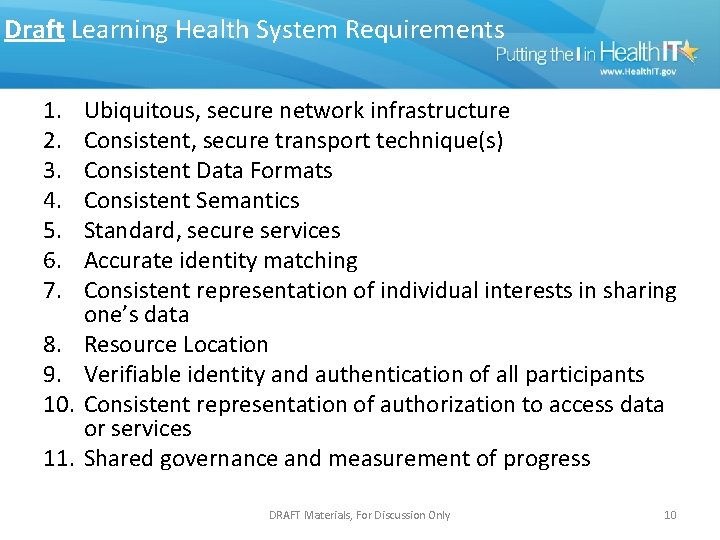
Draft Learning Health System Requirements 1. 2. 3. 4. 5. 6. 7. 8. 9. 10. 11. Ubiquitous, secure network infrastructure Consistent, secure transport technique(s) Consistent Data Formats Consistent Semantics Standard, secure services Accurate identity matching Consistent representation of individual interests in sharing one’s data Resource Location Verifiable identity and authentication of all participants Consistent representation of authorization to access data or services Shared governance and measurement of progress DRAFT Materials, For Discussion Only 10
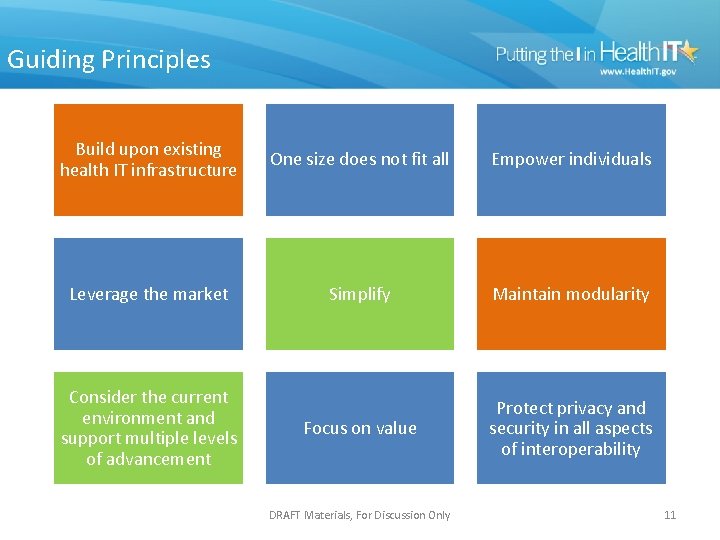
Guiding Principles Build upon existing health IT infrastructure One size does not fit all Empower individuals Leverage the market Simplify Maintain modularity Focus on value Protect privacy and security in all aspects of interoperability Consider the current environment and support multiple levels of advancement DRAFT Materials, For Discussion Only 11
Building Block: Clinical, Cultural, Business, & Regulatory Environments DRAFT Materials, For Discussion Only 12
Building Block: Clinical, Cultural, Business, & Regulatory Environments Feedback from the field: • There has to be a clear outcome-focused need and aligned economic incentives • Interoperability requirements should be consistent across federal, state & private programs • Private sector payors and purchasers are essential to shaping these incentives • Health IT needs to deliver on promises of efficiency and effectiveness in order to change these environments DRAFT Materials, For Discussion Only 13
Building Block: Clinical, Cultural, Business, & Regulatory Environments Sample Draft 3 Year (2014 -2017) Actions • Public and private payors incent or require the exchange and use of essential electronic health information that aligns with national standards in all value-based purchasing arrangements • ONC and FTC monitor and coordinate activities to advance interoperability by promoting competition and innovation DRAFT Materials, For Discussion Only 14

Building Block: Rules of the Road and Governance DRAFT Materials, For Discussion Only 15
Building Block: Rules of the Road and Governance Feedback from the field: • Unprecedented collaboration is required to achieve interoperability goals • Need a reliable governance framework that all parties can align with • Build on existing public/private efforts – accelerate successful governance entities • Emphasis on multi-stakeholder, public/private models • Include consumer and purchaser perspectives • Mechanism to monitor and enforce violations of trust and governance DRAFT Materials, For Discussion Only 16
Building Block: Rules of the Road and Governance Sample Draft 3 Year (2014 -2017) Action • ONC and stakeholders operationalize a nationwide governance framework that defines stakeholder responsibility, governance structure, technical standards and policy • Explicit rules that address organizational, trust, business and technical issues DRAFT Materials, For Discussion Only 17
Building Block: Core Technical Standards and Functions Building Block: Certification DRAFT Materials, For Discussion Only 18
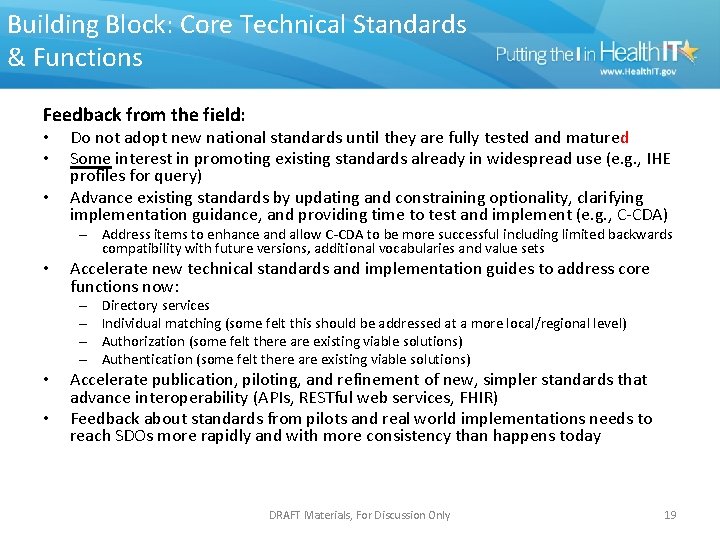
Building Block: Core Technical Standards & Functions Feedback from the field: • • • Do not adopt new national standards until they are fully tested and matured Some interest in promoting existing standards already in widespread use (e. g. , IHE profiles for query) Advance existing standards by updating and constraining optionality, clarifying implementation guidance, and providing time to test and implement (e. g. , C-CDA) – Address items to enhance and allow C-CDA to be more successful including limited backwards compatibility with future versions, additional vocabularies and value sets • Accelerate new technical standards and implementation guides to address core functions now: – – • • Directory services Individual matching (some felt this should be addressed at a more local/regional level) Authorization (some felt there are existing viable solutions) Authentication (some felt there are existing viable solutions) Accelerate publication, piloting, and refinement of new, simpler standards that advance interoperability (APIs, RESTful web services, FHIR) Feedback about standards from pilots and real world implementations needs to reach SDOs more rapidly and with more consistency than happens today DRAFT Materials, For Discussion Only 19
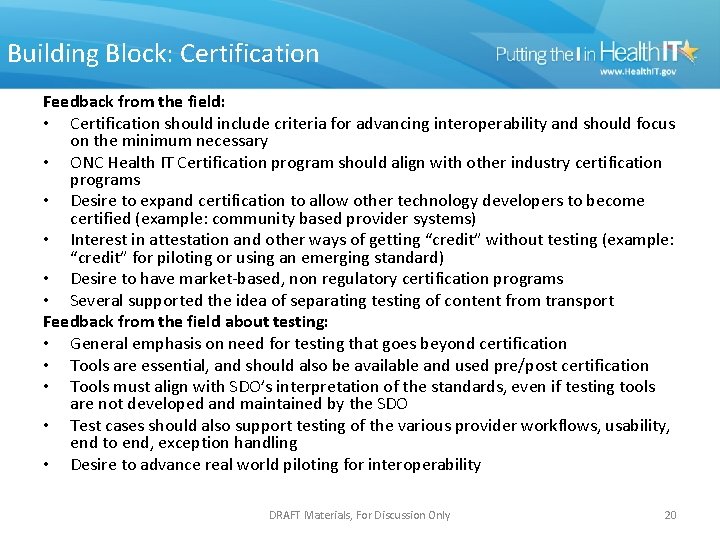
Building Block: Certification Feedback from the field: • Certification should include criteria for advancing interoperability and should focus on the minimum necessary • ONC Health IT Certification program should align with other industry certification programs • Desire to expand certification to allow other technology developers to become certified (example: community based provider systems) • Interest in attestation and other ways of getting “credit” without testing (example: “credit” for piloting or using an emerging standard) • Desire to have market-based, non regulatory certification programs • Several supported the idea of separating testing of content from transport Feedback from the field about testing: • General emphasis on need for testing that goes beyond certification • Tools are essential, and should also be available and used pre/post certification • Tools must align with SDO’s interpretation of the standards, even if testing tools are not developed and maintained by the SDO • Test cases should also support testing of the various provider workflows, usability, end to end, exception handling • Desire to advance real world piloting for interoperability DRAFT Materials, For Discussion Only 20
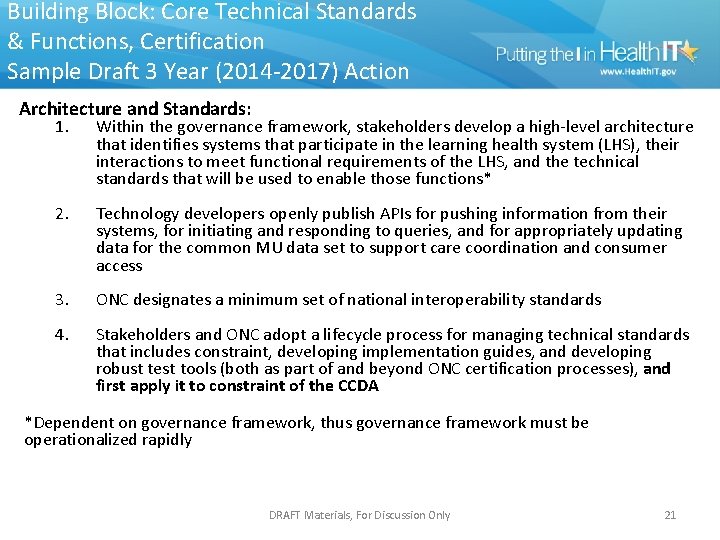
Building Block: Core Technical Standards & Functions, Certification Sample Draft 3 Year (2014 -2017) Action Architecture and Standards: 1. Within the governance framework, stakeholders develop a high-level architecture that identifies systems that participate in the learning health system (LHS), their interactions to meet functional requirements of the LHS, and the technical standards that will be used to enable those functions* 2. Technology developers openly publish APIs for pushing information from their systems, for initiating and responding to queries, and for appropriately updating data for the common MU data set to support care coordination and consumer access 3. ONC designates a minimum set of national interoperability standards 4. Stakeholders and ONC adopt a lifecycle process for managing technical standards that includes constraint, developing implementation guides, and developing robust test tools (both as part of and beyond ONC certification processes), and first apply it to constraint of the CCDA *Dependent on governance framework, thus governance framework must be operationalized rapidly DRAFT Materials, For Discussion Only 21
Building Block: Core Technical Standards & Functions, Certification Sample Draft 3 Year (2014 -2017) Action Core Functions: • Stakeholders and ONC improve identity management for individuals by improving the quality of data used for matching, including standardization of a minimum set of data elements and attributes used for matching and definition of accuracy/performance requirements for matching algorithms • To support improved provider identify management, CMS continues the NPPES modernization project, including the creation of an open API to support use of NPPES data in provider directory services DRAFT Materials, For Discussion Only 22
Building Block: Privacy and Security DRAFT Materials, For Discussion Only 23
Building Block: Privacy and Security Feedback from the field: • Strong desire for consistency and clarity in policies and standards for exchanging data across regions, states, etc. ; difficult to conform to multitude of policies and requirements (example: consent) • Desire for clear and consistent direction on authentication and authorization • Focus on simple and foundational issues before expanding to support more complex standards and policies (example of more complex: data segmentation at granular level, and granular consent) • Many indicated need for increased awareness and education on: – Individual rights to access their own data – Right of individuals to see who viewed their data (example: audit info) – Individual responsibility for privacy of their own health information (example: mobile applications and passwords) – Provider’s role in securing patient data DRAFT Materials, For Discussion Only 24
Building Block: Privacy and Security Sample Draft 3 Year (2014 -2017) Action • ONC and stakeholders develop methods for consistently representing, managing, and communicating privacy preferences and consent across the ecosystem • Stakeholders consistently implement security best practices, including encryption, for all health information at rest and in motion DRAFT Materials, For Discussion Only 25
Discussion DRAFT Materials, For Discussion Only 26
Appendix Slides Detailed DRAFT Interoperability Roadmap Material DRAFT Materials, For Discussion Only 27
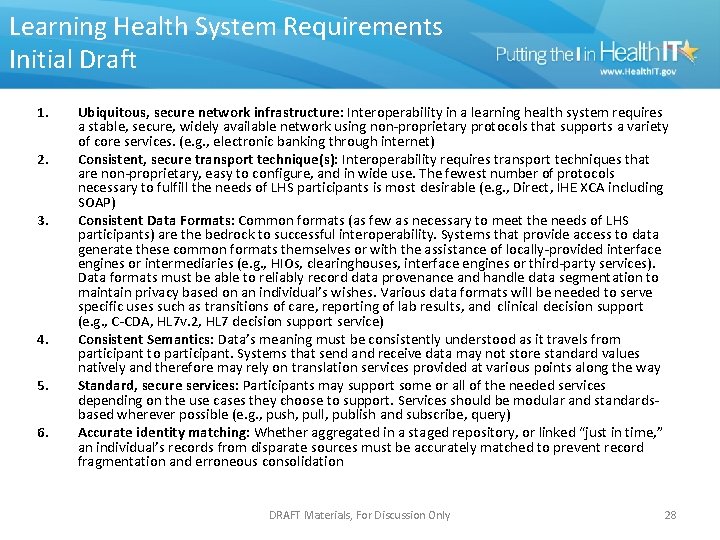
Learning Health System Requirements Initial Draft 1. 2. 3. 4. 5. 6. Ubiquitous, secure network infrastructure: Interoperability in a learning health system requires a stable, secure, widely available network using non-proprietary protocols that supports a variety of core services. (e. g. , electronic banking through internet) Consistent, secure transport technique(s): Interoperability requires transport techniques that are non-proprietary, easy to configure, and in wide use. The fewest number of protocols necessary to fulfill the needs of LHS participants is most desirable (e. g. , Direct, IHE XCA including SOAP) Consistent Data Formats: Common formats (as few as necessary to meet the needs of LHS participants) are the bedrock to successful interoperability. Systems that provide access to data generate these common formats themselves or with the assistance of locally-provided interface engines or intermediaries (e. g. , HIOs, clearinghouses, interface engines or third-party services). Data formats must be able to reliably record data provenance and handle data segmentation to maintain privacy based on an individual’s wishes. Various data formats will be needed to serve specific uses such as transitions of care, reporting of lab results, and clinical decision support (e. g. , C-CDA, HL 7 v. 2, HL 7 decision support service) Consistent Semantics: Data’s meaning must be consistently understood as it travels from participant to participant. Systems that send and receive data may not store standard values natively and therefore may rely on translation services provided at various points along the way Standard, secure services: Participants may support some or all of the needed services depending on the use cases they choose to support. Services should be modular and standardsbased wherever possible (e. g. , push, pull, publish and subscribe, query) Accurate identity matching: Whether aggregated in a staged repository, or linked “just in time, ” an individual’s records from disparate sources must be accurately matched to prevent record fragmentation and erroneous consolidation DRAFT Materials, For Discussion Only 28
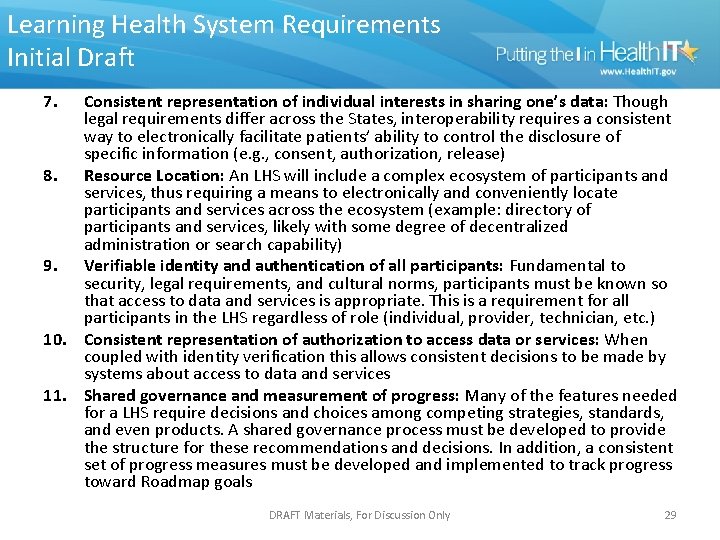
Learning Health System Requirements Initial Draft 7. Consistent representation of individual interests in sharing one’s data: Though legal requirements differ across the States, interoperability requires a consistent way to electronically facilitate patients’ ability to control the disclosure of specific information (e. g. , consent, authorization, release) 8. Resource Location: An LHS will include a complex ecosystem of participants and services, thus requiring a means to electronically and conveniently locate participants and services across the ecosystem (example: directory of participants and services, likely with some degree of decentralized administration or search capability) 9. Verifiable identity and authentication of all participants: Fundamental to security, legal requirements, and cultural norms, participants must be known so that access to data and services is appropriate. This is a requirement for all participants in the LHS regardless of role (individual, provider, technician, etc. ) 10. Consistent representation of authorization to access data or services: When coupled with identity verification this allows consistent decisions to be made by systems about access to data and services 11. Shared governance and measurement of progress: Many of the features needed for a LHS require decisions and choices among competing strategies, standards, and even products. A shared governance process must be developed to provide the structure for these recommendations and decisions. In addition, a consistent set of progress measures must be developed and implemented to track progress toward Roadmap goals DRAFT Materials, For Discussion Only 29
Building Block: Clinical, Cultural, Business, & Regulatory Environments DRAFT Materials, For Discussion Only 30
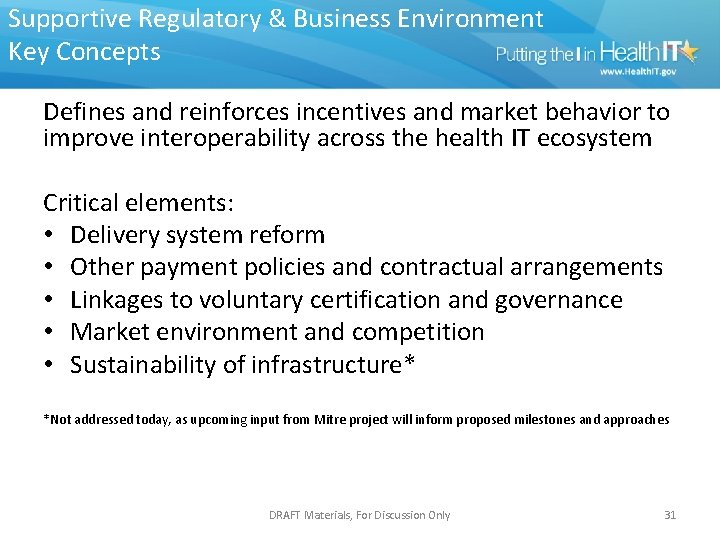
Supportive Regulatory & Business Environment Key Concepts Defines and reinforces incentives and market behavior to improve interoperability across the health IT ecosystem Critical elements: • Delivery system reform • Other payment policies and contractual arrangements • Linkages to voluntary certification and governance • Market environment and competition • Sustainability of infrastructure* *Not addressed today, as upcoming input from Mitre project will inform proposed milestones and approaches DRAFT Materials, For Discussion Only 31
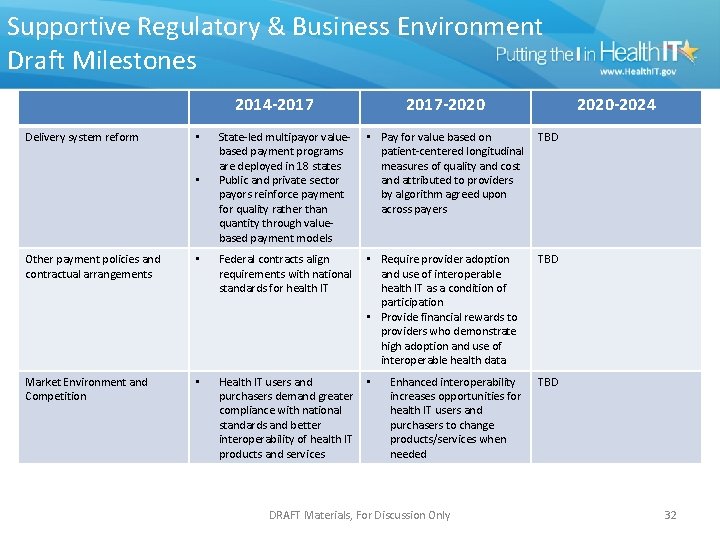
Supportive Regulatory & Business Environment Draft Milestones 2014 -2017 Delivery system reform • • 2017 -2020 -2024 State-led multipayor valuebased payment programs are deployed in 18 states Public and private sector payors reinforce payment for quality rather than quantity through valuebased payment models • Pay for value based on patient-centered longitudinal measures of quality and cost and attributed to providers by algorithm agreed upon across payers TBD Other payment policies and contractual arrangements • Federal contracts align requirements with national standards for health IT • Require provider adoption and use of interoperable health IT as a condition of participation • Provide financial rewards to providers who demonstrate high adoption and use of interoperable health data Market Environment and Competition • Health IT users and purchasers demand greater compliance with national standards and better interoperability of health IT products and services • Enhanced interoperability increases opportunities for health IT users and purchasers to change products/services when needed DRAFT Materials, For Discussion Only TBD 32
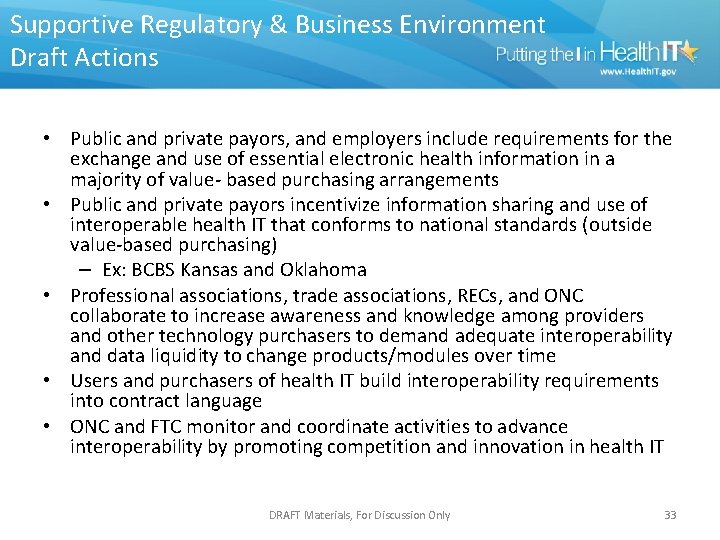
Supportive Regulatory & Business Environment Draft Actions • Public and private payors, and employers include requirements for the exchange and use of essential electronic health information in a majority of value- based purchasing arrangements • Public and private payors incentivize information sharing and use of interoperable health IT that conforms to national standards (outside value-based purchasing) – Ex: BCBS Kansas and Oklahoma • Professional associations, trade associations, RECs, and ONC collaborate to increase awareness and knowledge among providers and other technology purchasers to demand adequate interoperability and data liquidity to change products/modules over time • Users and purchasers of health IT build interoperability requirements into contract language • ONC and FTC monitor and coordinate activities to advance interoperability by promoting competition and innovation in health IT DRAFT Materials, For Discussion Only 33
Supportive Clinical and Cultural Environment Key concepts Establishes and reinforces knowledge and behavior that advances the use of interoperable health IT Critical elements: • Provider knowledge and behavior • Individual and caregiver knowledge and behavior DRAFT Materials, For Discussion Only 34
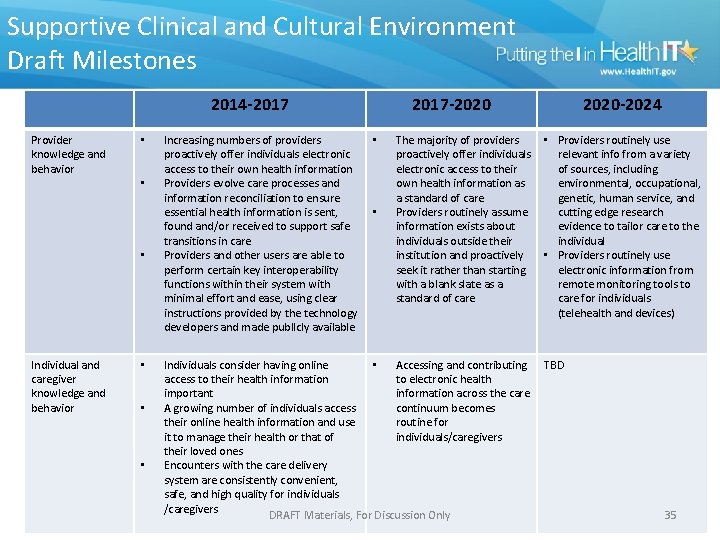
Supportive Clinical and Cultural Environment Draft Milestones 2014 -2017 Provider knowledge and behavior • • • Individual and caregiver knowledge and behavior • • • Increasing numbers of providers proactively offer individuals electronic access to their own health information Providers evolve care processes and information reconciliation to ensure essential health information is sent, found and/or received to support safe transitions in care Providers and other users are able to perform certain key interoperability functions within their system with minimal effort and ease, using clear instructions provided by the technology developers and made publlcly available 2017 -2020 • • The majority of providers proactively offer individuals electronic access to their own health information as a standard of care Providers routinely assume information exists about individuals outside their institution and proactively seek it rather than starting with a blank slate as a standard of care Individuals consider having online • Accessing and contributing access to their health information to electronic health important information across the care A growing number of individuals access continuum becomes their online health information and use routine for it to manage their health or that of individuals/caregivers their loved ones Encounters with the care delivery system are consistently convenient, safe, and high quality for individuals /caregivers DRAFT Materials, For Discussion Only 2020 -2024 • Providers routinely use relevant info from a variety of sources, including environmental, occupational, genetic, human service, and cutting edge research evidence to tailor care to the individual • Providers routinely use electronic information from remote monitoring tools to care for individuals (telehealth and devices) TBD 35
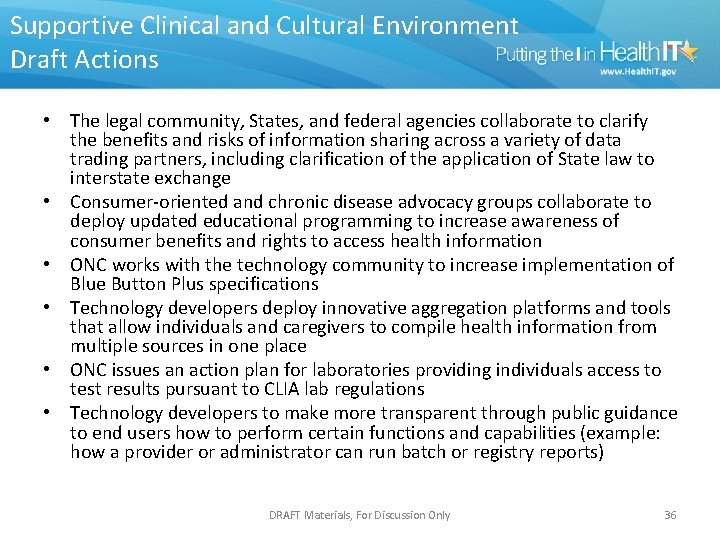
Supportive Clinical and Cultural Environment Draft Actions • The legal community, States, and federal agencies collaborate to clarify the benefits and risks of information sharing across a variety of data trading partners, including clarification of the application of State law to interstate exchange • Consumer-oriented and chronic disease advocacy groups collaborate to deploy updated educational programming to increase awareness of consumer benefits and rights to access health information • ONC works with the technology community to increase implementation of Blue Button Plus specifications • Technology developers deploy innovative aggregation platforms and tools that allow individuals and caregivers to compile health information from multiple sources in one place • ONC issues an action plan for laboratories providing individuals access to test results pursuant to CLIA lab regulations • Technology developers to make more transparent through public guidance to end users how to perform certain functions and capabilities (example: how a provider or administrator can run batch or registry reports) DRAFT Materials, For Discussion Only 36

Building Block: Rules of the Road and Governance DRAFT Materials, For Discussion Only 37
Common Rules of the Road and Governance Key Concepts Establishes processes and decisions that define actions, grant power and verify performance • Challenges and opportunities: – Increase trust to improve interoperability – Reduce business risk that comes with improved interoperability (weak links, bad actors) – Protect individual's (public) interests – Ongoing political support will be necessary • Critical elements: – Standards governance – Data, policy and operations governance DRAFT Materials, For Discussion Only 38
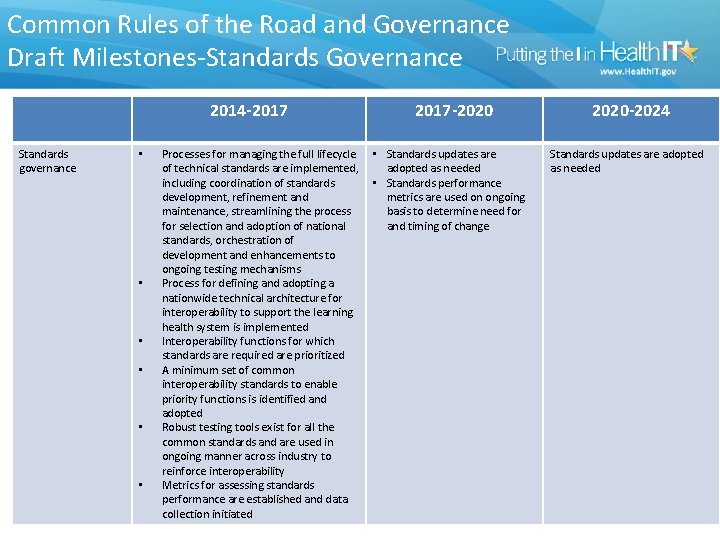
Common Rules of the Road and Governance Draft Milestones-Standards Governance 2014 -2017 Standards governance • • • 10/18/2021 2017 -2020 Processes for managing the full lifecycle • Standards updates are of technical standards are implemented, adopted as needed including coordination of standards • Standards performance development, refinement and metrics are used on ongoing maintenance, streamlining the process basis to determine need for selection and adoption of national and timing of change standards, orchestration of development and enhancements to ongoing testing mechanisms Process for defining and adopting a nationwide technical architecture for interoperability to support the learning health system is implemented Interoperability functions for which standards are required are prioritized A minimum set of common interoperability standards to enable priority functions is identified and adopted Robust testing tools exist for all the common standards and are used in ongoing manner across industry to reinforce interoperability Metrics for assessing standards performance are established and data collection initiated DRAFT Materials, For Discussion Only 2020 -2024 Standards updates are adopted as needed 39
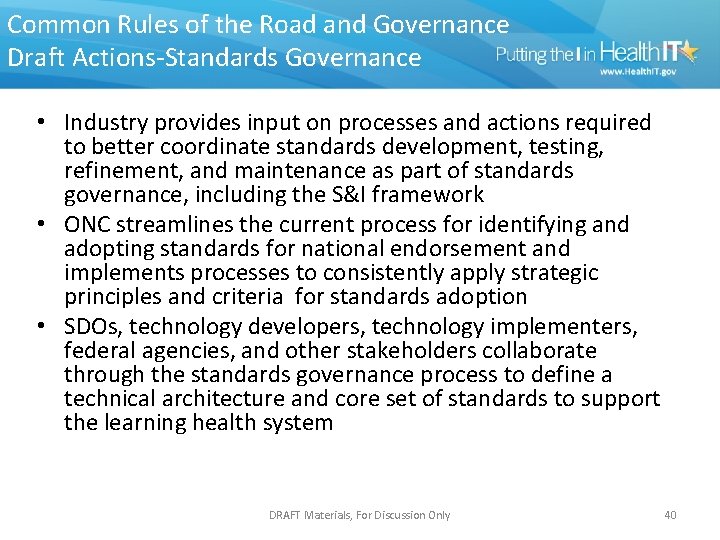
Common Rules of the Road and Governance Draft Actions-Standards Governance • Industry provides input on processes and actions required to better coordinate standards development, testing, refinement, and maintenance as part of standards governance, including the S&I framework • ONC streamlines the current process for identifying and adopting standards for national endorsement and implements processes to consistently apply strategic principles and criteria for standards adoption • SDOs, technology developers, technology implementers, federal agencies, and other stakeholders collaborate through the standards governance process to define a technical architecture and core set of standards to support the learning health system DRAFT Materials, For Discussion Only 40
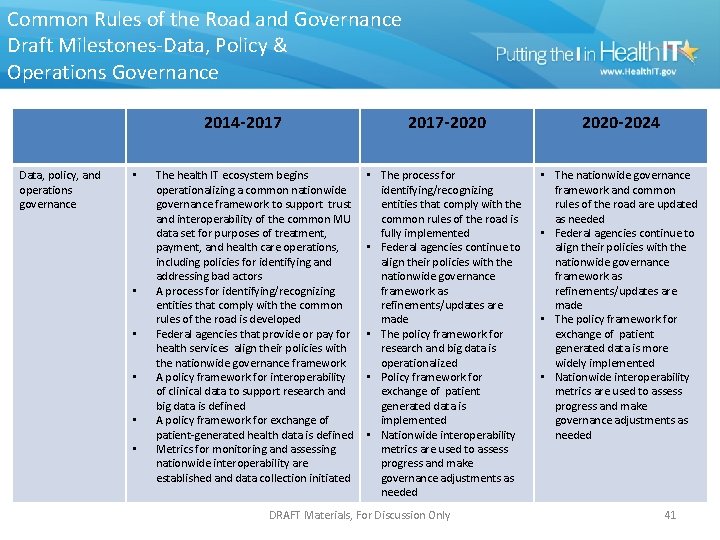
Common Rules of the Road and Governance Draft Milestones-Data, Policy & Operations Governance 2014 -2017 Data, policy, and operations governance • • • The health IT ecosystem begins operationalizing a common nationwide governance framework to support trust and interoperability of the common MU data set for purposes of treatment, payment, and health care operations, including policies for identifying and addressing bad actors A process for identifying/recognizing entities that comply with the common rules of the road is developed Federal agencies that provide or pay for health services align their policies with the nationwide governance framework A policy framework for interoperability of clinical data to support research and big data is defined A policy framework for exchange of patient-generated health data is defined Metrics for monitoring and assessing nationwide interoperability are established and data collection initiated 2017 -2020 -2024 • The process for identifying/recognizing entities that comply with the common rules of the road is fully implemented • Federal agencies continue to align their policies with the nationwide governance framework as refinements/updates are made • The policy framework for research and big data is operationalized • Policy framework for exchange of patient generated data is implemented • Nationwide interoperability metrics are used to assess progress and make governance adjustments as needed • The nationwide governance framework and common rules of the road are updated as needed • Federal agencies continue to align their policies with the nationwide governance framework as refinements/updates are made • The policy framework for exchange of patient generated data is more widely implemented • Nationwide interoperability metrics are used to assess progress and make governance adjustments as needed DRAFT Materials, For Discussion Only 41
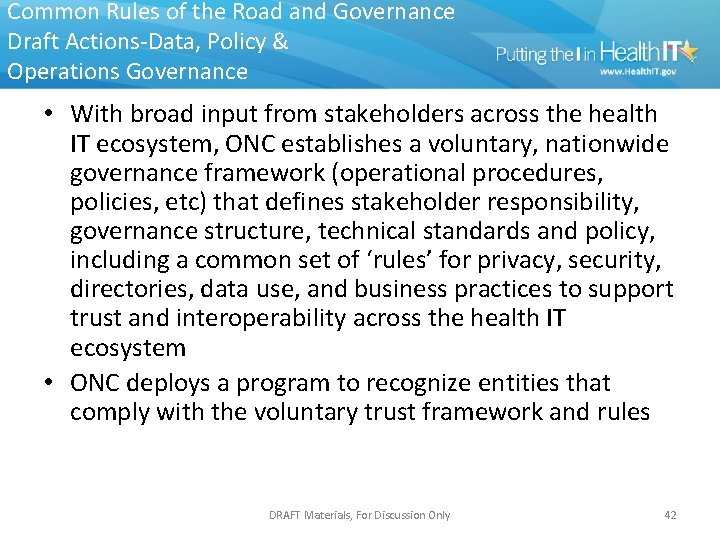
Common Rules of the Road and Governance Draft Actions-Data, Policy & Operations Governance • With broad input from stakeholders across the health IT ecosystem, ONC establishes a voluntary, nationwide governance framework (operational procedures, policies, etc) that defines stakeholder responsibility, governance structure, technical standards and policy, including a common set of ‘rules’ for privacy, security, directories, data use, and business practices to support trust and interoperability across the health IT ecosystem • ONC deploys a program to recognize entities that comply with the voluntary trust framework and rules DRAFT Materials, For Discussion Only 42
Building Block: Core Technical Standards and Functions DRAFT Materials, For Discussion Only 43
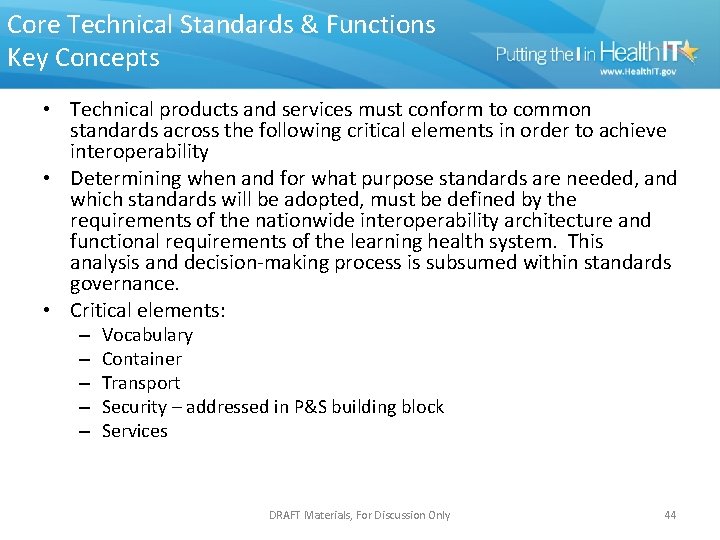
Core Technical Standards & Functions Key Concepts • Technical products and services must conform to common standards across the following critical elements in order to achieve interoperability • Determining when and for what purpose standards are needed, and which standards will be adopted, must be defined by the requirements of the nationwide interoperability architecture and functional requirements of the learning health system. This analysis and decision-making process is subsumed within standards governance. • Critical elements: – – – Vocabulary Container Transport Security – addressed in P&S building block Services DRAFT Materials, For Discussion Only 44
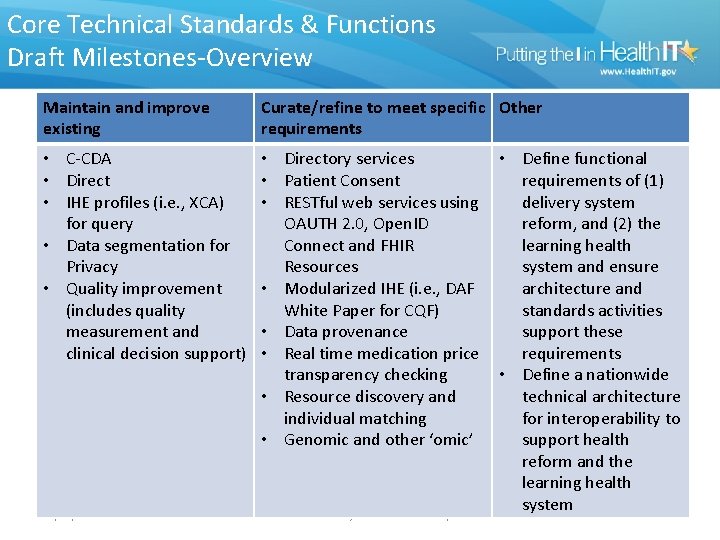
Core Technical Standards & Functions Draft Milestones-Overview Maintain and improve existing Curate/refine to meet specific Other requirements • C-CDA • Direct • IHE profiles (i. e. , XCA) for query • Data segmentation for Privacy • Quality improvement (includes quality measurement and clinical decision support) • Directory services • Patient Consent • RESTful web services using OAUTH 2. 0, Open. ID Connect and FHIR Resources • Modularized IHE (i. e. , DAF White Paper for CQF) • Data provenance • Real time medication price transparency checking • Resource discovery and individual matching • Genomic and other ‘omic’ 10/18/2021 DRAFT Materials, For Discussion Only • Define functional requirements of (1) delivery system reform, and (2) the learning health system and ensure architecture and standards activities support these requirements • Define a nationwide technical architecture for interoperability to support health reform and the learning health system 45
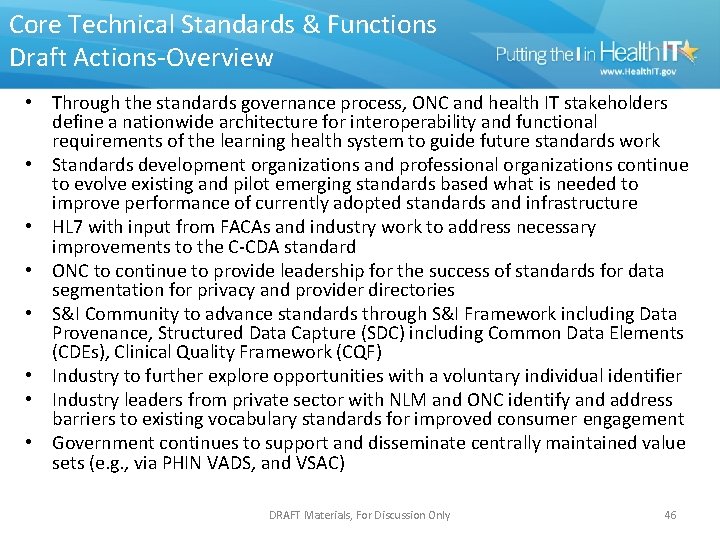
Core Technical Standards & Functions Draft Actions-Overview • Through the standards governance process, ONC and health IT stakeholders define a nationwide architecture for interoperability and functional requirements of the learning health system to guide future standards work • Standards development organizations and professional organizations continue to evolve existing and pilot emerging standards based what is needed to improve performance of currently adopted standards and infrastructure • HL 7 with input from FACAs and industry work to address necessary improvements to the C-CDA standard • ONC to continue to provide leadership for the success of standards for data segmentation for privacy and provider directories • S&I Community to advance standards through S&I Framework including Data Provenance, Structured Data Capture (SDC) including Common Data Elements (CDEs), Clinical Quality Framework (CQF) • Industry to further explore opportunities with a voluntary individual identifier • Industry leaders from private sector with NLM and ONC identify and address barriers to existing vocabulary standards for improved consumer engagement • Government continues to support and disseminate centrally maintained value sets (e. g. , via PHIN VADS, and VSAC) DRAFT Materials, For Discussion Only 46
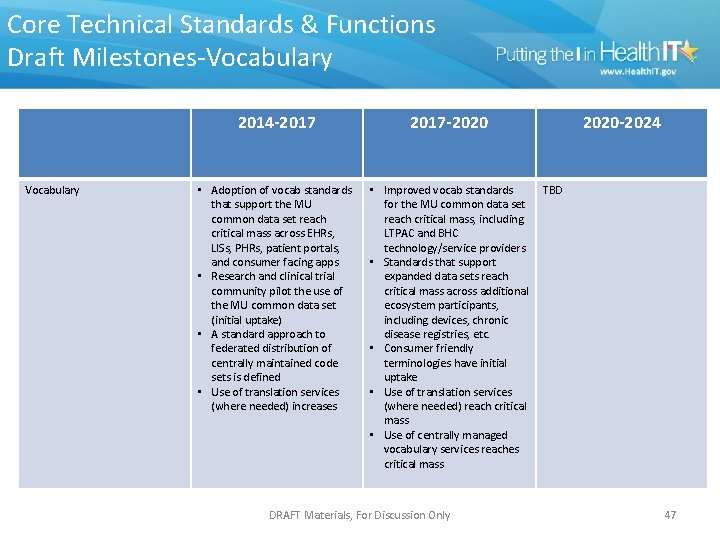
Core Technical Standards & Functions Draft Milestones-Vocabulary 2014 -2017 -2020 • Adoption of vocab standards that support the MU common data set reach critical mass across EHRs, LISs, PHRs, patient portals, and consumer facing apps • Research and clinical trial community pilot the use of the MU common data set (initial uptake) • A standard approach to federated distribution of centrally maintained code sets is defined • Use of translation services (where needed) increases • Improved vocab standards for the MU common data set reach critical mass, including LTPAC and BHC technology/service providers • Standards that support expanded data sets reach critical mass across additional ecosystem participants, including devices, chronic disease registries, etc. • Consumer friendly terminologies have initial uptake • Use of translation services (where needed) reach critical mass • Use of centrally managed vocabulary services reaches critical mass DRAFT Materials, For Discussion Only 2020 -2024 TBD 47
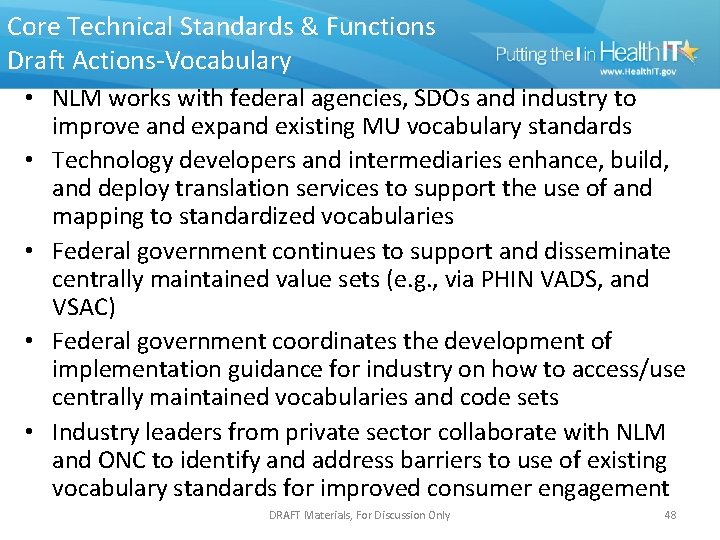
Core Technical Standards & Functions Draft Actions-Vocabulary • NLM works with federal agencies, SDOs and industry to improve and expand existing MU vocabulary standards • Technology developers and intermediaries enhance, build, and deploy translation services to support the use of and mapping to standardized vocabularies • Federal government continues to support and disseminate centrally maintained value sets (e. g. , via PHIN VADS, and VSAC) • Federal government coordinates the development of implementation guidance for industry on how to access/use centrally maintained vocabularies and code sets • Industry leaders from private sector collaborate with NLM and ONC to identify and address barriers to use of existing vocabulary standards for improved consumer engagement DRAFT Materials, For Discussion Only 48
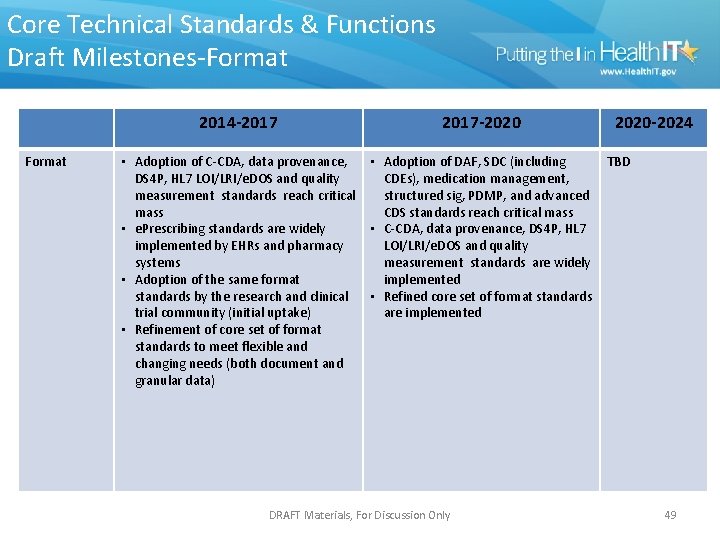
Core Technical Standards & Functions Draft Milestones-Format 2014 -2017 -2020 • Adoption of C-CDA, data provenance, DS 4 P, HL 7 LOI/LRI/e. DOS and quality measurement standards reach critical mass • e. Prescribing standards are widely implemented by EHRs and pharmacy systems • Adoption of the same format standards by the research and clinical trial community (initial uptake) • Refinement of core set of format standards to meet flexible and changing needs (both document and granular data) • Adoption of DAF, SDC (including CDEs), medication management, structured sig, PDMP, and advanced CDS standards reach critical mass • C-CDA, data provenance, DS 4 P, HL 7 LOI/LRI/e. DOS and quality measurement standards are widely implemented • Refined core set of format standards are implemented DRAFT Materials, For Discussion Only 2020 -2024 TBD 49
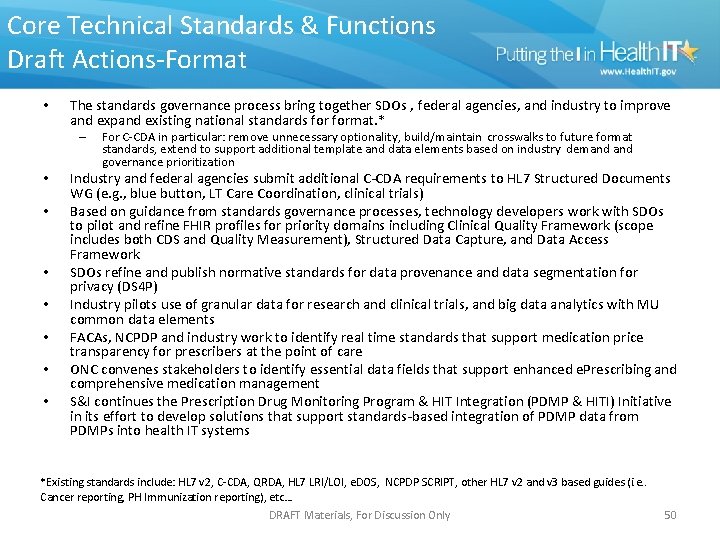
Core Technical Standards & Functions Draft Actions-Format • The standards governance process bring together SDOs , federal agencies, and industry to improve and expand existing national standards format. * – • • For C-CDA in particular: remove unnecessary optionality, build/maintain crosswalks to future format standards, extend to support additional template and data elements based on industry demand governance prioritization Industry and federal agencies submit additional C-CDA requirements to HL 7 Structured Documents WG (e. g. , blue button, LT Care Coordination, clinical trials) Based on guidance from standards governance processes, technology developers work with SDOs to pilot and refine FHIR profiles for priority domains including Clinical Quality Framework (scope includes both CDS and Quality Measurement), Structured Data Capture, and Data Access Framework SDOs refine and publish normative standards for data provenance and data segmentation for privacy (DS 4 P) Industry pilots use of granular data for research and clinical trials, and big data analytics with MU common data elements FACAs, NCPDP and industry work to identify real time standards that support medication price transparency for prescribers at the point of care ONC convenes stakeholders to identify essential data fields that support enhanced e. Prescribing and comprehensive medication management S&I continues the Prescription Drug Monitoring Program & HIT Integration (PDMP & HITI) Initiative in its effort to develop solutions that support standards-based integration of PDMP data from PDMPs into health IT systems *Existing standards include: HL 7 v 2, C-CDA, QRDA, HL 7 LRI/LOI, e. DOS, NCPDP SCRIPT, other HL 7 v 2 and v 3 based guides (i. e. . Cancer reporting, PH Immunization reporting), etc… DRAFT Materials, For Discussion Only 50
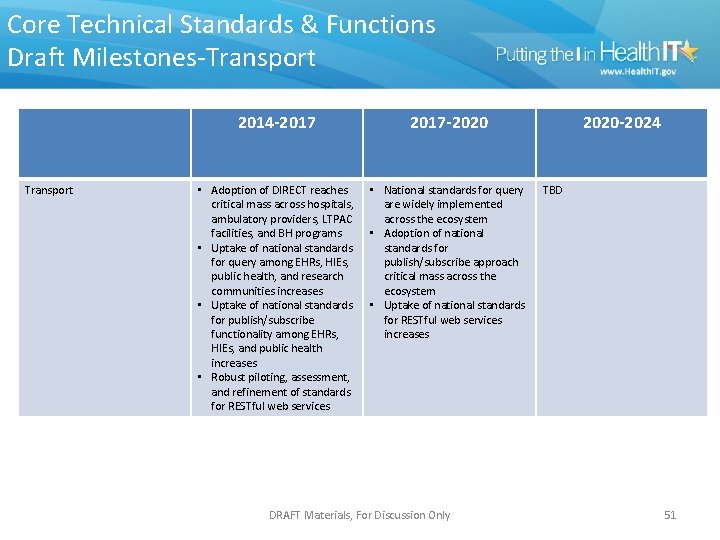
Core Technical Standards & Functions Draft Milestones-Transport 2014 -2017 -2020 • Adoption of DIRECT reaches critical mass across hospitals, ambulatory providers, LTPAC facilities, and BH programs • Uptake of national standards for query among EHRs, HIEs, public health, and research communities increases • Uptake of national standards for publish/subscribe functionality among EHRs, HIEs, and public health increases • Robust piloting, assessment, and refinement of standards for RESTful web services • National standards for query are widely implemented across the ecosystem • Adoption of national standards for publish/subscribe approach critical mass across the ecosystem • Uptake of national standards for RESTful web services increases DRAFT Materials, For Discussion Only 2020 -2024 TBD 51
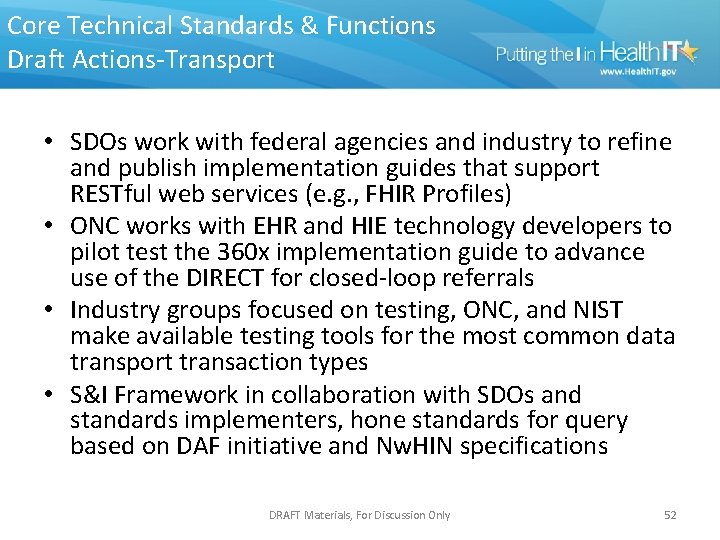
Core Technical Standards & Functions Draft Actions-Transport • SDOs work with federal agencies and industry to refine and publish implementation guides that support RESTful web services (e. g. , FHIR Profiles) • ONC works with EHR and HIE technology developers to pilot test the 360 x implementation guide to advance use of the DIRECT for closed-loop referrals • Industry groups focused on testing, ONC, and NIST make available testing tools for the most common data transport transaction types • S&I Framework in collaboration with SDOs and standards implementers, hone standards for query based on DAF initiative and Nw. HIN specifications DRAFT Materials, For Discussion Only 52
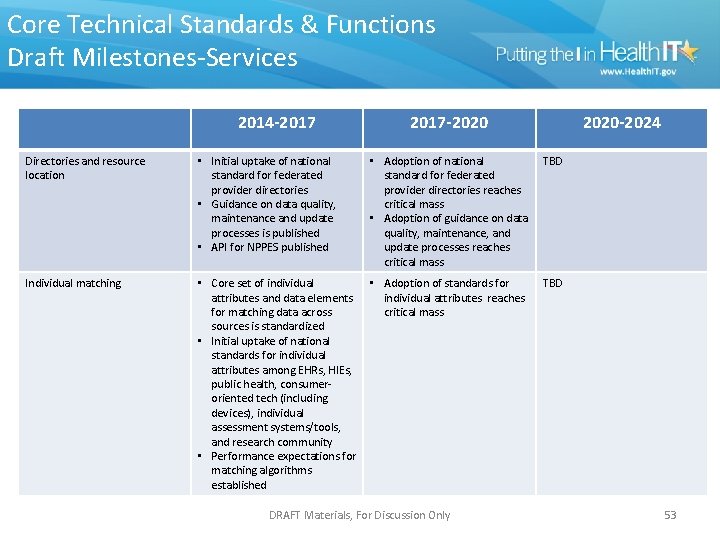
Core Technical Standards & Functions Draft Milestones-Services 2014 -2017 -2020 -2024 Directories and resource location • Initial uptake of national standard for federated provider directories • Guidance on data quality, maintenance and update processes is published • API for NPPES published • Adoption of national standard for federated provider directories reaches critical mass • Adoption of guidance on data quality, maintenance, and update processes reaches critical mass TBD Individual matching • Core set of individual attributes and data elements for matching data across sources is standardized • Initial uptake of national standards for individual attributes among EHRs, HIEs, public health, consumeroriented tech (including devices), individual assessment systems/tools, and research community • Performance expectations for matching algorithms established • Adoption of standards for individual attributes reaches critical mass TBD DRAFT Materials, For Discussion Only 53
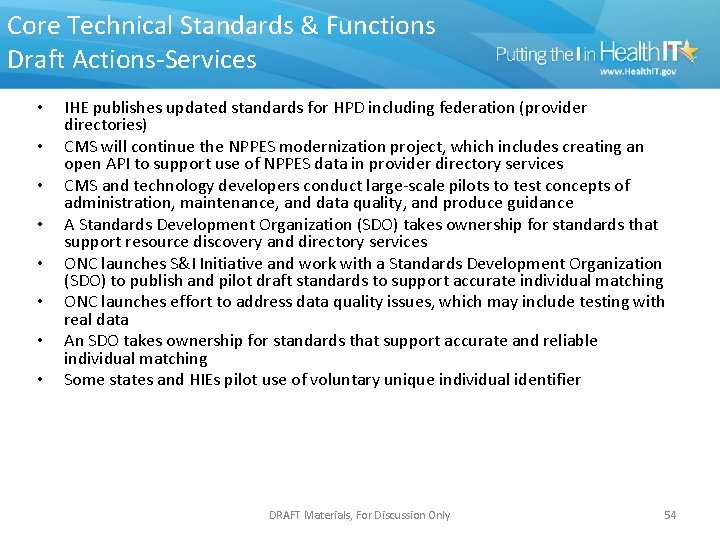
Core Technical Standards & Functions Draft Actions-Services • • IHE publishes updated standards for HPD including federation (provider directories) CMS will continue the NPPES modernization project, which includes creating an open API to support use of NPPES data in provider directory services CMS and technology developers conduct large-scale pilots to test concepts of administration, maintenance, and data quality, and produce guidance A Standards Development Organization (SDO) takes ownership for standards that support resource discovery and directory services ONC launches S&I Initiative and work with a Standards Development Organization (SDO) to publish and pilot draft standards to support accurate individual matching ONC launches effort to address data quality issues, which may include testing with real data An SDO takes ownership for standards that support accurate and reliable individual matching Some states and HIEs pilot use of voluntary unique individual identifier DRAFT Materials, For Discussion Only 54
Building Block: Certification DRAFT Materials, For Discussion Only 55
Building Block: Certification Key Concepts • A tool to provide health IT purchasers a sense of what they are buying • Validate standards compliance • Optimize interoperability through robust, ongoing testing • Critical elements: – Testing – Certification DRAFT Materials, For Discussion Only 56
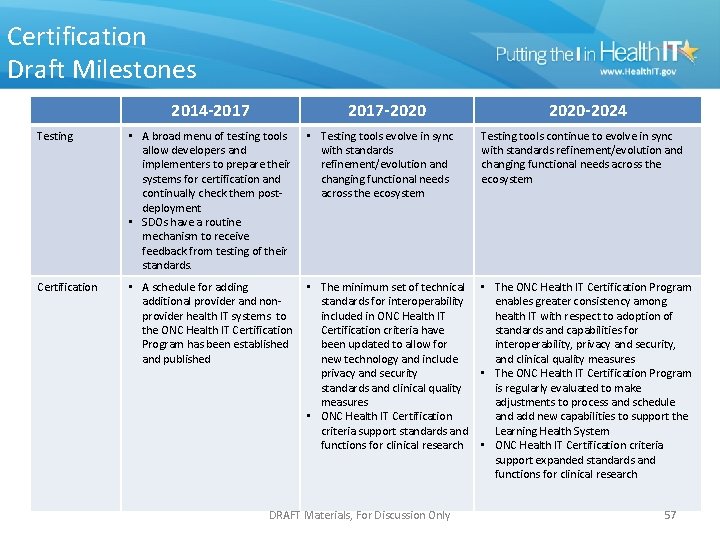
Certification Draft Milestones 2014 -2017 -2020 -2024 Testing • A broad menu of testing tools allow developers and implementers to prepare their systems for certification and continually check them postdeployment • SDOs have a routine mechanism to receive feedback from testing of their standards. • Testing tools evolve in sync with standards refinement/evolution and changing functional needs across the ecosystem Testing tools continue to evolve in sync with standards refinement/evolution and changing functional needs across the ecosystem Certification • A schedule for adding additional provider and nonprovider health IT systems to the ONC Health IT Certification Program has been established and published • The minimum set of technical standards for interoperability included in ONC Health IT Certification criteria have been updated to allow for new technology and include privacy and security standards and clinical quality measures • ONC Health IT Certification criteria support standards and functions for clinical research • The ONC Health IT Certification Program enables greater consistency among health IT with respect to adoption of standards and capabilities for interoperability, privacy and security, and clinical quality measures • The ONC Health IT Certification Program is regularly evaluated to make adjustments to process and schedule and add new capabilities to support the Learning Health System • ONC Health IT Certification criteria support expanded standards and functions for clinical research DRAFT Materials, For Discussion Only 57
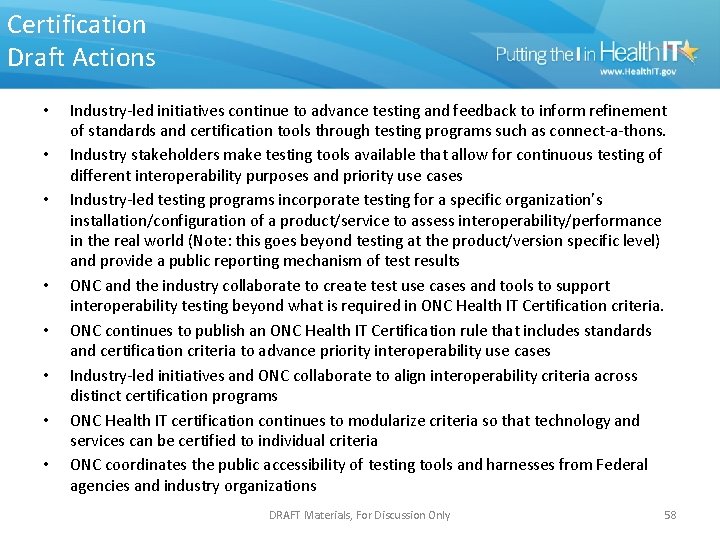
Certification Draft Actions • • Industry-led initiatives continue to advance testing and feedback to inform refinement of standards and certification tools through testing programs such as connect-a-thons. Industry stakeholders make testing tools available that allow for continuous testing of different interoperability purposes and priority use cases Industry-led testing programs incorporate testing for a specific organization’s installation/configuration of a product/service to assess interoperability/performance in the real world (Note: this goes beyond testing at the product/version specific level) and provide a public reporting mechanism of test results ONC and the industry collaborate to create test use cases and tools to support interoperability testing beyond what is required in ONC Health IT Certification criteria. ONC continues to publish an ONC Health IT Certification rule that includes standards and certification criteria to advance priority interoperability use cases Industry-led initiatives and ONC collaborate to align interoperability criteria across distinct certification programs ONC Health IT certification continues to modularize criteria so that technology and services can be certified to individual criteria ONC coordinates the public accessibility of testing tools and harnesses from Federal agencies and industry organizations DRAFT Materials, For Discussion Only 58
Building Block: Privacy and Security DRAFT Materials, For Discussion Only 59
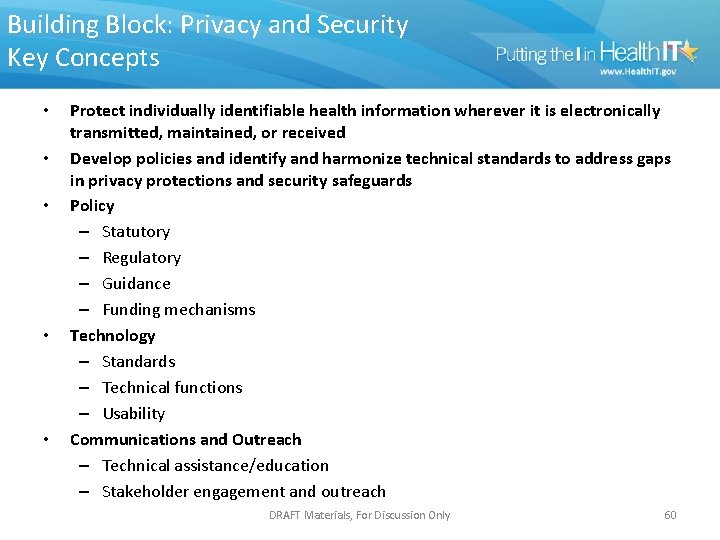
Building Block: Privacy and Security Key Concepts • • • Protect individually identifiable health information wherever it is electronically transmitted, maintained, or received Develop policies and identify and harmonize technical standards to address gaps in privacy protections and security safeguards Policy – Statutory – Regulatory – Guidance – Funding mechanisms Technology – Standards – Technical functions – Usability Communications and Outreach – Technical assistance/education – Stakeholder engagement and outreach DRAFT Materials, For Discussion Only 60
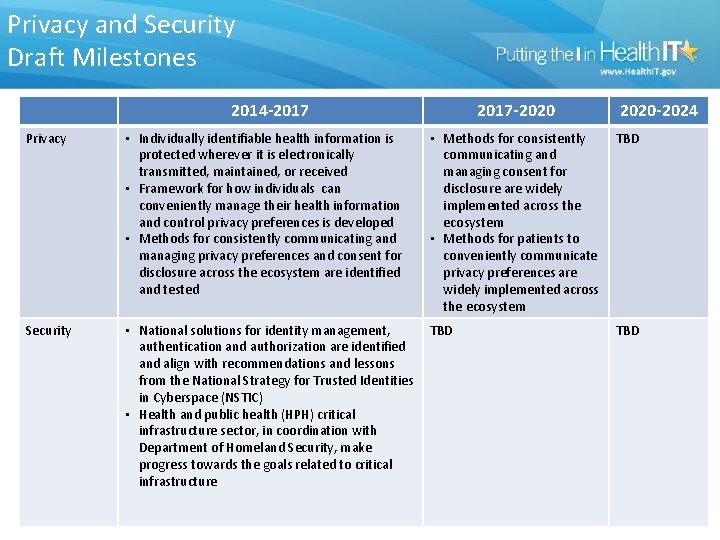
Privacy and Security Draft Milestones 2014 -2017 -2020 -2024 Privacy • Individually identifiable health information is protected wherever it is electronically transmitted, maintained, or received • Framework for how individuals can conveniently manage their health information and control privacy preferences is developed • Methods for consistently communicating and managing privacy preferences and consent for disclosure across the ecosystem are identified and tested • Methods for consistently communicating and managing consent for disclosure are widely implemented across the ecosystem • Methods for patients to conveniently communicate privacy preferences are widely implemented across the ecosystem TBD Security • National solutions for identity management, authentication and authorization are identified and align with recommendations and lessons from the National Strategy for Trusted Identities in Cyberspace (NSTIC) • Health and public health (HPH) critical infrastructure sector, in coordination with Department of Homeland Security, make progress towards the goals related to critical infrastructure TBD 10/18/2021 DRAFT Materials, For Discussion Only 61
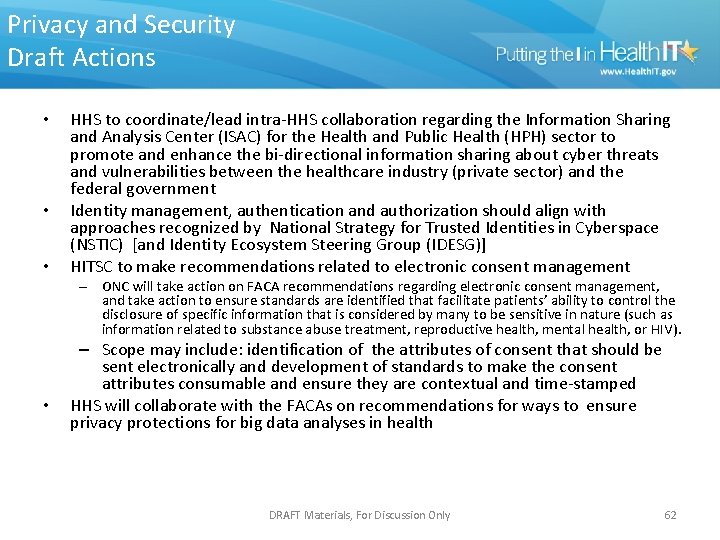
Privacy and Security Draft Actions • • • HHS to coordinate/lead intra-HHS collaboration regarding the Information Sharing and Analysis Center (ISAC) for the Health and Public Health (HPH) sector to promote and enhance the bi-directional information sharing about cyber threats and vulnerabilities between the healthcare industry (private sector) and the federal government Identity management, authentication and authorization should align with approaches recognized by National Strategy for Trusted Identities in Cyberspace (NSTIC) [and Identity Ecosystem Steering Group (IDESG)] HITSC to make recommendations related to electronic consent management – ONC will take action on FACA recommendations regarding electronic consent management, and take action to ensure standards are identified that facilitate patients’ ability to control the disclosure of specific information that is considered by many to be sensitive in nature (such as information related to substance abuse treatment, reproductive health, mental health, or HIV). • – Scope may include: identification of the attributes of consent that should be sent electronically and development of standards to make the consent attributes consumable and ensure they are contextual and time-stamped HHS will collaborate with the FACAs on recommendations for ways to ensure privacy protections for big data analyses in health DRAFT Materials, For Discussion Only 62
- Slides: 63