
INTEROPERABILITY FOR DISASTER RELIEF OPERATIONS IN SMART CITY
INTEROPERABILITY FOR DISASTER RELIEF OPERATIONS IN SMART CITY ENVIRONMENTS Manas Pradhan Doctoral Symposium WF-Io. T 2019 | 15 th-18 th April 2019 © Fraunhofer
OVERVIEW n Introduction: Background and Motivation n Objectives and Entailed Scientific Work n Scientific, Technological and Social Impact n Milestones © Fraunhofer
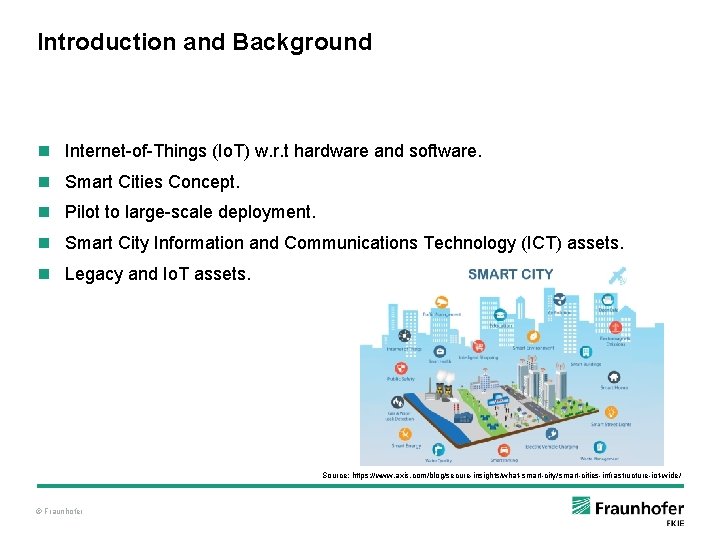
Introduction and Background n Internet-of-Things (Io. T) w. r. t hardware and software. n Smart Cities Concept. n Pilot to large-scale deployment. n Smart City Information and Communications Technology (ICT) assets. n Legacy and Io. T assets. Source: https: //www. axis. com/blog/secure-insights/what-smart-city/smart-cities-infrastructure-iot-wide/ © Fraunhofer
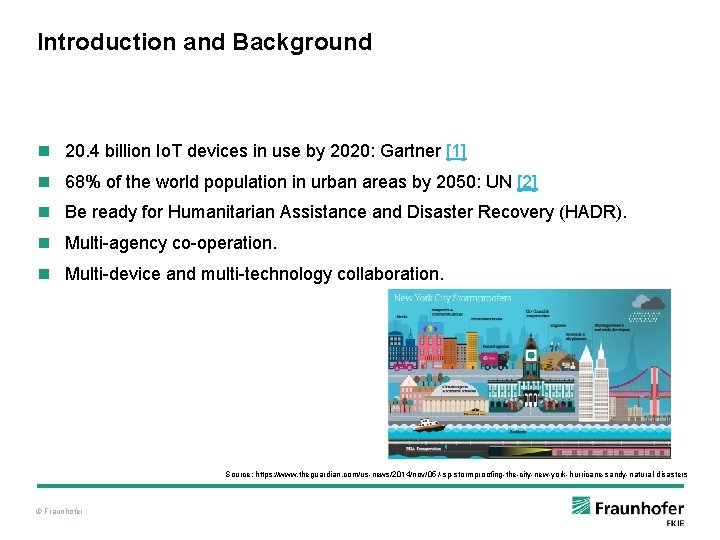
Introduction and Background n 20. 4 billion Io. T devices in use by 2020: Gartner [1] n 68% of the world population in urban areas by 2050: UN [2] n Be ready for Humanitarian Assistance and Disaster Recovery (HADR). n Multi-agency co-operation. n Multi-device and multi-technology collaboration. Source: https: //www. theguardian. com/us-news/2014/nov/05 /-sp-stormproofing-the-city-new-york-hurricane-sandy-natural-disasters © Fraunhofer
Issues in HADR Context n Heterogeneous nature of protocols and standard used by ICT assets. § Network protocol usage § Data exchange mechanisms or standards, Ontologies, Models § Service Modelling based on Service Oriented Approach (SOA) § Ontologies defining interactions between assets. n Interoperability issues between public (E. x city, private) and non-public domains (E. x Police, Military) n Gaps in the Situational Awareness (SA) picture. © Fraunhofer

Issues in HADR Context High Level Architecture for HADR Operations Interoperability in a Smart City Environment © Fraunhofer
Objectives and Entailed Scientific Work ”The objective is to propose a unified, extendable and abstract framework for systems integration. This framework is to be deployed in actual proof-ofconcepts and pilot deployments to ensure interoperability, which needs to be evaluated in the Smart City and Io. T context”. n Device an architecture to enable data and semantic interoperability between the non-public ICT domain and, the Io. T and Smart City domains. n Prevent extended discovery and configuration of the involved systems for HADR ops. © Fraunhofer
Objectives and Entailed Scientific Work n Analyse: n Smart City ICT Infrastructures n Available services, data, APIs and accessible devices n Current state and future directions of Io. T domain n Existing non-public ICT systems n Methods and mechanisms identified will be applied against several components of Smart City and non-public (ex. military) ICT systems. n Pilot implementations would provide the proof of the investigations, the approach used and the solutions being proposed to counter these challenges. © Fraunhofer
Milestones n Architecture deliverable. n Integration Framework deliverable. n Implementation System deliverable. © Fraunhofer
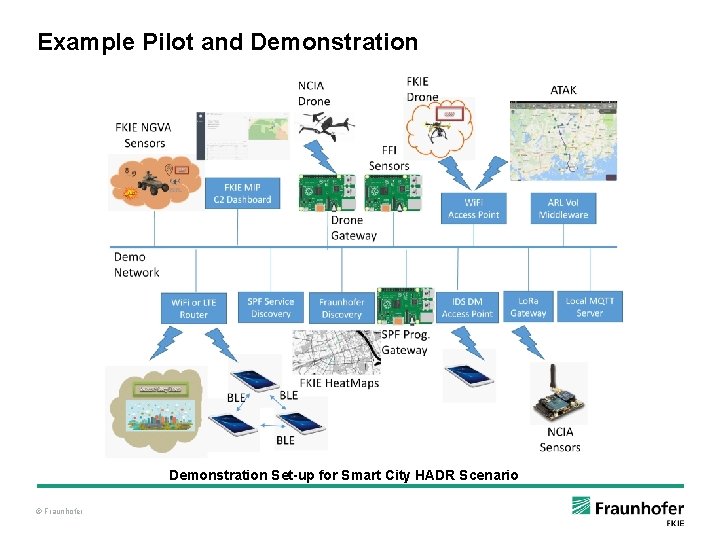
Example Pilot and Demonstration Set-up for Smart City HADR Scenario © Fraunhofer
Thanks for Your Attention! © Fraunhofer
References 1. 2. https: //www. gartner. com/en/newsroom/press-releases/2015 -12 -07 -gartner-says-smart-cities-will-use-1 -billion-connectedthings-in-2016 https: //www. un. org/development/desa/en/news/population/2018 -revision-of-world-urbanization-prospects. html 3. © Fraunhofer
- Slides: 12