
Internetworking Outline Internet Architecture Best Effort Service Model
Internetworking Outline Internet Architecture Best Effort Service Model CS 640 1
Layering revisited (cause it’s real important) • Recall pros and cons of packet switched networks – Pros: High utilization, low startup overhead – Cons: No guarantees on delay and loss • But files are transmitted without “holes”? • Reliable transfer is a function of a specific protocol layer (TCP) • Distinct functions are separated into layers – lower layers as black boxes (like C library) • Layering simplifies description of functions and enables interoperability in heterogeneous environment CS 640 2
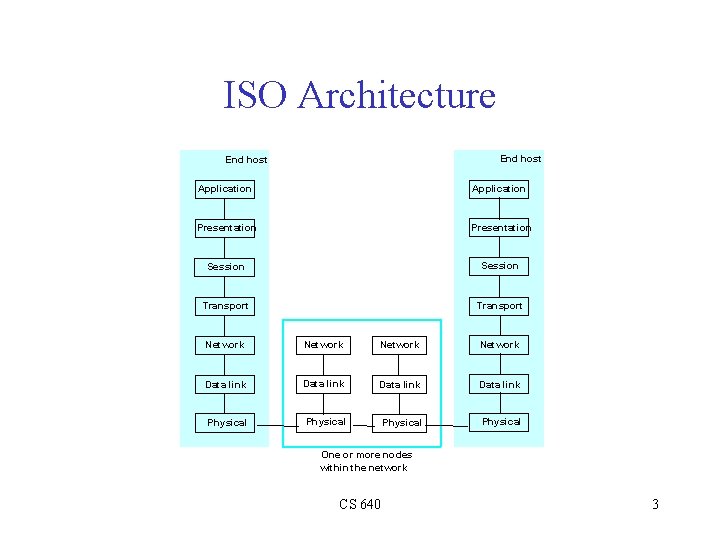
ISO Architecture End host Application Presentation Session Transport Network Data link Physical One or more nodes within the network CS 640 3
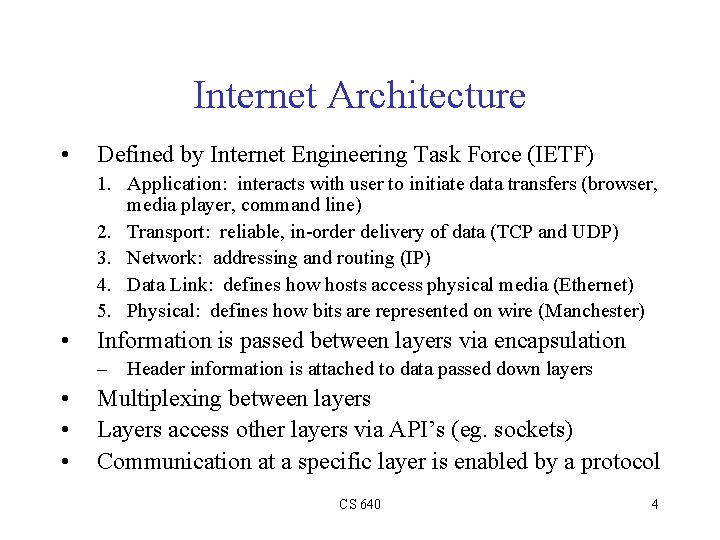
Internet Architecture • Defined by Internet Engineering Task Force (IETF) 1. Application: interacts with user to initiate data transfers (browser, media player, command line) 2. Transport: reliable, in-order delivery of data (TCP and UDP) 3. Network: addressing and routing (IP) 4. Data Link: defines how hosts access physical media (Ethernet) 5. Physical: defines how bits are represented on wire (Manchester) • Information is passed between layers via encapsulation – Header information is attached to data passed down layers • • • Multiplexing between layers Layers access other layers via API’s (eg. sockets) Communication at a specific layer is enabled by a protocol CS 640 4
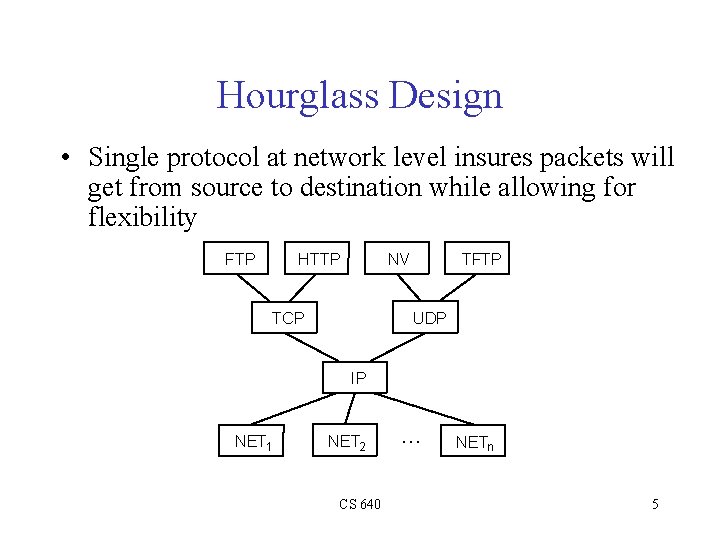
Hourglass Design • Single protocol at network level insures packets will get from source to destination while allowing for flexibility FTP HTTP NV TFTP UDP TCP IP NET 1 NET 2 CS 640 … NETn 5
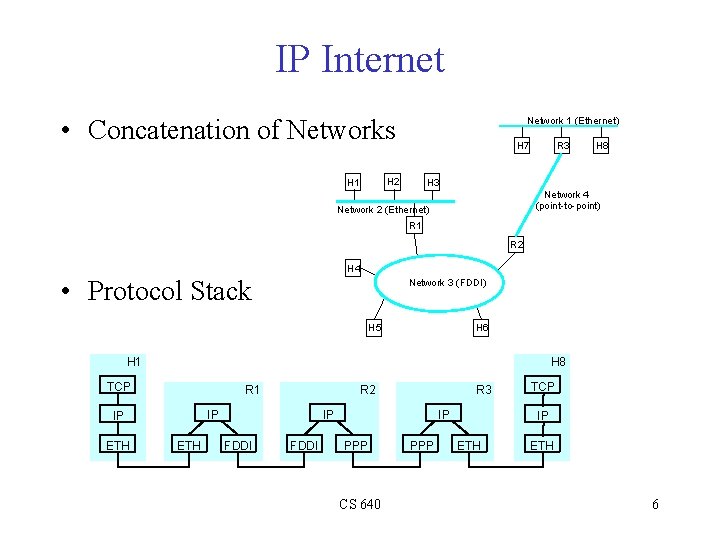
IP Internet • Concatenation of Networks Network 1 (Ethernet) H 7 H 2 H 1 R 3 H 8 H 3 Network 4 (point-to-point) Network 2 (Ethernet) R 1 R 2 H 4 • Protocol Stack Network 3 (FDDI) H 5 H 6 H 1 H 8 TCP R 1 IP IP ETH R 2 ETH R 3 IP FDDI IP PPP CS 640 PPP TCP IP ETH 6
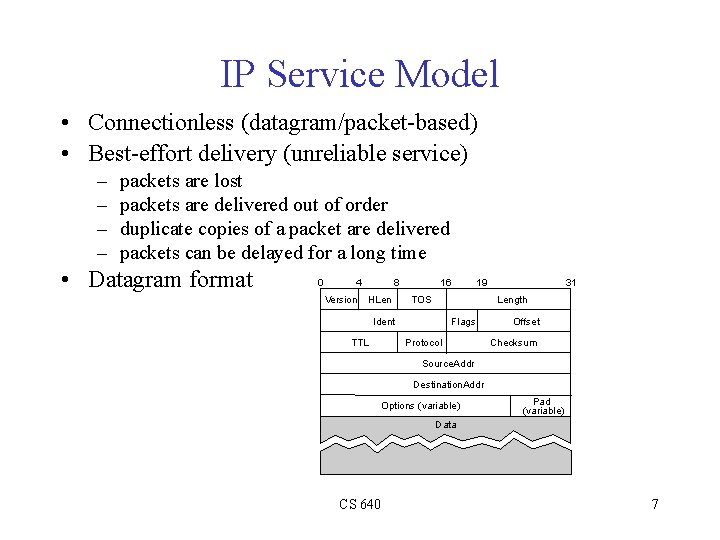
IP Service Model • Connectionless (datagram/packet-based) • Best-effort delivery (unreliable service) – – packets are lost packets are delivered out of order duplicate copies of a packet are delivered packets can be delayed for a long time • Datagram format 0 4 Version 8 HLen 16 TOS 31 Length Ident TTL 19 Flags Protocol Offset Checksum Source. Addr Destination. Addr Options (variable) Pad (variable) Data CS 640 7
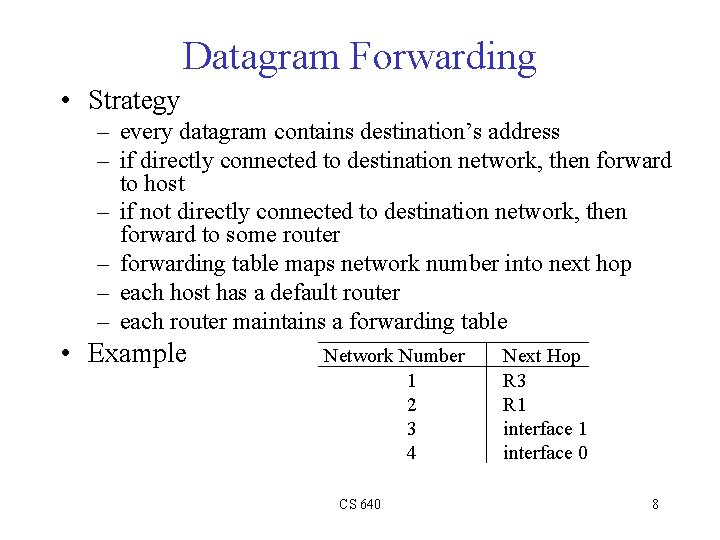
Datagram Forwarding • Strategy – every datagram contains destination’s address – if directly connected to destination network, then forward to host – if not directly connected to destination network, then forward to some router – forwarding table maps network number into next hop – each host has a default router – each router maintains a forwarding table • Example Network Number 1 2 3 4 CS 640 Next Hop R 3 R 1 interface 0 8
Forwarding Tables • Suppose there are n possible destinations, how many bits are needed to represent addresses in a routing table? – log 2 n • So, we need to store and search n * log 2 n bits in routing tables? – We’re smarter than that! CS 640 9
- Slides: 9