
Internetworking Concepts Architecture and Protocols 1 Motivation For

- Slides: 18
Internetworking: Concepts, Architecture, and Protocols 1
Motivation For Internetworking • LANs – Low cost – Limited distance • WANs – High cost – Unlimited distance 2
Heterogeneity Is Inevitable • No single networking technology best for all needs. 3
Universal Service • • • Fundamental concept in networking Pioneered by telephone system Arbitrary pair of computers can communicate Desirable Difficult in a heterogeneous world 4
Heterogeneity And Universal Service • Incompatibilities among networks – Electrical properties – Signaling and data encoding – Packet formats – Addresses 5
The Bottom Line • Although universal service is highly desirable, incompatibilities among network hardware and physical addressing prevent an organization from building a bridged network that includes arbitrary technologies. 6
An Internetwork • Begin with heterogeneous network technologies • Connect the physical networks • Create software to make resulting system appear homogeneous • Called an internetwork or internet 7
Connecting Heterogeneous Networks • Computer system used – Special-purpose – Dedicated – Works with LAN or WAN technologies – Known as • Internet router • Internet gateway 8
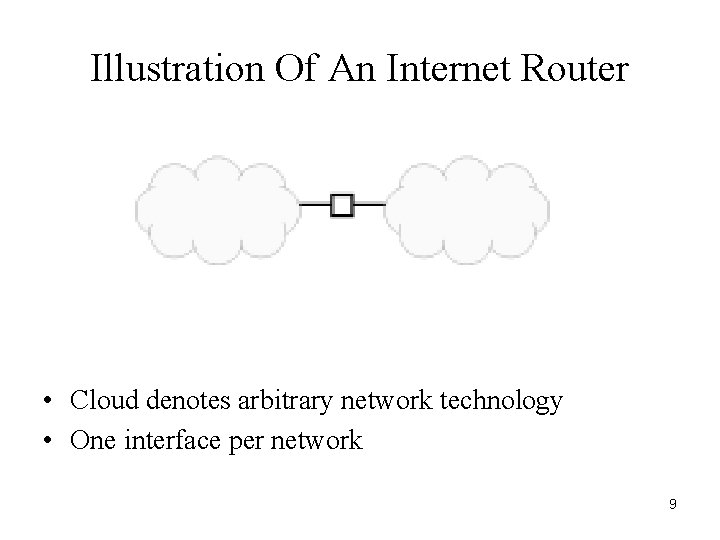
Illustration Of An Internet Router • Cloud denotes arbitrary network technology • One interface per network 9
Important Idea • A router can interconnect networks that use different technologies, including different media and media access techniques, physical addressing schemes, or frame formats. 10
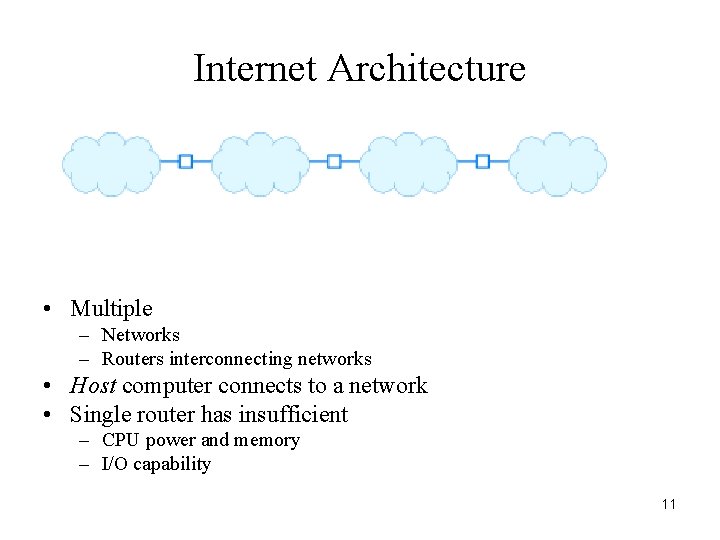
Internet Architecture • Multiple – Networks – Routers interconnecting networks • Host computer connects to a network • Single router has insufficient – CPU power and memory – I/O capability 11
Internetworking • Goal: communication system – Seamless – Uniform – General-purpose – Universal – Hides heterogeneity from user 12
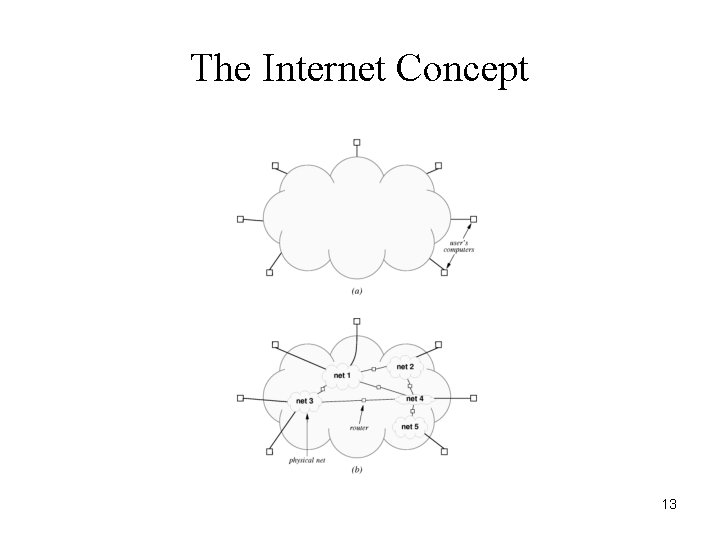
The Internet Concept 13
To Hide Heterogeneity • Create ‘‘virtual’’ network • Invent – Addressing scheme – Naming scheme • Implement with – Protocol software • Note: protocol software needed on both hosts and routers 14
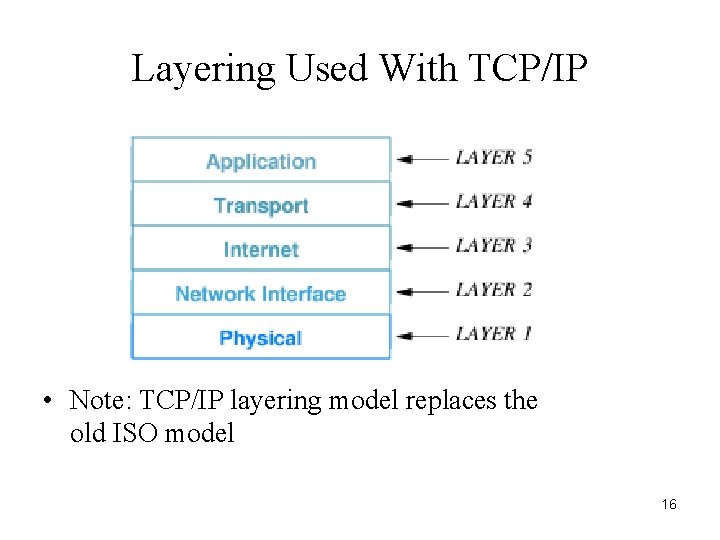
Internet Protocols • • Known as TCP/IP Many protocols comprise suite Designed to work together Divided into five conceptual layers 15
Layering Used With TCP/IP • Note: TCP/IP layering model replaces the old ISO model 16
TCP/IP Layers • Layer 1: Physical – Basic network hardware • Layer 2: Network Interface – MAC frame format – MAC addressing – Interface between computer and network (NIC) • Layer 3: Internet – Facilities to send packets across internet composed of multiple routers 17
TCP/IP Layers (continued) • Layer 4: Transport – Transport from an application on one computer to application on another • Layer 5: Application – Everything else 18