
InternetScale Systems Research Group MASH S 7 Cellular
- Slides: 23
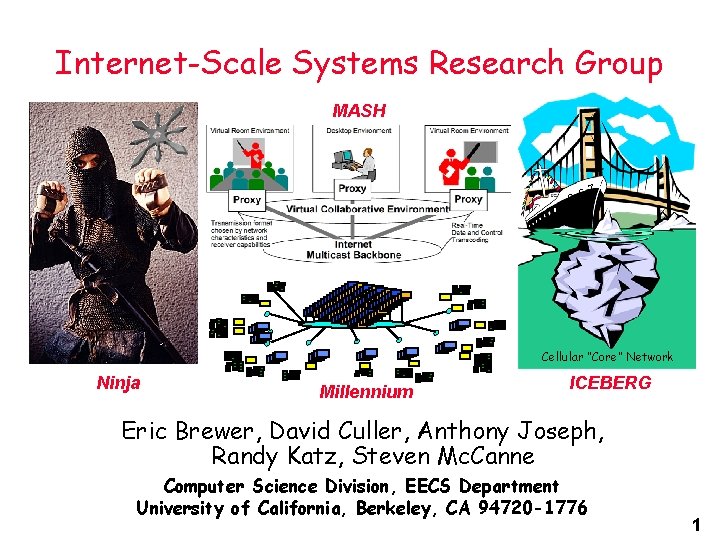
Internet-Scale Systems Research Group MASH S. 7 Cellular “Core” Network Ninja Millennium ICEBERG Eric Brewer, David Culler, Anthony Joseph, Randy Katz, Steven Mc. Canne Computer Science Division, EECS Department University of California, Berkeley, CA 94720 -1776 1
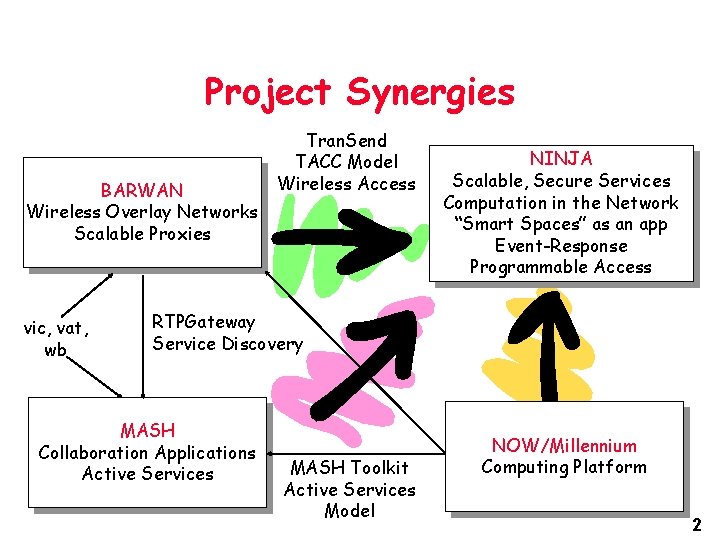
Project Synergies BARWAN Wireless Overlay Networks Scalable Proxies vic, vat, wb Tran. Send TACC Model Wireless Access NINJA Scalable, Secure Services Computation in the Network “Smart Spaces” as an app Event-Response Programmable Access RTPGateway Service Discovery MASH Collaboration Applications Active Services MASH Toolkit Active Services Model NOW/Millennium Computing Platform 2
Mission Statement Lead the evolution of the Internet through fundamental protocol and systems research – Grounded in real-world prototypes that are deployed across diverse user communities – Unify on-going and future research projects – Facilitate technology transfer and standardization – Work closely with industrial partners in an open laboratory environment 3
Strategy • Leverage interdisciplinary systems expertise in network-based applications, scalable services, network -connected computing platforms • Work collaboratively across applications, OS, networks, architecture • Interact closely with industry, to obtain early access to leading edge technologies and facilitate tech transfer • Cultivate ties with Bay Area (and beyond!) networking and systems research community 4
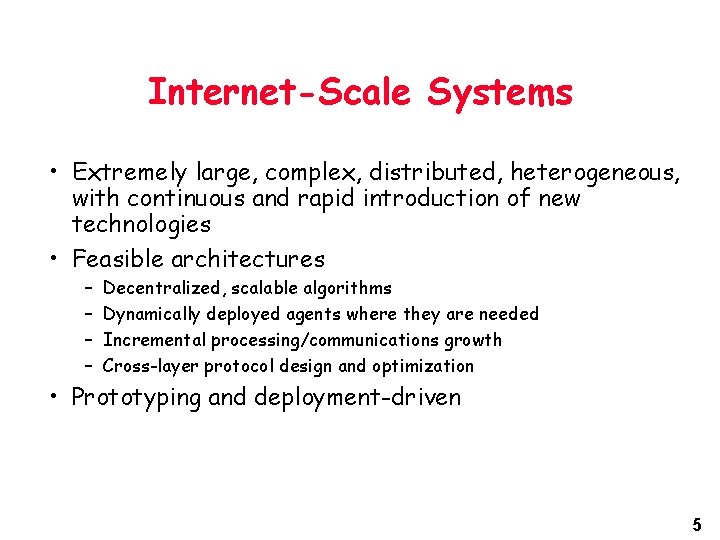
Internet-Scale Systems • Extremely large, complex, distributed, heterogeneous, with continuous and rapid introduction of new technologies • Feasible architectures – – Decentralized, scalable algorithms Dynamically deployed agents where they are needed Incremental processing/communications growth Cross-layer protocol design and optimization • Prototyping and deployment-driven 5
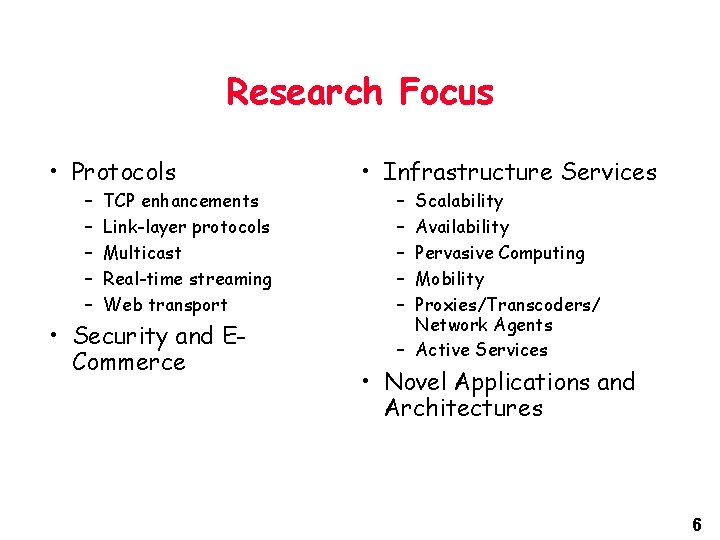
Research Focus • Protocols – – – TCP enhancements Link-layer protocols Multicast Real-time streaming Web transport • Security and ECommerce • Infrastructure Services – – – Scalability Availability Pervasive Computing Mobility Proxies/Transcoders/ Network Agents – Active Services • Novel Applications and Architectures 6
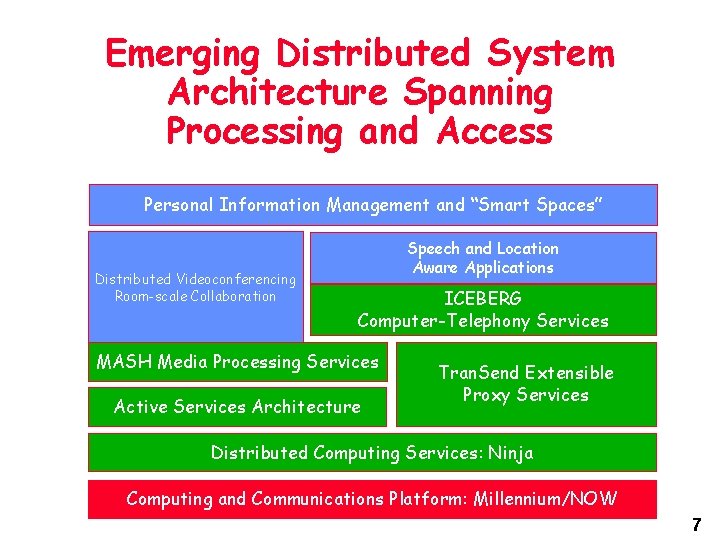
Emerging Distributed System Architecture Spanning Processing and Access Personal Information Management and “Smart Spaces” Distributed Videoconferencing Room-scale Collaboration Speech and Location Aware Applications ICEBERG Computer-Telephony Services MASH Media Processing Services Active Services Architecture Tran. Send Extensible Proxy Services Distributed Computing Services: Ninja Computing and Communications Platform: Millennium/NOW 7
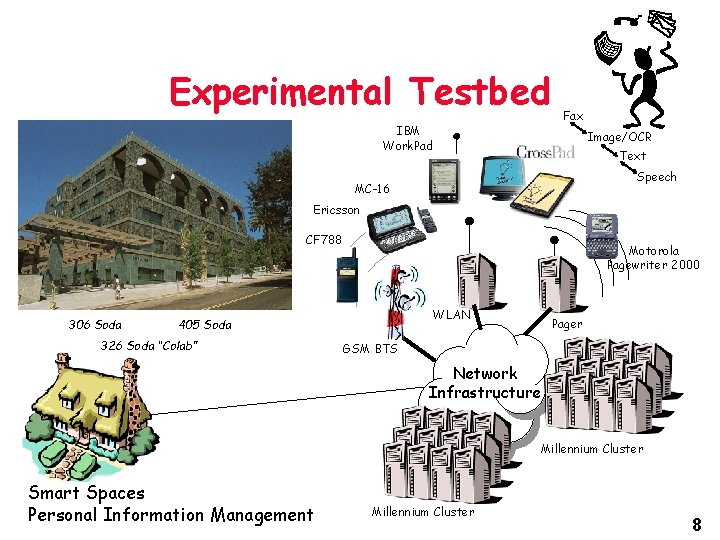
Experimental Testbed IBM Work. Pad Fax Image/OCR Text Speech MC-16 Ericsson CF 788 306 Soda Motorola Pagewriter 2000 WLAN 405 Soda 326 Soda “Colab” Pager GSM BTS Network Infrastructure Millennium Cluster Smart Spaces Personal Information Management Millennium Cluster 8
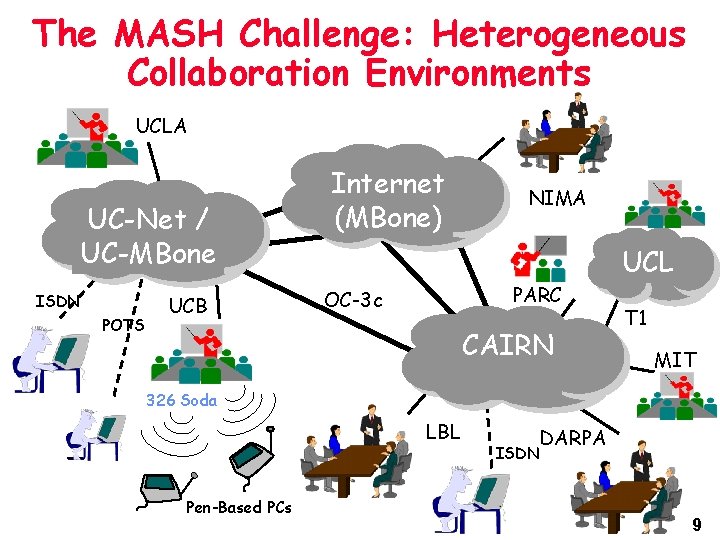
The MASH Challenge: Heterogeneous Collaboration Environments UCLA UC-Net / UC-MBone ISDN POTS UCB Internet (MBone) NIMA PARC OC-3 c CAIRN UCL T 1 MIT 326 Soda LBL Pen-Based PCs ISDN DARPA 9
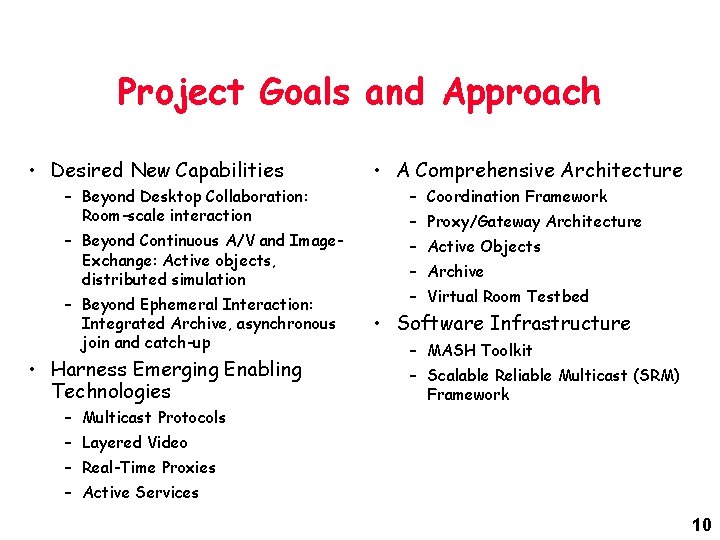
Project Goals and Approach • Desired New Capabilities • A Comprehensive Architecture – Beyond Desktop Collaboration: Room-scale interaction – Coordination Framework – Beyond Continuous A/V and Image. Exchange: Active objects, distributed simulation – Active Objects – Beyond Ephemeral Interaction: Integrated Archive, asynchronous join and catch-up • Harness Emerging Enabling Technologies – Proxy/Gateway Architecture – Archive – Virtual Room Testbed • Software Infrastructure – MASH Toolkit – Scalable Reliable Multicast (SRM) Framework – Multicast Protocols – Layered Video – Real-Time Proxies – Active Services 10
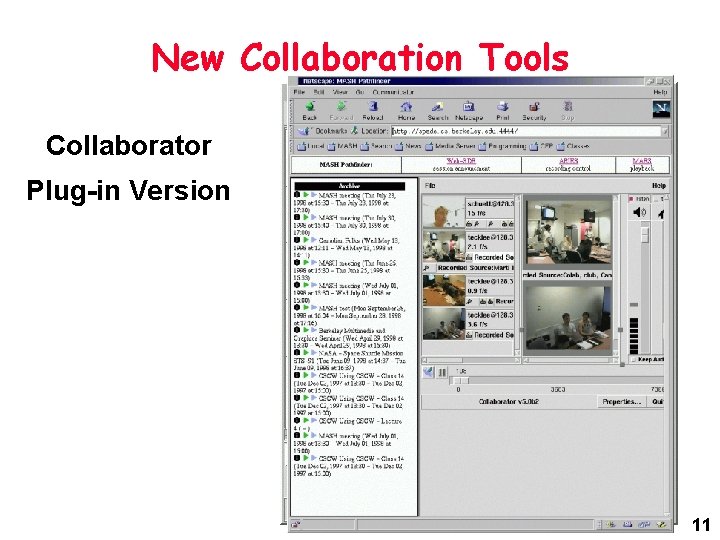
New Collaboration Tools Collaborator Plug-in Version 11
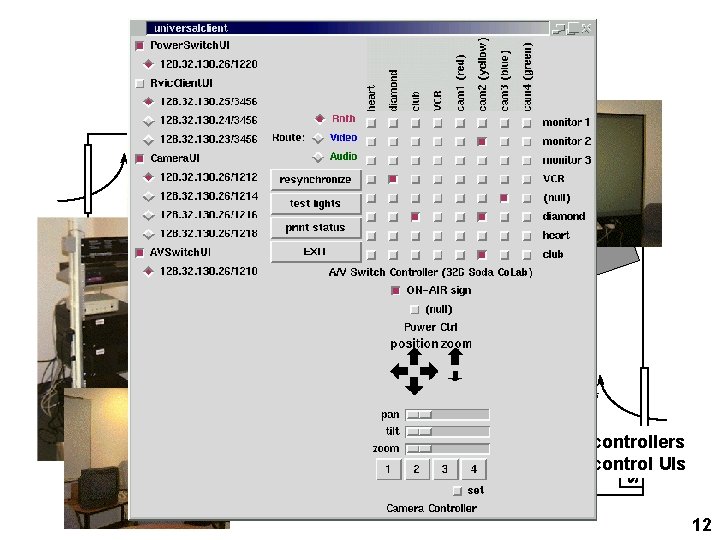
Room device controllers & XML-based control UIs spkr spk r Live Board spkr Rack mic r k p s spkr Virtual Room Testbed 12
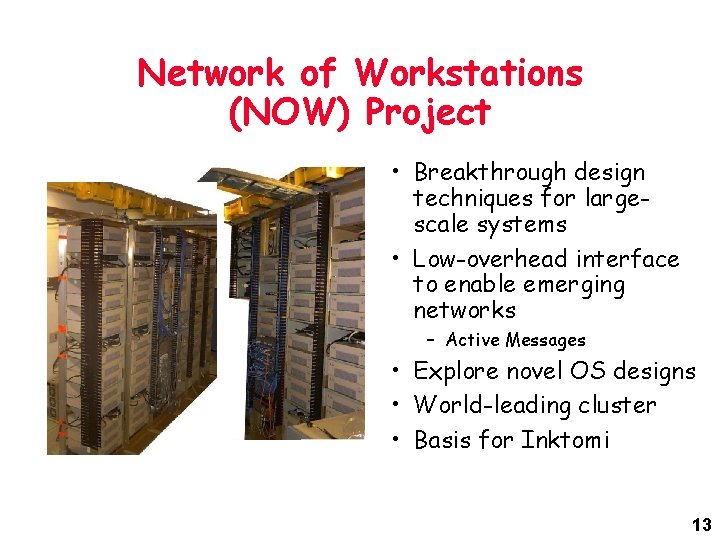
Network of Workstations (NOW) Project • Breakthrough design techniques for largescale systems • Low-overhead interface to enable emerging networks – Active Messages • Explore novel OS designs • World-leading cluster • Basis for Inktomi 13
Millennium Project Goals • Enable major advances in Computational Science and Engineering – Simulation, Modeling, and Information Processing becoming ubiquitous • Explore novel design techniques for large, complex systems – Fundamental Computer Science problems ahead are problems of scale • Develop fundamentally better ways of assimilating and interacting with large volumes of information – and with each other • Explore emerging technologies – networking, OS, devices 14
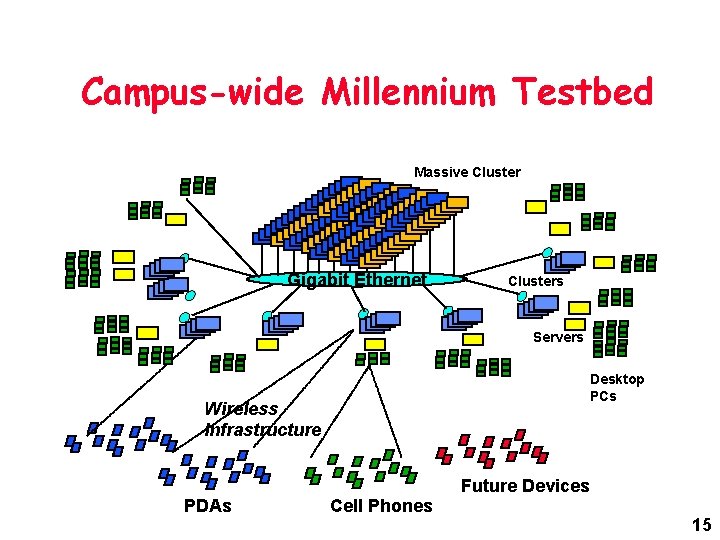
Campus-wide Millennium Testbed Massive Cluster Gigabit Ethernet Clusters Servers Desktop PCs Wireless Infrastructure PDAs Cell Phones Future Devices 15
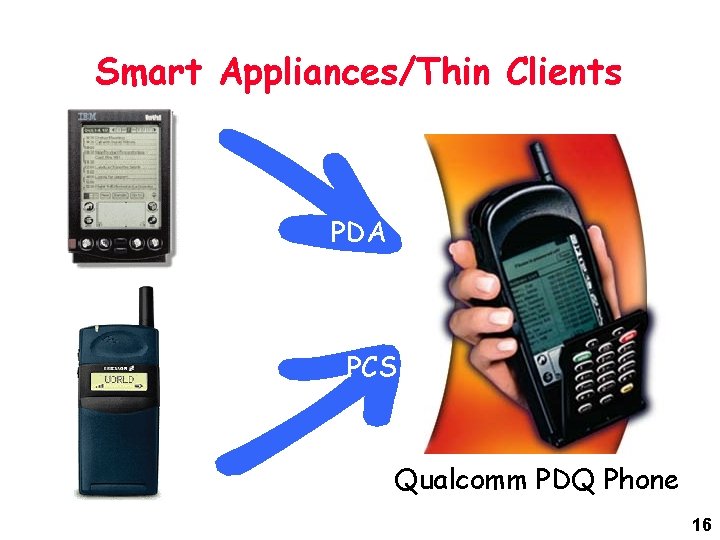
Smart Appliances/Thin Clients PDA PCS Qualcomm PDQ Phone 16
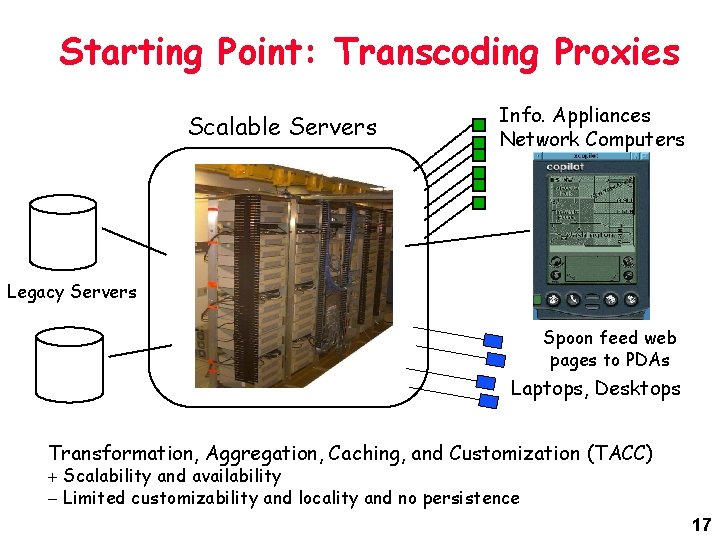
Starting Point: Transcoding Proxies Scalable Servers Info. Appliances Network Computers Legacy Servers Spoon feed web pages to PDAs Laptops, Desktops Transformation, Aggregation, Caching, and Customization (TACC) + Scalability and availability - Limited customizability and locality and no persistence 17
“Pro. Active” Infrastructure • Create a framework that enables programmatic generation and composition of services from strongly typed reusable components • Capabilities – Plug and play wide-area software components – Automatic discovery, composition, and use – Powerful operators » Clusters, databases, and agents – Viable component economics » Subscription, pay per use – Supports diverse devices, sensors, actuators – Connects everything » Ubiquitous support for access and mobility 18
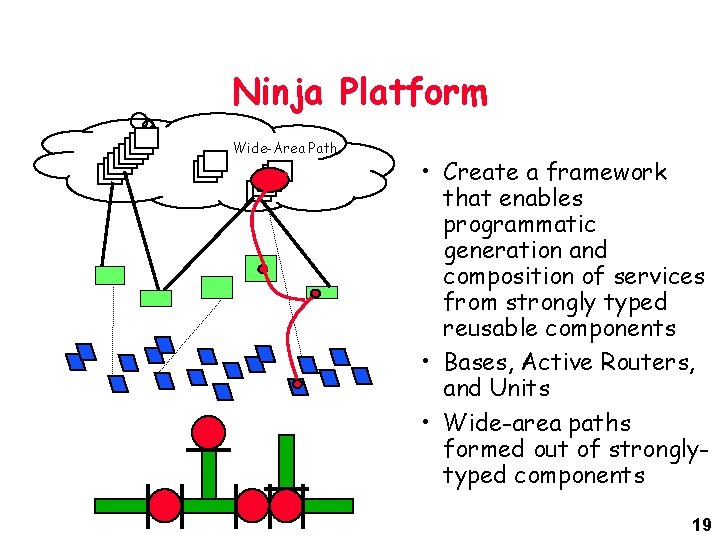
Ninja Platform Wide-Area Path • Create a framework that enables programmatic generation and composition of services from strongly typed reusable components • Bases, Active Routers, and Units • Wide-area paths formed out of stronglytyped components 19
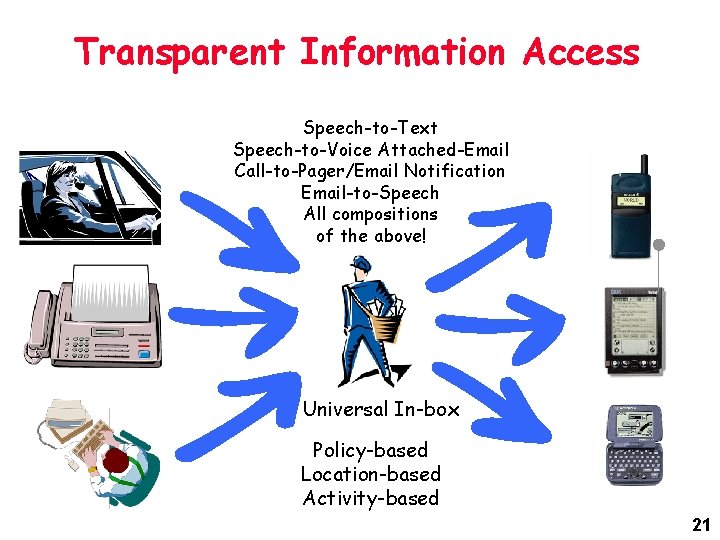
ICEBERG Project Goals • Demonstrate ease of new service deployment – Packet voice for computer-telephony integration – Speech- and location-enabled applications – Complete interoperation of speech, text, fax/image across the four P’s: PDAs, pads, pagers, phones) – Mobility and generalized routing redirection • Demonstrate new system architecture to support innovative applications – Personal Information Management » Universal In-box: e-mail, news, fax, voice mail » Notification redirection: e. g. , e-mail, pager – Home networking and control of “smart” spaces, sensor/actuator integration » Build on experience with A/V equipped rooms in Soda Hall 20
Transparent Information Access Speech-to-Text Speech-to-Voice Attached-Email Call-to-Pager/Email Notification Email-to-Speech All compositions of the above! Universal In-box Policy-based Location-based Activity-based 21
Participating ISRG Sponsors Service Companies Computer Companies Communications Companies 22
Summary and Conclusions • Internet-Scale Systems Research Group: Emerging Network-centric Distributed Architecture spanning processing and access • Open, composable services architecture--the wide-area “operating system” of the 21 st Century • Beyond the desktop PC: information appliances supported by infrastructure services--multicast realtime media plus proxies for any-to-any format translation and delivery to diverse devices • Common network core: optimized for data, based on IP, enabling packetized voice, supporting user, terminal, and service mobility 23