
Internet Web Security Case Study 2 Mobile IPv
Internet & Web Security Case Study 2: Mobile IPv 6 security Dieter Gollmann Hamburg University of Technology diego@tu-harburg. de 1 NISNet Winter School Finse 2008
Authentication in the Internet § § § We want to know the identity of the sender. § It had been suggested to use a PKI for this purpose, but no such PKI yet exists and it is doubtful that this will ever be the case. In IP, the identities we have are IP addresses. To verify cryptographically that data come from a claimed address, we have to reliably associate a cryptographic key with this address. 2 NISNet Winter School Finse 2008
Mobility § By definition, a mobile node can change its location (IP address!? ) in the network. § The ability to change location makes a node mobile. § In the “old” setting (fixed network), a node could lie about its identity (spoofing). § A mobile node can lie about its identity and about its location. 3 NISNet Winter School Finse 2008
Attacks by a mobile node § Alice could claim to be Bob to get messages intended for Bob (this issue is familiar from fixed networks). § Alice could claim that Bob is at her location so that traffic intended for Bob is sent to her (hijacking, “old” attack in new disguise). § Alice could claim that Bob is at a non-existing location so that traffic intended for Bob is lost. § To stop these attacks, check that Bob gave the information about his location. 4 NISNet Winter School Finse 2008
Bombing Attacks § Alice could claim that she is at Bob’s location so that traffic intended for her is sent to Bob. § Alice could order a lot of traffic and thus mount a denial of service (bombing) attack. § Verifying that the information about Alice’s location came from Alice does not help. § The information had come from her, but she had been lying about her location. 5 NISNet Winter School Finse 2008
Mobility § Mobility changes the rules of the (security) game. § In a fixed network, nodes may use different identities in different sessions (e. g. NAT in IPv 4), but in each session the current identity is the “location” messages are sent to. § With mobile nodes, we have to treat identity and location as separate concepts. 6 NISNet Winter School Finse 2008

Mobile IPv 6 § IPv 6 address (128 -bit): subnet prefix + interface id (location) § § (identity in subnet) IPv 6 address can specify node and location. Addresses of mobile nodes and stationary nodes are indistinguishable. subnet prefix interface ID 7 NISNet Winter School Finse 2008

MIPv 6 – Home Network § Mobile node is always addressable at its home address, whether away from home or currently attached to its home link. § Home address is an IP address assigned to the mobile node within its home subnet prefix on its home link. § While a mobile node is at home, packets addressed to its home address are routed to the mobile node’s home link. 8 NISNet Winter School Finse 2008
MIPv 6 – Care-of Address § While a mobile node is attached to some foreign link away from home, it is also addressable at a care-of address. § Care-of address is an IP address with a subnet prefix from the visited foreign link. § Association between a mobile node’s home address and care-of address is known as a binding for the mobile node. 9 NISNet Winter School Finse 2008
MIPv 6 – Home Agent § Away from home, a mobile node registers its primary care-of address with a router on its home link; this router to functions as the home agent for the mobile node. § Mobile node and home agent have a preconfigured IP security association (“trust relationship”). § With this security association, mobile node and home agent can create a secure tunnel. 10 NISNet Winter School Finse 2008
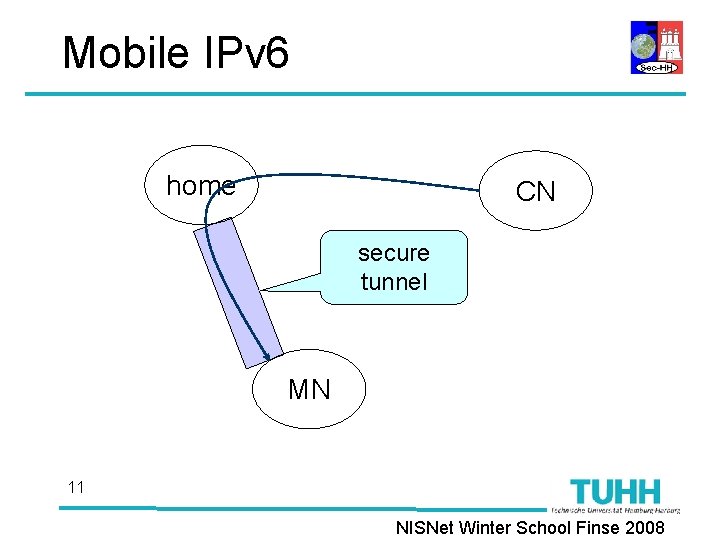
Mobile IPv 6 home CN secure tunnel MN 11 NISNet Winter School Finse 2008
MIPv 6 – Correspondent Nodes § Any other nodes communicating with a mobile node are called correspondent nodes. § Mobile nodes can information correspondent nodes about their current location using Binding Updates and Acknowledgements. § The correspondent stores the location information in a binding cache. § Binding updates refresh the binding cache entries. 12 NISNet Winter School Finse 2008
MIPv 6 – Binding Updates § Packets between mobile node and correspondent node are either tunnelled via the home agent, or sent directly if a binding exists in the correspondent node for the current location of the mobile node. § If binding updates are unprotected, attackers could create havoc with the Internet (also with the wired Internet). § Binding updates allow mobile nodes to participate in – and interfere with – network management. 13 NISNet Winter School Finse 2008
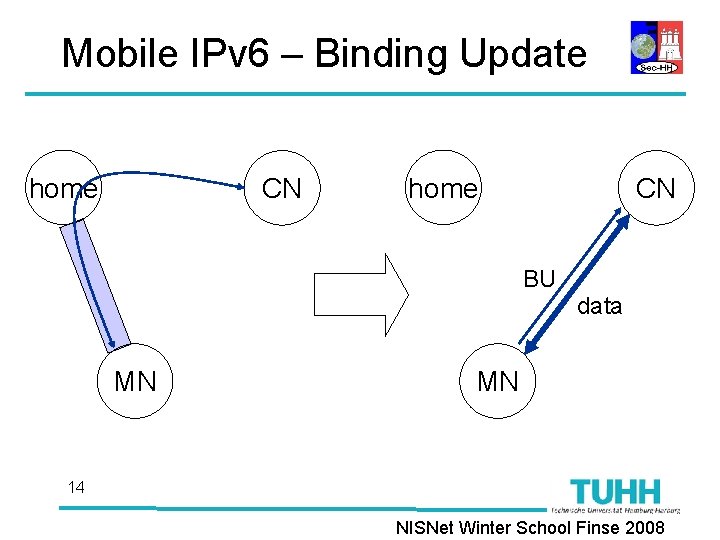
Mobile IPv 6 – Binding Update home CN BU MN data MN 14 NISNet Winter School Finse 2008
MIPv 6 Security (RFC 3775) § § Mobility must not weaken the security of IP. § § Resilience to denial-of-service attacks. § Cryptographic keys are sent in the clear! (You will see why. ) Primary concern: protect nodes that are not involved in the exchange (e. g. nodes in the wired Internet). Security based on return routability: Challenges are sent to identity and location, response binds identity to location. 15 NISNet Winter School Finse 2008
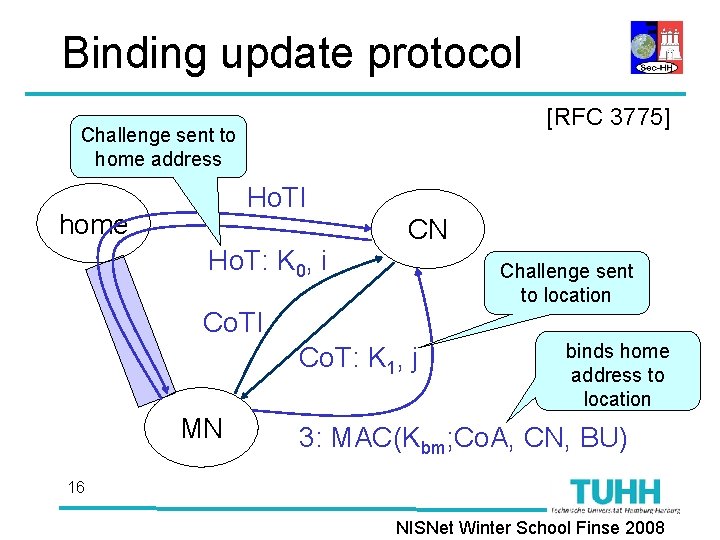
Binding update protocol [RFC 3775] Challenge sent to home address Ho. TI home Ho. T: K 0, i CN Challenge sent to location Co. TI Co. T: K 1, j MN binds home address to location 3: MAC(Kbm; Co. A, CN, BU) 16 NISNet Winter School Finse 2008
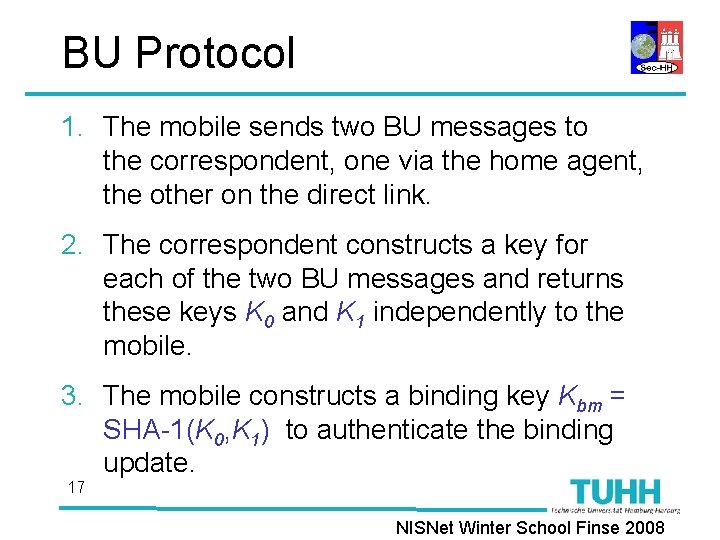
BU Protocol 1. The mobile sends two BU messages to the correspondent, one via the home agent, the other on the direct link. 2. The correspondent constructs a key for each of the two BU messages and returns these keys K 0 and K 1 independently to the mobile. 3. The mobile constructs a binding key Kbm = SHA-1(K 0, K 1) to authenticate the binding update. 17 NISNet Winter School Finse 2008
Design Principles – 1 § Return routability: Correspondent checks that it receives a confirmation from the advertised location. § The protocol creates a binding between home address (identity? ) and current location. § The protocol could be considered as a “location authentication” protocol. § Keys are sent in the clear, and could equally be interpreted as nonces. 18 NISNet Winter School Finse 2008
Design Principles – 1 (ctd) § The protocol is vulnerable to an attacker who can intercept both communications links, in particular the wired Internet. § If you are concerned about the security of the wired Internet, use IPsec to protect traffic between correspondent and home agent. 19 NISNet Winter School Finse 2008
Design Principles – 2 § Resilience against Do. S attacks: Protocol should be stateless for the correspondent; should not have to remember keys K 0 and K 1. § Each node has a secret node key, Kcn, used to produce the keys sent to the mobile nodes. § Keys K 0 and K 1 are derived from Kcn and session identifiers and can be reconstructed when the MAC is verified. § Kcn must not be shared with any other entity. 20 NISNet Winter School Finse 2008
Design Principle – 3 § Strong authentication using public key cryptography is a weakness when considering Do. S attacks. § Flooding attacks can exhaust the victim’s resources by triggering the execution of expensive public key crypto operations. § In mobile devices, such attacks may not only waste CPU cycles but can also exhaust batteries (the ultimate Do. S attack). 21 NISNet Winter School Finse 2008
Design Principle – 4 § Balancing message flows: A protocol where more than one message is sent in reply to one message received can be used to amplify Do. S attacks. § For this reason, the BU request is split in two; home address and care-of address could have been sent in one message but then the correspondent would have replied to one BU request with two BU acknowledgments. 22 NISNet Winter School Finse 2008
Active and Passive Attackers § In communications security, it is traditionally assumed that passive attacks (intercepting communications) are easier to perform than active attacks. § § In mobile systems, the reverse may be true. § Attempts to interfere with location management can be launched from anywhere. To intercept traffic from a specific mobile, one has to be in its vicinity. 23 NISNet Winter School Finse 2008
Defence against Bombing § § Bombing is a flow control issue. § It would be more accurate to check whether the receiver of a data stream is willing to accept the stream. § Instead of origin authentication we require an authorisation to send from the destination. Authenticating the origin of a BU does not prevent bombing; a node may lie about its location. 24 NISNet Winter School Finse 2008
- Slides: 24