
Internet Statistics Facts and Figures 1 st Tutorial
- Slides: 13
Internet Statistics – Facts and Figures 1 st Tutorial Session for CEG 3180 B January 18 th, 2005 Stejarel Veres <steju@ncct. uottawa. ca>
First things first: Internet? o o o Probably the most used example when it comes to Wide Area Networks (WANs) Originally a Do. D project [1], it has become the most widely used public internetwork It is the most technologically heterogeneous network ever to exist, short for one aspect: TCP/IP Stejarel Veres <steju@ncct. uottawa. ca> 2
Why Internet Statistics? o o Question: Why would we be interested in the Internet host count trends? Several pertinent answers: n n Curiosity Bandwidth consumption (i. e. , traffic) forecasting Address space usage forecasting … etc. Stejarel Veres <steju@ncct. uottawa. ca> 3
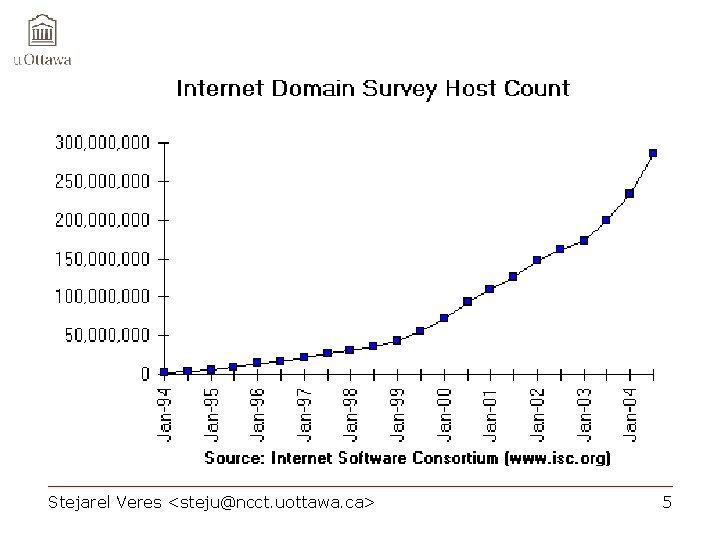
Well, how many are they? o How many what? n n o Hosts Originally, a host was a single computer on the network With the introduction of virtual hosts, however, a single computer could represent more than one host So… should we count virtual hosts too or not? According to the ISC, in June 2004 there were about 300 million hosts in the Internet Stejarel Veres <steju@ncct. uottawa. ca> 4
Stejarel Veres <steju@ncct. uottawa. ca> 5
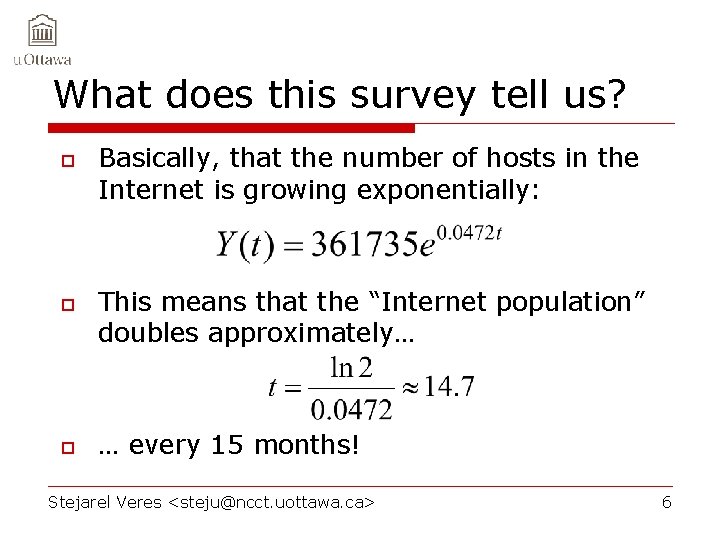
What does this survey tell us? o o o Basically, that the number of hosts in the Internet is growing exponentially: This means that the “Internet population” doubles approximately… … every 15 months! Stejarel Veres <steju@ncct. uottawa. ca> 6
How does the survey work? o o It is a Domain Name System (DNS) [3] survey What is the Domain Name System? n A hierarchical (i. e. , similar to the postal address system) way to name hosts in order to set a correspondence between domain names and IP [4] addresses n Top-level domains: . com, . net, . edu, . mil, . gov, . org, . int (and the more recent. biz, . info, . to etc. ) and the country top-level domains n Second-level domains: usually (but not always) organizations n E. g. , www. uottawa. ca means ‘the web server’ (www) ‘of the University of Ottawa’ (uottawa) ‘which is in Canada’ (ca) Stejarel Veres <steju@ncct. uottawa. ca> 7
How does the survey work? (2) o Two methods: n n Walking the domain name tree and doing zone transfers of domain data in order to discover hosts and further subdomains (original method, used until 1997) Walking the reverse delegation zones (i. e. , in-addr. arpa) and counting all addresses that have been assigned a domain name (new method, used since 1998) Stejarel Veres <steju@ncct. uottawa. ca> 8
Is the survey accurate? o o Question: How far can we trust these results? Answer: They will have to do it. Neither of the two survey methods is free of errors – it is virtually impossible to know the exact number of hosts in the internet However, a good approximation should be sufficient Stejarel Veres <steju@ncct. uottawa. ca> 9
Is the survey accurate? (2) o Reasons for the surveys not being able to provide error-free results: n n n Many DNS servers do not allow for whole zone transfers Not all hosts are registered in a domain name server Poorly configured DNS servers can lead to bogus entries Just because a hostname is assigned an IP address or vice-versa, does not mean that the host actually exists Poor connectivity can pose difficulties to the data collection process Stejarel Veres <steju@ncct. uottawa. ca> 10
Interesting facts o o What has the number of hosts in a certain country to do with its economic status? More. net hosts than. com hosts – does this mean that there are more hosts for “infrastructure” than for “services”? The top 2 host names: ~ 1 million www, ~ 400 k mail Canada has about 3. 5 million hosts in 21 k domains Stejarel Veres <steju@ncct. uottawa. ca> 11
Conclusions o o o The “Internet population” is growing at an exponentially rate Keeping track of the number of hosts in the Internet is important, for several reasons However, an extremely accurate counting is virtually impossible Stejarel Veres <steju@ncct. uottawa. ca> 12
References 1. 2. 3. 4. 5. http: //www. isoc. org/internet/history http: //www. isc. org/ds P. V. Mockapetris, STD 0013/RFC 1034: Domain names – concepts and facilities J. Postel, STD 0005/RFC 0791: Internet Protocol S. Deering, R. Hinden, RFC 2460: Internet Protocol, Version 6 (IPv 6) Specification Stejarel Veres <steju@ncct. uottawa. ca> 13