
Internet Protocol IP Packet Format Fragmentation Options Shivkumar
- Slides: 21
Internet Protocol (IP): Packet Format, Fragmentation, Options Shivkumar Kalyanaraman Rensselaer Polytechnic Institute shivkuma@ecse. rpi. edu http: //www. ecse. rpi. edu/Homepages/shivkuma Shivkumar Kalyanaraman Rensselaer Polytechnic Institute 5 -1
Overview IP features q IP datagram format q Fragmentation q IP options Ref: RFC 791, Chap 3, 11. 5 -11. 8, Lab 1 q Shivkumar Kalyanaraman Rensselaer Polytechnic Institute 5 -2
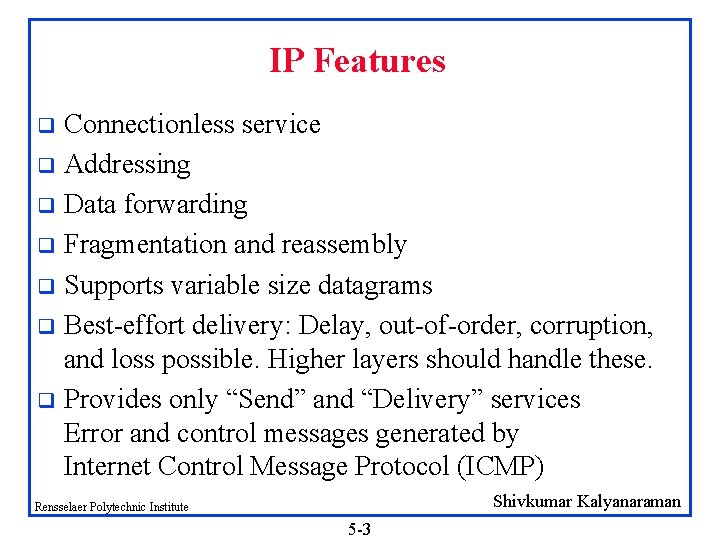
IP Features Connectionless service q Addressing q Data forwarding q Fragmentation and reassembly q Supports variable size datagrams q Best-effort delivery: Delay, out-of-order, corruption, and loss possible. Higher layers should handle these. q Provides only “Send” and “Delivery” services Error and control messages generated by Internet Control Message Protocol (ICMP) q Shivkumar Kalyanaraman Rensselaer Polytechnic Institute 5 -3
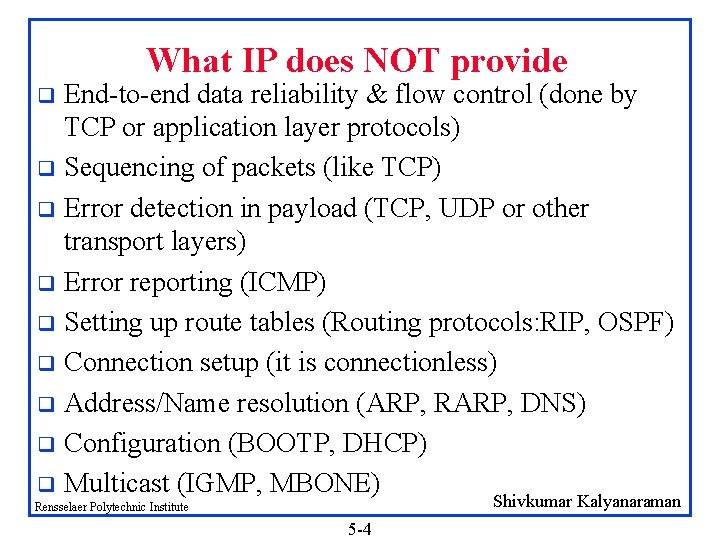
What IP does NOT provide End-to-end data reliability & flow control (done by TCP or application layer protocols) q Sequencing of packets (like TCP) q Error detection in payload (TCP, UDP or other transport layers) q Error reporting (ICMP) q Setting up route tables (Routing protocols: RIP, OSPF) q Connection setup (it is connectionless) q Address/Name resolution (ARP, RARP, DNS) q Configuration (BOOTP, DHCP) q Multicast (IGMP, MBONE) q Shivkumar Kalyanaraman Rensselaer Polytechnic Institute 5 -4
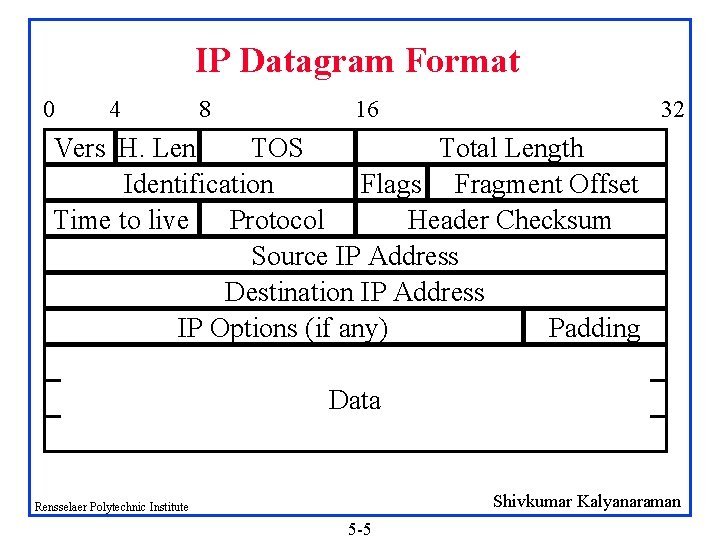
IP Datagram Format 0 4 8 16 32 Vers H. Len TOS Total Length Identification Flags Fragment Offset Time to live Protocol Header Checksum Source IP Address Destination IP Address IP Options (if any) Padding Data Shivkumar Kalyanaraman Rensselaer Polytechnic Institute 5 -5
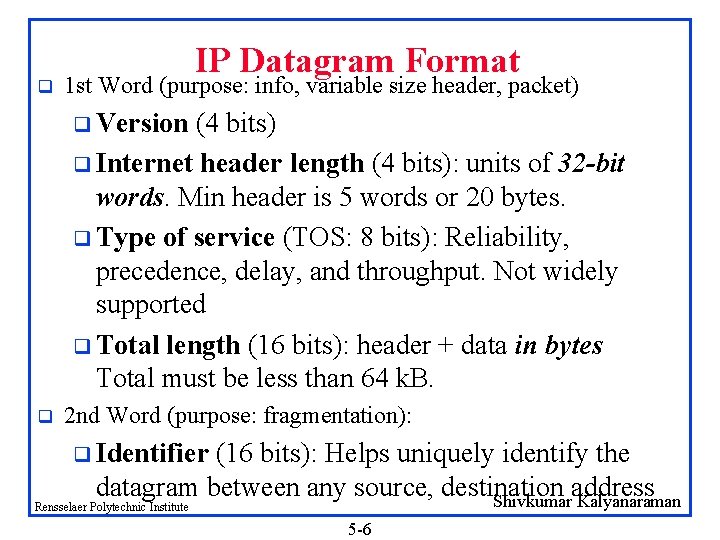
q IP Datagram Format 1 st Word (purpose: info, variable size header, packet) q Version (4 bits) q Internet header length (4 bits): units of 32 -bit words. Min header is 5 words or 20 bytes. q Type of service (TOS: 8 bits): Reliability, precedence, delay, and throughput. Not widely supported q Total length (16 bits): header + data in bytes Total must be less than 64 k. B. q 2 nd Word (purpose: fragmentation): q Identifier (16 bits): Helps uniquely identify the datagram between any source, destination address Shivkumar Kalyanaraman Rensselaer Polytechnic Institute 5 -6
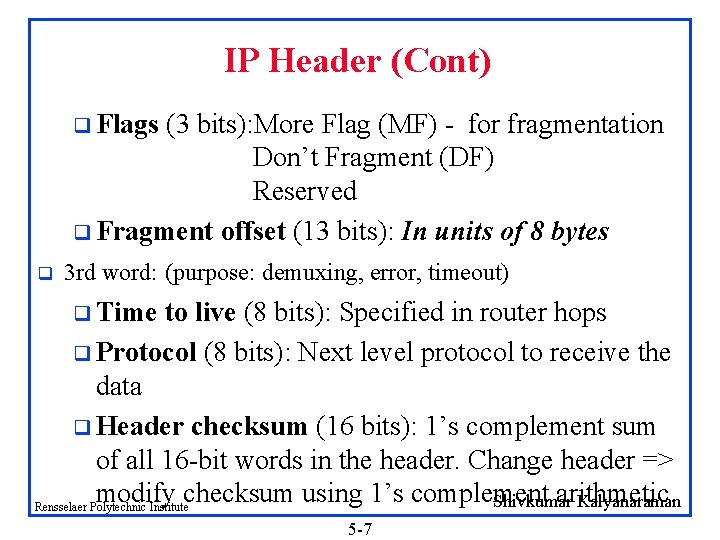
IP Header (Cont) q Flags (3 bits): More Flag (MF) - for fragmentation Don’t Fragment (DF) Reserved q Fragment offset (13 bits): In units of 8 bytes q 3 rd word: (purpose: demuxing, error, timeout) q Time to live (8 bits): Specified in router hops q Protocol (8 bits): Next level protocol to receive the data q Header checksum (16 bits): 1’s complement sum of all 16 -bit words in the header. Change header => modify checksum using 1’s complement arithmetic. Shivkumar Kalyanaraman Rensselaer Polytechnic Institute 5 -7
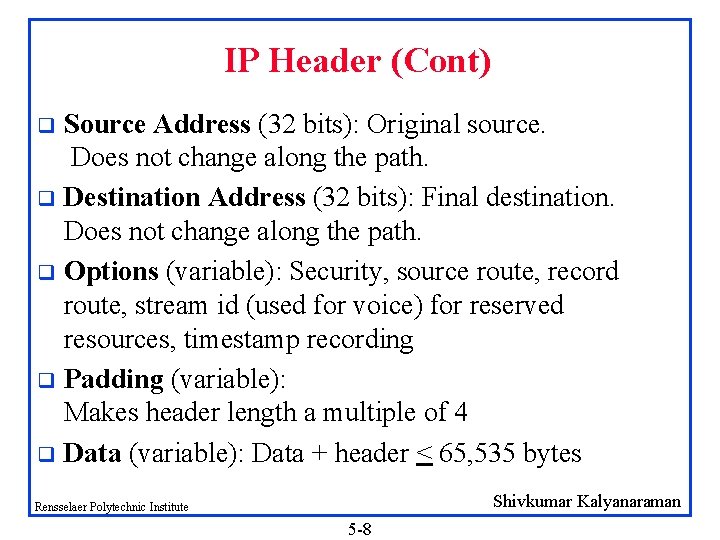
IP Header (Cont) Source Address (32 bits): Original source. Does not change along the path. q Destination Address (32 bits): Final destination. Does not change along the path. q Options (variable): Security, source route, record route, stream id (used for voice) for reserved resources, timestamp recording q Padding (variable): Makes header length a multiple of 4 q Data (variable): Data + header < 65, 535 bytes q Shivkumar Kalyanaraman Rensselaer Polytechnic Institute 5 -8
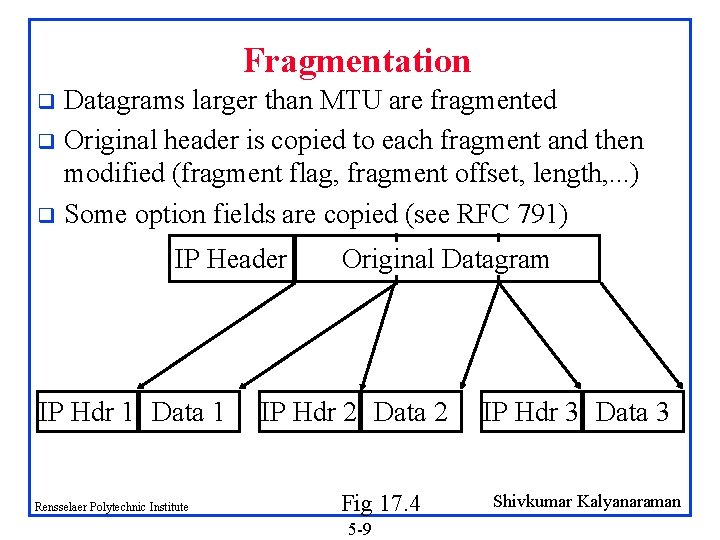
Fragmentation Datagrams larger than MTU are fragmented q Original header is copied to each fragment and then modified (fragment flag, fragment offset, length, . . . ) q Some option fields are copied (see RFC 791) q IP Header IP Hdr 1 Data 1 Rensselaer Polytechnic Institute Original Datagram IP Hdr 2 Data 2 Fig 17. 4 5 -9 IP Hdr 3 Data 3 Shivkumar Kalyanaraman
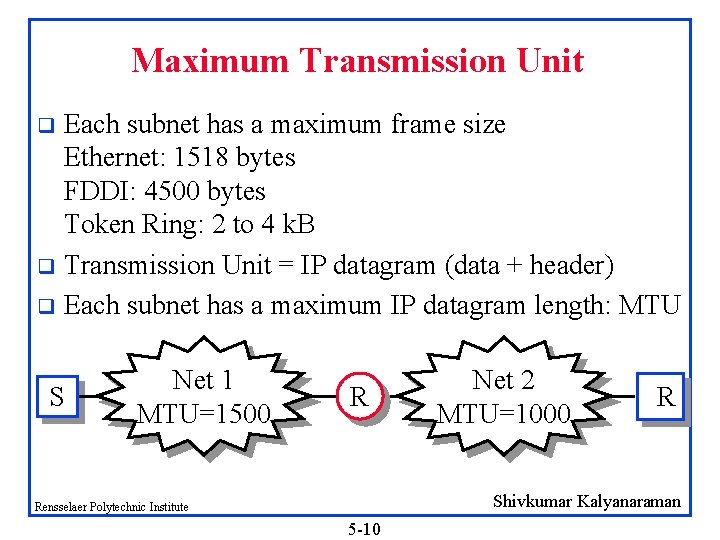
Maximum Transmission Unit Each subnet has a maximum frame size Ethernet: 1518 bytes FDDI: 4500 bytes Token Ring: 2 to 4 k. B q Transmission Unit = IP datagram (data + header) q Each subnet has a maximum IP datagram length: MTU q S Net 1 MTU=1500 R Net 2 MTU=1000 R Shivkumar Kalyanaraman Rensselaer Polytechnic Institute 5 -10
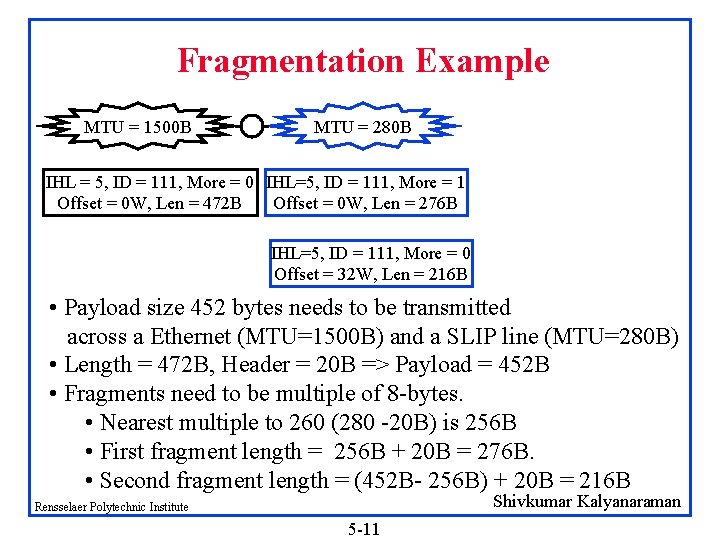
Fragmentation Example MTU = 1500 B MTU = 280 B IHL = 5, ID = 111, More = 0 IHL=5, ID = 111, More = 1 Offset = 0 W, Len = 472 B Offset = 0 W, Len = 276 B IHL=5, ID = 111, More = 0 Offset = 32 W, Len = 216 B • Payload size 452 bytes needs to be transmitted across a Ethernet (MTU=1500 B) and a SLIP line (MTU=280 B) • Length = 472 B, Header = 20 B => Payload = 452 B • Fragments need to be multiple of 8 -bytes. • Nearest multiple to 260 (280 -20 B) is 256 B • First fragment length = 256 B + 20 B = 276 B. • Second fragment length = (452 B- 256 B) + 20 B = 216 B Shivkumar Kalyanaraman Rensselaer Polytechnic Institute 5 -11
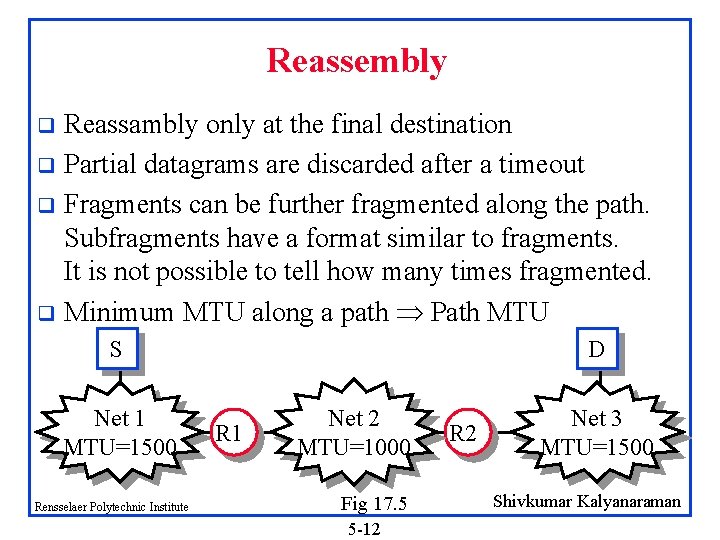
Reassembly Reassambly only at the final destination q Partial datagrams are discarded after a timeout q Fragments can be further fragmented along the path. Subfragments have a format similar to fragments. It is not possible to tell how many times fragmented. q Minimum MTU along a path Path MTU q S Net 1 MTU=1500 Rensselaer Polytechnic Institute D R 1 Net 2 MTU=1000 Fig 17. 5 5 -12 R 2 Net 3 MTU=1500 Shivkumar Kalyanaraman
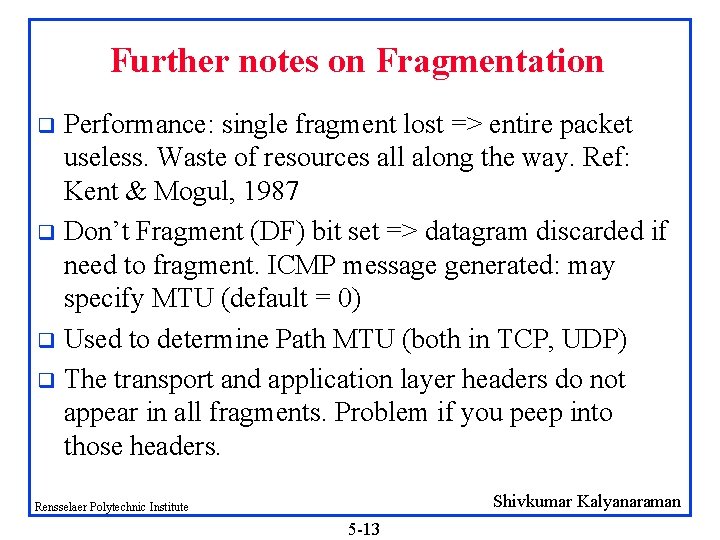
Further notes on Fragmentation Performance: single fragment lost => entire packet useless. Waste of resources all along the way. Ref: Kent & Mogul, 1987 q Don’t Fragment (DF) bit set => datagram discarded if need to fragment. ICMP message generated: may specify MTU (default = 0) q Used to determine Path MTU (both in TCP, UDP) q The transport and application layer headers do not appear in all fragments. Problem if you peep into those headers. q Shivkumar Kalyanaraman Rensselaer Polytechnic Institute 5 -13
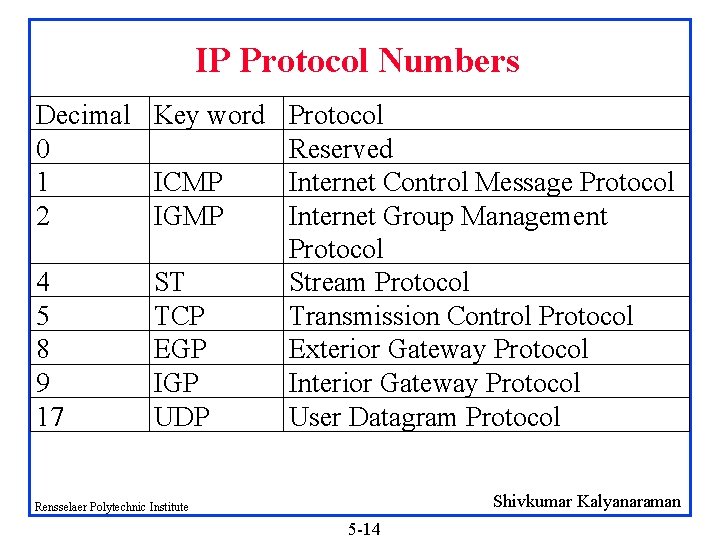
IP Protocol Numbers Decimal Key word 0 1 ICMP 2 IGMP 4 5 8 9 17 ST TCP EGP IGP UDP Protocol Reserved Internet Control Message Protocol Internet Group Management Protocol Stream Protocol Transmission Control Protocol Exterior Gateway Protocol Interior Gateway Protocol User Datagram Protocol Shivkumar Kalyanaraman Rensselaer Polytechnic Institute 5 -14
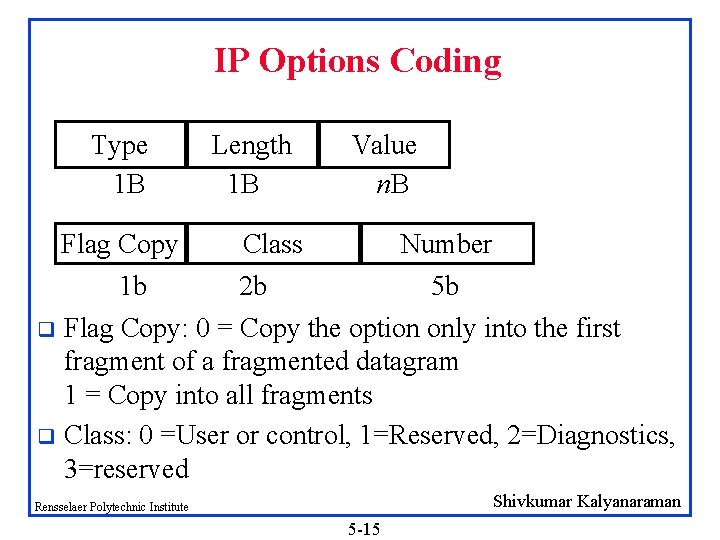
IP Options Coding Type 1 B Length 1 B Value n. B Flag Copy Class Number 1 b 2 b 5 b q Flag Copy: 0 = Copy the option only into the first fragment of a fragmented datagram 1 = Copy into all fragments q Class: 0 =User or control, 1=Reserved, 2=Diagnostics, 3=reserved Shivkumar Kalyanaraman Rensselaer Polytechnic Institute 5 -15
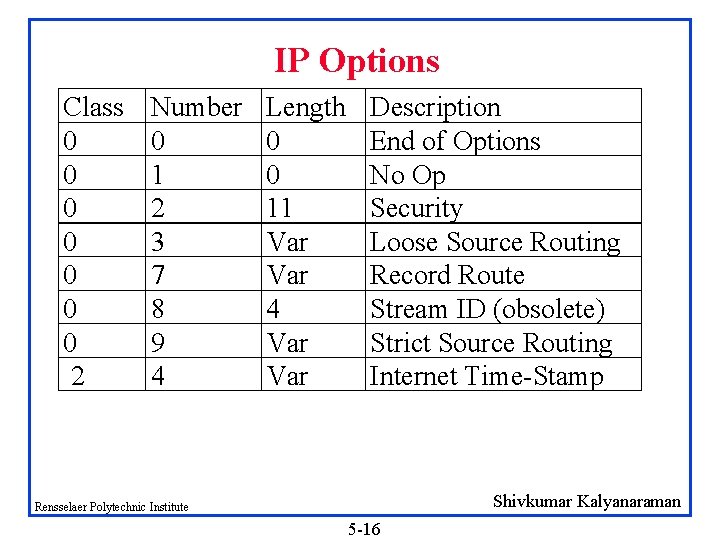
IP Options Class 0 0 0 0 2 Number 0 1 2 3 7 8 9 4 Length 0 0 11 Var 4 Var Description End of Options No Op Security Loose Source Routing Record Route Stream ID (obsolete) Strict Source Routing Internet Time-Stamp Shivkumar Kalyanaraman Rensselaer Polytechnic Institute 5 -16
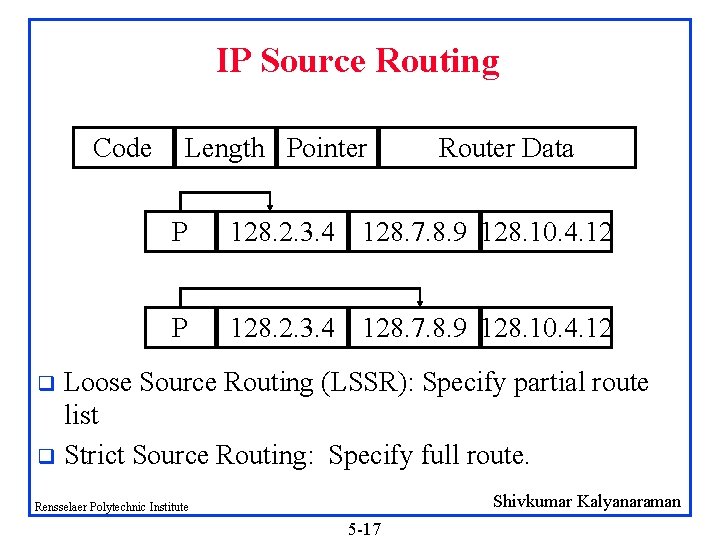
IP Source Routing Code Length Pointer Router Data P 128. 2. 3. 4 128. 7. 8. 9 128. 10. 4. 12 Loose Source Routing (LSSR): Specify partial route list q Strict Source Routing: Specify full route. q Shivkumar Kalyanaraman Rensselaer Polytechnic Institute 5 -17
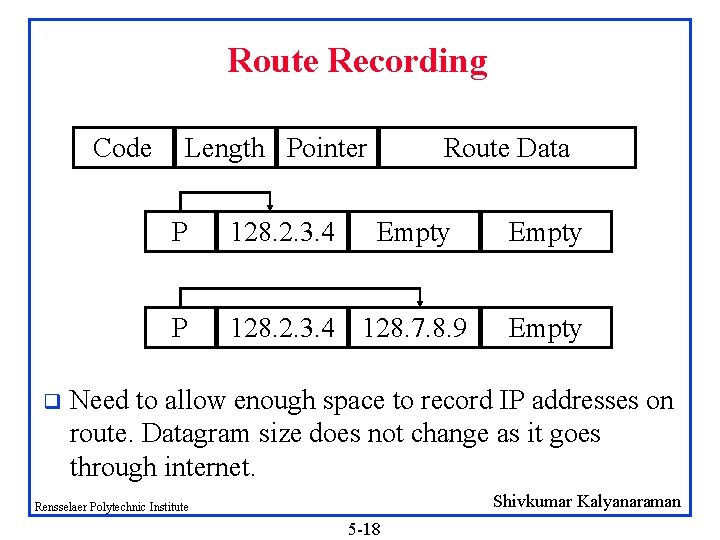
Route Recording Code q Length Pointer Route Data P 128. 2. 3. 4 Empty P 128. 2. 3. 4 128. 7. 8. 9 Empty Need to allow enough space to record IP addresses on route. Datagram size does not change as it goes through internet. Shivkumar Kalyanaraman Rensselaer Polytechnic Institute 5 -18
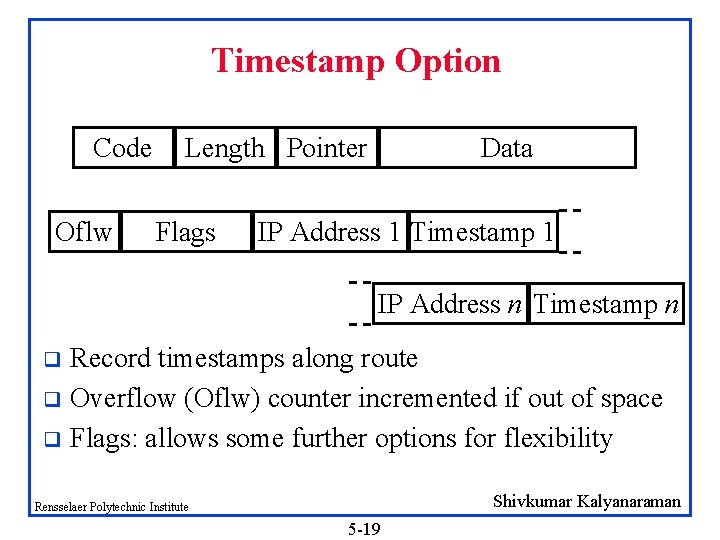
Timestamp Option Code Oflw Length Pointer Flags Data IP Address 1 Timestamp 1 IP Address n Timestamp n Record timestamps along route q Overflow (Oflw) counter incremented if out of space q Flags: allows some further options for flexibility q Shivkumar Kalyanaraman Rensselaer Polytechnic Institute 5 -19
Discussion on IP Header Design If fragmentation is going to be avoided all the time, why not have the 4 -bytes of fragmentation info as an IP option ? q Is 32 -bit addresses going to be enough ? q Why mess with variable length headers ? Can the variability in header length be controlled to allow better encoding ? q Are the IP options really that useful ? Why variable length option headers ? q Many of these issues addressed in IPv 6. q Shivkumar Kalyanaraman Rensselaer Polytechnic Institute 5 -20
Summary IP header: supports connectionless delivery, var length pkts/headers/options, fragmentation/reassembly, q Fragmentation/Reassembly, Path MTU discovery. q Options: Source routing, Record route, Timestamp q Shivkumar Kalyanaraman Rensselaer Polytechnic Institute 5 -21