
Internet Economics John Chuang School of Information Management
![Vertical Integration: Internet § Different vertical components of Internet [Lehr 98]: - Local access](https://slidetodoc.com/presentation_image_h2/19956c446d081d663eca5ae5498f7313/image-33.jpg "Vertical Integration: Internet § Different vertical components of Internet [Lehr 98]: - Local access")
- Slides: 54
Internet Economics John Chuang School of Information Management & Systems UC Berkeley chuang@sims. berkeley. edu John Chuang
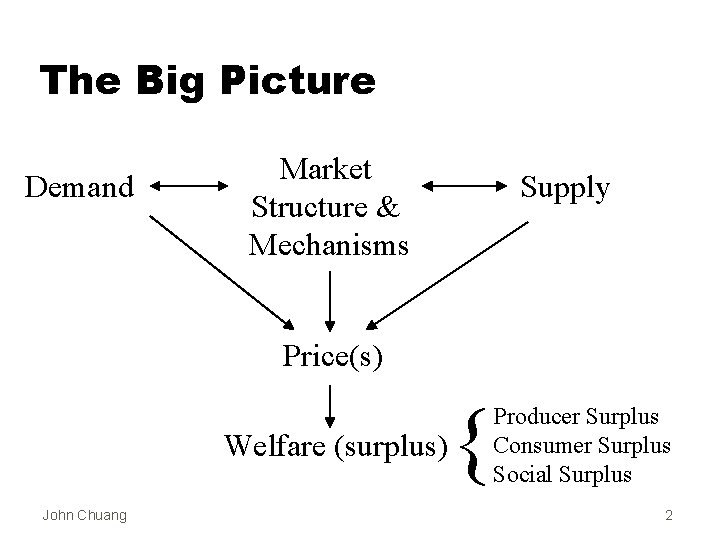
The Big Picture Demand Market Structure & Mechanisms Supply Price(s) Welfare (surplus) John Chuang { Producer Surplus Consumer Surplus Social Surplus 2
Why Study Internet Economics? § Internet has interesting economic properties § Resource allocation - Rule-based vs. pricing-based § Market structures - Interconnections - Horizontal mergers and vertical integration - Bandwidth markets § Policymaking - Sustainable competition - Universal access John Chuang 3
Outline § Economic characteristics of the Net § Resource allocation and pricing § Interconnection and industrial organization John Chuang 4
Economic characteristics of the Net § § Public vs. private good Economies of scale Economies of scope Network externalities John Chuang 5
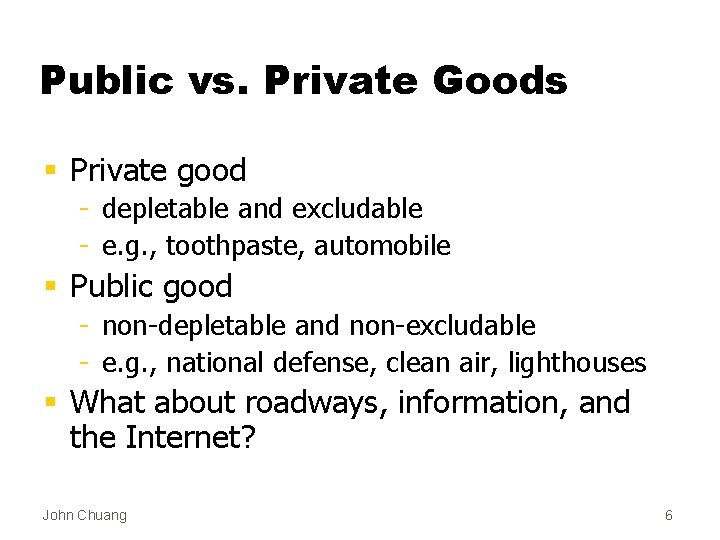
Public vs. Private Goods § Private good - depletable and excludable - e. g. , toothpaste, automobile § Public good - non-depletable and non-excludable - e. g. , national defense, clean air, lighthouses § What about roadways, information, and the Internet? John Chuang 6
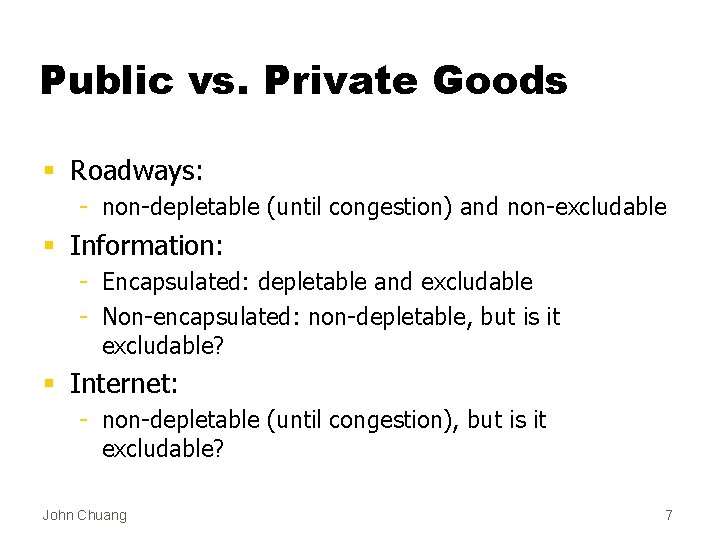
Public vs. Private Goods § Roadways: - non-depletable (until congestion) and non-excludable § Information: - Encapsulated: depletable and excludable - Non-encapsulated: non-depletable, but is it excludable? § Internet: - non-depletable (until congestion), but is it excludable? John Chuang 7
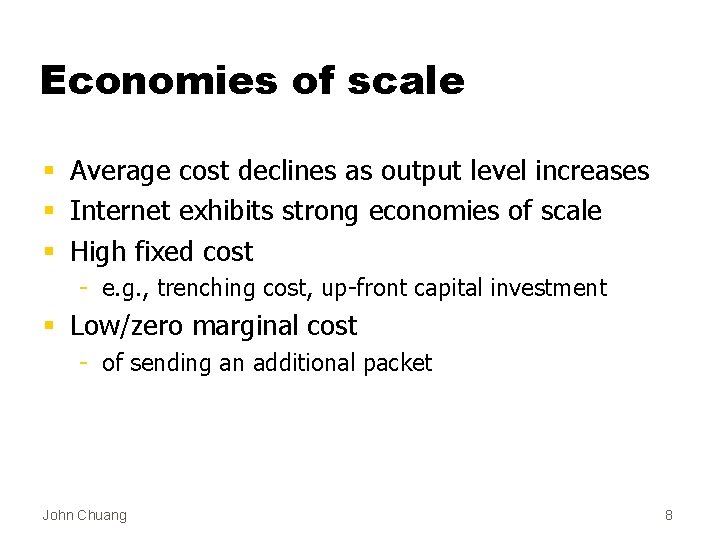
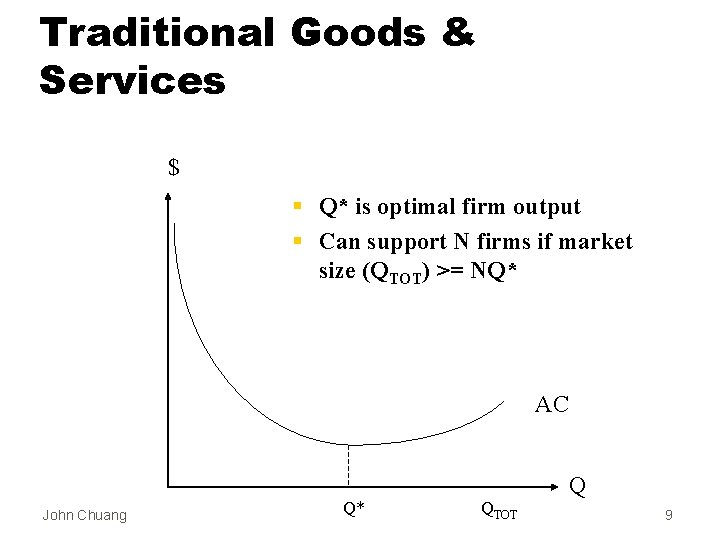
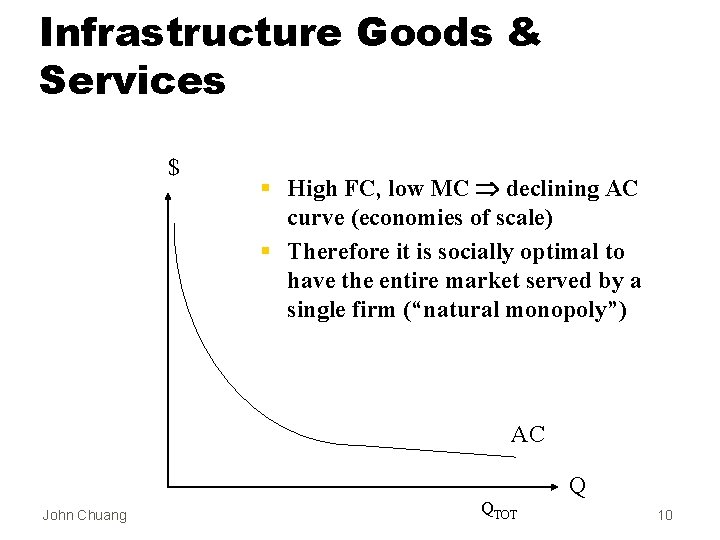
Economies of scale § Average cost declines as output level increases § Internet exhibits strong economies of scale § High fixed cost - e. g. , trenching cost, up-front capital investment § Low/zero marginal cost - of sending an additional packet John Chuang 8
Traditional Goods & Services $ § Q* is optimal firm output § Can support N firms if market size (QTOT) >= NQ* AC John Chuang Q* QTOT Q 9
Infrastructure Goods & Services $ § High FC, low MC declining AC curve (economies of scale) § Therefore it is socially optimal to have the entire market served by a single firm (“natural monopoly”) AC John Chuang QTOT Q 10
§ A monopolist: - is a price-setter, not a price-taker - maximizes producer surplus (profit), not consumer surplus § Alternatives: public utility or regulated monopoly - e. g. , AT&T historically treated as regulated natural monopoly - rate regulation - structural regulation John Chuang 11
Competition § In a perfect competition: - all firms are price-takers - P = MC in the long run - inefficient firms with high MC will exit market - long term profits = 0 - consumer and total surplus maximized John Chuang 12
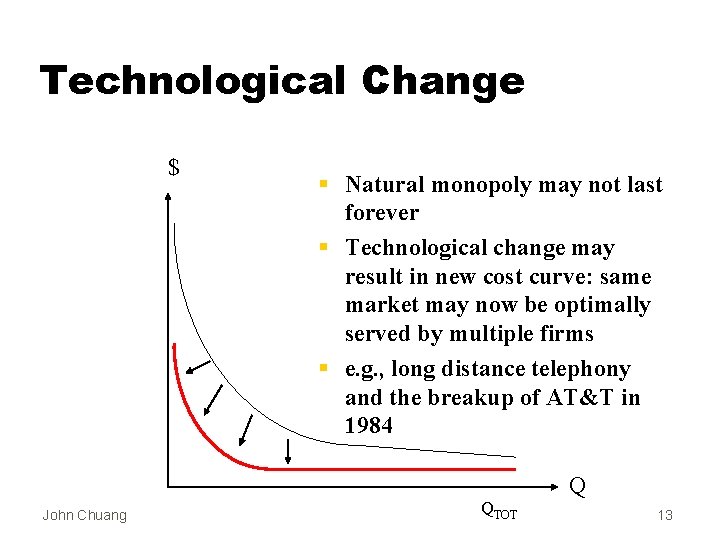
Technological Change $ John Chuang § Natural monopoly may not last forever § Technological change may result in new cost curve: same market may now be optimally served by multiple firms § e. g. , long distance telephony and the breakup of AT&T in 1984 QTOT Q 13
Economies of Scope § Significant joint costs of production for multiple goods/services § Examples: - GM plants produce sedans, SUVs, and minivans, etc. - Amazon. com sells books, music, and lawn-mowers, etc. - Internet supports multiple traffic types previously carried over different networks (telephony, radio, CATV, …) John Chuang 14
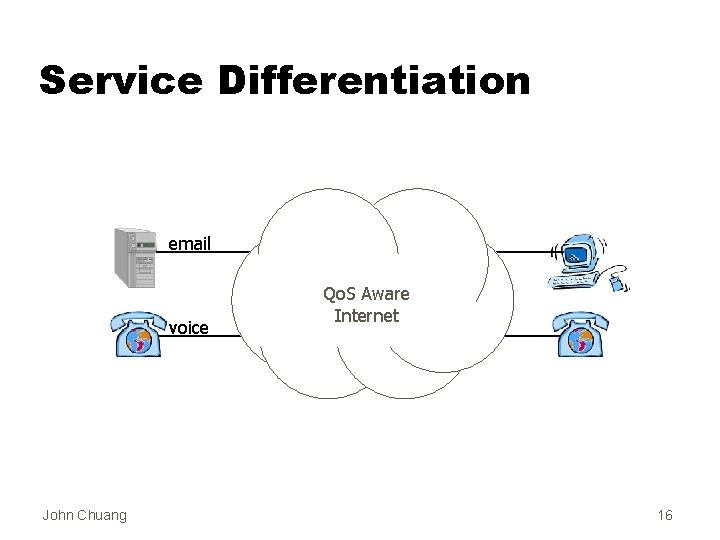
Service Differentiation email voice John Chuang Best Effort Qo. S Aware Internet SLA 16
Network Externalities § Externality: value (including costs and benefits) of a good/service not fully reflected in its price - e. g. , the price of an automobile does not include the economic impact of its potential to pollute § Network externality: value of the network is a function of the network size John Chuang 19
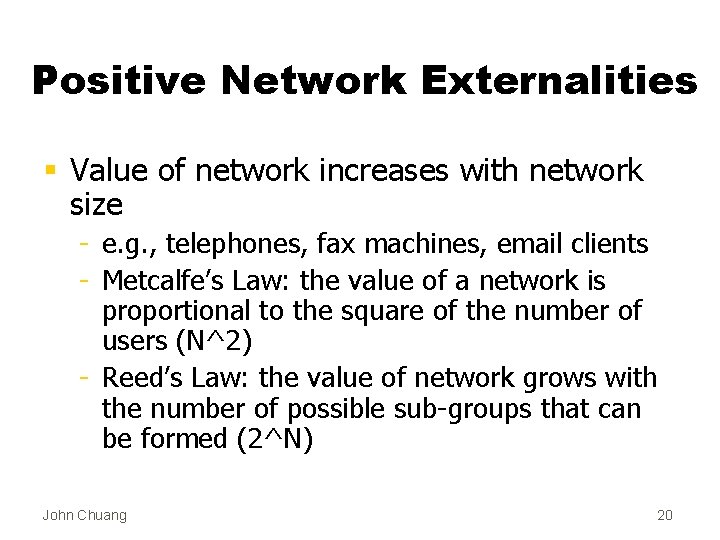
Positive Network Externalities § Value of network increases with network size - e. g. , telephones, fax machines, email clients - Metcalfe’s Law: the value of a network is proportional to the square of the number of users (N^2) - Reed’s Law: the value of network grows with the number of possible sub-groups that can be formed (2^N) John Chuang 20
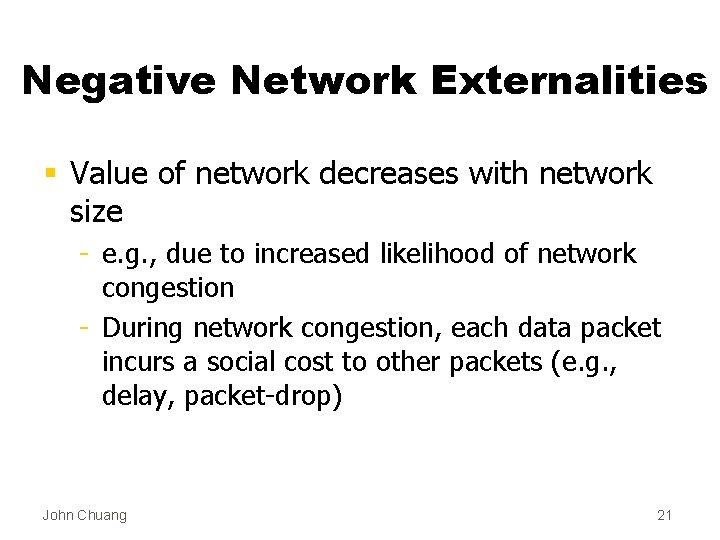
Negative Network Externalities § Value of network decreases with network size - e. g. , due to increased likelihood of network congestion - During network congestion, each data packet incurs a social cost to other packets (e. g. , delay, packet-drop) John Chuang 21
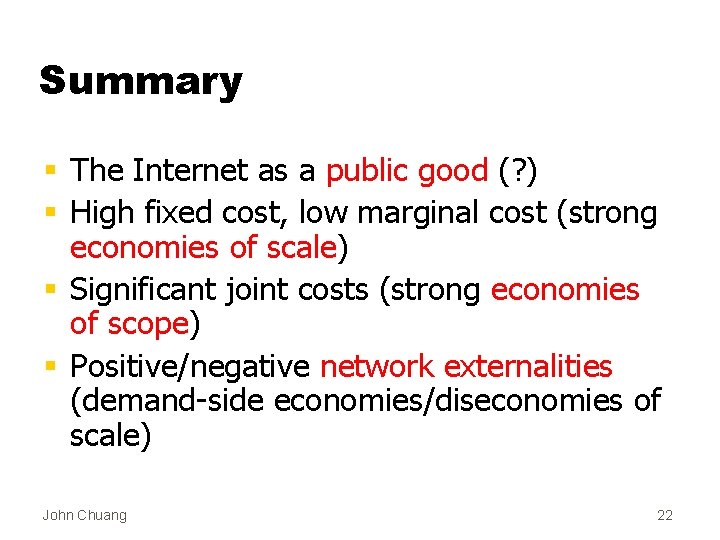
Summary § The Internet as a public good (? ) § High fixed cost, low marginal cost (strong economies of scale) § Significant joint costs (strong economies of scope) § Positive/negative network externalities (demand-side economies/diseconomies of scale) John Chuang 22
Outline § Economic characteristics of the Net § Resource allocation and pricing § Interconnection and industrial organization John Chuang 23
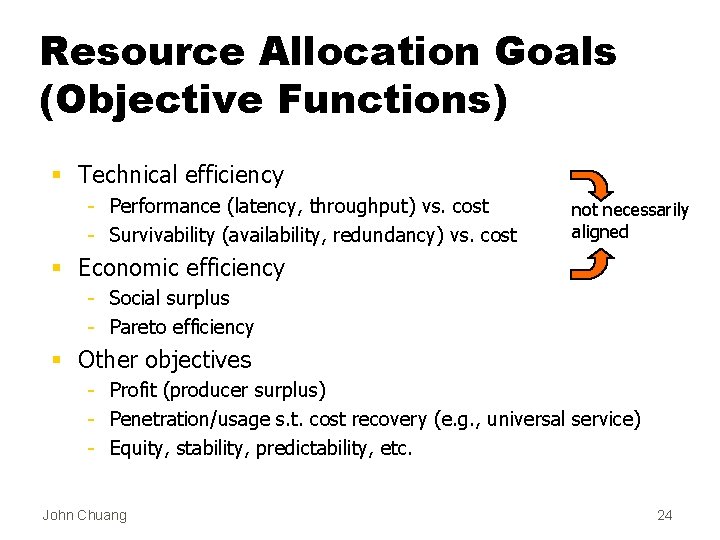
Resource Allocation Goals (Objective Functions) § Technical efficiency - Performance (latency, throughput) vs. cost - Survivability (availability, redundancy) vs. cost not necessarily aligned § Economic efficiency - Social surplus - Pareto efficiency § Other objectives - Profit (producer surplus) - Penetration/usage s. t. cost recovery (e. g. , universal service) - Equity, stability, predictability, etc. John Chuang 24
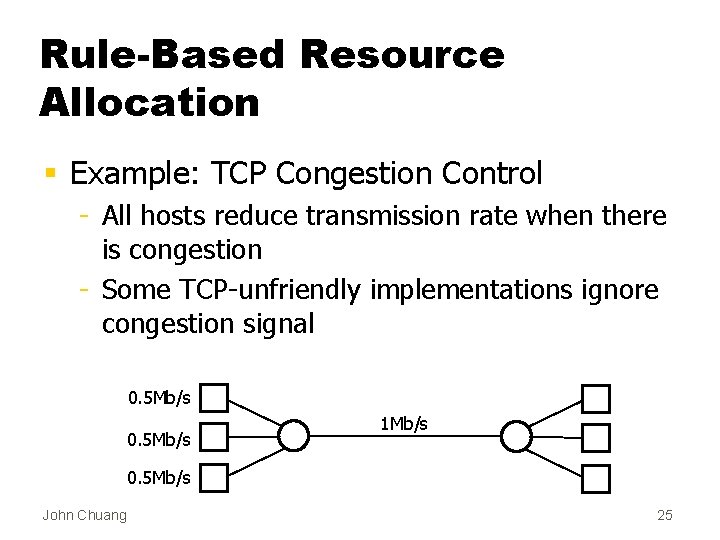
Rule-Based Resource Allocation § Example: TCP Congestion Control - All hosts reduce transmission rate when there is congestion - Some TCP-unfriendly implementations ignore congestion signal 0. 5 Mb/s 1 Mb/s 0. 5 Mb/s John Chuang 25
The Role of Prices § Allocate resources to maximize economic efficiency § Serve as feedback signals - Help users make efficient consumption choices - Help provider make optimal capacity expansions John Chuang 26
Pricing Network Services § Criticism of flat-rate pricing - Tragedy-of-the-Commons § Usage-based pricing - Metering costs - Users prefer predictable bills § Marginal cost pricing - MC=0 most of the time § Congestion-based pricing - Packets bid for service - Too costly to implement § Back to flat-rate? John Chuang 27
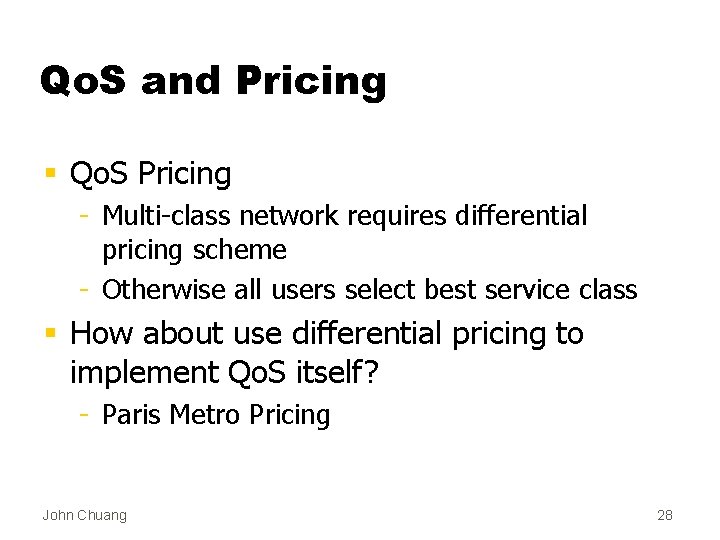
Qo. S and Pricing § Qo. S Pricing - Multi-class network requires differential pricing scheme - Otherwise all users select best service class § How about use differential pricing to implement Qo. S itself? - Paris Metro Pricing John Chuang 28
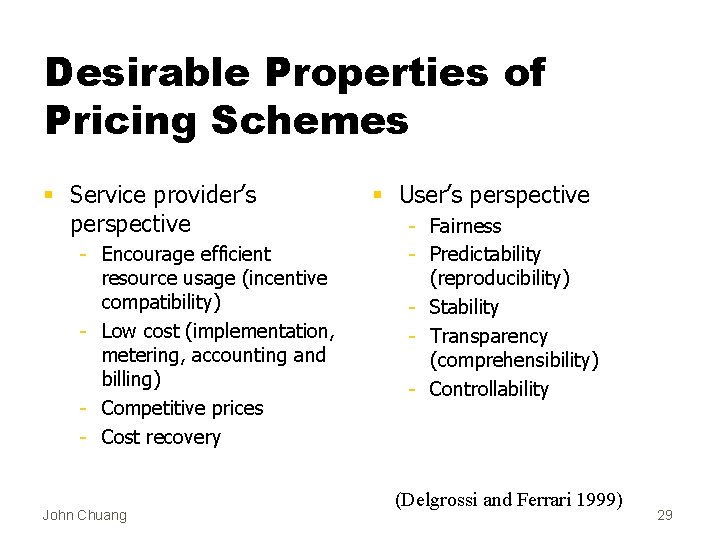
Desirable Properties of Pricing Schemes § Service provider’s perspective - Encourage efficient resource usage (incentive compatibility) - Low cost (implementation, metering, accounting and billing) - Competitive prices - Cost recovery John Chuang § User’s perspective - Fairness - Predictability (reproducibility) - Stability - Transparency (comprehensibility) - Controllability (Delgrossi and Ferrari 1999) 29
Outline § Economic characteristics of the Net § Resource allocation and pricing § Interconnection and industrial organization John Chuang 30
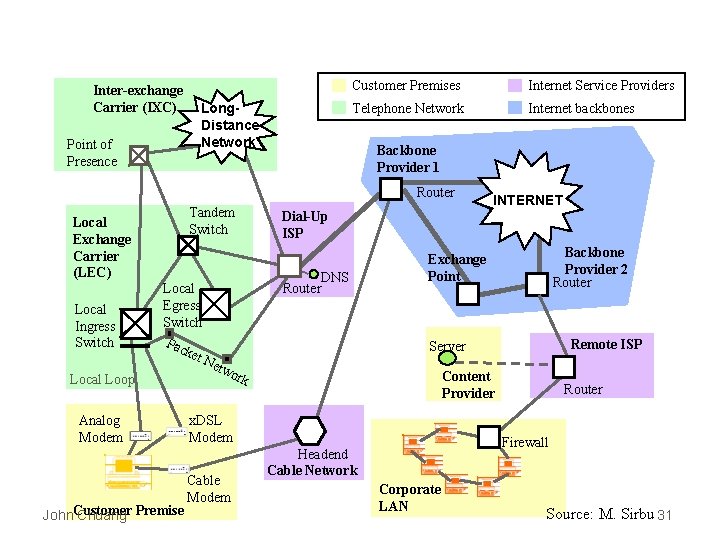
Inter-exchange Carrier (IXC) Point of Presence Long. Distance Network Customer Premises Internet Service Providers Telephone Network Internet backbones Backbone Provider 1 Router Tandem Switch Local Exchange Carrier (LEC) Local Ingress Switch Local Loop Analog Modem John. Customer Chuang Premise Dial-Up ISP DNS Router Local Egress Switch Pac ket N INTERNET Backbone Provider 2 Router Exchange Point Remote ISP Server etw ork Content Provider x. DSL Modem Cable Modem Router Firewall Headend Cable Network Corporate LAN Source: M. Sirbu 31
Industrial Organization § Horizontal merger § Vertical integration/disintegration § Determinants: - Technological efficiencies - Transactional efficiencies - Market imperfections John Chuang 32
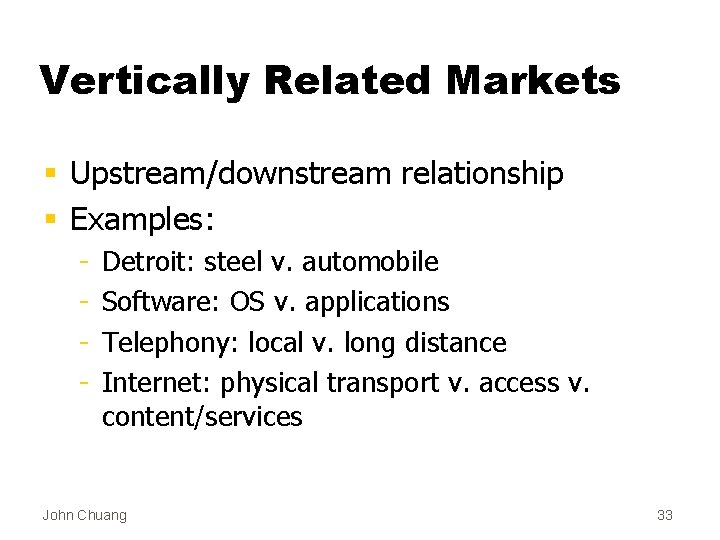
Vertically Related Markets § Upstream/downstream relationship § Examples: - Detroit: steel v. automobile Software: OS v. applications Telephony: local v. long distance Internet: physical transport v. access v. content/services John Chuang 33
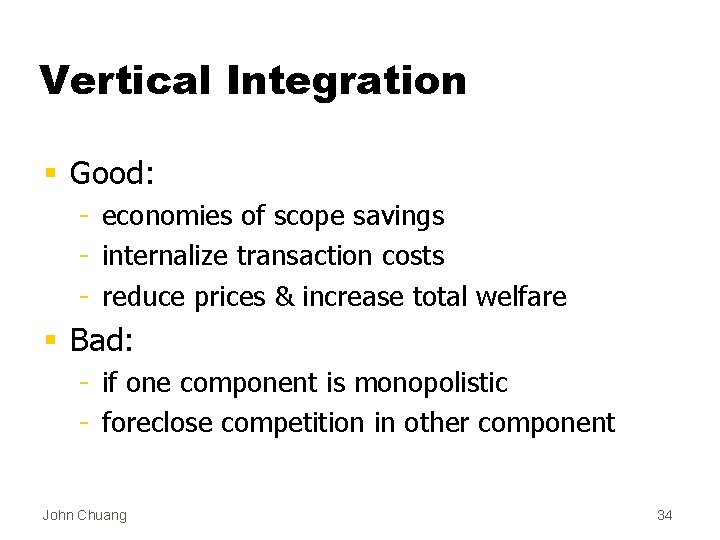
Vertical Integration § Good: - economies of scope savings - internalize transaction costs - reduce prices & increase total welfare § Bad: - if one component is monopolistic - foreclose competition in other component John Chuang 34
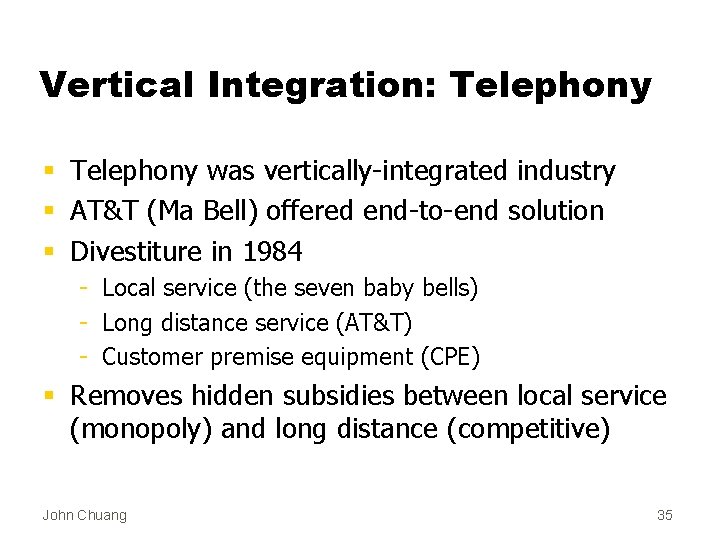
Vertical Integration: Telephony § Telephony was vertically-integrated industry § AT&T (Ma Bell) offered end-to-end solution § Divestiture in 1984 - Local service (the seven baby bells) - Long distance service (AT&T) - Customer premise equipment (CPE) § Removes hidden subsidies between local service (monopoly) and long distance (competitive) John Chuang 35
Vertical Integration: Internet § Different vertical components of Internet [Lehr 98]: - Local access transport (LAT): Pac. Bell, TCI (AT&T) - Retail Internet access provision (ISP): AOL, @Home - Wide area transport (WAT): AT&T, MCI-World. Com, Sprint, Qwest, Level 3 - Backbone Internet service provision (BSP): UUNET, AT&T, BBN § Note: AT&T vertically integrated across all four components John Chuang 36
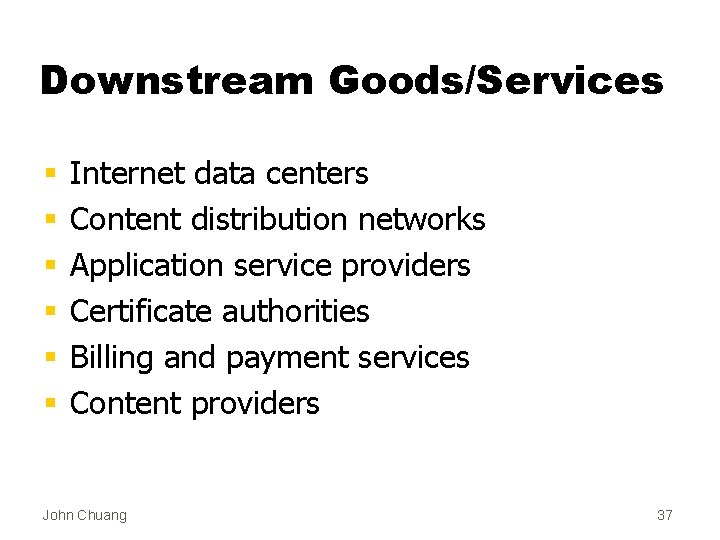
Downstream Goods/Services § § § Internet data centers Content distribution networks Application service providers Certificate authorities Billing and payment services Content providers John Chuang 37
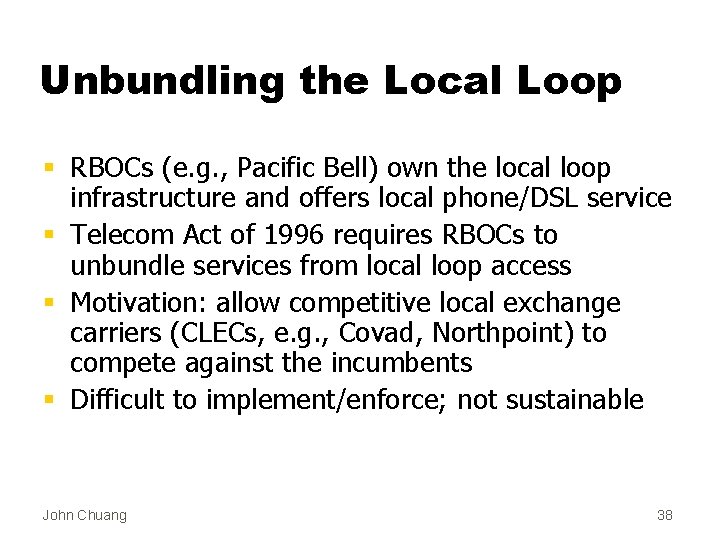
Unbundling the Local Loop § RBOCs (e. g. , Pacific Bell) own the local loop infrastructure and offers local phone/DSL service § Telecom Act of 1996 requires RBOCs to unbundle services from local loop access § Motivation: allow competitive local exchange carriers (CLECs, e. g. , Covad, Northpoint) to compete against the incumbents § Difficult to implement/enforce; not sustainable John Chuang 38
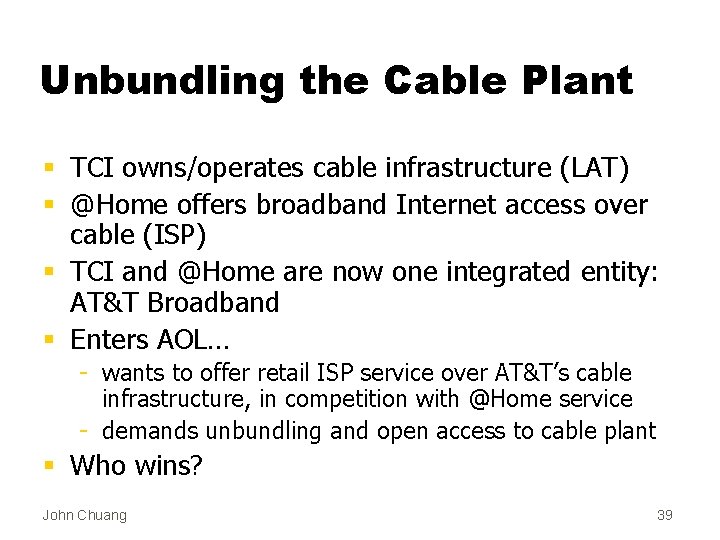
Unbundling the Cable Plant § TCI owns/operates cable infrastructure (LAT) § @Home offers broadband Internet access over cable (ISP) § TCI and @Home are now one integrated entity: AT&T Broadband § Enters AOL… - wants to offer retail ISP service over AT&T’s cable infrastructure, in competition with @Home service - demands unbundling and open access to cable plant § Who wins? John Chuang 39
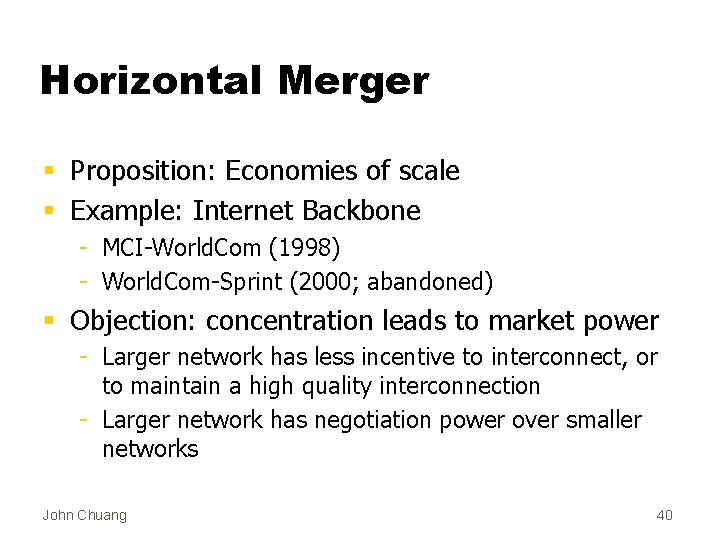
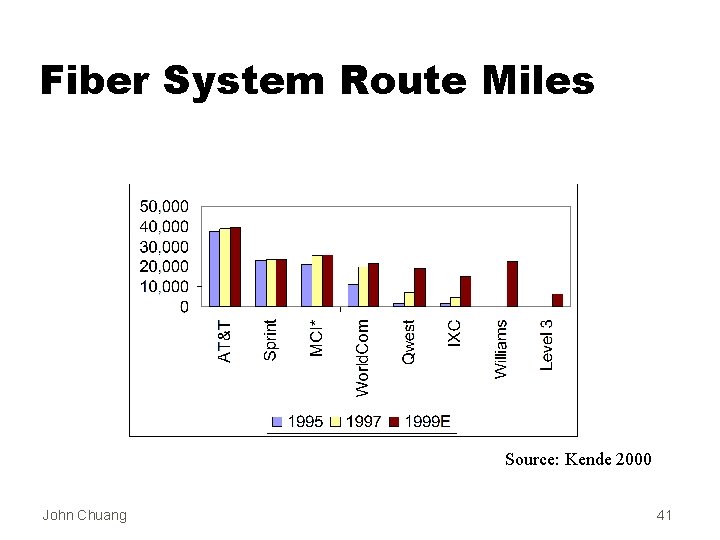
Horizontal Merger § Proposition: Economies of scale § Example: Internet Backbone - MCI-World. Com (1998) - World. Com-Sprint (2000; abandoned) § Objection: concentration leads to market power - Larger network has less incentive to interconnect, or to maintain a high quality interconnection - Larger network has negotiation power over smaller networks John Chuang 40
Fiber System Route Miles Source: Kende 2000 John Chuang 41
Horizontal Merger § Example 2: Local loop § Seven Baby Bells Merging - SBC + Pac. Bell + Ameritech Nynex + Bell. Atlantic Bell South US West § 1996 Telecom Act: unbundling and open access - competition in local exchange (e. g. , Covad, Northpoint and other CLEC’s ) § Facilities-based competition - e. g. , wireless, cable, satellite, … John Chuang 42
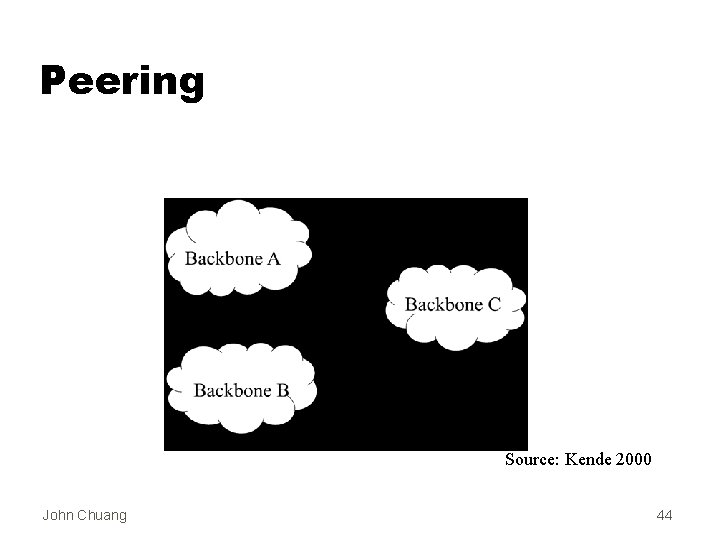
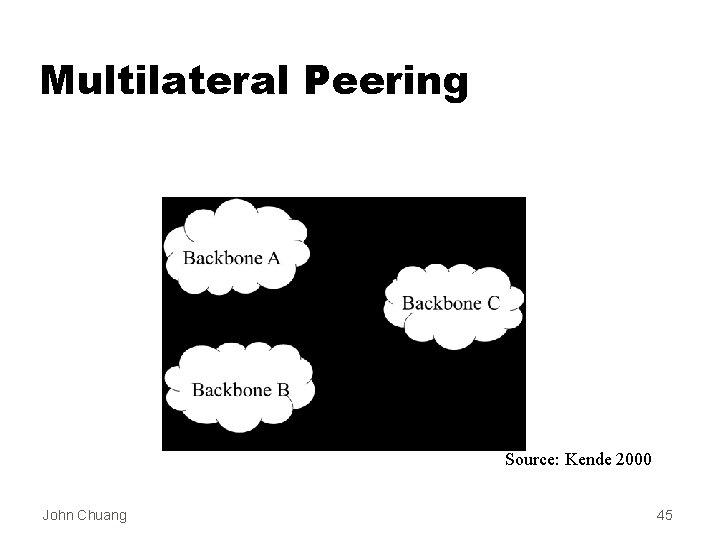
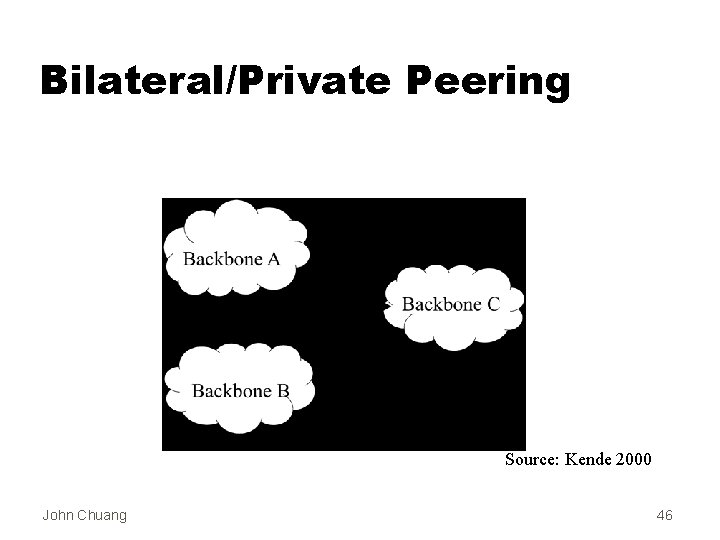
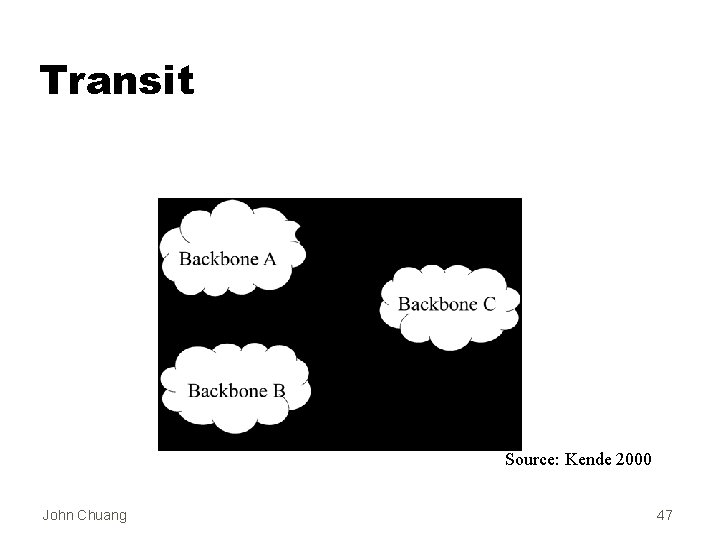
Network Interconnection § Network externalities motivate network operators to interconnect § Different types of interconnection: - Peering - Multilateral - Bilateral (or private) - Transit § Issue of settlement - Peer = settlement-free = sender-keep-all (SKA) John Chuang 43
Peering Source: Kende 2000 John Chuang 44
Multilateral Peering Source: Kende 2000 John Chuang 45
Bilateral/Private Peering Source: Kende 2000 John Chuang 46
Transit Source: Kende 2000 John Chuang 47
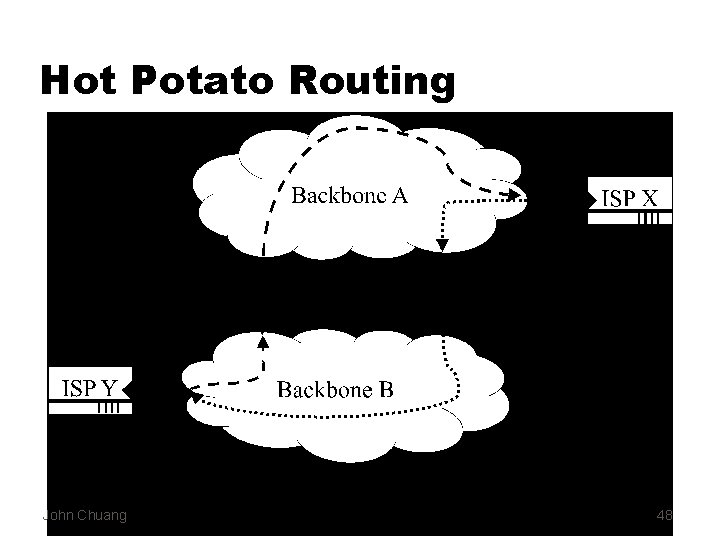
Hot Potato Routing Source: Kende 2000 John Chuang 48
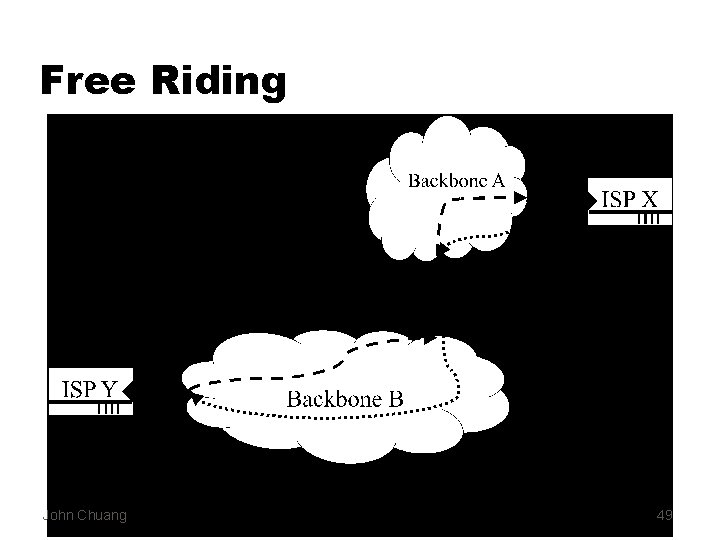
Free Riding Source: Kende 2000 John Chuang 49
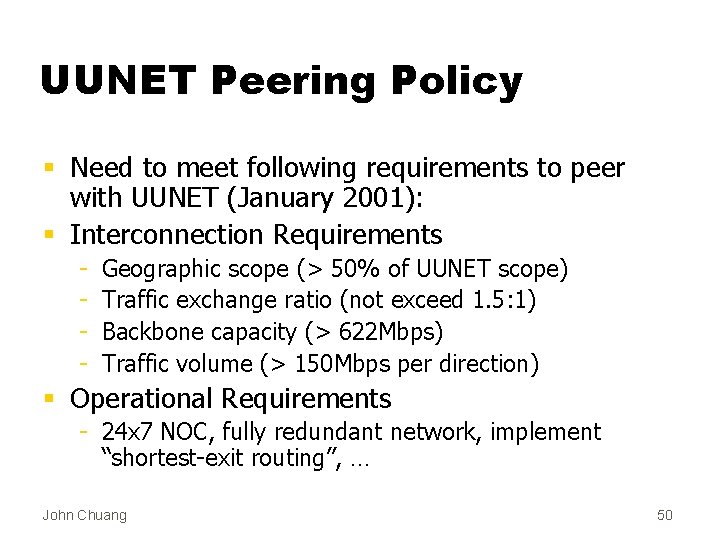
UUNET Peering Policy § Need to meet following requirements to peer with UUNET (January 2001): § Interconnection Requirements - Geographic scope (> 50% of UUNET scope) Traffic exchange ratio (not exceed 1. 5: 1) Backbone capacity (> 622 Mbps) Traffic volume (> 150 Mbps per direction) § Operational Requirements - 24 x 7 NOC, fully redundant network, implement “shortest-exit routing”, … John Chuang 50
Interconnection Issues § Peer or transit? - Size (market share) important § Why multilateral peering fails? - Tragedy-of-the-Commons § What about advanced services? - Inter-domain multicast, inter-domain Qo. S, content peering, … John Chuang 51
Markets § Bandwidth Markets - Bandwidth is perishable - Bandwidth as tradable commodity § Contract terms - What: Diameter of pipe (Mbps) Where: city A to city B When/how long Other: quality metrics (drop rates, latency, …) John Chuang 52
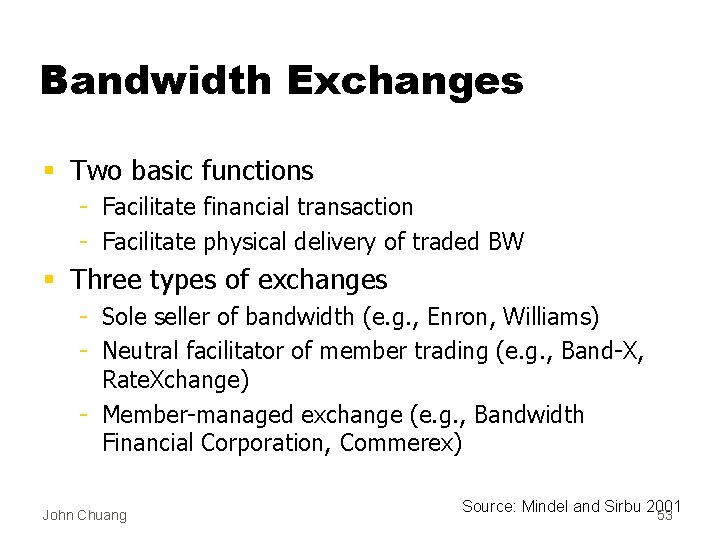
Bandwidth Exchanges § Two basic functions - Facilitate financial transaction - Facilitate physical delivery of traded BW § Three types of exchanges - Sole seller of bandwidth (e. g. , Enron, Williams) - Neutral facilitator of member trading (e. g. , Band-X, Rate. Xchange) - Member-managed exchange (e. g. , Bandwidth Financial Corporation, Commerex) John Chuang Source: Mindel and Sirbu 2001 53
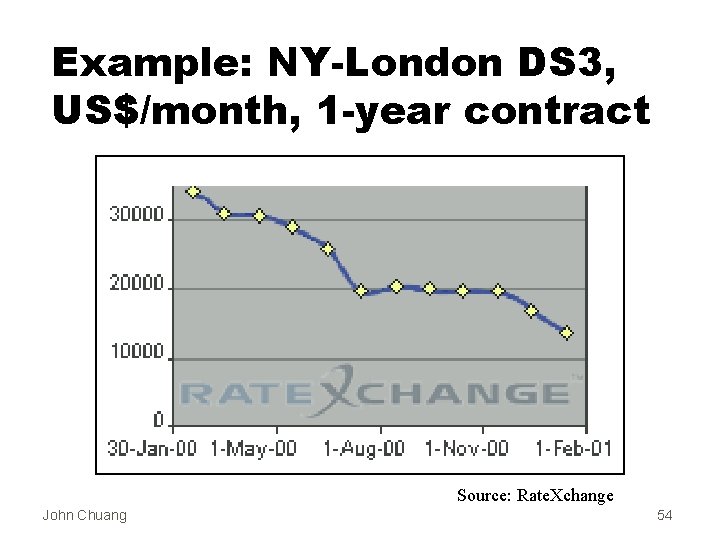
Example: NY-London DS 3, US$/month, 1 -year contract Source: Rate. Xchange John Chuang 54
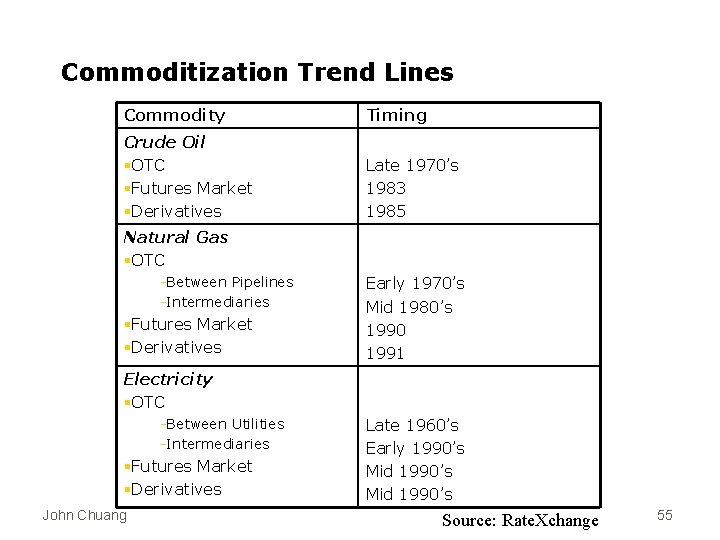
Commoditization Trend Lines Commodity Timing Crude Oil §OTC §Futures Market §Derivatives Late 1970’s 1983 1985 Natural Gas §OTC -Between Pipelines -Intermediaries §Futures Market §Derivatives Early 1970’s Mid 1980’s 1990 1991 Electricity §OTC -Between Utilities -Intermediaries §Futures Market §Derivatives John Chuang Late 1960’s Early 1990’s Mid 1990’s Source: Rate. Xchange 55
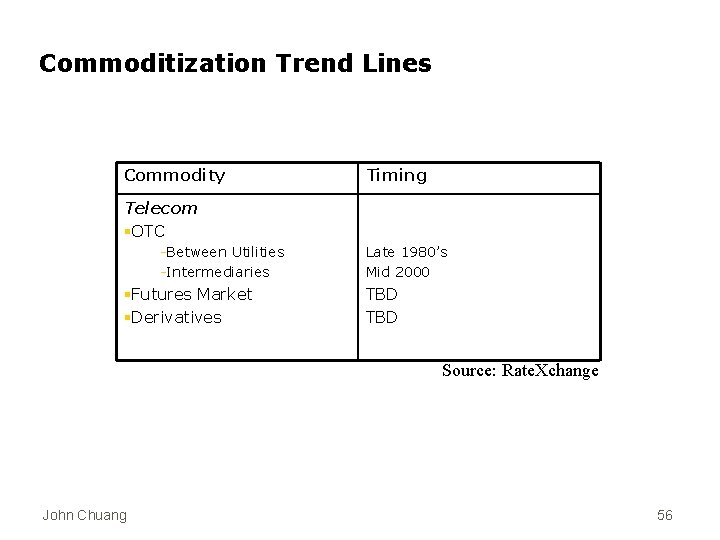
Commoditization Trend Lines Commodity Timing Telecom §OTC -Between Utilities -Intermediaries §Futures Market §Derivatives Late 1980’s Mid 2000 TBD Source: Rate. Xchange John Chuang 56
Other Markets? § Distributed processing (P 2 P) - SETI@Home, entropia, Popular Power § Distributed storage/caching § Distributed object services John Chuang 57