
Internet Addressing Reference Internetworking with TCPIP Principles Protocol

- Slides: 64
Internet Addressing Reference: Internetworking with TCP/IP: Principles, Protocol, and Architecture, 1 Douglas E. Comer 6 th Edition, 2017, , Pearson, ISBN 978 -93 -325 -5010 -0 Asst. Prof. Dr. Anilkumar K. G 1
Introduction • The traditional Internet addressing scheme, which was introduced with version 4 of the Internet Protocol (called as IPv 4), and is widely used. • The next version is IPv 6 (version 6 of the Internet Protocol). Asst. Prof. Dr. Anilkumar K. G 2
Universal Host Identifiers • TCP/IP uses the term host to refer to an end system that attaches to the internet. – A host can be a large powerful general purpose computer. – A host may have an interface that humans use (screen, keyboard, etc) or a network printer. – A host can use wired or wireless network technology. • The Internet divides all machines into two classes: – Routers and – Hosts • Any device that is not a router is classified as a host. Asst. Prof. Dr. Anilkumar K. G 3
Universal Host Identifiers • A communication system is said to supply universal communication service if the system allows an attached host to communicate with any other attached host. – To make a communication system universal, it needs a globally accepted method of identifying each host that attached to it. • The identifiers are classified as names, addresses, and routes: – A name identifies what an object is, – An address identifies where it is, and – A route tells how to get there. Asst. Prof. Dr. Anilkumar K. G 4
Universal Host Identifiers • Names, addresses and routes refer to lower level representations of host identifiers, – Unlike other types of networks, an internet is a virtual structure, imagined by its designers, and implemented by layered protocol SW running on both hosts and routers. • Because the Internet is virtual, its designers are free to choose packet formats and sizes, addresses, delivery techniques, and so on. – There is nothing is dedicated by HW. Asst. Prof. Dr. Anilkumar K. G 5
Universal Host Identifiers • The designers of TCP/IP chose an addressing scheme in which each host on an Internet is assigned a unique integer address called its Internet Protocol address (known as, IP address). • An IP address is divided into two parts: – A prefix of the address identifies the network to which the host attaches and – A suffix of the address identifies a specific host on the network. • All hosts attached to the same network share a common prefix. Asst. Prof. Dr. Anilkumar K. G 6
Universal Host Identifiers • An IP address is a number identifying a user computer or another device on the Internet – It is similar to a mailing address, which identifies where postal mail comes from and where it should be delivered. • IP addresses uniquely identify the source and destination of data transmitted with the Internet Protocol. Asst. Prof. Dr. Anilkumar K. G 7
IPv 4 and IPv 6 Addressing Scheme • IPv 4 addresses are 32 bits long (four octets). – An example of an IPv 4 address is 216. 58. 216. 164. • The maximum number of IPv 4 addresses, which is called its address space, is about 4. 3 billion (232, or 4, 294, 967, 296). • A major advantage of IPv 6 is that it uses 128 bits of data to store an address, permitting 2128 unique addresses, or the size of its address space is 340 duodecillion. – Is much larger than IPv 4. Asst. Prof. Dr. Anilkumar K. G 8
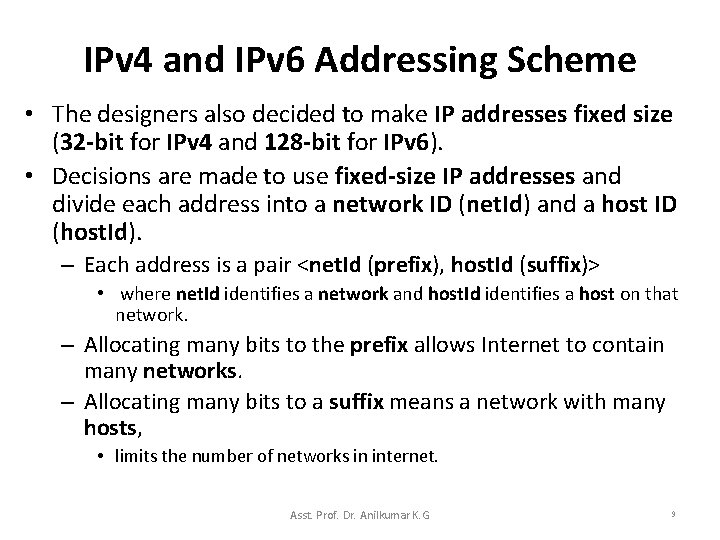
IPv 4 and IPv 6 Addressing Scheme • The designers also decided to make IP addresses fixed size (32 -bit for IPv 4 and 128 -bit for IPv 6). • Decisions are made to use fixed-size IP addresses and divide each address into a network ID (net. Id) and a host ID (host. Id). – Each address is a pair <net. Id (prefix), host. Id (suffix)> • where net. Id identifies a network and host. Id identifies a host on that network. – Allocating many bits to the prefix allows Internet to contain many networks. – Allocating many bits to a suffix means a network with many hosts, • limits the number of networks in internet. Asst. Prof. Dr. Anilkumar K. G 9
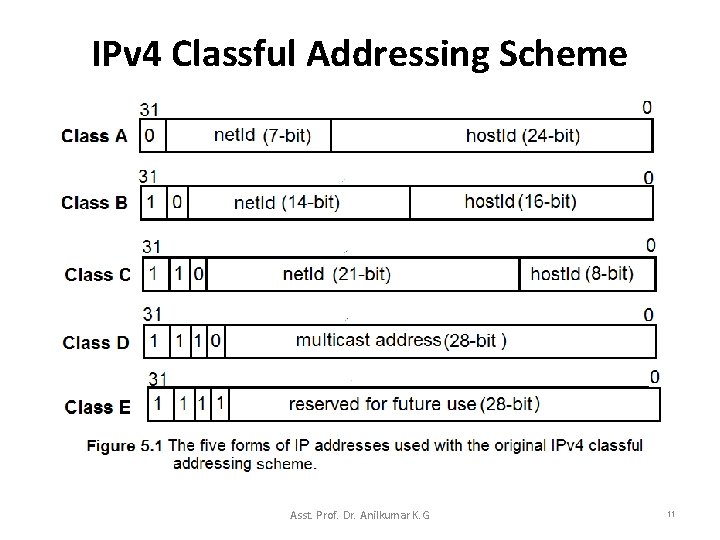
IPv 4 Classful Addressing Scheme • To accommodate into various network systems, the IP address designers did not choose a single division of the address instead: – invented a classful addressing scheme that allowed a given network to be large, medium, or small classes. • Figure 5. 1 illustrates how the original classful addressing scheme divided each IPv 4 address into two parts. • Although most of classful addressing scheme is no longer in usage, but it explains how the IPv 4 multicast address space was chosen. Asst. Prof. Dr. Anilkumar K. G 10
IPv 4 Classful Addressing Scheme Asst. Prof. Dr. Anilkumar K. G 11
IPv 4 Classful Addressing Scheme Courtesy : https: //www. ittsystems. com/introduction-to-subnetting/ Asst. Prof. Dr. Anilkumar K. G 12
Courtesy : Wikipedia Asst. Prof. Dr. Anilkumar K. G 13
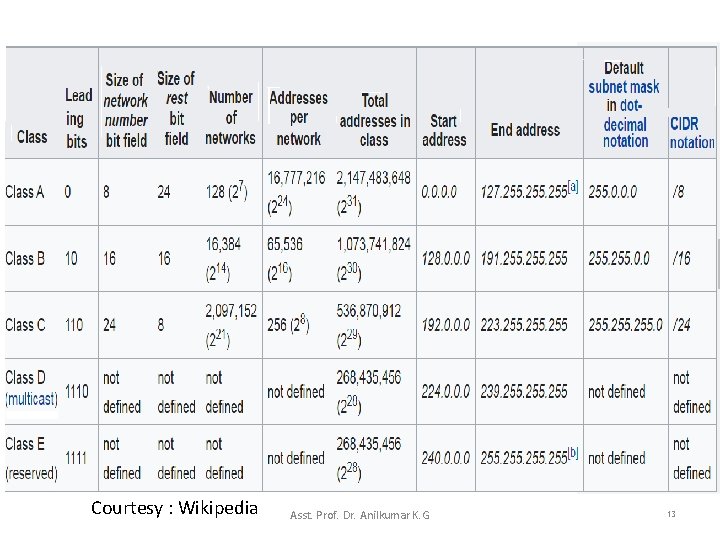
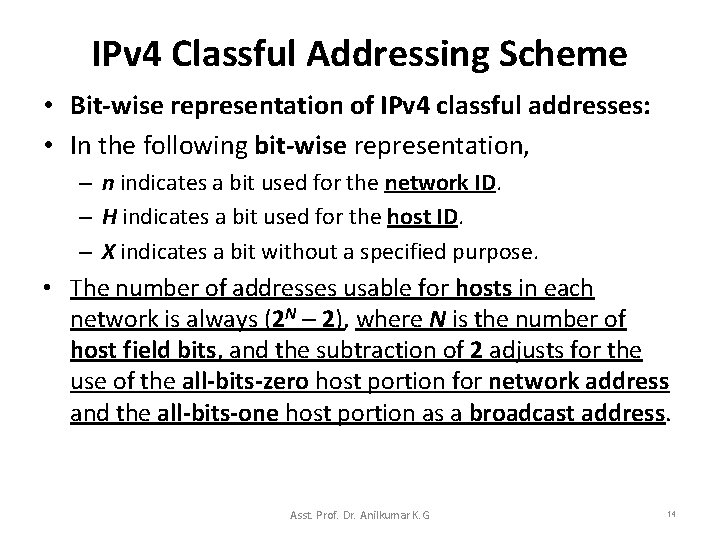
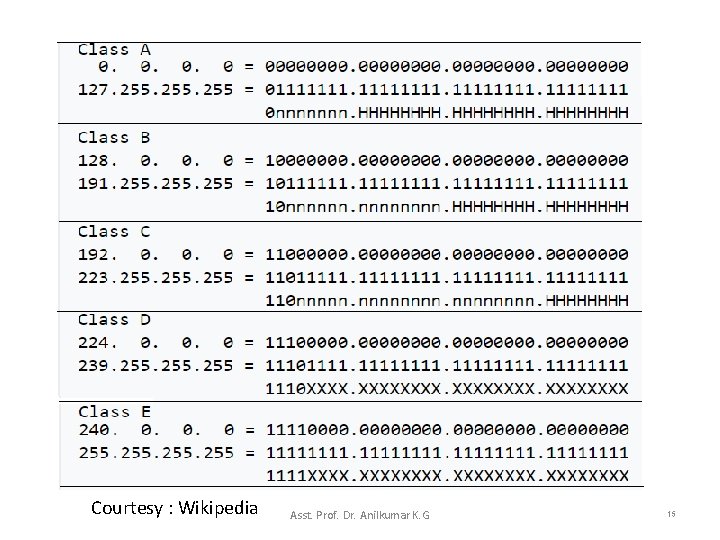
IPv 4 Classful Addressing Scheme • Bit-wise representation of IPv 4 classful addresses: • In the following bit-wise representation, – n indicates a bit used for the network ID. – H indicates a bit used for the host ID. – X indicates a bit without a specified purpose. • The number of addresses usable for hosts in each network is always (2 N 2), where N is the number of host field bits, and the subtraction of 2 adjusts for the use of the all-bits-zero host portion for network address and the all-bits-one host portion as a broadcast address. Asst. Prof. Dr. Anilkumar K. G 14
Courtesy : Wikipedia Asst. Prof. Dr. Anilkumar K. G 15
IPV 4 Classful Addressing Scheme Courtesy : https: //learningnetwork. cisco. com/docs/DOC-12872 Asst. Prof. Dr. Anilkumar K. G 16
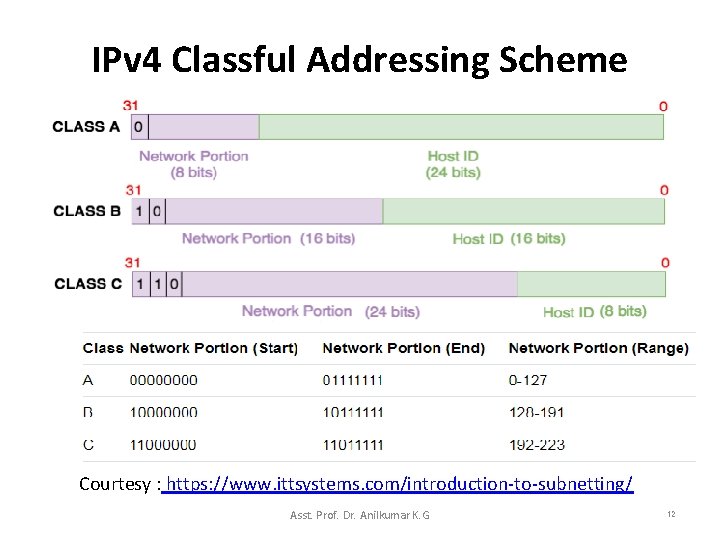
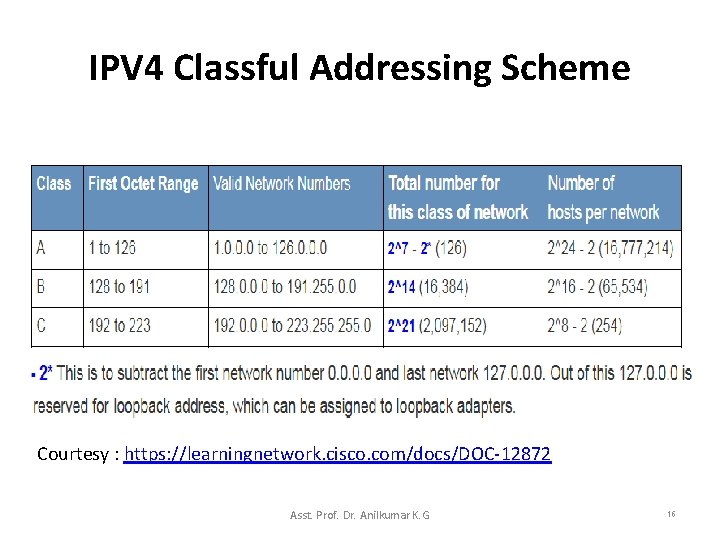
IPv 4 Classful Addressing Scheme • The address range of Class A network is actually 1 -126 because 0. x. x. x and 127. x. x. x are reserved. • With these classes, a computer/device can look at the first three bits of any IP address and determine what class it belongs to. – For example, the 192. 168. 1. 250 IP address falls into the Class C range (192 = 110000002) • Looking at the Host ID portion of the classes, we can determine how many hosts (or number of individual IP addresses) a network in each class will support. – For example, a Class C network will ideally support up to 256 host IDs i. e. from 0000 (decimal 0) to 1111 (decimal 255). Asst. Prof. Dr. Anilkumar K. G 17
IPv 4 Classful Addressing Scheme • Two of these host addresses (0000 and 1111) in Class C cannot be assigned to hosts because all 0 s represents the network address while all 1 s represents the broadcast address. • This leaves with 254 (28 -2) host IDs. • A simple formula calculates the number of hosts supported by a network is: No. of usable IP addresses (host addresses) = 2 host_bits 2 – Anyone who needed a network that supports up to 254 hosts can use a Class C network. – What if you only need just 10 IP addresses? – You still get a Class C network. This wastage of IP addresses It is even worse for Class B (65, 534 usable IP addresses per network) and Class A (16, 777, 214 usable IP addresses per network)! Asst. Prof. Dr. Anilkumar K. G 18
IPv 4 Classful Addressing Scheme • In the classful addressing scheme, each address is said to be self-identifying because the boundary between prefix and suffix can be computed from the address alone – Class A addresses used for networks with large hosts (it has 7 bit network. ID and 24 -bit host. ID). – Class B addresses used for medium size networks (it allocates 14 bits to the network. ID and 16 bits to the host. ID). – Class C addresses used for networks that have less than 28(256) hosts (it allocates 21 bits to the network. ID and 8 bits to host. ID). Asst. Prof. Dr. Anilkumar K. G 19
Dotted Decimal Address with IPv 4 • IPv 4 addresses are written as four decimal integers separated by decimal points. • A 32 -bit binary IP address can be given as 10000000 00001010 00000010 00011110 and is written as dotted decimal integers 128. 10. 2. 30 (a Class B address) – Application programs such as a web browser allow a user to enter a dotted decimal value instead of a computer name. Asst. Prof. Dr. Anilkumar K. G 20
IPv 4 Subnet Addressing • How can the technology accommodate growth without abandoning the original classful addressing scheme? • A technique called subnet addressing or subnetting allows a single network prefix to be used for multiple physical networks. – To understand subnetting, it is important to think about individual sites connected to the Internet. – A subnet is a logical partition of an IP network into multiple, smaller network segments. • Subnetting is typically used to subdivide large networks into smaller, more efficient sub-networks. Asst. Prof. Dr. Anilkumar K. G 21
IPv 4 Subnet Addressing – For example, a university started with a single LAN and obtained an IPv 4 prefix (network. ID). – If the university adds another LAN, the original addressing scheme would require the university to obtain a second network. ID for the second LAN. – Suppose the university has only a few computers. It can assign host addresses and arrange internal forwarding. – That is a site can choose and use IPv 4 addresses in unusual ways internally as long as all hosts and routers within the site agree to honor the site’s addressing scheme. – Other sites on the Internet can treat addresses as standard addresses with a network prefix that belongs to the site. • Subnet addressing takes advantage of the freedom by allowing a site to divide the host portion of their addresses among multiple networks. Asst. Prof. Dr. Anilkumar K. G 22
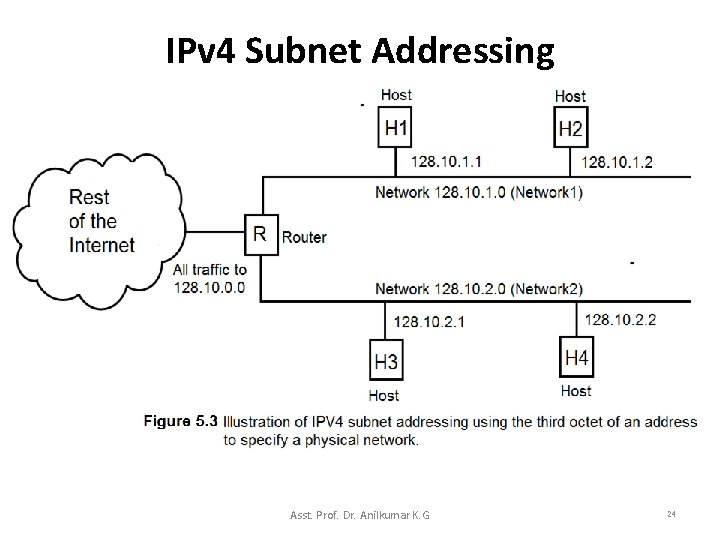
IPv 4 Subnet Addressing • How subnet addressing works? – Suppose a site has been assigned a single class B prefix, 128. 10. 0. 0 (it has 16 -bit network. ID and 16 -bit host. ID). – The rest of the Internet assumes each address at the site has one physical network with the 16 -bit network. ID (128. 10). – If the site obtains a second physical network, the site can use subnet addressing by using a portion of the host. ID field(0. 0) to identify which physical network to use. • Only hosts and routers at the site will know that there are multiple physical networks and how to forward traffic among them. – Figure 5. 3 shows an example using the third octet (3 rd 8 -bit of the addresses) of each address to identify a subnet. Asst. Prof. Dr. Anilkumar K. G 23
IPv 4 Subnet Addressing Asst. Prof. Dr. Anilkumar K. G 24
IPv 4 Subnet Addressing • In the Figure 5. 3, shows how the subnetting possible on a network with Class B address, 128. 10. 0. 0 : – All hosts on the Network 1 (net-address: 128. 10. 1. 0) have IP addresses of the form: 128. 10. 1. • Two hosts with IP addresses 128. 10. 1. 1 and 128. 10. 1. 2. – Similarly, hosts on Network 2 (net-address: 128. 10. 2. 0) have IP addresses of the form: 128. 10. 2. • Two hosts with IP addresses 128. 10. 2. 1 and 128. 10. 2. 2. – If R receives a packet, it checks the destination address: • If the address starts with 128. 10. 1, the R delivers the packet to a host on Network 1. • If the address starts with 128. 10. 2, the R delivers the packet to a host on Network 2. Asst. Prof. Dr. Anilkumar K. G 25
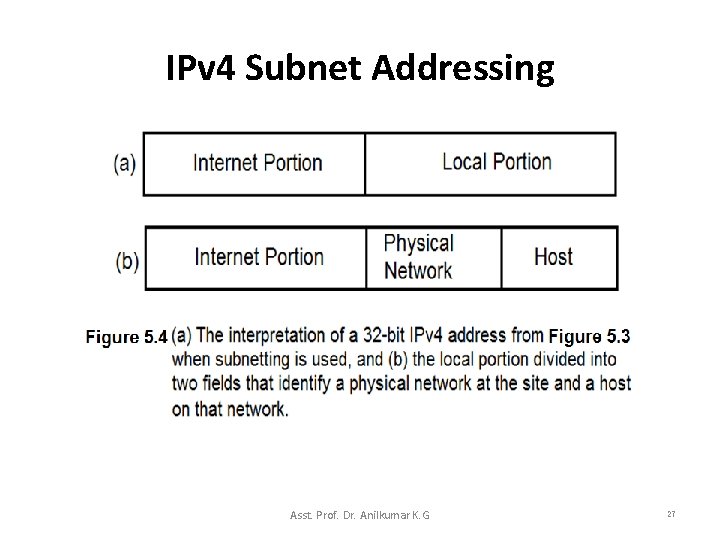
IPv 4 Subnet Addressing • Instead of dividing the 32 -bit IPv 4 address into a network prefix and host suffix, subnetting divides the IPv 4 address into an internet portion and a local portion – The internet portion remains the same as for networks that do not use subnetting. • When using subnet addressing, a 32 -bit IPv 4 address as having an internet portion and a local portion; – where the internet portion identifies a site, possibly with multiple physical networks, – and the local portion identifies a physical network and host at that site (see Figure 5. 3). • Figure 5. 4 illustrates how the example divides the IPv 4 address for subnetting. Asst. Prof. Dr. Anilkumar K. G 26
IPv 4 Subnet Addressing Asst. Prof. Dr. Anilkumar K. G 27
IPv 4 Subnet Addressing • Routers throughout the Internet use the top level of the hierarchy to forward a packet to the correct site: – Once the packet enters the site, local routers use the physical network octet to select the correct network. – Hence the packet reaches the correct network, a router uses the host portion to identify a particular host (see Figure 5. 3). Asst. Prof. Dr. Anilkumar K. G 28
Fixed Length IPv 4 Subnets • In the example in Figure 5. 3 shows a site was assigned a 16 -bit network prefix and used the third octet of the address to identify a physical network at the site and the fourth octet for the host on that network. – The TCP/IP standard for subnet addressing recognizes that not every site will have a 16 -bit prefix and not every site needs same addressing hierarchy. – Figure 5. 3 represents a site that only has two physical networks. • Imagine a company that owns 20 large buildings and has deployed 20 LANs in each building. Suppose the site has a single 16 -bit network prefix and it wants to use subnetting for all its local networks. Asst. Prof. Dr. Anilkumar K. G 29
Fixed Length IPv 4 Subnets • How should the 16 -bit local (host) portion of the address be divided into fields for a physical network and host? • ANS: – The 16 -bit local portion of Class B address is shown in Figure 5. 4(b) • It has an 8 -bit physical network identifier and 8 -bit host identifier. – Using 8 -bit to identify a physical network means a manager can generate up to 256 unique physical network IDs (LAN IDs). – Similarly, with 8 -bit host portion, a manager can generate up to 256 host IDs for each network. • Unfortunately, the company has 400 (20 x 20) local networks, which exceeds the 254 (28 -2) possible numbers. Asst. Prof. Dr. Anilkumar K. G 30
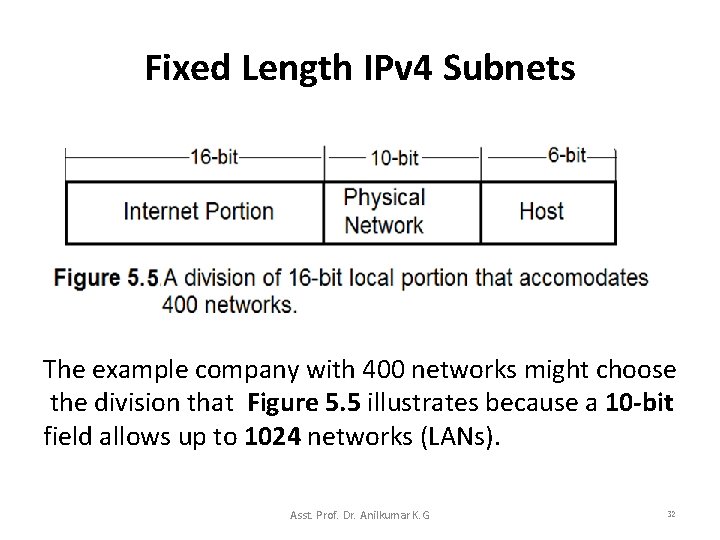
Fixed Length IPv 4 Subnets • To permit flexibility, the subnet standard does not specify that a site must always use third octet to specify a physical network in a Class-B address system as per the Figure 5. 4(b). • Instead a site can choose how many bits of the local portion to dedicate to the physical network, and how many to dedicate to the host. – The example company with 400 networks might choose the division that Figure 5. 5 illustrates because a 10 -bit field allows up to 1024 local networks. Asst. Prof. Dr. Anilkumar K. G 31
Fixed Length IPv 4 Subnets The example company with 400 networks might choose the division that Figure 5. 5 illustrates because a 10 -bit field allows up to 1024 networks (LANs). Asst. Prof. Dr. Anilkumar K. G 32
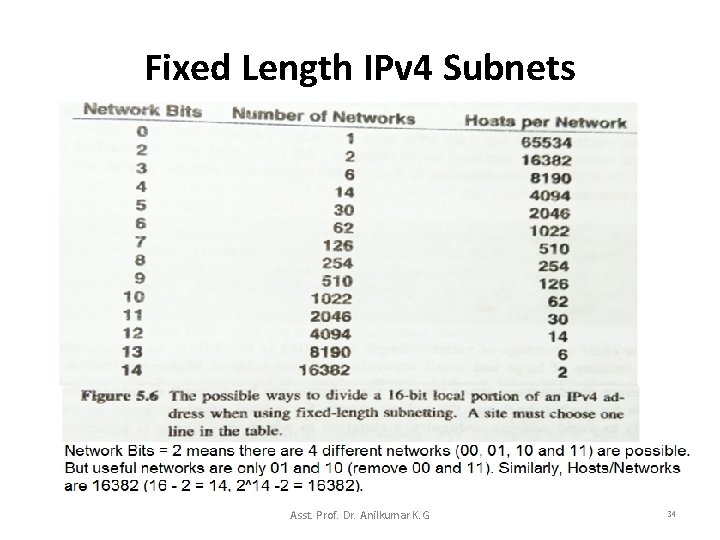
Fixed Length IPv 4 Subnets • The idea of allowing a site to choose a division for the local portion of its address and then using the division throughout the site is known as fixed-length subnetting. • Fixed-length subnetting is easy to understand because it partitions the local portion of an address between networks and hosts (see Figure 5. 4). – A manager chooses how many networks the site can have, and also determine the maximum number of hosts on each network. • Figure 5. 6 illustrates the possible choices if a site uses fixed-length subnetting with a 16 -bit local portion. Asst. Prof. Dr. Anilkumar K. G 33
Fixed Length IPv 4 Subnets Asst. Prof. Dr. Anilkumar K. G 34
Fixed Length IPv 4 Subnets • As the Figure 5. 6 illustrates, an organization that adopts fixed-length subnetting must choose a compromise: – If the organization opts for a large no. of physical networks, none of the networks can contain many hosts; – If the organization expects to connect many hosts to a network, the number of physical network must be small. • For example, allocating 3 bits to identify a physical network result in up to 6 networks that each support up to 8190 hosts. • Allocating 12 bits results in up to 4094 networks, but restricts the size of each to 14 hosts. Asst. Prof. Dr. Anilkumar K. G 35
Fixed Length IPv 4 Subnets • It should be clear why the designers did not choose a specific division for subnetting. • No single portion of the local part of the address works for all organizations: • Some need many networks with few hosts/network, while others need a few networks with many hosts attached to each. • Sits do not all receive a 16 -bit local portion, so the subnetting standard handles cases where a site is dividing fewer bits. Asst. Prof. Dr. Anilkumar K. G 36
Variable Length IPv 4 Subnet • Most sites use fixed-length subnetting because it is straight forward to understand administer. • When the designers invented subnetting, they have realized that fixed-length subnetting would not suffices for all sites. • The standard specifies that an organization can select a subnet partition on a per network basis and is called variable-length subnetting: – Once a partition has been selected for a particular network, the partition never changes. – All hosts and routers attached to that network must follow the decision; if they do not, datagram can be lost or misrouted. Asst. Prof. Dr. Anilkumar K. G 37
Implementation of IPv 4 Subnets with Masks • The subnet technology makes configuration of either fixed or variable length subnets. • The standard specifies that a 32 -bit mask is used to specify the subnet division. • Thus a site using subnet addressing must choose a 32 bit subnet mask for each network. • The mask covers the Internet portion and the physical network part (of the local portion) of the address: – Bits in the subnet mask are set to 1 if machines on the network treat the corresponding bit in the IP address as part of the subnet prefix, and 0 if they treat the bit as part of the host identifier. Asst. Prof. Dr. Anilkumar K. G 38
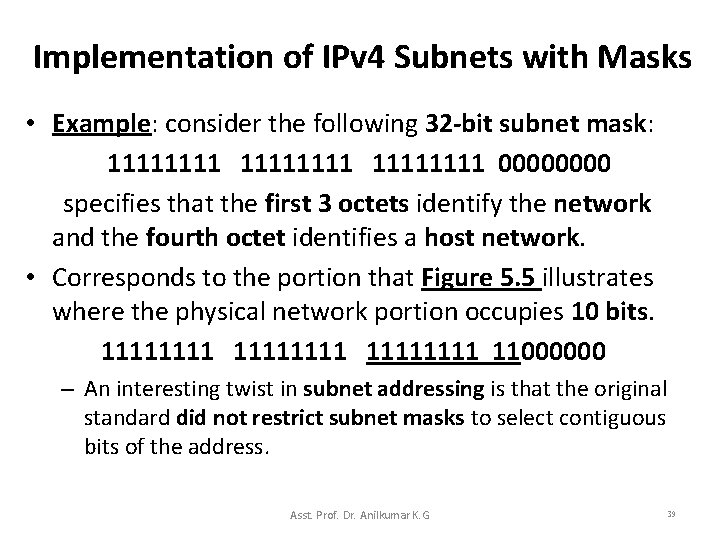
Implementation of IPv 4 Subnets with Masks • Example: consider the following 32 -bit subnet mask: 11111111 0000 specifies that the first 3 octets identify the network and the fourth octet identifies a host network. • Corresponds to the portion that Figure 5. 5 illustrates where the physical network portion occupies 10 bits. 11111111 11000000 – An interesting twist in subnet addressing is that the original standard did not restrict subnet masks to select contiguous bits of the address. Asst. Prof. Dr. Anilkumar K. G 39
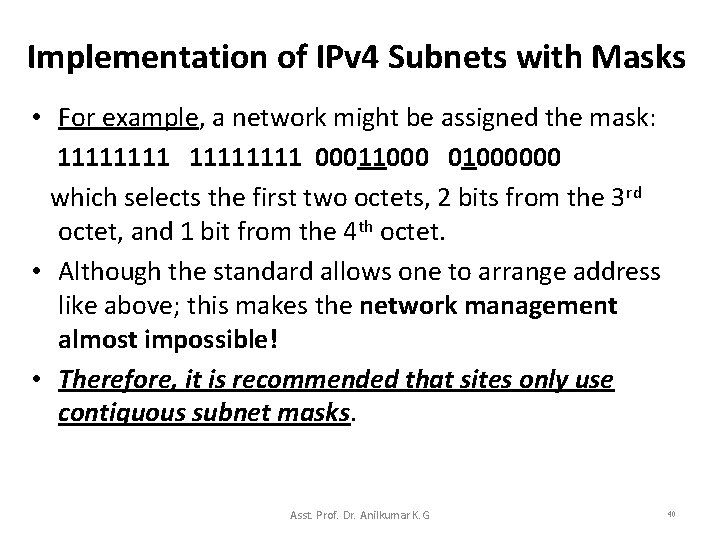
Implementation of IPv 4 Subnets with Masks • For example, a network might be assigned the mask: 11111111 00011000 01000000 which selects the first two octets, 2 bits from the 3 rd octet, and 1 bit from the 4 th octet. • Although the standard allows one to arrange address like above; this makes the network management almost impossible! • Therefore, it is recommended that sites only use contiguous subnet masks. Asst. Prof. Dr. Anilkumar K. G 40
IPv 4 Subnet Mask Representation and Slash Notation • Specifying subnet masks in binary is both awkward and prone to errors. • Hence SW allows alternative masking representation: – Most SW allows managers to use dotted decimal representation when specifying IPv 4 subnet masks. – Dotted decimal works well if a site can align the subnet boundary on octet boundaries. – The example Figure 5. 4(b) shows how easy it is to understand subnetting when the 3 rd octet of an address is used to identify a physical network and the 4 th octet is used to identify a host. Asst. Prof. Dr. Anilkumar K. G 41
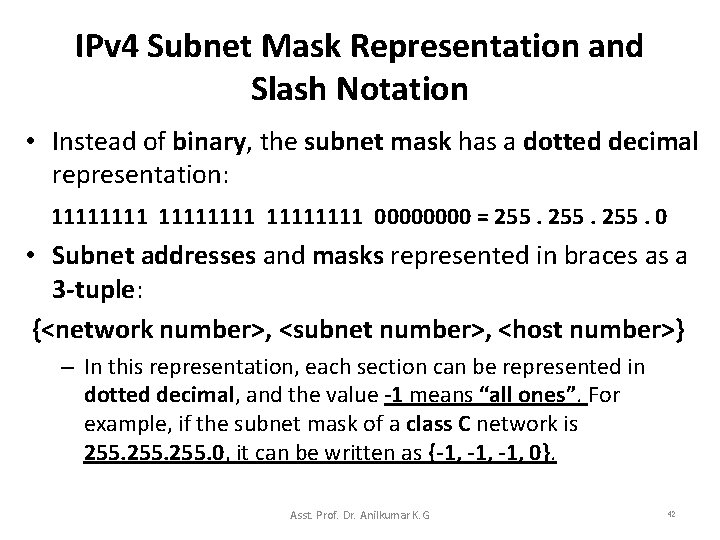
IPv 4 Subnet Mask Representation and Slash Notation • Instead of binary, the subnet mask has a dotted decimal representation: 11111111 0000 = 255. 0 • Subnet addresses and masks represented in braces as a 3 -tuple: {<network number>, <subnet number>, <host number>} – In this representation, each section can be represented in dotted decimal, and the value -1 means “all ones”. For example, if the subnet mask of a class C network is 255. 0, it can be written as {-1, -1, 0}. Asst. Prof. Dr. Anilkumar K. G 42
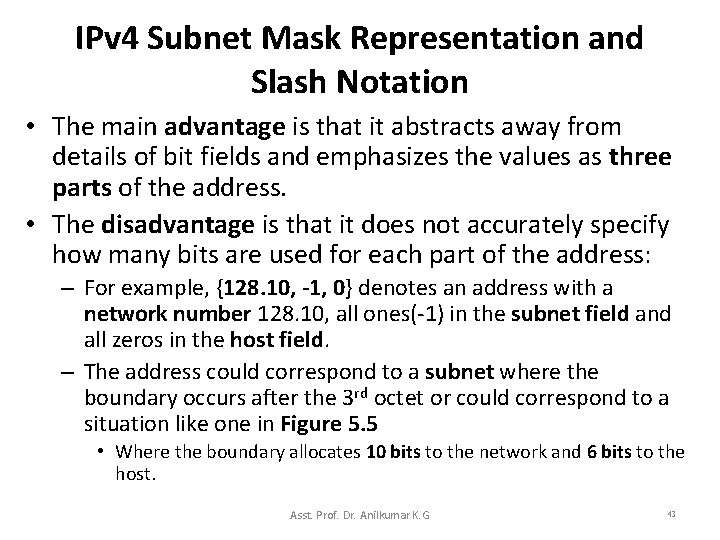
IPv 4 Subnet Mask Representation and Slash Notation • The main advantage is that it abstracts away from details of bit fields and emphasizes the values as three parts of the address. • The disadvantage is that it does not accurately specify how many bits are used for each part of the address: – For example, {128. 10, -1, 0} denotes an address with a network number 128. 10, all ones(-1) in the subnet field and all zeros in the host field. – The address could correspond to a subnet where the boundary occurs after the 3 rd octet or could correspond to a situation like one in Figure 5. 5 • Where the boundary allocates 10 bits to the network and 6 bits to the host. Asst. Prof. Dr. Anilkumar K. G 43
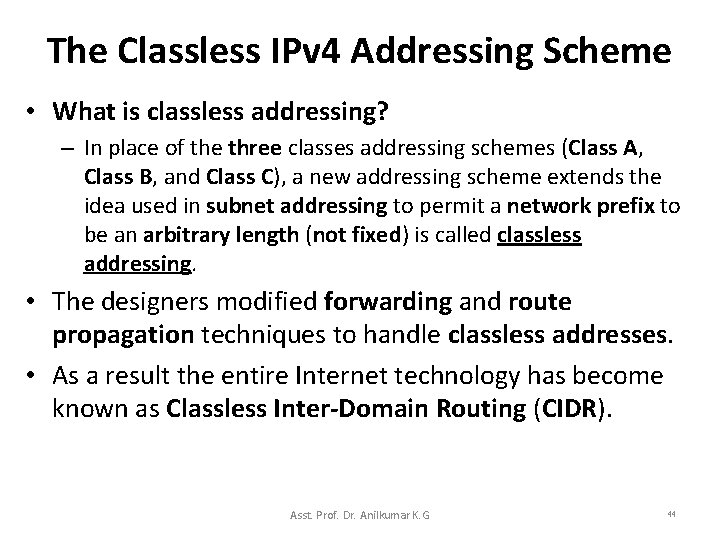
The Classless IPv 4 Addressing Scheme • What is classless addressing? – In place of the three classes addressing schemes (Class A, Class B, and Class C), a new addressing scheme extends the idea used in subnet addressing to permit a network prefix to be an arbitrary length (not fixed) is called classless addressing. • The designers modified forwarding and route propagation techniques to handle classless addresses. • As a result the entire Internet technology has become known as Classless Inter-Domain Routing (CIDR). Asst. Prof. Dr. Anilkumar K. G 44
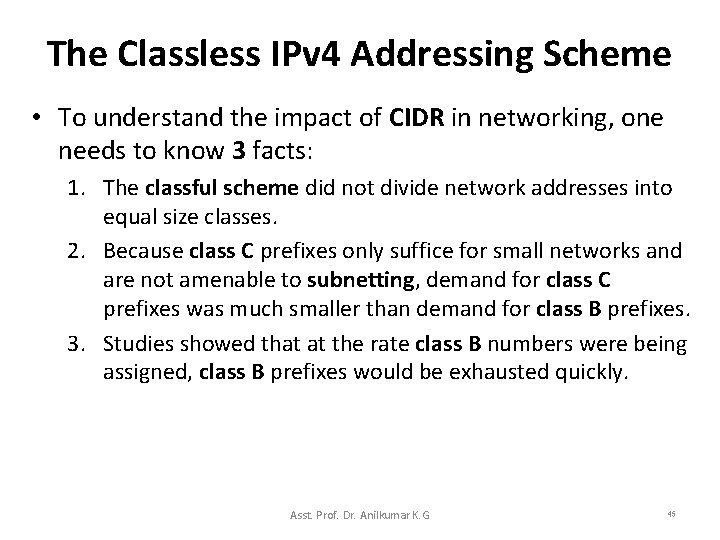
The Classless IPv 4 Addressing Scheme • To understand the impact of CIDR in networking, one needs to know 3 facts: 1. The classful scheme did not divide network addresses into equal size classes. 2. Because class C prefixes only suffice for small networks and are not amenable to subnetting, demand for class C prefixes was much smaller than demand for class B prefixes. 3. Studies showed that at the rate class B numbers were being assigned, class B prefixes would be exhausted quickly. Asst. Prof. Dr. Anilkumar K. G 45
The Classless IPv 4 Addressing Scheme: Supernetting • One of the first uses of classless addressing was known as supernetting: – To understand how supernetting works, consider a mediumsized organization that join the Internet. – Under classful addressing scheme, such an organization would request a class B prefix. – The supernetting scheme allows an ISP to assign the organization a block of class C addresses instead of a single class B number. – The block must be large enough to number all the networks in the organization and must lie on a boundary that is a power of 2. Asst. Prof. Dr. Anilkumar K. G 46
The Classless IPv 4 Addressing Scheme: Supernetting – For example, suppose the organization expects to have 200 networks: • Supernetting can assign the organization a block of 256 contiguous Class C numbers. • Although the first intended use of CIDR involved blocks of class C addresses, the designers realized that CIDR could be applied in a much broader context: – They envisioned a hierarchical addressing model in which each commercial ISP could be given a large block of internet addresses that the ISP could then allocate to subscribers. Asst. Prof. Dr. Anilkumar K. G 47
The Classless IPv 4 Addressing Scheme • Like subnet addressing, CIDR uses a 32 -bit addressing mask to specify the boundary between prefix and suffix. – Contiguous I bits in the mask specify the size of the prefix, and 0 bits in the mask correspond to the suffix. • At first glance, a CIDR mask appears to be identical to a subnet mask. – The major difference is that a CIDR mask is not merely known within a site. – Instead, a CIDR mask specifies the size of a network prefix, and the prefix is known globally. Asst. Prof. Dr. Anilkumar K. G 48
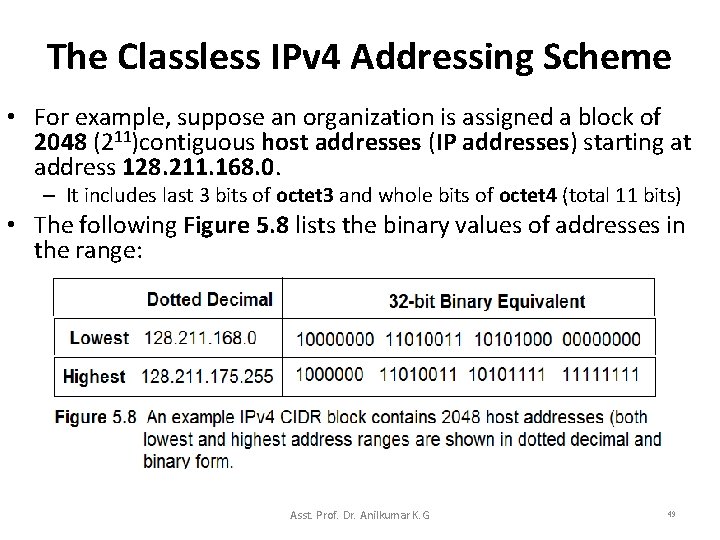
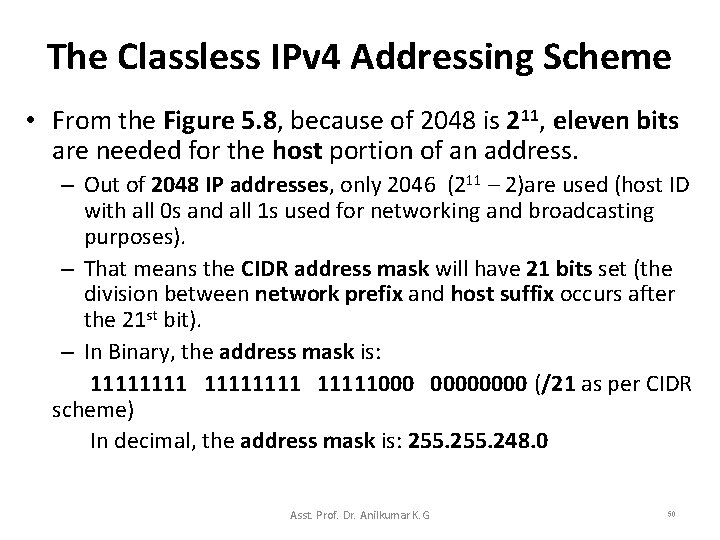
The Classless IPv 4 Addressing Scheme • For example, suppose an organization is assigned a block of 2048 (211)contiguous host addresses (IP addresses) starting at address 128. 211. 168. 0. – It includes last 3 bits of octet 3 and whole bits of octet 4 (total 11 bits) • The following Figure 5. 8 lists the binary values of addresses in the range: Asst. Prof. Dr. Anilkumar K. G 49
The Classless IPv 4 Addressing Scheme • From the Figure 5. 8, because of 2048 is 211, eleven bits are needed for the host portion of an address. – Out of 2048 IP addresses, only 2046 (211 – 2)are used (host ID with all 0 s and all 1 s used for networking and broadcasting purposes). – That means the CIDR address mask will have 21 bits set (the division between network prefix and host suffix occurs after the 21 st bit). – In Binary, the address mask is: 11111111 11111000 0000 (/21 as per CIDR scheme) In decimal, the address mask is: 255. 248. 0 Asst. Prof. Dr. Anilkumar K. G 50
IPv 4 Address Blocks And CIDR Slash Notation • Unlike the original classless scheme, the CIDR addresses are not self-identifying: – For example, if a router encounters address 128. 211. 168. 1 (see figure 5. 8), which is one of the addresses in the example block a router cannot know the position where the boundary lies unless external information is present. – Thus, when configuring a CIDR block, a network manager must supply two pieces of information: 1. The starting address and 2. an address mask that tells which bits are in the prefix. Asst. Prof. Dr. Anilkumar K. G 51
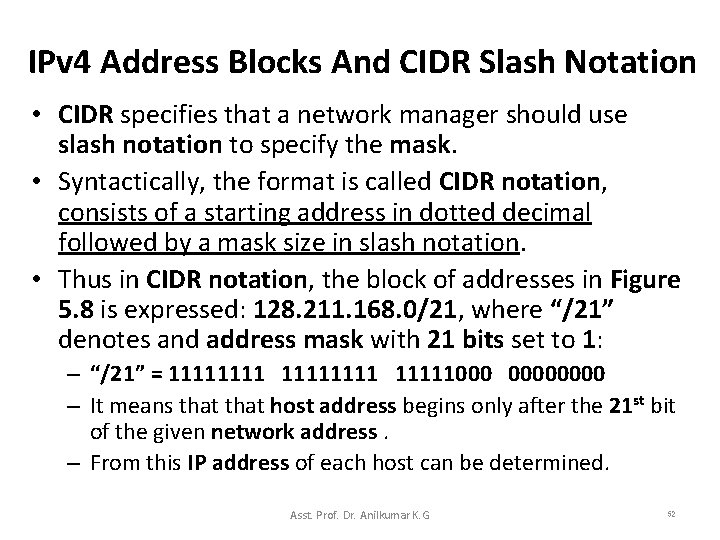
IPv 4 Address Blocks And CIDR Slash Notation • CIDR specifies that a network manager should use slash notation to specify the mask. • Syntactically, the format is called CIDR notation, consists of a starting address in dotted decimal followed by a mask size in slash notation. • Thus in CIDR notation, the block of addresses in Figure 5. 8 is expressed: 128. 211. 168. 0/21, where “/21” denotes and address mask with 21 bits set to 1: – “/21” = 11111111 11111000 0000 – It means that host address begins only after the 21 st bit of the given network address. – From this IP address of each host can be determined. Asst. Prof. Dr. Anilkumar K. G 52
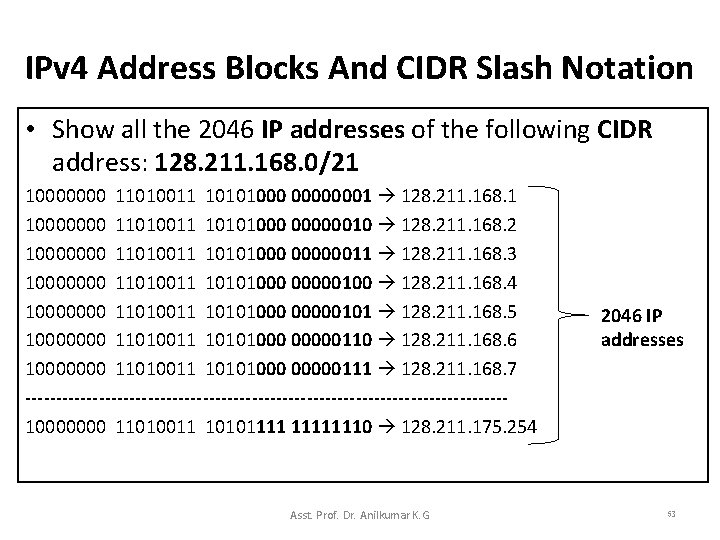
IPv 4 Address Blocks And CIDR Slash Notation • Show all the 2046 IP addresses of the following CIDR address: 128. 211. 168. 0/21 10000000 11010011 10101000 00000001 128. 211. 168. 1 10000000 11010011 10101000 00000010 128. 211. 168. 2 10000000 11010011 10101000 00000011 128. 211. 168. 3 10000000 11010011 10101000 00000100 128. 211. 168. 4 10000000 11010011 10101000 00000101 128. 211. 168. 5 10000000 11010011 10101000 00000110 128. 211. 168. 6 10000000 11010011 10101000 00000111 128. 211. 168. 7 ---------------------------------------10000000 11010011 101011111110 128. 211. 175. 254 Asst. Prof. Dr. Anilkumar K. G 2046 IP addresses 53
Classless IPv 4 Addressing Example • Figure 5. 8 illustrates one of the chief advantages of classless addressing, which provides a complete flexibility in allocating address blocks of various sizes. • When using CIDR , the ISP can choose to assign each customer an address block of an appropriate size: – The host size needs rounded to the nearest power of 2. – Observe that a CIDR mask of N bits defines an address block of (32 N) host addresses. – Therefore, a smaller host address block has a longer mask. Asst. Prof. Dr. Anilkumar K. G 54
Classless IPv 4 Addressing Example • If the ISP owns a CIDR block of N bits, the ISP can choose to assign a customer any piece of its address space by using a mask longer than N bits – For example, if the ISP is assigned 128. 211. 0. 0/16, the ISP is assigned any address to its customers out of 65534 IP addresses : 10000000 11010011 00000001 65534 IP addresses 10000000 11010011 11111110 – If the same ISP also has a small customer with only two computers, the ISP might choose to assign another block 128. 211. 176. 212/30, which covers the address range that Figure 5. 9 specifies: 10000000 11010011 10110000 11010101 4 -2 = 2 IP addresses 10000000 11010011 10110000 11010110 Asst. Prof. Dr. Anilkumar K. G 55
Classless IPv 4 Addressing Example • One way to think about classless addresses is as if each customer of an ISP obtains a variable-length subnet of the ISP’s CIDR block – Thus, a given block of addresses can be subdivided on an arbitrary (not fixed) bit boundary, and a router at the ISP can be configured to forward correctly to each subdivision. – As a result, the group of computers on a given network will be assigned addresses in a contiguous range, – but the range does not need to correspond to the old class A, class B, and class C boundaries. Asst. Prof. Dr. Anilkumar K. G 56
Summary • Classless IPv 4 addressing which is now used throughout the internet assigns each ISP a CIDR block and allows the ISP to partition addresses into contiguous sub blocks, • where the lowest address in a sub block starts at a power of 2 and the sub block contains a power of 2 address. Asst. Prof. Dr. Anilkumar K. G 57
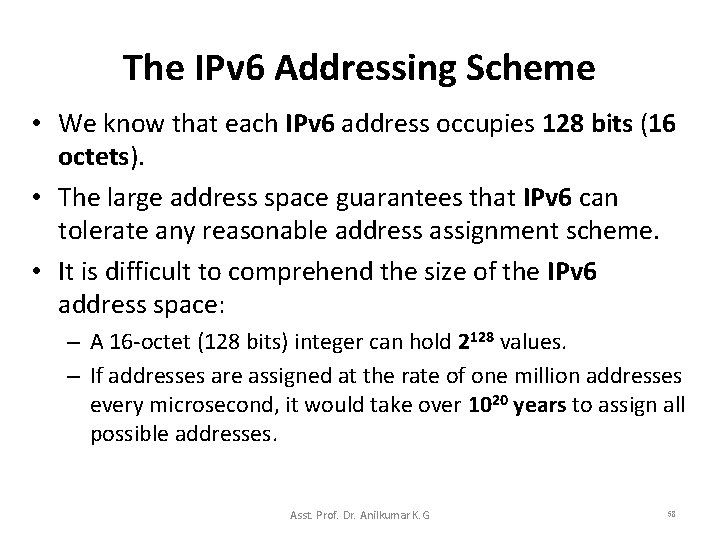
The IPv 6 Addressing Scheme • We know that each IPv 6 address occupies 128 bits (16 octets). • The large address space guarantees that IPv 6 can tolerate any reasonable address assignment scheme. • It is difficult to comprehend the size of the IPv 6 address space: – A 16 -octet (128 bits) integer can hold 2128 values. – If addresses are assigned at the rate of one million addresses every microsecond, it would take over 1020 years to assign all possible addresses. Asst. Prof. Dr. Anilkumar K. G 58
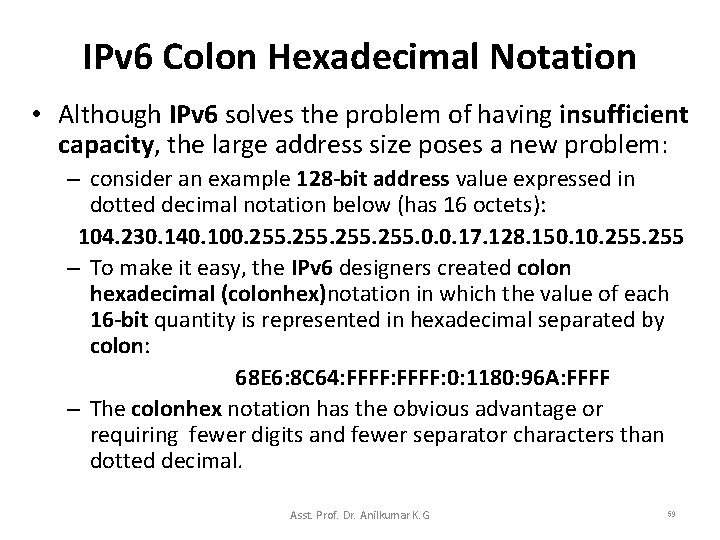
IPv 6 Colon Hexadecimal Notation • Although IPv 6 solves the problem of having insufficient capacity, the large address size poses a new problem: – consider an example 128 -bit address value expressed in dotted decimal notation below (has 16 octets): 104. 230. 140. 100. 255. 0. 0. 17. 128. 150. 10. 255 – To make it easy, the IPv 6 designers created colon hexadecimal (colonhex)notation in which the value of each 16 -bit quantity is represented in hexadecimal separated by colon: 68 E 6: 8 C 64: FFFF: 0: 1180: 96 A: FFFF – The colonhex notation has the obvious advantage or requiring fewer digits and fewer separator characters than dotted decimal. Asst. Prof. Dr. Anilkumar K. G 59
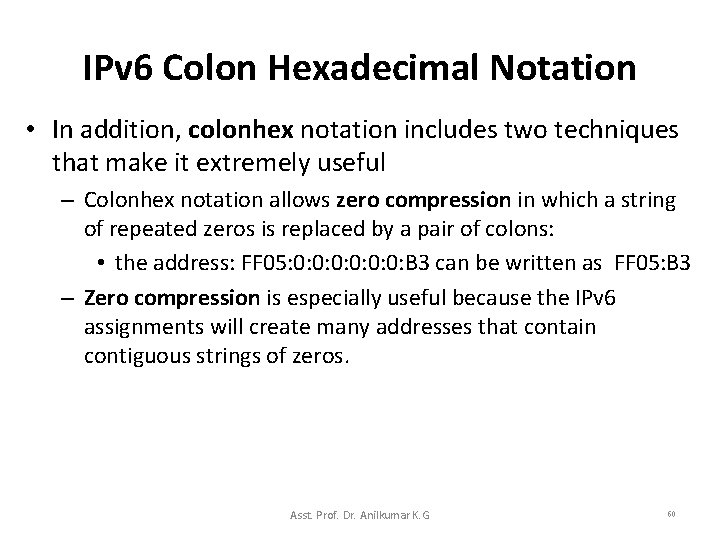
IPv 6 Colon Hexadecimal Notation • In addition, colonhex notation includes two techniques that make it extremely useful – Colonhex notation allows zero compression in which a string of repeated zeros is replaced by a pair of colons: • the address: FF 05: 0: 0: 0: B 3 can be written as FF 05: B 3 – Zero compression is especially useful because the IPv 6 assignments will create many addresses that contain contiguous strings of zeros. Asst. Prof. Dr. Anilkumar K. G 60
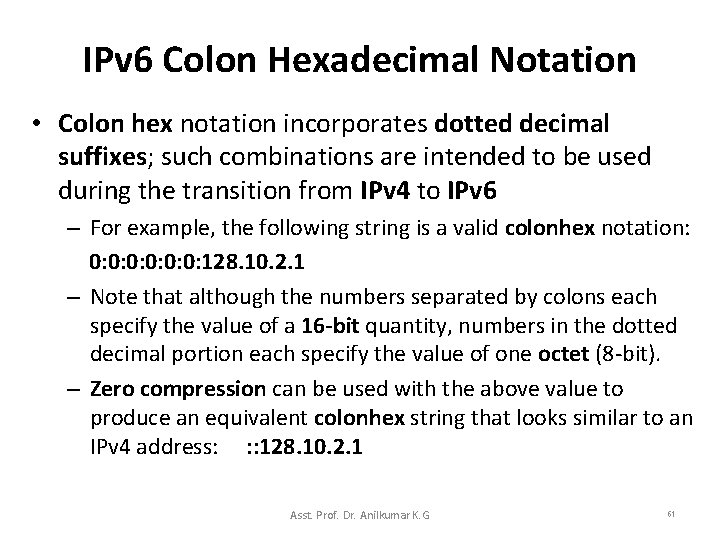
IPv 6 Colon Hexadecimal Notation • Colon hex notation incorporates dotted decimal suffixes; such combinations are intended to be used during the transition from IPv 4 to IPv 6 – For example, the following string is a valid colonhex notation: 0: 0: 0: 128. 10. 2. 1 – Note that although the numbers separated by colons each specify the value of a 16 -bit quantity, numbers in the dotted decimal portion each specify the value of one octet (8 -bit). – Zero compression can be used with the above value to produce an equivalent colonhex string that looks similar to an IPv 4 address: : : 128. 10. 2. 1 Asst. Prof. Dr. Anilkumar K. G 61
IPv 6 Colon Hexadecimal Notation • Finally, IPv 6 extends CIDR-like notation by allowing an address to be followed by a slash and an integer that specifies a number bits. – For example, 12 AB: : CD 30: 0: 0/60 specifies the first 60 bits of the address which is 12 AB 0000 CD 3 H Asst. Prof. Dr. Anilkumar K. G 62
IPv 6 Address Space Assignment • The question of how to partition the IPv 6 address space has generated: – There are two issues: • How human manage address assignment and how routers handle the necessary forwarding tables. – Unlike the current Internet, which uses a two-level hierarchy of network prefix (assigned by IP) and host prefix (assigned by an organization). – The large address space in IPv 6 permits a multi-level hierarchy or multiple hierarchies. Asst. Prof. Dr. Anilkumar K. G 63
IPv 6 Address Space Assignment • Large ISPs can start with large blocks of addresses and assign sub blocks to second-level ISPs, which can each assign sub blocks from their allocation to thirdlevel ISPs, and so on. • The IPv 6 address space has been divided into blocks of addresses analogous to the original classful scheme used with IPv 4 – The first 8 bits of an address are sufficient to identify the basic network types. – Like IPv 4 classful addressing, IPv 6 does not partition the address space into equal-size sections. Asst. Prof. Dr. Anilkumar K. G 64