
International Workshop on High Energy Circular Electron Positron

- Slides: 32
International Workshop on High Energy Circular Electron Positron Collider CEPC parameter optimization and lattice design Dou Wang, Yuan Zhang, Yiwei Wang, Chenghui Yu, Na Wang, Huiping Geng, Jiyuan Zhai, Yudong Liu, Sha Bai, Xiaohao Cui, Tianjian Bian, Cai Meng, Weiren Chou, Jie Gao Many Thanks: K. Oide(KEK), Y. Cai (SLAC), C. Zhang (IHEP), D. Zhou(KEK) 6 -8 November 2017, IHEP.
Outline Ø CEPC CDR parameters Ø Combined magnet scheme (D+S) based on CDR lattice Ø Alternative lattice design for collider ring
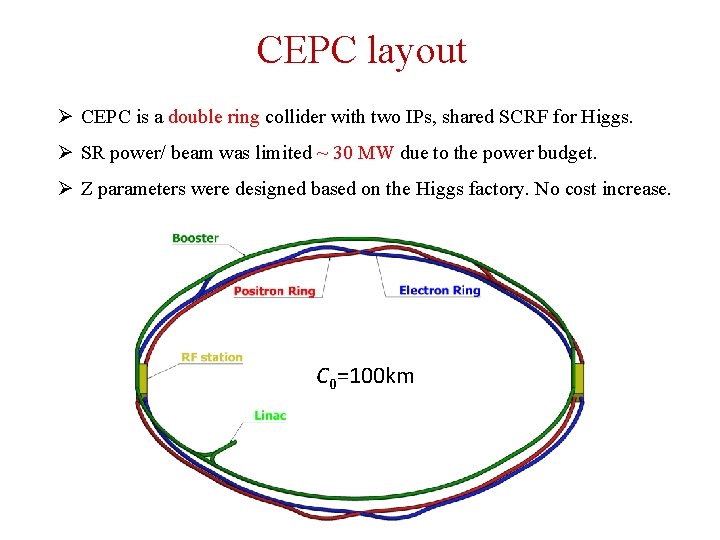
CEPC layout Ø CEPC is a double ring collider with two IPs, shared SCRF for Higgs. Ø SR power/ beam was limited ~ 30 MW due to the power budget. Ø Z parameters were designed based on the Higgs factory. No cost increase. C 0=100 km
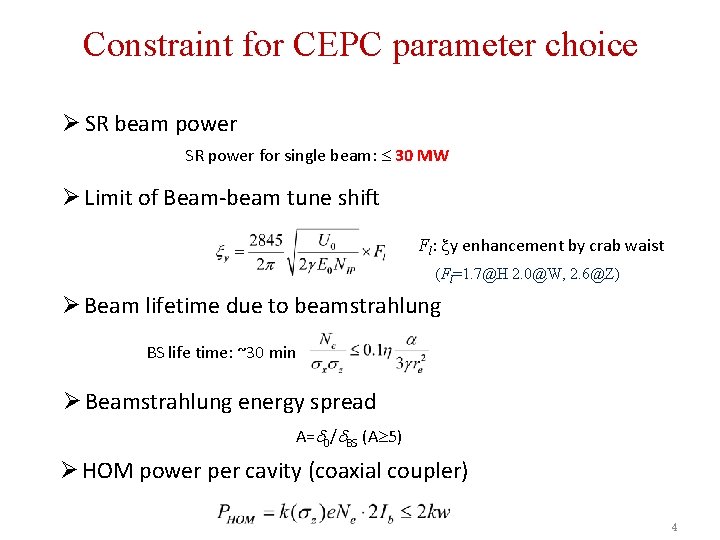
Constraint for CEPC parameter choice Ø SR beam power SR power for single beam: 30 MW Ø Limit of Beam-beam tune shift Fl: y enhancement by crab waist (Fl=1. 7@H 2. 0@W, 2. 6@Z) Ø Beam lifetime due to beamstrahlung BS life time: ~30 min Ø Beamstrahlung energy spread A= 0/ BS (A 5) Ø HOM power per cavity (coaxial coupler) 4
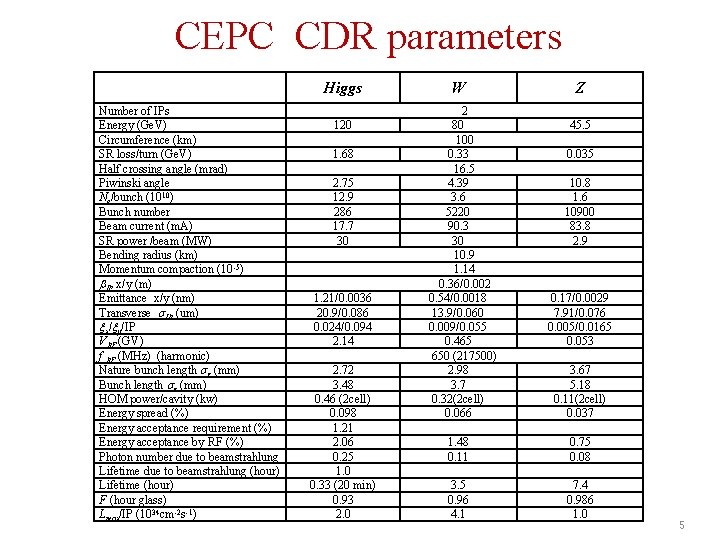
CEPC CDR parameters Higgs Number of IPs Energy (Ge. V) Circumference (km) SR loss/turn (Ge. V) Half crossing angle (mrad) Piwinski angle Ne/bunch (1010) Bunch number Beam current (m. A) SR power /beam (MW) Bending radius (km) Momentum compaction (10 -5) IP x/y (m) Emittance x/y (nm) Transverse IP (um) x/ y/IP VRF (GV) f RF (MHz) (harmonic) Nature bunch length z (mm) Bunch length z (mm) HOM power/cavity (kw) Energy spread (%) Energy acceptance requirement (%) Energy acceptance by RF (%) Photon number due to beamstrahlung Lifetime due to beamstrahlung (hour) Lifetime (hour) F (hour glass) Lmax/IP (1034 cm-2 s-1) 120 1. 68 2. 75 12. 9 286 17. 7 30 1. 21/0. 0036 20. 9/0. 086 0. 024/0. 094 2. 14 2. 72 3. 48 0. 46 (2 cell) 0. 098 1. 21 2. 06 0. 25 1. 0 0. 33 (20 min) 0. 93 2. 0 W 2 80 100 0. 33 16. 5 4. 39 3. 6 5220 90. 3 30 10. 9 1. 14 0. 36/0. 002 0. 54/0. 0018 13. 9/0. 060 0. 009/0. 055 0. 465 650 (217500) 2. 98 3. 7 0. 32(2 cell) 0. 066 Z 45. 5 0. 035 10. 8 1. 6 10900 83. 8 2. 9 0. 17/0. 0029 7. 91/0. 076 0. 005/0. 0165 0. 053 3. 67 5. 18 0. 11(2 cell) 0. 037 1. 48 0. 11 0. 75 0. 08 3. 5 0. 96 4. 1 7. 4 0. 986 1. 0 5
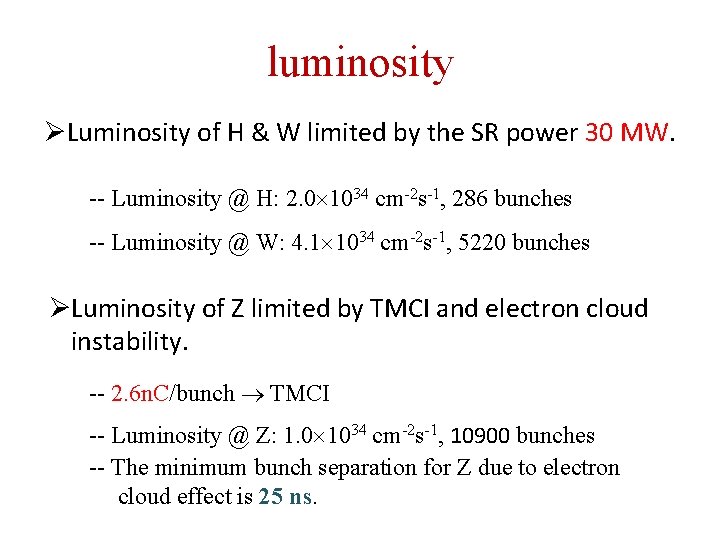
luminosity ØLuminosity of H & W limited by the SR power 30 MW. -- Luminosity @ H: 2. 0 1034 cm-2 s-1, 286 bunches -- Luminosity @ W: 4. 1 1034 cm-2 s-1, 5220 bunches ØLuminosity of Z limited by TMCI and electron cloud instability. -- 2. 6 n. C/bunch TMCI -- Luminosity @ Z: 1. 0 1034 cm-2 s-1, 10900 bunches -- The minimum bunch separation for Z due to electron cloud effect is 25 ns.
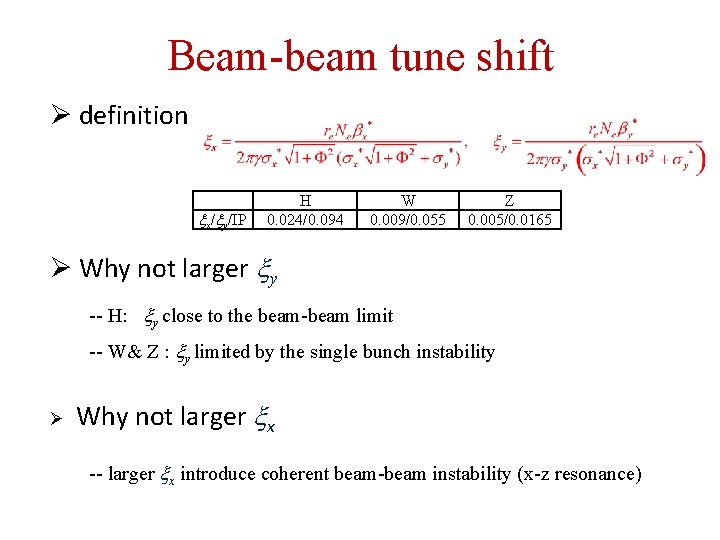
Beam-beam tune shift Ø definition x/ y/IP H 0. 024/0. 094 W 0. 009/0. 055 Z 0. 005/0. 0165 Ø Why not larger y -- H: y close to the beam-beam limit -- W& Z : y limited by the single bunch instability Ø Why not larger x -- larger x introduce coherent beam-beam instability (x-z resonance)
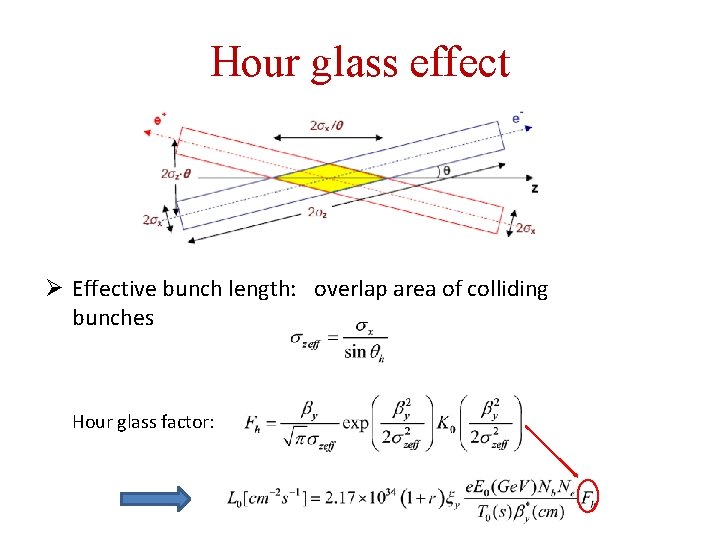
Hour glass effect Ø Effective bunch length: overlap area of colliding bunches Hour glass factor:
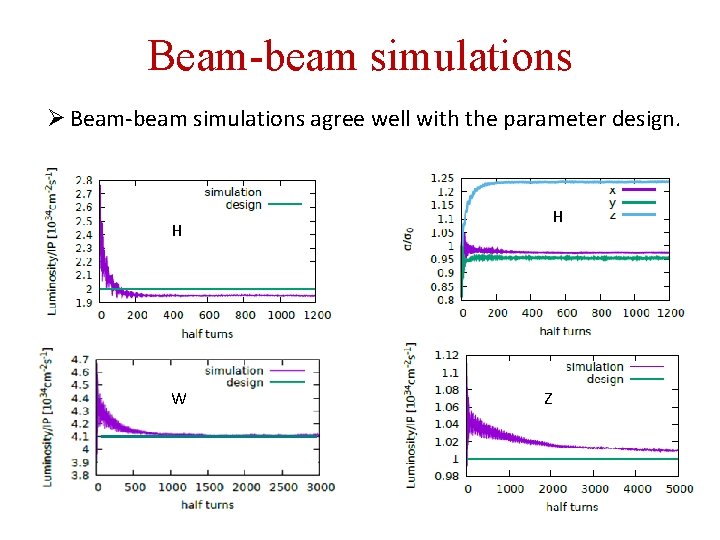
Beam-beam simulations Ø Beam-beam simulations agree well with the parameter design. H W H Z
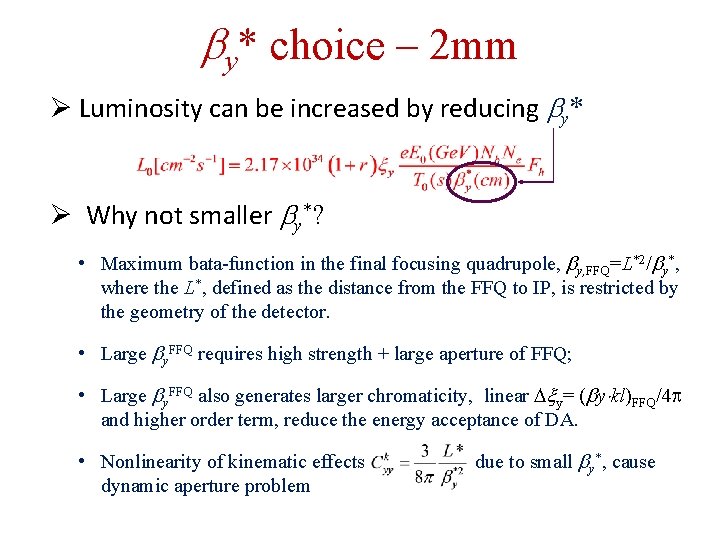
y* choice – 2 mm Ø Luminosity can be increased by reducing y* Ø Why not smaller y*? • Maximum bata-function in the final focusing quadrupole, y, FFQ=L*2/ y*, where the L*, defined as the distance from the FFQ to IP, is restricted by the geometry of the detector. • Large y. FFQ requires high strength + large aperture of FFQ; • Large y. FFQ also generates larger chromaticity, linear y= ( y kl)FFQ/4 and higher order term, reduce the energy acceptance of DA. • Nonlinearity of kinematic effects dynamic aperture problem due to small y*, cause
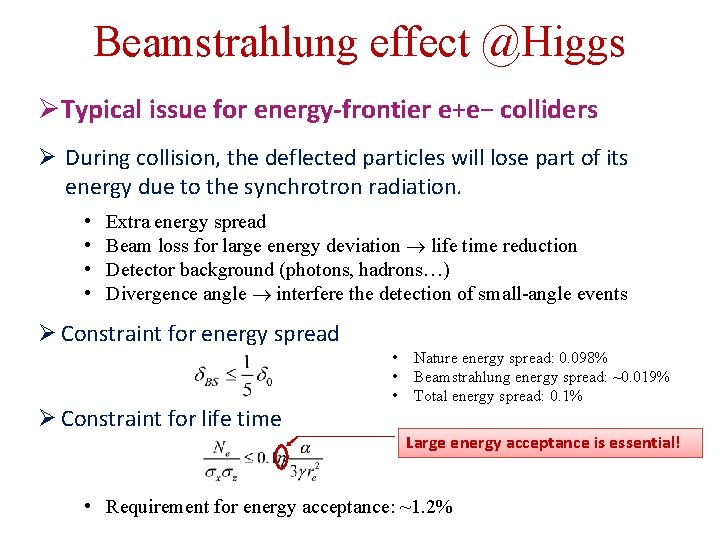
Beamstrahlung effect @Higgs ØTypical issue for energy-frontier e+e− colliders Ø During collision, the deflected particles will lose part of its energy due to the synchrotron radiation. • • Extra energy spread Beam loss for large energy deviation life time reduction Detector background (photons, hadrons…) Divergence angle interfere the detection of small-angle events Ø Constraint for energy spread Ø Constraint for life time • • • Nature energy spread: 0. 098% Beamstrahlung energy spread: ~0. 019% Total energy spread: 0. 1% Large energy acceptance is essential! • Requirement for energy acceptance: ~1. 2%
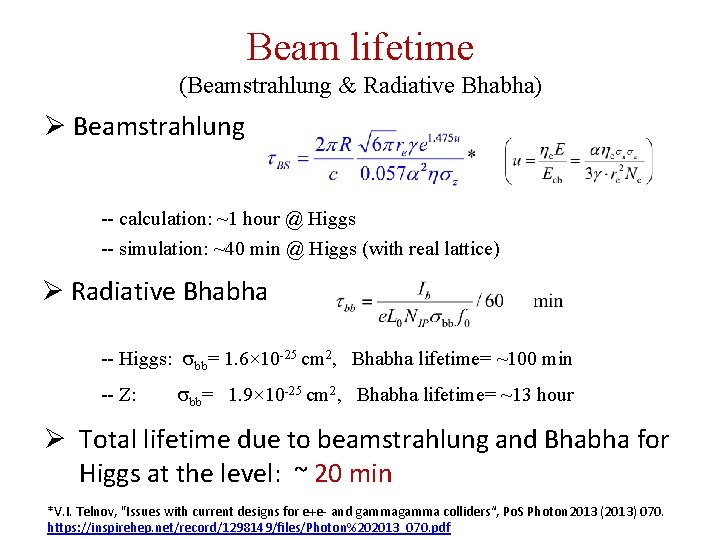
Beam lifetime (Beamstrahlung & Radiative Bhabha) Ø Beamstrahlung -- calculation: ~1 hour @ Higgs -- simulation: ~40 min @ Higgs (with real lattice) Ø Radiative Bhabha -- Higgs: bb= 1. 6× 10 -25 cm 2, Bhabha lifetime= ~100 min -- Z: bb= 1. 9× 10 -25 cm 2, Bhabha lifetime= ~13 hour Ø Total lifetime due to beamstrahlung and Bhabha for Higgs at the level: ~ 20 min *V. I. Telnov, "Issues with current designs for e+e- and gamma colliders“, Po. S Photon 2013 (2013) 070. https: //inspirehep. net/record/1298149/files/Photon%202013_070. pdf
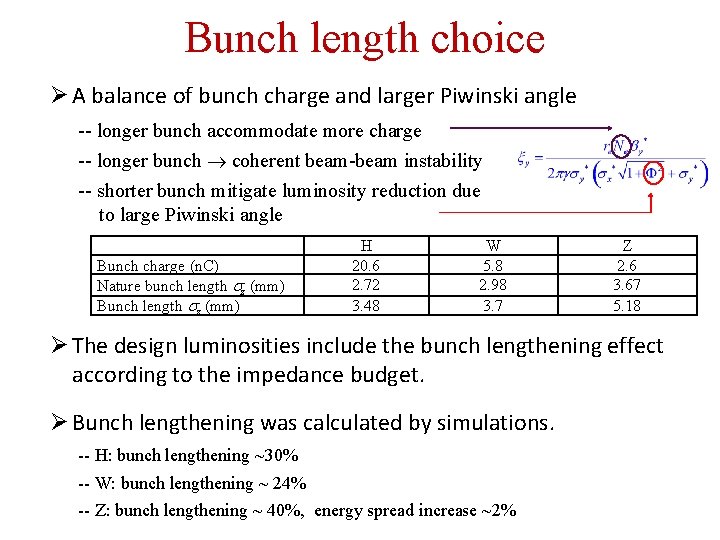
Bunch length choice Ø A balance of bunch charge and larger Piwinski angle -- longer bunch accommodate more charge -- longer bunch coherent beam-beam instability -- shorter bunch mitigate luminosity reduction due to large Piwinski angle Bunch charge (n. C) Nature bunch length z (mm) Bunch length z (mm) H 20. 6 2. 72 3. 48 W 5. 8 2. 98 3. 7 Z 2. 6 3. 67 5. 18 Ø The design luminosities include the bunch lengthening effect according to the impedance budget. Ø Bunch lengthening was calculated by simulations. -- H: bunch lengthening ~30% -- W: bunch lengthening ~ 24% -- Z: bunch lengthening ~ 40%, energy spread increase ~2%
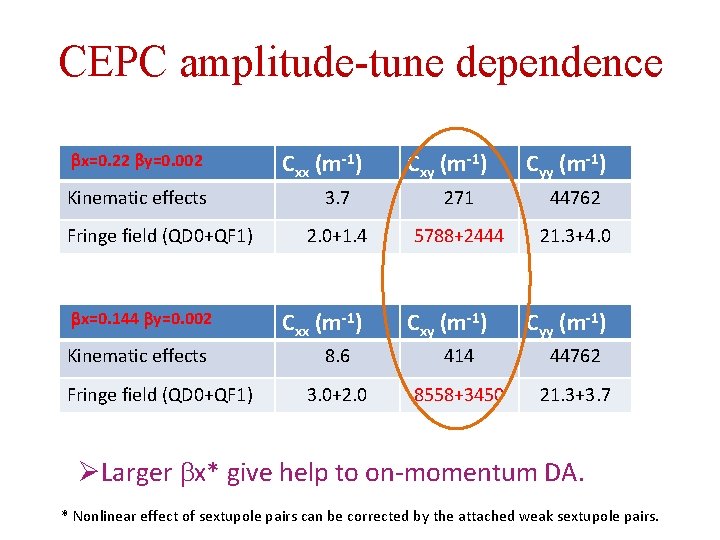
CEPC amplitude-tune dependence x=0. 22 y=0. 002 Kinematic effects Fringe field (QD 0+QF 1) x=0. 144 y=0. 002 Kinematic effects Fringe field (QD 0+QF 1) Cxx (m-1) Cxy (m-1) Cyy (m-1) 3. 7 271 44762 2. 0+1. 4 5788+2444 21. 3+4. 0 Cxx (m-1) Cxy (m-1) Cyy (m-1) 8. 6 414 44762 3. 0+2. 0 8558+3450 21. 3+3. 7 ØLarger x* give help to on-momentum DA. * Nonlinear effect of sextupole pairs can be corrected by the attached weak sextupole pairs.
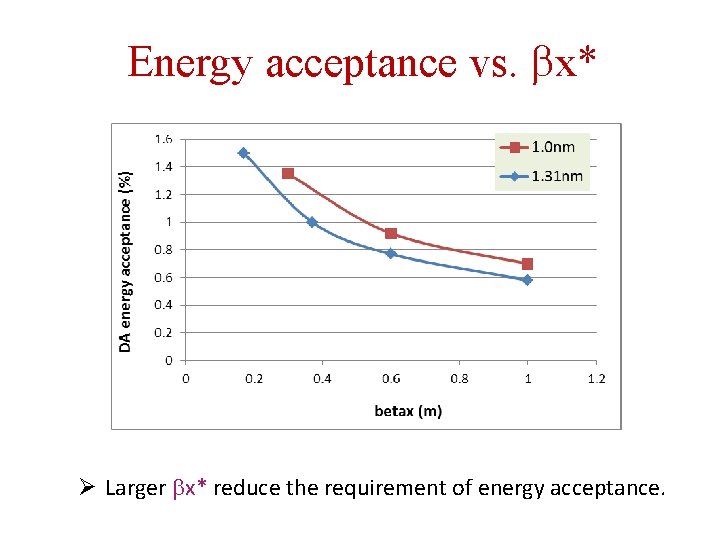
Energy acceptance vs. x* Ø Larger x* reduce the requirement of energy acceptance.
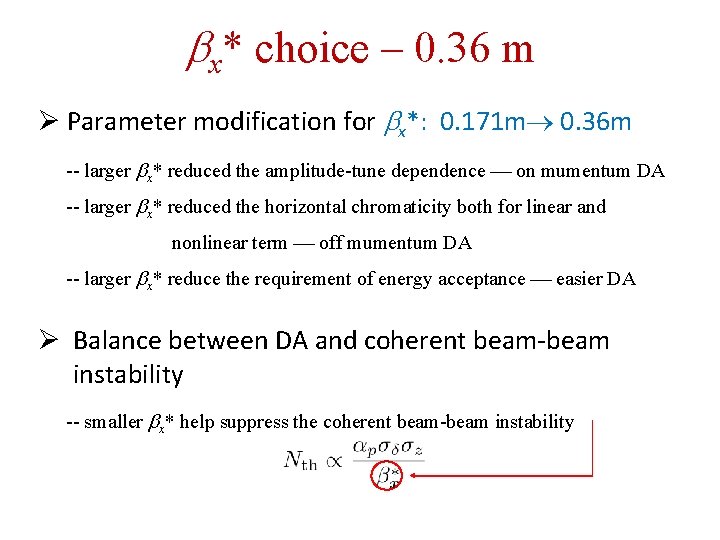
x* choice – 0. 36 m Ø Parameter modification for x*: 0. 171 m 0. 36 m -- larger x* reduced the amplitude-tune dependence on mumentum DA -- larger x* reduced the horizontal chromaticity both for linear and nonlinear term off mumentum DA -- larger x* reduce the requirement of energy acceptance easier DA Ø Balance between DA and coherent beam-beam instability -- smaller x* help suppress the coherent beam-beam instability
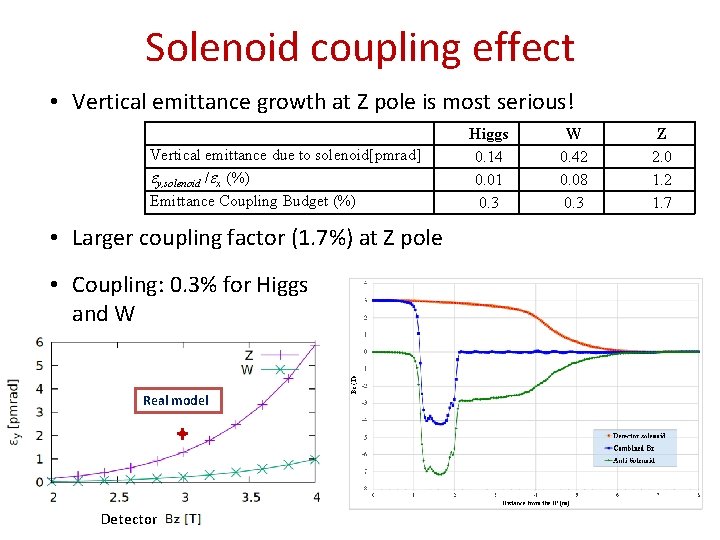
Solenoid coupling effect • Vertical emittance growth at Z pole is most serious! Vertical emittance due to solenoid[pmrad] y, solenoid / x (%) Emittance Coupling Budget (%) • Larger coupling factor (1. 7%) at Z pole • Coupling: 0. 3% for Higgs and W Real model Detector Higgs 0. 14 0. 01 0. 3 W 0. 42 0. 08 0. 3 Z 2. 0 1. 2 1. 7
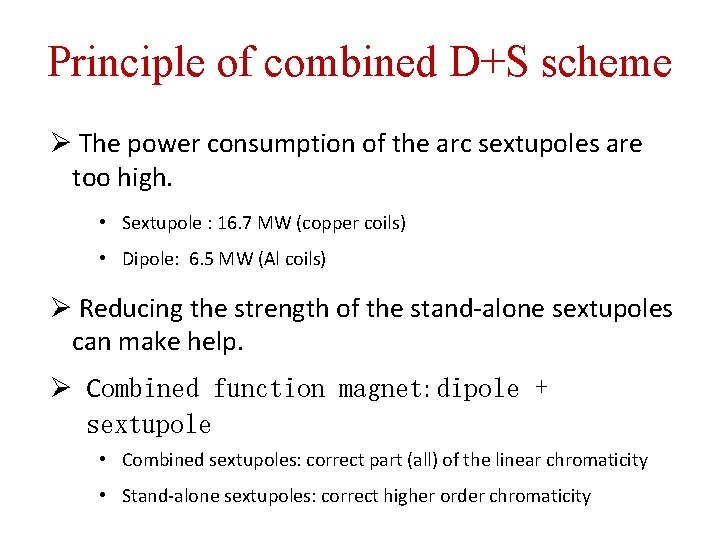
Principle of combined D+S scheme Ø The power consumption of the arc sextupoles are too high. • Sextupole : 16. 7 MW (copper coils) • Dipole: 6. 5 MW (Al coils) Ø Reducing the strength of the stand-alone sextupoles can make help. Ø Combined function magnet: dipole + sextupole • Combined sextupoles: correct part (all) of the linear chromaticity • Stand-alone sextupoles: correct higher order chromaticity
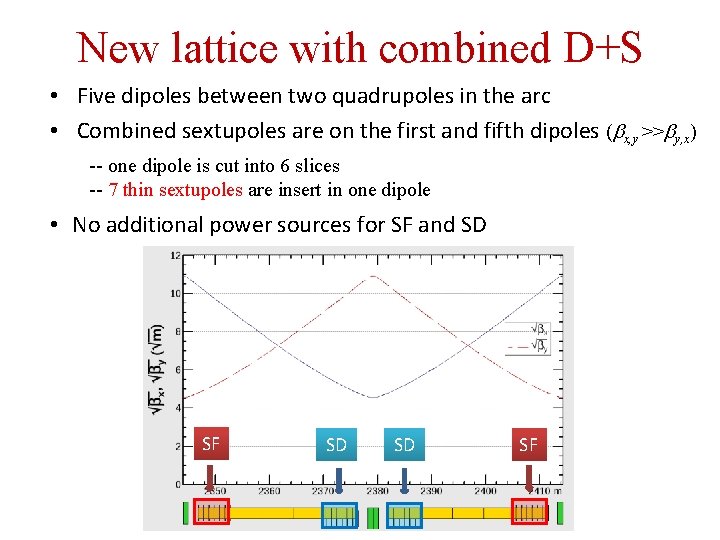
New lattice with combined D+S • Five dipoles between two quadrupoles in the arc • Combined sextupoles are on the first and fifth dipoles ( x, y >> y, x) -- one dipole is cut into 6 slices -- 7 thin sextupoles are insert in one dipole • No additional power sources for SF and SD SF SD SD SF
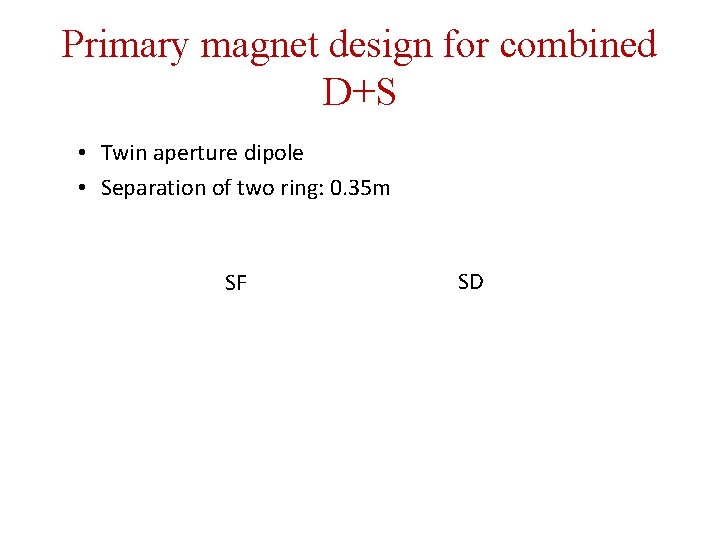
Primary magnet design for combined D+S • Twin aperture dipole • Separation of two ring: 0. 35 m SF SD
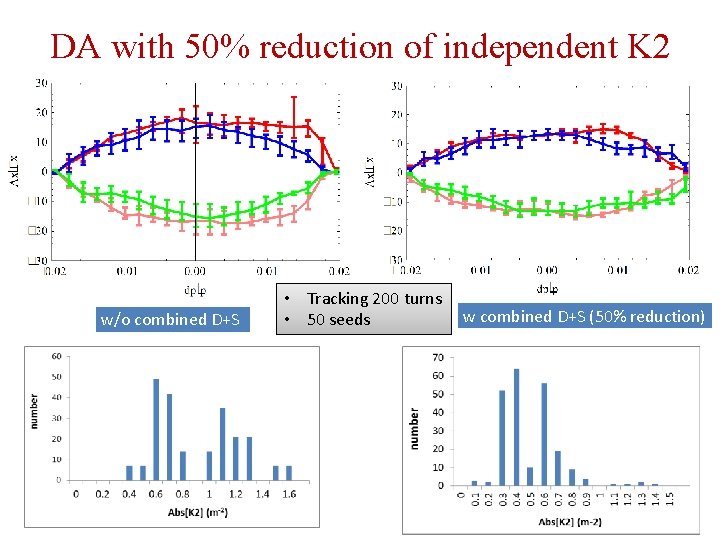
DA with 50% reduction of independent K 2 w/o combined D+S • Tracking 200 turns • 50 seeds w combined D+S (50% reduction)
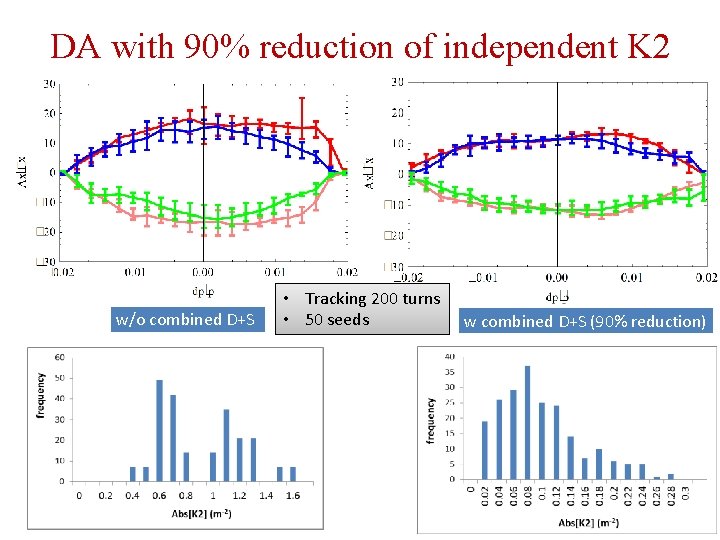
DA with 90% reduction of independent K 2 w/o combined D+S • Tracking 200 turns • 50 seeds w combined D+S (90% reduction)
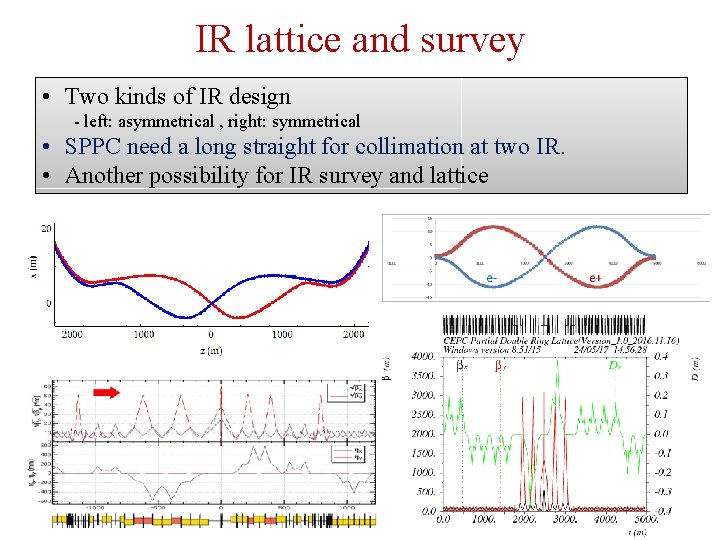
IR lattice and survey • Two kinds of IR design - left: asymmetrical , right: symmetrical • SPPC need a long straight for collimation at two IR. • Another possibility for IR survey and lattice
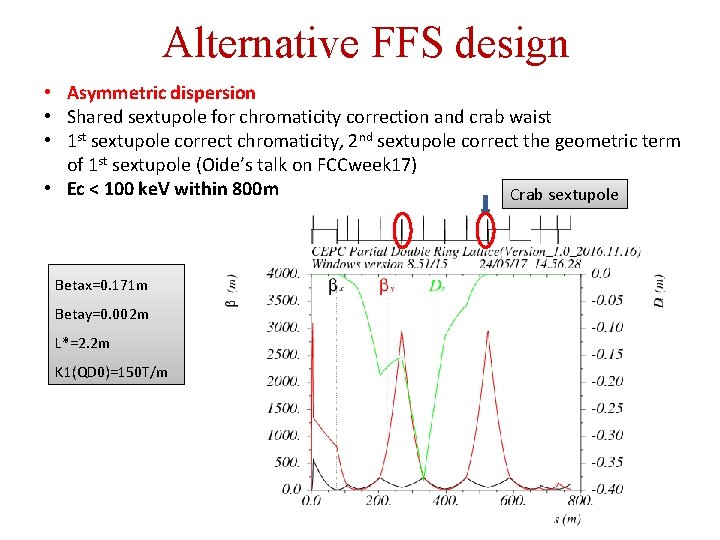
Alternative FFS design • Asymmetric dispersion • Shared sextupole for chromaticity correction and crab waist • 1 st sextupole correct chromaticity, 2 nd sextupole correct the geometric term of 1 st sextupole (Oide’s talk on FCCweek 17) • Ec < 100 ke. V within 800 m Crab sextupole Betax=0. 171 m Betay=0. 002 m L*=2. 2 m K 1(QD 0)=150 T/m
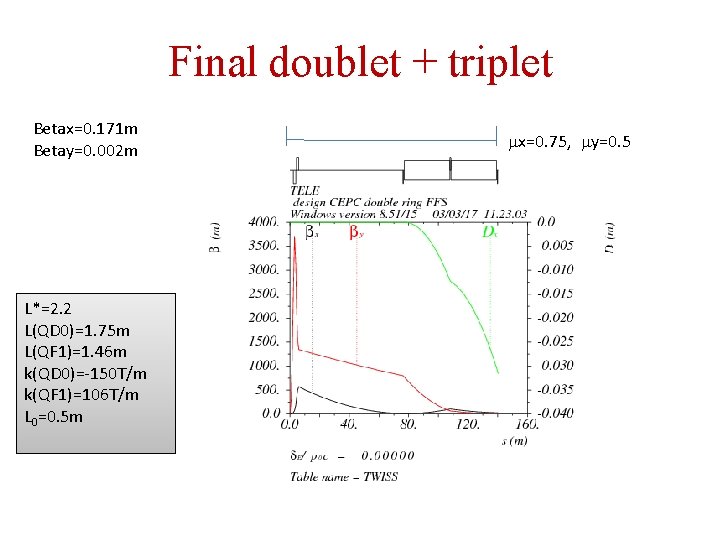
Final doublet + triplet Betax=0. 171 m Betay=0. 002 m L*=2. 2 L(QD 0)=1. 75 m L(QF 1)=1. 46 m k(QD 0)=-150 T/m k(QF 1)=106 T/m L 0=0. 5 m x=0. 75, y=0. 5
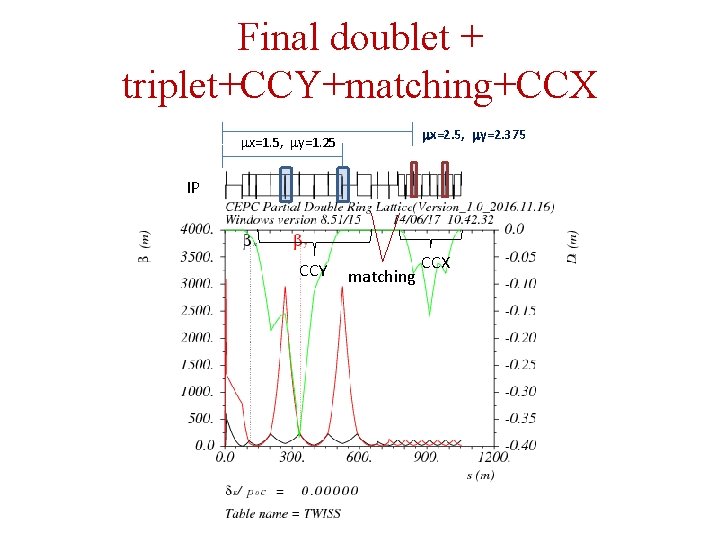
Final doublet + triplet+CCY+matching+CCX x=2. 5, y=2. 375 x=1. 5, y=1. 25 IP CCY matching CCX
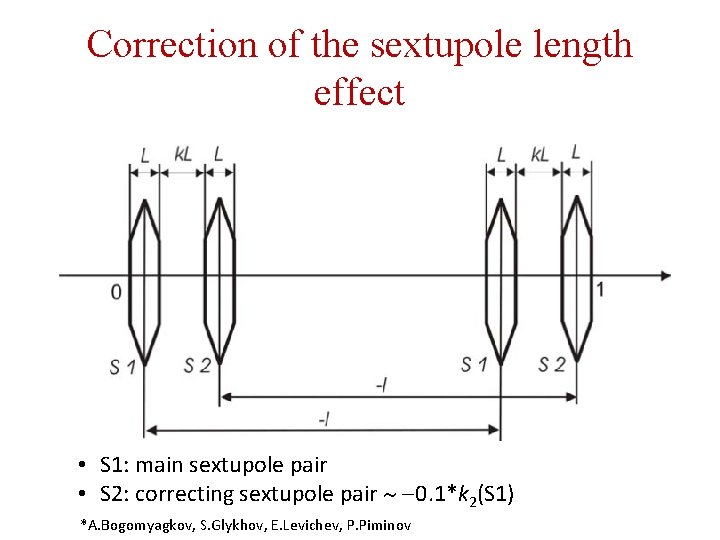
Correction of the sextupole length effect • S 1: main sextupole pair • S 2: correcting sextupole pair 0. 1*k 2(S 1) *A. Bogomyagkov, S. Glykhov, E. Levichev, P. Piminov
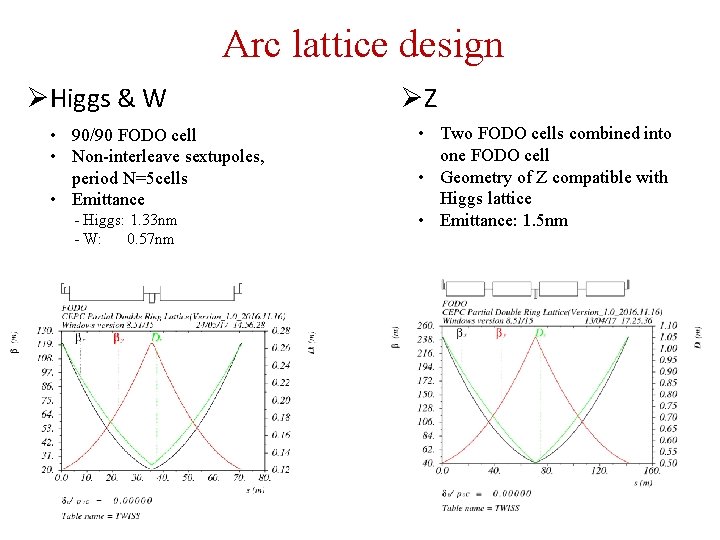
Arc lattice design ØHiggs & W • 90/90 FODO cell • Non-interleave sextupoles, period N=5 cells • Emittance - Higgs: 1. 33 nm - W: 0. 57 nm ØZ • Two FODO cells combined into one FODO cell • Geometry of Z compatible with Higgs lattice • Emittance: 1. 5 nm
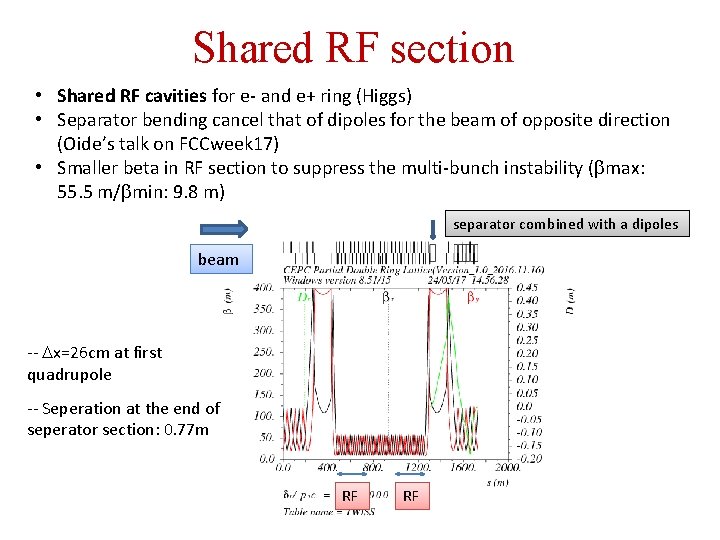
Shared RF section • Shared RF cavities for e- and e+ ring (Higgs) • Separator bending cancel that of dipoles for the beam of opposite direction (Oide’s talk on FCCweek 17) • Smaller beta in RF section to suppress the multi-bunch instability ( max: 55. 5 m/ min: 9. 8 m) separator combined with a dipoles beam -- x=26 cm at first quadrupole -- Seperation at the end of seperator section: 0. 77 m RF RF
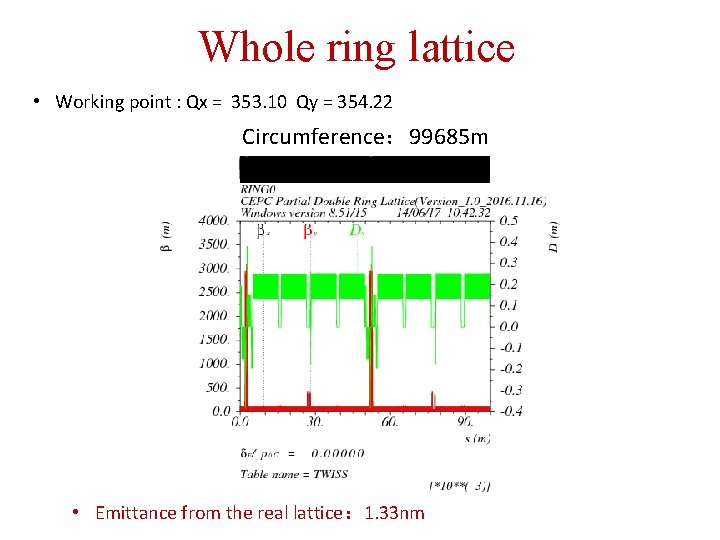
Whole ring lattice • Working point : Qx = 353. 10 Qy = 354. 22 Circumference: 99685 m • Emittance from the real lattice: 1. 33 nm
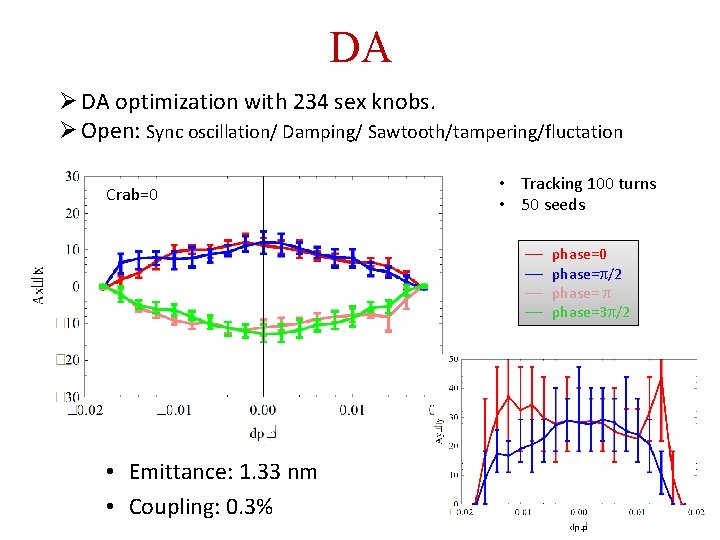
DA Ø DA optimization with 234 sex knobs. Ø Open: Sync oscillation/ Damping/ Sawtooth/tampering/fluctation Crab=0 • Tracking 100 turns • 50 seeds • Emittance: 1. 33 nm • Coupling: 0. 3% phase=0 phase= /2 phase=3 /2
Summary • A consistent analytical method for CEPC parameter design with carb waist scheme has been created. Crosscheck luminosity with beam-beam simulations • Luminosity of Higgs is limited by power budget and luminosity of Z is limited by bunch charge due to TMCI. • First taste of combined magnet (D+S) looks good. -- Power for sextupoles ¼, 50% reduction of independent K 2 • Alternative lattice for collider ring was explored. DA is comparable with CDR lattice. Far from maturity.