
International Workshop on Global Fundamental Geospatial Data Themes
International Workshop on Global Fundamental Geospatial Data Themes for Africa The Fundamental Geospatial Data Journey Greg Scott, UN-GGIM Secretariat United Nations Statistics Division Department of Economic and Social Affairs United Nations, New York Positioning geospatial information to address global challenges
A bit of history…and a lot of vision… “I believe we need a ‘Digital Earth’ – a multi-resolution three-dimensional representation of the planet, into which we can embed vast quantities of geo-referenced data. We have an unparalleled opportunity to turn a flood of raw data into understandable information about our society and our planet. This data will include high-resolution satellite imagery of the planet, digital maps, and economic, social, and demographic information. If we are successful, it will have broad societal and commercial benefits in areas such as education, decisionmaking for a sustainable future, land-use planning, agricultural, and crisis management; and to collaborate on the long-term environmental challenges we face. ” Al Gore, 1998: The Digital Earth: Understanding our planet in the 21 st Century Positioning geospatial information to address global challenges
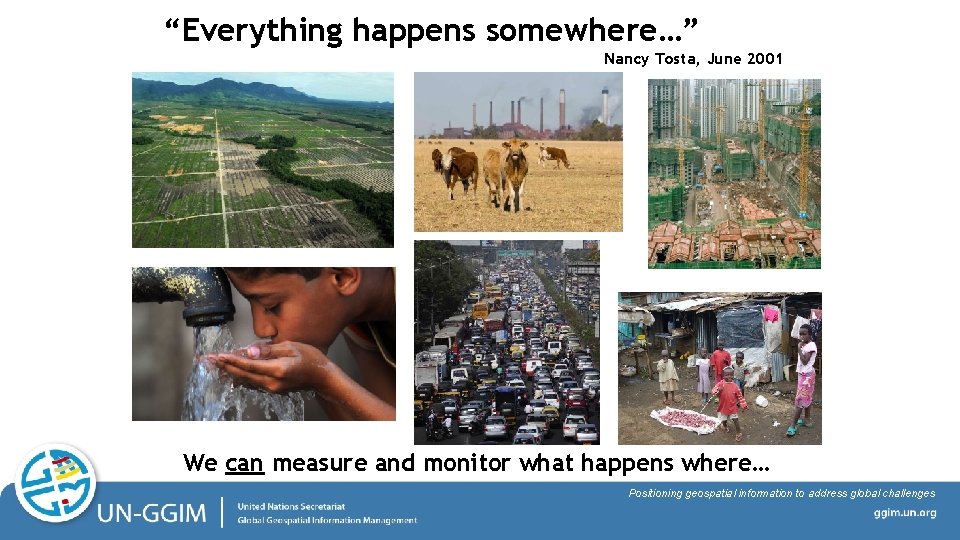
“Everything happens somewhere…” Nancy Tosta, June 2001 We can measure and monitor what happens where… Positioning geospatial information to address global challenges
Fundamental Datasets for Africa, 2007 As geospatial information becomes widely accepted…. a pancontinental and common definition of what constitutes a minimally necessary core of geospatial data and information products is required. Objective: Identify and enumerate these core, or fundamental, geospatial datasets to support Africa’s development agenda. A key aspect of fundamental datasets is that they should be a reference frame, foundation, or base for the development and integration of geospatial datasets at a national, subregional and regional level. To be accomplished, it is necessary for the data to be available and widely accessible so that new geospatial data can be developed through the cooperation of users. Positioning geospatial information to address global challenges
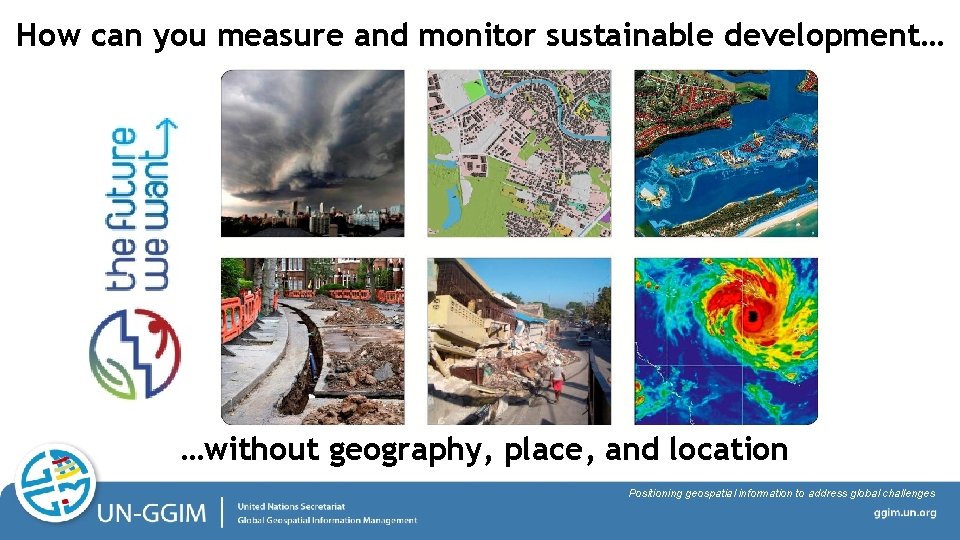
How can you measure and monitor sustainable development… …without geography, place, and location Positioning geospatial information to address global challenges
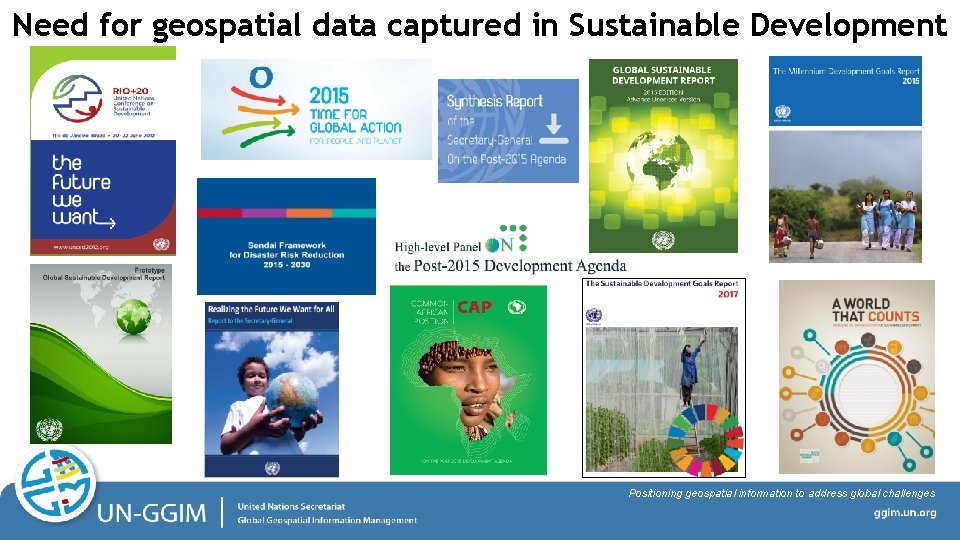
Need for geospatial data captured in Sustainable Development Positioning geospatial information to address global challenges
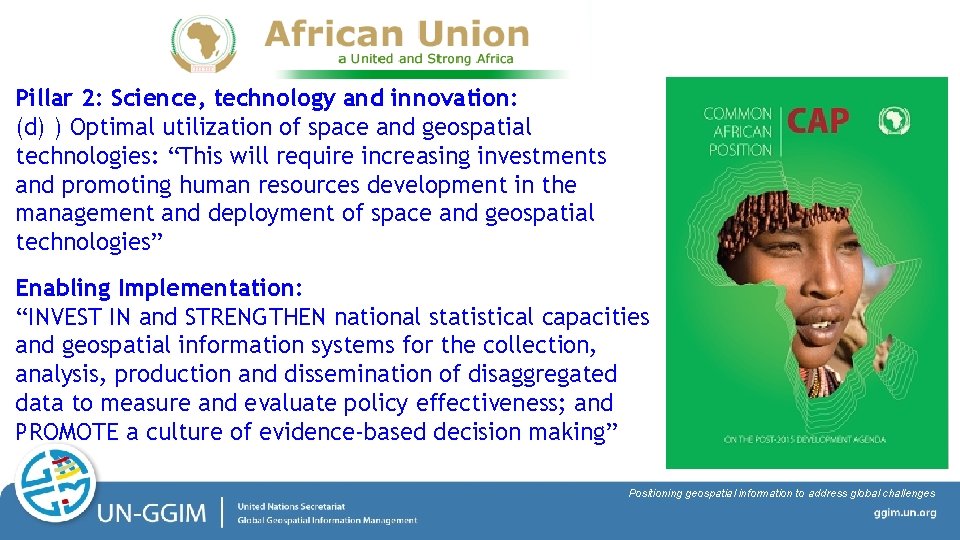
Pillar 2: Science, technology and innovation: (d) ) Optimal utilization of space and geospatial technologies: “This will require increasing investments and promoting human resources development in the management and deployment of space and geospatial technologies” Enabling Implementation: “INVEST IN and STRENGTHEN national statistical capacities and geospatial information systems for the collection, analysis, production and dissemination of disaggregated data to measure and evaluate policy effectiveness; and PROMOTE a culture of evidence-based decision making” Positioning geospatial information to address global challenges
Data Approaches for Monitoring Sustainable Development Progress: The Case of Africa The increasing use of geospatial information needs to continue: • Geospatial information is increasingly being used in Africa, but more capacity building will be needed to scale up existing initiatives and to bring innovative applications from other parts of the world to Africa. • The lack of consistent up-to-date base mapping fundamental geographic datasets such as geodetic control, elevation, drainage, transport, land cover, geographic names, land tenure, etc. – across Africa remains a challenge. Positioning geospatial information to address global challenges
Data Approaches for Monitoring Sustainable Development Progress: The Case of Africa There is an increasing tendency to now make use of multiple data sources: official statistics, geospatial and satellite data, big data, scientific data, data produced by NGOs and research foundations, data from the media, from the crowd and from the business sector. To explore the full potential of these data sources, the data needs to be easily accessible, interoperable and standardized – so that users are able to integrate difference sources and types of information. Data, and its metadata, needs to be open access (i. e. free and accessible). Positioning geospatial information to address global challenges
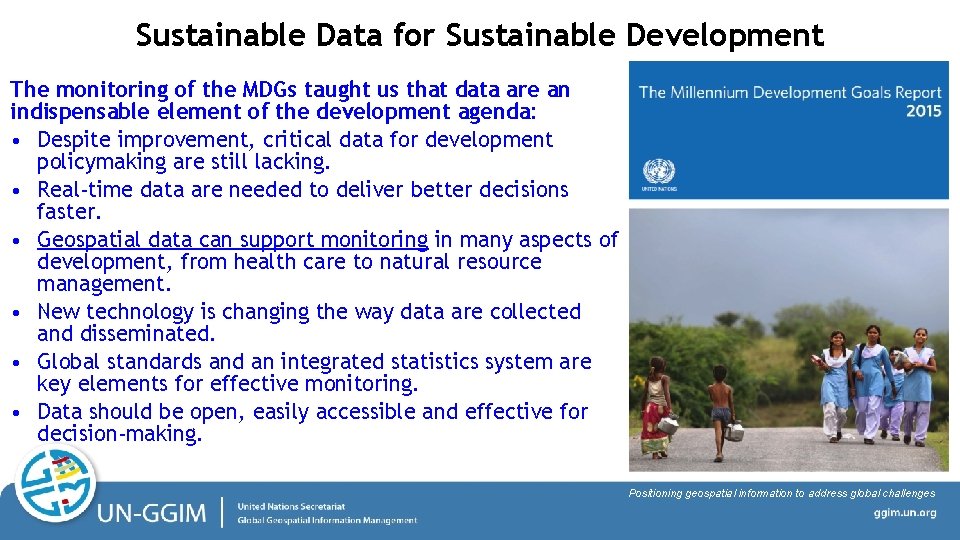
Sustainable Data for Sustainable Development The monitoring of the MDGs taught us that data are an indispensable element of the development agenda: • Despite improvement, critical data for development policymaking are still lacking. • Real-time data are needed to deliver better decisions faster. • Geospatial data can support monitoring in many aspects of development, from health care to natural resource management. • New technology is changing the way data are collected and disseminated. • Global standards and an integrated statistics system are key elements for effective monitoring. • Data should be open, easily accessible and effective for decision-making. Positioning geospatial information to address global challenges
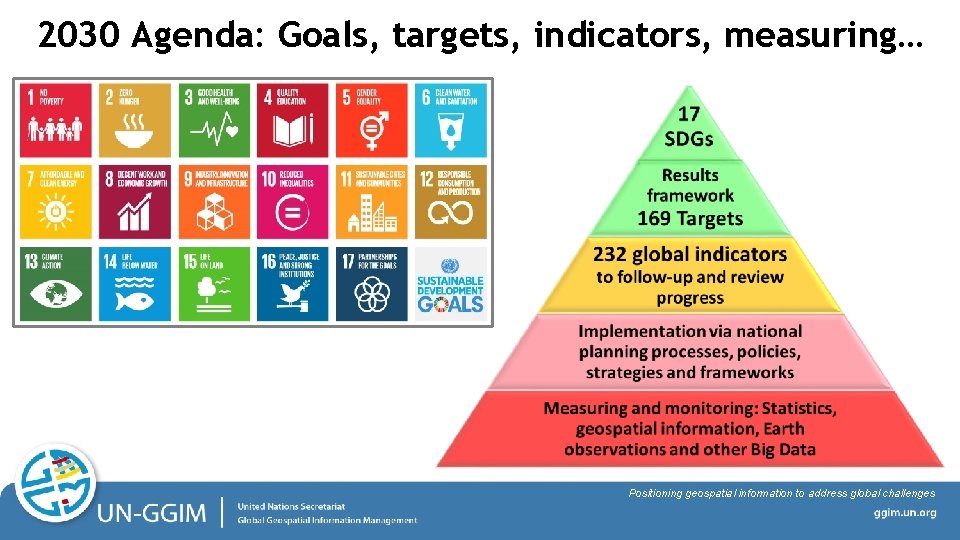
2030 Agenda: Goals, targets, indicators, measuring… Positioning geospatial information to address global challenges
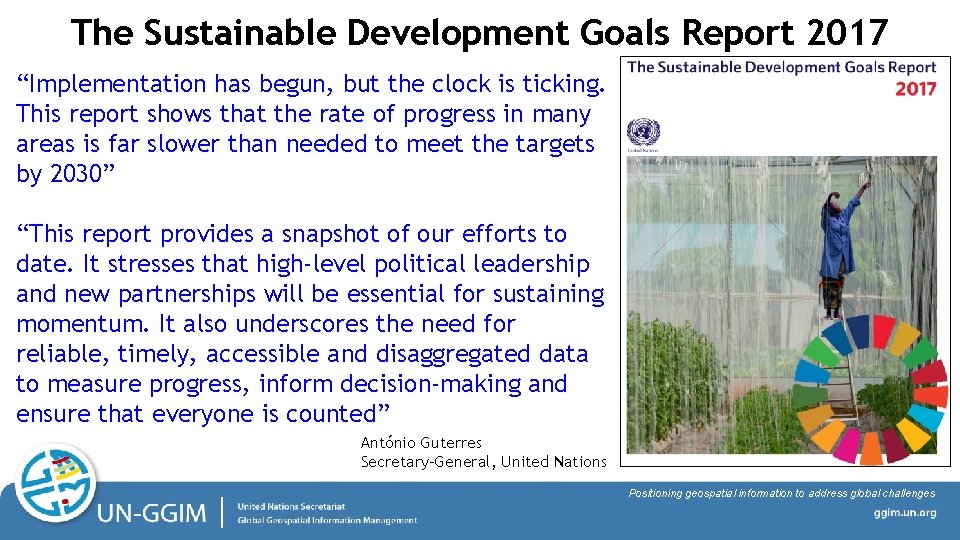
The Sustainable Development Goals Report 2017 “Implementation has begun, but the clock is ticking. This report shows that the rate of progress in many areas is far slower than needed to meet the targets by 2030” “This report provides a snapshot of our efforts to date. It stresses that high-level political leadership and new partnerships will be essential for sustaining momentum. It also underscores the need for reliable, timely, accessible and disaggregated data to measure progress, inform decision-making and ensure that everyone is counted” António Guterres Secretary-General, United Nations Positioning geospatial information to address global challenges
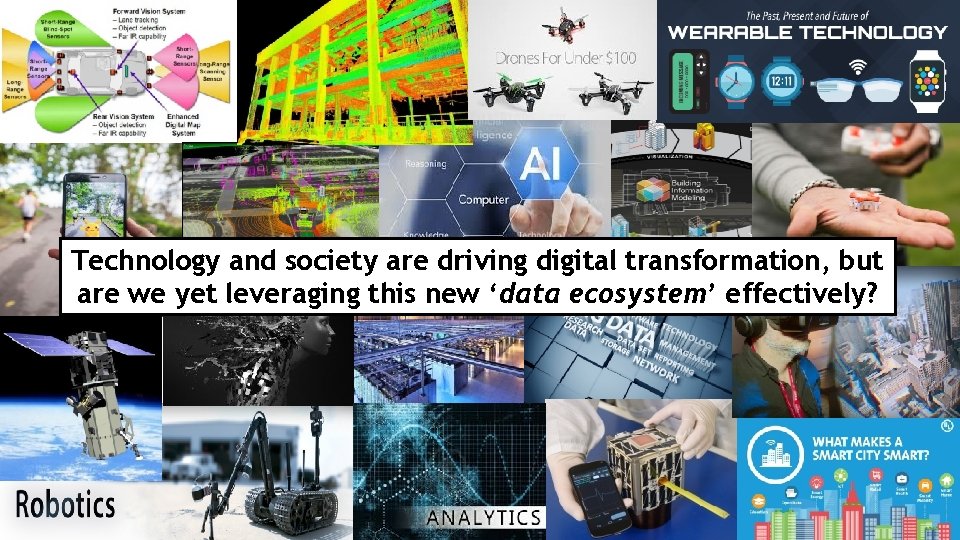
Technology and society are driving digital transformation, but are we yet leveraging this new ‘data ecosystem’ effectively?
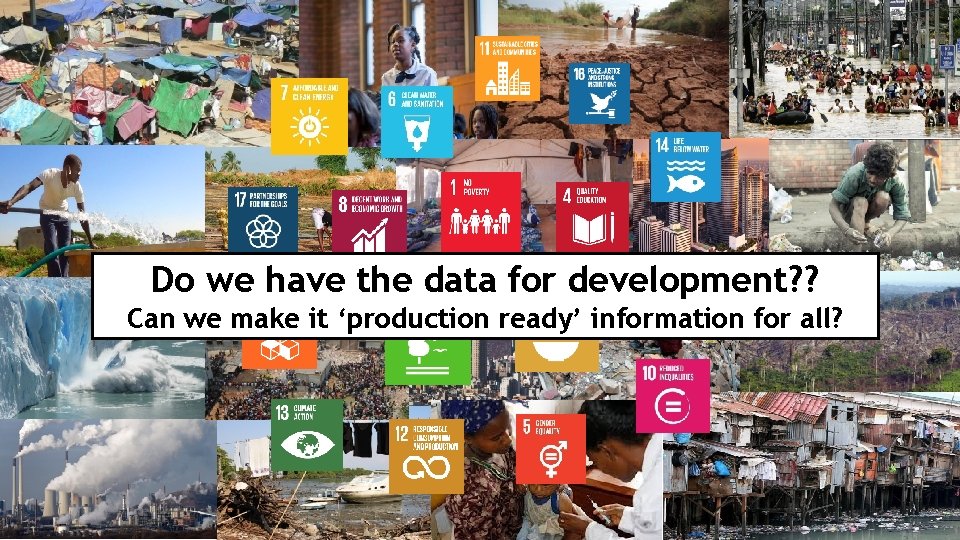
Do we have the data for development? ? Can we make it ‘production ready’ information for all?
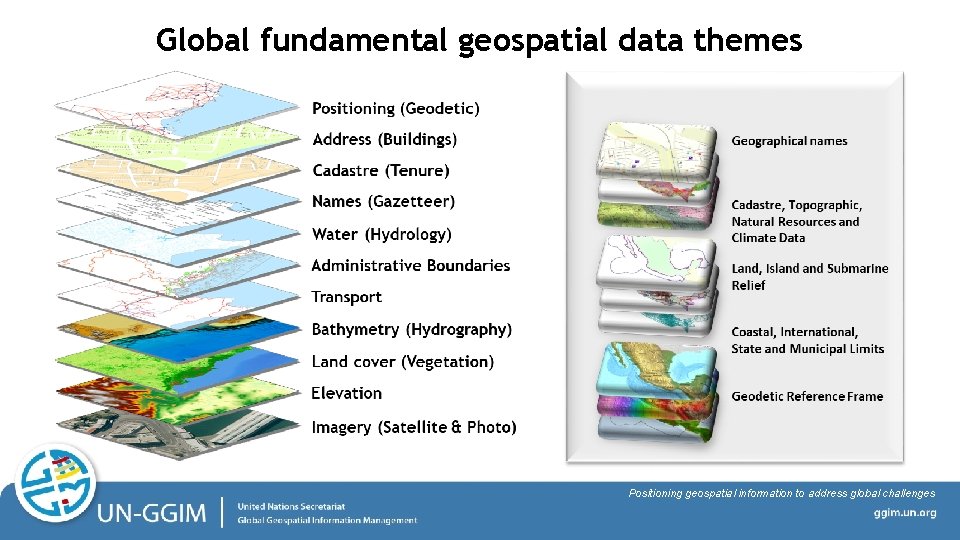
Global fundamental geospatial data themes Positioning geospatial information to address global challenges
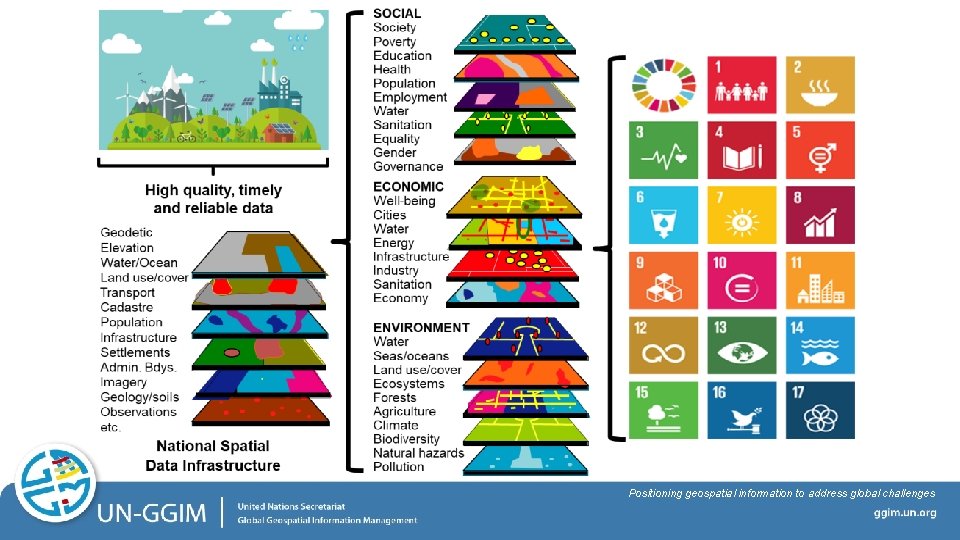
Positioning geospatial information to address global challenges
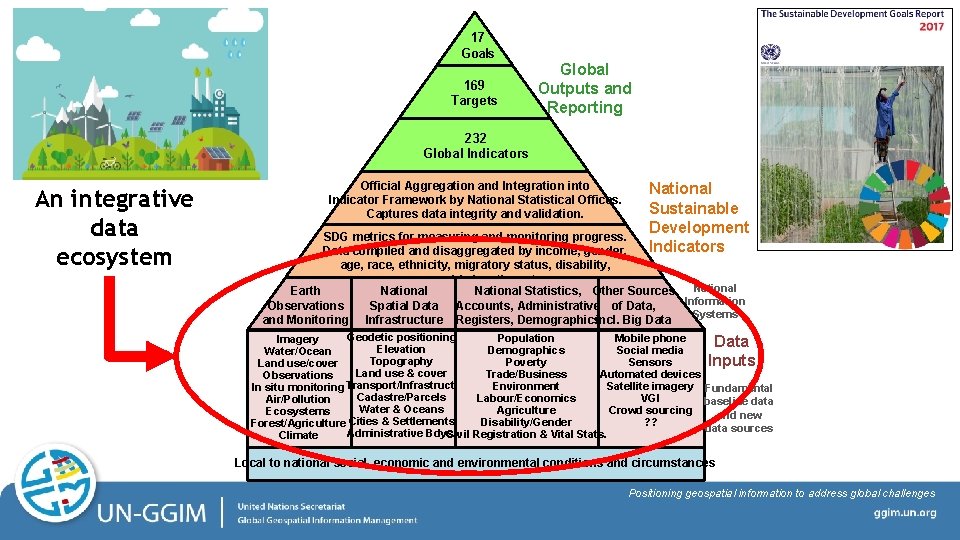
17 Goals 169 Targets Global Outputs and Reporting 232 Global Indicators An integrative data ecosystem Official Aggregation and Integration into Indicator Framework by National Statistical Offices. Captures data integrity and validation. National Sustainable Development Indicators SDG metrics for measuring and monitoring progress. Data compiled and disaggregated by income, gender, age, race, ethnicity, migratory status, disability, geographic location, etc. National Statistics, Other Sources Earth National Information Observations Spatial Data Accounts, Administrative of Data, Systems and Monitoring Infrastructure Registers, Demographicsincl. Big Data Geodetic positioning Population Mobile phone Imagery Data Elevation Demographics Social media Water/Ocean Topography Poverty Sensors Inputs Land use/cover Land use & cover Trade/Business Automated devices Observations Environment Satellite imagery Fundamental In situ monitoring Transport/Infrastruct. Cadastre/Parcels Labour/Economics VGI Air/Pollution baseline data Water & Oceans Agriculture Crowd sourcing Ecosystems and new Disability/Gender ? ? Forest/Agriculture Cities & Settlements data sources Administrative Bdys. Civil Registration & Vital Stats. Climate Local to national social, economic and environmental conditions and circumstances Positioning geospatial information to address global challenges
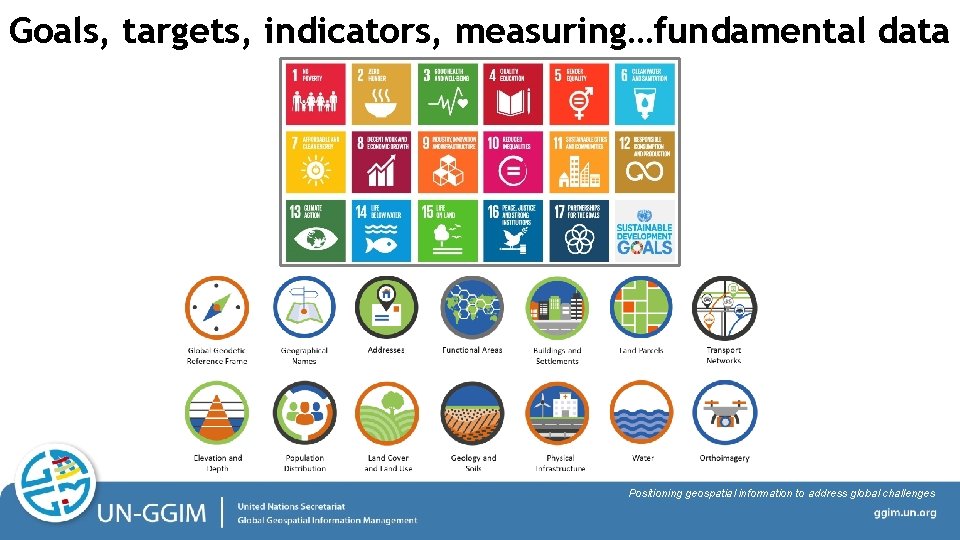
Goals, targets, indicators, measuring…fundamental data Positioning geospatial information to address global challenges
- Slides: 18